Tag: workplace trends

  • “Trump will be good for business”: Sir Martin Sorrell’s take on the 2024 US election

    “Trump will be good for business”: Sir Martin Sorrell’s take on the 2024 US election

    Sir Martin Sorrell

    There were two clear issues in the 2024 US election: firstly, as James Carville put it, it’s the economy, stupid. Secondly, it was the immigration question, though there were some signs in the exit polls that the future of democracy was also important.

    The Democrats got it wrong – and the pollsters did too. But then I think Trump, for the second time out of three, has conducted really tactically interesting campaigns. In 2016 he used a San Antonio agency called Giles-Parscale which was run by a guy Brad Parscale with only about 100 employees. It was the days of Cambridge Analytica and personalised data: they ran an extremely effective campaign in 2016.

    In 2024, the Democrats outspent the Republicans very heavily. In 2016 they had new media; in 2024, they had a “new-new” media. They only had a staff of about four people; the Democrats had about 100. It’s ironic that the Democrats are left with a bill for £20 million for three celebrity concerts which they’re unable to pay for: I think Trump has offered to pay off the debt.

    I thought Trump would win until the last few days. Then I thought the issue with the comedian Tony Hinchliffe calling Puerto Rico an ‘island of garbage’ in the warm-up at the Madison Square Garden comment – I thought that wouldn’t go down well. I also wondered whether the comments he made about Liz Cheney would have a negative impact on his prospects.

    But fundamentally, it doesn’t matter what Trump says. When he once said he could shoot somebody on Fifth Avenue and not lose any votes, he was right. In 2024, he hit the nail on the head over and again and was very disciplined, especially when he repeated the Reagan line: “Are you better off than you were five years ago?”

    He was also very disciplined on the advertising. The Democrats used the “new-old” media: Facebook and Instagram and so on.

    Nevertheless, it was a surprise that they took the seven swing states, as well as the House and the Senate: it was the scale of the victory more than the victory of itself which came as a mild surprise.

    All of this means that Trump is in a very strong position, particularly for the first two years, since there’s usually a reaction in the mid-terms. The stock markets have welcomed the win and Treasury yields have risen slightly and so there are some natural concerns now surrounding inflation. We’ll also see what the impacts of the proposed tariffs are going forwards.

    On the Democrat side, I don’t know if it would have made a difference if Biden had pulled out of the race earlier, and if the Democratic Party had had an open convention. I don’t think Tim Walz was a good pick as Vice-President – Pennsylvania governor Josh Shapiro would probably have been better, but perhaps Kamala was worried about the competitive element there. She didn’t want a strong personality.

    Going down into the results a little, the Republicans managed to engage with Latinos, with young blacks, and with less college-educated young whites. The other surprise for me was that the Roe v Wade decision and abortion was not as prominent as we expected: women didn’t react as aggressively as we thought they would do.

    Of course, Trump’s rallies and speeches were extremely dark. Kamala’s rallies were the opposite, with her smiling a lot – but there was a lack of content. That left a gap for Trump to make some shrewd moves: to take tax off Americans living abroad; and to take corporation tax down from 21 per cent to 15 per cent as well as lowering income tax. All these were far more substantive than anything the Harris campaign said.

    I saw a TikTok of a young black woman with a massive apple in her hand. She said to camera: “Do you know how much this apple costs?” It was a massive apple, about the size of a pomegranate. She said: “I thought it was one or two dollars – but it was seven dollars!”

    At the end that was the thing which swung it: the economy.

    And going forwards? Trump has put into place a Cabinet and advisors who very much represent what he was going to do.

    People say he didn’t expect to win in 2016. This time around, it’s not a surprise and he has the four years of experience. He is somewhat controversial, to put it mildly. But he has firm views.

    Whatever business said before the election, deep down they wanted Trump because he stands for low tax and low regulation. Overall, Trump is good for business and good for North America.


    Sir Martin Sorrell is the chair of S4 Capital.
  • Opinion: Why Hybrid Working is the Future

    Ever wondered why hybrid working is the future? Finito World looks at a question likely to be of perennial interest well into the future


    Hybrid working is proving itself remarkably flexible and popular.

    New research from IWG shows that hybrid working has led a boom in ‘active commuting’, with increasing numbers of workers travelling to local flexible workspaces via foot and bike.

    That’s good for our health, both physical and mental and is just another reason why employees seem to be voting with their feet nowadays.

    The study found that commutes to local workspaces are 38% more likely to be active than commutes to city centre locations. Workers aged 55-64 have reported a 109% increase in active commuting, the most of any age group.

    Health benefits


    That also has a significant knock-on effect. This follows recent census data which revealed that those who walked or cycled to work face a lower risk of mental or physical ill health, lowering their risk of admission to hospital for any illness by 10-11%.

    The increased use of local flexible workspaces by hybrid workers has been central to this shift. Almost two thirds (62%) of commutes to local workspaces are now mostly or entirely active. This is a 38% increase compared to commutes to city centre offices.

    The study was conducted by International Workplace Group (IWG), the world’s leading provider hybrid working solutions. It included brands such as Regus and Spaces, and included more than 1,000 hybrid workers. It found that walking (88%), cycling (34%), and running (28%) were the most common forms of active commuting. Workers travel on average 324 km via walking, 366 km via running, and 418 km on bike to a local workspace annually.

    The research also revealed some more novel forms of active transport, including travelling to work by scooter (7%), skateboards (6%), and rollerblades (4%), as workers cut long daily commutes by train or car and take advantage of workspaces closer to where they live.


    Rise of the “silver strollers”

    Hybrid work creates generation of “silver strollers”

    The research also reveals that older workers have made the most significant increases to the time they spend exercising as part of their commutes. Those aged between 55 and 64 reported a 109% increase in active commuting when travelling to a local workspace instead of a central office.

    Two thirds (67%) said they are more likely to incorporate physical activity into their commute when travelling to a local workspace instead of a city centre location. Meanwhile, more than three quarters (79%) have reported improvements to their physical health as a result.

    The most popular form of exercise for this “silver stroller” generation is walking, with workers aged 55-64 travelling an additional 259 km a year on foot by active commuting.


    Why hybrid working is the future
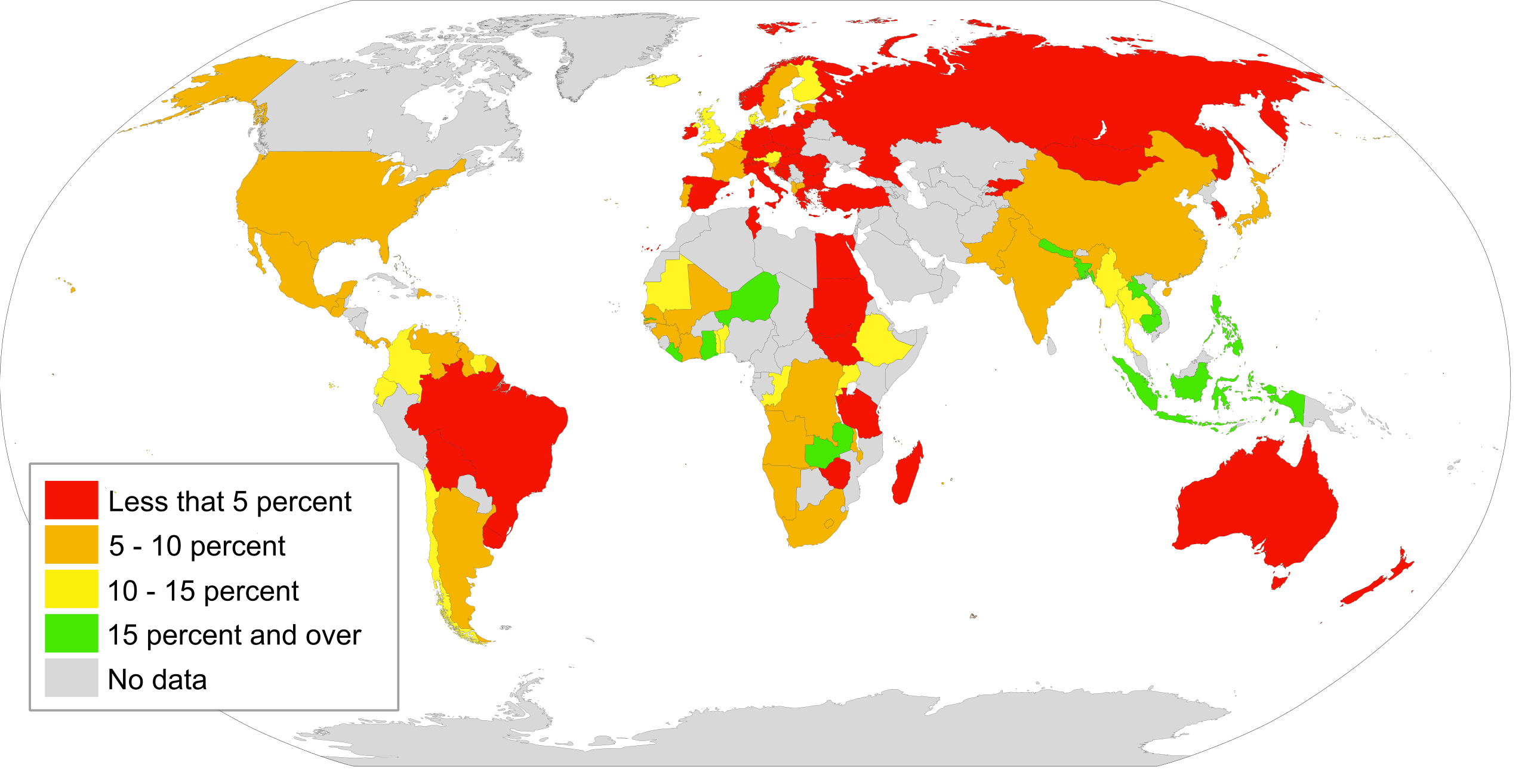
    This map shows the percentages of hybrid working by country


    A Question of Productivity

    Active commuting fuels mental health and productivity gains

    Beyond the obvious physical health benefits for all generations, active commuting to local workspaces has improved mental wellbeing, productivity and work/life balance. More than four in five (82%) of those that active commute said that incorporating exercise into their commute improved their mental health, with three in five (60%) reporting increased productivity at work.


    This is supported by additional research from International Workplace Group which found that three quarters (75%) of workers experienced a dramatic reduction in burnout symptoms, after transitioning to a hybrid model***.

    The improvements to work/life balance have resulted in 85% of hybrid workers saying they are more satisfied in their jobs and 75% reporting higher levels of motivation.


    Why hybrid working is the future
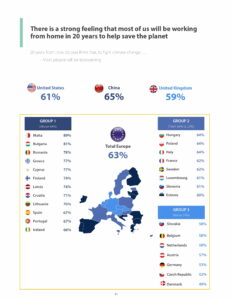
    This chart shows strong consensus around the ecological benefits of working from home


    Closer to Home

    Given the clear health benefits of active commuting, it’s no surprise that nearly three in five (59%) of workers want their employers to provide access to local workspaces closer to home, so they can fit in more exercise – as three quarters (75%) say they are more likely to incorporate physical activity into their commute when using a local workspace.

    It appears that business leaders are listening to their employees. Recent research among more than 500 UK CEOs found that three quarters (75%) said that returning their employees to a central office five days a week isn’t a business priority. Two thirds (65%) said they would lose talent if they insisted on their employees being present in a central office every day.

    IWG locations in rural, suburban, and commuter areas have seen a surge in foot traffic since the lifting of Covid-19 restrictions. Towns like Uxbridge (up 1839%), High Wycombe (up 1412%) and Maidenhead (up 1186%) experienced significant growth in footfall between June and August compared to the same period in 2021, when Covid-19 restrictions were in place.


    Win/Win

    To help meet this demand, IWG has opened more than 300 new locations in the first half of 2024, with the majority in rural, suburban and commuter areas closer to where workers live.

    Mark Dixon, International Workplace Group CEO stated: “The growing use of workspaces closer to where employees live, allowing them to reduce long daily commutes, is contributing to major improvements in worker’s physical and mental wellbeing.

    “This research demonstrates that hybrid working is a win/win for everyone. Business leaders are seeing substantial productivity and financial gains, while employees enjoy a better work/life balance and higher job satisfaction.

    Companies are increasingly appreciating that they will not only will they have a happier, healthier workforce when they allow people to work flexibly, but people actually feel more productive and motivated.”


    Need mentoring about hybrid working and the future of work? Go to finito.org.uk


    See also these artices:


    The Power of Motivation in the Workplace


    An Interview with revered clinical psychotherapist Dr. Paul Hokemeyer about Get Back and workplace toxicity


  • The Great Gig Economy: Is Freelancing the Future of Work?

    Stuart Thomson looks at the growing trend of the gig economy


    There can often be an emphasis, especially at the start of a career, on getting a job. That role is seen as a foundation stone for building networks and experience. But is that right for everyone? Is there an alternative? Is a more flexible, freelance approach something to think about?


    My own experience is of having worked for large legal and PR consultancies for my entire career until a few years back when I was made redundant. I am not the first and certainly not the last to find the whole experience shocking and, at times, distressing. It does lead to a period of reflection.


    The obvious choice would be to simply look for a new role but there are alternatives. I chose to consider those in more detail. Choices about potential next steps do not exist in a vacuum. There are always financial requirements to consider potentially alongside caring responsibilities and other commitments. Those could be to spend time traveling or exercising, issues much more focused on personal needs. There are no right or wrong approaches. It is all down to the individual, but it is always considering what your priorities are.


    I already had a company set-up for the communications training I deliver so I chose to go down a freelance and consultancy route. The aim is not to build a business and employ people but instead to engage in challenging projects and work with people I like. That means my ‘gig’ approach is a mix of short-term projects, longer-term consultancy, and membership of an in-house team. Alongside this I also hold voluntary positions for a Board and delivering mentoring which is very important to me.


    This could be considered a ‘portfolio’ approach with a range of different projects on the go. That is not without its complications. Balancing the needs of clients and projects means that there is no typical working day and there are no fixed hours.


    If you are considering making a similar career move, based on my two years as a freelancer, I would suggest the following:

    1)    Talk to others who have already made the move to freelancing and chat to them about their experiences. Otherwise, it will always seem like a hugely daunting prospect. People are always willing to chat because they remember what it was like for them.

    2)    Get some professional advice – for me that was getting an accountant who could help me get the fundamentals of my business right.

    3)    Spend time getting your ‘credentials’ in place – it might be easy to try and crack on with reaching out to connections for work, but do you know what you are really saying to them? What is it that makes you different from others?

    4)    Materials – another important foundation would be to get a website up and running and for it to feature those clear ‘credentials’. Employers, customers etc need to see that you are serious.

    5)    Join networks – there are professional and work-related networks to join across sectors, nationally and internationally. Being a freelancer isn’t just about generating your own work, it can also mean working in partnership with others to deliver for a client or project. Those opportunities often come through networks.


    The danger with being a freelancer is that you can sometimes feel quite isolated. When you engage with your network do not think of it as solely being about trying to generate new work, but also as time chat and not think about work. That is valuable time.


    Being part of the great gig economy is not a panacea and it is not for everyone, but it is an option and maybe provides the flexibility that many are looking for. Think about the option.


    See other articles by Stuart Thomson here:

    Stuart Thomson on the importance of personalising your job role


    Company Spokesperson, “Your key role at work?