Tag: work trends

  • The Future of Project Management: The Next Gen’s Guide

    Lysan Drabon, Managing Director – The Project Management Institute

    We live in a world of constant flux, where technology is rapidly advancing, society is shifting, and the climate is changing around us. Both the private and public sector are moving to adapt and react to these evolving trends, by developing new projects across sectors like infrastructure, healthcare, data, security, and utilities, as well as many more.

    Project management provides the tools to bring structure and progress to what can be perceived as chaos and help steer these change-driving projects towards successful outcomes. It is a profession which is dynamic and impactful, giving individuals the opportunity to play a part in facilitating some of the world’s most ambitious changes and shifts. Mastering project management is like gaining a superpower, equipping you with essential skills to navigate complexity, achieve your goals, and shape a better future.

    Project management is defined as “the application of knowledge, skills, tools, and techniques to project activities to meet project requirements.” This might sound formal, but it boils down to getting things done – efficiently and effectively. In a world grappling with climate change, social inequalities, and rapid technological advancements, the need for skilled project managers has never been greater. These skills are essential in virtually every industry, from developing life-saving vaccines to launching innovative tech start-ups.

    The UK, like many nations, faces a critical skills gap. Businesses struggle to find individuals with the project management expertise needed to drive innovation and productivity. This presents a huge opportunity for young people. Graduates equipped with project management skills are highly sought after, possessing the ability to plan, execute, and deliver projects that are successful. This translates into tangible value for organisations and opens doors to a wide range of career opportunities. In a competitive job market, project management skills, even from personal projects or volunteer work, gives you a distinct edge.

    And it’s not just about landing a job; it’s about thriving in your career and navigating the evolving world of work. Project management empowers you to take ownership, manage your time effectively, and achieve your professional goals. It builds confidence, develops leadership skills, and prepares you for the demands of the 21st-century workplace. In today’s digital age, with the rise of remote work and the gig economy, project management skills are even more valuable. They are essential for managing online collaboration, multitasking, and adapting to new technologies.

    The profession is also changing and adapting to a new world. Project managers are at the forefront of AI use, using it to boost productivity, effectiveness, and creativity. AI-powered platforms like Jira Align and Monday.com offer data-driven insights for better planning and resource allocation, while tools like Asana and Trello, integrated with AI, provide real-time progress monitoring and alerts. Furthermore, AI automates routine tasks, freeing project managers to focus on strategic work, and enhances collaboration through tools like Slack, which are particularly beneficial for international teams. AI is no longer a bonus, but a necessity, for a modern project manager.

    It is not only technology which is changing the profession – women are increasingly leading the charge as agents of change within the sector, driving critical initiatives across various sectors, and demonstrating the transformative power of project management. Empowering women in project management is crucial for driving innovation and economic growth. There is ample opportunity for further individuals to make their mark – the Project Management Institute (PMI) projects a need for 25 million new project professionals worldwide by 2030. This presents a significant opportunity for young people, particularly women, to enter a growing field and make a real impact.

    For young people in the UK, facing an uncertain economy and a competitive job market, project management offers a pathway to success. It’s not just about career advancement; it’s about equipping yourselves with the skills to navigate a complex world, drive innovation, and make a real impact on the issues important to you. Project management, powered by AI, is your toolkit for shaping a better future. Embrace it and unlock your full potential.


  • Opinion: Why Hybrid Working is the Future

    Ever wondered why hybrid working is the future? Finito World looks at a question likely to be of perennial interest well into the future


    Hybrid working is proving itself remarkably flexible and popular.

    New research from IWG shows that hybrid working has led a boom in ‘active commuting’, with increasing numbers of workers travelling to local flexible workspaces via foot and bike.

    That’s good for our health, both physical and mental and is just another reason why employees seem to be voting with their feet nowadays.

    The study found that commutes to local workspaces are 38% more likely to be active than commutes to city centre locations. Workers aged 55-64 have reported a 109% increase in active commuting, the most of any age group.

    Health benefits


    That also has a significant knock-on effect. This follows recent census data which revealed that those who walked or cycled to work face a lower risk of mental or physical ill health, lowering their risk of admission to hospital for any illness by 10-11%.

    The increased use of local flexible workspaces by hybrid workers has been central to this shift. Almost two thirds (62%) of commutes to local workspaces are now mostly or entirely active. This is a 38% increase compared to commutes to city centre offices.

    The study was conducted by International Workplace Group (IWG), the world’s leading provider hybrid working solutions. It included brands such as Regus and Spaces, and included more than 1,000 hybrid workers. It found that walking (88%), cycling (34%), and running (28%) were the most common forms of active commuting. Workers travel on average 324 km via walking, 366 km via running, and 418 km on bike to a local workspace annually.

    The research also revealed some more novel forms of active transport, including travelling to work by scooter (7%), skateboards (6%), and rollerblades (4%), as workers cut long daily commutes by train or car and take advantage of workspaces closer to where they live.


    Rise of the “silver strollers”

    Hybrid work creates generation of “silver strollers”

    The research also reveals that older workers have made the most significant increases to the time they spend exercising as part of their commutes. Those aged between 55 and 64 reported a 109% increase in active commuting when travelling to a local workspace instead of a central office.

    Two thirds (67%) said they are more likely to incorporate physical activity into their commute when travelling to a local workspace instead of a city centre location. Meanwhile, more than three quarters (79%) have reported improvements to their physical health as a result.

    The most popular form of exercise for this “silver stroller” generation is walking, with workers aged 55-64 travelling an additional 259 km a year on foot by active commuting.


    Why hybrid working is the future
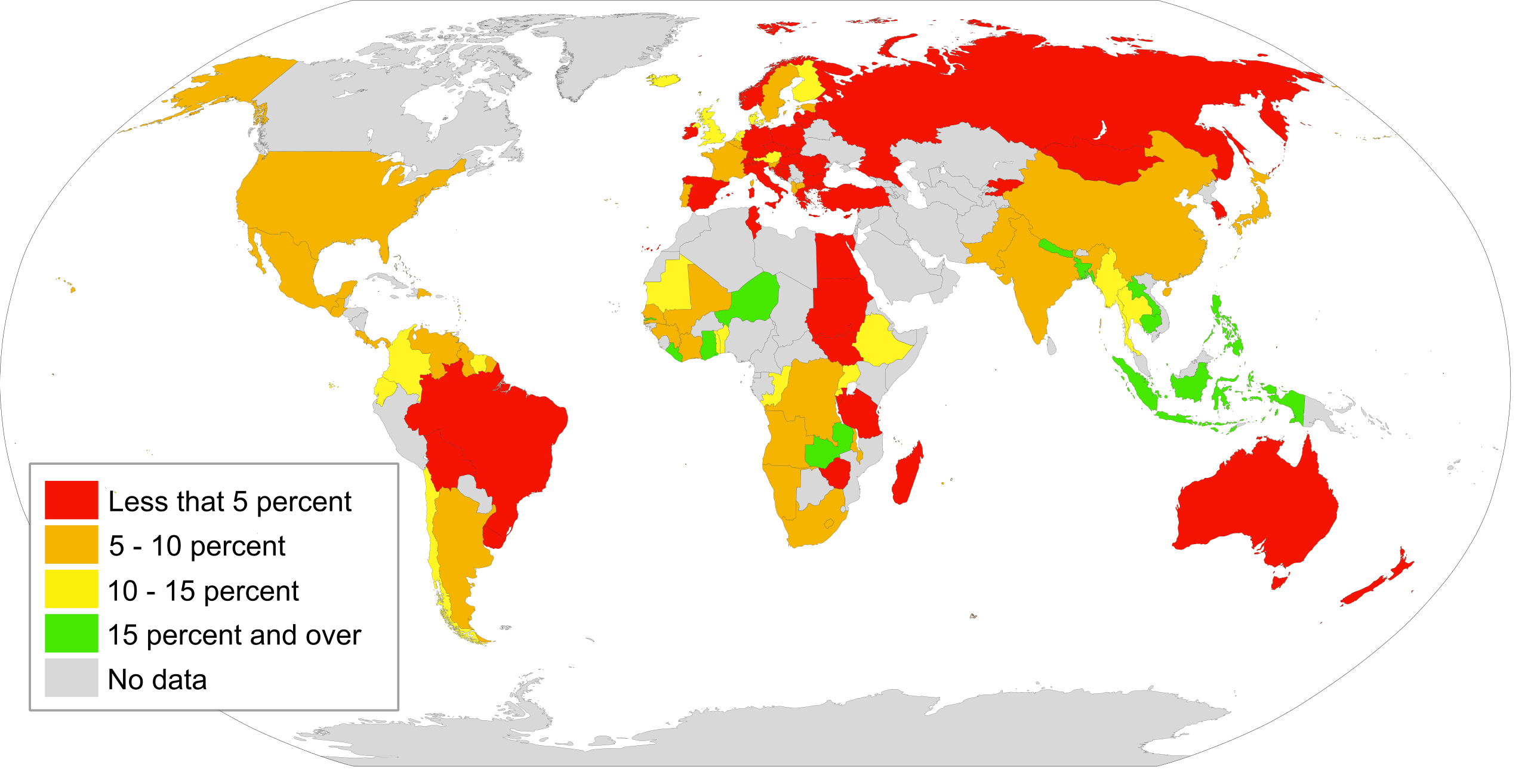
    This map shows the percentages of hybrid working by country


    A Question of Productivity

    Active commuting fuels mental health and productivity gains

    Beyond the obvious physical health benefits for all generations, active commuting to local workspaces has improved mental wellbeing, productivity and work/life balance. More than four in five (82%) of those that active commute said that incorporating exercise into their commute improved their mental health, with three in five (60%) reporting increased productivity at work.


    This is supported by additional research from International Workplace Group which found that three quarters (75%) of workers experienced a dramatic reduction in burnout symptoms, after transitioning to a hybrid model***.

    The improvements to work/life balance have resulted in 85% of hybrid workers saying they are more satisfied in their jobs and 75% reporting higher levels of motivation.


    Why hybrid working is the future
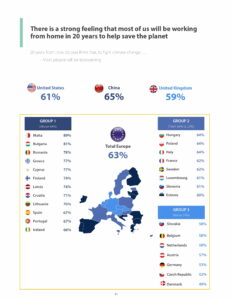
    This chart shows strong consensus around the ecological benefits of working from home


    Closer to Home

    Given the clear health benefits of active commuting, it’s no surprise that nearly three in five (59%) of workers want their employers to provide access to local workspaces closer to home, so they can fit in more exercise – as three quarters (75%) say they are more likely to incorporate physical activity into their commute when using a local workspace.

    It appears that business leaders are listening to their employees. Recent research among more than 500 UK CEOs found that three quarters (75%) said that returning their employees to a central office five days a week isn’t a business priority. Two thirds (65%) said they would lose talent if they insisted on their employees being present in a central office every day.

    IWG locations in rural, suburban, and commuter areas have seen a surge in foot traffic since the lifting of Covid-19 restrictions. Towns like Uxbridge (up 1839%), High Wycombe (up 1412%) and Maidenhead (up 1186%) experienced significant growth in footfall between June and August compared to the same period in 2021, when Covid-19 restrictions were in place.


    Win/Win

    To help meet this demand, IWG has opened more than 300 new locations in the first half of 2024, with the majority in rural, suburban and commuter areas closer to where workers live.

    Mark Dixon, International Workplace Group CEO stated: “The growing use of workspaces closer to where employees live, allowing them to reduce long daily commutes, is contributing to major improvements in worker’s physical and mental wellbeing.

    “This research demonstrates that hybrid working is a win/win for everyone. Business leaders are seeing substantial productivity and financial gains, while employees enjoy a better work/life balance and higher job satisfaction.

    Companies are increasingly appreciating that they will not only will they have a happier, healthier workforce when they allow people to work flexibly, but people actually feel more productive and motivated.”


    Need mentoring about hybrid working and the future of work? Go to finito.org.uk


    See also these artices:


    The Power of Motivation in the Workplace


    An Interview with revered clinical psychotherapist Dr. Paul Hokemeyer about Get Back and workplace toxicity


  • Floating Solar – Coming Soon

    Dinesh Dhamija


    From Dutch lakes to African reservoirs, from hydropower stations to ocean bays… floating solar power installations are among the stars of future energy generation.


    A new study estimates that power from floating solar will reach 6GW within the next seven years, up from the present 3GW in Asia-Pacific alone. Researchers at Lancaster and Bangor University found that if the UK capitalised on its floating PV potential, it could produce as much as 2.7TW of electricity every year. A European Commission project, meanwhile, estimated that using just 2.3 per cent of the continent’s hydropower reservoirs for floating installations could generate an annual 42.3TWh.

    The benefits of using hydropower reservoirs include existing power transmission infrastructure, bodies of water that are suitable for PV installations, limitation of water loss from evaporation and reduction of damaging algal blooms in reservoirs. The cooling effect of water also helps to maximise PV productivity, since solar panels can lose generating power if they over-heat.

    A study conducted in 2021 on floating solar panels on a reservoir in Jordan found that they reduced evaporation by 42 per cent, while producing 425 MWh of electricity per year. In the UK alone there are around 570 reservoirs, meaning there could be a great future for the sector. “The potential gain in energy generation from FPV [Floating Photovoltaic] is clear, so we need to put research in place so this technology can be safely adopted,” said Dr Iestyn Woolway of Bangor University, who authored the report.


    This research must understand what possible negative effects could stem from FPV installations, such as reducing aquatic life in the water due to lack of sunlight. The market for solar energy is expected to grow by 43 per cent each year, to reach $24.5 billion by 2031, according to a report from the BBC. It could help developing countries to meet their entire electricity needs: the Bangor/Lancaster University report cites Papua New Guinea, Ethiopia, Rwanda, Benin and Kiribati as examples. Others could generate much of their power through FPV.

    “Solar installations are going to increase much more on water than land,” said Antonio Duarte, technical engineer at SolarisFloat, which is developing a series of projects. “Why? Because land is becoming a very precious asset.”

    Countries such as Japan and Singapore are now investing heavily in floating solar installations, in response to the rising economic benefits of the technology combined with limited land availability.

    Expect to see floating solar projects on water near you in the years to come.


    Read more by Dinesh Dhamija:


    Hard Truths About Fossil Fuels: Dinesh Dhamija’s Call to Action


    Dinesh Dhamija founded, built and sold online travel agency ebookers.com, before serving as a Member of the European Parliament. Since then, he has created the largest solar PV and hydrogen businesses in Romania. Dinesh’s latest book is The Indian Century – buy it from Amazon at https://www.amazon.co.uk/dp/1738441407/