I’ve recently published a book about Churchill, and it’s interesting as the dust settles on the Johnson administration, and as we enter a period of strikes under Rishi Sunak with Boris even out of Parliament now, to consider the way in which Churchill is all bound up in this.
Sometimes Boris created the idea that he was dumb but he certainly wasn’t. He always knew what he was doing and why. Boris’ novel is even a copy of Churchill’s novel; he complains about being a victim, just as Churchill did. He copies Churchill to that extent; Boris really does think Churchill was the greatest person ever.
Churchill could say what he did and get away with it, because behind him was the British Empire, which was supported by a large part of the British population. Some of the Scots, whether you like it or not, were the most ardent imperialists. That’s why, with the decline of the Empire, the more nationalist tendencies have come out in Wales, Scotland and England.
What Boris tried to do was to nurse a special form of English nationalism, linked very much to Churchill and his so-called heroism –
and to make this part of the new mythology. If you withdraw from Europe, or Scotland might go from the Union – as seemed more likely when he was Prime Minister than it does now – then you need something, and for Boris that was Churchill.
America also plays into this. He used Churchill to say to the Americans that we have a long-standing relationship, and that we will be better partners than Germany, for instance, because we’ve been attached by an umbilical wire. Blair played that line in the most vulgar way, as did Thatcher. Boris attempted the same. What that results in is a Britain completely tied to the United States without any room for manoeuvre.
This all played out of course in respect of the reaction to Putin’s crazed assault on Ukraine – and still does under Rishi Sunak. The British media class went semi-hysterical, though they’re beginning to calm down now. If you look at France, Germany and Italy, they all supported NATO but the tone was more measured.
Even in America itself, there’s a different tone: look at Thomas Friedman’s columns in the New York Times. I’m not a huge fan of his, but he has sought a balanced tone, and even pointed out the mistakes the Americans have made.
We also need to look at the situation in Yemen which is infinitely worse than what is going on in Ukraine. The reason for the lack of coverage is that the media largely supports the government, and so they’ve been told by the Foreign Office that this isn’t a priority. I notice that all four parties drool over Zelensky’s addresses, and especially when he mentions Churchill; and I do sometimes wonder whether the Foreign Office has a hand in writing those.
The big debate now is really this: How long do you want to tie the Russians down? American intelligence boasts that the Russian generals who were killed, were killed because of us. Older intelligence people in the US are saying: “Keep your mouth shut. Do you want a retaliation?” How long will Biden want to carry this out? It will either be non-stop escalation or a negotiated settlement.
Putin’s invasion has been a mistake, and he has lost the support of the usually pro-Russian segment of Ukraine. That means that Putin is in a position where he might need to negotiate a settlement in any case. So far, the Americans have irresponsibly chosen to continue the war.
The roots of our present problems domestically are also deep. The post-War consensus required the rebuilding of the country and that meant a form of social democracy. This wasn’t just in Britain – it was also in Europe. It was never meaningfully altered by Conservative governments, until Thatcher destroyed the mining industry.
That development was dual in nature. First, it showed she didn’t care about the British working people anymore. Secondly, it meant that Arthur Scargill would have to be dealt with. The British trade union movement never recovered from that defeat. Privatisation was never contested in Britain in the same way it was in many other countries – for instance in South Korea. There was a huge strike wave in South Korea in the 1980s against multinationals. The banners in front of the Japanese multinationals said: “You can’t crush us, we’re not English.”
That was a huge triumph for Thatcher, and Blair carried on and to some extent went further. They were looking for a strike to crush – but unfortunately for them the only strike going on was the nurses, and even they felt that nobody in their right minds would regard them as the enemy within.
When it came to both the Blair and Brown premierships, the first person they invited in was Thatcher. Then Cameron made no secret of the fact that he was an admirer of Blair. I call this the ‘extreme centre’. It doesn’t seem to matter who comes in. They do the same thing; they fight the unions, and fight America’s wars. What is the point of an election under such circumstances? It just becomes a ritual.
And a ritual all bound up with Churchill, who himself fought the unions in Wales and Scotland. That’s why the hatred of Churchill went so deep, and why I get so many messages from working class people saying how much their grandparents hated Churchill. Rishi Sunak should know that rubbing British noses in British mud doesn’t go down well.
Tariq Ali’s Winston Churchill: His Times, His Crimes is out now
Sir Winston Churchill’s remarkable life is a yardstick in how we discuss mental health, writes Robert Golding
On 11th July 1911, Winston Churchill went to dinner with his cousin Ivor Guest and his wife Alice. Afterwards, he reported back to his wife Clementine: “Alice interested me a great deal in her talk about her doctor in Germany, who completely cured her depression. I think this man might be useful to me if my black dog returns.”
My black dog. In time, this phrase would become an aspect of the Churchill myth – even though, as Churchill’s biographer Andrew Roberts points out, it was a term he himself only used on this one occasion. It gives us the Churchill we think we know, who is in turn an aspect of our national story. In this telling, the former prime minister becomes not just a great leader, but one who triumphed against mental difficulty.
In the Covid-19 age, where mental health is an increasing concern – indeed, almost a buzz word – Churchill feels like an illuminating yardstick. His is a tale, the story runs, of heroic self-medication. He drank and he painted – above all, he worked.
The relevance of Churchill’s predicament continues today. When I talk to Fiona Millar, the wife of Alistair Campbell, she displays a profound understanding of the relationship between power and mental strife. Campbell, who for many years was Tony Blair’s right hand, suffered from depression; Millar now runs a support group for those co-habiting with those with mental illness.
When I mention Churchill, she states that there are more mental health problems in top-flight politics than we might think. “If you look at our current politicians, you’ve got to feel that there’s something going on in their backgrounds which makes them want to do it,” she says.
This might remind us that Churchill is not the only drinker to make it to 10 Downing Street. Alistair Campbell’s old boss Tony Blair admitted in his memoirs to drinking wine during stressful periods in office. And everybody remembers the argument and associated wine spillage in the Boris Johnson household just before the current Prime Minister assumed power.
What does Millar think engenders pressure for the likes of Churchill, Blair and Johnson? “I think it’s just very high-pressured. It’s very competitive and it’s quite lonely. Almost certainly, there are more problems than we know about; I have Labour MP friends who have had serious problems.”
Do we talk about it enough? “I think we’re beginning to – but Estelle Morris was a long time ago. Estelle just said: “I can’t do it and it’s not for me.” But Millar also points to double standards, mentioning the recent case of James Brokenshire MP, who left Cabinet on account of his cancer having spread. “That’s interesting, isn’t it?” says Millar. “That it’s okay to say that – but not to say you’re giving up because you’re not functioning well mentally is deemed less acceptable.”
Of course, Churchill lurks in the background here – the bulldog expression, the look of the fighter. Inwoven in his image is that you can fight back against depression. I mention to Millar Johnson’s regular referencing of Churchill. Millar replies: “I expect he [Johnson] probably thinks it [mental health] is all a big girls’ game – or however he likes to phrase it.”
But of course, Churchill was living at a time where work stress was to be handled with private stoicism. Today, we are beginning to understand the enormity of the problem.
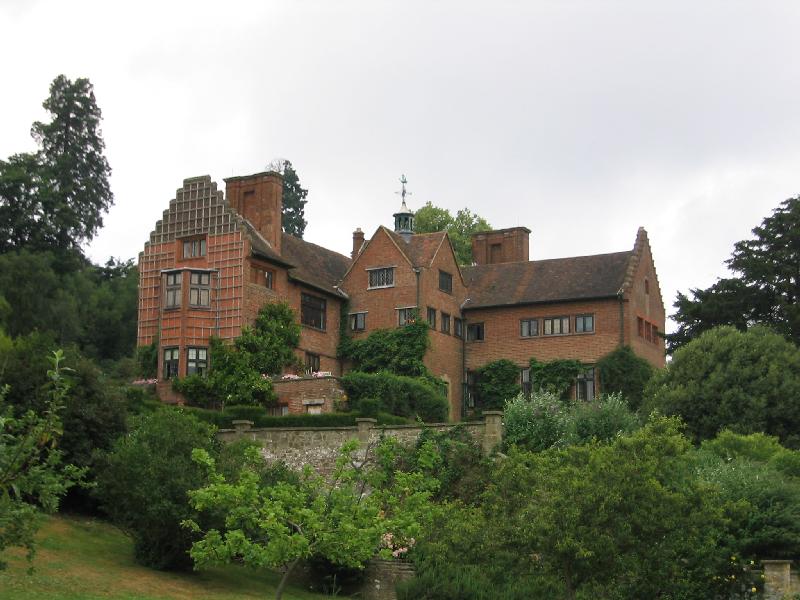
Chartwell in Kent, where Churchill would often retreat to paint his ‘daubs’
Dr. Konrad Hitz is a medical director at The Kusnacht Practice in Switzerland. He thinks that the pressures Churchill faced are relevant in all leadership roles. “CEOs and business leaders have many similar pressures to those in political power,” he tells me. “Making big decisions that affect many people’s lives can present an individual with huge challenges and stresses – and I think that has been magnified during the pandemic with many business closures and job losses.”
Hitz also points to a recent study by the National Institute of Mental Health which found that 72 per cent of executives and entrepreneurs are directly or indirectly affected by mental health issues compared to just 48 per cent of non-entrepreneurs. “A psychological pandemic has been unleashed by the virus,” he argues.
So what can we learn from Winston about tackling this pandemic? In the first place, his biography displays strategies of coping which might seem to us less sensible than they did to Churchill’s contemporaries.
One of these was drinking, and everybody knows about the obligatory Pol Roger and the bottles of wine at breakfast. Sometimes, we glimpse that this took its toll on his leadership. For instance, on the 6th July 1944, Churchill got very drunk before a Defence Committee meeting. You can feel that Anthony Eden, the then foreign secretary and future prime minister, was underplaying the affair somewhat when he recalled that ‘really ghastly Defence Committee meeting nominally on Far Eastern strategy. Winston hadn’t read the paper and was perhaps rather tight…Altogether a deplorable evening.”
Hitz thinks this is one area where we need to eschew Churchill’s example: “Individuals are now better educated about the dangers associated with heavy drinking than they were 80 years ago.” But in Hitz’s opinion we’re not out of the woods yet. “Clearly there are still challenges around alcohol,” he continues. “A recent survey in the US indicated that alcohol abuse has risen during the pandemic, with approximately 17 million over-18-year-olds now having an alcohol use disorder, with 10 per cent of children living in a home with a parent who has a drinking problem.”
Even so, historians are now beginning to argue that Churchill’s alcoholism may have been exaggerated – not least by him. Everybody knows the famous gag that he had always taken more out of alcohol than it had taken out of him. Andrew Roberts’ verdict feels like a corrective of the myth: “The overwhelming evidence is that Churchill loved alcohol, drank steadily by sipping, had a hardy constitution and was only rarely affected by it.”
Either way, drink wasn’t Churchill’s only way of coping. Today, there is mounting appreciation for Churchill’s achievement as an artist, and there can be little doubt that his ‘daubs’ as he modestly called them, represented a profound alleviation of stress.
Susan M. Coles is an arts educator, who has long been arguing through her APPG for Art, Craft and Design in Education which she runs with Labour MP Sharon Hodgson that the arts should have broader representation on the National Curriculum. She emphasises the good that painting did the wartime leader: “For Churchill it was also an escape,” she says. “Making art is where we step off life’s conveyor belt and have contemplative moments. We use our hands as well as our mind and it’s invaluable to busy people.” This, she argues was the case for Churchill too. “His role was so pivotal in politics that the escape hatch was to making art, and as he mainly worked with landscapes, he re-engaged with nature, which is also empowering in lifting the human spirit.”
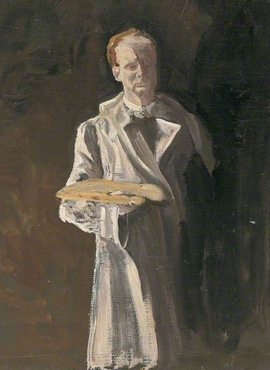
An early self-portrait by Churchill, thought to have been painted when he was still depressed after the failure of the Dardanelles expedition. Photo credit: By Source, Fair use, https://en.wikipedia.org/w/index.php?curid=66326956
Over at The Kusnacht Practice, Hitz agrees with Coles’ assessment, although he also points to the many other options, less applicable to Churchill, available at the clinic: “At The Kusnacht Practice, we encourage many patients to be creative and to explore a hobby or pastime that helps them to relax, slow down and remove stresses from their lives. Exercise, reading, cookery, music and art therapy activities such as painting and sculpture can be highly beneficial when employed alongside other therapies. If a patient can find a passion point like painting, that can be a useful tool in recovery.”
But through all this, the impression remains that Churchill’s principal remedy was work. Whatever else he crammed into his 90 years, a back-breaking schedule was the dominant fact of his life. Even in the 1930s, which we think of as his period in the wilderness, his work rate was phenomenal. Roberts reports: “In 1930 he gave sixty-one major speeches, then forty-eight in 1931, twenty-eight in 1932, forty-one in 1933, thirty-nine in 1934, fifty-four in 1935, twenty-three in 1936, fifty-five in 1937, thirty-nine in 1938, and thirty-six in 1939, not including hundreds of lesser interventions in Westminster and scores of articles.” Reading this, it’s possible to see how Winston steamrollered his way to the premiership by sheer force of will.
Sir Winston Churchill, Distant View of the Pyramids, 1921
For Alastair Campbell, work was also an escape. Millar tells me that she was always amazed at how charming and amusing her husband could be at work, reserving his low moods for her in the domestic setting. Before taking up his Downing Street role, Campbell informed Blair of his condition. “He said to Blair, ‘You just need to be aware that this has happened,” Millar recalls. “And Blair said, ‘That’s fine, I’m totally aware of it’.” Millar continues: “For Alistair, work was the way he dealt with his mental health and he did work phenomenally hard – and was very, very productive. It was a positive in that sense for the government, who were his employers, but it was never good for his family.”
All of which makes one recall that it was Clementine Churchill all along who bore the burden of Churchill’s exceptional life. When I speak with another high-achieving sufferer Lord Dennis Stevenson, the former chair of HBOS, and co-author of a report ‘Thriving at Work’ which was warmly welcomed by the May administration, he states that he had a similar approach to Campbell: “There are some people who can cope. In my case, I’ve run large companies, and major not-for-profit things, and no one was the wiser. But it’s like walking through glue.”
Hitz is familiar with the condition of the workaholic: “We see a number of workaholic cases at The Kusnacht Practice, many of them entwined with other behaviours and dependencies. During the pandemic, work-life balances have been challenged and, with our leadership treatment programmes, we try to reset this balance, encouraging routines and defining clear lines between work and free time.”
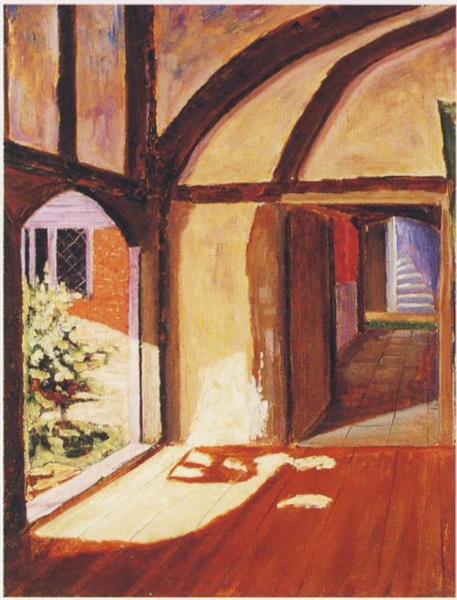
Sir Winston Churchill, Interior at Breccles, Date uncertain
The conversation around Churchill then, feels like a measure of how far we have come in the question of mental health. Roberts makes it clear that the the image of Churchill as a depressive has been exaggerated. It might be that this in itself should guard us against inaccurate labelling in this field where definitions are still in their infancy.
Even so, he undoubtedly had his low moments. And to study Churchill is to encounter someone highly resourceful, intelligent and gifted who needed to discover his own path forward whenever the Black Dog struck.
So what conclusions can we draw about Churchill’s life? Hitz quotes Churchill himself: “Success is not final, failure is not fatal, it is the courage to continue that counts. If you’re going through hell, keep going.” Hitz adds that this mantra “is equally applicable now as we start to come out of this generation’s global crisis.” Millar, meanwhile, argues strongly for the need to create networks of support in communities, in line with her own online group which helps the partners of those suffering with poor mental health. Dennis Stevenson agrees, saying that mental health ‘doesn’t need the politicians anymore’, pointing to the momentum already established on the question.
But he also has some sound advice: “At first I was very bad at externalising issues and problems – and not just mental health problems. But as I got older, I got better at articulating it.”
Stevenson’s words remind me of an early scene in Macbeth, when the hero first meets the witches in the Scottish wilderness. He asks them what they are up to, and they reply: “A thing without a name.”
It occurs to me that this power of naming is very strong, and that Churchill, the greatest wordsmith ever to assume the prime ministership, showed to a high degree the importance of that when he spoke of his black dog. Now that we too are embarked on that same project to address this issue, there’s much we can learn from his struggles.