Tag: Vincent Van Gogh

  • Interview: Roger Federer’s favourite artist Nadeem Chughtai: “I’m blown away by the positive reaction.”

    Christopher Jackson


    There used to be a dead tree in Ruskin Park in South-East London, which always struck me as somehow sculptural. The other day I saw that it had fallen. I had grown so fond of this particular tree, it’s optimistic reach towards the skies, that I was bereft when I saw it had collapsed.


    But this probably minor development in the history of my local parklands makes me all the more delighted that this same tree is still standing in the work of a remarkable artist Nadeem Chughtai. Chughtai’s recent exhibition A Liminal State has people talking in Peckham, which as everybody knows is also the artistic centre of the universe. Chughtai used the tree as a basis for his picture There’s This Place On The Edge of Town (2020).
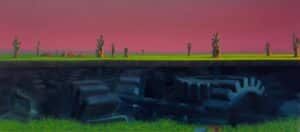
     

    There’s This Place on the Edge of Town


    One of the most basic requirements of an artist is power: Chughtai’s images always have an immediacy which nevertheless lets you know that your first impression is only the first part of your journey with that work of art. In this picture we see how we have become mechanised in ourselves, and how this can only lead to stunted growth. But the beauty of the tree, which looks like it almost wants to be an upwards staircase, suggests potential.


    It’s a brilliant conception, like all Chughtai’s pictures. So was it always art for him, or did he toy with other careers? “It really was art all the way for me,” Chughtai tells me. “Ever since I was very young I’d draw. Encouraged by my mum and influenced by a beautiful framed pencil drawing my dad made of my mum in the 1960’s. However, I did loads of jobs before going full time with an art publishing contract which set me on my way. Before that I always kept myself in the minimum wage positions for fear of committing myself further down other career paths.”


    Chughtai has had some major successes, with some celebrity clients including Roger Federer who chanced upon his work in Wimbledon village one year. Chughtai is particularly well-known for Nowhere Man, his character which he gave up at the start of the pandemic. These pictures, taken together, amount to a vast dystopian opus which tell the viewer unequivocally what we all sense: we are not headed in the right direction as a species.


    We never see Nowhere Man’s face. Sometimes there’s more than one of him. It is also possible to say that Nowhere Man is always in a negative setting, beset by the circumstances of modern life: alarming architecture, the trippiness of drug culture, the terrifying ramifications of contemporary uniformity.
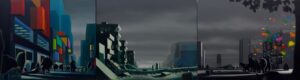
     

    I Dream of a World That the Capitalist Philosophy Will Never Make Possible. Oil on three canvases (2017)

    I also note that they’re always dramatic force in these pictures, and I related this to the career Chughtai had on film sets, with his work including the Bourne series and Love Actually. Did that experience impact the way he paints now? “Yes, I always mention my scenic art days. I call it my apprenticeship. It was absolutely magical to be working on those film sets at Pinewood and Shepperton Studios,” Chughtai recalls. “I originally went there to try and make films after losing my way with drawing and painting after college, but as soon as I saw the huge painted scenery backdrops surrounding the sets I was sucked back in.

    I had hands on experience of painting pictures on giant canvases, off scissor lifts using strings, hooks and chalk to draw our lines. I learnt about so many aspects of painting as well as the cameras eye. The big one was perspective. Learning about that was enlightening for me.”


    I ask Chughtai if he has had any artistic mentors, and his answer also dates to this time: “Well, I always mention Steve Mitchell,  the scenic artist who I assisted over a five year period from 1999- 2004. He’s still doing it at 70 and we’re still in touch. He’s one of the world’s top scenics. I can’t tell you what I learnt over those scenic years and how it got me back into the art of painting.”

    I can tell how passionate Chughtai is about his calling, but the melancholy of these pictures is always there. It seems to cry out for some kind of remedy. Is Chughtai pessimistic about the human race and its future? “I believe we are not only on the path to a dystopian future but within it now. Just look at all the horrific and unnecessary human suffering going on all over the world and right down to our own neighbourhoods. However, I remain an eternal optimist and have every faith that the human race will unite to overcome this and bring about the necessary change required.”


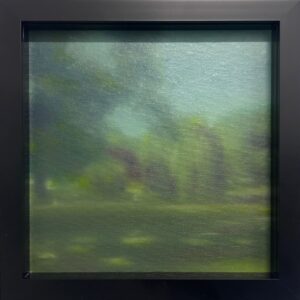
    The new pictures, with their liminal greens, seem to be the start of some new potential. Here we see Green Park as it might be seen in a dream, or in the hypnagogic state between sleep and waking. The journey to the centre of town to make these pictures is perhaps indicative of an interior shift in Chughtai. The new pictures also mark a big change away from character towards some other kind of painting which feels like it is yearning for mysticism – maybe even a metanoia away from despair.


    Was it hard to give up Nowhere Man? Might he ever experiment with another character? “It was very hard to shed the Nowhere Man. I doubt there would ever be another character. For me it represented humanity. If I ever need a central character again I’m pretty sure I’d call him up.”


    Humanity then is for Chughtai somehow passive and faceless – asleep perhaps. This makes the notion of an exploration of the liminal all the more important; it is to do with exploring what Seamus Heaney called ‘the limen world’, that curious borderland of the unconscious. I have a sense that these recent works are a necessary transition period and that it may in time lead to some sort of reconciliation between Chughtai and the damage of the world – a more optimistic vision perhaps.

    How did these new paintings come about? “The works exhibited recently at the Liminal State exhibition are exactly that; Liminal, as in kind of between or on the threshold. For me personally, up until just before lockdown in 2020 I was creating paintings with a central anonymous figure – the Nowhere Man. 16 years through the eyes of this character, so, shedding that to allow the next body of work to arrive has taken these last four years, and counting… The title, A Liminal State can also have numerous interpretations and could additionally refer to many other aspects; mentally,, physically, technically, artistically, societally… liminal.”


    These then are between states, and that means flux – in Chughtai’s art certainly, and therefore, since artists are their art, in his life. I ask Chughtai about his method of composition. Is it evolving? “It’s evolving and continuing its journey. I’ve changed the approach, technique, materials used and so much more since 2020. In fact, almost everything – but still the work has naturally evolved through different states to where it is now.

    It’s a continual fluid journey. I have also been developing an artistic theory and putting that into practice. It involves perspective and the way the eyes see and the brain interprets an image. It’s great testing a science based theory on my artistic practice… and it actually works. My most recent painting entitled, Turn Left. (2024) shows the theory in practice in its most developed stage to date, and I was blown away by the positive reaction it got when exhibited for the first time at the show.
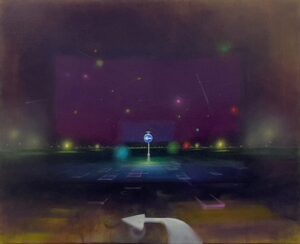
     

    Turn Left, 2024


    This again, seems to me like a dream where the dreamer is sometimes given clear but mysterious indications of what to do – strange snatches of disembodied advice. To look at these pictures after immersing oneself in the Nowhere Man corpus is to see a kind of hope peeping through, because the world seems to be acquiring a kind of charge, groping towards some form of meaning. My sense is that this makes the next few years of decisive importance for Chughtai’s art. If we follow that sign, where does it lead?

    This new work has also sent Chughtai on a rewarding course of study. “Over the last four years I have really delved deep into studying and expanding my artistic learning. Visiting the London galleries on a weekly basis and getting to understand the philosophies of some of the great painters, while also educating myself about the amazing artists from around the world and their histories.”


    So who are his heroes? “I have to mention Van Gogh, I just love. His pencil drawings, they make me wanna scream. I would say that more recently I have been appreciating 20th century Western heavyweights such as Bacon, Klee, and Rothko who’s section 3 of the Seagram murals brought me to tears on more than one occasion. It was during a particularly emotional time for me personally whilst simultaneously looking to move my work along an different path. That painting allowed me to see within it what I wanted to do with my own work.”


    Chughtai has been going strong for a long time. So what are his tips for young artists about the business side? “Well, yes, it is a business – if you do it full time for your living. So if you don’t have the luxury of financial security, you will need to sell your work.

    This predicament will most likely influence the type of work you produce and therefore could involve compromise. That’s the tightrope. It can work in your favour but can also be a hindrance if not deterrent, which is a real shame because then we miss out on hearing and experiencing the voices from within those walks of life. So, believe in what you’re doing, put the time in and keep on making your art.”
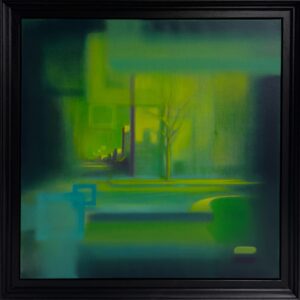
     

    Maxted Morning, 2024


    And would Chughtai recommend the art fair route? “I love going to art fairs. It’s where it all started for me. Like our society, the art world is very hierarchical, but whether you’re at the bottom rung or at the very top, when all is said and done they’re markets with their stalls out. It’s great because people can stand in front of the work in the flesh, which is how I feel art works are best experienced… and there is so much under one roof. Art fairs are a great way to spend an afternoon… if you can afford the entrance fee, of course.”


    That’s often the problem for young artists at all. Has the conversation around NFTs affected him at all? “I did look into NFT’s a little some years ago but it seems to have gone quiet on that front so am unaware of where it currently stands. The whole digital thing is obviously a direction the art world is going down and there are many possibilities to explore. However, my focus and studies are with oil paint and a canvas because there’s so much more to come from there and that will always be ahead of any artificial intelligence.”


    Chughtai is an artist of rare talent, who is doing something very valuable: he is pursuing his vision where it leads. It takes courage to do that. Every artist can learn from somebody who has chosen his path so decisively then pursued his craft with such passion.


    For more information go to nadeemart.com 

  • Tuesday Poem: Omar Sabbagh’s ‘After Van Gogh’

    The poet Omar Sabbagh gives us a meditation on the work ethic of the great painter.


    After Van Gogh


    Think of a man gone past like this:

    unschooled by any length of scholarship,

    but still seeing a path through and by

    the brimming cup and rip of his seeping madness,

    a way of doing things with paint

    and an eye, a wholly newly naked way

    of haggling with the daylight and the night,

    and then to let all the others see the whip-

    like pictures built from a mind’s priest-less cathedral.

    He made his mark on history, fusing to a trouble

    time’s wide white canvas, mimicking the rain,

    the fearsome hail-stroke of living.  What was natural

    to him, his early death, was the very letter of that

    early death spelt in the desperate, breathless color

    and might that crowned him with their feats

    and with the more halcyon golden bells of hindsight.

    He died penniless, disregarded, going under

    the earth alone; but he’d made, the while, color wonder,

    and light made to sunder the gift of light.


  • What can Vincent Van Gogh teach us in our careers?

    By Christopher Jackson


    To say it’s Vincent Van Gogh season in London might be to overstate the case: it always is. Every day people come from all over the world to see Sunflowers in the National Gallery – that great tour de force which reinvents the colour yellow for all time.

    The artist’s fame would have seemed odd to his contemporaries, especially those who knew his eccentric habits in Arles, in southern France towards the end of his life. There was a time when Vincent Van Gogh couldn’t get anyone to look at his paintings. Today, it’s hard to get in front of one long enough to have a proper look without a tourist straying in to spoil the view.

    But great fame is often reductive: in loving his pictures so much, we’ve tended to simplify him. We attribute his current reputation to ‘madness’ – as if Starry Night were primarily an expression of insanity. It’s true that Vincent struggled all his life with what we would probably label today ‘bipolar disorder’, but the truth is that Vincent was always sane when he was painting, and that painting was in fact his best method of staving off episodes which occurred throughout his life. These were frequent and he was heartbreakingly honest about them in letters to his brother Theo: “It appears that I grab dirt from the ground and eat it, although my memories of these bad moments are vague,” he once confided.

    It is an arresting image: the great painter literally eating the earth. It might even serve as a metaphor of his achievement: Vincent was always imbibing real life, insisting on it to an unusual extent. His is a world of peasants and down-and-outs: he might be the only great painter in history whom it’s impossible to imagine as a courtier.

    If you look at the popular image of the artist, you could almost imagine that Vincent is a completely separate case, someone we can’t expect to learn from at all, because we are not mad and he was. But his greatness cannot in the end be assigned to insanity, but instead to skill, vision and application. This means that we have more to learn from Vincent and his methods than we might think: this is true if we want to work creatively, but true also no matter what we wish to do with our working lives.

    The first thing we mustn’t do is think him a uniquely hopeless case as a man in order to consider him a uniquely remarkable artist. As the pandemic has brought into focus, the world is always liberally stocked with mental ill-health. We might be deluding ourselves if we consider ourselves well, and Vincent not. It may even be that the reverse is the case more than we might realise or wish.

    Secondly, we mustn’t forget how much hard work underpins Van Gogh’s achievement. The popular caricature of Vincent’s life still seems to invite us to imagine the world binary, divided between the sane and the insane. In actual fact, his life increasingly makes me think that we are instead divided between those who are committed and those who are not.

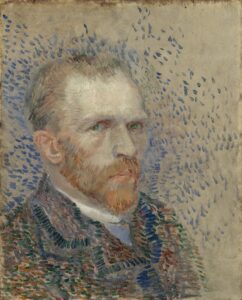
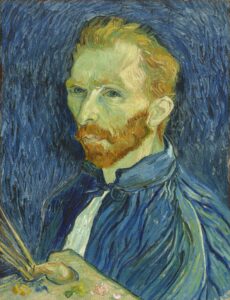
    With all this in mind, I have come to the Courtauld Institute to see a remarkable exhibition housing 27 Vincent self-portraits collected together across two rooms. The Institute has spent a fortune renovating itself, and emerged on the other side of £57 million in expenditure looking almost identical to what it looked like before.

    Anyone who wishes to get upset about this financially alarming decision however, can seek solace in being restored to one of the great collections of the world. Among them is Vincent’s famous Self-portrait with Bandaged Ear, which he made after the terrible and incomprehensible incident in Arles which most people know about: after experiencing increasing tension in his friendship with Paul Gauguin, he cut off his own ear and delivered it to a prostitute with a cryptic note attached.

    The exhibition may be said to build towards this picture as towards a crisis. But there is another way of looking at it: here, spanning over a decade of helter-skelter work, is a celebration of the joy of discovery. We might be disinclined to cut off our own ear, but we should certainly leave open the possibility that there is an activity waiting for us in life which we can grow into over time: a room we might walk into without ceilings or impediments where we might become more and more richly ourselves. By that measure this exhibition is extraordinarily valuable: it shows the sheerness of Van Gogh’s application to the art of painting and might even unlock something within ourselves.

    The early pictures, drawn in his native Holland, are sombre affairs compared to what he would later produce. As such, they are a very precise measure of how far he would develop. By the vigour and the colour they lack, these pictures imply both an openness to doing things in a different way and also state an uncompromising desire to make his craft secure before he did branch out. The dominant influence here is Rembrandt. Here again there is a lesson which might apply to other disciplines: seek the best in what you wish to do, learn from it respectfully, and only then stake out new territory.

    There’s another lesson, stemming from the fact that so many self-portraits exist. Vincent was a little unnerving as company, partly due to his physical appearance which was by no means prepossessing, and partly because of his unpredictability. As a result, throughout his short life, he found it difficult to find models willing to sit for him. The only model always willing to do so was himself.

    This points to his resourcefulness and to his determination. In his letters to Theo – some of the loveliest documents in the history of art – we get a lot of detail about materials Vincent is buying. Here again, he is always sensible with money, frugal with what he’s able to afford, and a fortunate beneficiary of his brother’s generosity. Unfortunately, because Theo’s letters weren’t kept, and Vincent’s were, we rarely get a sense of Theo’s view of Vincent, though what we do know points to fraternal adulation. But this absence further augments the sense of Vincent as a man alone.

    The Courtauld exhibition shows that Vincent always left himself free to experiment, without ever losing the intensity of work ethic which always marks out his pictures. He studied his own face from every angle. He told us his every mood. By the end of this exhibition, we feel we know him. It’s this intimacy – together with the perennial simplicity of his signature – which makes us comfortable (think Don Maclean’s song of the same name) enough just to call him ‘Vincent’. We do not call Cezanne ‘Paul’ or still less Monet ‘Claude’. Vincent is touching in a way few great artists are. One of his virtues was always humility. It’s this which has brought him so many posthumous champions. Knowing what it was to be despised, he never despised anyone. He is always in the trenches of life with us. It is difficult to think of another artist who cared so much for the downtrodden and the outcast.

    In these self-portraits we see always the same determined mouth, the slightly watery eyes, the hooked and even austere nose, and the receding hairline. But this is where the similarities between each picture end. Given that the same subject recurs throughout, it is an exhibition so various in its mood and techniques as to cause astonishment.

    The main reason for this versatility is that Van Gogh had made himself open to the gigantic discovery of the age, Impressionism, and then moved swiftly forward, making out of it a unique and wholly personal achievement.

    But here again we must be careful. The truth is that in a pre-Internet age, Vincent never could have discovered Impressionism without having been immersed in the art world through Theo’s work as an art dealer. He couldn’t google Seurat; he had to meet Seurat.

    In actual fact, if we might look at the matter objectively Vincent made all the right moves, which makes his achievement no accident at all. In fact, he often foresaw in his letters that his victory would have to be posthumous. There was a worldly, even calculating side to him at odds with the stock image of the freewheeling madman.

    Other lessons can be found in his life. He moved away from a career in the priesthood to which he was unsuited, though he took what he had learned there – the importance of the numinous in life – and applied it to his art. Nothing was ever wasted. He then applied himself with rigorous dedication to painting, and connected himself in that world, making sure that he was working not according to some outdated understanding of his craft but to its latest developments.

    As he carried out all this he was frugal, careful, and utterly committed. He also had an unfailing instinct for the next subject, and was prepared to subject himself to upheaval in order to pursue those instincts to their logical conclusion. The most famous example of this is his decision to leave Paris and move down to Arles in southern France.

    He did so because he craved another light. It was a masterstroke – when what Vincent calls that ‘high yellow note’ has entered his pictures, we feel he has come home somehow. It looks like something which had to happen. But this again is an illusion: he made it happen. Again, because his life ended tragically, we forget that he was possessed of exceptional self-reliance to have got as far as he did.

    Of course, a more organised person would have found somewhere less depressing than Arles to settle. It’s true that it had a few places going for it – the old Roman amphitheatre and some decent museums in towns nearby. But one senses that almost anyone else would have pressed on to Italy – or to Tahiti, as Gauguin did and follow their decision to relocate to its logical conclusion and find their way to a more appealing town.

    It was his hyperactive fascination with what he saw which made him stay. The fields, the café, his chair, his room: these were enough for him, because he realised that just by going to Arles he had learned to see things in a way which nobody before him had been able to do.

    No-one has seen like that since – and it must be that no artist has communicated to so many people with such immediacy. In fact, his work has the immediate comprehensibility of photographs: it is mass art in the way in which magazines are. And yet it stands up.

    This is abundantly clear at the blockbuster Vincent Van Gogh: the Immersive Experience now touring the world where huge crowds, including children, experience Vincent ‘interactively’. At times the exhibition – as in its roomful of sunflowers – feels somewhat gimmicky, but sometimes it astonishes.

    The centrepiece of the exhibition is a vast, almost cubist cinematic experience, where we see the familiar story of Vincent’s life written in subtitles while music contemporary to Vincent’s life plays and his paintings are shown in detail on large screens. The fascination of the show is that it’s impossible to see all of it at one go, and we’re reminded of what a complicated thing a life is, and especially a creative life like Vincent’s.

    But the principal reflection is this: it’s very hard to imagine a show on this scale for any other artist dead or alive. Picasso, perhaps. Hockney, just maybe. But in each case, I doubt that their work and life has the deep appeal of Vincent. Picasso is at heart too grotesque and misogynistic; Hockney’s work is probably not quite good enough, especially in the last 20 years or so.

    What accounts for this? It is that Vincent truly loved the world and truly loved all people. In his life, he imagined creating an artists’ colony alongside Gauguin and others where the world would be righted. Sometimes, Vincent had little self-awareness: he had neither the organisational skills, nor the money, nor really the personal magnetism, to make such a thing happen.

    But it happens today at any Vincent exhibition where people gather in a kind of loose arrangement of fascination, seeing the world again through his eyes. Of course that arrangement dissolves swifter than Vincent had in mind when he imagined a colony of artists. But it is something – more than something.

    And with every passing year we need to understand that Vincent’s popularity isn’t a quirk of madness. It was because his life in its way was exemplary, and there is much we can learn from him.


    Van Gogh. Self Portraits runs at the Courtauld Institute until 8th May 2022