Tag: Universities

  • The Finito World Guide to Ivy League Universities

    Patrick Crowder

    The US group of universities known as the Ivy League is world renowned for the history, high academic standard, and excellent experience offered by the institutions which fall under the Ivy League umbrella. They are among the oldest schools in the nation – in fact, many of them predate the nation – but they continue to attract students from around the world.

    In the UK, there is a growing interest in attending American university, with one in five school leavers reporting that they have their eyes set on a US institution. To help our readers navigate the complicated world of US unis, we’ve prepared this ranked guide of the Ivy League schools. It is important to note that these institutions have been competing, in some cases, for more than 300 years. Each has its own strengths and weaknesses, and often finding the best fit will come down to personal preference. For example, someone who likes living in the city may find the quiet town of Hanover lacking and choose Columbia University over Dartmouth as a result. Alternately, a nature-lover might choose Dartmouth over the University of Pennsylvania in bustling Philadelphia. At the end of the day, these are all excellent institutions, and we hope that this guide helps you on your higher education journey.

    1.     Harvard University – Cambridge, Massachusetts
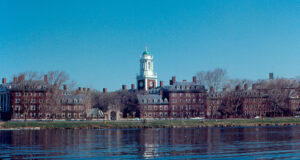
    Harvard University is one of the most prestigious within the Ivy League

    Average Undergraduate Tuition: $55,587
    Acceptance Rate: 5%
    Top Majors: Law, Economics, Medicine, Engineering

    With a history dating back to 1636, Harvard University is the oldest university in the US, predating the founding of the country by 140 years. Harvard is perhaps most famous for its stellar reputation in the fields of law and medicine, but it is also worth noting that the Harvard School of Divinity is widely considered to be the world’s most respected theological programme. Harvard students are known to be extremely driven and hardworking, and that’s no surprise considering the school’s extremely low acceptance rate, but Harvard also offers ample opportunity for students to explore the City of Cambridge and Boston as a whole. A historical city which feels more like an oversized town than a sprawling metropolis, Boston is a place to explore the history of the nation and enjoy the rich culture embodied by the Boston Symphony Orchestra, the Museum of Fine Arts, and Fenway Park.

    2.     Yale University – New Haven, Connecticut
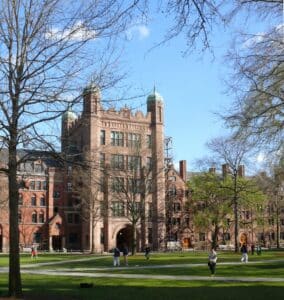
    Ivy League

    Average Undergraduate Tuition: $59,950
    Acceptance Rate: 6.5%
    Top Majors: Economics, History, Political Science

    Yale is often seen as the Ivy League school with the heaviest focus on the arts, and for good reason – Yale’s art, film, dance, and music courses are among the best in the world. Since 1701, Yale University has provided the highest level of instruction to History, Social Science, Engineering, and Mathematics students, but their offering doesn’t stop there. If a student’s interests cannot be contained by a single traditional programme, Yale also offers multidisciplinary programmes. The city of New Haven is not as large or bustling as Boston or Manhattan, but there is a good amount of culture and nightlife to be found near Yale. Crime in the city can be a problem, but the vast majority of Yale students have no issue and rapidly adjust to life in New Haven. Yale is also home to the world famous Whiffenpoofs, so if a cappella singing appeals to you, it’s worth checking out the longest-running a cappella group in the US.

    3.     University of Pennsylvania – Philadelphia, Pennsylvania
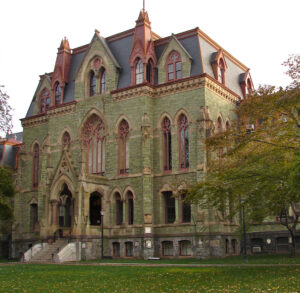
    Ivy League

    Average Undergraduate Tuition: $61,710
    Acceptance Rate: 9%
    Top Majors: Finance, Registered Nursing, Philosophy

    The University of Pennsylvania is known for its work hard/play hard attitude, but don’t let the active social lives of the students distract from their tireless work to maintain the institution’s reputation as a top research university. Founded in 1740 by Ben Franklin (who was also no stranger to the party life) the University of Pennsylvania is best known for the Wharton Business School, which is one of the best in the country. Wharton often overshadows the university’s other offerings, though the School of Engineering and Applied Science and the School of Nursing are also highly respected. The university’s location in Philadelphia will give students the chance to feel the weight of the history surrounding them each time they walk down the street. Bars, museums, and music halls offer great places for a night out, and PennU’s sprawling campus can often feel like a city of its own. While UPenn is still highly selective, it does sport a higher acceptance rate than other Ivy League schools, and extracurricular activities are considered more heavily when making admission decisions.

    4.     Princeton University – Princeton, New Jersey
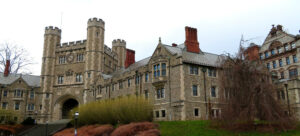
    Ivy League

    Average Undergraduate Tuition: $56,010
    Acceptance Rate: 5.6%
    Top Majors: Social Sciences, Engineering, Economics

    Princeton University is one of the finest of the Ivy League schools, with a world-renowned reputation for International Relations and Public Affairs, and the humanities in general. Princeton’s alumni, among other prominent figures, include the US Presidents Woodrow Wilson, James Madison, and John F. Kennedy. Founded in 1746, making it one of the oldest universities in the country, Princeton offers students the unique opportunity to become accustomed to thesis writing through the Junior Project, which is completed under the supervision of a faculty member. The application process and requirements for Princeton are notoriously difficult, placing much more emphasis on pure academics than extracurricular activities. While the university campus spans more than 600 acres, the town of Princeton, New Jersey is much more suited to nature lovers than city-dwellers. While the town is not large, with a population of around 30,000, there are good restaurants to be found, and downtown Princeton offers opportunities to see a bit of history while visiting the shops. It is recommended to drive, as while there is public transport, having a personal vehicle is far more convenient if you plan to leave town.

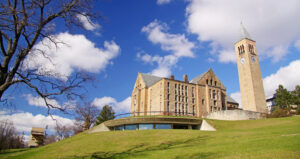
    5.     Cornell University – Ithaca, New York
    Ivy League

    Average Undergraduate Tuition: $61,015
    Acceptance Rate: 10.7
    Top Majors: Computer Science, Biology, Labor and Industrial Relations

    Cornell University may have the highest acceptance rate of the Ivy Leagues, but that does not mean that the quality of instruction is second class. Since its foundation in 1865, Cornell students have had the opportunity to study under Nobel laureates, Pulitzer Prize winners, and other major leaders in fields ranging from Agriculture to Industrial and Labour Relations. Greek life is a large part of life at Cornell, but if joining a fraternity or sorority doesn’t appeal to you, there are many other extracurricular activities including the Glee Club, Kung Fu, and Archery. The city of Ithaca is fairly small, and though it does contain some solid restaurants and nightlife, you will almost certainly want to be comfortable driving a car as the small town can be isolating to those accustomed to the big city.

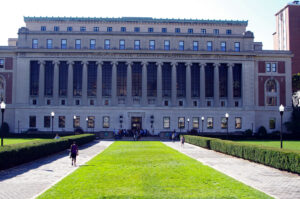
    6.     Columbia University – Manhattan, New York
    Ivy League

    Average Undergraduate Tuition: $63,530
    Acceptance Rate: 6.7%
    Top Majors: Political Science, Computer Science, Engineering

    Originally founded by King George II in 1754, Columbia University can now be best defined by the cutting-edge research taking place there. Home of the Pulitzer Prize, Columbia’s humanities courses are well-respected, however the long-standing engineering programme is the most famous and prized course. Columbia’s application process is heavily academic, however they value a well-rounded student over one who excels in only a few areas. The core curriculum at Columbia also seeks to expose students to diverse ideas far beyond the confines of their chosen field of study. Columbia’s location in Manhattan comes with all of the advantages and drawbacks of living in New York. For those who crave the big city life and the wealth of opportunity which comes with living in such a major financial and cultural hub, Columbia is an ideal choice, however factors such as cost of living and fast-paced lifestyle should be carefully considered. Students at Columbia will not need a car, as public transport is well established in Manhattan.

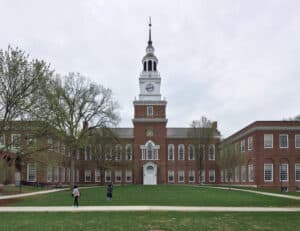
    7.     Dartmouth College – Hanover, New Hampshire
    Ivy League

    Average Undergraduate Tuition: $60,870
    Acceptance Rate: 9.2%
    Top Majors: Biological Sciences, Engineering, Social Sciences

    Founded in 1769, Dartmouth College has the history one would expect from an Ivy League institution while maintaining the new ideas present at more modern schools. A great example of this is their flexible “D Plan”, which is a schedule consisting of four 10-week terms per year. This means that students have time to take advantage of internships which run during normal university times, and Dartmouth’s many study abroad opportunities. The Thayer School of Engineering is one of the oldest schools of its kind in the country, and it offers a dual-degree programme allowing students from other universities to attend. Greek life is a huge part of Dartmouth’s tradition, and students from the many fraternities and sororities flock to the great outdoors available in Hanover. Hanover is a small town, but what it lacks in bright lights and vibrant nightlife it makes up for with its beautiful hiking trails, rivers, and opportunities for outdoor sports. If living near nature interests you, Dartmouth is the place to be; the College even owns its own ski hill!

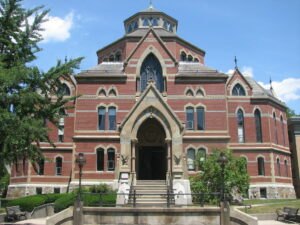
    8.     Brown University – Providence, Rhode Island
    Ivy League

    Average Undergraduate Tuition: $62,304
    Acceptance Rate: 7.7%
    Top Majors: Applied Mathematics, Economics, Computer Science

    Brown University takes a different approach than other Ivy League schools, in that students are not locked in to one field of study, and the school has no strict majors. The “Open Curriculum” programme at Brown allows students to combine classes from different fields to tailor their experience to their own specialisation, though they must complete at least one “concentration” to graduate. Brown was founded in 1764 on the novel idea that students of all religions were welcome to attend, and that open attitude is still present in the university’s philosophy today. Brown’s eight-year Program in Liberal Medical Education is highly regarded and is an excellent way to work towards an MD, and extracurriculars including sailing, journalism, and martial arts provide an effective way for students to take a break from their studies while also bettering themselves. Located in Rhode Island’s capital Providence, students at Brown have ample opportunity to explore a lesser-known city which nonetheless features excellent restaurants, an active nightlife, and the historical architecture of College Hill.


  • 2022 Highlights: Essay – How did universities become a money-making industry?

    2022 Highlights: Essay – How did universities become a money-making industry?

    By Alice Wright

    The UK is home to a high concentration of world-leading universities. Our venerated institutions offer higher education qualifications from bachelor’s and master’s degrees to PhDs that are designed to equip the country with a skilled workforce as well as produce researchers to contribute to the advancement of academic knowledge and the betterment of society. 

    Yet the idea that students and staff at these establishments aren’t getting “a fair deal” is never far from the headlines. So when did the pursuit of higher education and academia become part of the industry-speak of cost-benefit analysis, and what might be the long-term ramifications? 

    On the surface the shift can largely be attributed to the introduction of tuition fees in 1998. Over the next two decades fees snowballed and now top £9,000 a year with maintenance grants largely converted into loans. 

    One increase after the Browne Review in 2010 led to large scale protests, some of which turned violent. Despite the unpopular nature of tuition fee policy, there are no signs that it will be reversed any time soon. 

    The commercialisation can be seen in how universities have become increasingly reliant on international students who pay much higher fees than their UK counterparts. In 2017−18, 14.4 per cent of undergraduate students and 35.8 per cent of postgraduate students were from outside the UK, according to a 2019 study from Universities UK

    In 2017−18, the total reported income of UK higher education institutions was £38.2 billion. £21.1 billion of this was related to teaching activities (fees and grants from government). Thus government sees universities as a prudent investment, even though government expects that only 25 per cent of current full-time undergraduates who take out loans will repay them in full, according to the Commons Library. The value of outstanding loans at the end of March 2020 reached £140 billion. The Government forecasts the value of outstanding loans to be around £560 billion by the middle of the century.  

    Continued government investment is in part down to the fact that the higher education sector has tangible benefits to the economy. In 2014–15, universities across the UK generated £95 billion in gross output for the economy. The UK university sector contributed £21.5 billion to GDP, representing 1.2% of the UK’s GDP. The sector also supported more than 940,000 jobs in the UK. 

    The pandemic has further brought university finances into mainstream conversations and thrown more attention on the matters affecting their performance for both academics and for their fee-paying students. 

    The government paid out £2.6 billion in tuition fees early instead of a multi-billion bailout for universities that the institutions requested in May 2020. Then in December 2020 and February 2021 new funding worth £20 million and £50 million respectively was announced. This is expected to indirectly support industry revenue growth in 2020-2021. 

    Universities pivoted to remote learning as government restrictions were implemented in March 2020. However, whilst there has been consistent coverage of the dissatisfaction of students with remote learning, both student applicant and UCAS acceptance numbers have hit record highs. 

    Indeed, according to Ibis World “rising unemployment and increased competition in the jobs market in the short term as a result of the economic effects of the COVID-19 (coronavirus) pandemic is expected to drive a higher number of both young and mature applicants to enter higher education.” 

    The pandemic has brought about serious concerns about mental health on university campuses. In 2017−18, around two-thirds (65.5%) of UK higher education institutions had an annual income of £100 million and yet a lack of funding for services means vulnerable and struggling students are not adequately supported on many campuses. Students feel that their high fees are not being fairly exchanged for academic teaching and students services such as counselling. The pervasive feeling amongst students is that they feel ever-more neglected by the onset of remote learning. 

    Students are not the only ones, however, that feel disaffected by the increasing commercialisation of higher education. There are around half a million staff employed at UK higher education institutions. 

    Career trajectories of academics often involve precarious nine-month contracts with staff usually moving around many different institutions in their working life. The University and College’s (UCU) decision to partake in a series of strikes over pensions has left a bitter divide between students paying for teaching they feel they are not receiving, and academics that feel that the commercialisation of institutions has left them short-changed too. 

    David Mathews outlined in a report for Times Higher Education the issue of academics no longer being able to spend enough time on their research and how this will put the industry in trouble. 

    Mathews argues that the essence of academia is to be given the time and resources to think deeply about a subject and hopefully as a result contribute to the wealth of recorded knowledge upon it. Yet he states that “progression in academia is often progression away from why you got into it in the first place” as those that climb up the ladder from junior scholars to professors end up doing more admin and management work than actual research or even teaching. 

    A 2020 report produced by Bethan Cornell at the Higher Education Policy Institute (HEPI) shows that 67 per cent of PhD students want a career in academic research but only 30 per cent stay in academia three years on. Some of the report’s findings support the idea that the long hours dedicated to activities other than research and precarious work contracts are among the factors limiting retention of academics. 

    Among the PhD students that were interviewed included one quoted as saying that “the requirement to move around in pursuit of short term postdocs is terrible for social and family life”. Another claimed they did not wish to pursue a career in research and teaching as “the academic culture will be detrimental to my mental health.” 

    Nick Hillman, the Director of HEPI, said that postgraduates are “crucial to the whole country, as postgraduate students provide the pipeline for academic, commercial and charitable research. If we are to cure diseases, improve productivity and improve people’s lives, that is likely to come via original research. So it is vital that, as a society, we look after our researchers”. 

    As with many industries, the higher education job market has been in flux and left many employees and those trying to break into the sector in an anxious state. However, Professor Charles Stafford, Vice Chair of the Appointments Committee at LSE, argues that although the academic job market has been affected by the pandemic it is important for academics and those looking to enter the field to understand the situation in their own subject area, and not to over generalise the situation. 

    Stafford also stated that the increase in student numbers may correlate to an increase in teaching based rolls, though it is too early to see any conclusive data confirming that this will be a long term trend.  

    Whilst the commercialisation and industrialisation of academia has clear drawbacks, there are also arguments for stronger links between industry, universities and government – as the collaboration between pharmaceutical company AstraZeneca, Oxford University and the NHS has shown in the successful roll out of a covid vaccine. 

    Chief knowledge officer of Times Higher Education, Phil Baty, states in a November 2020 report on university-industry collaboration that universities “cannot fulfil their limitless potential without collaboration – collaboration between institutions, with industry and across borders […] In particular, partnerships between universities and industry will be vital as nations seek to rebuild their economies after the devastation of the pandemic – reskilling the workforce and rebooting the knowledge economy.” 

    So it’s clear that universities have a role to play – but equally there is an urgent need for these institutions to adapt both to continue to attract students and to make sure that staff are retained. As former Chicago mayor Rahm Emanuel put it: “Never let a crisis go to waste.”


  • Stuart Thomson: ‘Universities need to protect and enhance their career offer’

    Stuart Thomson

    There is no doubt that most people’s time at University goes past in a flash.  It is a heady time of friendships, socialising, expanded horizons and, of course, learning.  But the realisation soon dawns that attention has to be turned to getting a job. That’s when things start to get really difficult.

    Universities must sell themselves to prospective students.  Most place an emphasis on the learning and wider life experiences that a student can look forward to when they study there.  There may even be a nod to how successful students are in finding jobs when they leave.  But such numbers are quite blunt and frankly don’t really reveal much about a students’ real job prospects.  What students really need are activist careers services that offer support from Day One.  Careers services are one of the most undervalued parts of university life but ever increasing in importance.

    There is no doubt that the government recognises the value of education.  It is constantly looking to help support students at schools and in further education. It sets standards and makes demands of institutions, not least for careers support.  For a large part higher education is no different but the case is different when it comes to careers services, where universities are left to their own devices.  While higher education institutions are not actually required to provide careers advice, they clearly must because students expect it.

    There is help and support available, so each university does not have to find its own way.  There is also help and support available to students. For instance, the Office for Students has issued a “Graduate Employment and Skills Guide” and has offered a local graduates competition to help graduates into local employment opportunities.

    The government has put in additional investment in the National Careers Service.  The Department for Education in Westminster is working with Universities UK, the Association of Graduate Careers Advisory Services, the Institute of Student Employers, the Office for Students, and others to understand what else they can do to support graduates entering the labour market.

    The Higher Education Careers Services Unit supports the work of careers and employability professionals and their institutions and AGCAS is a membership organisation for higher education student career development and graduate employment professionals.

    But the reality is that the picture remains a mixed one.  When political inquiries are undertaken into the careers support available then the picture that comes back doesn’t always reflect well on the university system.

    The All-Party Parliamentary Group on Social Mobility issued a report in 2017, “The Class Ceiling: Increasing Access to the Leading Professions”, which suggested that: “Universities should ensure careers services are a core part of the university support system and, in particular, target proven interventions at disadvantaged students to improve their awareness of career opportunities.”

    This highlighted the varied quality of careers advice but also suggested that employers needed to be more proactive in working with universities as well.

    There are often arguments about the balance between equipping students for the workplace and seeing education as a widening of horizons.  In other words, it shouldn’t just be about getting a better job.  But the reality, especially given the levels of debt that students come out of university with, is that there is an expectation that the institutions need to help students equip themselves for the world of work.

    Universities must challenge themselves as to the types of job markets they are looking at – local, national, global?  And that will vary between courses as well.  Many educational institutions are focused on the inputs – the courses, the variety of learning, quality of teaching, the research base – but there needs to be an emphasis on the outputs for graduates as well.

    The reality is that as universities come under the glare of government for how they have dealt with teaching during Covid, the money they pay their leadership teams etc, that makes more aspects of their operations open to government diktat.  This government isn’t averse to intervention so there is no reason to believe that the university sector should believe itself to be exempt.

    So, careers services certainly need to empower individuals, offer mentoring, provide online skills for LinkedIn but also help improve personal productivity.

    Universities also have to help students appreciate the importance of their careers service offer as well.  Most students only start thinking about these issues towards the end of their time at university.  The help and support from universities only comes in towards the end as well.  Instead, the careers advice should be built in from the very start.

    The reality is that a student that is ready for the job market has a CV that allows them to stand out.  That means giving it attention throughout university life, not simply looking at it towards of the end of their study.

    It is another pensions problem. One of those issues that we only start thinking about when, in reality, it is already too late.

    Universities need to protect and enhance their careers offer.  They need to ensure that at a time of tight finances, especially post Covid, that careers services are not cut.

    Built and financed properly, engaging with businesses, helping to challenge social mobility, a university’s career service can help to attract students looking to build a career and ensure a return on their investment.


    Read Stuart Thomson’s piece on the importance of a creative working environment

  • Katharine Birbalsingh on grammar schools, universities and wokeness

    I was at Oxford University and I didn’t really know what to do with my life – I only knew I wouldn’t really fit in at McKinsey’s and places like that. I was involved in an organisation at that time which was about opening up access to Oxford and Cambridge. They would send black students at Oxford to schools with a diverse intake and say: “I’m there, and I’m doing okay.” I used to go to schools in Birmingham, Manchester and London and I could see children changing their minds in front of me. I thought: “You can really make a difference.” And I’ve never regretted my choice.

    Grammar schools aren’t really the gold standard anymore. They take the best and capable kids, but they’re not necessarily the best schools. In fact, I’d argue that grammar schools don’t have to be particularly good at all – precisely because of their intake. The kids will always do well because they’re super bright. At Michaela Community, we don’t have those kids – and it’s really complex teaching your bottom sets. If you only get the top slice you don’t have to think about learning in the same kind of way. If you have a school with real diversity, you have to be doing a great many things to get those kids learning.

    If a private school headmaster came to my area, they wouldn’t have a clue. That said, there are ways in which private schools can support state schools, without going in and telling them what to do. They can send some of their students over to do some tutoring of younger children, or they can offer their careers fair to the local state schools can go and join. Or they can send teachers across – these are things they can do without seeming patronising.

    All universities are influenced by popular culture. And our culture now is one that’s woke –  that’s the problem. Of course, you might say, “Oh, but that isn’t the case everywhere and if you go out somewhere in middle England you can find families who are not thinking that way. Yes, possibly. But the media, the establishment, and all the people who set the tone for the country, are of that mindset. And the universities are also that mindset and perhaps even further along. So it it’s not even as if you can choose: any university you go to, that’s what you’ll come across. Unfortunately, there isn’t anything I can do about that. It’s great that there are people thinking of setting up non-woke universities like Barry Weiss in Texas – but it’s still worrying. Having said that, if our students have spent seven years with us, hopefully we’ll have done a good job of grounding them and giving them certain values. 

    Often, I think families think that tutors are some kind of magic pill that you take families. And you can tell the tutors come by once a week, they do a bit of teaching in an hour. And it’s something but the habits of learning are created over years on a daily basis. The problem you’ve got is if you aren’t being given the correct work to learn and if you’re not being taught properly in essence, it is hard for a family to support the home with that. I could suggest to you online maths programmes that would be far better than any maths tutor because the maths tutor can only do it once a week.

    I have to remind parents: it’s not just the quality of the school, but the quality of the teachers. Within one school, there is more in-house variation in one school in terms of the quality of the learning that takes place than there is between schools. So families often think: “If I just get them into good school, then that’ll be fine”. But within that good school, there will be more variety than there is between the good school and the bad school. So even in the good school, you will have teachers that are not necessarily able to teach your child in a way that helps your child learn. Now what is good is if the good school has good behaviour, then that certainly makes it easier for the for the weaker teachers in the school.

  • Omar Sabbagh’s Letter from Dubai: ‘As soon as it was safe enough to reopen, that was done’

    Omar Sabbagh’s Letter from Dubai: ‘As soon as it was safe enough to reopen, that was done’

    Academic, poet and essayist Omar Sabbagh airs his worries for the younger generation in Dubai  

    Over the course of the last year, I have felt quite fortunate to live and work in Dubai. Whether during the period between spring and summer 2020, when lockdown regulations meant you had to apply for a permit to go from one place to the next (via a user-friendly app), or whether it was the rigors of the rules about numbers permitted in cars, taxis and social gatherings, the high levels of technological efficiency proved to be a blessing here. 

    So Dubai has been a comparatively good place to be during lockdown. Malls, for instance, immediately set up mass temperature monitors at their entrances. The university where I teach built a new gate and passageway at its entrance for this purpose. In pandemic times, a highly monitored society, with efficient avenues for top-down governmental action, puts the ‘brotherhood’ into any pat notion of ‘Big Brother.’   

    Of course, Dubai – and the UAE more generally – has suffered economically, like anywhere else in the world.  Things have contracted: shops for a long while curtailed their hours of availability; work hours in the second half of 2020 were shortened; and there are fewer jobs.  A close relative spoke of laying-off a third of his staff, and having to halve salaries in Q3 of 2020. Another was forced to take paid leave for a month from his sales job in retail.  

    That said, it was announced early on that the government would take keen action to make sure the country would be protected. Tourism – an important aspect of Dubai’s economy – has also suffered, but it was clear to all that as soon as it was safe enough to reopen that was done. I myself have travelled more than three times in the last year, needing only to follow PCR-testing regulations. Returning to Dubai, it usually takes less than 24 hours for your PCR-test at the airport to ping as an SMS on your phone. The services have always been stellar here. 

    I have been teaching, too, since spring last year, online and at times via a new ‘Hyflex’ system, whereby students can opt during registration, to attend in person or remotely, online.  For teachers like myself this involved a scramble to learn new technologies in the classroom, by which one would lecture in person but simultaneously with a camera and microphone to engage with those learning remotely. I was anxious of the burden of learning to use the technology, but the inhibition before the event turned soon to enthusiasm on my part. 

    Young people’s prospects here are good; this is one of the best places in the Middle East to study alongside Beirut and Cairo. The majority of students will end up in business, media, engineering and perhaps architecture or design. There is absolutely no sense of rebellion in Dubai. 

    That said, the students seem to have lost some of their gusto. When I see the odd stray young person on campus, he or she invariably seems to me to look lonely. It’s much easier for an academic like myself – a person who revels in a week spent on the couch reading or thinking, writing or teaching – to deal with these circumstances than for other kinds of people. It’s also much easier for a man nearing forty, too, than for someone half my age to accept the reality of the pandemic.  

    I dare not let my wife catch on, but being homebound suits me like pie and goes down like sugar.  Bookworms or not, it’s the young I feel for. Of course, they’re getting on with their lives, and many are learning by other means. But if things are concerning in Dubai, if I look across at my native Lebanon, I am forced to imagine what absolute lockdown would be like. That country is suffering from its infrastructural weaknesses, in a country which was weakened already by internal strife and corruption.  

    I remain hopeful. Perhaps when things improve, and our old outdoorsy life recommences, we will have – in a manner of speaking – gone back to the future. It might even be that this hiatus will bring forth new fruits.  To paraphrase that great fabulist Lawrence Durrell: in the midst of winter we can feel the inventions of spring. 

    Omar Sabbagh is an Associate Professor at American University in Dubai

  • Thwarted plans: why the new UCAS report must be acted on by schools

    Thwarted plans: why the new UCAS report must be acted on by schools

    Alice Wright

    The University and College Admissions Service (UCAS) has released a report stating that one in five students are ill-prepared for university because they are not able to take the correct subjects at school that would allow them to study a degree that interests them.  

    The report went on to say that two in five students stated they would have made “better choices” if they had been provided with better information. It’s clear that young adults are being asked to make decisions that will affect their working future increasingly early on in life. Subject choices as early as GCSE are becoming factors in what degrees are open to them, and then in what careers they may pursue. 

    In other words, pupils are being failed. To create opportunities and leave paths open, children and young adults must be given the correct information. Such information must also be given in creative and stimulating ways to ensure it sinks in. It is no good handing out dry, colourless leaflets with lists of required subjects under a list of alphabetised career paths. People bring professions to life, and schools should make use of engaging speakers at the top of their industries who are willing to talk about what their working life has been like and how others might follow them.  

    This year, the government has decided to implement the “Enterprise Adviser Network”, and idea facilitated by the Careers and Enterprise Company. The idea – a laudable one – is to connect youngsters with leaders in different sectors and to provide careers advice. But only another such report in following years will tell if it is enough.   

    Making the right educational decisions as a young adult is also important in the backdrop of a highly commodified higher and further education system. Universities and colleges are financially incentivised to recruit as many students as possible, and fill gaps in courses whose capacity has not been reached. According to the Social Market Foundation, this has led to a so-called “turf-war” between the two sectors. This self-interest means students should not rely on those institutions for impartial advice. They must get it earlier from schools services – but above all, make their own informed decisions.  

    Knowledge can spark inspiration and passion that will determine a young adult’s future. Schools must look at UCAS’ findings and get creative to ensure their pupils are armed with the best information to take them forward into higher or further education, and eventually into the working world.  

  • Opinion: It’s time for us all to praise the unsung heroes of the pandemic – students

    Opinion: It’s time for us all to praise the unsung heroes of the pandemic – students

    by Diana Blamires

    Students have been blamed for spreading coronavirus and pilloried for having parties during lockdown but there have not been headlines trumpeting the good they’ve been doing in the pandemic.

    Medical students and student nurses from universities across the country have been helping on the frontlines and many have now volunteered to help with the mass vaccination programme.

    Academic staff are also lending a hand. Coventry University Assistant Professor Steph Coles, a paramedic who herself was ill with coronavirus last year, started working at West Midlands Ambulance Service over Christmas as soon as the academic term ended because she wanted to support her healthcare students who had taken on roles helping the NHS.

    In Northern Ireland, medical students and nurses were fast-tracked into roles helping out with the pandemic as soon as their university courses finished. Our healthcare students are among the unsung heroes of this pandemic working long hours to play their part in saving lives.

    This is a far cry from the proliferation of headlines blaming students for spreading coronavirus and censuring those who have been arrested for holding parties. As always, the few spoil it for the many. The vast majority of students are following very strict guidelines. International students who are stranded on campus are strolling or running on their own or with one other student. Shopping trips for food are predominantly alone. The overwhelming majority of students are loyal to the communities in which they live and want to play their part by not spreading the virus.

    Contrary to headlines about isolated students with no university support, some universities have gone to great lengths to focus on the welfare of students during the pandemic. The University of Buckingham is even enabling students to take therapy dogs out for their daily exercise. A student is allowed to go for a walk with one member of the welfare team and the dogs. In normal times the university’s two black therapy cockapoos, Millie and Darcie, are available to help homesick freshers who are missing their pets, and relieve anxiety for stressed students. Walking and cuddling them calms students at exam time. Research indicates a few minutes spent petting animals, especially black dogs, helps to reduce the stress-inducing hormone cortosol.

    Furthermore, most universities are offering virtual sessions simply for students to chat and air concerns. A number of smaller ones are arranging for students to be phoned regularly. Counselling sessions are available online.

    There are the many students who have helped with Oxford University’s world-leading vaccine programme and other such research projects who have quietly played their part while the university grabs the limelight.

    Although headlines are shrieking about students paying rent while living at home a significant number of universities managed to offer face to face sessions on campus right up until the end of last term when the government announced lectures must be online only. Many universities managed one to one or very small group meetings in person. Students at universities with face-to-face and good online provision are not asking for their money back for tuition fees as they feel their university did the best it could in the circumstances.

    The estate departments of universities went to enormous lengths to ensure in-person meetings were in safe environments and cleaners were deployed to guard against the spread of coronavirus as a result of those sessions.

    Student unions also pulled out all the stops to come up with imaginative ways of enabling groups of six to meet outdoors including barbecues and outdoor workouts as well as picnics and organised walks.

    Whilst inevitably in some student cities the virus thrived when students first arrived, in the autumn many stopped the spread in their local communities thanks to huge efforts by staff and students. It is vital that we appreciate our students for the positive and vital role they are playing in this pandemic rather than simply berating them as superspreaders when the vast majority have played by the rules and had a very challenging year at university as a result.

    Photo credit: Micurs