Tag: UK Politics

  • Brooks Newmark on Rwanda, Lifelong Learning, and His Humanitarian Work in Ukraine

    As an MP, over 25 per cent of the people who approach you for surgeries is generally about their children and their children’s education. My mum didn’t have much education – she left school when she was 12 or 13 – she was also a great believer in having a good education, and having me her eldest child going to Harvard Business School and Oxford was a proud thing for her. So the importance of education has been instilled in me from a young age.

    While I was an MP, in my second year in Westminster around 2007, I had the opportunity to work on a social action project in Rwanda. This was post-genocide Rwanda when they were still trying to rebuild the country and Claire Short, who had been Blair’s International Development Secretary, donated a huge amount of money for Rwanda. The UK at the time was the largest donor to Rwanda.

    Cameron decided this was important, and a trip was organised with eight MPs, and we worked on five different social action projects. I was in charge of a project which involved helping to fix up a small nursery kindergarten in a poor area in Kigali. There were 83 kids. I put in around £5,000 of my own money and we fixed up the school: we got electricity, we had two big water tanks, a lot of rooves and walls had holes in and we fixed that up.

    David Cameron then came over for two years to see the projects we were doing. And I remember one of the journalists who was with me came and visited me and he said: “You’re here for a couple of weeks and then leave it. What difference can you possibly make?” I explained that the infrastructure was better and so on.

    Back in the UK, six weeks later, I received a phone call saying: “Rwanda Health and Safety want to shut it down”. I said: “What do you mean?” He said: “Well there were 83 kids and now there are 343 children there in these tiny classrooms.” So I flew back and I met with the Minister of Education and I said: “Don’t close the school down. I will rebuild it.” In my head I thought it would cost me £100,000.

    I found a new site which I bought about a kilometre away, and spent two years getting planning permission, which I finally secured. We had a foundation laying and the President decided to come and I asked him why he came. He said: “Most people come to me giving advice. You came, saw a problem and put your hand in your pocket to fix it.” He added: “I would like you to do one thing: make sure there are all Rwandan teachers.”
    At that time a lot of teachers came from surrounding countries like Uganda, Tanzania and Kenya and so on. So I took that on board and we finally opened the school in January 2012. I then created a charity called a Partner in Education and we went on to build a secondary school. By 2017, we were ranked in the top three in the country, with nearly 100 per cent Rwandan teachers. At that point, I built a teacher training centre too.

    When I left Parliament in 2015, my old tutor came to see me and said: “Brooks what are you doing next?” He said: “We’ll figure out what exactly you do.” In 2016, I was sitting next to a Professor in the education department and I was asked to give a talk. I was asked to sit in on his class. I suddenly realised how little I knew about education even though I had this school.

    After three classes I asked if I could do his Masters. I passed and got in. I was 60 years old, but I always love learning. It’s never left me. I went back to university at the age of 60 and my dissertation focused on fine motor proficiency of seven year old children as a predictor of academic achievement.

    They then said I should stay on and do a doctorate. I decided to look at policy-making in Rwanda. I realised there are a lot of policy ideas which are generated without real focus on outcomes. For instance, they have this thing one laptop per child. But if there isn’t broadband in schools, or the teachers aren’t trained you won’t get satisfactory outcomes. We can’t really think about these things in a linear way.

    I decided to look at it through the lens of a systems approach and consider what enables and what constrains policy implementation. For instance, if teachers have only rudimentary understanding of English they can’t overnight suddenly be able to deliver lessons in English to children who themselves don’t speak English. It was understandable why the Rwandan government wanted to bring that in; but this top down approach wasn’t working.

    Having been in government myself, I can say with some authority that we have a habit of coming up with great ideas which in principle sound good, but we don’t think enough about who we need to bring on board to implement these things properly.

    But things happen in life and get in the way. I started my DPhil and then in 2020 Covid hit, and I couldn’t do my field research. Then, my mum got sick in 2021 and I could see from January she would pass away, which she did in May of that year. Finally I did some research in November 2021, and then suddenly the Ukraine war starts.

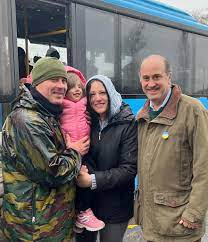
    It seems I will continue to find reasons not to work! I saw a friend of mine was on the Polish border moving people along refugee centres into Europe. I messaged him and asked if I could come and join him. Four days became two weeks. Soon, I began bringing buses into Ukraine from Lithuania, moving people from Kviv and Lviv to the Polish borders.

    As the war moved to the East, I had hubs across Ukraine, and I spent a lot of time in Kharkiv: we moved 1,000 women and children out of a Russian-controlled area. To do that we had to move 500 metres of anti-tank mines, which was an amazing achievement.

    I am torn between doing what I am doing in Ukraine and not wanting to drop the ball on my DPhil. I’m trying to navigate with my supervisors between my work with Ukraine and getting to the next stage of my DPhil.

    But the moral of the story is you’re never too old to learn. While my wife does Sudoku as a form of brain gym, I have my doctorate. Having started 40 years ago, I feel much better prepared through having had life experience in business and as an MP.


    Brooks Newmark was formerly Minister for Civil Societies
  • Opinion: Tony Blair’s Book “On Leadership” misses the critical point

    Tony Blair’s Book “On Leadership” misses the point.

    Finito World


    “The centre cannot hold/mere anarchy is loosed upon the world’. So WB Yeats wrote towards the end of his life. It doesn’t feel entirely irrelevant as a description of Starmer’s Britain.

    The early months of Labour’s time in government has seen some good ideas, the first signs of governmental infighting, some naivety and some poor decisions too.

    None of this ought to come as any surprise – and it would hardly be news at all if there wasn’t a mounting sense that the country needs leadership on a different scale to what we had under the Conservatives. Lord Darzi’s NHS report alone was enough to make people realise the scale of the inheritance Labour has – but that’s not to say there aren’t other problems. From education to housing, to transport and defence, to productivity and growth, the UK’s difficulties appear to be legion.

    But if the leadership we need isn’t yet evident in the Starmer government – and yet to materialise from an opposition still bruised by the recent general election’s thumping defeat – where is it to be found?

    Despite the fact that he left office nearly 15 years ago, there will be many who are still not ready to listen to the pronouncements of Sir Tony Blair. This is understandable when one considers the legacy of his Middle Eastern Wars, his awkwardly gilded post-premiership, not to mention the quangocracy which was certainly not curtailed by 14 years of Conservative-led government.

    And yet in a recent interview with The Observer‘s Andrew Rawnsley, designed to promote On Leadership, he did what Blair has always been good at: making an argument.

    Observing that the civil service is essentially unfixable, and that bureaucracy will have an innate tendency towards being bureaucratic, Blair offered the alternative: leadership from the centre.

    This is a very different thing to having a centralised system which we have come what may. Blair explained: “…unless you’re driving from the top, it [change] won’t happen. It won’t happen for several reasons. It won’t happen because the system won’t have a clear enough direction if it doesn’t get it from the very top. It won’t happen because too many issues require many departments to work together. And you need the centre to do that.”

    This is true, and seems all the more so from watching over a decade of prime ministers who couldn’t control the centre: May was a Remainer asked to enact Brexit; Johnson lacked discipline; Truss was never prime minister material; and Sunak could do the day-to-day, but lacked vision. Starmer is, so far, a sort of blend of May and Sunak.

    But if we accept this argument for strong leadership, it needn’t just apply to Westminster where it seems least likely to be successful. It can form a part of all our working life.

    It is a remarkable fact how little education there is in our society surrounding leadership. There is very little leadership education during our formative years: indeed, it might be argued that a samey curriculum tends to homogenise students – and this process is the opposite of generating the individuality which we associate with leadership.

    Of course, if we accept the need for leadership in our society then we might wonder how best to foster it. As Sir Terry Waite argued in a previous issue of Finito World, the study of history is important, especially if we can look at what made, say, Abraham Lincoln an effective leader and ask students to apply his essential pragmatism and patience to their own lives.

    Furthermore, this magazine applauds the work conducted by the Institution for Engineering and Technology in highlighting the importance of engineering on the curriculum; one attractive aspect of such an approach is that it engenders precisely the kind of problem-solving which makes for inventive leadership.

    In these pages too, Emma Roche has argued that an understanding of the original practical nature of ancient philosophy is of importance too when it comes to creating a generation which knows how to lead.

    But really it’s in mentorship that we are most likely to learn the skills needed: at Finito we believe that mentoring has a unique ability to create the knowledge base for effective leadership.

    The country in fact is in such a state that we are not in a position of being able to simply submit to the powers of some great man or woman – were that person to come along, which seems unlikely. In fact, in the shape of Starmer it might be that we have another underperforming PM.

    Instead, Blair’s book seems to spark off a series of thoughts which its author may not have anticipated. The new centre can’t be located in 10 Downing Street; it needs to be in each one of us.

  • Baroness Anne Jenkin: ‘In 2024, Women Must Have a More Powerful Role in Every Meeting’

    Baroness Anne Jenkin

    I founded Women2Win with Theresa May in November 2015. At that stage the Conservative party had nine per cent women MPs – I spin it around the other way and say ‘91 per cent male’. The first thing was to rattle the cage and explain to the Party why it mattered.

    It was just before David Cameron became leader and he embraced it. In his first speech he said: “I want the Party to better reflect the country I seek to serve.” Now we’ve plodded onto 25 per cent. The Labour Party is at 51 per cent but they use all-women short lists.

    Besides, Labour has an easier pond to fish in. They have the trade unions and the public sector, and these structures mean that young female candidates are better supported on their journey. Labour also has a far less rigorous system of quality control in order to get on the candidates list.

    Women2Win matters because women’s life experiences are different to men’s. You have to have that different experience better reflected around the Cabinet table, as well as in Whitehall and in Westminster more broadly. I’m absolutely sure that we wouldn’t have made such a hash of education during Covid if we’d have had more women around the Cabinet table. That’s why I urge senior colleagues never to have a meeting without a woman round the table, and preferably two.

    After a recent reshuffle, a senior minister said to me: “I hope you’re pleased that there’s been an increase.” I said: “Yes, an increase of one, and the Cabinet Office has no women in it. It has nine male ministers.” They also don’t often consider the impact of appointments. I think the Foreign Office has more female ministers than men, meaning they travel a lot. But then there are no women in the Business, Energy and Industrial Strategy departments (BEIS), or in Scotland, Wales or Ireland. They need to be aware that our voices need to be heard.

    My campaign was to get more women to come forward. The sort of women who would make good Conservative MPs may be on a trajectory to become partner at a firm like PwC. They know if they work hard and do a good job that although it may be challenging, they’ve a very good chance of making partner, and being well rewarded. We’re asking them to move to a risky profession where they may not get selected or then elected – and if they get elected they may well lose their seat.

    Furthermore, no matter how hard they work, promotion isn’t dependent on ability. Not surprisingly they see sharp-elbowed men who know how to play the game differently being promoted and it gets very frustrating – and they leave. That’s not always the case, of course: the government is currently busy promoting women ahead of men, which can create frustration in the other direction. Even so, it’s not an easy path.

    My concern has always been around attracting the right people. In the main from my experience it’s about character which you can’t define easily. I regret that the party doesn’t use our best asset – our people – to show the fascinating narratives of those who do get into Parliament.

    I’m focussed on getting more to step forward, and on helping them navigate the maze that gets them into Parliament. That means assisting them with selection, and explaining how to appeal to those are going to pick you as a candidate. Then I aim to help them once they’re in the job.

    Finding MPs, however, should really be the Party’s job. Famously, Gillian Keegan, who’s now minister of state in the Department of Health with responsibility for social care, I met at the theatre. The Party needs to step up and do a focused outreach job. 

    We really work with women once they have passed the Parliamentary Assessment Centre and are on the official candidates list. We do speech practice, Q&A practice, and we have weekends away where candidates work on their CVs and other relevant skills. We have even included improv comedy sessions, as women can find humour difficult. That aspect is hard for women, who tend to take ourselves more seriously, especially if we’re entering public life. We aim to give our female candidates confidence to do the self-deprecating humour.

    Theresa May remains our patron, and she comes to things regularly. We had our 15th anniversary last year and she was our guest of honour. She’s unlikely to be mentoring people individually as she used to do. She helped that generation of Amber Rudd and Andrea Leadsom a lot. We now have quite an effective group of female Conservative MPs and Peers called the 2022 Committee – she comes to all those meetings, and has made a real difference for young women in the Party.  

  • Successful Government Transition: What Happens When a New Government Takes Office?

    Understanding Government Transition, Stuart Thomson


    Government transition between one of the two main political parties have rarely happened in recent years. Since the time of Mrs Thatcher in the 1980s the baton has only been passed in 1997 and 2010 and now again in 2024. But what really happens when such shifts take place?

    After any General Election there are always a number of new Members of Parliament (MPs) that are elected. This time around the churn has been much higher. The example is often given that when everyone arrives in Westminster for the first time, it is like a fresher’s week. There are lots of new people making new friends, catching up with old ones, finding their way around, and not really knowing what they are doing!

    Then there are the logistics of being allocated an office, sorting IT, and for many, recruiting an office team as well. They are nowadays provided with some notes on what to expect and a ‘buddy’ system is in place but the government transition process can still be a daunting prospect.

    The results this time around, especially for some Labour MPs, mean that victory will have been unexpected. This means resigning from their existing jobs with immediate effect. There is also then the impact of a very different sort of working day and week. It is not 9-5 which may sound fine in theory but takes time to get used to not least for those around an MP. There can also be issues about where to live as well.

    For the Government itself the key challenge is in getting up and running as quickly as possible. Once the PM has been appointed by the monarch, there will be a speech to deliver on the steps of Downing Street. This sets the tone of everything that will then happen and many literally go down in history.

    Then there is the hard work of governing to get on with, Ministers to appoint, and briefings with civil servants as everyone gets up-to-speed in their new roles. A PM also needs to start ringing world leaders as well as engaging on national security measures.

    One of the over-riding thoughts especially for this Government transition will be the first 100 days. They will already have mapped much of that out so that they can demonstrate a clear plan, deliver some quick wins, and show that they are different from the party which has just been removed from office. There will also be a King’s Speech to finalize, setting out the new government’s legislative agenda, and I would assume a financial statement from Rachel Reeves opening up the books and explaining what a poor state Rishi Sunak and Jeremy Hunt have left them in.

    It might be thought that the size of the majority will make life easier for Starmer but trying to manage such a large number brings its own challenges. Even from the moment he appoints Ministers he has to consider party management and whether he is brewing up potential trouble in the future. Government transition, even in the event of such a successful election campaign can be wrought with dilemna.

    The Ministerial team will be appointing political and media (special) advisers, and Starmer too will be adding to the team already around him. There will be other appointments to be made as well potentially around engagement with business but we do not operate in a US-style system that sweeps out officials and replaces them with new political appointees. The British style of government is one of a smooth and seamless transition of power, rather than a sea change. The independent civil service means that a change from Conservative to Labour can happen, a new approach implemented, and new policies progressed almost as if nothing has really changed.

    Who said starting a new job was easy?

  • Opinion: Are General Elections in the UK still fit for purpose in 2024?

    Opinion: Are General Elections in the UK still fit for purpose?

    Finito World


    ‘Laugh about it/shout about it/when you’ve got to choose/anyway you look at this you lose.’ So sang Simon and Garfunkel in their song ‘Mrs Robinson’, and judging by the sheer number of people who voted for smaller parties and independents in the July 2024 general election, it would seem many feel the same.

    This isn’t about the result of the general election, which was the largest display of collective schadenfreude ever aimed at a UK government, but about process. When Sir Keir Starmer arrived on the steps of 10 Downing Street to announce that the country had voted for change, most people in the country inwardly assented. Indeed many Conservatives had been privately wanting their leadership to change tack for years.

    But then the question followed: what kind of change? Even when Starmer announced at the end of that first address to the nation as Prime Minister that he was heading indoors to get to work there was still a good deal of doubt as to what precise work he might be referring to.

    Would he empty the prisons as his new advisor James Timpson wanted him to? And how would his new Justice Secretary Shabana Mahmood feel about, having said rather different things? Would Starmer raise taxes? And if so, which ones? And to do what?

    Labour’s campaign had been a masterclass in campaigning according to Napoleon’s dictum of never interrupting your opponent while they’re making a mistake.


    The format of our general elections had meant that by and large he hadn’t had to elaborate on his plans. This isn’t good for the electorate – and it’s not ideal for the Labour Party itself which will eventually disappoint partly because people have been projecting their hopes at this vagueness. “I serve as a blank screen on which people of vastly different political stripes project their own views,” as President Obama wrote in The Audacity of Hope.

    At one point in his speech, Starmer said he would be ‘unburdened by doctrine’. This was good to hear, since we are crying out for sensible politics – but it’s difficult to think of a more ideological policy than the end to the VAT exemption for private schools.

    Starmer has said some promising things, but mainly people like the way he has said them, since that’s mostly what they have had to go on. At the tail end of 2024, positions will need to be carved out and crises will need to be responded to. Shakespeare’s Hamlet found out that there is nothing quite like events for forcing you into a display of your character which will smoke out your beliefs whether you like it or not.

    When it comes to employability, the subject of this magazine, the matter hardly came up throughout the six-week campaign – except tangentially in that there was talk of an increase in green jobs due to decarbonisation of the economy. Labour also stated that a ‘back to work plan’ would aim to increase the employment rate from 75 per cent to 80 per cent.

    The new Department for Work and Pensions secretary Liz Kendall spoke during her 2015 leadership campaign of her commitment to the living wage, and expressed support for worker representation on company boards – which Theresa May also at one time espoused. None of this is much to go on.

    In fact, the media must take a larger share of the blame for our lack of knowledge about the nature of the new government. The TV debates were once again ludicrous with the whole of the taxation or healthcare system having to be explained in 45 seconds. The manifesto coverage was slender, as were the manifestos themselves.

    The typical response from the media is that they must whittle the issues down in order to cater to voters’ dwindling attention spans. But what if there is a far greater hunger for detail than they think? One often hears its chief reporters speculating about how a certain matter is ‘only for people in the Westminster bubble’. The depth of emotion around politics at each election cycle makes on think that at 45 seconds into an explanation around tax, the people may not be tuning out – they may just be tuning in. To paraphrase Starmer, it’s time for a change.

  • Valete to Michael Gove: Reflecting on an extraordinary Political Legacy in 2024

    Valete to Michael Gove, Tim Clark


    I was fortunate to be able to attend a hastily arranged breakfast in support of Helen Grant OBE, MP for Maidstone and Malling with Michael Gove, who agreed to be guest of honour, despite announcing a few days earlier and making news headlines that he would not be standing at the next General Election.

    Although many of our readers will want to say a more formal farewell and thank-you to him at a later date, this was an historic last Ministerial breakfast on the day Parliament dissolved.

    The event was held in the Beaumont Hotel in Mayfair and attended by some 25 supporters and well-wishers. Also seated around the table were four student foot soldiers in Helen’s campaign team who have already been hard at work pounding the streets of her constituency; welcomed and treated as equals, together with other business leaders, such is the example of Finito’s commitment to supporting and inspiring young people.

    Michael, of course, needs no introduction here. At 56, the MP for Surrey Heath since 2005 he has held several key offices of state: Secretary of State for Education; Chief Whip; Secretary of State for Justice; Secretary of State for Environment, Food and Rural Affairs and latterly, since 2022, Secretary of State for Levelling Up, Housing and Communities.

    There can be few who have been so continually in such high-profile roles and so continually in the limelight. But Michael brings so much more to the table than just being an experienced, consummate politician: he co-founded the conservative think tank Policy Exchange and has had a successful career in journalism and as a writer – his controversial Celsius 7/7 analysed the roots of radical Islamism and the West’s response to it.

    To list Michael’s achievements, however, completely fails to really paint the true picture: he is a man of razor-sharp intellect but with the ability to explain and simplify complex issues; his knowledge and deep understanding of contemporary politics is phenomenally extensive; his wit is ready and genuine and his manner always engaging and polite.

    Over breakfast he was pressed on everything from national service to education; from the economy to defence; from taxation to foreign affairs, but not once did he faulter or miss a beat: every question received an immediate, logical, coherent and convincing response. Where appropriate his responses were light-hearted, such as when he said he had carried out market research into national service – he had asked his son and daughter!

    But despite the ability to be disarmingly charming and funny, his political steeliness and assertiveness are never far from the surface, for example when exposing Starmer’s former support for Corbyn (“Corbyn without a beard”) and Starmer’s comment when a barrister that, “Karl Marx was, of course, right”. Equally, however, his warmth and compassion were also evident in his support for Diane Abbott, someone with whom he profoundly disagrees on practically every issue, because for the way she has been treated by the Labour Party.


    Michael Gove
    Finito breakfast networking event at The Beaumont Hotel, London with Michael Gove. 30.5.2024 Photographer Sam Pearce/www.square-image.co.uk


    Michael’s departure from front line politics will be a massive loss to Parliament, to the Party and to the country as a whole. Whether or not you support his passionately held views on education, Brexit or whatever, no one can deny his remarkable ability to think radically and to argue his case in an engaging and convincing manner. Helen Grant, in her vote of thanks, admitted to not usually shedding a tear over breakfast, but saying farewell to Michael was just one such occasion.

    As was to be expected, he kept his cards close to his chest as to what happens next – more books, a return to journalism or, as many at the breakfast publicly hoped, a high profile role in the Lords – but there’s one thing of which we can be sure: in our host’s closing remarks he likened Michael Gove to the end titles in a Bond film and, like James Bond, Michael Gove will return.


    Tim Clark MA, PGCE, FRSA

    Author of bi-annual Better Schools: The Future of the Country