Tag: UK government

  • Opinion: Tony Blair’s Book “On Leadership” misses the critical point

    Tony Blair’s Book “On Leadership” misses the point.

    Finito World


    “The centre cannot hold/mere anarchy is loosed upon the world’. So WB Yeats wrote towards the end of his life. It doesn’t feel entirely irrelevant as a description of Starmer’s Britain.

    The early months of Labour’s time in government has seen some good ideas, the first signs of governmental infighting, some naivety and some poor decisions too.

    None of this ought to come as any surprise – and it would hardly be news at all if there wasn’t a mounting sense that the country needs leadership on a different scale to what we had under the Conservatives. Lord Darzi’s NHS report alone was enough to make people realise the scale of the inheritance Labour has – but that’s not to say there aren’t other problems. From education to housing, to transport and defence, to productivity and growth, the UK’s difficulties appear to be legion.

    But if the leadership we need isn’t yet evident in the Starmer government – and yet to materialise from an opposition still bruised by the recent general election’s thumping defeat – where is it to be found?

    Despite the fact that he left office nearly 15 years ago, there will be many who are still not ready to listen to the pronouncements of Sir Tony Blair. This is understandable when one considers the legacy of his Middle Eastern Wars, his awkwardly gilded post-premiership, not to mention the quangocracy which was certainly not curtailed by 14 years of Conservative-led government.

    And yet in a recent interview with The Observer‘s Andrew Rawnsley, designed to promote On Leadership, he did what Blair has always been good at: making an argument.

    Observing that the civil service is essentially unfixable, and that bureaucracy will have an innate tendency towards being bureaucratic, Blair offered the alternative: leadership from the centre.

    This is a very different thing to having a centralised system which we have come what may. Blair explained: “…unless you’re driving from the top, it [change] won’t happen. It won’t happen for several reasons. It won’t happen because the system won’t have a clear enough direction if it doesn’t get it from the very top. It won’t happen because too many issues require many departments to work together. And you need the centre to do that.”

    This is true, and seems all the more so from watching over a decade of prime ministers who couldn’t control the centre: May was a Remainer asked to enact Brexit; Johnson lacked discipline; Truss was never prime minister material; and Sunak could do the day-to-day, but lacked vision. Starmer is, so far, a sort of blend of May and Sunak.

    But if we accept this argument for strong leadership, it needn’t just apply to Westminster where it seems least likely to be successful. It can form a part of all our working life.

    It is a remarkable fact how little education there is in our society surrounding leadership. There is very little leadership education during our formative years: indeed, it might be argued that a samey curriculum tends to homogenise students – and this process is the opposite of generating the individuality which we associate with leadership.

    Of course, if we accept the need for leadership in our society then we might wonder how best to foster it. As Sir Terry Waite argued in a previous issue of Finito World, the study of history is important, especially if we can look at what made, say, Abraham Lincoln an effective leader and ask students to apply his essential pragmatism and patience to their own lives.

    Furthermore, this magazine applauds the work conducted by the Institution for Engineering and Technology in highlighting the importance of engineering on the curriculum; one attractive aspect of such an approach is that it engenders precisely the kind of problem-solving which makes for inventive leadership.

    In these pages too, Emma Roche has argued that an understanding of the original practical nature of ancient philosophy is of importance too when it comes to creating a generation which knows how to lead.

    But really it’s in mentorship that we are most likely to learn the skills needed: at Finito we believe that mentoring has a unique ability to create the knowledge base for effective leadership.

    The country in fact is in such a state that we are not in a position of being able to simply submit to the powers of some great man or woman – were that person to come along, which seems unlikely. In fact, in the shape of Starmer it might be that we have another underperforming PM.

    Instead, Blair’s book seems to spark off a series of thoughts which its author may not have anticipated. The new centre can’t be located in 10 Downing Street; it needs to be in each one of us.

  • The civil service is a ‘truly fantastic profession’: Sir Philip Rutnam


    Sir Philip Rutnam


    I worked in the civil service from 1987 until 2020; I began by working in the Treasury and my initial expectation was exceeded in terms of the interest in the work and responsibility that I was given quite early on. There’s this erroneous idea of it being a stuffy place full of hierarchy and restrictions instead I found it was a place where you were given very clear objectives and a lot of responsibility to take them forward.

    The treasury is interesting because it’s right at the centre of government but you also realise that while the Treasury has the power to say no, it doesn’t generally have the power to make things happen: it can could refuse to provide the funding but it can’t actually usually change the system of education or healthcare.

    Did I have mentors in the early days? I had very good people responsible from management giving me direction and mentors who gave me more informal advice. Like any career you do end up having to make your own way but what’s vital is to have exposure to a range of different people who have got advice and give advice and to try to learn the best from each of them.

    When it comes to what the optimal setup is within the civil service, I definitely think you need to have people with a combination of deep specialist expertise with enough capacity as a generalist to get things done within government. In my own career I liked staying in roles for a good few years in order to try to get to grips with what was happening. By the time I was permanent secretary at the transport I feel we got the balance right.  Incidentally, I believe HS2 will get to Euston in the end – and I hope without too much delay.

    The fundamental job of the top of the civil service is to help ministers – and sometimes they will have just arrived in position – to translate their political objectives into practice. It’s a question of helping ministers identify their objectives sufficiently and then work out how they are going to be turned into reality.

    I never found it difficult to be apolitical because that’s a core part of the professional skills set. You are there to serve the democratically elected government so being impartial is a precondition for being there.

    It’s important to understand that there is an enormous variety of different things you can do in the civil service: it has about 500,000 people employed in it.   People tend to think that the civil service is all about working with ministers – somewhere between Yes, Minister and The Thick of It.  There are scientific and technical jobs of huge importance.

    In the Department of Transport working for me, there were people responsible for investigating air accidents or rail accidents; people working in and running really large operational systems like licensing drivers and vehicles at the DVLA – nearly 5000 people the single biggest employer in Swansea.   We also had really large complicated computer systems: so we had IT experts, and experts in programme and project managements.

    In fact, we had everything from policy experts through to statisticians, data scientists, social researchers, economists, lawyers, actuaries, accountants, finance experts, and specialists in estate management. This is a hugely under-appreciated: if we don’t think this message is important we won’t end up with a good civil service.

    There are also lots of different entry routes.   There are apprenticeship entry routes, and other degree entry options.   There is the fast stream with the exam, which is probably one of the smallest entry routes. You can become a specialist in HR, finance, or project and programme management or commercial management.

    The fast steam certainly means that your get more opportunity subject to performance to get promoted earlier: but once you have got to grade 7 there’s no further advantage to being on that track. It is competitive but enormous efforts are made to identity talented people from a wide range of backgrounds. It’s a fantastic profession.


  • Opinion: Are General Elections in the UK still fit for purpose in 2024?

    Opinion: Are General Elections in the UK still fit for purpose?

    Finito World


    ‘Laugh about it/shout about it/when you’ve got to choose/anyway you look at this you lose.’ So sang Simon and Garfunkel in their song ‘Mrs Robinson’, and judging by the sheer number of people who voted for smaller parties and independents in the July 2024 general election, it would seem many feel the same.

    This isn’t about the result of the general election, which was the largest display of collective schadenfreude ever aimed at a UK government, but about process. When Sir Keir Starmer arrived on the steps of 10 Downing Street to announce that the country had voted for change, most people in the country inwardly assented. Indeed many Conservatives had been privately wanting their leadership to change tack for years.

    But then the question followed: what kind of change? Even when Starmer announced at the end of that first address to the nation as Prime Minister that he was heading indoors to get to work there was still a good deal of doubt as to what precise work he might be referring to.

    Would he empty the prisons as his new advisor James Timpson wanted him to? And how would his new Justice Secretary Shabana Mahmood feel about, having said rather different things? Would Starmer raise taxes? And if so, which ones? And to do what?

    Labour’s campaign had been a masterclass in campaigning according to Napoleon’s dictum of never interrupting your opponent while they’re making a mistake.


    The format of our general elections had meant that by and large he hadn’t had to elaborate on his plans. This isn’t good for the electorate – and it’s not ideal for the Labour Party itself which will eventually disappoint partly because people have been projecting their hopes at this vagueness. “I serve as a blank screen on which people of vastly different political stripes project their own views,” as President Obama wrote in The Audacity of Hope.

    At one point in his speech, Starmer said he would be ‘unburdened by doctrine’. This was good to hear, since we are crying out for sensible politics – but it’s difficult to think of a more ideological policy than the end to the VAT exemption for private schools.

    Starmer has said some promising things, but mainly people like the way he has said them, since that’s mostly what they have had to go on. At the tail end of 2024, positions will need to be carved out and crises will need to be responded to. Shakespeare’s Hamlet found out that there is nothing quite like events for forcing you into a display of your character which will smoke out your beliefs whether you like it or not.

    When it comes to employability, the subject of this magazine, the matter hardly came up throughout the six-week campaign – except tangentially in that there was talk of an increase in green jobs due to decarbonisation of the economy. Labour also stated that a ‘back to work plan’ would aim to increase the employment rate from 75 per cent to 80 per cent.

    The new Department for Work and Pensions secretary Liz Kendall spoke during her 2015 leadership campaign of her commitment to the living wage, and expressed support for worker representation on company boards – which Theresa May also at one time espoused. None of this is much to go on.

    In fact, the media must take a larger share of the blame for our lack of knowledge about the nature of the new government. The TV debates were once again ludicrous with the whole of the taxation or healthcare system having to be explained in 45 seconds. The manifesto coverage was slender, as were the manifestos themselves.

    The typical response from the media is that they must whittle the issues down in order to cater to voters’ dwindling attention spans. But what if there is a far greater hunger for detail than they think? One often hears its chief reporters speculating about how a certain matter is ‘only for people in the Westminster bubble’. The depth of emotion around politics at each election cycle makes on think that at 45 seconds into an explanation around tax, the people may not be tuning out – they may just be tuning in. To paraphrase Starmer, it’s time for a change.

  • Fatima Whitbread: World Champion javelin thrower on her campaign to improve the social care system for children: “We’re all in it together”


    Christopher Jackson


    I meet Fatima Whitbread at a restaurant in Westminster and immediately warm to her kindly down-to-earth manner. Whitbread is one of our best-loved athletes, having won the World Championship in the women’s javelin in 1987, and a former world record-holder in that event.

    We sit in a corner and order our food, which prompts reminiscences about Whitbread’s relationship to diet when she was a top athlete: “You are what you eat – for me, when I was a competing athlete I was constantly working three times a day training. Most of my competitors were six foot and I’m 5 foot 3 so my diet had to be right. I was on a diet of about 8,000 calories a day which is a huge amount, usually women are on 2,500-3000.”


    But Whitbread’s story isn’t an ordinary one. Her childhood is enough to make you fight back tears. She was abandoned as a child and spent her early life in care. “I was left to die,” she recalls. “A neighbour heard a baby cry and called the police. They rammed the door down and rescued the baby. I spent the next seven months in hospital with malnutrition and nappy rash – I’m pleased to say I’ve recovered from that.”


    Whitbread says this matter-of-factly and I find it hard to feel that there is residual trauma: she is serene, and I will come to learn that this has to do with the rare sense of mission she feels about fixing the social care system. “The reason it’s been my ministry is that I was made a Ward of Court by Hackney Borough Council. I spent the next 14 years of my life in children’s homes. These were institutions with large numbers, all run by matrons – and our emotional needs were not really being met.” Whitbread then gives me a heart-breaking detail: “My first five years were spent in Hertfordshire.

    I spent a lot of time in the playing room which faced the car park. I remember whenever I saw anyone come in I’d say: ‘Is that my mummy coming?’ A lot of us children felt that way. Nobody ever really sat me down to discuss things. There was nothing at Christmases – nothing to indicate there was anybody out there for me.”

    One day Whitbread’s mother did turn up, when the future World Champion was five years old, and this led to an unspeakable set of events. “That morning I sat in the foyer. There was an opaque glass window and the matron opened the door and a large lady with curly hair came in –  but she never looked across to me or made eye contact. Then there was a lady with mousy hair, duffel coat on, smiling and engaging and I thought: ‘That must be my mummy’.”

    But of course, her mother was the lady with the curly hair: “In all the journey down to the next home in Hertfordshire, I sat in the car and nobody spoke to me. The biological mother never spoke to me. We got to the next home, a small residential place, and I was told to go through to the garden. There was a little girl of four there, and I started playing with her. I was about to go down a slide, and then I felt a hand on me: “You look after your sister otherwise I will cut your throat.’ Those were the first words my biological mother said to me.”


    what happened to fatima whitbread

    Another appalling episode occurred when Whitbread, aged nine, was taken out of the home and raped “at knifepoint” by her mother’s then boyfriend. There seems to be no other word for this than evil. But incredibly, the story has a happy ending. “Sport was my saviour. I was at a netball match and I saw a javelin on the floor and it seemed interesting to me. Then a voice behind me said: ‘I see you looking at that javelin. Would you like me to teach you to throw it?’ This would turn out to be her surrogate mother. “Through that I discovered the love of the Whitbreads,” she recalls.

    All this amounts to a damning indictment of the social care system as it was in the 1970s, but more worrying than that is that it isn’t necessarily leagues better today. In fact, it seems an issue which governments don’t want to go near. “In many respects it’s the same. I’ve seen governments come and go, and the care system really is broken. It’s not serving the children well.”

    To say that Whitbread is a passionate campaigner is to riot in understatement: throughout our conversation I can sense the intensity with which she used to throw a javelin has been transferred to this admirable mission. She is also, of course, a loving advocate as she knows exactly what she’s talking about – precisely what it feels not to have your needs met as a child. Knowing the terror these children are experiencing, she knows the dimensions of love required to fill these gaps. “I’m a great believer that children are our future, and that what they become will define what our society will become.”

    So what’s the goal of Fatima’s campaign? “I want to build happy lives, better communities, and a better society, and the only way we can do this is with collaborations,” she tells me. “I’ve confirmed a two day summit next year for the 23rd and 24th April at the Guildhall in London. We’re non-political but we do need cross-party support. We want to harness the power of one voice and bring the four nations together. There’s a lot of good work on the ground level but there’s no collaboration.”

    The summit will include young people (‘they’re at the forefront of everything’), as well as decision-makers, charities and donors. What Whitbread is aiming at is nothing less than “the rejuvenation of the system” through strategic partnerships. “I want to bring the private sector in too,” she says with her bright, kindly eyes flashing.

    “We’re looking at employability initiatives for our young people who are between 18 and 25 year olds to help upskill our young people. 27 per cent of our young people suffer from mental health problems too – and affordable housing is another issue which we need to tackle. The people in the system don’t have Mums, Dads, aunts and uncles to advise them and, appallingly, the government wipes its hands of it. In addition to all this, when they leave the system, 33 per cent of them in their first two years end up homeless.”

    But the forces of darkness likely haven’t reckoned on the astonishing energy of Whitbread. “It’s down to me to use my lived experience and Olympic platform to meet people, to get through doors, and get the campaign together.”


    what happened to fatima whitbread

    Fatima’s UK campaign is seeking private funding in order to roll out an ambitious scheme across the country. For only £20 a week – which translates to £1000 a year – individuals or companies can sponsor a child in care to take part in weekly activities around technology, sport or art – according to what the individual’s interests are. “I want to make sure every child has the chance I had to become an Olympic champion.

    I want to put them on a human path to reaching their potential and their goals.  Every child has a right to a safe and happy childhood, but if they do end up in the care system, they need to have a safe, secure pathway to come out of that system, to be educated properly, and to feel secure that there’s a proper foundation for the future. In that way, they can break that cycle and live a proper independent life so that history won’t repeat itself when they have a family. I believe we can manage that: it’s not impossible – in fact it’s very doable.”

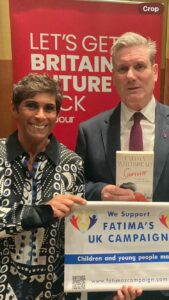
    Others agree and have pledged their support – especially those in the new Starmer administration. “We have a charity dinner on the first night where Lord John Bird, the founder of The Big Issue will speak. Sir Keir Starmer has pledged his support as have members of his government such as has Yvette Cooper. The Timpson family do a lot of work in prisons and they are also on board.”

    what happened to fatima whitbread

    Prisons are very important to the campaign. “I do a lot prison visits,” Whitbread says. “I want to engage with young people so they have something to go to. That’s half the problem for young people when they come out: there’s nothing to come to. Then they realise they’ve got a warm cell, food and friends inside and it’s a wasted opportunity for life. We have these collaborators but who don’t talk to each other, which is a shame. We’re all in it together.”

    Whitbread is one of those rare people who has found a second act in life – and she is pursuing it with the same passion that she did the first. There is a possibility that if we heed her call, we can all hand on a better life to the children of the future.


    To learn more go to: fatimascampaign.com