Tag: Travel

  • Review: Bodysgallen Hall in Wales: ‘luxurious peace’

    Christopher Jackson reviews Bodysgallen Hall and enjoys every minute of it


    It is always a curious thing to arrive somewhere at night: we experience a world without contours and landmarks – a dense dark which really could be anywhere, and yet we also know we are entering somewhere new.

    We arrived in northern Wales just in time for a storm to lambast Conwy, just as storms have been doing for millions of years: Wales always feels like ancient history.

    My main memory is of watching the windscreen wipers rushing back and forth in increasing desperation to rid the windscreen of rain, as if seeking some slightly higher setting than the maximum.

    We negotiated a long winding drive, unimpressed sheep crossing the pathway in their own time to move out of the way of our car. As we emerged from our vehicle, our bags immediately weeping with rain, we scaled some steps and the door peeled back magically: this was the greeting of the avuncular night porter Marion.


    First impressions


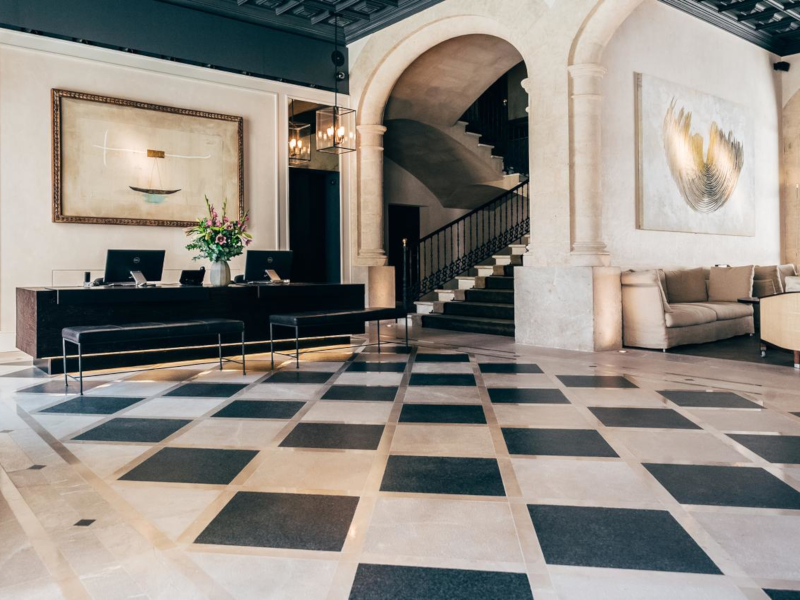
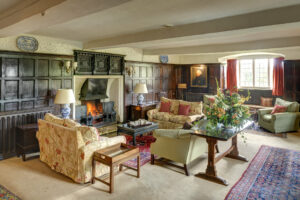
    As I glanced at the décor of Bodysgallen Hall – the fireplace, the 17th century panelling, the venerable portraiture – I thought: “Well, this is a whole better than the M6.” Better than the M6, and indeed better than more or less any hotel I’ve stayed at, as it would turn out.
     

    Reception, Bodysgallen Hall
    Reception, Bodysgallen Hall

    We were shown upstairs to a warm upper room, and learned from Marion that the building was initially constructed as a tower house at some unspecified point in the Middle Ages. Its meaning was to serve as support for Conwy Castle, that marvellously preserved stronghold overlooking the bay: from Bodysgallen you can replay how a signalling system might have worked between this place and Conwy. One imagines Irish ships, a flame of warning, and then the bustle of preparation for whatever came next.

    What came next is what always comes: invasion, conquest, resistance, peace – the known variations of human life. It is, in fact, a marvellous place for a spa, as the history here is so rich you know precisely what it is you’re seeking to get away from.

    I had just enough time before I drifted into sleep to learn that Bodysgallen had once been a place where Cadwallon Lawhir, King of Gwynedd – the name means ‘long-fingered’ – had lived, when a luxurious peace enveloped me, which probably had something to do with not being on the M6 but also something to do with excellent bedding.

    Into Enchantment


    The following morning, the first amazing thing I did in what was to be an entirely enchanted day, was to open the curtains. This isn’t normally a particularly marvellous aspect of life in London: my curtains usually reveal Southwark Council branded bins and houses opposite which look identical to the house I have just woken in.


    At Bodysgallen Hall, the experience is very different: you look out onto an unbroken glory of horticulture, leading onto a still more beautiful and dreamy landscape: that masterpiece of nature which is Wales’ northern coastline.

    It must be admitted that Wales probably gets about three days of delightful sunshine per year: we got one of them, and in late October. The trees everywhere were having their annual rethink, deciding on russets and umbers. Their dying can sometimes seem peculiarly optimistic.

    Our first move was to eat a breakfast of champions in the tall-windowed breakfast room: a full English exactly as it should be done – heartily, and without any unnecessary complications. The food in the restaurant is Michelin standard.
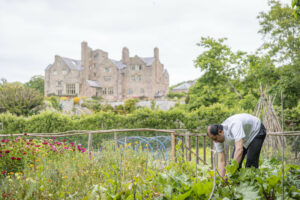
    Kitchen garden at Bodsygallen Hall
    Kitchen Garden at Bodysgallen Hall

    The views from the gardens are not to be forgotten. It was a day of bronze and misty light: Conwy seemed in shadow. The medieval folly can be seen in the distance, and it’s possible to walk up there for a better view of the coastline beyond the Orme and Little Orme headlands.

    The garden has a remarkable history. The original garden design dates from 1678 and is credited to Robert Wynn, son of Hugh Wynn, who was the first of that family to come into ownership of the Hall. A sundial bears that same date 1678. In that year Bunyan published the first part of The Pilgrim’s Progress, and the Battle of Saint-Denis was conducted between the French and the Dutch, with the verdict disputed by both sides, though its result all too clear to the 5,000 or so soldiers who lost their lives.

    In those days, everything was in the Dutch fashion: with high walls which make you want to know what lies beyond them. There is also a topiary maze, and a rose-garden which was still giving out a beautiful scent even in mid-October. The herb garden produces herbs and vegetables which form part of the menu in the first-class restaurant.

    Everywhere you go is beauty – and this was an unusually beautiful day. One could really spend a week walking these grounds, and not be near the end of it, but our time was more limited.

    The Spa

    Bodysgallen Hall is known also as a spa, and so we went there during children’s hour. Newspapers I would not have time to read were laid out in civilised fashion in the reception area.

    The spa itself consists of a warm swimming pool, a jacuzzi, steam room and sauna. My eight year old boy splashed around in children’s hour, which wasn’t quite long enough for him, and one sometimes wishes there weren’t such severe regulations around jacuzzi use when it comes to children.
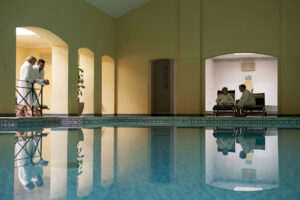
     

    Spat at Bodysgallen Hall
    Spa at Bodysgallen Hall


    After that we walked again up to the obelisk, which was built in 1993 and a landmark visible from all around. It is, like Kafka’s castle, a thing which one nears but never quite gets to. But the trying to get there yields acres of mushroomy woodland, and a sense of blessing at trying to get there at all.

    Lunch consisted of sandwiches taken in the crocodile alcove. Bodysgallen Hall is a place of little nooks and surprises. It is also a place of superb beef sandwiches. My son and I agreed we could quite easily have eaten 400 of them, but had to settle for eight.


    The Land Beyond


    As the afternoon began I sensed Conwy calling. We had been in the castle before on a previous visit: it is an extraordinary place which the first-time visitor will need to do. But the joy of second-time visits is to strike out in surprising directions, and so we decided instead on two churches.

    The first is Llangelynnin Old Church, which is to be found a 20 minute drive out of Conwy up a winding slope. It isn’t where you’d expect to find a church, amid the beginnings of the Welsh hills. We didn’t expect it to be open, but the door had an obliging give when we tried it: inside the side walls date from the 13th century and the impression is of a peace which is worth climbing up here for.

    Round the corner is St Mary’s church which is on the site of Aberconwy Abbey which was founded in 1172. Here, you begin to get to the nub of the matter: two yew trees older than Chaucer preside over the church, and there is information inside establishing the ancient nature of this site, where the Romans also had an outpost. Both these churches are supported by the National Churches Trust.


    This is the infinite nature of Wales: its wonder is to do with deep time, and the many layers it contains. Bodysgallen is the way to explore it and also to experience a luxury which is both classy and not too ostentatious. It is an additional pleasure that to come here is also to support the National Trust, which in addition to maintaining our nation’s heritage, also clearly knows how to run a hotel. A special mention must also go to the magnificent receptionists Catherine and Hayley who were helpful and kind throughout our all-too-brief stay.

    In our second swimming session, my son Beau, determined now and fortified by a fine day in Wales, swam his first length – a cunningly constructed amalgamation of front crawl and breaststroke. We might have arrived at night – but we left sensing a sort of dawn in ourselves.
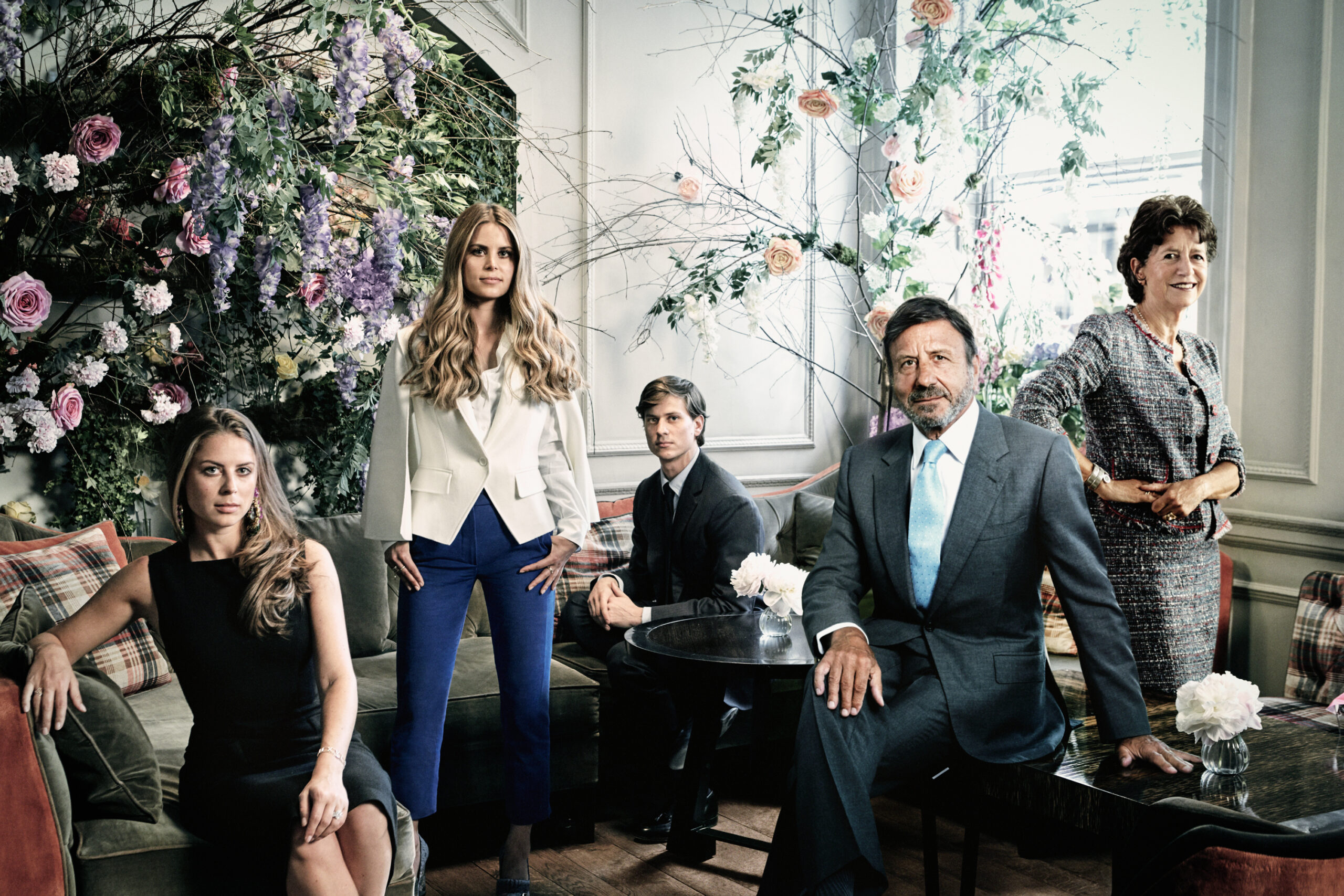


  • Sir Rocco Forte on Mastering a Thriving Family Business

    Sir Rocco Forte on Mastering a Thriving Family Business

    Sir Rocco Forte on running a family business


    The attractions of the hotel industry are the same as they were before the pandemic. Young people should know that hotels dependent on a domestic audience are doing better than hotels that had been dependent on an international market. For instance, my sister has two hotels, the Hotel Tresanton in Cornwall and Hotel Endsleigh in Devon. They have been doing very well. 

    My father, the late Lord Forte, had an enthusiasm for the hospitality business, and a great sense of dedication to it. He was very disciplined in his approach and a man of huge integrity. His view of business was that it’s important to be fair to people, to one’s partners, one’s customers, staff and suppliers – and to treat everyone with equal respect. He was an intelligent man with great charm and the ability to communicate. 

    Looking back, he created an atmosphere – a culture which was very strong and it all to do with him. I try to do the same in the businesses I’ve created. That’s the thing I’m most proud of. However much money and wealth I’ve created, what pleases me is the sense of culture and continuity which you’ll find across my properties. 

    My hope is that there’s a warmth and welcoming atmosphere in all my Forte hotels which you don’t find in all other properties – I aim for that sense of family, history and continuity and I hope my staff see us as family. My sister Olga, and my children too, are all passionate about what we do and care very much about the results and the quality of the service we give to our customers. We have a professional team of people working for us, very good training programmes, development schemes and so on. 

    As to my children, they all have different roles within the business. My daughter Lydia is responsible for restaurants and bars. She has long experience of working outside the company in restaurants. In fact, after her university degree at Oxford, she became a waitress in one of Mark Hix’s restaurants and did a year and a half with him, before being recruited to be assistant manager at the Markham Inn in Chelsea. 

    My second daughter Irene is responsible for the spas, and also worked holiday jobs and spent a year and a half working in Brown’s going through various departments. Having worked on the personal training side and taken special initiatives there, she developed a spa philosophy for us because we’d never had one before she came on board – but then I don’t like them, and don’t use them myself!

    Irene has also developed some organic skincare products off her own bat called Irene Forte, and she’s launching that effectively as a separate business though we’ll continue to have a shareholding in it. My son works on the development side finding new hotels and so on. We’d be especially in moving into America and Paris at some point.

    I’m sometimes asked about the Everyman hardbacks in the rooms. It’s a feature we’ve had in our hotels, but again it’s a family thing. My sister’s really pushed that as part of decoration in the hotels. It’s do with making them feel more homely and more comfortable. The Everyman range has a big cross section of books, and we try and put books relating to the locality of the hotel in the rooms. So for example in the Verdura Resort in Sicily, we have Montalbano novels, as well as Lampedusa’s The Leopard

    I only speak Italian and French. I don’t speak German unfortunately; I’ve been too lazy to learn it. I’ve had a hotel presence there for ten years now and hardly speak a word of it, so I suppose I should be chastised for that. Obviously, if you speak people’s languages you can interact that much better. Although Italy is my second country, my blood is Italian so I have a natural instinct for Italy. I’m thought of as an Italian in Italy, or as a Brit in the UK – or a very strange one! But what makes the hotels work so well is this family culture I’m describing.

  • Discovering the Charm Budapest: Tom Pauk’s Letter from the Heart of Hungary

    Tom Pauk


    I’m writing at our table in the New York Café, Budapest, although to call this ridiculously ornate former insurance hall a café seems at best irreverent. I’ve just polished off a bowl of somloi galuska, Hungarian trifle made with walnuts, chocolate and cream, soaked in apricot brandy.

    I’m here with my wife Rachel in Hungary’s capital visiting friends and relatives. My parents fled the country during the 1956 Uprising, so it’s another opportunity for me to practice my rusty Hungarian, a dauntingly opaque language linked only to Finnish and Estonian.

    Budapest is above all a city of bridges, connecting the commercial side, Pest, with the leafy hills of Buda, dominated by Castle Hill with its steep, cobbled alleys, atop which the imposing Castle, Fisherman’s Bastion and magnificent Matthias Church.

    During your visit you’ll find yourself crossing the Danube often in order to take in this stunningly beautiful city and walk off the calories. The most famous crossing is the “picture postcard” Széchenyi Chain Bridge; designed by an Englishman, constructed by a Scot.


    Pest is home also to Hungary’s 286 metre-long neo-Gothic Parliament (or Országház) in Kossuth Square. It’s well worth the visit and the No. 2 tram and Line 2 metro stop right outside. If you’ve been to Vienna you’ll be reminded of its architectural doppelganger, Vienna’s gothic City Hall.

    Prior to WW2, Budapest was home to one of Europe’s largest Jewish communities. The first anti-Jewish laws had been passed in 1938; Jews were banned from working in government and from editing newspapers, and only six per cent. of lawyers, doctors and engineers were permitted to be Jewish. The events that followed Nazi Germany’s invasion of Hungary in March 1944 need no retelling here, suffice to say that my own family (both maternal and paternal sides) was severely impacted.

    The Dohány Street (or Great) Synagogue (closest metro stop Astoria), built in an Arabic-Moorish style (check out those Alhambra-like domed towers), remains Europe’s largest with a capacity of 3,000 worshippers. A visit (guided and private tours can be booked on-line, or just buy a ticket and wander around) takes in the synagogue itself, memorial gardens and the Hungarian Jewish museum on the site of the house where Theodor Herzl was born. Especially poignant, the dramatic Emanuel Tree (or Weeping Willow) Memorial, which has the names of thirty thousand Holocaust victims inscribed on its metal leaves.

    Dohány Street marks the border of the former Budapest Ghetto within Budapest’s District 7, an area now popular for its specialist coffee shops, falafel bars, craft beers and quirky shops. While there, admire the fusion of Judeo-Art Nouveau of the orthodox synagogue, and stop off for a superb flat white at Stika.

    Do also visit the Cipők a Duna-parton (or Shoes Memorial) roughly half-way between Parliament and Széchenyi Chain Bridge on the Pest embankment. The sixty pairs of iron shoes, boots and sandals commemorate the hundreds of Budapest Jews lined up and shot into the river by the Hungarian Fascist Militia in December 1944. My father, then only eight, was one of those rounded up for execution. Mercifully, he was able to run away and avoid recapture.

    Budapest is famous for the wellbeing properties of its waters. The city sits on a geological fault line with hundreds of natural springs jetting skywards. Following their conquest of Hungary in 1526 the Turks built a number of Hamman-style thermal baths, three of which, Rudas, Király and Veli Bej, operate today. However, for the full spa experience, head over to either of Gellért Baths (in the fabulous Art Nouveau Hotel Gellert on the Buda side), and Széchenyi Baths (the largest spa complex in Europe, and especially wonderful in winter) for a full range of spa treatments, and for mineral-rich indoor and outdoor swimming.

    A quick mention of Hungarian politics. Hmm. Hungary continues to struggle with … let’s politely say idiosyncratic views, likely a result of being subjugated over the centuries by successive invaders (Ottoman, Austro-Hungarian, Soviet) and now struggling to assert its own identity. Happily, as a visitor you’ll be oblivious to the country’s growing political radicalisation on the global stage, and unless you’ve a good grasp of Hungarian you’ll miss the inflammatory political messaging on posters and billboards.

    Where to stay? You could check in to one of the global 5* brands (Four Seasons, Kempinski, Ritz Carlton and others) but Budapest also has an abundance of boutique hotels and Airbnb properties. On one memorable visit Rachel and I stayed at Brody House,  a former artists’ salon, now quirky boutique hotel, in which each of the ten rooms has been decorated by a different artist.

    If you’re staying for more than a long weekend, a half-day in the small baroque town of Szentendre along the banks of the Danube (40 minutes on the HÉV H5 local train from Margit Bridge) provides a wonderful escape from the bustle of the city on a hot summer’s day. With its narrow cobblestoned streets, art galleries, coffee shops and churches, Szentendre is home also to the Szamos Csokoládé Múzeum (Museum of Chocolate).

    Your waistline won’t thank me but trust me, you will!

    On the subject of food (I keep coming back to that, don’t I), traditional Hungarian restaurants abound, and with the forint weak against Sterling and US$ you’ll find prices generally low by say London standards. I’d suggest avoiding the glitzy eateries along the Pest embankment and up on Castle Hill in favour of more authentic dinning venues like Café Kor, Két Szerecsen and, for a modern take on Hungarian classic cuisine, Szaletly. Reservations are always wise; Budapest is busy all year round.

    More Budapest top tips:


    ABSOLUTELY take the number 2 tram (Pest side) on its stunningly scenic 20-minute meander from Közvágóhíd to Jászai Mari Square at the Margit Bridge. For 450 forint (under a quid!) you’ll take in many of the major Budapest landmarks. When you get off, walk half-way across the bridge to Margit Island, a one-kilometre green oasis equivalent to say Hyde or Central Park. It will take you a pleasant hour or so to circumnavigate.

    Download the BudapestGo app to purchase e-tickets for bus, tube and tram. Alternatively, buy books of ten from ticket machines (4,000 forint or roughly £8.50). A word of caution: ticket inspectors are ruthless and abundant, and all tickets (paper and digital) must be validated in a designated machine to avoid incurring a hefty penalty fare.

    Download the Főtaxi taxi app,  Budapest’s cheap and reliable equivalent to Uber.  Főtaxi is the official provider of taxi services to and from Budapest Airport. Fares are transparent and reasonable. Bolt also operates in the city.


    Budapest is a walker’s paradise (wear comfortable shoes) and is perhaps even more beautiful after dark!


    ***


    Back at the New York Café our waitress has returned. Would we like the bill, she enquires, her eye on the growing queue of impatient faces that now snakes all the way back to the main entrance. Not just yet. Could we see the menu again? That raspberry and pistachio tart looks rather tempting.

  • Scenic Cruises CEO Richard Twynam: “Working in travel is an opportunity to break down prejudice

    Christopher Jackson meets a charismatic MD with a profound love for the life opportunities that come with working in travel


    I must admit that I didn’t know much about cruises until I spoke to Scenic Cruises head Richard Twynam. Twynam is affable and enthusiastic – he strikes me, even at one remove over Zoom, as a man unusually happy in his job: ““I work in travel because I went round the world when I was 18 in 1990,” he recalls. “That was before Internet and mobile phones and I knew within weeks of being in Australia I wanted to spend my career in travel .”

    Over time he would specialise in the sector he has come to love, and in which he is one of the leading figures. “I fell into cruising in 2010 having seen a managing director’s job for a Virgin brand advertised in The Sunday Times and I got the job: I was one of the youngest managing directors at Virgin at the time. In those days cruising wasn’t as mainstream as it is now.” Twynam stayed at Virgin for three years before running a brand for Royal Caribbean, a role which he began in 2013 and which you guess added depth to his experience.

    Of course, in 2020, everyone was about to experience the great shock of the pandemic. But after a few years taking on advisory roles in the industry, Twynam was approached in 2022 for his current role: “It was too good an offer to say no,” he tells me.

    So how does his current role divide up? “I live in Surrey and the office is in Manchester – I’m passionate about that city, it has such great energy. I spend three days a week there, meeting the team, looking at the numbers and being very involved with the operational side.”

    Scenic Cruises is an owner-founder business and so it’s crucial for Twynam to have a good relationship with Glen and Karen Moroney, which he certainly does. “Glen and Karen started the business 36 years ago,” says Twynam, “and they’re rightly very protective and proud of it. If they don’t like something, they’ll tell you – but more generally they’re excited about the benefits of the new yachts.”

    What you most feel when talking to Twynam, is the notion that cruises are an exciting frontier in the world of travel. “Cruising has evolved massively not just in the last decade but over the past 20 years,” he explains. “The great thing is there’s a cruise for every one – for every taste or price point. If you want a low key cruise you can do that, but if you want to go paddle-boarding on a cruises you can do that.” Then comes what will to many be his clinching argument: “You only have to unpack your suitcase once and wake up to a different location each day. That’s why 2023 is likely to be a record year for cruising.”

    It does seem as disaster-proof as a holiday can reasonably get: a mixture of luxury and adventure which will appeal to many. The company has two brands: Scenic Cruises and Emerald Cruises.

    The flagship of the company is Scenic Eclipse. “We call that the world’s first discovery yacht,” says Twynam. “It means you go to the wildest places on earth in complete luxury. For instance, you can go to the heart of Antarctica, and explore all that but then come back at the end of your day to a luxury yacht experience. Above, you have a helicopter and below you have a submarine.”

    The Emerald cruise ships meanwhile are, says Twynam, “slightly smaller, and designed for warmwater coastal cruising. The ships looks like a James Bond villain’s favourite yacht, with beautiful sleek lines. They’re designed for coastal cruising in Croatia and Greece, and can winter in the Caribbean.”

    So what sort of luxury do customers experience on board? “Scenic Eclipse has eight restaurants, a spa, and a watersports platform on the back with all the toys,” explains Twynam. “Emerald has the same. You’ve also got a butler, a whisky bar with over a hundred scotches. We’re reassuringly expensive. Of course you can spend £150,000 by taking the main suite on the Eclipse, but equally Emerald is £3,000 per person for the Grecian cruise.”

    So what is it Twynam loves about cruising? “It’s a gentle way to see the world,” he says without missing a beat. “You’re gliding down the river watching the world go by. It’s not an intensive holiday. We’ve got these big lounges and it’s a marvellous thing to just watch the world go by. The ship is your conveyance to see the land; it always amazes me how as human beings we’re drawn to the water.”

    That this is true is reflected in the demand for the company’s experiences, and therefore the size of the company. Scenic Cruises employs 120 people. “That covers all the facets of running a business: financial, commercial, marketing, digital, reservations, and sales,” Twynam explains. “A high proportion of our workforce is under 30; many are under 25. A lot of them have a passion to work in travel, and many have done degrees or been to college. One of my commercial analysts has got two more degrees than I’ve got. There are lot of opportunities if you want something easy to learn and want to learn quite quickly. But if you have a particular skillset – whether that be in social media, studio or marketing – we have roles there too.”

    And, of course, there’s a whole different set of employment opportunities around the ships themselves. “Working on a ship is a glamorous thing to do. We have a British submarine pilot on Scenic Eclipse. You’ve also got culinary roles, hotel function, guest service, tour leading, and many other things.”

    Of course, all these roles also attract travel perks. “I’m going on one of our yachts tomorrow,” he says, enthusiastically. “We also want out staff to benefit from friends and family offers – we want it to be clear that there are major benefits to working in the travel industry.”

    Twynam adds that there other, deeper benefits to a career in the sector. “A lot of the younger guys who work for us recognise that the more they travel and understand the world, the more it’s an opportunity to break down prejudice and misunderstanding. They’re passionate that if we live on this planet we should understand everyone’s cultures. I’ve worked in the travel industry for 29 years and had some amazing life experiences.”

    And the challenges? Twynam doesn’t mince words. “Of course, travel by its nature is highly operational and you have to deal with that. We all know what can happen: the plane gets delayed or the hotel booking gets cancelled. One of the vagaries of cruising in Europe is that you get high and low water which can be challenging for different reasons. On the high seas, you have the weather to contend with – and that’s before you get to the question of strikes and so on. But in the last years we’ve had the tsunami in Japan, and the ash cloud over Iceland. As a sector we’ve become extremely experienced and dealing with things.”

    And with that he says a genial goodbye, no doubt pleased to be heading on his cruise tomorrow, leaving me to write about him in the cold March weather. I am briefly sure which of the two of us has the better lot in life.


    For more information go to scenic.co.uk

  • Study shows best, worst countries to freelance

    Patrick Crowder

    The freelance life is longed for my many, achieved by some, and not desired at all by others. If you like structure, stability, and clearly set tasks, then freelancing is probably not for you. However, if you wish to benefit from the creative freedom, variable schedule, and healthy work-life balance that freelancing can provide, then it is important to know what opportunities await you around the world.

    The financial tech company Tide has drawn up a list of the top ten countries for freelancers based on a variety of factors: cost and speed of broadband, legal rights for freelancers, cost of living, gender pay gap data, searches for freelance work and availability of co-working spaces per 100,000 people, and the happiness index.

    Singapore won the top spot on the list due to fast, affordable internet and numerous co-working spaces, though it leaves a bit to be desired in the cost of living and happiness index departments. New Zealand came in a very close second, with its advantages being strong legal protections for workers, a good happiness index score, and equality of pay.

    In third place, Spain is much more affordable than the other top countries and has a low gender pay gap. However, it may not have the same breadth of opportunity in the freelance sector as other countries.

    The rest of the list is fairly close-matched, with the main deterministic points being cost of living and searches for freelance jobs. In order, Australia, Denmark, Canada, Switzerland, Lithuania, Sweden, and Ireland make up the remaining seven spots. 

    Tide also found the worst countries for freelancing. Japan had the lowest score due to few legal protections for workers, low interest in freelancing, and a problematic gender pay gap in many industries. China was named second-worst due to a poor happiness index score and little interest in freelance work, though it is affordable. Italy was next, primarily due to slow internet speeds and weak legal protections in the country.

    The Netherlands showed the highest interest in freelancing, with 1,305 searches made for freelance workers per 100,000 people. Denmark took the top spot on the happiness index, and India was first for affordability.

    Wherever you choose to work in the world, freelancing is never free of its faults, but for many, the freedoms afforded to freelancers outweigh the instability that they can sometimes face. Additionally, one of the lower-ranked countries on this list could end up being the perfect fit for you depending on your field and preferred style of living and working. Therefore, take this as a guide to assist in your research, not determine your future home. By recognising the advantages and disadvantages of each location and comparing them to what your personal preferences and expectations are, you may be able to find your dream freelance destination.


    Read about how Georgia Heneage navigated the world of freelancing during the pandemic here

  • The highest paying travel-based jobs

    Patrick Crowder

    For many people, getting paid to travel is the dream. For many, it also seems unattainable, but that isn’t necessarily the case. While some travel-friendly jobs are quite obvious, others fly under the radar, so we’re taking a look at research from Absolute Digital Media (ADM) which shows top roles for the aspiring jetsetter.

    The highest-paying profession which involves travel is architecture. Architects earn £43,729 per year on average, according to ADM. Not all architecture jobs require or even allow for travel, and many are office based. However, the nature of the profession means that there are roles available in overseas construction monitoring, on-site design, and other overseas roles. While architecture is no guaranteed ticket to travel, the roles are out there if you look for them.

    The nice thing about being a qualified bartender is that, largely, the work doesn’t change no matter where you go. Sure, some countries will have different license requirements and regulations, but at the end of the day it comes down to mixology, people skills, and common sense. Bartenders in Australia make around £31,947 per year, so that is a common destination for qualified mixologists looking to live abroad. In the US, bartenders can make up to $28 per hour. Of course, there are bartending roles in nearly every country, so the options are plenty and the final choice of country will come down to personal preference and experience.

    There are a few obvious choices when it comes to travel jobs, but that does not mean that these options are any less attainable for those looking to escape the desk. One (which is fairly close to home for this writer) is journalism. Journalism, depending on publication and reach, can take you all over the world meeting interesting people and having irreplicable experiences all while getting paid for it. Journalism is by no means an easy job, but whether your expertise is in radio, film, research, or the written word, there are probably travel opportunities in your future. Journalists earn £25,910 per year on average.

    Cruise ship staff, Event Planners, Freelance Travel Photographers, and Flight Attendants also live lives full of travel, and they all make somewhere between £23,000 and £25,000 per year. It all comes down to where an applicant’s strengths lie; Some people are made for freelance work, while others prefer the structure of working for a company. Some people love planning events and networking with people, while others prefer solitary, self-dependant work. Some people are terrified of flying, and even more have rough stomachs on the water. With the wide variety of roles available, the choice is yours, so be aware that getting paid to travel can be much more than a daydream.

    Source: https://absolute.digital

  • Mr and Mrs Smith Founder James Lohan: Journal of a Voyage Round My Room

    Mr and Mrs Smith Founder James Lohan: Journal of a Voyage Round My Room

    As the travel industry continues to confront headwinds, James Lohan tells us about what the life of a travel executive is like during a pandemic. First published in February of 2021.

    Monday 1st February

    The overnight dreams that preface my working week are of a world where travel has made a triumphant return (flying, literally) and the pandemic is yesterday’s news. Then I wake, read the actual news on my Kindle, and wish I was still asleep. Turmoil in the US, the NHS at breaking point, flooding across the UK…bleak doesn’t really do it justice. I’ve been lucky enough to have escaped the virus and many of its direst repercussions. But for someone who spends most of his waking (and sleeping) hours either dreaming of or actually in far-off destinations, the enforced domesticity of lockdown is a perverse kind of cruelty.  

    After digesting much of the daily news cycle, I check the company’s daily booking stats. Unfortunately, these usually confirm that I should have opened that article on Brexit – another car crash that would’ve made for happier reading. Then I’m up and out to walk Ziggy, our working Cocker Spaniel, to clear my mind. Or I consider filling it with yet another inspiring podcast to make me feel like I haven’t achieved enough lately. Gunnersbury park is fine but I’m starting to feel like a lion at Longleat: I want some bigger plains to roam.

    After two cups of coffee, a refreshed To-Do list and an inbox clean-up, it’s straight into a “thrilling” ops-board meeting to discuss cancellations, amendments and furlough rotas (again). After that, it’s my direct team catch-up to decide what can get done during their limited flexi furlough hours. Furlough has been a great financial help but it’s hard to run the business when your team is so part-time. Funny how we’ve come to view the scheme: it used to be a dirty word, some colleagues interpreting it like they’d been benched. Others have loved it, seeing it as time to rest and contemplate their futures. By now, though, everyone understands how important it is to help us survive the next few months.

    Tuesday 2nd February

    Tuesday mornings it’s yoga, 8am, to keep my ageing joints moving in the right direction – even if right now the business isn’t. On this particular Tuesday we’re bracing ourselves for another surprise announcement from No.10 Sesame Street, before which we hold our breath and wonder what Big Bird Boris and Kermit Hancock are going to spring on us next. I have no problem with lockdown – an absolute necessity in response to the crisis. What’s so difficult for us is the lastminute.com nature of the decision-making that’s causing chaos for agents like ourselves who have to pull rabbits out of hats as we yet again cancel or amend our members’ holiday plans – with less than 24 hours’ notice. It’s a nightmare, too, for hoteliers who might be rueing that enormous food order and wondering, for instance, what they’re going to do with 200 turkeys. But while it’s soul-sapping for our team, I’m proud of the way we’re doing our very best as a business to keep our members and hoteliers happy.

    Wednesday 3rd February

    The thing I do like about working from home is the commute: very convenient indeed. That said, it’s an odd sensation when the day’s big ‘outing’ is a shopping trip to the local greengrocer and butcher in Chiswick – in a mask and at a safe two-metre distance. But cherished time away from my desk it has most certainly become. Wednesday also means a meeting with my main team to discuss sustainability and what we’re doing to integrate such practices throughout the business. We’ll shortly be announcing our efforts in supporting the Blue Marine Foundation and the World Land Trust, two vital conservation charities with goals to protect the earth’s precious assets on land and sea. And we’re adding a more dedicated sustainability section on each page of our 1,400-strong collection to help our members find and book the planet’s most forward-thinking hotels. I’m certain that an important by-product of the pandemic will be people’s greater awareness of the climate crisis and how our travel choices impact it.  

    Thursday 4th February

    Yoga day two, where I try to pretend I’m on a beach in Bali doing my downward-facing dog, but the rumbling of the E3 bus keeps breaking my shavasana in our front living room where I’m practicing. It’s nearly the weekend, which as a concept begins to mean less and less – just with fewer meetings and emails. What to do with the kids to keep them off their computers is the weekend challenge, and explaining that we can’t see Grandma and no you can’t have a play-date and yes we will be walking the dog again and yes it will be in the same location as yesterday…it’s tough for them. Home-schooling and even just making three meals a day for us all is not an easy gig. I never thought I’d miss my Pret a Manger lunchtime sandwich so much, which was just a few minutes’ walk from our office in Shepherd’s Bush.

    I sit next to my wife (our CEO) in our home office and it’s a constant juggle to agree on who’s speaking or who’s muting during the various online meetings so we don’t create feedback for the other poor Zoomers on our call. We’re both going slightly mad as we’re also forced by proximity to hear each other’s individual calls, and the ‘how’s-Covid-working-out-for-you?’ chat that precursors every conversation nowadays. That said, a couple of very nice new partnership meets means the day has been a success, and all wins – however big or small – are gratefully received right now.

    Friday 5th February

    Thank God: the day of wine. I don’t drink during the week, so Friday has become a celebration of, well, my midweek abstinence. And as I’m drinking a little less, I’m spending a little more on each bottle – and I can’t wait for Friday to come around to pop open my next treat. Work slows on a Friday, too, as so many of the team is on furlough, so it’s a good time to tidy up loose ends so Monday feels a little less daunting. Our flight has just been cancelled for February half term to what would have been our first curation trip / holiday (always mix business with pleasure) in nearly a year. Gutted. It gets to midday and I’m already thinking about cracking open the wine but I still have a couple of meetings left so better hold off. 

    Friday is also when WhatsApp group texts with mates seem to explode into life, gaining more momentum throughout the day as people clock off one-by-one and begin mixing their G&Ts. How strange that socialising has been reduced to this, although the novelty has very much worn off by now. Tentatively, we all discuss getting together for a group holiday in a villa when lockdown ends and I’m quizzed on predictions for travel opening up again and where best to go.  There’s no doubt in my mind that 2021 will eventually end up being a good year; I just wish we could get on with it sooner. Patience has never been the trait of an entrepreneur – so I’ll just have another glass and remind myself: we’ll get there. Cheers.

  • Review: The Hotel de Russie in Rome and the Hotel Savoy in Florence


    George Achebe


    It is an aspect of the absurdity unleashed by the pandemic that work sectors experienced contraction, stability, or even expansion, according to their relationship to human touch and proximity. It is as if someone had madly gone through society punishing only people over six feet six, or those with red hair.

    But though it was a pretty safe bet being an air pilot or an events manager before Covid-19 had its way with the world, I still think the reversal experienced by the hotel sector counts as the most symbolic. Most of us never saw an empty aeroplane – we saw empty skies. And events moved online.

    But we all cancelled our holidays, and many of us can easily imagine an empty hotel. We were also all too familiar with the interiors of our own homes. Hotels are in fact symbols of power, and nothing quite so brought home the strangeness of coronavirus than their sudden lapse into emptiness, and the surrealness of furlough.

    They had a particularly powerful advocate for staying open in the shape of Sir Rocco Forte, who has been vocal in Finito World and elsewhere about government policy which he views as far too restrictive. The mask has had no greater foe, and social distancing no greater cynic than Forte. But then most people would be cynical of any government regulation which cost them £100 million overnight as this one did.

    Once the pandemic began to lessen a little, I realised it would be a missed opportunity not to return to Italy, the heart of the Forte empire, to see how his two great hotels – the Hotel de Russie and the Hotel Savoy – had fared in the interim. There was more than curiosity at work here: I’ve always loved these hotels and sometimes feel I am simply marking time in London, waiting to go back to them.

    Rome is, in its way, one of the most powerful nouns on the planet. It seems almost to have the same force as those large abstractions: love, peace, truth, goodness. It connects back to a former time – or a series of former times – which seem to contain people who were better and wiser then than we are now.

    Perhaps that’s never felt more the case than to return there now after the pandemic. Our forebears lived daily with the thought of death; it can sometimes seem as if we have sanitised it. It has also to be said that nowhere I’ve been in the world has quite such a passion for regulation as Italy. Whether this is an inheritance of Catholicism, or a more mysteriously national appetite for rules, I’ve never been able to decipher. But it’s definitely the case that if in Italy you walk into a sandwich shop and forget your mask for even a moment you run the risk of being accosted not by an owner but by a customer. This is a noticeable difference in cultural mores which no doubt must vex Forte himself.

    To look at Italy politically there is a sense that it has fallen on hard times, with debt levels not far off Greece’s, and significant poverty especially in the South, where a shadow economy may or may not be making life more supportable for young people, depending on which economist you speak to. I sometimes think that the beauty and the significance of Italy’s history somehow excuses it from doing anything in the crucial realm of the present. But I forgive it this as everything else: I’ve never been unaware in Italy that this is a country which has fallen on somewhat unhappy times since the time of Michelangelo; but then I’ve never minded much because I’m in the country of Michelangelo.

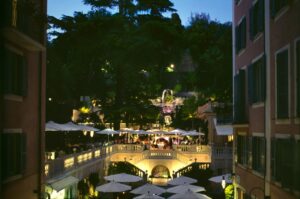
    The Hotel de Russie is right under the Borghese Gardens, next to Piazza del Popolo. That makes it reasonably near the Spanish Steps and about a half hour walk from the Coliseum and the Forum ruins. It’s a hotel so good it makes you delay your sight-seeing a little – and that’s the case even in a city where you know you’re ridiculously up against the clock on a long weekend, since there is more to see here than can be seen in a lifetime.

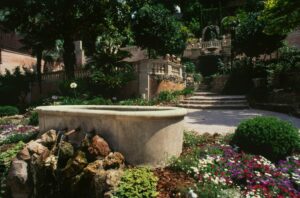
    The Hotel de Russie’s Secret Garden sweeps upwards in attractive tiers, almost as far as the Borghese. It is a place of white climbing roses, yews and palm trees. Water fountains trickle on each tier, meaning that breakfast is a calm affair. Several years ago, they used to serve delicious honeycomb as part of the buffet, but that has now been jettisoned due to the pandemic, a sad legacy.

    The hotel has a star-studded history. It was here that Pablo Picasso and Jean Cocteau stayed when collaborating on Palade, the first of the so-called Ballets Ruses, a production which counts as the first Cubist ballet. The hotel is justifiably proud of this heritage, and has a Stravinsky bar, and a Picasso suite. On the top floor there is a vast apartment with a sauna in it where the cast of Ocean’s 11 reportedly stayed.

    On our first day, exhausted by EasyJet’s tendency to demand farmers’ hours of its clientele, we were jolted into wakefulness by the magnificence of the Coliseum. Vaccine passports were on use in that attraction – and in all the others we went to – and seemed to work well.

    Inside, you feel dwarfed by the scale and ambition of what you find, and overwhelmed by the evidence of a civilisation with more intellectual force than ours. It is a strange thing that our society for all its ingeniousness seems to lack some quality which theirs had. Perhaps the Roman confidence can only come once to a species, but that doesn’t mean we can’t learn from it, and enjoy a touch of nostalgia along the way. Of course, in the process we must be careful not to turn a blind eye to the brutality of gladiatorial combat and slavery. But the fact remains: there is something about being in Rome which makes you want to do something big with your life, and why not begin that today?

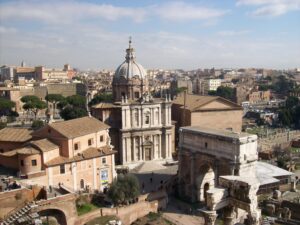
    The ruins of the forum will forever remain one of the sites of the world, especially at sundown, when they are filled with a melancholy light which knows all about the rise and fall of civilisations. It is futile, by the way, to search here for the place of Julius Caesar’s assassination since that took place around a half kilometre away in the Largo di Torre Argentina.

    What are we searching for among these ruins? It seems to relate to some lack in ourselves which is betrayed by our glass architecture, our world of consumption, our frenetic pace. It is said by John Buchan that the peoples of the past were all storm and sunshine – that is they lived next to the bad in life and so experienced a heightened sense of the good. Anyone who even glances at the Pantheon knows that it may as well have been created by aliens: nobody alive, and least of all our modern architects, seems to know how to do this.

    If Rome makes us feel as though we have become somehow pale, then this is the case too when we compare ourselves to the Renaissance. Rome isn’t necessarily the best place to understand the Renaissance, partly because Raphael and Michelangelo dominated all the commissions. Besides, much of what they did is squirrelled away in the Vatican, either in rooms the public can’t access, or in places the public accesses too much. Even the Sistine Chapel feels like the expression of one man’s slightly cantankerous achievement.

    Instead, to understand the Renaissance in its breadth and depth, you have to go to Florence, and fortunately the Rocco Forte chain have created the excellent Hotel Savoy there, this time just off the Piazza del Repubblica.

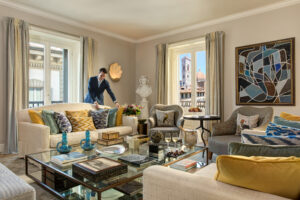
    The suites here have been enlarged and the number of them reduced since I was last here in 2017, meaning that the customer has a roomier experience. The Presidential Suite in particular is one of the finest hotel rooms in the world with excellent views of Brunelleschi’s Duomo and Giotto’s Campanile.

    Giotto didn’t live to see his bell-tower completed, but Italy is a reminder that the work we do, if it’s any good, will be taken on by others. The Renaissance is a relay-race: we think of it as a time of great individuals when really it was a team effort. This is perhaps best encapsulated by a young Leonardo da Vinci’s role in raising the great gold ball on a pulley system to cap Brunelleschi’s lantern on the cathedral. Years later, whenever he needed to summon up courage for the next big task he would recall that day: it’s for others to show us what is possible, and for us to enact that on our own terms.

    Italy asks that we summon up courage in our own lives. By hosting both the Roman Empire and the Renaissance it reminds us that a country can be great more than once – and it does so even in its present condition when so much else has atrophied.

    The great joy of Florence is in its churches. It is vital not to miss Donatello’s pulpits in San Lorenzo, and while you’re there not to forget to see the Laurentian Library whose steps were designed by Michelangelo. Tourists should also know that these are on separate tickets and by separate entrances, and not always open on the same day. If you go to Santa Croce make sure to visit the Pazzi chapel and its adjoining courtyard: they are places of rare peace and tranquillity.

    The city has suffered during Covid, as is to be expected when the country bore the brunt of the earliest part of the pandemic in Europe. In particular, a favourite restaurant Il Menagere had not yet reopened when we were there. Meanwhile, the Orsanmichele was permanently closed when we were there at the end of 2021 and still operates reduced opening hours at time of publication.

    But world historical cities like Florence have in-built resilience which stems from their perennial desirability. Boccaccio begins his book The Decameron with a description of the Black Death and how it affected his contemporaries. You can still visit today the Santa Maria Novella where that scene is set, and I hope people will still be able to do so hundreds of years from now.

    Inside the church you can see Giotto’s Crucifixion, and Masaccio’s Trinity which more or less single-handedly started a revolution in art which still governs the way we see today. When the Black Death came, few would have imagined that the world was on the cusp of two hundred years of unprecedented achievement across every area of human endeavour.

    Perhaps this is ultimately what Italy has to say to us now: that any civilisation worth its salt is in it for the long haul. And although the Rocco Forte chain has had a difficult pandemic, one senses that these magnificent hotels will bounce back also. The good things in life always do because ultimately that’s what people want.


  • How the travel sector handled Covid-19

    How the travel sector handled Covid-19

    By Lana Woolf

    There is a phenomenon called Stendhalismo named after the French novelist Stendhal, which refers to the act of travelling abroad and then swooning before objects of great beauty. It was in Florence where Stendhal – born Marie-Henri Beyle – first experienced an almost hallucinatory sense of awe at the Italian experience: ‘I was in a sort of ecstasy, from the idea of being in Florence,’ he wrote, ‘close to the great men whose tombs I had seen. Absorbed in the contemplation of sublime beauty.’

    Two hundred years later, we have a new version of this phenomenon – but altered to reflect our new pandemic reality. It might be too flippant to call it Covidismo, but it can entail pausing in our UK homes and suddenly having a flashback as to all the travelling we did, which we now doubt we’ll ever do to the same extent. For those of us who were lucky enough to travel widely, a rhythm we hardly knew we had established has been suddenly suspended. Never again will the airport be quite so routine; nor shall we return home to find ourselves gearing up for the next trip with quite the same regularity.

    Time is now marked in a different way. What else to do then, but sit at home and dream – of Florence, of New York, of Kyoto, of all the places that we have been to and loved. In our best moments we can feel grateful we had what we had; but it is also possible to swoon Stendhalstyle in our kitchens and feel bereft at what have been so arbitrarily deprived of.

    Balearic Blues

    But what if travel is your livelihood? Like a career in aviation it would have seemed at the start of the year the safest of all sectors – and perhaps few countries would be safer to work in than that perennial favourite Mallorca.

    Sometimes during Covid-19 I have thought back to this island of peace and lemony light, where Robert Graves lived out his years, and where Chopin and George Sand visited. It was surreal to imagine a touristless summer there.

    Miguel Feliz is the general manager of Sant Francesc, a five-star hotel in the centre of Parma. ‘It’s been a tough and challenging year for all of us, especially those in the hospitality industry,’ he explains. ‘We are extremely lucky that Sant Francesc is a well-established, year-round property and Palma is a popular destination even in the cooler months,’ he explains, adding that he ‘remains optimistic that we will begin to see some normality from September onwards, which is just in time for my favourite month in Mallorca.’

    If the guests return – and at time of writing the government’s muchcriticised quarantine policy has made travel an anxious business – then guests will find a subtly altered hotel. ‘We have put extensive new measures in place by following the recommendations and directives from the Spanish National Health Services, as well as the World Health Organisation, in order to ensure the wellbeing of our guests and team members,’ Feliz tells me. ‘These include everything from twice-daily temperature checks for all staff as well as guests on arrival, to mandatory use of masks for our team – and masks and hand sanitizer being readily available to guests at all times. Extensive new cleaning programmes have been put in place for guest rooms and all public areas and social distancing will be encouraged wherever possible.’

    As workable as that sounds, it was also a tough time for the company in another sense when the owners had to address the question of the expected opening of a sister property Can Ferrerata in Santanyí. ‘We decided to postpone until March 2021 and take our time, in order to give it the opening it deserves.’

    This hiatus has been painful – and of course Sant Francesc is just one story among thousands globally where hotels have had to pause, pivot, or just take the financial hit. The effect on the hotel industry has been seismic, as any brief walk through central London immediately attests: one thinks of the empty forecourt of Buckingham Palace, or the nowunphotographed lions of Trafalgar Square.

    But travel is a vast industry with numerous professions attached to it, which  have experienced the knock-on effects of the virus. From aviation, hotel events, to travel PR, and travel journalism, it’s a sector full of economically significant subsets.

    I catch up with Cathy Adams, who is the travel editor at the Independent. She’s on maternity leave at the moment, and says she’s grateful to have a break from breast-feeding to share her thoughts with me. For her, travel journalism was already in a state of ruction pre-Covid. ‘Even before coronavirus swept the globe, travel journalism was changing fast,’ she tells me. ‘We were working to promote underserved destinations rather than those afflicted by overtourism; and the climate crisis had made us rethink how we spoke about travel and holidays to promote more responsible tourism. Then came coronavirus, which in many ways has accelerated the issues many travel journalists have been grappling with in recent years.’

    So is travel journalism still a career you can go into? The answer is yes, but with caveats. ‘Travel journalism, when, like travel itself, it returns to the masses, will continue to become more thoughtful: expect more coverage of British holiday spots as travel restrictions drag on and we want to inject more money into our domestic tourism market. Plus, the coronavirus has highlighted just how risky travel can be – in terms of spreading the virus, and how quickly border closures can stop travel; the world will no longer be seen as a free-for-all, and journalism will take this into account when deciding which destinations to talk about.

    And will hotels still feel able to host significant numbers of journalists in order to make sure they get their copy? Adams explains that ‘editorial will remain an important part of a destination’s marketing plans, but I imagine with the focus on fewer trips and a smaller tourism market generally, they won’t be quite the all-out affairs they once were.’

    How PR went into ER

    Every one of these hotels has its marketing budget and there are many PR firms around the world earning their crust by promoting them. One of the best of these is Perowne International run by the redoubtable Julia Perowne.

    Perowne recalls for me the bizarre events of February 2020: ‘I realised in February that the situation was getting more serious and that its impact would spread outside China. In many ways the hospitality industry was one of the first sectors impacted and sadly will likely be the last.’ It was a fast-moving situation, she says. ‘We have clients all over the world and several beautiful hotels in Italy which was impacted first in Europe. We were shocked by the speed and severity of its development there and could see quickly that this would not be contained to one country. In early March we started to analyse the situation in more detail and prior to lockdown actually went to our clients and offered them significant fee reductions to help them through this tough time.’

    Overnight, the nature of the job changed: ‘The most significant thing has been the emotional support the clients have needed rather than just the practical,’ explains Perowne. ‘This has been a devastating time for the industry – businesses that have worked so hard have been hit badly and there’s definitely been a need to help people emotionally get through this. In addition, we have needed to look ahead to the future and ensure that when we come through this, the clients are looking as desirable and as relevant as ever. The consumer’s values have changed over the last few months and we need to ensure that we are prepared for that.’

    Perowne was forced to take advantage of the furlough scheme (we’re hopefully in the process of reinstating them’), though she would have liked to have seen a different scheme in place. ‘It would have been great if the government could have subsidised salaries and allowed people to still work if they could as they did in Ireland,’ she argues. ‘We desperately needed all-hands-on-deck but simply weren’t getting the fees from the clients so we had to utilise the scheme.’

    Echoing Adams’ observations about journalism, Perowne says that Covid-19 ‘will simply accelerate the changes that were happening,’ adding that ‘we have to be compelling storytellers.’

    Tricky Calculus

    Perowne praises the agility of her clients. One of these is the Cambridge University Arms, where Ian James, the general manager, approached the crisis in a highly community-minded way. Although he closed the hotel on 22nd March ‘with heavy heart’, he explains that ‘it was also important to us to help alleviate the strain on our NHS.’

    As the city’s oldest continually operating hotel, the team was minded to take the long view. ‘The property has truly stood the test of time – living through two world wars, the fight for woman’s rights and in 1665, the University Arms temporary closed its doors due to the Bubonic Plague,’ James explains. ‘Isaac Newton had to work from home and he used this time to develop Calculus and the theory of Gravity. Therefore, we remain positive that we will soon put this latest travail behind us. As Solomon said, “This too shall pass”.

    It’s also a hotel which has been caring toward its staff and the people in the immediate locality. ‘As the hotel closed and we were heading into lock down, our main concern was the wellbeing of our team,’ he explains. ‘Our Chef Director Tristan Welch and his team coordinated care packages to keep everyone going during the difficult times of self-isolation. Our ‘Most Wanted’ packages were filled with essentials including many items that were proving difficult to come by in the supermarkets at the time. These included everything from pasta, flour and toilet paper, to oats, sugar, cereals, stock cubes, tinned goods as well as fresh fruit. In addition to this, the property has donated some key items locally to those in need. These included disposable aprons and gloves to the Papworth Trust as well as eggs, yogurt, vegetables and other food items to Cambridge Cyrenians.

    This is a sector which has experienced the severest setbacks of any. And yet it’s a hopeful sector. James is cautiously optimistic: ‘The desire people have to travel will always prevail and the industry will always need fresh talent.’

    Miguel Feliz echoes those sentiments: ‘The hospitality industry is so versatile and offers the unique opportunity to travel the world and learn about different cultures, so there is always an appetite for travel.

    Nothing will take that away from us.’ Perowne adds in respect of a career path in travel PR: ‘for those who really want to go for it, the opportunities are endless.’

    So in a sense the buoyancy of the sector comes back to Stendhalismo: a French writer broke out into a cold sweat because of the treasures of Florence, and there will always be a part of us that will long to do the same. Far-flung parts and new experiences are things we’ll always be susceptible to, and a virus will not decrease our need for adventure – indeed, in the long run it may only increase it.