Tag: Tony Blair

  • Jon Sopel’s fascinating take on January 6th, the Starmer administration – and why he left the BBC

    Jon Sopel


    I am sometimes asked about why I left the BBC. I remember the corporation went through this spasm of asking themselves how to attract the young. If you watch the news, by and large you’re over 60. The same is true of the Today programme.

    The editor of the 6 O’Clock News was thinking about how we get more young people. Do we need younger presenters? Or do we need old people like me talking about young people’s issues? This was at a time when LPs were making a comeback. We sent a young reporter down to Oxford Street, and said to a teenager, holding up an LP: “Hello, I’m from the Six O’Clock News. Do you know what this is?” The teenager replied: “Yes, it’s an LP. What’s the Six O’Clock News?”


    Thinking back to January 2021, I can’t forget the day after the inauguration when Joe Biden was finally President. Washington DC that day was less the elegant neoclassical city that most people remember from the Capitol through to the Supreme Court and the great museums that go to down the Mall. It was a garrison town, the place was absolutely sealed off. There were rolls and rolls of barbed wire because of what had happened on January 6th. I will never forget the shock of that.

     

    Jon Sopel book launch in aid of Hospice UK and hosted by Finito at The East India Club, London. 17.9.2024 Photographer Sam Pearce / www.square-image.co.uk


    January 6th is also inscribed on my mind. I’ve been in situations where I’ve faced greater personal danger, when you’re in a warzone and you’ve got a flat-jacket one, and there’s incoming fire. But I’ve never seen a day more shocking than January 6th when the peaceful transfer of power hadn’t happened. I went on the 10 o’clock news and the mob still had control of Congress and Joe Biden’s victory still hadn’t been certified. That’s the starting point for my new book Strangeland: I wonder how safe our democracies are. My experiences in America made me realise that we cannot be complacent in the UK.


    Another thing happened the day after January 6th. The Capitol had been sealed off by razor wire and I went as close as I could, and went live on the 6 O’Clock News. There were lots of Trump supporters around and they heckled me throughout so that the anchor Sophie Raworth had to apologise.

    It soon morphed into a chant: “You lost, go home! You lost, go home!” I was trying to figure out what that meant. At the end of my live broadcast I said to this guy: “What on earth does this mean?” He poked me in the chest and said: “1776.” I thought: ‘Do I explain that my family was in a Polish shtetl at that stage?”


    Peter Hennessey, the great chronicler of government in the UK, talks of the good chap theory of government – you rely on people to do the right thing otherwise the system falls apart. I came back to the UK at the beginning of 2022 after eight years in America. The first election I voted in was 1979. For the next three years I knew three prime ministers: Margaret Thatcher, John Major and Tony Blair. In 2023 we had three in one year – that’s a reminder of the volatility of the times we live in. In many ways in 2016 – with Brexit and with Trump – the world jumped into the unknown.
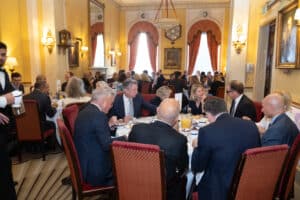
     

    Jon Sopel book launch in aid of Hospice UK and hosted by Finito at The East India Club, London. 17.9.2024 Photographer Sam Pearce / www.square-image.co.uk


    It’s always seemed to me that the Labour Party finds power a really inconvenient thing to happen. They much prefer it when they’re forming Shadow Cabinets and discussing the National Executive. Then you’d get pesky people like Tony Blair who come along and remind them it is about power. The Conservative Party was always the ruthless machine of government: there is an element in which the Conservative Party is in danger of going down the Labour Party route. It was the Conservative Party membership, for instance, who gave us Liz Truss, the patron saint of our podcast The News Agents. We launched in the week she became Prime Minister – and my God, she was good for business.


    What would Britain look like if there were 10 years of Starmer? He’s done the doom and gloom, and how everything is the Conservatives’ fault. That’s fine – but so far, he’s not set out what the future is going to look like under him. Is it Rachel Reeves’ vision of the growth economy? Or is it Rayner’s vision of increasing workers’ rights. I think Starmer is an incrementalist and simply doesn’t know. If he has any sense at all he will look at the centre of political gravity in the electorate and go for growth because that’s what the country needs.
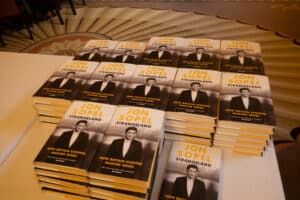
     

    Jon Sopel book launch in aid of Hospice UK and hosted by Finito at The East India Club, London. 17.9.2024 Photographer Sam Pearce / www.square-image.co.uk


    Hospice UK do the most amazing work. The book I’ve written Strangeland deals with the challenges facing Britain at the moment. Hospice UK do the most amazing work. Strangeland deals with some of the huge challenges facing the . Hospice care is one area where something urgent needs to be done.


    Jon Sopel was talking at a Finito event given in aid of Hospice UK. To donate, go to this link: https://www.hospiceuk.org/support-us/donate


  • Opinion: Tony Blair’s Book “On Leadership” misses the critical point

    Tony Blair’s Book “On Leadership” misses the point.

    Finito World


    “The centre cannot hold/mere anarchy is loosed upon the world’. So WB Yeats wrote towards the end of his life. It doesn’t feel entirely irrelevant as a description of Starmer’s Britain.

    The early months of Labour’s time in government has seen some good ideas, the first signs of governmental infighting, some naivety and some poor decisions too.

    None of this ought to come as any surprise – and it would hardly be news at all if there wasn’t a mounting sense that the country needs leadership on a different scale to what we had under the Conservatives. Lord Darzi’s NHS report alone was enough to make people realise the scale of the inheritance Labour has – but that’s not to say there aren’t other problems. From education to housing, to transport and defence, to productivity and growth, the UK’s difficulties appear to be legion.

    But if the leadership we need isn’t yet evident in the Starmer government – and yet to materialise from an opposition still bruised by the recent general election’s thumping defeat – where is it to be found?

    Despite the fact that he left office nearly 15 years ago, there will be many who are still not ready to listen to the pronouncements of Sir Tony Blair. This is understandable when one considers the legacy of his Middle Eastern Wars, his awkwardly gilded post-premiership, not to mention the quangocracy which was certainly not curtailed by 14 years of Conservative-led government.

    And yet in a recent interview with The Observer‘s Andrew Rawnsley, designed to promote On Leadership, he did what Blair has always been good at: making an argument.

    Observing that the civil service is essentially unfixable, and that bureaucracy will have an innate tendency towards being bureaucratic, Blair offered the alternative: leadership from the centre.

    This is a very different thing to having a centralised system which we have come what may. Blair explained: “…unless you’re driving from the top, it [change] won’t happen. It won’t happen for several reasons. It won’t happen because the system won’t have a clear enough direction if it doesn’t get it from the very top. It won’t happen because too many issues require many departments to work together. And you need the centre to do that.”

    This is true, and seems all the more so from watching over a decade of prime ministers who couldn’t control the centre: May was a Remainer asked to enact Brexit; Johnson lacked discipline; Truss was never prime minister material; and Sunak could do the day-to-day, but lacked vision. Starmer is, so far, a sort of blend of May and Sunak.

    But if we accept this argument for strong leadership, it needn’t just apply to Westminster where it seems least likely to be successful. It can form a part of all our working life.

    It is a remarkable fact how little education there is in our society surrounding leadership. There is very little leadership education during our formative years: indeed, it might be argued that a samey curriculum tends to homogenise students – and this process is the opposite of generating the individuality which we associate with leadership.

    Of course, if we accept the need for leadership in our society then we might wonder how best to foster it. As Sir Terry Waite argued in a previous issue of Finito World, the study of history is important, especially if we can look at what made, say, Abraham Lincoln an effective leader and ask students to apply his essential pragmatism and patience to their own lives.

    Furthermore, this magazine applauds the work conducted by the Institution for Engineering and Technology in highlighting the importance of engineering on the curriculum; one attractive aspect of such an approach is that it engenders precisely the kind of problem-solving which makes for inventive leadership.

    In these pages too, Emma Roche has argued that an understanding of the original practical nature of ancient philosophy is of importance too when it comes to creating a generation which knows how to lead.

    But really it’s in mentorship that we are most likely to learn the skills needed: at Finito we believe that mentoring has a unique ability to create the knowledge base for effective leadership.

    The country in fact is in such a state that we are not in a position of being able to simply submit to the powers of some great man or woman – were that person to come along, which seems unlikely. In fact, in the shape of Starmer it might be that we have another underperforming PM.

    Instead, Blair’s book seems to spark off a series of thoughts which its author may not have anticipated. The new centre can’t be located in 10 Downing Street; it needs to be in each one of us.