Tag: social mobility

  • Exclusive: How King Charles III became the most important voice for social mobility in the UK


    Christopher Jackson


    No matter how hard the King’s lighting team tries, it is difficult to create an intimate space. He speaks in front of a picture of his late mother – he is addressing the nation as a son in grief as much as a new monarch – but behind him the room recedes into marble pilasters, state-of-the-art rugs: the scale proper to a King.

    Charles says: “Queen Elizabeth’s was a life well-lived; a promise with destiny kept and she is mourned most deeply in her passing. That promise of lifelong service I renew to you all today.”

    Perhaps the most important word in that passage is ‘all’. King Charles III is, whether people like it or not, the King of not just England, but of Wales, Northern Ireland and Scotland too. Perhaps there has long been a degree of tension in this fact: it is a leitmotif of any biography of the Royal Family that the subject must preside over a United Kingdom peppered with nationalist sympathies.

    Charles has known this from first-hand experience since the stressful day of his investiture at Carnarvon which took place amid rumours of an imminent bomb, and on which occasion a member of the public threw an egg at the Queen’s carriage.

    His position, while it remains this nation’s main marker of stability, also has its uncertainties. These might partly be to do with being pelted with eggs – the same thing recently happened to Charles himself – but are just as likely to be felt as unease about the monarchy’s own relevance in the modern era. In an age of acronyms – of AI, AGI, NFTs, and LMAO – what relevance can the elaborate language of a court circular have?

    It doesn’t end there. In a time of iPhones, of TikTok and Snapchat, what do we feel, if anything, about the deep past from Charles acquires his position and authority? And is palatial opulence permissible in an age of strikes amid a ‘cost of living’ crisis? In a time of drones and clones, can we experience emotion at all at the sceptre and the anointed oil? In short, what does history mean in the present?

    Personally, I think the answer is that it means a great deal. But it is a question every monarch must answer.

    Charles continues: “In the course of the last 70 years we have seen our society become one of many cultures and many faiths. The institutions of the state have changed in turn.”

    When the speech is shown again on the ITVX documentary The Real Crown, we see him from a different angle: one of those images which shows the cameras and the soundman’s booms, and what it’s like for the King to be filmed. Then we see just how big the room is, tapering off, like Las Meninas, towards other rooms, and corridors and flights of stairs.

    The King, with his bent, careful septuagenarian tread moves across a room larger than many people’s houses, to become framed in a doorway far larger than one might have imagined: he waves at the assembled camera crew, but also at us: his nation.


    Streamlining


    Since Queen Elizabeth II reigned for such a long time, we have almost forgotten that a change of monarch has a bearing on how we feel as a country. Since we are all citizens as much as we are individuals, the accession of Charles III therefore impacts in surprising ways on one’s own identity. We are used – all too used – to experiencing this with respect to the current prime minister is. This information, though it is clearly an external matter, also turns out to be vital to our own lives: we feel differently when Rishi Sunak is prime minister to how we felt when Liz Truss ran the country.

    The question then of what kind of man the King is, turns out to be strangely shaping in terms of our own lives. This fact alone is the best barometer one has of the power of monarchy to alter and affect us, and to matter. For this article we spoke to those who have worked with and for him, those who have known him since childhood, and even those who know him only from his handwriting, to seek to understand our new monarch.

    What emerges is a man of unusual sensitivity and empathy; someone kind, but also capable of obstinacy. Despite a certain fastidiousness – some will remember his frustration over being given the wrong pen at a signing ceremony early in his time as King – this is not a monarch without imagination or creativity. Perhaps above all, he is – in a rather refreshing way – an unusual man.

    He is also a man of unusual experience. With tens of thousands of state visits to his name, the King knows the country better than anyone. Of course, there are severe constraints placed on the nature of his experience. His visits must all be conducted through the prism of the fame conferred by his role: his is a life of people on their best behaviour, a world to some extent cordoned off from unguarded human experience.
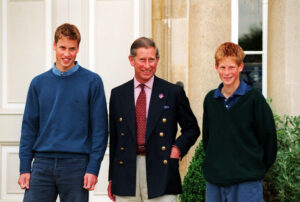
    B4TNT6 Prince Charles with his two sons Prince William left and Prince Harry at Buckingham Palace July 1999

    This state of affairs is something Charles has long since railed against. According to Jonathan Dimbleby’s masterly The Prince of Wales: A Biography, as early as November 1978 the future King would write pleadingly to his then assistant private secretary Oliver Everett: “I want to consider ways in which I can escape from the ceaseless round of official engagements and meet people in less artificial circumstances.’

    Even so, the sheer range of his experience of the world even at a ceremonial level is one possible reason for the empathy he’s shown as King so far. In an age where most of the public sector is on regular strike, and with the rest of us experiencing rising inflation, Charles has already given an intelligent lead. Opulence is out, and frugality – insofar as is possible in such a gilded situation – very definitely in. This means that we are experiencing a decidedly ‘scaled back’ Coronation year. Meanwhile, for those who work for the Royal Household, the era of the grace-and-favour home is over.

    For Michael Cole, the royal writer and broadcaster, and former BBC TV Court Correspondent, the King has begun his reign wisely: “The King is right. Slimming down the Royal Family is in tune with the tough times faced by millions in Britain and his 14 overseas realms,” he tells us.

    So what is the reason for this approach? “The King is responding to the realities of the world. It is nonsense with royal knobs on to suggest that the King’s eminently sensible proposal to focus on the direct line of succession, Prince William and nine-year-old Prince George, will bring the monarchy to “the brink of collapse”, as a recent study by the think-tank Civitas ludicrously suggests.”

    This Civitas report, authored by Frank Young, created a minor storm, claiming that without Princes Harry and Andrew working for “The Firm” the Royal Family “will disappear from public view”.

    In disagreeing with this, Cole explains how the new slimmed down Royal Family will look: “Never again will we witness more than 20 members of the Royal Family on the balcony at Buckingham Palace. The King knows instinctively that this sends the wrong message. And he’s right.”

    For Cole, Charles has taken inspiration from the past: “A keen student of his family’s history, he’s following the lead of his grandfather, King George VI, who led this country through war and economic austerity. He said the Royal Family was best when it was “Just us four” – himself, Queen Elizabeth and their daughters Elizabeth and Margaret.”

    It is a reminder that Charles has always loved History and English as subjects. For Cole, this puts His Majesty in good stead: “The King has read the national mood and correctly decided “less is more”, which the late Queen certainly believed. Civitas 0, King Charles 5 – himself, William, George, Charlotte and Louis, in that order.”


    Keen Interests


    After Charles conducts that characteristic hunched pivot to wave goodbye to the cameras, and walks on to his next engagement, I am reminded that it is sometimes rumoured that both the King and the late Queen have been said to dislike Buckingham Palace, with each preferring their country residences. Balmoral has been particularly loved by both monarchs.

    In the Queen’s case, this preference might be put down to a sheer love of the great outdoors. In respect of Charles, a more complex and intellectual figure, I am reminded of Sir Kenneth Clark’s observation that nobody in the history of civilisation has had an interesting thought in a Palace; that requires, Clark said, a room of one’s own, of the sort Virginia Woolf pined for. That’s precisely, of course, what Charles hasn’t had: privacy, and the ability to shape a distinctive personal destiny without the encumbrances of duty.
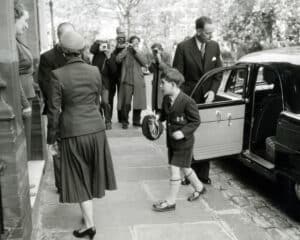
     

    EJ9JGE PRINCE CHARLES arrives at Hill House School in Knightsbridge, London, in 1957


    But the people we spoke to for this article attest that he has worked through these difficulties, with many emphasising the help of the Queen Consort. In fact, Charles has done something rather more interesting than complain about his lot in life. He has continued his intellectual passions while carrying out his duty. If one considers the success of the Prince’s Trust, it could be argued that nobody – with the possible exception of his mother – has done more good in this country over the past half a century.

    One has always been conscious of Charles’ intellectual curiosity. It is the trait which most defines him, and which propels his astonishing work ethic which now percolates the Royal Household and which all courtiers must now get used to. It is this restlessness which was at his elbow when he wrote the famous Black Spider Memos to the Blair government in the 1990s on everything from the armed forces, to arcane aspects of agriculture and education.

    He is always well-informed – sometimes, in fact, to a nearly ludicrous extent. It was said of Bach that his genius is tragic in that his cantatas were far better than they needed to be for a regional kappelmeister to justify his position. Charles is a little like this: his energy can’t quite be contained by the position he has; it keeps spilling out.

    One representative story is of Lee Elliot Major OBE, the country’s first social mobility professor, who was honoured by the King at Buckingham Palace. “When I received my OBE, it was Prince Charles who was presenting the medals,” he tells me. “I was in a long line of recipients and I was doing a lot of reflection about what it meant in terms of my own life.”

    It is a reminder that whenever Charles meets anyone for the first time, it is always in this context: it is for him to help his subjects navigate the sheer oddity of the moment. “He asked me about the Sutton Trust, and he knew about my social mobility work,” continues Major. “In the end, they had to prise me away because we were chatting so much. Now you could say he was simply well-briefed by the officials around him, but I think it indicated a personal conviction.”

    Of course, it’s likely the case that a double whammy is in play: the King is both well-briefed and speaks from personal conviction.

    All of this makes one wonder a little about his education. Was there some germ in the deep past which sparked the King’s curiosity, or was it innate, even a sort of Royal anomaly? Interestingly, when Kings and Queens have considered their offspring’s education, they have generally plumped for precisely what Elliot Major advocates for the rest of us: one-to-one tutoring. “When done well it is the ultimate in education,” he continues. “I would argue that the rates of learning you get from one-to-one tutoring are the best you ever get. You’re never going to match that in a classroom: provided you get the chemistry right.”

    In fact, the future King was educated for a brief while by a governess: Catherine Peebles. But when it came to prep school age, he became the first monarch not to be educated by private tutors, instead attending a variety of schools. It might be that this exposure to his subjects has created in him a more empathetic persona than we’re used to as monarch.

    If so, he suffered a little for his people. It is widely known that Gordonstoun was an unhappy experience for him. At Gordonstoun, it seems that the injunction for Charles not to be treated any differently from other pupils led to an appalling bullying culture which is horrible to read about today, with the then Prince deliberately picked on during rugby matches and so forth. As the Coronation ceremony approaches perhaps there are a few privileged people in their late seventies feeling shame for the way they treated the King some six decades ago.


    As the novelist William Boyd, who was educated there alongside the King, has said: “Being educated over a 10 year period at a single-sex boarding school in the north of Scotland has a massive effect on your young personality and nature. What is then required is an equally massive process of re-education.”

    This, of course, is precisely what Charles would do. But what receives less press than the King’s unhappy time at Gordonstoun, is his education at Hill House School, presided over by the redoubtable Colonel Townend. This turns out to be rather more interesting. The restauranteur Philipp Mosimann, who also attended Hill House, recalls: “It was a very simple ethos. The Colonel believed in life skills.

    He believed you should learn to swim before you learn to read and write, because that would actually save your life. He was also a huge advocate of team-building. His father had been a priest and he had fought in World War Two; he used to show us videos of A Bridge Too Far. He went on to win two gold medals in the Empire Games. He was a real hero.”

    One can immediately glimpse the parallels between this ethos and the values of the Prince’s Trust, Charles’ great contribution, which he would found a quarter of a century later.

    Mosimann continues: “I remember these massive sermons the Colonel would give which the parents would attend; they’d just sit there enthralled. If you were well-behaved, you’d be invited to go up the mountains at weekends. It was fantastic; it was a child’s dream of education. It was all about getting out there, becoming friends and creating camaraderie. Townend believed strongly in becoming an all-rounder. Music was very important; it was mandatory to play one – if not two – musical instruments.”

    And can Mosimann recall what effect all this had on Charles? “There is a wonderful picture of Charles when he arrived in Knightsbridge with the Colonel. It really was marvellous; and it imbued you with the idea that you had one education from your parents but they won’t give you everything. For the right reasons, the King became quite humbly confident.”

    Looking at this picture, I feel similar emotions to what I feel whenever I see images of the young Prince William or Prince Harry, and indeed when I meet any young child: one has a sense of rooting for the young, and half-wishing the adult world won’t ever encroach upon them. One feels the same when one sees images of Charles as a young man: slender, slightly reminiscent of Gussie Finknottle in the PG Wodehouse Jeeves and Wooster series. Whatever one thinks of his privilege, one cannot ignore his vulnerability.
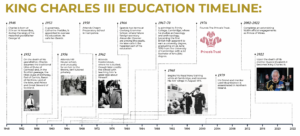
    Philipp Mosimann says: “I think it’s very difficult to be King. When it comes to friendship, you have to be cautious with regards to your position, and they don’t have any choice about that. It’s a huge amount of responsibility for life, and you owe that responsibility to millions around the world.”

    Most of us, even prime ministers, seek development, the forward steps of a career. Charles hasn’t had that. As Mosimann says: “If you take that decision seriously and do good – which Their Royal Highnesses really are doing – there’s not much rest. It’s a full-time job. You could say: ‘I’m okay financially and I’m off’. But they don’t – they uphold their duty. I think in terms of friendship, that may suffer in terms of time, so they need to have a close circle of friends from a very young age.”

    Baron Levene of Portsoken, the former Chairman of Lloyd’s of London, who has interacted regularly with the King throughout a long and successful career, adds: “You can’t compare members of the Royal Family to the rest of us, even to prime ministers. A member of the Royal Family is always going to be in their position and will try hard to keep out of anything controversial. Members of the Royal Family are all trained and brought up in the same way but are all entirely different characters.”

    In our lives, we wonder how to gain a position, and then how to develop that position towards greater fulfilment – the succession of steps which we call a career. A Prince or King must decide what to do with the position they have. Mosimann explains: “If you know you have a guaranteed position, how do you go about resonating your presence?” This question has been percolating Charles’ mind since youth, and no doubt still does even now. It is the conundrum of his life.


    The High Seas


    But he has had a career of sorts, somewhat apart from his Royal role. Over time, after attending the University of Cambridge to read Archaeology and Anthropology, the future King chose to carve out a role in the Royal Navy. These experiences, together with what he had learned at Hill House, would also impact on the King’s thinking and shape his contribution.

    If Prince Charles had a mentor then one would have to name Lord Mountbatten, the maternal uncle to Charles’ father, Prince Philip. Dimbleby calls him “the great single influence on his life”. It was Mountbatten who, through his wife Edwina, came into the country house Broadlands, where Charles spent so much of his time in the 1970s.
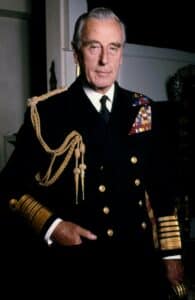
    Liz Brewer, the etiquette expert and contributing editor of Finito World, remembers this period: “The King founded the Prince’s Drawing School, which is now the Royal Drawing School. I would arrange for the school to go fishing on the River Test.” Founding things is a continual thread in Charles’ life. And Mountbatten? Brewer recalls: “Mountbatten was very dapper. He’d be very much at home in today’s world.”

    Mountbatten was certainly an interventionist presence in the Prince of Wales’ life; most people know about his failed efforts to ensure that Charles would marry his granddaughter Amanda Knatchbull, now Lady Amanda Ellingworth.

    Less well known is Mountbatten’s role in persuading Charles to join the Navy. For instance, Mountbatten wrote to the then Prince in no uncertain terms while he was still at Gordonstoun: “I would like to repeat…I am quite certain that you must have a “mother service” that you really belong to and where you can have a reasonable career. Your father, Grandfather and your Great Grandfathers had a distinguished career in the Royal Navy. If you follow in their footsteps this would be very popular…”

    As ever with Charles, that’s a lot of footsteps to follow in. If anyone has ever felt nervous about starting some new chapter in their lives, then perhaps there will be a degree of comfort to know that their current King has known that trepidation too. Here he is on the eve of attending the Naval College: “I am beginning to pale at the thought of what Dartmouth is going to do to me. Whatever it is, it’s going to be far worse than the most excruciating tortures they could ever dream at Cranwell! [where Charles had spent five happy months with the Royal Air Force beforehand].”

    Dartmouth in those days was a strict environment, and another challenge for someone of so sensitive a nature as the future King. After his first weeks, Charles reported back glumly to Mountbatten: “I have hardly had a moment to breathe since I arrived. We get up at six a.m. most days and have to suffer the early morning indignities of being bawled at by a Whales Island GI [i.e. gunnery instructor] with a voice like a horse. It’s either that or torture by Morse Code.”

    This sounds, and probably was, fairly awful. But elsewhere in his correspondence, Charles strikes a more positive note. “Everywhere I look my eye catches some familiar face peering down at me from a portrait on the wall. Papa wrote and said I could console myself with the thought that I was serving ‘Mum and Country’! I hope I can and it fills me with pride to think I might be able to be of some service.”

    Reading between the lines, more consolation was needed here than was provided for by his parents. Even so, it had its good effects. Today everybody reports on the King’s work ethic, and it is tempting to think that the lineaments of this may have been established at Dartmouth.

    Either way, not everything went right for the King. When he eventually took his place on board Norfolk (‘this mighty vessel’ as he called it) he was self-deprecating about his abilities: “Chaos reigned in the charthouse. No sooner had I completed my artistic handiwork than the navigator appeared and proceeded to rub everything out…In the end the ship sailed in the direction of my revised lines and by some curious accident Plymouth hove into sight at approximately the right time in the morning. My relief was ill-concealed..!”

    But to struggle in a strict environment is surely a good education for a future King. He didn’t have things his own way, and this experience has enabled him to imagine his way into the lives of others less fortunate than himself.

    A former serviceman tells me: “I know he was very fond of his time in the Navy. He is a proud naval officer.”

    The same interviewee tells me that the experience may have had its impact on the principles underpinning the Prince’s Trust: “I think, of all the services, the Navy – especially compared to the Army – is more of that collaborative working approach.” And why is that? “Everything has such a specialist role from your radar operator, to your torpedo-handler. It’s not just raw leadership – shouting at people, leading men over the wall – it’s training people to a high degree and empowering them to do the jobs they’ve been trained to do, and collaboratively being a team. It’s a different leadership style.”

    Throughout his time in the Royal Navy, Charles grew in confidence. His career is a reminder of the salutary effect of having to test one’s potential against confines – and even to toil for some period at what one isn’t necessarily suited to. But he was beginning to feel that he could, in his own words, ‘be more useful elsewhere’.


    Hard Slog


    After leaving the Royal Navy, Charles began the relentless and essentially ceremonial life which he has kept up ever since. In 2022, at what for everyone else is retirement age, this has been ramped up again.

    What sets him apart is that he has done all this, and yet given the impression that it isn’t quite enough for him. He can seem a sort of activist Prince Hamlet, somewhat at odds with what he has been born into.

    The more you examine is life, the more you realise that what he craves is depth of experience in addition to the breadth of ceremonial experience he cannot avoid.

    In the letter to Everett I quoted earlier, the then Prince goes on to say: “I want to look at the possibility of spending, say, 1. Three days in one factory to find out what happens; 2. Three days, perhaps, in a trawler (instead of one rapid visit); 3. Three or four days on a farm. I would also like to consider 4. More visits to immigrant areas in order to help these people to feel that they are not ignored or neglected and that we are concerned about them as individuals.”

    This is a wholly admirable letter which I find it hard to imagine any other heir to the throne writing. Perhaps the most characteristic part of it is the request for that extra day on the farm, but all of it is shot through with a restless energy wholly his.

    So what is life like for him? Baron Levene of Portsoken got to know the King when carrying out his stint as Lord Mayor of London. “I know him reasonably well,” he tells me. “He’s waited a hell of a time to do this job, even after such a short time. He’s very well-informed on many, many subjects.”

    Levene is sympathetic to the enormously demanding nature of a life dominated by ceremony. “When I was Lord Mayor – not nearly as bad as being the King, of course – I shook hands with about 70,000 people over the course of the year. You have so many formal dinners and banquets and ceremonies. It’s very demanding – not intellectually, just physically. I used to get up at seven and go to bed at midnight every day.”

    So is it possible to enjoy a life dominated by such a punishing schedule where you must always be on your best behaviour?

    “I enjoyed it but it’s very tiring,” Levene replies. “When people at the end of it all asked me what I thought of it, I said a third of it was terrific, another third was okay – and the final third was ghastly.”
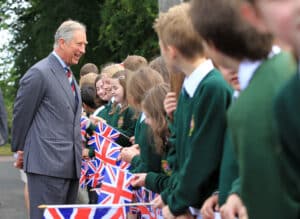
    C8F12A Britain’s Prince Charles speaks with school children in Northern Ireland

    This then is Charles’ reality – except in the crucial respect that he doesn’t get to finish after a year. Levene continues: “When I was Lord Mayor I went to a wedding in London of a member of the Royal Family, who I happened to know well. I was sat next to the Queen of a well-known country. She said: ‘Look, it’s alright for you, you can stop after a year’. And if you look at the Court Circular each day, they go to the most obscure places: it’s undeniably a hard slog,”

    I decide to do this and land at random on the Court Circular for 5th April 2023. It reads:


    The King and The Queen Consort this afternoon visited Talbot Yard Food Court, Yorkersgate, Malton, and were received by His Majesty’s Lord-Lieutenant of North Yorkshire (Mrs. Johanna Ropner) and the owners of the Fitzwilliam (Malton) Estate (Sir Philip Naylor-Leyland, Bt. and Mr. Thomas Naylor-Leyland).

    Their Majesties, escorted by Mr. Naylor-Leyland, toured the Food Court and met local business founders and owners.

    I note the plural ‘local business founders and owners’ and note how such an occasion might proliferate. I try to imagine how each of those business people is experiencing the highlight of their year, and perhaps of their lives, and how the King must be mindful of this, and cannot afford to put a foot wrong. But the day isn’t over yet:


    The King later met representatives of local charitable organisations at York House, 45 Yorkersgate, Malton, and was received by the Co-Founder and Director of Circular Malton and Norton Community Interest Company (Mrs. Susan Jefferson).

    It is an unending round whose ground note can hardly be anything besides banality.

    The longest serving Foreign Secretary of Australia and former High Commissioner of Australia Alexander Downer has also seen all this up close. “When I was High Commissioner of London, with Australia being a realm country, I would deal with Buckingham Palace a lot, but also with the Prince of Wales, as he was then,” he tells me.

    Had Downer met him before? “I’ve known Charles a long time, as he went to Geelong Grammar where I also went. I first met him here in London when I was 13 and he was a couple of years older, 15. I wouldn’t call it a friendship, but a friendly acquaintance. With someone as famous as the King of England, if you know him at all you might say you were great friends, but that wouldn’t be right!”

    Downer describes for me the level of detail which goes into each event. “In general, I would meet him more at events. But on one occasion, the Prince of Wales and Camilla – now the Queen Consort – were planning a visit to Australia, so I went to talk to him at Clarence House about what he might do while in Australia, and then we had follow-up meetings.”

    Was he good at assimilating information? “As the Prince of Wales, he had advisors and people he would learn from, and he read a lot as well –

    a thoughtful kind of person. If you’re the King, you have to be interested in everything as best you can be. I’m not sure how interested he is in the weekend’s football. Would he watch a Formula One Grand Prix? Would he watch Chelsea drawing with Everton? My guess is he’s interested in horses, like his mother was.”

    This predominantly ceremonial life sometimes yields amusing anecdotes. Royal Warrant Holder Wendy Keith, the eponymous founder of shooting stocking design firm, Wendy Keith Designs says: “I attended a Reception at St James’s Palace with my husband who was a Senior QC at that time. In conversation, His Royal Highness asked my husband what he was doing there. My husband replied: “I am merely a companion to my talented wife”, to which the reply came :“I know the feeling!”.

    When smiling at such a remark, one must take a moment to remind oneself of the punishing routine of the man who made it.


    Scenes from the Chase


    In addition, all this activity must take place in the glare of the world’s most brutal tabloid media.

    In light of what happened to his first wife Diana, Princess of Wales, this is naturally a painful topic. But it needs to be admitted that there are many excellent journalists in the UK whose aim is to report legitimately on an important part of our national life.

    One such is Michael Cole, who recalls for me a visit made by Charles and Diana to the US in the mid-1980s, when he was the BBC royal correspondent. “In many ways, Princess Diana was a wonderful person and quite easy to report upon, and not just because she was the cameraman’s dream, incapable of “taking a bad picture”  —  i.e. she always looked wonderful,” he recalls.

    “The Royal Family made big mistakes in the way they treated her and especially in not giving her a greater speaking role and much earlier. On her first visit to the United States, in 1985, there was a major news conference at the National Gallery in Washington. What is the point of a news conference? To ask questions that elicit answers and to record those answers for possible broadcast or other publication.”

    This seems a reasonable enough assessment, but things didn’t quite transpire as Cole was expecting. “Just before the conference was due to start, Michael Shea (then press secretary) announced that the Princess would not be speaking and her husband, Prince Charles, would not be taking any questions at all about the Ball at the White House the previous evening when Diana had danced with John Travolta, among other lucky men.”
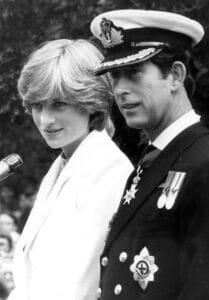
    MPX798 PRINCE CHARLES AND LADY DIANA AT HMS MERCURY NEAR PETERSFIELD.
    PORTSMOUTH 1981

    Something of a fandango ensued. “These were absurd restrictions and I told Michael that I would be ignoring them, not least because the White House official photographs of the Princess and the star of Saturday Night Fever were on the front page of every American newspaper that morning and had been shown and discussed on the major morning news shows.”

    When questions were invited, I stood up and said: “Would Prince Charles be kind enough to let us know how the Princess is finding her first visit to the United States and in particular how she enjoyed dancing last night with John Travolta?”

    Cole continues: “Prince Charles was livid. His face contorted with anger. He began by saying that he was not “my wife’s glove puppet” but then just about managed to offer a reasonable answer. The exchange is visible online.”

    Cole took the following lesson: “It just proved how unwise it is for so-called PR professionals to try to shackle a free media, especially when there is not the slightest hint of a good reason for doing so; I wasn’t asking about State secrets or probing intrusive personal matters; I was asking for basic information about a story that was already well known and the point of conversations worldwide.”

    Of course, he was asking – albeit tangentially – about the state of what we now know was an unhappy marriage, and so in retrospect one can imagine that Charles’ frustration on this occasion opened up onto the broader frustration of hi not being with Camilla.

    The story has a sequel: “When they did start to allow the Princess to speak – or rather when she asserted her wise and instinctive wish to speak for herself – she did so very effectively and always made an overwhelmingly positive impression on her audience. It was just a shame that it wasn’t allowed much, much earlier.”

    Cole says: “I have often reflected on this truth: if you stop running, they will stop chasing.”


    Itsy Bitsy Spider


    But chase they do – and chase we do. It strikes me that the desire to hunt for the King’s personality is especially absurd when one considers not just the expansive quotations in Dimbleby’s book but also the so-called Black Spider Memos released in the mid-1990s after a Freedom of Information request. Partly because the King expected these not to be made public, they are the best window we have into how his mind works.

    When the Black Spider memos were released there was an attempt to treat them as scandalous. But really they’re a reminder that policy, when you get right down to the detail, is never scandalous. There is in reality something impenetrable about the memos, which renders them a non-story. The Prince was accused at the time of lobbying, but really one might as well accuse him of being extremely knowledgeable about certain topics: especially, agriculture, education, the condition of troops in Iraq, and, his guiding passion, the environment.

    “You have certainly managed to bring together a powerful alliance of N.G.O.s and countries,” the future King writes in one letter to the then Minister for the Environment Elliot Morley. “I particularly hope that the illegal fishing of the Patagonian Toothfish will be high on your list of priorities because until that trade is stopped, there is little hope for the poor old albatross, for which I shall continue to campaign…” Morley’s reply isn’t readily available in The Guardian archive.

    To the then prime minister Tony Blair, Charles writes: “The main issue that we talked about was agriculture. I mentioned to you the anxieties which are developing, particularly amongst beef farmers and to a lesser degree sheep farmers, of the consequences of the Mid Term Review. There is no doubt that decoupling support from production provides many opportunities, but it is also creating some real fears amongst the livestock sector.” The letter which ensues contains eight points full of closely argued detail; it resembles a legal brief. One is left in no doubt that this is a man who knows what he’s talking about, though the correspondence is very far from being a page-turner.

    “As you know, I always value and look forward to your views – but perhaps particularly on agricultural topics,” replies Blair, possibly through clenched teeth.

    My guess is that it’s this which makes Charles standoffish with the media: there is no scandal about him, but the questions he has to field always seem to suppose that there is, might be, or even should be, scandal. It is always annoying if you want to enact a change to agricultural policy to be asked about your divorce. Charles cares about other things and other people; but the media keeps wanting to turn things back to him.


    There is a complexity about our current monarch. The Queen, with her stoicism and an intellect which didn’t range quite so widely as does Charles’, was perhaps more comfortable with the symbolic nature of the role she was called upon to enact. Charles isn’t like that, and so perhaps he will make us all look inwards and wonder what more we might be capable of. One can imagine a nation more analytical, perhaps even, in some positive sense, more curious with him as King.


    A Question of Trust


    Nevertheless, the fact that he is human is another non-story and therefore another inconvenient truth for journalists.

    Philipp Mosimann tells me an excellent story which encapsulates this perfectly. “Mosimann’s has been very involved in the Prince’s Trust,” he explains. “We had a gentleman who became an apprentice on one of the cooking programmes, and we hosted him at an event with the King in attendance. The apprentice had written a long speech to thank the future King for what he had done for his life chances. But when he came to deliver his speech, the apprentice broke down and cried and the whole room was filled with tears.”

    The next person to speak was Charles. “It caught him off guard and he welled up, laughing and crying at the same time, and it was a lovely down-to-earth moment. Literally, his eyes had filled with tears. I will never forget that. You realise why we’re all here.”

    It was a moment of tremendous levelling. “We were all there in the same room and everybody was at the same level and having the same emotion, about the chance we all have to change people’s lives.”

    It is a lovely story, and very revealing in its way, but I can’t imagine it being front page of the Mail. The unglamorous humanity of the King and his endeavours is also echoed in Lord Cruddas’ experience. “If you work with the Prince’s Trust, you meet people who have been in difficult situations – maybe members of gangs, or drug addicts who have pulled themselves together,” he tells me. “You meet people on the front line of society, and it’s very sobering and it keeps your thinking on track.”

    Cruddas recalls one moving occasion: “I was at this exhibition and walking around with King Charles. Everyone was treating me as an important person as I was with him. At the end of it, a young woman called Gina came up to me and said: “Thank you for everything you do.” I thanked her. And she said: ‘You don’t know me. If it wasn’t for people like you, I’d still be in prison. Because of your work with the King, I’m now a florist and I can look after my three children every day’. It’s a very rewarding charity.”

    Of course, no assessment of King Charles would be complete without an understanding of The Prince’s Trust, which Charles founded in 1976 – amid, according to Dimbleby, much scepticism from his parents.

    It sometimes seems as though you have to try hard to find a senior business figure who hasn’t been involved with The Prince’s Trust.

    In our tribute in this issue to Lord Young of Graffham, Sir Lloyd Dorfman explains the charity’s evolution. “Whilst the charity had been founded by the then Prince of Wales in 1976, David Young had helped accelerate its growth. He was supportive of the charity enabling young people from underprivileged backgrounds find jobs and also start businesses. As Secretary of State for Employment and then for Trade and Industry in the 1980s, he famously devised a matched fund-raising scheme to support the Trust’s enterprise work. The government ended up committing millions of pounds, much more than had been imagined, to the surprise even of his Prime Minister Margaret Thatcher.”

    One of Britain’s best-known entrepreneurs is John Griffin, who founded Addison Lee. He famously began with one car and forty years later sold the Company for £350 million. He effuses praise about The Prince’s Trust. “As a young man, I watched my own employer and thought that I could do better. It wasn’t that I was unemployable but there was a burning desire to prove to myself that I could achieve anything that I wanted. To be an Enterprise Fellow for the charity is one of the best ways to inspire the next generation. I like their motto, “Start Something.”

    “Even in my own octogenarian age, I am always looking to begin my next business,” continues Griffin, who is also Finito’s Advisory Board Chairman. “There are so many entrepreneurs who owe him a debt of gratitude for providing that early start and helping them on their way. I also commend King Charles III’s late father for The Outward Bound Trust, which teaches young people the two most important words in life “I can”.’

    What is Cruddas’ assessment of Charles’ contribution? “If you look at King Charles, every single year he raises £100 million a year for good causes. He uses his status and position to help ordinary people and you have to admire that. He works hard at it. He’s not just a symbolic head of the Prince’s Trust.”

    Finally, Elliot Major has this assessment: “When it comes to social justice, it’s not just about plucking academically able disadvantaged pupils and getting them to Oxford, Exeter, Cambridge or Durham. That‘s important, but what we want is diversity in the upper echelons of academia and society.”

    For Elliot Major, the Prince’s Trust has the right focus: “In many ways, the bigger problem we have is the huge number of people who leave school without basic skills and often come from families who themselves have had a bad experience of education. I think what’s really good about their work is that it’s not just about academic talent, it’s about recognising that young people have different talents: it’s focusing on the unsexy side of social mobility.”

    So along with the unsexy Black Spider memos, we have this unsexy charity. But there will always need to be people doing things which others haven’t the patience to grapple with. Elliot Major concludes: “Having interacted with them, I think that’s a laudable aim. It’s very practical in many ways; they definitely are doing good work.”


    A United Kingdom


    Since the late Queen’s death, everybody who works in the royal household, has had to get used to the King’s relentless pace of work: his curiosity, essentially admirable, isn’t passive. The Queen had a well-documented style of working, which in hindsight is already considered more relaxed than the new King’s. Meanwhile, the handover of staff must take place; those who used to work for the Queen are in many cases still in position, meaning that in some cases there’s more than one person doing essentially the same job. It is like a very high end company merger.

    And, in fact, a merger where the main premises are undergoing a huge refurbishment (Buckingham Palace is receiving a one room at a time makeover), all while planning the first Coronation in most people’s living memory.

    There’s a lot of work to do. The King waves in the doorway, and then walks off into the future. It is one that he has already done much to help shape.

    What kind of country is he waving back at? It is a country which, in spite of the last few years, feels more united than one might have expected. It’s true that the new Prince of Wales, due to Welsh nationalist feeling, needs to decide what kind of investiture ceremony to have, if any. But one doesn’t get an immediate sense that Wales is about to leave the Union.

    In Ireland, the ructions which Brexit caused have not only passed but the deal which may do a lot to create a return to power-sharing in Northern Ireland even has a Royal name: the Windsor Accords.

    Finally, if Scottish independence is imminent after the travails of the SNP in 2023 then I am an avocado.

    It is also a nation which is aligned in many ways with the new King’s values. Environmentally-concerned, aware of the importance of social mobility, and as his letter to Everett shows, mindful of the nature of modern Britain, and penny-pinching during a time of financial hardship, he may yet prove to be the right man for this historical moment. King Charles probably wouldn’t have chosen to be King had any choice been granted; and perhaps the nation, at various points, might have reciprocated this unease. But I suspect that over time, many will come to realise that we’re lucky to have him.
  • Exclusive – The Inside Story on How Stormzy Transformed the Diversity Conversation in the UK

    Patrick Crowder


    When you think about Oxbridge education, grime music probably isn’t the first place your mind goes. Nevertheless, world famous rapper Stormzy looks right at home talking to Cambridge students and professors about his scholarship programme for black students. At six-foot-five, the 28-year-old towers over the crowd gathered outside the historic university buildings on a rare sunny day.

    “Every time I see Cambridge students I always make it a proper point to let them know ‘you lot are sick!’, but because I’m a rapper, sometimes it can sound corny like ‘read your books guys, it’s cool to stay in school, kids!’ But genuinely, as someone who’s tried to be one of you lot, it’s f**king difficult! It was so difficult, so I know first-hand.”

    As Stormzy chats with the students, it becomes clear just how much respect
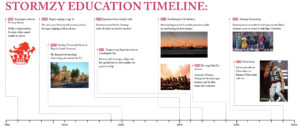
    he has for their achievements and what they represent. In his childhood Stormzy, then known as Michael Omari, was a high flyer in school, winning praise from his teachers and earning impressive marks. However, as he jokingly admits, he was also frequently “the one to throw a sandwich at someone’s head during assembly”.

    “I’ve always considered myself to be very smart, not to be arrogant you know,” he explains. “For GCSEs I got all the grades, I got to A-levels and said ‘this is tricky’, got to A2 and it was like, pfft. School was a breeze, I smashed my GCSEs to pieces, loads of A*s, but when I went to college I was like ‘wow, this is what it’s like actually being a student’, and that transition was so difficult.”

    Like many students who find school easy at a young age, Stormzy became bored of his education and did not develop proper study habits. He and the people around him always predicted that he would

    earn a spot at one of the nation’s top universities, but he blames a lack of focus, complacency, and troublemaking on his failure to get a place.


    “Every time I see Cambridge students I always
    make it a proper point to let them know
    ‘you lot are sick!’”


    “I did quite alright at A-levels, I got A, B, C, D, and at the time I was gutted but now looking back it’s like that’s not too bad. But you’ve got people here who’ve got A*, A*, A*, A*. I think when you get to that stage natural ability becomes second to focus, and commitment, and working hard, which is the difficult bit because you get someone like me who went through school naturally gifted, but then it’s like… that juice just doesn’t work here.”

    Stormzy was expelled from Stanley Technical High School when he “put loads of chairs on another student” in what he described as “just banter”. The administration took a different view – and just like that, his shot at going to Cambridge was gone. Stormzy laughs as he explains how his early perceptions of what it takes to get into Cambridge led him to start the Stormzy Scholarship.

    “When I was younger, the reason I thought I could come to Cambridge is because I just thought, ‘I’m smart.’ I didn’t think nothing else. Luckily, I wasn’t tainted by what I’d heard from people, like society and that. I didn’t even think about my criminal record!”

    The Stormzy Scholarship


    Stormzy has an admirable respect for learning – and so, while there’s criticism out there about him, it’s hard to escape this central fact about him. “As much as people think rappers, footballers, and celebrities are glorified, trust me – learning, education, and reading is a much more powerful and beneficial thing,” Stormzy has said.

    It is no secret that the Oxbridge experience has traditionally been a white one, and a male one. Together with Stormzy, Cambridge University is trying to change that.

    In 2018, Cambridge announced a partnership with Stormzy; the Stormzy Scholarship. In the beginning, the scholarship supported two black students a year, giving them full
    tuition and a maintenance grant throughout their time at Cambridge. This year, 13 students have been given that opportunity. The high-profile programme aims to change the perception of Cambridge and make it clear that students from all backgrounds are welcome, and the evidence says that it’s working. Dubbed ‘the Stormzy effect’, Cambridge has seen a massive influx of black students. Between 2017 and 2020, Cambridge saw an over 50 per cent increase in the number of black students admitted to undergraduate courses, and even higher numbers of applications.


    “If you’re academically brilliant,

    don’t think that because you come from

    a certain community that studying

    at one of the highest education institutions

    in the world isn’t possible.”


    Jesse Panda is the President of the African and Caribbean Society (ACS) at Cambridge. He’s a first-year engineering student with some big ideas on how
    to improve the black experience at Cambridge. We asked him about the so- called “Stormzy Effect”.

    “I think that’s an accurate name. I think the support from someone as prominent
    as Stormzy makes black students who want to come to Cambridge feel more welcome,” Panda explains. “They think, ‘Okay, there’s a system for me – maybe I won’t get the scholarship, but I can see that they’re trying to put a system in place to be more welcoming to black students.’”

    The numbers show that Cambridge’s efforts to welcome black students seem to be working, but removing a centuries- long stigma is not easy. And, as Panda points out, even with record numbers of black students attending Cambridge, white students still far outnumber them.

    “I think the main problem is removing that stigma – the perception that Cambridge is not a place for black students – and, to be frank, it’s still got a long way to go,” Panda continues. “I feel that I’m fortunate, but not as fortunate as I could be, if you see what I mean. I’m lucky to not be one out of 40 black students as it was in the past, but now I’m still only one out of 180 black students, whereas a white student will be one out of 2,000 or so.”

    Removing that stigma is exactly what Stormzy has set out to do. “When we first launched the scholarship, I always said that I wanted it to serve as a reminder that the opportunity is there. If you’re academically brilliant, don’t think that because you come from a certain community that studying at one of the highest education institutions in the world isn’t possible,” Stormzy has said.

    Jesse Panda and the other members of the ACS are doing their best through events and outreach programmes to show that Cambridge is a place which welcomes black students. However, due to the lack of diversity within both the university and the city itself, Panda says that he understands if some black students decide that it isn’t the place for them.

    “We had an offer holiday through the ACS, so future students were able to see what the society was doing. It was more welcoming for them, because they could see that Cambridge is not just a space for white people, it’s also accommodating for black people as well,” Panda explains. “I think we need more opportunities like that because Cambridge is not very diverse. In the media, it is pushed that Cambridge
    has no space for black people, when in reality there are spaces – but if someone doesn’t want to come here because of the imbalance, that would make sense to me.”

    Despite this, Panda is optimistic about the future of black students at Cambridge, while also realising that there is much work to be done. He is enjoying his first year in the city, and
    the ACS has provided a place for him to liaise with other black students and make a lasting change for the future of the university. While Panda’s experience has been a good one overall, the lack of diversity is still a large departure from his life in London.

    “I think that’s always going to be there to be honest. As much as Cambridge
    is taking steps in the right direction, when you look at Cambridge you still see a white environment. I haven’t been as intimidated as I thought I would be, because there are more black students than I thought there would be. But coming to Cambridge from London is still a big jump in terms of diversity.”

    For Stormzy, the scholarship is a symbolic continuation of his own stalled academic journey and a way to provide an opportunity to students which he did not have himself.

    “I actually look back at my school years and say that they’re the best years of my life,” Stormzy says. “I was reminded by my teachers that I was destined to study at one of the top universities if

    I wanted to go down that path, but I diverted and ended up doing music so
    it didn’t happen to me. But I felt like I was a rare case in the sense that I knew it was possible, which I feel like is not always the case. When students are young, academically brilliant, and they are getting the grades, they should know that’s an option.”

    Grime and violence

    Having secured a place as a music star known partly as a lyricist, Stormzy’s views have often been sought on education. On one occasion he responded to criticism of the message in his music in conversation with Charlamagne Tha God: “You say, ‘Let’s learn about Shakespeare’, but Shakespeare has stories of bloodbaths and murder, so I always say, ‘I am as positive as Shakespeare, I’m as negative as Shakespeare.’ Let’s get out Shakespeare stories right now and go through them one by one.”

    Of course, these sort of remarks open Stormzy up to the observation that he has a long way to go before he can be said to display the nuance and poetry of the UK’s most famous writer, and some will raise eyebrows at him even making the comparison.

    So that while Stormzy’s charity work is undeniably a force for good, it can be hard to reconcile this positive impact on young people with the negative impact which his lyrics are often said to have. Grime does not shy away from portraying life in underrepresented communities, which can include depictions of crime, violence, and sexism.

    Katharine Birbalsingh CBE is an experienced educator who chairs the
    Social Mobility Commission. She is also co-founder of Michaela Community School in Wembley, a free school which has been described as the strictest school in Britain. Birbalsingh takes issue with Stormzy’s influence because she sees his lyrics to be glorifying crime and sending young people down a wayward path.

    “Yes, some love Stormzy and other drill, grime, rap etc. artists who are misogynistic, glorify violence, wear stab vests etc. They don’t care how it destroys the lives of boys in the inner city. They think it is cool. They even campaign to teach Stormzy over Mozart in schools,” Birbalsingh tweets.

    She later posted screenshots of a conversation between herself and a prison officer who was commending her for “exposing Stormzy as a poor role model” and detailing the kinds of destructive media prisoners often identify with. Birbalsingh adds, “Those of you promoting Stormzy have no idea of the damage you do.


    “You say, ‘Let’s learn about Shakespeare’,

    but Shakespeare has stories of bloodbaths and murder,

    so I always say, ‘I am as positive as Shakespeare.

    I am as negative as Shakespeare”


    It is worth remembering that grime is by no means the first genre of music accused of corrupting the younger generation, and it will not be the last. Even Baroque music was initially seen as an ungodly thing – a passing trend which was sure to die soon.

    In the 1930s, the blues was seen as the musical root of corruption. This view of the genre was not helped by the barbaric attitudes towards race in America at the time, and the fact that it was usually performed by black people. Often slammed as needlessly violent, sexual, and profane, blues was “the Devil’s music” of the day. While accepted as a blues classic now, take the example of Robert Johnson’s .32-20 Blues:

    ‘F I send for my baby, and she don’t come

    ‘F I send for my baby, man, and she don’t come

    All the doctors in Hot Springs sure can’t help her none

    And if she gets unruly, thinks she don’t wan’ do

    And if she gets unruly and thinks she don’t wan’ do

    Take my .32-20, now, and cut her half in two

    The .32-20 in question is, in this context, a powerful and then-feared handgun cartridge not dissimilar to today’s .44 magnum. So a song released in 1936 was named after a weapon and went on to describe the murder of a woman whose only crime is disobedience.

    Much like in the blues tradition, grime is deeply rooted in the experiences of the artists who perform it. Stormzy has defended the violence of his lyrics on LBC, explaining that the connection between actual crime and speaking about crime is dubious at best.

    “The reason why we speak about these things is that these are things which go on in our community. We’re just being social commentators,” Stormzy argues. “But it is such a far-fetched statement to say that grime music is the reason for the country’s knife crime epidemic – that is wild. How do you even get there?”

    When asked if he is careful about what he says in his songs because of children listening, Stormzy makes it clear that he is aware and wary of his massive influence.

    “Every time I write a lyric or make music, I have the responsibility and the duty to tell my own truths – whether they’re positive or negative,” The artist continues: “Secondly, now that I’ve progressed to a certain stage, I try to be more careful but I’m not going to put some censor on it because everything I talk about is true. It’s things I’ve done in the past, things my friends have done, or stuff that we were immersed in, so I have the responsibility to tell my own truth.”

    Stormzy sees presenting a sanitised version of his life experiences bereft of uncomfortable, violent imagery as a dereliction of his duty as an artist. An artist’s duty is to tell the truth in an interesting way, and therefore some art must make the viewer want to look away. However, he now also wrestles with his duty as a public figure. Subjects which he once spoke about only to a relatively small audience of people who mostly shared his life experiences are now being broadcast to the nation. This, Stormzy says, is the root of the issue and could explain the backlash against violence in grime lyrics.

    “Things like this are so easy for the public to have an opinion on. Like, ‘Oh my God, Stormzy does grime and he spoke about a gun, he spoke to a murderer!’ but our truth and where we come from is so different. I don’t even expect people to understand,” Stormzy says.

    On the topic of sexism, Stormzy is somewhat of a trailblazer in terms of changing the way grime artists talk about women. In 2016, well before his Glastonbury performance, Stormzy held a Q&A at Oxford University. When called out on the genre’s troubling
    lyrics about women, he appeared to have an epiphany on stage after initially attempting to defend himself.

    “I’m sure a lot of MCs are derogatory towards females but we’re not as bad as the Americans. Me personally, I say the odd b-word or ‘slut’ or ‘sket’ – this sounds so bad man now I’m saying it,” Stormzy says, “I don’t know enough to give a proper comment cos I don’t want to say ‘we’re not that bad’ when we probably are. But, yeah, MCs stop cussing girls. I’ll have a word with the fellow grime massive.”

    Stormzy felt great embarrassment when his mother asked him about some of his harsher lyrics towards women, which led him to take a step back and consider the message behind his music. Since he pledged to “have a word” with the grime community about sexism, he has stopped relying on the tired misogynistic tropes once typical of the genre.

    Stormzy by Mark Mattock

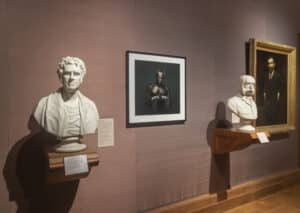
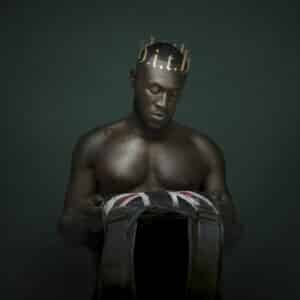
    Stormzy, by Mark Mattock with art direction by Hales Curtis, 2019

    Portrait of the Artist

    The portrait above of Stormzy gazing reflectively at the Banksy stab vest
    which he famously wore at Glastonbury found a place in the Victorian Galleries at the National Portrait Gallery. I sat down with veteran photographer Mark Mattock, who made the image, to find out more about the process and what the piece means to him.

    I meet the photographer at a Farringdon pub called The Eagle – “one of the first gastropubs in the 80s” according to Mattock himself. It was a fitting setting: early in his photography career Mattock took commercial photos of the food at that very same pub. Now, he returned to tell me about the difficulties and triumphs which went into creating the famous image. The first hurdle was scheduling, but Mattock says that his experience taught him not to be surprised by Stormzy’s late arrival.

    “You have to be prepared for the situation you’re going into,” Mattock explains. “Stormzy was late, which I knew he would be, I knew he would come in at three in the afternoon, not ten o’clock in the morning.”

    When Stormzy arrived and they began the photo shoot, realising the vision of the piece did not come easily. It wasn’t until Mattock sat down for a one-on-one with Stormzy that things began to come into focus.

    “There were all the ideas that I was told, but I realised that they weren’t really coming from him. I remember on the day I could tell that he wanted to portray something, so it came down to just shooting and photographing him looking down at the stab vest, and I knew that every photo would look very nearly the same, but there was something subliminal he was looking for,” Mattock says. “There came a point where everyone was frustrated that it wasn’t happening. Stormzy and I sat down for a quick chat and he got
    a piece of paper, drew a square and a simple illustration of him in that frame, and said ‘I want it to look like that’. Then we added the other elements, the Glastonbury vest, and everything else.”

    After settling on a clearer direction, Mattock was able to bring in the elements which make the portrait so potent in its setting. Through classical imagery and elements of British cultural iconography, the portrait was transformed into a piece which almost subliminally causes the viewer to ask questions of history, race, empire, and royalty.

    “The idea was that it would feel like a Renaissance painting. It began with having a Tuscan stormy sky in the back, and I worked a lot on that before it became the green background. And it’s almost a British racing green, so there are still subliminal elements to it,” Mattock says, “It looks Renaissance, but it’s also about the British green. The crown was added digitally, and I think it came out really well. It took a lot of tweaking to get all the exaggerations and nuances which make it look like a painting right. It’s not a single image, it’s a combination of five images.”

    The final product took incredible skill in composition, vision, and digital manipulation. But for Mattock, the significance comes not from the process or the final image, but from its placement and the context surrounding it.

    “I’m proud of it because of the National Portrait Gallery. It’s not about the work, it’s about the social statement being made, and that’s what I’m really proud to take part in. When I went to see it, it just became really obvious what we’d done here. It sits in a wing of the National Portrait Gallery of all the so-called greats of Britain. The only other Black person depicted in that whole wing of supposed British greats is Queen Victoria handing a Bible to a Kenyan noble. And you realise the
    potency of the statement made – it wasn’t quite a brick thrown through the window, but it’s the whole language of it, and that’s what was really important.”

    Stormzy says that it is “nothing but an honour” to have his portrait hung “in a gallery which exhibits so many incredible portraits of those from British history.” As a champion of black British culture, it should come as no surprise that Stormzy is happy to see the National Portrait Gallery representing a black artist.

    “It’s not about the work,

    it’s about the social statement being made,

    and that’s what I’m really proud

    to take part in.”

    For the National Portrait Gallery, Stormzy’s portrait represents a shift towards a more contemporary approach to representing major figures in Britain’s history and culture. I spoke to Dr. Sarah Moulden, who is the curator of the Victorian Galleries, to learn more about the reasoning behind the decision.

    “We were really interested in representing Stormzy in the gallery after his Glastonbury performance, and right before Heavy is the Head came out. When we were working with Atlantic records, there was a conversation about where it should go in the gallery, and we were quite clear that it should go in a historic gallery,” Moulden says, “We wanted to broker this interesting visual and conceptual conversation between new and old portraits, so we agreed that the most meaningful place to do that was the Victorian Galleries. Particularly, we wanted to place the portrait in the statesman’s gallery, which is mostly populated by white male Victorians. That juxtaposition provided visitors with a place to stop and think about the legacies of empire and colonialism, and the impact of people of colour on UK society.”

    Mattock's Stormzy portrait on display

    Stormzy portrait at the National Portrait Gallery, London

    The painting of Queen Victoria and a Kenyan noble which Mattock referred to is titled “The Secret of England’s Greatness”. The now uncomfortable painting is not actually the only depiction of a Black person in the Victorian Galleries, but it is certainly the largest and most prominent. Moulden describes how, during his visit, Stormzy was drawn in by a different portrait of Croydon-born mixed-race composer Samuel Coleridge-Taylor.

    “He’s such a humble person – a towering, but very humble person,
    and it was so interesting to see him and his team flock to that portrait of Samuel Coleridge-Taylor. It shows that oftentimes it’s about seeing yourself in the galleries. Many visitors come through the door and say ‘I can’t see myself represented here’, and that’s what we’ve taken onboard,” Moulden says. “But seeing Stormzy and his team walk through the gallery and zero in on this one small portrait among a sea of stale, male, dead, white heads is just another example of seeing yourself in the gallery. Yes, we have gaps in our collection and we have to deal with that, but we can be clever about it, we can do interventions, and we can think about using different media as well.”

    When the portrait went on display near the end of 2019, people flocked to see the new addition. Unfortunately, the NPG closed for the pandemic and began renovations, but visitors will be able to return in Summer of 2023.

    Tear Him for his Bad Verses

    Asked if he has a favourite line in his songs Stormzy doesn’t miss a beat when talking to The Fader: “My favourite line is: ‘All my young black kings rise up/ Man this is our year/ And my young black queens right there/ It’s been a long time coming I swear.’ [the lines come from his song ‘Cold’]. I just love the fact that I can say that on the tune, and it can resonate… with that one message it becomes bigger than me.”

    An oft-quoted fun fact states that the word “rap” comes from the combination of the words “rhythm” and “poetry”, which is a nice, believable explanation. The actual etymology of the word most likely stems from the word “rapport” or “repartee”, with the “rap” we know today emerging from hip politically active circles in the 1960s, where it originally referred to quick-witted oration rather than music. No matter the term’s actual roots, perhaps “rhythm and poetry” is a good definition of rap, rather than an origin story. Since the earliest rap artists hit the scene, there has been a debate over whether the often witty, well-constructed lyrics can be considered poetry. I put this question to Todd Swift, former writer-in-residence at Pembroke College, Cambridge. His answer? Of course rap is poetry, and the debate should have been settled a long time ago.

    “The debate about whether or not song lyrics are ‘literature’ or ‘poetry’ – or not – should have been laid to rest after the Bob Dylan Nobel Prize, if not after the ubiquity of Leonard Cohen’s ‘Hallelujah’, which is sometimes voted the greatest song ever written. Of course, in this age of constant social media unrest, and very divided political and aesthetic sensibilities, such debates continue, though very few but the rudest or most obtuse of critics would now consider denying the power and style of rap lyrics, for instance.”

    So will Stormzy be studied in the future? Swift is confident he will be: “By the standards of lyrics/poems currently taught in schools and universities, awarded prizes, published, anthologised, and performed and recorded, Stormzy
    is a canonical author. Why wouldn’t he be?”

    So there it is. Historical context shows that rap and song lyrics are absolutely poetry – even Shakespeare’s poems were often sung. We’ve established that Stormzy writes poetry, but does Swift think that it’s good poetry? I sent him the lyrics to “Crown” off of Stormzy’s latest album to find out. We’ve reprinted a brief selection here for context.

    Amen, in Jesus’ name, oh yes I claim it

    Any little bread that I make I have to break it

    Bruddas wanna break me down, I can’t take it

    I done a scholarship for the kids, they said it’s racist

    That’s not anti-white, it’s pro-black

    Hang me out to dry, I won’t crack…

    Searchin’ every corner of my mind

    Lookin’ for the answers I can’t find

    I have my reasons and life has its lessons

    I tried to be grateful and count all my blessings

    But heavy is the head that wears the crown

    “In this lyric/poem by Stormzy, a lot is at play – from the mid-line caesura, somewhat Beowulfish, establishing contracts and multiple options (‘any little bread that I make I have to break it’) – with the brilliant bread/break rhyme, and the many types of ambiguity, money, biblical prayer and ritual, comingling in the song’s Christian themes – the poem is a re-enactment of the manna from heaven versus Mammon from the earthly cities conflict which humans encounter. Or, the secular and the divine tussle,” Swift says.

    Swift continues: “As he says: ‘two birds with one stone’ – the song will explore the challenges of his business and his spiritual paths, as a successful black man. The poem is rich in irony, actually: ‘Gotta stay around but make a comeback too’ is both a comment on the Jesus of the text, and the business model Stormzy is wrangling with.”

    It is worth pointing out that not all scholars of poetry will agree with Swift’s analysis, however he makes it clear that there is a significant amount of substance within these lines. The complex biblical and literary allusions should prove to even the strongest of critics that grime can be about a lot more than drugs and violence. And, as Swift says, in the context of Stormzy’s music such criticism holds little meaning.

    “Even Northrop Frye would have to admit, this single song has as many references and allusions as almost any canonical Judaeo-Christian poem by
    John Donne, besides which it has the advantage of being post-colonial and post-canonical, re-saying and re-inscribing these images and themes for a contemporary, young, black audience. He is not anti-white, the text says, but ‘pro-black’,” Swift explains. “Of course, this commentary is rendered both archaic and unnecessary on arrival, given the lyrics are well-prepared for any white scholarly guff that may be thrown its way: ‘don’t comment on my culture, you ain’t qualified’. As the poem says: ‘Amen’.”

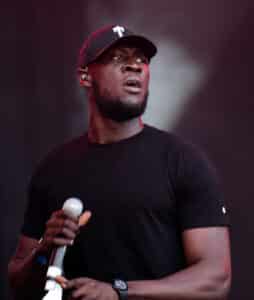
    Stormzy performing on stage

    Stormzy performing on stage

    Grime, Live!

    For people who don’t follow grime music, Stormzy is perhaps most famous for his appearance on the Pyramid stage at Glastonbury 2019. While he had a significant following before, this was a major turning point in his career, and his performance is widely considered to be Glastonbury history. In hindsight this may seem ridiculous, but at the time Stormzy thought that he had completely blown it. “Onstage it was the worst thing ever. After about 20 minutes my sound blew and I couldn’t hear nothing… I came off stage bawling my eyes out,” Stormzy says on The Jonathan Ross Show. Thankfully, he was convinced by the recording of his performance, saying, “When I watched it I was like ‘Thank God! I can’t believe this actually went well!”

    Grime has long been fraught with controversy, both over violence and drug references in lyrics, and over the genre’s potential sticking power. In 2018, the BBC had already published an article asking if grime was dead. For me and 1,999 people at the sold-out O2 Shepherd’s Bush Empire on the 11th of May, grime was alive and well.

    I don’t have a background in grime music – in fact, I’m relatively unaware of the modern music scene compared to my friends and colleagues. You’re much more likely to find me at folk gigs and dad rock shows than at any
    of the big festivals, but I can enjoy just about any kind of music if I’m exposed to it. That’s why, when researching this piece, I started listening to grime and liking what I heard. In fact, I came to the conclusion one Friday evening that I couldn’t honestly write about a genre without going to a show myself. Luckily, Tottenham-born rapper and grime giant Chip had a show booked for the following week.


    “Most working musicians never got the capital

    together to buy a house, so they don’t have any security.

    That’s kind of the trade-off,

    you live hand to mouth.”


    The Shepherd’s Bush Empire is an ideal venue for bands and solo artists. It’s large enough to attract big names, but small enough that you don’t need binoculars to keep track of the performers. For Chip’s show, I opted for the standing tickets, which ended up being an excellent call. I must admit that I arrived with a little bit of trepidation. For the past week before the show I had been reading commentary about how violent of a genre grime is and the danger of the imagery, so I had no idea what to expect. I am happy to say that if Katharine Birbalsingh wanted proof that grime is not all about violence, she would have found it at this show.

    I walked in at the opening time – 7:30 – in a show of punctuality and complete unawareness. Little did I know that Chip wouldn’t be coming on until 9:30, and the fact that I cruised through the line with ease didn’t tip me off either. However, I’m glad that I arrived early, because it gave me a chance to scope out the venue, take in the opening acts, and meet some fine folks. Contrary to the image which is often portrayed of grime music and its fans, everyone I met was extremely nice even though I looked very out of place. I dress like a 1970s dad who’s taking his kids camping in Yosemite most days, and that day was no exception. If there had been any meanspirited energy in the crowd, I would have been an easy target, but almost immediately I found myself making friends.

    While looking around I saw busy lights, modern looking bars, but also charming turn-of-the-century scrollwork which reminded the audience that the place was built in 1903, and large analogue clocks with illuminated signs reading “TRANSMISSION” and “REHEARSAL” harkening back to the days when the venue was still in use as the BBC Television Theatre. But beyond the venue itself, the thing which struck me most was the amount of people required to put on the show. Everyone thinks of the musicians themselves, but becoming an artist is a far less secure way to make a living than the myriad other jobs available in live performance.

    Daniel Maitland is a lifelong musician who both writes original music
    and teaches students a number of instruments. His career may lead you to believe that he thinks music is a very good choice to make a living, but he takes a more realistic view when it comes to achieving great fame, or even earning decent money in the industry.

    “I think there’s a danger. The truth about pursuing music is it will give you a more interesting life, and you’ll have more adventures than you would if you worked in the post office, and you’ll have a vocation which is a comfort when times are hard – but you almost certainly will be poor,” Maitland says, “Most working musicians never got the capital together to buy a house, so they don’t have any security. That’s kind of the trade-off, you live hand to mouth.”

    Following one’s dreams is an admirable thing, but as Maitland describes, it is not practical to think that music is a surefire way to make a career, or to get out of poverty. From security and bar staff to lighting designers, sound engineers, and managers, there are many different people who create the atmosphere required for a stellar show. Live sound engineers have the extremely important job of making sure that the performer can actually be heard. They can make up to £40,000 a year with experience, so that’s a solid career choice for those with a passion for music and performance.

    Events promoters who take charge of marketing for a gig can make around £30,000 a year, depending on venue, frequency of events, and experience. Booking agents often charge 10-20% commission for an event, so their salary completely depends on how big of a gig they’re booking for. Their job is to find people like DJ Ironik, who warmed up the crowd at Chip’s show.

    DJ Ironik’s set got the crowd in a good mood, which didn’t take much considering reasonable drink prices and a strong feeling of anticipation in the air. The tunes were accompanied by a large screen displaying 90s bowling alley style graphics of CRT televisions, tumbling dice, flames, and at one point spinning igloos at a snowy arctic outpost.

    When Chip took to the stage, the crowd went crazy – but that cheer was nowhere near as loud as when Chip announced that his parents were in the crowd, with good seats on the second level. He launched into his set, starting with some of his older songs, then moving on to selections from his new album “Snakes and Ladders”. He has an energetic stage presence, assisted by a mastery of the mic and a mix engineer who made it clear there was no lipsyncing going on. This was pure performance, and thanks to the work of everyone involved in the process, we were all loving it. What struck me most was the sense of community – not based on racial or social constructs but based purely on love of the music. Everyone was there to have a good time, and if you were there to have a good time too, then you were part of the furniture.

    Stormzy headlines the Pyramid stage at Glastonbury
                 Stormzy headlines the Pyramid stage at Glastonbury, Julie Edwards.

    The Rags to Riches Myth

    So how do artists like Chip and Stormzy make it to the top? These stories of rising from hardship to have a following on the world stage are inspiring, but is it practical, or even healthy, to tell young people that the same thing can happen to them?

    To find out the connection between music, social mobility, and education, I also spoke with Lee Elliot Major OBE, who is the nation’s first Professor of Social Mobility at the University of Exeter. He is quick to warn that, as a rule, most people don’t ‘make it’ to the same level as people like Stormzy, and he stresses that more help is needed to make the music industry more accessible to people from disadvantaged backgrounds.

    “Stormzy is a great exception to the rule, of course, and it’s interesting that he has kind of very publicly – generously, in some ways – committed to help people. It’s interesting that he’s chosen Cambridge for his scholarship. It’s great to try and help kids get into Cambridge, but arguably we need more support for young people to get into the music industry,” Major argues. “One of the dilemmas Stormzy will have, and a lot of artists suffer from this, is that the working-class credentials and background you have which made the songs authentic to begin with gets lost as you become successful. What do
    you write about when you are suddenly rich and middle class, to some extent? You see this in many older artists, that’s part of the age, you’re just not as young and maybe in tune with some of the younger generations. But another big part of it is also your class, right? You’re just not experiencing the same real- world experiences that other ‘normal’ people will be experiencing. So it’ll be interesting to see how Stormzy evolves, and whether he retains that authenticity that he currently has.”

    As artists gain fame, they often can become detached from their audiences simply because their lives begin to bear no resemblance to the everyday struggles which once provided inspiration.

    For Stormzy, fame has shown him a different side of life – a side full of people incredulous at his success due to race. “You can tell they think I’m not supposed to be here,” Stormzy has said, referring to his experiences at high end establishments. “I’m going to live where I live, I’m going to have my hood up, wear all black, and I’m going to be in a first class lounge, or in this mad restaurant, or in this posh hotel and be like, ‘Oh, you didn’t think young black people could be here?’”

    Whether Stormzy is going down the path of disconnection with his audience is yet to be seen, but for now, Major argues that he has more influence over young people than top politicians. I showed him these lyrics from the song “Crown” off Stormzy’s album H.I.T.H.

    All these fancy ties and gold plaques

    Never had no silver spoons in our mouths, we sold (crack),

    Don’t comment on my culture, you ain’t qualified

    Stab us in the back and then apologise If you knew my story you’d be horrified The irony of trappin’ on a Boris bike

    Major replies: “I would argue that one of the main problems with low social mobility is that we have increasingly detached elites, both in the US and the UK. And that’s not a political point. Whoever the political leaders are, because they come from quite
    privileged backgrounds, they really
    do not understand where some of the young working-class people are coming from, so those sort of lyrics speak to that,” Major continues. “And Stormzy has more power, in many ways, in terms of influencing the young generation than politicians could ever have, because they’re just kind of out of touch with normal people. There’s two dimensions to this – one is that they come from very different social classes, but there’s also a generational divide as well which I think is very strong now.”


    “Never had no silver spoons in our mouths,

    we sold (crack).”


    Young people often take inspiration from celebrities, and that’s not always a bad thing. We frequently hear “follow your dreams” from people who actually mean “follow your dreams but limit your expectations”. The issue is one of scale. Yes, some people will go from disadvantaged backgrounds to becoming superstars, and there’s no reason not to try and make it big. However, programmes designed to increase social mobility must be further reaching than that in order to help a larger number
    of people. Major argues that Stormzy represents a type of success which only happens to a select few and offers some alternatives to affect more widespread change.

    “The problem with this is that it’s almost the American Dream version of social mobility, which is very powerful, but very dangerous. And the reason for this is that only very few people do make that incredible journey. You get the same thing with elite sports, when we see the premiership players, some of whom come from working class backgrounds, who are earning incredible amounts. Now, that’s a combination of talent,
    work, luck, etc. and that certainly is not the case for everyone. So I worry about narratives of social mobility that are very narrow around that kind of rags to riches transition,” Major says. “Cambridge is an incredibly prestigious, elite institution. It’s a wonderful place, but very few people go there, right? If we really want to improve social mobility more generally, then we have to try and help those kids who don’t go to university. So we’re talking about apprenticeships, we’re talking about local jobs, and those sorts of transitions are really important in the social mobility picture.”

    Former Secretary of State for Education Nicky Morgan believes that the key to promoting social mobility is starting from a young age. With a focus on a return to pre-pandemic norms in the classroom and an increase of degree-level apprenticeships, Morgan says that social mobility can be greatly increased.

    “Education is one of the greatest engines of social mobility and there are still too many students of all ages not getting that opportunity to change their lives through a great education,” Morgan says, “Ensuring that higher education is clearly open to everyone, including broadening the diversity at our top universities is important – but with the growth of apprenticeships this is becoming more finely balanced, and the opportunity to do degree-level apprenticeships needs to be more widely known. Post-pandemic, ensuring that the focus on high standards at schools and face to face teaching at universities are restored as quickly as possible are vital to ensuring greater social mobility.”

    The Stormzy Scholarship is certainly seeking to achieve the goal of “ensuring that higher education is clearly open to everyone”, and at Cambridge the scholarship is driving a change. However, the strides being made in educational racial equality by Stormzy’s scholarship are currently only present at the highest level of university education. Based on Morgan and Major’s advice, perhaps the best way for Stormzy to increase social mobility would be to sponsor degree-level apprenticeships and raise money for early education in underfunded schools, alongside his high-profile Cambridge project.

    Stormzy at Ronnie Scott's for the MOBO Awards nominations

    Stormzy at Ronnie Scott’s for the MOBO Awards nominations, 2015

    The question of Stormzy is a complex one. On the one hand, there’s no
    doubt that in reflecting his own life experiences and those of the people around him Stormzy has produced lyrics which are at times unsettling. For Birbalsingh, the messages found in some of Stormzy’s lyrics are enough to warrant a full condemnation of the artist. But this is more than offset by what he has achieved at Cambridge, as shown by my conversation with Panda. Yes, the Oxbridge experience has a long way to go before it can be hailed as truly all-inclusive, but it is clear that Stormzy is helping to end the stigma surrounding elite higher education institutions by showing black students that there are systems in place to help them in what could be an uncomfortable environment.

    Part of what makes the image at the National Portrait Gallery so interesting is that Stormzy isn’t a straightforward figure. His influence on British culture is undeniable, which is why the National Portrait Gallery chose to include Mattock’s striking portrait. Mattock and Moulden’s pride in being a part of the changing direction of the National Portrait Gallery shows that the portrait of Stormzy is not only evidence of his cultural influence but is in fact yet another example of his power to shift longstanding norms.


    “It is clear that grime is both art and poetry.”


    Todd Swift has assuaged any doubts I may have had about the lyrics. While not everyone will agree with the Shakespeare comparison, it is clear that grime is both art and poetry, both of which have always taken on new forms over the years. But Stormzy’s story also reminds us that we have a long way to go in terms of social mobility in this country, as both Major and Morgan explain. Without programmes which help a wide range of people from disadvantaged backgrounds, social mobility will continue to stagnate, and the rags-to-riches elevation of just a lucky few will not solve the problem. To this writer, Stormzy is an artist who is trying in his own way to use his platform for good. He recognises the weight of his role, he’s attempting to correct past mistakes, and he’s making commitments to help young people for the future. For someone who became a household name at 23, Stormzy is handling the pressures of his success far more gracefully than most.

    Nobody should think that a career in music is easily achieved. On the other hand there is no doubt that Stormzy is an example of what is possible with talent, hard work, and yes, a little luck.


    Read Stuart Thomson’s take on social mobility in the UK here

  • Lee Elliot Major – The Good Parent Educator: Book Review (2024)

    The Good Parent Educator by Lee Elliot Major, a review by Evgenia Lazareva

    I have been following Lee Elliot Major’s inspiring work for some time now. A global leader in his field, he advocates for social mobility and empowering parents. The captivating title perfectly defines a new era of parents post pandemic, which we all became involuntarily. Raising a young child in London puts immense and constant pressure to get it right education-wise, despite me working in the industry, so as soon as I saw the book, I clicked order.  

    It was just what I needed. A comprehensive step by step guide, an insightful education roadmap – from birth to workplace. Backed up by solid and thorough research, yet so easy to read, it is cleverly structured, with fascinating facts, key takeaways, and useful bits of advice. You can independently explore each area and dig deeper thanks to helpful additional reading and references provided at the end of every chapter. The author speaks as a parent and educator, thus making it very relatable.

    It also could not have come at a better time: emerging from lockdowns, still slightly traumatised by home schooling, it’s the right time to be rethinking education entirely. As parents, we desperately try to get our children ahead in this turbulent reality. We are also exhausted, confused, and some even consider relocating to the sunnier climates and leaving this “educational arms race” behind (I know I am). Wherever you end up, the information that Elliot Major presents in this book is applicable to any family. 

    It compels the reader to “reflect on what you think education is for”. It is not “just grades”, but the fact remains that certain university degrees result in much higher earnings. Do you then aim for Oxbridge, or look at the bigger picture? “Parents are the single biggest predictor of children’s life outcomes”, says Elliot Major. No pressure then. It is about balance, finding out what matters most to your child and using available resources and information. The good news? “Most things turn out to be ok in the end”.

    So how do you become a good parent educator? If you do only one thing, “instil a love of reading” in your child. Ok, I think I have nailed that one. If you are struggling, Elliot Major offers practical and realistic tips to succeed. The section on choosing schools struck a (painful) chord. It completely consumes parents and often is a significant expenditure. Read that chapter very carefully before going to any school visits, and you will be well equipped.

    Unfortunately, parents can’t solely rely on schools to deliver results. The evidence in the book states that “what happens outside, not inside, the school gates” and “stable and supportive home background” are key for academic success. Work needs to be done at home, and not just the homework (which is more important in secondary than primary). Children need help with their mindset, motivation, and efforts, and to “light the creative or sporting spark.” Elliot Major believes that “children should devote as much time to arts and sports as to scholarly study” as they are “central to human development”. I could not agree more and instantly felt better about myself as a parent educator by the end of chapter seven.

    The research on attainment of summer born children was eye opening. It is disappointing that our rigid system needs that much challenging. But there are things that can be done: in particular, don’t be afraid to become your child’s advocates. Elliot Major further explores tutoring, digital exposure, learning styles, assessments, and a few other significant areas that parents must be aware of.

    The book culminates at life after school: apprenticeships, universities, Oxbridge, and venturing into the job market. Once again, Elliot Major stresses that no matter which path you choose – and there is a case to be made for each of them – “nurturing essential life skills’ is crucial when stepping into the real world of work (and avoiding your adult children living with you).

    Wherever you are on your child’s educational journey, the knowledge and advice in this book are valuable. There is even a little quiz at the end for readers, which took me completely by surprise, but I did well. I will be re-reading this book as my child grows and in moments of parenting doubts, and will continue to empower my inner Good Parent Educator.

    The writer is the co-founder of Collab Education

  • Exclusive: how Emma Raducanu changed the world of tennis

    Christopher Jackson examines the rise and stall of the 2021 US Open champion, and asks what we can learn from her in our own careers


    Emma Raducanu sits in a luxury hotel, immediately more interesting than the backdrop behind her. Interior designers will have specific words for the subtle gradations of brown, beige and mauve which I see, conveying low-key opulence. The gold struts of a light disappear out of shot. Behind her, half-lost in the night, are the ghosts of other buildings, suggesting Raducanu is in some upper floor suite: this feels appropriate since she has been in the stratosphere of sporting stars for the last 14 or so months.

    Raducanu is perched on the sofa, professionally lit. She is dressed in what looks like a purple ballgown and which is probably Dior – one of her sponsors. The spangly crucifix which she wears for all her matches – including her 2021 US Open final victory – disappears in the glitter of her dress. It is as if she has found herself by accident in the interviewee’s chair and decided to allot some brief time before heading out for the night.

    Recalling the last helter-skelter year, she says: “I’ve had a lot of new things that have been exciting. It’s great to learn from different industries and see new things, and I can apply it into every aspect of my life really, even my tennis. So I think that’s been really eye-opening.”

    To recap for those who may have missed what has been without exaggeration the most astonishing fairytale in all sport, Emma Raducanu began 2020 as a little known tennis player. The armchair fan might easily have pigeon-holed her as the latest in a long run of British tennis players who ‘don’t quite make it’. It would have been easy to imagine without any disrespect intended to any of these players that here was another Johanna Konta, Elena Baltacha, or Heather Watson – one of those British hopes, who shine briefly then move off into commentating, coaching, management, or agenting.

    It didn’t work out like that. Instead, Raducanu had a promising run at Wimbledon in 2021. At that time, she was ranked outside the Top 300, and entered the tournament as a wild card. She charmed everyone on her way to the fourth round. That match was disappointing at the time, and saw her lose to Ajla Tomlianoviç  after experiencing breathing difficulties.

    But in retrospect it was formative: Raducanu subsequently entered the US Open Championships and had to win three qualifying matches to be able to enter the main draw.

    What happened next would be deemed unlikely if submitted as a Hollywood script. Raducanu went on to beat a string of top players: Stefanie Vögele, Zhang Shuai, Sara Sorribes Tormo, Shelby Rogers, Belinda Bencic, Maria Sakkari and Leylah Fernandez to win the tournament. More than this she did so without dropping a set. On her victory, she received public congratulations from the late Queen Elizabeth II, who called it: “a remarkable achievement at such a young age…testament to your hard work and dedication”.

    These developments have let to pressure, of course, but Raducanu herself has been philosophical about that. “I’m a Slam champion, so no one’s going to take that away from me,” she has said. “If anything, the pressure is on those who haven’t done that.”

    In short, this sort of thing doesn’t happen; to Raducanu it did.


    School’s out


    Raducanu’s victory was astonishing in itself: it also revealed somebody who revealed herself as well-spoken, educated, charming and humorous. She has sometimes been deemed, as we shall see, a poster-girl for social mobility or diversity in sport. Interestingly she has a grammar school background having attended Newstead Wood School in Orpington, which though it celebrates her on its website does so in a more understated way than other schools might.

    In fact, for much of her ascent to superstardom, Raducanu was multi-tasking her burgeoning tennis career with A Levels, but now things have shifted a bit. Raducanu continues, telling Harper’s Bazaar: “Even though I’ve finished my A Levels now, I like to keep my brain quite active. Bath time is also when I watch TV or Netflix– I find I don’t get much spare time to do that otherwise. People always ask what I’m watching but it’s usually quite obscure.”

    And what is she watching and reading? “Right now I’m really into these different Chinese shows because I’m trying to improve my Mandarin! As for books, I recently finished The Monk Who Sold His Ferrari by Robin Sharma  which is about this lawyer searching for the meaning of life. I like non-fiction books best. I also like talking to my friends – not so much on the phone, but I’m a big texter.”

    It’s this which sets Raducanu apart: her maturity and willingness to learn. As you consider the person on the hotel sofa, you realise how she is already an old head on young shoulders, used to being the object of attention and fascination; the impression is of somebody who has very swiftly reconciled herself to fame, as if her astonishing story was what she expected to happen long ago. She came prepared.

    So what is it like when the limelight comes for you? When I speak to Chris Eaton, the former World No.317, who reached the second round of Wimbledon in 2008, he compares his own experiences as a tennis player to what Raducanu is experiencing: “I would say that my experience would be extremely different to a lot of other peoples’: it’s rare to have an experience with the press which is only positive. For me, there was no expectation. Nobody got my phone number, social media wasn’t what it was. Accessibility-wise, you didn’t have Instagram where you could message somebody or post something. Emma has outrageous expectation.”

    I remember once talking to a tennis coach at Reed’s tennis school, which the former British No.1 Tim Henman – and Eaton – had attended. He told me that many students had been as talented as Henman but Henman had been the only person who, if you told him to hit a ball against a wall for 10 hours, would follow the order unquestioningly.

    The story, apocryphal or not, seems to open up onto the question of what success means in sport, and how much should be sacrificed in order to obtain it. Furthermore, success in sport has its relationship to success in other disciplines, and young people already wish to find out how they can emulate her achievements in their own lives.

    “I think the confidence comes from just inner belief,” Raducanu has told Vogue. “My mum comes from a Chinese background, they have very good self-belief. It’s not necessarily about telling everyone how good you are, but it’s about believing it within yourself. I really respect that about the culture.”

    2M5W3PM Emma Raducanu, MBE, British tennis player, close up of face, smiling, in evening dress,


    But Raducanu’s story is already a layered one as much to do with setback as it is to do with that astonishing victory. 2022 was the year she began to experience reversal as she adjusted to joining the main tour: the latest example of this was her defeat to American teenager Coco Gauff in straight sets in the second round of the 2023 Australian Open.

    Raducanu has been both a meteoric success story and someone who has increasingly had to wrestle publicly with disappointment. In the merciless world of stratospheric celebrity, disappointment will mean criticism, most of it unfair. Press intrusion is now an aspect of her life; perhaps it’s even its defining note – along with her newly found wealth which itself cannot come without its own measure of difficulty.

    Raducanu admits this publicly, telling Sheer Luxe: “Professionally speaking, I’m very proud of my resilience this year. I’ve faced quite a bit of adversity and I’ve had to keep getting back up a lot. So much stuff is said about me that isn’t true, but I try not to let it affect me. The past year has meant getting used to that side of things – the publicity and hearing all these things I never even knew about myself! The attention on the tour is so intense.”

    Behind the beauty and the smile and the Raducanu we think we know there is someone far more complex, and indeed perhaps less obviously enviable than the one we had her down for.


    Numbers Girl


    By their endorsements shall ye know them. Raducanu has had the most monied and famous brands beating their way to her door, and this has given her, in addition to instant financial security, a host of commitments.

    Raducanu explains in that plush hotel room: “I’ve been lucky enough to work with Dior and Maria Grazia Churi who I’ve met a few times and she’s so nice. I also like that she’s all about feeling comfortable and having casual stuff in your wardrobe that you can wear day to day. Nike is probably another one because I’m always in tennis clothes and don’t go out very often! That said, I think they’re the masters at making the sporty stuff just look a bit cooler. I’m also into quite masculine pieces – you’ll often find me wearing a men’s polo and tennis shorts.”

    Eaton explains how it goes for the likes of Raducanu: “It all depends on what contracts she has with these brands. Is it to wear a watch at the end of everything and do one corporate day a year? If so, it shouldn’t be a problem. If it’s a question of five different sponsorships requiring ten days a year, suddenly you’re looking at 50 days a year which then means you don’t get any time off and you’re always working.”

    For Raducanu, the sponsorship questions feel different; for this article, we spoke to Christopher Helliar, her agent, who was willing to cooperate on the basis that our magazine was interested in Emma’s substance.

    And there’s a lot of that. In general, her endorsements feel thought-through. Raducanu is able to talk articulately about the sponsors she’s signed up with. Consider this excerpt, for instance, this dropped-in reference from an interview with Harper’s Bazaar: “I wake up a lot during the night and my hydration always takes a hit overnight – I’m an athlete, so I need to keep on top of that to perform properly during the day. You’ll always find a big bottle of Evian next to my bed, so the first thing I do is normally have a big glug of water!”

    Likewise, her commitment to BA chimes with the jet-setting lifestyle of an international tennis player, and her physical beauty makes her a natural fit for Tiffany’s jewellery and Dior.

    But the same brands would be a good fit for many other tennis player on the circuit. As one looks through the long list of her endorsements, one leaps out as somehow being more specific to Raducanu and that is her deal with HSBC to work on financial literacy, about which she has said: “To partner with HSBC is so natural for me having grown up playing in the HSBC Road to Wimbledon and having been a customer for many years. If I wasn’t a tennis player, I would definitely want to work in finance so I’m excited to learn more about the industry in the years to come.”

    Raducanu’s parents are both in finance and so it is of interest to look at what the sponsorship might mean. Strangely, HSBC say they are unable to comment which makes one wonder a little about the depth of their commitment to the question itself. However, there can be no doubt that financial literacy is of importance and that the broad idea is valuable, even if HSBC’s approach to the sponsorship might be deemed unduly standoffish.

    I talk to Anna Freeman, founder of Zavfit, a business committed to financial literacy. So, what does she make of the partnership between Raducanu and the bank? “From a marketing perspective it makes a lot of sense,” she tells me. “HSBC has always looked to use ambassadors who connect cultures while using sport as a tool for education around their brand and products. Emma is a great example of someone who is young and has found her passion and taken her chance with a brilliant platform to carry a message to a new generation.”

    Of course, it’s not necessarily a straightforward match. Freeman continues: “While it’s hard to ignore the fact that Emma won’t be having financial struggles herself anytime soon and she’ll have obligations to support HSBC with their advertising returns, she is relatable to a younger audience while representing aspiration, so using her to help bring education to the next generation is very important. However well it does as a campaign, we’d like the big players like HSBC to continue using real people in everyday situations to tell their stories and make the conversation reach everyone.”


    2JDRRM0 Emma Raducanu features on HSBC advertising outside their branch in Wimbledon ahead of the 2022 Wimbledon Championship at the All England Lawn Tennis and Croquet Club, Wimbledon. Picture date: Thursday June 23, 2022.


    So why is financial literacy a problem in society? “It’s not understood because it’s not interesting. It’s not interesting because it’s not relatable,” Freeman replies. “Children and young people have learnt preconceptions about financial literacy and money from their parents which will usually have a negative connotation. We’re made to think that ‘money = problems’ and so we avoid learning about it. We’re then brought into a society where every finance operator sells the same thing ‘Saving is Good, Spending is Bad’ and the cycle continues from generation to generation.”

    So what is Freeman’s solution? “Instead of talking about all the bad things associated with finance, why don’t we talk about the good it could do?” she asks. “How to spend our money in ways that improve our health and happiness and get away from the model that finance is all about protecting a future that feels like lightyears away to the younger generation.”

    This failure has real mental health effects in Freeman’s view, and it’s this insight which led to her founding Zavfit. “From our perspective, we see money in the same as diet and fitness – we know people want to do the right thing but they don’t know what that is. We’re all different and so we need to find what works for us. Instead of ‘how much money do I have’ we should be thinking about ‘How can my money make me happy’.”

    The above conversation illustrates the power of Raducanu: she can make us talk about things which we wouldn’t otherwise talk about.


    Eschewing the Negative


    But, of course, building a brand is a complicated business. Formerly of BDB Pitmans, Stuart Thomson is one of the UK’s foremost public affairs practitioners and explains: “Hitting the heights of winning the US Open at such a young age has presented Raducanu with the opportunity of  building her brand the way she wants it to be. For many more established players, there isn’t the level of interest or relative blank sheet that Raducanu has. That lack of history is a real benefit to her.”

    And does he foresee any difficulties there? “Well, with that, of course, comes the pressure not only to win more tournaments but also to live and breathe her newly established personal brand. Many audiences will be interested in any deviations from the brand and use that against her or to generate click-bait adverse headlines. She will need to get the right people around her in both a sporting and communications setting so that her brand is built and protected for the long-term.”

    And, of course, there is a substantial team of people behind her from her financially savvy parents; her agents Helliar and Max Eisenbud; her physiotherapist Will Herbert; her nutritionist Kate Shilland; and hitting partner Matthew James. Professional sport as it grows and expands produces an array of well-paid careers undreamed of even 20 years ago.

    Despite these people around her, tennis is often considered a highly individual sport – and it is. There is a loneliness about the match situation which can only be partially offset by the creation of a large entourage. This is tennis’ particular fascination: it is a game of fine margins, where the scoring system makes it possible to win more points than your opponent but still be defeated because you didn’t win the crucial points at a crucial time. There isn’t another sport like this which so advertises the need to compete well in pressure situations.

    In others words, it’s an abnormally stressful career choice. It might also be said that Raducanu’s story opens up onto the whole question of positivity in sport and in our lives generally. Her uniqueness is so far encapsulated by that incredible run at Flushing Meadows in 2021. If she never wins another major championship it will always be a remarkable story: it can never be taken away from her.

    So how did she manage to hit those heights, and what might we ourselves learn in our careers from her? After all, work must be said to have its element of performance, analogous to sporting performance.

    To learn more, I talk to leading psychologist Dr. Paul Hokemeyer, who tells me: “Succeeding in both competitive sports and a competitive life in times of elevated stress requires us to elevate above our emotional reactivity and utilize our prefrontal cortex. This is the part of our brain that enables us to control our emotional responses and channel them into concrete and focused action.”

    What’s interesting is that Hokemeyer doesn’t just find this in his sporting patients; it’s replicated in other sectors. “Many of my highly successful patients frequently describe this ability as ‘supernatural’ or as an ‘out of body’ experience,” he continues. “They go on to explain how in this state, they are removed from what they see as their human form and come to occupy a highly mechanical state that has no feelings. In this highly automized state of being, their emotional reactivity is suspended, their physical sensations fall away and their mind becomes myopically focused on the immediate task at hand – be that task winning a tennis match or closing a real estate deal.”

    When it comes to Raducanu, she has been able to reach heights few other players have ever managed, but then she has found it hard to rediscover that form. Likewise, in our own lives we have good days and bad days, a period of peak performance, and moments when we end up wondering why we couldn’t replicate our best.

    So what is happening to us in our careers when things aren’t working out? Hokemeyer tells me: “When it comes to sport, not everyone is biologically wired to withstand this intense level of being. Some people, in spite of their talents and discipline are genetically wired and environmentally tuned to reject the pressures and stresses of elite competition. Their central nervous systems short circuit the elevated cognition needed to stay focused. For these people, failing or surrendering becomes a primitive and highly successful strategy to put them back into a place of physical and emotional safety.’

    So on some level then, it’s almost as if we want to lose. Eaton, who now coaches at Wake Forest, one of the top tennis universities in the the US, agrees with Hokemeyer, and tells me that the very top players – Federer, Nadal, Djokovic and Murray – all of whom he has got to know well on tour and as a coach, very rarely let this mindset enter into the picture. “These very top guys. They have five or six people to take care of them, which definitely helps. But take Andy Murray, who I got to know well – his attention to detail is amazing. Here at Wake Forrest, I’m coaching 22-year-olds and some are very good and some will turn pro. But what’s hard is to get across how far along the best guys are in terms of desire.”

    Eaton gives me an example: “Look at the Andy Murray Netflix documentary Resurfacing. It just punches you in the face how desperate he is to be great. You watch the practice drill, the warm-ups, what he’s doing between shots: everything is immaculate. It stinks of desperation to be great. Very successful people are operating on that different level of detail.”

    And yet for everybody – even for Roger Federer and Rafael Nadal, and certainly for Raducanu – things go wrong. “For my players here,” continues Eaton, “I see the frustration when it comes to dealing with things going wrong. It’s not this generation’s strength: they’re very used to getting what they want and so when things don’t go well they don’t always respond well.”

    For Eaton, if you look at the stories of the great players, they always met a moment similar to the one Raducanu finds herself in 2023. “It seems like everybody has to conquer a personal flaw to get to be great. Federer for a while was too angry, or maybe too relaxed in his personality. He conquered that. Nadal used to seem scared or too timid; he certainly conquered that. There was a point when Djokovic would complain too much about injury. And in that documentary, you can see Andy Murray sitting in a hotel room in Australia having just lost to Djokovic in the semi-final, and saying, ‘This is not acceptable. What can I do to change this?’”

    And Raducanu? “It will be interesting to see how she deals with it. She’s young and she’s got expectation and there’s this way out smiling at her – her marketing ability. It will be interesting to see how desperate she is to be great.”

    Careers wise, there are sports psychologists out there to help the likes of Raducanu, and a good coach will also be a mentor: here, then, we meet another analogy between the world of work and sport.

    One of the leading sports psychologists is Matt Shaw who works for Inner Drive. So what work does he do and how did he discover it was what he wanted to do?

    “In my role, I work in two main contexts, in sport and in education. In sport I tend to work in two key areas: all-round development and learning and performance under pressure. In the all-round development element, I help athletes to learn better, improve and to grow as a person, whereas in the performance under pressure element, I help athletes to thrive under pressure when it matters most. Both my sport and education roles require me to deliver 1-1 support to athletes and speak in front of large groups of pupils, staff, and parents.”

    So how does he teach players to optimise performance? “Our athletes work with us to explore what being mentally strong really looks like in the build-up to a big event. For example, working on things like how to deal with mistakes, asking for help, and how to appraise stressful and important events. This enables athletes to better focus on what’s important in the moment and to think in helpful ways in order to perform at their best.”

    Matt wisely refrains from commenting on Raducanu’s precise plight as he says it’s not helpful to comment from the outside. I ask him instead what it is about those like Tiger Woods who do come back from injury, and what we might ourselves – and perhaps Raducanu herself – might learn from them? “What we tend to see with experts like Tiger Woods and other successful athletes is not only a physical muscle type memory whereby they are able to complete successful movements over and over again, but also a resilience that is built by a long and often challenging path to success. For many athletes we often only hear about their success which of course teaches them how to win and the emotional control associated with that. However, it’s often the tough moments that the best grow in and learn from to get better next time.”

    By that measure, Raducanu is entering the most important years of her life now; what she chooses to do in these years will define her as an athlete and as a person. It will be difficult, as all careers are, but that difficulty is also a gigantic opportunity for a new level of greatness.


    Simply the Best


    But there are many promising signs that Raducanu is grounded and self-aware. She knows she is in that rare category who have not only discovered what they might be capable of, but explored it, conquered her demons, and achieved a career as a result.

    But this isn’t the case for everyone; many have an inkling that tennis might be for them, but they have no serious chance of knowing for sure one way or the other. For instance, she has shown herself admirably concerned over the question of social mobility and tennis.

    The great issue in relation to tennis is that many young people from disadvantaged backgrounds don’t have the opportunity even to discover if a tennis career is possible for them: our country is full of a latent athleticism which, lacking an easy outlet, fizzles out in far too many cases.


    2G68NJ7 Emma Raducanu of Great Britain in action against Sorana Cirstea of Romania during the third round at The Championships Wimbledon 2021, Grand Slam tennis tournament on July 3, 2021 at All England Lawn Tennis and Croquet Club in London, England – Photo Rob Prange / Spain DPPI / DPPI


    Fortunately, there are many people, and some of them highly influential, who are making it their life’s mission to fix the problem.

    One is Nino Severino, a former tennis coach, and the widower of former British No. 1 Elena Baltacha. To say Baltacha, who died of liver cancer at the horribly early age of 30 in 2014, is much missed is to riot in understatement: when she died, she left a terrible gap in many lives.

    But this might be to state the case too despairingly: because of what Baltacha committed to during her life, she continues to impact lives positively: her generosity of spirit is her legacy, and, as you talk to Nino, an astonishingly active legacy at that. Raducanu donated two tennis rackets to the charity auction organised by charity Love All, with proceeds going to several charities including the Elena Baltacha Foundation.

    I ask Nino how the foundation started: “It was when we were travelling. What Bally noticed whenever we were travelling was that tennis is typically for more affluent children and the kids in the deprived areas weren’t getting a chance because tennis didn’t go to the schools. She said she wanted to do something about it.”

    Many would make the observation and then do little about it. Bally, by all accounts, wasn’t like that. “In between travelling the world on tour, we started to organise school trips with a view to introducing tennis to deprived areas.”

    Soon others became involved: “Judy Murray loved the idea. That was back in 2010 and she loved Bally like a daughter. She came on as patron and then she was followed by Martina Navratilova. All we’ve tried to do is get as many girls as possible into tennis.”

    Raducanu has sometimes been deemed a poster girl for social mobility in tennis. After the famous 2021 US Open victory, the Olympian javelin-thrower Tessa Sanderson wrote in The Sun: “For years, tennis in Britain was generally regarded as a white and middle class sport but thanks to Emma Raducanu now it is not.”

    Severino agrees: “Emma is as close to a tennis miracle as you can get. Qualifying was tricky enough so to go and do that. It’s funny though, in all my years of coaching, you come to realise there’s no accident. It’s their pathway to greatness, and it’s their opportunity to continue their rise.”

    What Severino is now focused on is giving that same opportunity to as many people as possible. The Elena Baltacha Foundation is focused on young people who may well get on the track to a professional career. Judy Murray (“she really gets her hands dirty”, Severino says) is focused on helping kids near Dunblane. Tim Henman is active in the area too with the Tim Henman Foundation.

    Another is Patrick Hollwey, who has founded TennisForFree with comedian Tony Hawks, a charity which aims to regenerate park space with a view to giving young people the opportunity to take part in tennis.

    Hollwey tells me about the genesis of TennisForFree: “It’s a bizarre story as to how it all started. My wife was always a tennis player and when I took it up I must admit that I found the cliquiness in clubs quite off-putting. It’s not the most welcoming of environments if you’re not a good player.”

    This caught his attention and as his interest in the sport grew, something began to bug him: “I began to notice that the public courts were never used and were padlocked. You had to go down to a hut, pay to get on the court and it made the game a bit unwelcoming.”

    And how did he pair up Hawks? “A few months later I was on a plane coming back from India with Tony, and we had both had pretty rough trips. We sat at the bar and put the world to rights; among the topics discussed was the elitism of middle class sport. A few days after the flight, Tony called me up and asked if I was serious about making a difference. I said I was. So we went down to the local tennis court and chained Tony to it. Then we sent a cutting email to the Minister for Sport, the Head of the LTA and other tennis luminaries and we essentially said: “This is a public sporting facilitiy that is locked and excluding people. You don’t do this with basketball, or skateboard parks. Why do you do it with a tennis court?”

    Fast forward to 2023 and many people have listened. For one thing, Hollwey and Hawks have an impressive list of celebrity endorsers including Pat Cash, Hugh Grant and Stephen Fry. But the government and the LTA are listening now too.

    Hollwey is among those who applauds the government and the LTA in committing to delivering this changed landscape: “We talk with the Department for Culture, Media and Sport. DCMS is currently investing £22 million into public tennis courts, and the LTA top that up with £8 million, and £3o million over the next few years. That’s a lot of money going into the question of rectifying the dilapidation of public facilities.”

    But there’s still a long way to go, he adds: “What we need to do is to encourage people to get out there. People need to know what is available and what the benefits are, and I don’t think enough people know of the opportunities.”

    This is where Raducanu is of such importance. Hollwey says: “I can’t think of any comparisons to Emma’s story – not even Leicester City winning the premier league. To go through qualifying like that – it’s Roy of the Rovers stuff. She’s inspirational to young girls and teenage girls are the hardest to get into the sport – and then to retain.”


    Business case


    Tennis then keeps intersecting with other things: with politics, with business, and with our essential ideas about justice. Perhaps this is a function of its popularity; but of course not all young people who take tennis seriously can have a lengthy career in it.

    We might forget what a high level the top players are at: it is quite likely that even if you are stratospherically good at tennis, you’ll eventually meet a ceiling where you can’t get any better.

    But if that’s the case then there are other options; excellence at tennis has much to teach us about how to attain excellence in the wider world. Hokemeyer tells me: “I rarely find a highly successful person who has not engaged in some sort of sport in the past or is currently engaged in a sport of some kind in the present. For this reason, I advise the parents I work with to find some sort of sport, activity or hobby their children can engage in.” So what are the precise benefits? “Sport enables our children to cultivate discipline and develop a sense of agency over their lives,” Hokemeyer explains. “In clinical speak, through sport we develop what’s known as an internal locus control. We see the connection between effort and outcome and we develop healthy bodies and minds that can manage stress and conflict in productive ways. It’s also important to note that people can start playing a sport, be it tennis or bridge at any stage of their life.”

    Severino sees other synergies between sport and business. “You’ve got to have a Plan B,” he explains and points to his work at SportsSkills4Business which aims to help young people beyond their sporting journey. “We want our SS4B Student Athletes to know that their time in sport is not only about learning how to become technically and tactically skilful at their sport, but also to be connected with the virtues and skills that being a competitive athlete will provide them with,” the website’s mission states.

    Hollwey is also bullish about the opportunities available in sport: “There are so many opportunities for people to work in sport. A lot of coaches left the sport during the pandemic; they had no work and took up other temporary careers which have turned into full time careers. So there is a shortage of supply of coaches and particularly new young coaches with a different mentality and a different outlook.”

    Eaton also points out the win-win nature of trying to make it at tennis, or other sports. “Some of my students go on to be pro, and go onto the tour; some do well and others struggle,” he says. “We have the same conversation, and I always say: “Go on tour and play for a year.” Don’t go straight into a job. For employers, it’s quite appealing to have somebody who’s been a sportsman, and who has some real experience of having travelled the world. Sport gets you far: it shows that you’re decent under pressure, able to deal with things when they go wrong. I say to my guys: “Do you really want to be the same person as 700 other applicants?” You can say: “I’ve done everything they’ve done,  but I’ve spent the last two years in 25 different countries, basically running my own business.”

    And Raducanu? The curious thing about these tennis players is that they exercise a certain fascination because of fame, talent, and wealth. But something about the way they acquired all this is so extraordinarily simple – a case of dedication and talent at a single sport –  that you find yourself looking for the next thing about them. But often there really isn’t much more to it than this and that is what feeds the media frenzy: an appetite has been created for something which isn’t there.

    With Raducanu, the more I look into her I feel differently: she has hit the heights but shown rare dignity when difficulty has arisen. She’s been wise and thoughtful in her choice of sponsors, and articulate about what she wants to achieve, and philosophical when she’s had setbacks. Our world is full of sporting phenomena. Raducanu, in her talent, her single-mindedness, and in her fallibility is something rarer. The only word for it is inspiration – and you don’t need to be a budding tennis player to feel it.


    Emma Raducanu Timeline


    Nov. 13th, 2002 – Born in Toronto, Ontario to Ion Raducanu and her mother Renee Zhai.


    2004 – Moves to England at the age of two, raised in Bromley


    2006 – Attends Bickley Primary school in Bromley


    2007 – Begins playing tennis, alongside a number of other hobbies including gokart racing, ballet, and horse riding


    2013 – Begins attending Newstead Wood School in Orpington


    2015 – Becomes the youngest ever to win an International Tennis Federation tournament at the age of 13 when she wins the Nike Junior International in Liverpool


    2018 – Professional debut on the ITF women’s circuit, winning the $15,000 ITF Tiberias, her first professional title. Later that year, she would go on to win a second title at the ITF Antalya.


    2020 – During the pandemic, she wins LTA British Tour Masters title while preparing for her upcoming A-level exams.


    2021 – She reaches the fourth round in her Grand Slam main-draw debut, before winning the US Open without dropping a set. She tests positive for Covid-19, causing her to miss her second exhibition match at Royal Albert Hall. She completes her A-levels, earning an A* and an A in mathematics and economics, respectively.


    2022 – Faces aftereffects of Covid-19 and injury, leading to an early withdrawal from the Nottingham Open and causing her to miss Eastbourne. She competes in Wimbledon where she is defeated in the second round, and enters the US Open again where she loses her opening match.


  • Katharine Birbalsingh on the problem with government

    Katharine Birbalsingh


    I am sometimes asked if there’s any danger of children being put off by reading Shakespeare. Our children at Michaela Community, some of them start here at 11 years old and they’ve got the reading age of a seven year old and so we are just trying to get them to read at all – especially in the age of phones and Internet and so forth.

    You might have a few kids in the top set who might read. When I do assemblies and take copies of Julia Donaldson and ask who’s read The Gruffalo and so on, a few children from the top sets might put their hands up, but most won’t. So they don’t really know books at all. For us, it’s not a question of should we do Ian Fleming instead of Shakespeare. It’s much more fundamental than that.

    In our library we have speed reads, what they are books written for six and seven and eight year olds, we don’t want them to feel they’re written for younger children. The idea of them being voracious readers isn’t accurate, apart from a few children in the top set. One of them we say when families come into Year 7, is we want children reading half an hour every day – that’s additional to their English lessons. For some of them, we say, they can do ten minutes a day.

    But in their lessons, they love Shakespeare. In their lessons they really enjoy it – they understand him, they can access him, and it’s dramatic. But our families have never heard of Hamlet – not only do the kids not know, but the parents don’t know. And the few who have, certainly don’t talk to them about it at home.

    We’re trying to get families to talk to their children – and it could be about anything. Many middle class people without knowing it are in on this secret club without knowing it where everyone knows how to teach their children. They mention Hamlet, or they count how many peas are on the plate, or the daily news, or they teach them who the prime minister is, and to ask how their day is. They know how to do it and it’s naturally.

    I’ve worked my whole life with people who don’t know much about their children. The question then is how to change this. The problem is that education moves very slowly. What’s a good today can be a bad school in three years’ time. The Education Secretary changes every couple of years and if you set up a new school it takes five years before you have results but by then you’ve had two education secretaries. It takes a while for things to change.

    People in government I know from working in the Social Mobility Commission, they’ll change every few months – somebody new joins, and trying to find consistency is really hard and and that’s why there’s no institutional knowledge. I don’t know how you fix that – you’d have to change the way government works.

    I suspect it’s a problem across government. It’s one of the things which makes the state weak. The people at Apple have been at Apple for years and year. Of course, they’ll bring in new people and lose people, but at any point time you’ll find that the core people have been there for at least eight to ten years. In government, you’ll often find that people have been there for that period, but the system they’ve been moving around within government doing different roles.

    It’s not that they leave government, or that they’re not paid enough, it’s just the way the government is set up. Those who work there like the variety. I bought all my team of the Social Mobility Commission to Michaela Community to show them what’s possible, but it takes a long time to get them on board. And then you get them on board and they go off to some other part of government.

    I’ve never chaired a commission and I’m not giving up just yet. I’m at the stage where I’m persuading people, and people are coming on board and I’m hoping people will stay and they won’t move. I’m hoping they’ll stick with me because they’ll have been inspired by what they see and hear.


    Katharine Birbalsingh is the headmistress of Michaela Community School 


  • News: Finito mentioned in House of Commons skills debate

    Finito World


    We are pleased to say that earlier this week, Finito and its CEO Ronel Lehmann were mentioned in the House of Commons during a debate around employability, work and skills. This is a proud moment.

    It also highlights the important work that the company is doing via its All-Party Parliamentary Group and its bursary scheme to improve social mobility in a country where opportunities are too often limited.

    To watch Siobhan Baillie MP’s excellent speech go here:


    To read Guy Opperman’s response go here:

    https://hansard.parliament.uk/Commons/2023-07-11/debates/A21FE67B-1D3B-495B-9908-3A8F99E646DB/IncreasingEmploymentTraining#contribution-BE468098-32FF-4FDA-B24D-C3E0A1D58892

    This is another landmark moment in the company’s history where the work we do to help young people is definitively highlighted. To learn more about the APPG and how you can be involved go to:

    http://appgfutureofemployability.org