Tag: Roger Federer

  • Rafael Nadal: a member of “the elite of the elite of the elite”

    Why is Rafael Nadal so important? As the great tennis-player retires, it is clear he inhabits very rare company, writes Christopher Jackson


    It is the humility of Rafael Nadal which is part of what makes him so magnificent. Retiring from professional tennis in mid-November 2024, he described himself as ‘just a kid who followed his dreams’.


    He was that, of course. But his great rival Roger Federer came closer to the mark when he wrote in his moving statement marking Nadal’s departure from the sport: “You made Spain proud. You made the whole tennis world proud.”


    In fact, Nadal – like Federer himself – comes from a very small group of sportspeople who make the whole world proud. They are a credit to their species. Part of living in an era whose defining obsession is sport is to find a dramatic increase in the type which we might call the elite of the elite of the elite.
     

    Why is Rafael Nadal so important?
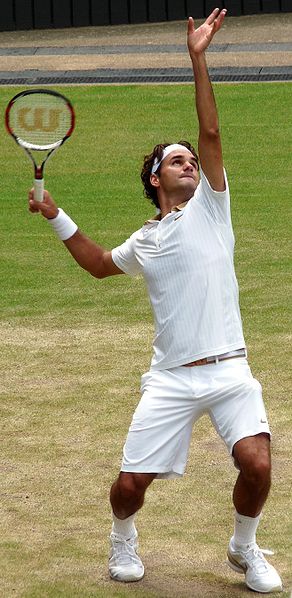
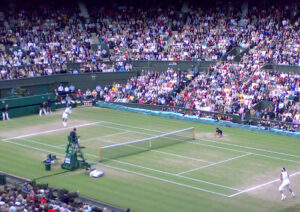
    The 2008 Wimbledon final. Federer is serving for the third set


    The group I am describing is not made up of No.1’s – though all of the people I would put forward for this category have been at one time or another the best in the world at what they do. But being no. 1 in the world doesn’t get automatically get you entry to this club. Being the best in the world here is a mere starting point to being perhaps one day somewhere near this conversation.


    Anyhow, you need to be World No. 1 for a long time to qualify. You have to be world no.1 over and over and over – but even that doesn’t get you there. Rory McIlroy has been the no.1 golfer time and again, but he isn’t in this category: he isn’t actually particularly close. The English swing bowler James Anderson is closer, but not quite there either.


    To be in the elite of the elite of the elite you need to do things nobody else can do – in fact, you need to perform at a level to which nobody else has ever performed. And you need to do it in a certain way. We can call this genius, or magic.


    In the first place, it has partly to do with ease of doing – or apparent ease. When we watch Simone Biles performing her floor routine we can see that she is doing much more than the relatively prosaic thing of winning her gold medal. She is reinventing that sport: she is qualitatively different. The same used to be true of Federer when he would waltz through a Grand Slam without dropping a set. It wasn’t just the ease with which he did this – it was the beauty with which he did it.


    Usually the elite of the elite of the elite express themselves in memorable moments – moments where time itself might seem to slow down, to expand, or to become elastic in some way. Furthermore, these moments will usually be tied to some form of necessity: they therefore represent necessity surmounted, or responded to with unusual skill and awareness.


    These are the moments which send a shiver. One thinks of Michael Phelps in the Beijing Olympics in the 100m breaststroke. Going for his seventh gold medal – to tie the Michael Spitz record which he subsequently beat – he was looking tired coming down the stretch against Milorad Cavic.


    Then something happened. Nearing the finish, Phelps summoned some last ditch strength, and rose out of the water with a sudden show of speed, to tap 0.01 seconds ahead of his rival. He rendered himself above an impossible moment.


    Tiger Woods was able to do the same. At the 2005 US Masters, Woods needed a birdie on the famous 16th hole. His drive went left down a precipitous slope. Viewers at home tend not to know how difficult the greens at Augusta National are: it’s like putting on glass.


    Woods, as every golf fan knows, lofted the ball up and it ran down the slope. It teetered on the edge of the hole then toppled in. Woods went on to win the tournament. He needed to do something nobody had ever done before and he did.


    The presence of someone who is in the elite of the elite of the elite doesn’t always need to come in moments when their backs are to the wall. It can also show itself with a certain ease of doing which can lend itself to a sort of inverse drama: it is the drama of things not being close at all.


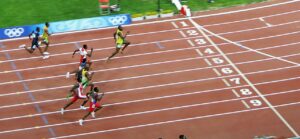
    In this category one thinks of Usain Bolt at the 2008 Beijing Olympics already celebrating about 80 metres in as he broke the world record by a vast margin. He looked almost as if he was flying. Nobody else has ever looked like that. In Bolt’s case it was tied together with a sense of theatre which in retrospect had to do with an extra awareness about the nature of the occasion: the nature of the occasion being that he was very likely to win and so could afford to lark about a bit.
     

    Michael Jordan is another example. When we watch reels of him hanging in the air before dunking a ball, it really can seem as though he has a different relationship to the essential physical structures of life to everybody around him.


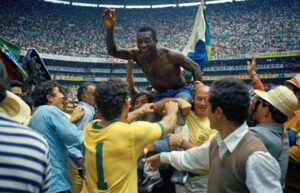
    In team sports sometimes we find a certain heightened sense of strategy and inventiveness – the ability to conduct surprising situations with a certain innate virtuosity. In this category we find the great footballer Pele. I have always been fond of the last pass that leads to Carlos Alberto’s goal against Italy in the 1970s World Cup Final.


    Pele looks like he’s playing against children. He collects the ball with his left foot, cradles it briefly, and then with a kind of infinite laziness sends it off to Carlos Alberto, who rifles into the net.


    Some of my favourite Pele moments have almost a kind of silliness to them. The attempt to score from behind the halfway line against Czechoslovakia in the group stages of the 1970 World Cup. The ball misses, but its sheer audacity opens up onto a whole realm of possibilities about how we might play football.


    Similarly, in the same tournament against Uruguay, Pele is running towards the box and the keeper coming towards him, both towards a cross coming from the left wing. Instead of trying to poke it past the keeper, Pele lets the ball go and circles back on himself while the goalkeeper flounders. That he then misses the goal doesn’t matter: he’s shown that there are another set of possibilities for the people to come after him to explore.


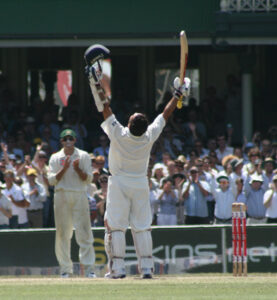
    Sometimes the elite of the elite of the elite can create moments which enter national folklore: inherently patriots, they can have a heightened sense of what their country requires of them. In 2008 Sachin Tendulkar, batting against England in the wake of the appalling Mumbai attacks, needed to produce a century to lift his country’s spirits, and he did. There can be something solicitous about the elite of the elite of the elite: they do what we need to them to do on our behalf.


    Clive James used to tell a story of Joe DiMaggio towards the end of his career. One of the greats of his sport, he was asked why he was warming up so hard when the game didn’t matter all that much in the context of a hugely successful career. “Because there’s a kind out there who hasn’t seen me play before,” came the reply.


    When this top flight of sportspeople are obstinate, their obstinacy can take on infinite proportions. Shane Warne, another member of the elite of the elite of the elite, was once asked who was the best batsman he’d ever bowled against. He replied: “Tendulkar first, then daylight, then Lara.” Asked why, he recalled how during one particular tour Tendulkar had found himself getting out to the cover drive. Unprepared to accept this reality, he simply cut the shot out of his repertoire all day long. Warne was shocked and delighted at the sheer determination of the man.


    Warne shows another example of the way this rarefied group can respond to circumstances. In Warne’s case, everything he did was characterised by a certain adventurous humour. During the 2006-7 Ashes, Warne was provoked by Ian Bell’s sledging to produce his highest test score. Bell, who Warne had been calling the Shermanator throughout the series, chose to answer back.


    Warne pointed his bat at Bell who was in the slips and said: “You mate, are making me concentrate.” Warne went on to score 71 from 65 balls. The implication is that he was so good he could stand in the great arenas of his sport, and not need to concentrate. But if you ever provoked him to do so, he could be as much a batsman as a bowler.


    Nadal reached these heights not because it was easy for him, but because he managed to balance extraordinary effort with profound humility. It was this which made him seem, as commentators frequently said, of another planet.


    That perhaps is what really unites these great sportspeople: they feel separate from us – they seem to resemble gifted visitors. One is sometimes left with the impression that the gulf between us and them is too great for it so be possible to learn anything from them.


    And yet at other times, it seems as though they have everything to teach. What makes it all a little easier to swallow is that time and again they teach the same sorts of things: hard work, humility, endeavour, a mysterious depth of commitment and even humour. We will need all those things in our own lives: that’s we won’t go far wrong if we make the Nadals and the Federers of this world our mentors.

     

  • Interview: Roger Federer’s favourite artist Nadeem Chughtai: “I’m blown away by the positive reaction.”

    Christopher Jackson


    There used to be a dead tree in Ruskin Park in South-East London, which always struck me as somehow sculptural. The other day I saw that it had fallen. I had grown so fond of this particular tree, it’s optimistic reach towards the skies, that I was bereft when I saw it had collapsed.


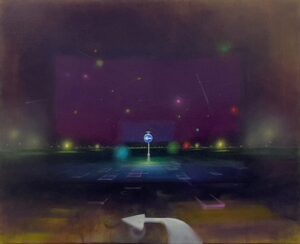
    But this probably minor development in the history of my local parklands makes me all the more delighted that this same tree is still standing in the work of a remarkable artist Nadeem Chughtai. Chughtai’s recent exhibition A Liminal State has people talking in Peckham, which as everybody knows is also the artistic centre of the universe. Chughtai used the tree as a basis for his picture There’s This Place On The Edge of Town (2020).


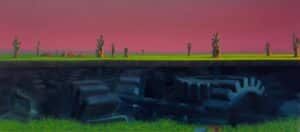
    There’s This Place on the Edge of Town


    One of the most basic requirements of an artist is power: Chughtai’s images always have an immediacy which nevertheless lets you know that your first impression is only the first part of your journey with that work of art. In this picture we see how we have become mechanised in ourselves, and how this can only lead to stunted growth. But the beauty of the tree, which looks like it almost wants to be an upwards staircase, suggests potential.


    It’s a brilliant conception, like all Chughtai’s pictures. So was it always art for him, or did he toy with other careers? “It really was art all the way for me,” Chughtai tells me. “Ever since I was very young I’d draw. Encouraged by my mum and influenced by a beautiful framed pencil drawing my dad made of my mum in the 1960’s. However, I did loads of jobs before going full time with an art publishing contract which set me on my way. Before that I always kept myself in the minimum wage positions for fear of committing myself further down other career paths.”


    Chughtai has had some major successes, with some celebrity clients including Roger Federer who chanced upon his work in Wimbledon village one year. Chughtai is particularly well-known for Nowhere Man, his character which he gave up at the start of the pandemic. These pictures, taken together, amount to a vast dystopian opus which tell the viewer unequivocally what we all sense: we are not headed in the right direction as a species.


    We never see Nowhere Man’s face. Sometimes there’s more than one of him. It is also possible to say that Nowhere Man is always in a negative setting, beset by the circumstances of modern life: alarming architecture, the trippiness of drug culture, the terrifying ramifications of contemporary uniformity.


    I Dream of a World That the Capitalist Philosophy Will Never Make Possible. Oil on three canvases (2017)

    I also note that they’re always dramatic force in these pictures, and I related this to the career Chughtai had on film sets, with his work including the Bourne series and Love Actually. Did that experience impact the way he paints now? “Yes, I always mention my scenic art days. I call it my apprenticeship. It was absolutely magical to be working on those film sets at Pinewood and Shepperton Studios,” Chughtai recalls. “I originally went there to try and make films after losing my way with drawing and painting after college, but as soon as I saw the huge painted scenery backdrops surrounding the sets I was sucked back in.

    I had hands on experience of painting pictures on giant canvases, off scissor lifts using strings, hooks and chalk to draw our lines. I learnt about so many aspects of painting as well as the cameras eye. The big one was perspective. Learning about that was enlightening for me.”


    I ask Chughtai if he has had any artistic mentors, and his answer also dates to this time: “Well, I always mention Steve Mitchell,  the scenic artist who I assisted over a five year period from 1999- 2004. He’s still doing it at 70 and we’re still in touch. He’s one of the world’s top scenics. I can’t tell you what I learnt over those scenic years and how it got me back into the art of painting.”

    I can tell how passionate Chughtai is about his calling, but the melancholy of these pictures is always there. It seems to cry out for some kind of remedy. Is Chughtai pessimistic about the human race and its future? “I believe we are not only on the path to a dystopian future but within it now. Just look at all the horrific and unnecessary human suffering going on all over the world and right down to our own neighbourhoods. However, I remain an eternal optimist and have every faith that the human race will unite to overcome this and bring about the necessary change required.”


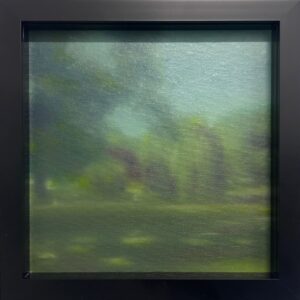
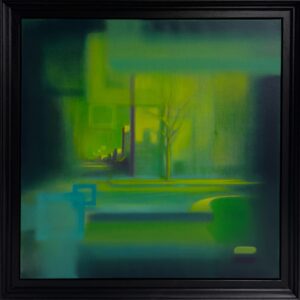
    The new pictures, with their liminal greens, seem to be the start of some new potential. Here we see Green Park as it might be seen in a dream, or in the hypnagogic state between sleep and waking. The journey to the centre of town to make these pictures is perhaps indicative of an interior shift in Chughtai. The new pictures also mark a big change away from character towards some other kind of painting which feels like it is yearning for mysticism – maybe even a metanoia away from despair.


    Was it hard to give up Nowhere Man? Might he ever experiment with another character? “It was very hard to shed the Nowhere Man. I doubt there would ever be another character. For me it represented humanity. If I ever need a central character again I’m pretty sure I’d call him up.”


    Humanity then is for Chughtai somehow passive and faceless – asleep perhaps. This makes the notion of an exploration of the liminal all the more important; it is to do with exploring what Seamus Heaney called ‘the limen world’, that curious borderland of the unconscious. I have a sense that these recent works are a necessary transition period and that it may in time lead to some sort of reconciliation between Chughtai and the damage of the world – a more optimistic vision perhaps.

    How did these new paintings come about? “The works exhibited recently at the Liminal State exhibition are exactly that; Liminal, as in kind of between or on the threshold. For me personally, up until just before lockdown in 2020 I was creating paintings with a central anonymous figure – the Nowhere Man. 16 years through the eyes of this character, so, shedding that to allow the next body of work to arrive has taken these last four years, and counting… The title, A Liminal State can also have numerous interpretations and could additionally refer to many other aspects; mentally,, physically, technically, artistically, societally… liminal.”


    These then are between states, and that means flux – in Chughtai’s art certainly, and therefore, since artists are their art, in his life. I ask Chughtai about his method of composition. Is it evolving? “It’s evolving and continuing its journey. I’ve changed the approach, technique, materials used and so much more since 2020. In fact, almost everything – but still the work has naturally evolved through different states to where it is now.

    It’s a continual fluid journey. I have also been developing an artistic theory and putting that into practice. It involves perspective and the way the eyes see and the brain interprets an image. It’s great testing a science based theory on my artistic practice… and it actually works. My most recent painting entitled, Turn Left. (2024) shows the theory in practice in its most developed stage to date, and I was blown away by the positive reaction it got when exhibited for the first time at the show.


    Turn Left, 2024


    This again, seems to me like a dream where the dreamer is sometimes given clear but mysterious indications of what to do – strange snatches of disembodied advice. To look at these pictures after immersing oneself in the Nowhere Man corpus is to see a kind of hope peeping through, because the world seems to be acquiring a kind of charge, groping towards some form of meaning. My sense is that this makes the next few years of decisive importance for Chughtai’s art. If we follow that sign, where does it lead?

    This new work has also sent Chughtai on a rewarding course of study. “Over the last four years I have really delved deep into studying and expanding my artistic learning. Visiting the London galleries on a weekly basis and getting to understand the philosophies of some of the great painters, while also educating myself about the amazing artists from around the world and their histories.”


    So who are his heroes? “I have to mention Van Gogh, I just love. His pencil drawings, they make me wanna scream. I would say that more recently I have been appreciating 20th century Western heavyweights such as Bacon, Klee, and Rothko who’s section 3 of the Seagram murals brought me to tears on more than one occasion. It was during a particularly emotional time for me personally whilst simultaneously looking to move my work along an different path. That painting allowed me to see within it what I wanted to do with my own work.”


    Chughtai has been going strong for a long time. So what are his tips for young artists about the business side? “Well, yes, it is a business – if you do it full time for your living. So if you don’t have the luxury of financial security, you will need to sell your work.

    This predicament will most likely influence the type of work you produce and therefore could involve compromise. That’s the tightrope. It can work in your favour but can also be a hindrance if not deterrent, which is a real shame because then we miss out on hearing and experiencing the voices from within those walks of life. So, believe in what you’re doing, put the time in and keep on making your art.”


    Maxted Morning, 2024


    And would Chughtai recommend the art fair route? “I love going to art fairs. It’s where it all started for me. Like our society, the art world is very hierarchical, but whether you’re at the bottom rung or at the very top, when all is said and done they’re markets with their stalls out. It’s great because people can stand in front of the work in the flesh, which is how I feel art works are best experienced… and there is so much under one roof. Art fairs are a great way to spend an afternoon… if you can afford the entrance fee, of course.”


    That’s often the problem for young artists at all. Has the conversation around NFTs affected him at all? “I did look into NFT’s a little some years ago but it seems to have gone quiet on that front so am unaware of where it currently stands. The whole digital thing is obviously a direction the art world is going down and there are many possibilities to explore. However, my focus and studies are with oil paint and a canvas because there’s so much more to come from there and that will always be ahead of any artificial intelligence.”


    Chughtai is an artist of rare talent, who is doing something very valuable: he is pursuing his vision where it leads. It takes courage to do that. Every artist can learn from somebody who has chosen his path so decisively then pursued his craft with such passion.


    For more information go to nadeemart.com 

  • New balls, please: how tennis could be the sport for 2022

    Christopher Jackson

    A while ago I wrote a book about Roger Federer. During my researches, I recalled a story of a friend of my father’s. This was Mike Eaton, who had been a formidable tennis player in his day, playing Junior Wimbledon. He subsequently fathered a son, Chris Eaton.

    Chris, as some readers might remember, had an impressive run to the second round of Wimbledon in 2008. Chris was one of those players, a sort of early male prototype of Emma Raducanu, who relished the big occasion. He didn’t win his second round match that year against Dmitri Tursonov, the then 25th seed, but it was close for a while: “the Eaton rifle” as he had once been known at school lost 6-7, 2-6, 4-6.

    Chris reached a career high singles ranking of 317. Thinking back to 2008, in retrospect Eaton was never likely to take a set off Tursonov. But if Tursonov had any temptation to gloat about it, it was swiftly removed: he lost in the next round to Janko Tipsarević. And Tipsarević at that time, as he would now admit, wasn’t realistically in the position of taking a set off any of the likely winners – then, as now, one of Roger Federer, Rafael Nadal and Novak Djokovic.

    The Raducanu rise means that tennis continues to be a pretty reliable bet for any young person thinking of entering sport

    Why do I bring this up? It’s because of a simple fact that Eaton’s father once relaid to me. Namely, that he had never once managed to return a single serve of his son’s. Let’s remember that Mike was a brilliant player in his own right. And let’s remember how easily Chris was dispatched from Wimbledon.

    In a story like this we begin to gauge the sheer level which the best players are at. Most of us don’t need a reason to feel more admiration for the so-called Big Three: we feel it already. But it is sometimes difficult to know quite how good they are. The story of the Eaton family tells us.

    The continued popularity of tennis seems assured, even though there must soon come a time when Federer and Nadal must retire, their bodies finally succumbing to decades on the tour. Djokovic will likely following suit in time, and surely will be the most gilded player of them all when he does so.

    The success of the game hasn’t always seemed as certain as all that. I am old enough to remember the big serving nadir of men’s tennis in the early 1990s when people like Michael Stich and Richard Krajicek could win Wimbledon seemingly while possessing one shot. I remember the 1991 final, between Stich and an ageing Boris Becker, as an unwatchable fiesta of boredom, where one wondered whether equipment had begun to chip away at skill: the battle went to the biggest serving, which really meant it kept going to the tallest.

    It was part of the magnitude of Federer’s achievement to change that, more or less on his own. People forget that in 2003, we felt excitement at the brilliance of his play – but also relief that we were now allowed to watch rallies again. And though Nadal and Djokovic both brought different styles to the game, they eventually learned to beat Federer on terms of Federer’s own making. It’s probably this which makes Federer fans so ardent: they remember what went before.

    Looking ahead, there is a natural trepidation about any era where Federer, Nadal and Djokovic aren’t playing anymore. But if anyone had any doubts about the future of tennis: enter Emma Raducanu.

    Raducanu’s success remains the most extraordinary story – and may even have been made more so by her subsequent decline in form, which I’m willing to bet, has nothing to do with core motivation, but all to do with her inherent instinct for the big occasion. The real test of Raducanu won’t be how she does in Transylvania but how she does in Melbourne in early 2022. After the dizzying heights of her US Open victory, it may take Wimbledon to get her fully motivated again.

    The Raducanu rise means that tennis continues to be a pretty reliable bet for any young person looking to enter sport. Of course, nowadays, with prize money as it is, you can earn a decent living as a player even without lifting many trophies. To take a random example, the current world number 99 Henri Laaksonen – not a player I had heard of until Google turfed him up – has career earnings in prize money alone of $1,849,304. That approaches financial security. To put this into perspective, it surpasses the earnings of one of the true greats of the game Rod Laver, who is estimated to have earned around $1,500,000 in the 1960s.

    So the money keeps pouring into this most gladiatorial of sports:  and some of it trickles down into other career options. Some of these are advertised on the Lawn Tennis Association website which has a helpful Live Vacancies tab. A Tennis Relations and Events Manager at the National Tennis Centre can command £45,000 pa plus, although the ads also stipulate that you need to be at the office in Roehampton three days a week. The job is seeking candidates who will “provide and implement strategic event development opportunities across our Events business and support with the delivery of our Athlete Plan.”

    Other jobs abound on the web. There is an ad for a seasonal gardener at Wimbledon – an idyllic-sounding job if, like me, you feel that Wimbledon fortnight is somehow elevated above all the other fortnights the calendar year has to offer. This is advertised as a “flexible role across the whole Horticultural Department’ and in the ad at least sounds like a great opportunity to see how those lawns look so immaculate year in, year out – and join a dedicated team to boot.

    Sometimes, there are also marketing initiatives which need staffing. The LTA’s current project is called “Tennis Opened Up” and its mission is to make tennis Relevant, Accessible, Welcoming and Enjoyable.”

    There is just a hint here that tennis has fallen behind other sports – most notably football – in terms of appealing to those outside the fee-paying school system. But it also means that more and more, having taken part in Wimbledon fortnight isn’t necessary in order to have a fulfilling career in the sport.

    Of course, as with every sport today there are a range of careers which touch on tennis: from sports agent to sports journalist and sports PR and sports charity, the major sports now touch every area of life. At Finito we have mentors with sports specialty and welcome all candidates seeking a career in the sector.

    And Eaton? That’s easy, he now works as a tennis coach. He joined the Wake Forest men’s tennis staff as an assistant coach during the 2016-17 season before being elevated to associate head coach prior to the 2018-19 season. When I last saw his father, he still hadn’t returned one of his son’s serves.