Tag: Robert halfon

  • 2022 Highlights: Finito event Report – Chair of the Education Select Committee Robert Halfon MP at the East India Club

    The much-loved Conservative MP discussed the issues facing education in the country covering everything from the legacy of Covid to the skills deficit

    Finito friends and mentors were treated to breakfast at the East India Club and a morning talk by Conservative MP for Harlow, Robert Halfon. As the current Chair of the Education Select Committee, Halfon is always in a perfect position to discuss the best way to help young people looking forward. He has so far used his role to promote the importance of apprenticeships, and has often had some frank criticisms of Russell Group universities.

    The finely decorated room made a suitable place for discussion, with its intricate moulding which frames ceiling and floor, and historic portraits dating back to the club’s foundation in 1849. Those in attendance included Finito CEO Ronel Lehmann, Baron Gold of Westcliff-on-Sea, Myles Stacey, the Special Advisor to the Prime Minister, Professor of Social Mobility at Exeter University Lee Elliot-Major, Chair of Capital Economics Roger Bootle, and numerous other high-profile business and thought leaders.
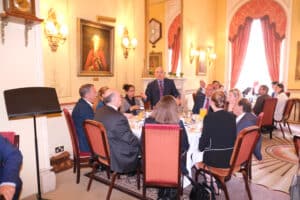
    Finito Education welcome Robert Halfon, MP, Chair of the Education Select Committee, as a special guest of honour at a Finito business breakfast at The East India Club, St James, London. 29.6.2022 Photographer Sam Pearce

    Amidst a turbulent time for national politics, Halfon  accepted the gravity of the cost of living crisis affecting so many across the country. “One of the reasons why there’s so much anger is because of the cost of living,” Halfon explained. “The Chancellor of the Exchequer [at the time of the event the position was held by Rishi Sunak] has just spent £37 billion in terms of energy rebates and is providing up to £1,200 to 8 million vulnerable families. But the fact is people are struggling to  afford to pay £2000 to £3000 on energy, even with the rebates. They can’t afford to drive to work. And that is the reality for millions of our countrymen and women.

    Halfon was speaking not just as Chair of the Education Select Committee, but also as the popular MP for Harlow, and he repeatedly turned the conversation back to the issues facing his constituents. Though Halfon has often been tipped for frontline politics, and has launched numerous successful campaigns during his time in Westminster, the prevailing sense was of a man who has never forgotten the constituents and their concerns.

    Halfon continued: “The second issue we face is that there is a view that government isn’t working. I mean you try to get a GP appointment, it’s virtually impossible. You try and get a passport. A constituent of mine paid £150 for a fast-track passport. They were told on the day before that they couldn’t get it, and they were told to refresh the website all the time as if they were trying to book an Ed Sheeran concert.”
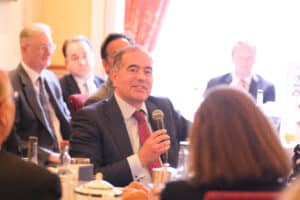


    Halfon spoke here not so much as a critic of the government but as a supportive voice who realises that all administrations are incomplete and that there is always more to do to support people who need that help. It was in this spirit that he raised an issue which has been close to his heart throughout his parliamentary career: “The fourth and final thing is social justice. Now I’m a conservative, I believe in the free market – and, of course, I believe in capitalism. But we haven’t mentioned the term ‘social justice’ as a party for quite a long time.”

    Again, Halfon’s remarks were measured and he took the opportunity to give balance to his remarks: “The government does some very important things, most of which the public don’t know about, such as individual measures to help with domestic violence and to help troubled families – but we need to put forward a coherent narrative.”

    Halfon argued that a major part of the social justice issue begins with education, and he continues to argue that Covid has damaged education at all levels greatly. He spoke movingly too about the role of chairing the Education Select Committee, one which he obviously relishes. “This is the best job I’ve ever had because I am privileged to hold a platform where I can effect real change for our children ,” he explained.

    So what does he think needs to happen to ensure our young people are work-ready when the time comes? “We have three problems facing our education system. We’ve got the COVID deficit. I was passionately against school closures, and I campaigned against them from the beginning, day and night. I thought that it would destroy our children’s life chances, their mental health, their educational attainment, and create safeguarding hazards and that’s exactly what’s happened.”

    Halfon is an important voice partly because he has such integrity: he is always a considered and passionate voice. He continued: “And with the social justice deficit, disadvantaged groups are just not doing well in the education system, and we have this perennial problem of education-based skills deficits. To be fair to the government, they have been doing a lot of good things in terms of the lifetime skills guarantee, the reforms to the Covid Catch-Up programme (based upon the Education Committee’s report), but I think we need a real debate on our national curriculum and whether it is fit for purpose in preparing students for the future world of work and the fourth industrial revolution.”
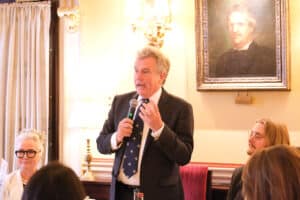
    So what do we need to do? Halfon was clear: “It’s all about knowledge, knowledge, knowledge, and it should be about knowledge and skills. Why don’t we have a wider curriculum where we do a mixture of skills, knowledge, vocational and technical education all the way through, rather than just having the dividing line that we do at the moment? We’re doing an inquiry on that. So the Covid deficit, the skills deficit, and the social justice deficit. I would argue that those are real challenges facing education.”
    There followed a lively and passionate Q&A. Neil Carmichael, who sits on the Finito advisory board, and previously held Halfon’s post, congratulated his successor on the work he is doing as Chair of the Education Select Committee. Carmichael agreed that the issues set out by Halfon all exist but questioned why economic productivity was left off the list.

    Halfon responded: “The productivity answer for me is skills. And my first ever speech was about apprenticeships in the House of Commons in 2010. We need to do more – there are nine million adults in our country who are innumerate or illiterate. I mean, that is incredible. 6 million adults are not even qualified to level two. I do believe in the new Post-16 and Skills Act that has just passed, but we must change our curriculum, promote skills, and get more young people doing apprenticeships.”

    There was an audible intake of breath when Sarah Findlay-Cobb, the CEO of the Landau Forte Academy, mentioned that her heatings bills for her schools had rocketed from £150,000 to over £1 million in the past year. It was a vivid indicator of the seriousness of the cost of living crisis and Halfon movingly expressed his sympathies.

    This was a remarkable event which showed what can be achieved by a good-hearted man in Westminster. As Myles Stacey returned to Downing Street for his daily meeting with the then Prime Minister Boris Johnson he had much to relay.


    Read MP Robert Halfon’s take on poetry in the national curriculum here

  • Robert Halfon on poetry and the national curriculum: “We don’t want a society of Mr Spocks”

    Robert Halfon reacts to the government’s decision to make poetry optional at GCSE on the national curriculum

    I’ve been asked lately about the Department for Education’s decision to make poetry optional on the national curriculum. I don’t think poetry has as much prominence in parts of our education system as it should – in some ways that’s understandable because of all that’s gone on during Covid-19.

    I understand the government’s concerns – that children are being left behind and not learning. I also understand those who worry about the Fourth Industrial Revolution and the predictions that 28 per cent of jobs might be lost to young people by 2030. There’s a natural recognition that the curriculum has to adapt and change. 

    But what the government doesn’t understand is that poetry and literature are one and the same. In my view, you can’t promote one subject over another: literature is actually just as much about learning poetry as reading books. I hope this is just a temporary thing – though it’s undeniably becoming a more widespread assumption in our society that poetry isn’t seen as important.

    “Of course, the Department for Education will say that it’s a temporary measure, and designed to take the strain off pupils, but the danger is that a temporary measure becomes precedent. “

    It’s a good time then to remind ourselves of the value of poetry – sometimes it can almost be like a puzzle. You have to think more, and it trains your mind in a very different way. If this changes suddenly became permanent, I think that would be very worrying.

    And of course, culture – and I include poetry in this – has an absolutely important role, not just in the economy but in our society. It shapes our lives. It’s not just good for our learning; it’s good for our mental health, and expanding our horizons. We don’t want a society where everyone is Mr Spock. 

    At the same time I do firmly believe that whatever degree or study people do they should do work experience alongside. If you’re a poet, why wouldn’t you do a placement at the Robert Burns Birthplace Museum? There should be practical work experience alongside the process of expanding your intellect. 

    The reason I mentioned Robbie Burns is because I had to learn him for a school competition. I have these bad legs and I didn’t lean on anything at that time. I remember standing up and my knee cap would always shake up and down. But I remember learning the first two or three verses of A Red, Red Rose by Robbie Burns – and my kneecaps just shaking in front of the whole school. 

    I’m sometimes asked if my reading has affected my career in politics. What I read goes into my subconscious. It helps me when I’m writing articles – I may think of things and quote things, or use metaphors. I wouldn’t say it’s necessarily directed me towards change of policy. It infuses my thoughts and permeates like a kind of beautiful stew in cooking for a long time – and it always tastes much nicer on the second or third day of eating it.

    But mainly I read to relax – and I’m happy at the moment as I’ve just read some very early stuff from Tolkein – not just The Lord of the Rings and The Hobbit, but also The Unfinished Tales and The Silmarillion, which his son, Christopher Tolkein gathered together after his father’s death. Tolkein was not just a great author but also a great poet: if you read Beren and Luthien, you’ll see what I mean. 

    “There’s an unwritten story: the importance of Conservatism in 20th century art”

    But if I’m honest I don’t read enough poetry. I tend to read books more than verse. But when I do read it I like it. I particularly like poetry that tells stories and also poetry which rhymes – especially Philip Larkin, though I won’t quote my favourite poem, This Be The Verse, since this is a family publication. He was a Conservative of course, as was my other hero, the painter LS Lowry. That’s an unwritten story – the importance of conservatism in 20th century British art.

    And again work was important Lowry actually began doing pictures when he was collecting rents in Manchester. Thinking about it, Lowry and Larkin, working in the library in Hull, might almost be the embodiments of my apprenticeships agenda.

  • Covid-19: What is the real cost for school children?

    Covid-19: What is the real cost for school children?

    Georgia Heneage

    A report from the Institute for Fiscal Studies (IFS) has revealed that school children are likely to lose as much as £40,000 each from their yearly salary in the future, due to repeated school closures during this second lockdown.

    The figures are not plucked from thin air, but are based both on estimations from the World Bank that a year of schooling increases earnings by on average 8% and that loss of face-to-face teaching could result in a total of £350bn lost earnings for 8.7m students across the UK. The £40,000 statistic is based on the average yearly salary in the UK.

    The disadvantages and even dangers of homeschooling and isolation have been widely discussed in the past month; remote learning has been seen as an inferior model of education to face-to-face contact, especially at a younger age, and continual isolation from peers is already having a knock-on effect on children’s mental health.

    But seeing the wider ramifications of school closures on children’s future career prospects and income puts the cost of the pandemic in an even bleaker light; the IFS’s figures are more applicable to those from lower socio-economic backgrounds, so the loss in yearly salary will worsen the already-huge fissure in education and later on in class pay gaps.

    Professor of Social Mobility Lee Elliot Major sees the UK as being at a ‘tipping point’ in terms of social inequality, which begins at the level of education. He says it’s become “near-impossible for young people from poorer backgrounds” to move up class and career ladders. If the onset of the pandemic added “extra weight” to this imbalance between class opportunities, these latest figures are likely to tip the scales even further.

    On Twitter this morning MP and Chair of the Education Select Committee Robert Halfon called the figures the fourth pillar of the “four horsemen of the school closure apocalypse”, the other three being “big loss of education attainment, huge rise in mental health problems, significant safeguarding hazards”.

    As ever, the cost is hard to quantify and these figures are mere estimations: but they play an important part in opening our eyes to the indelible effect school closures will have on the lives of what Halfon has called the ‘lost generation’.

  • Opinion: Diana Blamires on the need for live learning in the home

    Opinion: Diana Blamires on the need for live learning in the home

    Diana Blamires

    The recent plummet back into homeschooling has shown that the gulf between setting homework and live classes could not be wider. In some cases, it will mean the difference between passing and failing GCSEs, or worse, a career succeeding or failing.

    Assiduous students will most likely succeed with or without live sessions, but there is a huge swathe who will lose out if there isn’t a full diet of Zoom-style live engagement every day. This is why MP and Chairman of the Education Select Commitee Robert Halfon’s decision to call for the government and Ofsted to urgently come up with detailed guidance for online provision is so well-timed.

    Boys are most vulnerable; peer pressure dictates that set work should be done as fast as possible, not as well as possible, and the rest of the day is usually spent on the playstation. Once we hit the anniversary of the first lockdown, some students will have lost almost a year of their lives to such recreations. They will have shot down their chances of success with too much time spent on the wrong kind of screen.

    What’s more, lazy students forfeit their place on the top table by pretending to do their work when in fact they are inputting random answers just to get the work done. The students whose parents have time to check that Seesaw, an online learning app, hasn’t been swapped for social media will succeed. It’s easy to look like you’re top of the class when you’re on Tik Tok.

    Social media depicts earnest children and parents at the kitchen table with laptops, but don’t be deceived: for those with challenging children the struggle is untenable. When asked to do set work, many children react with defiance. This leads to the offering of sanctions or bribes, and the defiance continues. Some children are immune to sanctions and bribes, and for a significant number of challenging children no work is done. And parents, working from home, are most likely at their wits’ end.

    This scenario is being played out in countless homes by families (or worse, single parents) every day. Some parents resort to violence or the child lashes out, and the situation escalates. Zoom work calls are abandoned and siblings are left traumatised; parents have breakdowns; children struggle with their mental health. Remote homework has the potential to morph into more serious situations and bring about new challenges for exhausted parents.

    Asking a child to attend a live lesson, however, is not often met with the same defiance. Children want to be with their friends in real time as they are desperately missing interaction. After face-to-face interactions, live lessons are the next best thing. And it is not just private schools who get a glowing report. Some state schools are offering a full timetable of live lessons, and those at the top of the class in the state sector have proved it can be done. 

    Some childrens’ futures are being needlessly thrown down the drain. It’s time to act; it doesn’t take a GCSE in computing to provide a week of live lessons, and they will change lives.

    Diana Blamires is an education PR consultant