Tag: Religion

  • 7th October one year on: A Letter from Israel

    Christopher Jackson


    This letter is ten years late. I went to Israel for the first and so far only time in 2013, and for obvious reasons have been thinking about the country a lot since the attacks on 7th October 2023, and the events which followed. This is really a letter to Israel – a delayed epistle I’d been waiting for an excuse to write.

    I was unlucky in the lead-up to that trip: I dislocated my knee playing tennis a week before flying. I was thus forced to cut a comic figure in Jerusalem and Tel Aviv, hobbling with my grandfather’s old silver cane around the Old Town, which, as visitors will know, contains numerous steep pathways, including the famous Via Dolorosa up which Jesus is meant to have shouldered his cross. At one point, I remember an eight-year-old girl trying to steal my cane off me, leading to a scene reminiscent of the sort of thing which might happen to Larry David in Curb Your Enthusiasm, where I sought to wrest it back and found myself only just equal to the task.

    But I found I loved the country: loved its noise and its contention, and the passion for theology, philosophy and history that lay behind its disagreements. Jerusalem is a microcosm of the human story. To step into it – even casually, and unwittingly – is akin to presenting yourself to humanity for inspection. It all amounts to the strangest of looks in the mirror.

    In Jerusalem, it’s not unusual to find people coming up to you in a bar and asking some variant of the question: “Who are you?” “Where are you from?” To ask this question in any other city in the world is to issue a pleasantry; in Jerusalem it feels deeper than that, an invitation to consider your personal identity. Most people who go to Israel end up feeling that they somehow needed the experience. At times, it feels like undergoing therapy.
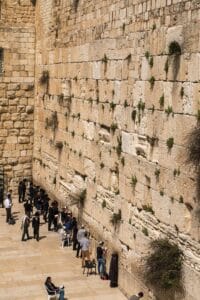
     

    It’s no coincidence that in the Gospels Jesus’ opening remarks to his disciples constitute both a salutation and a challenge: “What seek ye?” Quite a lot of the time in Jerusalem one closely neighbours the related question: “What am I seeking?”

    The answer, if we’re honest, almost always involves some sort of large noun: truth, beauty, happiness, love, God – peace. Jerusalem is a place to consider all these things, although periodically, as on October 7th 2023, it particularly evokes the question of peace. That’s because that question: “What am I seeking?” hasn’t always summoned up the same answers in the hearts of human beings.

    The large nouns mean different things to different people: for some happiness is a rave – for others it’s a church service. Peace in turn can be the means by which we gently seek to bring others into our sense of the world, or open ourselves to new avenues of being.  Alternatively, as with Hamas, peace might almost slide into its opposite: it might masquerade as the means by which we seek to still a murderous resentment which all too readily rises up in human minds.

    The founding of the state of Israel was widely deemed necessary in the aftermath of the Holocaust, but soon ran into a difficulty which now feels somewhat inevitable due to the geography of the situation. And yet if we believe at all in human freedom then we can’t quite throw up our hands and shrug that it had to be that way. We must admit that the whole question of the state of Israel foundered on human frailty.

    As a general rule, wars are what incompetent governments inflict on unsuspecting peoples. We cannot call the period from 1948 a period of model governance. On the other hand, there have been periods of statesmanship: the Oslo Accords, begun in 1995, and the Unilateral Disengagement Plan in 2005 both amounted to attempts to move towards the solution of the problem.

    As I travelled through Israel, I found myself asking how the situation has deteriorated so seriously so rapidly. The first clue is in the history itself. Everywhere else on earth, history feels asleep by comparison. Here, you feel its urgency – its pulse. To be surrounded by so much holiness is to exist in a highly alert moral condition, and this is the case if you’re only visiting. To live here must be another step up.

    Secondly, I often think of an observation once made by Daniel Barenboim the c0-founder, with Edward W. Said, of the West-Eastern Divan Orchestra. This orchestra brings together Israeli and Palestinian musicians. Barenboim was at a rehearsal and stepped out for a moment, returning to find his orchestra at loggerheads over politics. He watched them argue and reflected that both sides of the argument are of a similar temperament. It isn’t, Barenboim reflected, like a conflict between the Swedes and the Italians. This fact alone, Barenboim says, accounts for much.

    It all amounts to a charged atmosphere. There is a lovely museum Ticho House in Jerusalem which all visitors should see. It was founded by Dr Abraham Ticho, the husband of the landscape artist Anna Ticho. When Abraham, an ophthalmologist, was injured in the 1927 Palestinian Riots everybody – Jews, Christians and Palestinians – prayed for his recovery since he was the go-to man for the treatment of the common ailment trachoma.

    These riots, in which 133 Jews were killed by Arabs and 116 Arabs killed predominantly by Mandate police, were sparked by questions of access to the Western wall. It all reads like a terrible promo of the conflict we now have. The Shaw Commission, charged with looking into the matter, would find that the riots were caused by “the Arab feeling of animosity and hostility towards the Jews consequent upon the disappointment of their political and national aspirations and fear for their economic future”.

    Of course, one might have feelings of disappointment and anxiety without resorting to murder, and Ticho’s story reminds us that many didn’t have these feelings. It is worth visiting the Ticho museum to remember not just Ticho, but the people of every denomination who prayed for him because his medical skill ensured he was part of their shared interest. In Ticho’s story, we receive a tantalising glimpse of another set of possibilities for the region which sadly has never yet been taken up.

    And there is something unique about his wife Anna’s landscapes too. In these pictures, it is as if the land of Israel, like Jerusalem itself, carries a particular charge. This isn’t solely to do with politics: for Christians (and for many Muslims), these are the hills which Jesus retreated to in between sermon and miracle; for Jews, each bush can be aflame, as it was for Moses, with the suddenness of God; for Muslims, the very sky is open – filled with the idea of ascending to the Heavens. That means that Ticho can never be painting landscape in quite the same way that, say, Constable is painting landscape: she’s painting spirit.
     

    Injured though I was, I decided it would be worth taking a taxi out onto the West Bank. In Bethlehem, you can visit the Church of the Nativity – the supposed original of the manger which we used to recreate in our youth in rural Surrey. As we drove out, I saw the grape sellers – all Palestinians – reduced to selling grapes on the side of a dusty road, where little traffic comes. All drivers know that non-dusty grapes are available in the supermarkets of the built-up settlements nearby. It is a hopeless situation and even those broadly supportive of Israel will wonder at a lack of humanity which is so evident but whose causes are so difficult to trace.

    In Hebron, the look and feel is of a warzone without the bombs falling. Children kick bedraggled footballs against the walls of shuttered shops; Israeli tanks move through the streets, like sharks through a fish tank. Here the guidebooks point you to the Cave of the Patriarchs, considered to be the burial place of Abraham and Sarah – figures whose importance the major religions agree on.

    Here one feels one is entering something like the crux of the matter. As a Westerner, I was only able to go in through the Israeli side. There is an entrance for Muslims I didn’t see, and the interior itself is partitioned. I hobbled up towards some Israeli soldiers who seemed to be mocking my injury in Hebrew, which didn’t strike me as the most welcoming start.
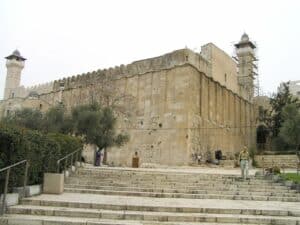
    Cave of the Patriarchs

    Inside, there is a seminary where Jewish students recite passages from the Torah, and everywhere there was a hushed seriousness and, to me at least, a palpable sense of things being about to kick off. This is the hard fact about Israel: from Woody Allen to Larry David, Jerry Seinfeld and Mel Brooks, nobody has made the world laugh harder than Jewish people. But to come to this land is to feel that everything keeps coming back to a flammable seriousness.

    In that Shaw Report which I quoted a moment ago, the writers added that the cause of those 1927 riots was the Palestinian sense that Jewish settlers were ‘not only a menace to their livelihood but a possible overlord of the future.’ In 1927, some two decades before the founding of the state of Israel, this was remarkably prescient: for many Palestinians this is what did happen.

    As you climb the hill to see Herodium, Herod the Great’s palace, I had a panoramic view of the homogeneous settlements somewhat resembling the worst kind of British council housing. As I hobbled skywards, the Adhan – the Islamic call to prayer – reached me easily from the skies. Sometimes it sounded like an assertion of some kind; at others a cry for help. Looking down on those towns from the archaeological site, everything felt so terribly boxed off.

    A commitment to freedom of movement is what we still have here in Britain and in the UK: this in turn is built on trust and the notion that everyone potentially has something to contribute through hard work to the betterment of all our condition. Interestingly, if you had to pick a country in the Middle East which has some of this spirit, you’d also pick Israel, especially Tel Aviv with its superb food and Miami-like energy of expansive bustle.

    We have all seen music festivals like the one which was taking place near Re’im on Black Saturday; most of us have been to them. These festivals, very far from my cup of tea, are part of our national life, and so we might recognise ourselves in the victims of the massacres. Alarmingly, I don’t think if Hamas were exported to the UK, that they would have much hesitation in massacring Glastonbury, as appalling as that might be to contemplate.

    This, in turn, cannot help but generate some questions regarding the pro-Palestinian – and all-too-often pro-Hamas –marches on the streets of London. Firstly, how many have been to Israel? Secondly how many of them have been to Glastonbury? One suspects here a far higher percentage in answer to the second question than to the first. But if this is the case, then many are marching in favour of the very people who would murder them if they had half a chance.
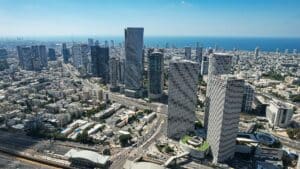
     

    Tel Aviv skyline

    None of this means that Israel has behaved in a flawless manner. Too often, violence has met with ratcheting language, and counterproductive violence. The failure is predominantly one of political leadership: no one would accuse Benjamin Netanyahu of too much resembling Nelson Mandela. But to consider this an isolated failure on the part of Israel’s leadership, as so many do, is a dangerous fantasy. To land on a fairly obvious point: any organisation whose central text is the Protocols of the Elder Zion, as is the case with Hamas, has a fair amount to learn about peace-making.

    Some people need to be fought; there is such a thing as the legitimate causus belli. In addition, the Mandelas of this world have a far greater dose of realpolitik in their make-up than we realise when we later lionise their achievements in peace. We forget that they often pivot to resolution only after having defeated the harshness of their enemies. Hamas has never been as cuddly as the left-wing intelligentsia has liked to imagine it.

    The reality is that history – any nation’s history – is peppered with injustices of every kind. The past is in some fundamental sense unthinkable – and yet it all happened.

    The usual way in which we move beyond atrocity is by acknowledging that many evils were perpetrated by the dead. This is the basis on which we forgive and forget. In England, we no longer identify with a particular side of the War of the Roses; I am as welcome in Lancaster as I am in York. Except when a rugby match rolls round, we have also rather forgiven the Norman conquest – and anticipate, as we walk through Paris, a degree of forgetfulness regarding Agincourt. The past has to recede because it was conducted by imperfect people.

    The same is true of the founding of Israel, and in relation to recent history in the region. There are two differences. Firstly, these events are closer in time. But secondly, the fear is that they shall in same way always remain so, because they revolve around both temporal and eternal questions. For so many people, Christianity, Judaism and Islam still matter, forming part of our essential hopes beyond the life of the body. It is not just that these affections won’t go away – it’s that anyone of religious inclination would be bereft if they did.

    If you want to know what that would look like then you have Soviet Russia, and maybe the hard-left wokeness in the UK to sample: identikit moralities where power goes not to the meek, the thoughtful or even the hard-working but to the noisy and the cunning. That’s the real reason one suspects that a large chunk of the left marches against Israel: they don’t believe in any eternal dimension whatsoever and would like to delete that from their lives. Like Christopher Hitchens, they loathe religion full stop, and can’t distinguish easily between the book of Genesis and Hamas: to them, it can all be grouped under the ‘God is not great’ banner.

    This is the intractability of the crisis: it goes deep into all of us and keeps refusing to recede. Israel is a remarkably complex undertaking with a paradox at its centre. It is, in one sense, a representative of the Western way of life in the Middle East. There are few cities so Bohemian as Tel Aviv. But, at the same time, when you get right down to it, it isn’t a particularly secular country. Too much of the Bible and the Koran takes place there for that to be possible.

    These two aspects have both created enemies. The hard fundamentalist right dislikes its licence; the left dislikes the obligation it places on us to consider religion. Israel is a land of miracles and from one perspective the bar of not killing one another over a set of misunderstandings feels sufficiently low that it ought to have been achievable by now. But we have to admit that it hasn’t been and that if you ever go to Israel you’ll be visiting the saddest, but also the most necessary, place in the world. It’s not a foreign country – it’s our collective story and that’s why it will always matter.


    For other examples of our letter series try these:


    Discovering the Charm Budapest: Tom Pauk’s Letter from the Heart of Hungary

    Omar Sabbagh’s Letter from Dubai: ‘As soon as it was safe enough to reopen, that was done’


  • Exclusive: Prosper in a busy world – Sir Terry Waite

    How to prosper in a busy world, Sir Terry Waite

    I retain equilibrium in our busy world by having time alone. Everybody needs some solitude and everybody needs a break from other demands of life because we live in an instant age. We notice the effects of this very clearly in all sorts of behavioural patterns – most particularly, in the anger and resentment we all see online.

    It is as if people today now have a very short fuse: they expect to get everywhere instantly, and this is an unconscious development arising out of our constant use of the Internet. Today we have to answer emails immediately whereas before there was a necessity to take life at a more leisurely pace, and to be able to digest things. The best antidote to all this and to prosper is to take time for reflection, and ideally a period of time off each year for a retreat or something of that kind.

    There are three goals to work towards in life in order to prosper. The first is to work for harmony in yourself and establish a healthy balance between body, mind and spirit. The second vital goal is to work for harmony with other people – and to be compassionate and understanding in that regard. The third, which we see people more conscious of today than ever, is to be in harmony with our environment.

    If you look at these three areas, the bad news is that we seem to be suffering crisis on all three fronts. The fact is that the rapid rise in mental illness particularly amongst young people is often due to this lack of inner harmony, and a failure to achieve internal coherence. On the second point, the anger and frustration with our neighbours tends to be brought about by a lack of understanding and compassion. Finally, the way in which we treat the environment is already wreaking a tremendous revenge on us in all sorts of ways when we see all the effects of climate change.

    Of course, there is such a thing as natural climate change, which we accept. However, we have confused the situation by our exploitation of the environment: we are out of harmony with nature, and sometimes behave as if we have forgotten that we are a part of it. The atoms that constitute our human body are the very same atoms that make up the stars. We are a part of a much bigger creative process: we are called upon to be creators and co-creators with God, but too often we behave as consumers and destroyers instead.

    We therefore need to encourage everybody – and especially to encourage young people – to be active in co-creation. The moment you accept this understanding, then an interesting thing happens: a sort of happy responsibility is bestowed upon you, and you become a creator with God. In my experience, this is the moment when the possibilities of life open up, and can be felt in your personal life as much as in your working life.

    The point is, of course, that God has created us in freedom: we are not just here to obey his commands, important as that is. We’re actually called to something far higher: we have been given the ability to choose between creation and destruction. It hardly needs saying that these are enormous powers given to the human species, and that we have to take them with the utmost seriousness.

    Quite naturally, if we don’t realise the importance of this, then we begin to suffer – and it is this suffering which makes up such a visible aspect of our present predicament: the restlessness and uncertainty which we all see when we look at the world. It is because we are not engaged in what we should be engaged in: the co-creation with God of a better world for ourselves and for others.


  • Book Review: Fantasyland: How America Went Haywire: A 500-Year History by Kurt Andersen

    Melanie Trudeau

    In his thought-provoking book Fantasyland: How America Went Haywire, New York Times best-selling author Kurt Andersen connects the dots from America’s Puritan past to today’s fantasyland of fake news, conspiracy theories and alternative facts that gave rise to the Trump presidency. Reading Andersen’s 500-year history crystallises the reasons why we’ve become a country with a partially developed frontal lobe, incapable of fully functional reasoning and rationality, prone to the fantastical.

    While Donald Trump’s victory in the 2016 election shocked America – Andersen suggests it even took Trump by surprise – his rise in politics is proof of America’s ultimate embrace of Fantasyland. Trump’s triumph hinged on his ability to play an impresario who leveraged the fantasy-industrial complex to his advantage like no one had ever done before. He played to conspiracy theories, exploited myths of white racial victimhood, and rode a far-right extremist counterculture that had taken over the American right before his rise to power.

    Founded on an excitable thirst for independence from their European past, Americans always harbored a tendency towards ultra-individualism. The American Revolution and Constitution coincided with the Age of Enlightenment, igniting a national movement that “guaranteed personal liberty above all, where citizens were officially freer than ever before to invent and promote and believe anything”. Americans’ right to bear arms gave rise to a deeply engrained gun culture and religious freedoms evolved into an exceptionally literal and fantastical religiosity. But the nation’s unraveling didn’t just happen overnight. Rather, the route Andersen takes us on traces the common threads of religious zeal, pseudoscience, and conspiracy theories, from the Salem witch trials and occult Freemasonry of the Enlightenment to the Satanic Panic of the 1980s, New Age theology and apocalyptic paranoia.

    As Andersen maps the journey through fantasyland, religion – particularly Christianity – plays a pivotal role in feeding the frenzy. The Puritanical ideology of discipline, austerity and hyperliteracy morphed into The Great Awakening of the 18th century, the formation of Scientology and the Mormon Church, and eventually the contemporary evangelical movement. Charismatic religious leaders like Pat Robertson, Billy Graham, Oral Roberts and Jerry Falwell became charismatic entertainers made famous through television and the Internet.

    The freedom to reinvent oneself within an anything-goes personal belief system gave rise to a collection, writes Andersen, of “fantasists, some religious and some out to get rich quick, all with a freakish appetite for the amazing”. Impresarios and hucksters such as P.T. Barnum and Buffalo Bill preceded Walt Disney, Hollywood and an industrial entertainment industry that blurred the lines between reality and fantasy. Oprah Winfrey brought magical thinking to twelve or thirteen million viewers every day, promoting New Age beliefs, alternative medicine (famously, Dr. Oz), anti-vaccine conspiracies, and imaginary energies. Andersen points to the 1980s as a tipping point for the convergence of entertainment and politics. Ronald Reagan’s rise from Hollywood actor to President of the United States seemed like a perfectly natural progression. Talk radio and TV news shows morphed into “politicised show business”.

    The digital era that began in the 1990s arrived just in time to amplify what Andersen calls the Kids “R” Us Syndrome where American adults began “playing videogames and fantasy sports, dressing like kids … and even getting surgery to look more like kids”. Gaming boomed into a multibillion-dollar industry creating imaginary worlds that felt realistic and offered an immersive experience for adults who wanted to play like children. Andersen points to Trump as having the ultimate case of Kids “R” Us Syndrome: “spoiled, impulsive, moody, a seventy-year-old brat”.

    It didn’t end there. Digital platforms allowed for “even greater immersion in the unreal”. Conspiracy theories and rampant falsehoods that were once on the fringe became mainstream. The mostly unregulated internet and social media platforms became vehicles for spreading fake news and fantastical stories to an audience which had little ability to distinguish between reality and fantasy.

    While Andersen admits that “flecks of fantasy are charming condiments in everyday existence,” he wonders if “it’s only America’s destiny, exceptional as ever, to unravel in the Fantasyland fashion”. His final call to action for Americans is to fight for facts and objective truth, find new protocols for information media hygiene, and regain national balance and composure. America’s ability to accomplish this is yet to be seen.

    Melanie Trudeau is an English major turned digital strategist. As a dual Canadian/American citizen, she splits her time between rural Vermont and Toronto.

  • The Archbishop of York at Easter: ‘We’re going to have to live digitally for the sake of the planet’

    The Archbishop of York at Easter: ‘We’re going to have to live digitally for the sake of the planet’

    The Archbishop of York, Stephen Cottrell


    York was quite severely hit during the pandemic in hospitality and tourism. My job is to be a voice of the Christian faith – and therefore a voice which is trying to speak up for the poor, and for issues of justice and peace. The Church is always trying to be involved as a voice for good within all the networks of our society; here in the North of England – as it’s known in the political discourse and perhaps it’s the job of the Church in part to constructively hold the government to account.

    Perhaps even now it’s too early to draw conclusions but there has been some fascinating research done about the impact of Covid on the church. For a while there was for a short while a narrative running about the Church being withdrawn – but that turned out not to be true. Two things I’ve noticed have been the building and nurturing of online community; many churches now tell a story of people participating in online church of one kind of another. We don’t yet know whether those people have gone on to participate in person. We’ve nurtured online communities in ways which churches three years ago which once had had 50 participants in person sometimes had 70 or 80 participants online.

    For the whole world, we’re going to have to learn to live digitally for the sake of the planet. There is an opportunity for us to find new ways of living which will be better for the planet – it’s already a hybrid world and I want to see the Church take the lead on that.

    When it comes to the pandemic, and the cost of living crisis, because the church has a presence – amazingly still in virtually every community in this land, we have been in the front line when it comes to providing support and pastoral care to people in need, particularly isolated people. It’s not just been the church, of course, but often the church has been in the lead with others when it comes to doing simple things like during Covid, making sure that an isolated person gets their prescription for them. Then there’s all the other stuff that’s well-known with food banks, debt counselling, homelessness, shelters, it is the Church on the ground which is leading in these things and I think we have seen the benefits of that.

    The question of work is a complex one. The most important thing I do each day is to say my prayers: that is the foundation and heart of my day. The Christian way of inhabiting life encourages us to live by that Biblical principle of the Sabbath. By that I don’t just mean literally the Sabbath, but the Sabbath as a principle which runs through life: God’s good ordering of time and space whereby we give time for rest and refreshment.

    My great hope is that as 2023 continues, we won’t go back to how we were before the pandemic. The first thing we should consider is time for refreshment and rest. Of course, we all do that in different ways; my advice is to weave prayer into the rhythms of your daily life. Even in lockdown, most of us had routines. My advice is to examine the existing routines of your daily life, and see where prayer can be woven into it, so that you stop seeing prayer as an additional burden, by getting up half an hour earlier for instance. Instead, look at your working day and consider whether there is an opportunity to weave prayer in. For instance, if you walk the dog, for example, you might find that that is a good opportunity to pray or be still. Some of it comes down to personality; some of us find stillness much easier when we’re moving. You need to find the way which is right for you. I sometimes worry that people have a picture in their mind of what prayer is and think they must conform it.


  • Easter feature: How the Internet reinvigorated the nation’s cathedrals

    Easter feature: How the Internet reinvigorated the nation’s cathedrals

    In the first of a series of articles on jobs within the religion sector, Robert Golding delves into how Anglicanism has coped during Covid-19 

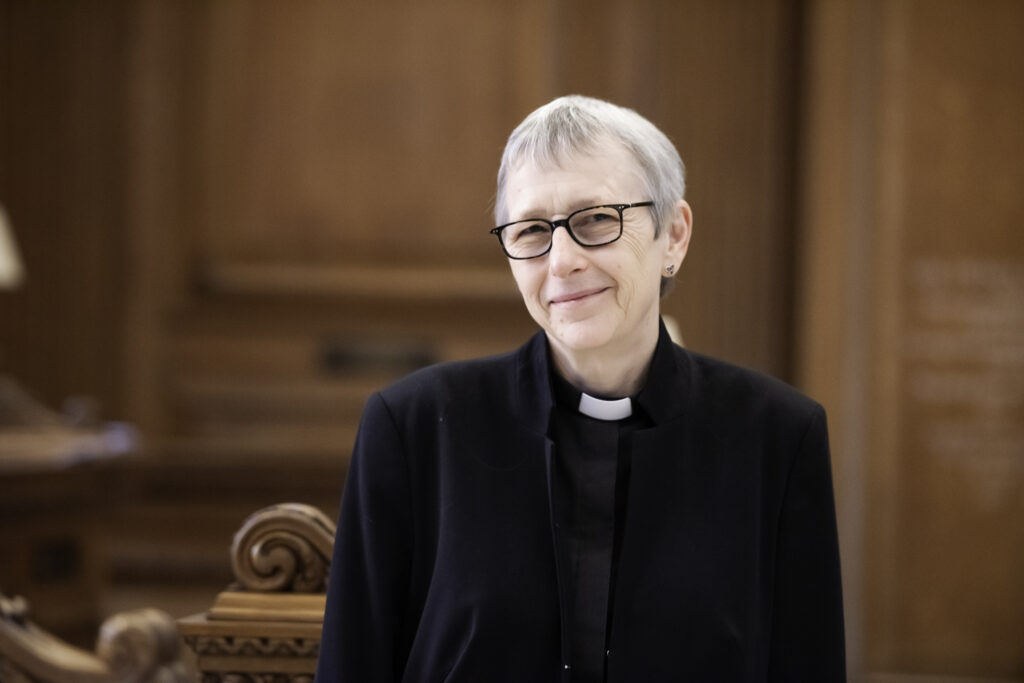
    If you visit the Reverend Alison Joyce at the famous Wren church of St Bride’s just off London’s Fleet Street, there’s a decent chance that she’ll take you into the hub looking out onto Salisbury Court. 

    There you’ll find a stone memorial to a woman called Mary Ann Nichols, who is best known as one of Jack the Ripper’s victims. Bespectacled and intelligent – one of those Oxbridge-educated reverends who is also a theologian – Joyce points it out as I’m leaving. “It’s one of the things I’m most proud of. If you read the history books she’s a victim – but she was a member of this parish and we still owe her a duty of care.” 

    The plaque is moving. But you have to be here in Wren’s famous space to feel its full force. That’s true also of the memorial to journalists who have lost their lives the world over – among them James Foley and Clive James. 

    All our services have gone out online. Since March 2020, we’ve never missed a service. We can do that because we have an amazing choral tradition. 

    The Reverend Alison Joyce

    “Covid has impacted on every aspect of our life as a church,” Joyce says. “The most challenging aspect has been the pastoral one. You add the Covid restrictions in a ministry where touch is very important – you need to be able to hold someone’s hand. We are a sacramental church which means things like communion are very important.” 

    The Biblical phrase which is most applicable to the pandemic is that which is supposed to have been uttered by Jesus upon his resurrection: ‘Noli me tangere’ – do not touch me. It’s still not clear why he says this, whether it is a warning of the physical ramifications of touching him – or as theologians might say, touching his ‘risenness’ – or whether to do so might be to incur some strange and insupportable physical sensation. 

    Alison Joyce has seen an increase in her international congregation at St Bride’s. Photo credit: Slater King

    What’s certain is that the church has had to operate for the last year without touch. Like museums, they’ve been sent online; also like cultural institutions they’ve found a global audience which they might not have expected to encounter.  

    Joyce explains St Bride’s pivot to online: “All our services have gone out online. Since March 2020, we’ve never missed a service. We can do that because we have an amazing choral tradition. And of course the lovely thing about that is, we’ve got people contributing to those services internationally. There’s one woman who does readings from the States – so actually we’ve got an amazingly global congregation.” 

    So the Anglican church, which stretches back to the marital woes of Henry VIII, cannot avoid the need to think about tech provision. Last summer I visited St Lawrence’s in Ludlow and found myself immediately accosted by a warden extolling the virtues of the church’s new app. At St. Lawrence’s if you point at the famous misericords with your phone, you’ll see them flicker into interactive life: a medieval woman cooking, a knight galloping towards you.  

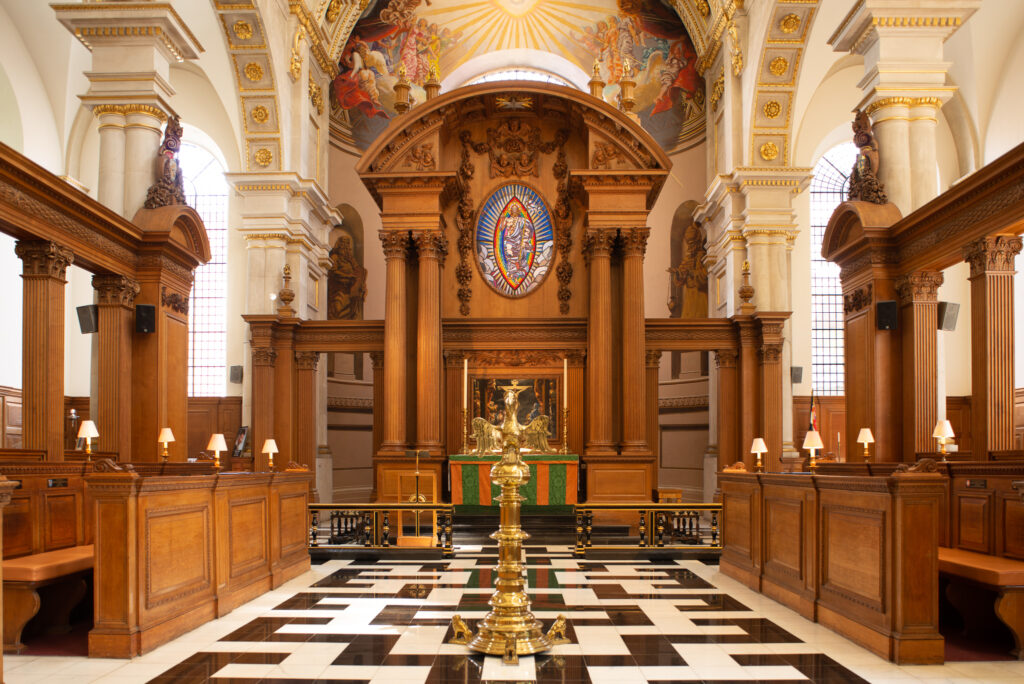
    The East End of St Bride’s

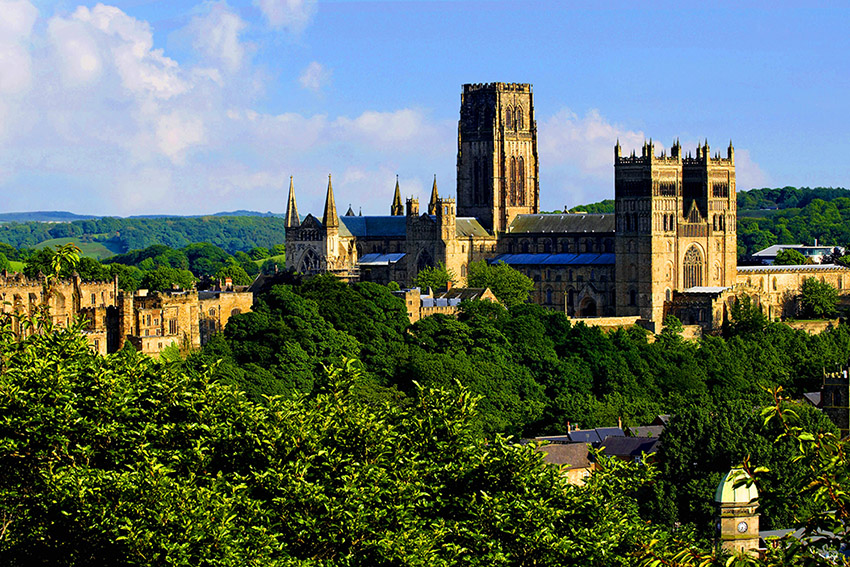
    During the pandemic, I’ve often found myself wondering about those medieval structures which I most came to mind about in the days when going to them was part of a typical calendar year. Durham cathedral, my vote for the most beautiful building in Europe, where the remains of St Cuthbert are buried, at time of writing lies numerous Covid tiers away.  

    Interested to know how they’re doing, I catch up with Charlie Allen, the residentiary canon at the cathedral to find out how things have been. The cathedral also moved to online worship, and now has, according to Allen, “a global community of prayer of 340 members.” (It is a feature of writing about the Anglican church that the numbers discussed can seem heartbreakingly small). 

    That’s all well and good, but central to Christian experience for thousands of years has been the Eucharist. Allen concedes the problem: “It has been impossible to engage with the subtleties of the Eucharist in this way. The touch of a wafer and the taste of wine cannot be communicated in digital form.”  

    “The touch of a wafer and the taste of wine cannot be communicated in digital form”

    charlie allen, residentiary canon at durham cathedral
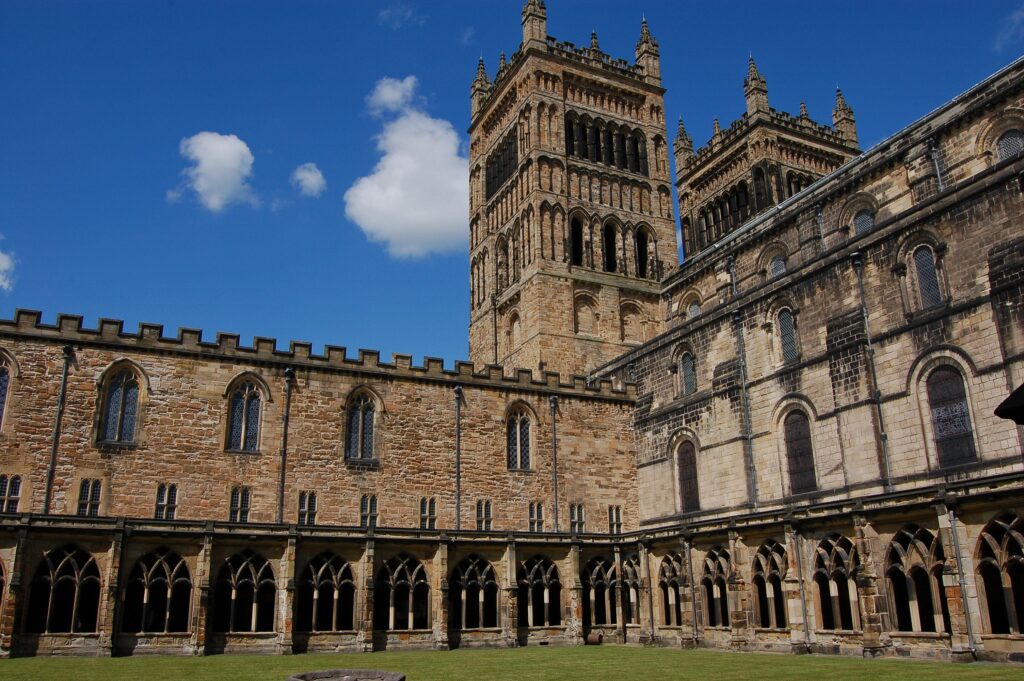
    The cloister at Durham cathedral

    Even here Allen remains optimistic in a way which might help us all in our strange locked down lives: “We are looking forward to being able to gather physically again, but we are also aware that having to withdraw from contact for so long has heightened our senses and given us a deeper appreciation of that which we have missed.” 

    It might interest readers to know how many job opportunities there are in the Church, even during an era of apparently declining belief. That’s partly because the decline takes place against a backdrop of extremely high belief: Christianity remains the religion of the nation, even if church attendance is extremely low. Locally, it’s a part of the fabric of life, even if it is beset by indifference during a time when there is so much else to claim our attention. According to the Faith Suvrey, church attendance has declined from 6,484,300 to 3,081,500 for the period between 2008-2020. And yet as the state has shrunk, the church has sometimes rushed in to fill the void. 

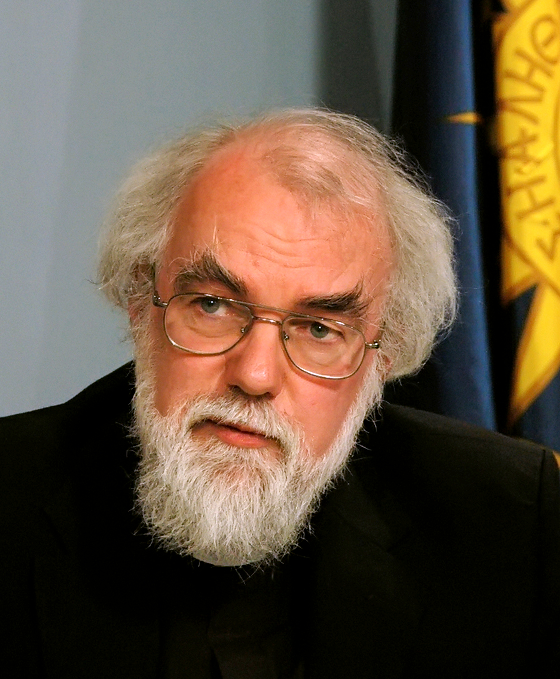
    This author recently visited the home of the former Archbishop of Canterbury Rowan Williams who joked that he had ‘made it big’ in the church, while making me a Nespresso.

    For instance, the Church Times still has a jobs section which shows a lively number of options for people wanting to be involved. It might even be crudely said that it’s still possible to achieve stardom of a kind. This author recently visited the home of the former Archbishop of Canterbury Rowan Williams who joked that he had ‘made it big’ in the church, while making me a Nespresso. His house was a vast receding grace-and-favour home round the corner from Magdalen College, which he would leave shortly after. Russian Christian art hung from the walls, and Williams’ study was jammed with books.  

    Rowan Williams alikens today’s small church attendance to the early times under St. Paul. Image credit: By Brian from Toronto, Canada – Archbishop of Canterbury, CC BY-SA 2.0

    We talked about the low attendance at typical London church services, and he alikened the church today to those early services during the time of Paul of Tarsus, where meaning was arrived at not just in spite of sporadic attendance, but partly because of it. 

    “We have catering jobs, housekeepers and hospitality staff, education, facilities management, members and retail: there’s a considerable range of jobs for the laity”

    christopher hamilton-emery

    Williams’ point may ring especially true during Covid, where people are especially searching for meaning. And if it does strike a chord in students, then job opportunities are there. “As a cathedral we have a team of paid staff, and an even more extensive team of volunteers,” Allen explains. One interesting figure who recently joined the ranks of the church is the great publisher and poet Christopher Hamilton-Emery, whose brilliant poem ‘And Then We’, which we reproduce opposite, celebrates his change of career.  

    Hamilton-Emery explains to me how he was “dislodged from my own [secular] convictions”. His role at The Shrine of Our Lady of Walsingham is a reminder that there are many roles available outside the route of taking holy orders. “At the Shrine, we have catering jobs, housekeepers and hospitality staff, education, facilities management, membership and retail: there’s a considerable range of jobs for the laity,” Hamilton-Emery tells me. “The Church has a lot to gain from experienced general managers coming into serve – so I hope people, even people with no faith, can see that the Church has lots to offer society and can come in and help develop businesses.” 

    The poet Christopher Hamilton-Emery recently left Salt Publishing to take up a position at The Shrine of Our Lady of Walsingham

    And what traits are required? “You don’t need to believe, but you do need to sympathise. You need empathy with the aims, you need to accept moral goodness and love (which may strike some as odd). But most of all you have to care for people and to put the human at the centre of everything you do.” 

    That might appeal to some at a time when we’ve seen retired GPs volunteer to administer the vaccine, as well as an increase in people applying for nursing qualifications.  

    Of course, the career you have will depend on the locality of the institution you end up at. Joyce’s ministry at St. Bride’s is highly unusual, with a small residential population, which in usual times would predominantly serve commuters. This segment evaporated overnight in March 2020. “We have a very different community to serve from somebody in rural Oxfordshire or a parish on the outskirts of Birmingham,” Joyce explains. “We’re also lucky because obviously it’s a famous building and we’re also famous for being a journalist church. That in itself makes it an international ministry.”  

    Pre-pandemic I would give out between 10-20 food parcels and fuel card top-ups per week…We are now giving out 150-200 per week

    The Reverend catherine shelley

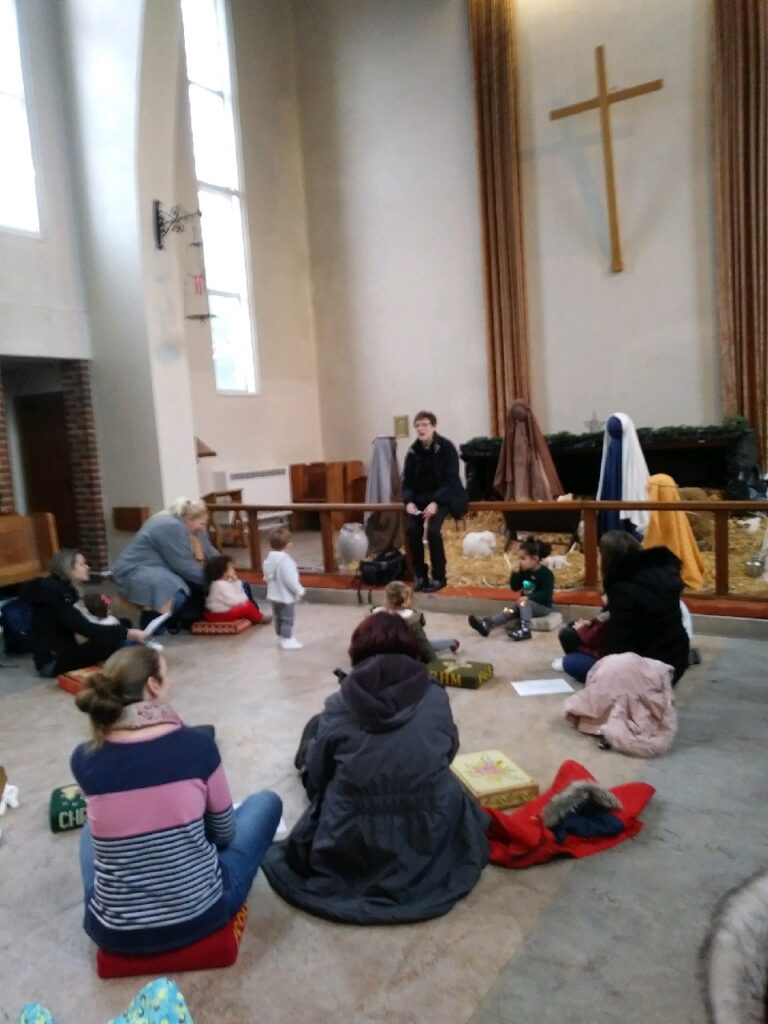
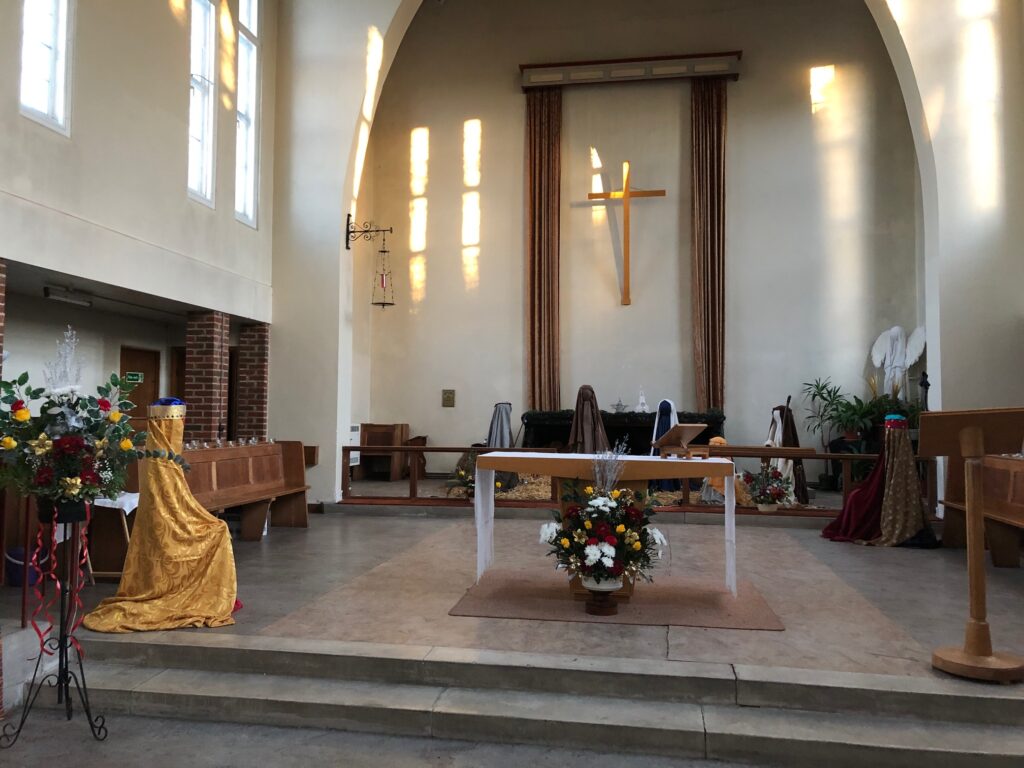
    Things are somewhat different for a nearby ministry run by Rev Dr Catherine Shelley – that of St Edward’s in Mottingham, in Kent, on the borders with south-east London.  

    This is a more impoverished area – but also in a suburban part of London where footfall has increased during coronavirus as more people work from home. Shelley implemented an unexpectedly eclectic online programme: “Karate and taekwondo, Zumba, dance and Slimming World have all been able to go online, though personally I cannot do Zumba online!” 

    St Edward’s in Mottingham has a more impoverished congregation, with only a third having email access.

    However, the impoverished conditions of her parishioners differentiate Mottingham from Joyce’s parish, and from the wealthier area around Durham Cathedral. “A lot of the congregation and community do not have internet access,” Shelley explains. “One third do not have email and local schools are still using booklets for remote learning as families cannot access online provision. The circulation of sheets has increased from 55 at the start of the pandemic to over 100 paper copies and we also send out over 50 by email to those who are online. Some of the increased circulation is to families we have known previously through sporting and social activities in the church hall; some of it is to families we have come to know through the ever-expanding foodbank.” 

    We all have a role to play in healing and recovering and seeking forgiveness. It’s a moral failure if we don’t do this within society.

    christopher hamilton-emery

    It’s the food bank which has really taken off. “Pre-pandemic I would give out between 10-20 food parcels and fuel card top-ups per week,” Shelley continues. “We are now giving out 150-200 parcels per week. We have also prepared regular hot meals for some who struggle to cook, collected medicines, shopped for those shielding or self-isolating, provided access to IT to support job searches, benefit applications and advice, IT access for virtual court hearings, housing support and so on… We never really know what is going to be asked next.” 

    It is impossible not to admire the sheer range of the church’s response – after hearing from Shelley, the church appears far from a quaint and marginalised aspect of our societal fabric. It feels integral. 

    Eve so, Shelley is more pessimistic than Joyce, Allen or Hamilton-Emery about the financial position of many dioceses: “There have been rumours of significant cuts in clergy posts – with some mention of a reduction of 20 percent but it is too early to say what the picture will be across the country,” she says.  

    How does she think it will play out? “It will vary from diocese to diocese because each diocese is a separate charity, with differing resources and priorities. It is suggested that some are in a precarious position financially so more mergers, such as happened in Wakefield, Bradford and Leeds a few years ago, appear likely.” And what’s the prognosis in London? “One thing that will make a difference is the exodus of families from London. I am aware in my own area in South East London, that some parishes are losing up to 20 families who have decided to re-locate outside London because of the possibilities of home-working or due to redundancy. That will probably have a larger impact on church and diocesan profiles and jobs than the pandemic itself.”  

    And if working in the church isn’t of interest, what does it have to teach us at this time? All those I spoke with for this piece felt that there was great meaning to be found in lockdown – and everyone agreed that there would be a revelatory atmosphere in the world once restriction are lifted.  

    Hamilton-Emery is optimistic for the future: “We all have a role to play in healing and recovering and seeking forgiveness. It’s a moral failure if we don’t do this within society. I see this as an opportunity of unity and reengagement rather than fracture and dissolution.” 

    Over at Durham, Allen seconds that: “The pandemic has invited each of us to face up to our own mortality, and to the mortality of those whom we love. Rather than making us morbid, my experience has been that this has given people a fresh appreciation of all that they value in life.” 

    That rings true. It may be that the Anglican church, far from being irrelevant, is about to find itself more relevant now that people have been given time to pause and consider the direction of their lives. Reality, it turns out, has a way of impacting on us, even if we can’t touch one another. Perhaps somewhere in there is the true meaning of that mysterious phrase: Noli Me Tangere.  

    And Then We


    And then we embraced, sprawling on the green deck like scattered gulls.

    And then we knelt under bound flax sail cloth, stinking and making the day.

    And then we carried whom could not stand to the red chapel blithely.

    And then we walked through your pristine marsh without hours or love or trees.

    And then we drew about us buckram cloth and wool dyed with kermes and slept.

    And then we pierced cockleshells and yearned for a tangled feast of eels.

    And then we walked by sordid wolves and boars in corporal torment.

    And then we met with hirsute leather brigands and were lost.

    And then we starved, Lord, and knew concupiscence, gnawing your works.

    And then we heralded salt wind, seal routes and spectres and walked dully on.

    And then we saw your slipper chapel and spread our toes on a mile of stones.

    And then we wept. At the ruin of our bodies we wept. At our just ruin.

    And then we dressed and swayed, all the same, through the unifying street in a love queue.

    And then we bent and entered Nazareth to see her and to know her choice.

    And then we knew a high permanent land, our eyes fixed on accommodating angels.

    And then we fell in stone-sealed Walsingham, with our fiat ringing, unanchored, teeming.

    And then we left to see ice oak burials, flame drift farms, our backwards night talk blazing.

    And then we sailed on, working new bones, each a prayer to the star of the sea.

    --Christopher Hamilton-Emery


  • The Poet at Work III: Christopher Hamilton-Emery

    The Poet at Work III: Christopher Hamilton-Emery

    Continuing our regular series, we spoke to former Salt director Christopher Hamilton-Emery about juggling life as a publisher, with his work as a poet.

    Christopher Hamilton-Emery was born in Manchester in 1963. He studied sculpture, painting and printmaking at Manchester College of Art and Design before taking a degree in graphics at Leeds Polytechnic, graduating in 1986. Emery has published three collections of poetry, as well as a writer’s guide, an anthology of art and poems, and pocket editions of Emily Brontë, Keats and Rossetti. His work has been widely published in magazines and anthologised. He lives in Cromer, North Norfolk, with his wife and children.

    Until recently, Hamilton-Emery was the director of Salt Publishing, and there is a sense in which he has given so much of his time to other authors – Luke Kennard, Xan Brooks and Sian Hughes are among those who much to thank him for – that his own work may be somewhat underestimated. Recently he left his role at Salt to start a new role as Director of Operations at Shrine of Our Lady of Walsingham in Norfolk.

    For Finito World, Hamilton-Emery has written a remarkable poem ‘And Then We’. By telling details we are transported to another time and place – a world of ‘bound flax sail cloth’, ‘would dyed with kermis’ and a ‘tangled feast of eels’. This poem asks us to wonder what deeper meaning our work has and it demands that we imagine our way back into the shared past. It could only have been written by a poet with a profound sense of meaning, and moral duty. It shows a poet at the top of his form, whose strength is to have found a new lease of life in his work.

    As ever, we print an interview with the poet after the poem itself.

    And Then We

    And then we embraced, sprawling on the green deck like scattered gulls.

    And then we knelt under bound flax sail cloth, stinking and making the day.

    And then we carried whom could not stand to the red chapel blithely.

    And then we walked through your pristine marsh without hours or love or trees.

    And then we drew about us buckram cloth and wool dyed with kermes and slept.

    And then we pierced cockleshells and yearned for a tangled feast of eels.

    And then we walked by sordid wolves and boars in corporal torment.

    And then we met with hirsute leather brigands and were lost.

    And then we starved, Lord, and knew concupiscence, gnawing your works.

    And then we heralded salt wind, seal routes and spectres and walked dully on.

    And then we saw your slipper chapel and spread our toes on a mile of stones.

    And then we wept. At the ruin of our bodies we wept. At our just ruin.

    And then we dressed and swayed, all the same, through the unifying street in a love queue.

    And then we bent and entered Nazareth to see her and to know her choice.

    And then we knew a high permanent land, our eyes fixed on accommodating angels.

    And then we fell in stone-sealed Walsingham, with our fiat ringing, unanchored, teeming.

    And then we left to see ice oak burials, flame drift farms, our backwards night talk blazing.

    And then we sailed on, working new bones, each a prayer to the star of the sea.

    Interview

    You’re rare in that you’ve managed to be both a high-functioning poet and businessman – two skills that don’t always go together in the same person! What is the relationship between poetry and work like for you? Is it antagonistic or fruitful?

    At one level work simply pays for my writing life, or at least the space to have a writing life, though this wasn’t always the case. I was an editor at Salt for over twenty years, and that was complex and at times bad for my writing. It left no room; though I didn’t realise this when I started out in 1999. Of course, I came to choose to give up a large part of my life to my authors – thousands of them over the years – but the sacrifice, if we can call it that, came to swallow up almost all of my life. There was a lot of collision between my sense of myself as a writer and my publishing activities, yet I came to be wholly subsumed into the publishing role. The switch back to being employed elsewhere has been liberating, and I’ve been able to separate out my business life from my writing life and, more broadly, my private life. I mean, I actually have a private life now! I’m only eighteen months into this new operational role but going back to being a general manager has been very rewarding. I’m fortunate to have a great boss and wonderful colleagues and the move into the Church has been personally enriching for me. So certainly very fruitful, and not antagonistic at all. In fact, I’ve never written so much. I’ve always believed that I needed to be in the world of business, I didn’t want to teach, I didn’t want to live through grants or patronage, I wanted to do something commercial and, don’t get me wrong, for years I enjoyed my private sector life. But everything comes to an end. All endings are beginnings.

    You decided to step back a bit from Salt in order to work for The Shrine of Our Lady of Walsingham. Can you talk us through your decision to move careers?

    I’ve touched on this earlier. However, the decision to leave Salt and move to work for a Shrine wasn’t prompted by some calculated sense of balancing my writing life. I was going through a profound personal realignment. I’d lived a successful and content secular life for forty years, I had a rather dim view of religion, when suddenly I was dislodged from my own convictions. This was in part a process of disbelief, disbelief in secular satisfactions. I came to doubt the limitations of my own world view. I also realised, and had in my own writings, the limits of science in dealing with human experience, I used to consider how we cannot live in a world without mystery, but I didn’t know quite what this phrase meant. As I was travelling through this accommodation of my past – I’m a cradle Catholic – within a matter of weeks, I was interviewed and employed by the Shrine. I shan’t bore you with the personal narrative and experiences that fed into this, but it was the right decision for me and, after two decades of publishing and running my own business, I decided to serve Christ.

    The government has recently said that poetry should be optional at the GCSE level – a significant demotion in its importance on the curriculum. What is your view on that and what do you feel the impact will be?

    Whether poetry is inherently part of a curriculum or not, it will survive as an art form, so I don’t worry about its relationship to fiction or drama in the framework of syllabus development. I don’t worry about poetry in terms of its share of the education establishment. But there’s a wider context to this and that’s the way kids come into contact with poetry, or orchestral music, or ballet, or opera, or theatre. In this sense, education is the gateway, the space that gives permission to children, and in this context there’s a political and egalitarian component to this debate around poetry. The children of middleclass parents, those enjoying private education, the rich, are afforded more opportunities for this kind of assimilation into culture, and without the rebalancing of access within state education, we end up with a form of cultural apartheid. I hope this makes some kind of sense – it’s not the qualifications or curriculum, it’s the introduction, the initiation to this cultural capital that I find disturbing. I also recognise that poetry is a pain in the arse, yet it’s meant to be awkward, tricksy, resistant to authority, dissonant – things that are hard to teach and accommodate, things that can’t easily be measured or controlled. Poetry provides a critical citizenship and, I think, helps form the unity of the person and offers a living communion today and indeed through history.

    Was there a particular teacher when you were younger who turned you onto poetry?

    If memory serves, Mr Deacon, a supply teacher or trainee English teacher at my grammar school in Manchester, who was so exasperated with the boys not paying attention to some prticular text he threw his book through a window, smashing it. The headmaster promptly turned up and invited him to step out of the classroom for a private word. This singular act made me realise that something could have so much meaning to someone that they would physically act upon it. It was the perfect illustration of genuine literary passion and it set me off on the lifelong task of trying to create beauty and rapture. Or, not getting ahead of myself, at the very least, poignancy. Anyway, I do hope Mr Deacon survived his spell at St Peter’s and went on to do great things in teaching.

    What’s your favourite poem(s) about the workplace?

    Naturally, Larkin springs to mind, though his signal contribution is rather around the comedy of drudgery – and the progress of working life to its eschatological conclusion. Working life needn’t be quite so dreary! Most of us meet our spouses in this space. Most of find friends through work. A few of us find meaning in it. Elizabeth Bishop’s ‘Filling Station’ recovers the tiny spiritual attendances of working life. Plath’s ‘The Applicant’ is a terrific feminist retort to Hughes’ ‘Secretary’. Gary Snyder, Philip Levine great on work.