Tag: Queen Elizabeth II

  • Ian Botham’s unbelievable journey: Headingley 1981, Geoffrey Boycott, and transformative philanthropy

    Christopher Jackson


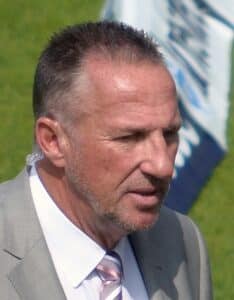
    In person, Ian Botham is utterly solid, calling to mind a rugby prop forward more than England’s greatest cricketing all-rounder. Botham is a famous wine enthusiast, and hunched over his lunch as if he could easily eat one’s own meal as well, it would be a lie to say one can’t see that he’s enjoyed himself from time to time.

    Botham is one of those very few sportsman whose achievements carry across the generations. Sport is really to do with the dramatic maximisation of the present moment: we are rarely quite so conscious of life as when we watch closely to see whether a ball has nicked a bat. Especially because there is so much of it, little sticks in the mind.


    1981 and All That


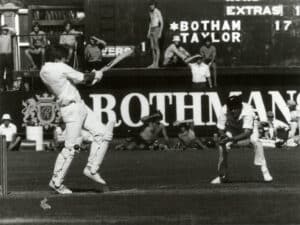
    Something about Botham did: it was to do with the fearlessness with which he played the game, allied always to a certain laddish humour which is still in evidence today. Especially Botham is known for the Ashes in 1981 now forever known as Botham’s Ashes, when Botham’s swashbuckling 149 not out at Headingley began an unlikely set of events. Not until 2005 would cricket come alive in this country to anything like the same extent.

    When we think back on that Test match, It should really be Bob Willis’ test, since it was Willis, who died of cancer in 2019, took 8-43 to bowl out the Australians. Willis hangs over lunch, since Botham is here to raising money for the Bob Willis Fund which raises money for better prostate cancer research.

    Botham tells a wonderful anecdote about that storied day in 1981: “Australia needed a 130 to win. The Australians were 50-1. Bob comes on, and turns to Briers [Mike Brearley, the then England captain] and he said: ‘Any chance I could have a go down the slope with the wind?’ He steamed in and took 8-53.”

    This led to an amusing administrative issue over the unexpected celebrations which Botham, as the world knows, enjoyed more than anyone. “We had this young lad – Ricci Roberts, a 140year-old: he was over from South Africa as a runner. I said to him: “Look we haven’t got any champagne, because obviously thought we weren’t going to win the game.” The Australians thought they would. I said to Ricci: “Go and knock on the Australians door, and be polite and just say: ‘Could the England boys have a couple of bottles of champagne, please?” He did exactly that, but added on the end: ‘Because you won’t be needing them’.”

    The Australians may not have reacted well. Botham continues: “Ricci came through the door horizontal. He had one bottle in each hand and he didn’t spill a drop. Ricky Ricci went on to be Ernie Els’ caddie in all Ernie Els’ major wins. That was down to what we taught him – and how Bob taught him to pour a pint.”


    The Two Geoffreys

    At Lord’s, alongside the extraordinarily likeable Geoff Miller, Botham gave a jovial tour through his career, joking that Geoff Miller was ‘the livelier of the two Geoffreys I played with’ referring to his long-running grudge against Geoffrey Boycott, who Botham famously ran out in Christchurch in 1978. On that famous occasion, Boycott was batting at his usual glacial pace when the situation required runs. Botham picks up the story: “I was asked by Bob, who was then the vice-captain, to run him out and I said: “I’m playing my fourth game and he’s playing his 94th.” Bob replied: “If you don’t do it, you won’t play your fifth.”

    It is impossible to not feel nostalgic about the fun of those times. Botham has come along way. In fact, when Botham recalls his upbringing, as is usually the case with the extraordinarily successful, his story comes into focus in all its glory and improbability: “My father was in the services in the Navy and was serving in Northern Ireland on active duty. When his wife Marie, my Mum, was due to give birth, they sent us over to Heswall in Cheshire.”


    Crunch Time

    The family then moved down to Yeovil and Botham, having shown exceptional sporting prowess, had a difficult decision to make by the age of 15. “I had to make a choice between soccer and cricket. Crystal Palace offered me an apprenticeship. I had just signed at 14 with Somerset – I registered with them and when it came to the decision, I sat down with my dad. He said: “You are by far a better cricketer”. I listened to him – for once.”

    Botham then transferred to Lords for a year and half, before being called back to Somerset at 18. It didn’t work out too badly, did it? Botham smiles: “Not too bad.”

    Botham recalls his first Test match. “The way they did it in those days – well, let’s just say it wouldn’t happen nowadays. You’re driving down a motorway. At three minutes to 12 you turn into a layby and switch the radio on and wait for the 12 O’Clock News. And the England team to play Australia is…And I thought: ‘Yes, I’m in’.”

    That sent Botham up to Trent Bridge, where another lovely anecdote occurs. “We lined up at the start of the game and it was the Queen’s Jubilee. The Queen went down the England line, and wished me luck on my debut. Then she went over to the Australia line, and came to DK Lillee [the great Australian fast-bowler].

    Dennis pulled out of his back-pocket an autograph book. “Ma’m, would you sign this?” She said: “I can’t do that now.” But clearly the Queen had remembered the encounter. Botham continues: “When Lillee got home from the tour six or seven weeks later, through the letterbox there came this envelope with the Royal seal and there was a picture of the Queen. It now sits on his mantelpiece.”


    Merv the Great

    It’s a lovely story – and the more time you spend in Botham’s spell, the more the stories keep coming. Merv Hughes also gets the Botham treatment. “In 1977-78 we toured Australia, one of my first tours. We were sponsored by a company called JVC Electronics. They decided in their infinite wisdom that on the rest day morning at about 10 o’clock – when most of us had only been in bed 10 minutes – we’d go to a shopping mall in north Melbourne to mingle. None of us were particularly excited about that prospect.”

    So what did Botham do? “I hid behind this tower. This young lad came up in a tracksuit and said: “Good day, Mr Botham. Mate, I want to be a fast bowler have you got any advice for me?” I wasn’t feeling great so I said: “Mate, don’t bother – go and play golf and tennis.”

    Fast forward to 1986: the first test at Brisbane. Botham recalls: “Merv Hughes makes his Ashes debut in that game. In Brisbane, you could see this little black line, that in about 30 minutes became a thunderstorm – hailstones the size of golf balls. Hughes bounces it in, then the gigantic hailstones. Merv wasn’t happy as I’d hit him for 22. We weren’t going to play anymore, the ground was covered with these golf balls.

    One of the lads brought me a beer. Merv comes out and I say: “Congratulations on your first Ashes.” He said: “You know we’ve met before.” I said: “No. Where?” “At the shopping centre in Melbourne.” I was that kid who came running up to you, and you told me not to be a fast-bowler but to play tennis and golf.” He said: “What do you reckon now?” I said: “I was bloody right.”
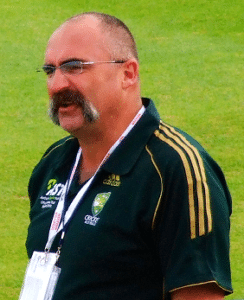
     

    Beneath the swagger of the public persona, there is his immense generosity as a philanthropist and his life as a family man. His grandson, James, is following in Botham’s footsteps as a sportsman. Botham speaks with evident pride: “He’s had a couple of years with injuries. His confidence is back – he played very well against South Africa at Twickenham. James was born in Cardiff and said: ‘I’m playing for Wales’. He’s got a task on his hand and we’ll see.”


    A Decisive Difference


    But it’s the philanthropy which really brings a tear to the eye. “I’m very proud of it,” says Botham. “In 1977, I was playing against the Australians and stepped on the ball and broke a couple of bones in my foot. In those days you didn’t stay with the England squad, you got sent back to your mother county. Mine was Somerset.  So I get to Musgrove Park Hospital in Taunton, the club doctor’s waiting for me. To get to the physio department you had to go past the children’s ward.”

    This turned out to be a fateful walk since it would change many peoples’ lives. “You can see children who are obviously ill – tubes sticking out, and their feet up. There were four lads sitting round the table playing on the board games. I said: “Are these guys visiting?” He said: “No, they’re seriously ill.” I said: “But they look fine.” He replied: “You’ve got eight weeks of intensive treatment to get it right for the tour. Those four lads in all probability will not be there when you finish your treatment. True enough at the end, all four of them had passed away.”

    It made a deep impact on Botham who found he couldn’t stand by and do nothing. “What the hospital used to do was give them a party, whether for one of their birthdays or for Christmas. And they were so drugged up with painkillers. As I was leaving the hospital, I said: “Is there anything we can do to help?” He said: “Well, you’ve now seen four parties. We don’t get any funding for those.” I said: “I’ll stick my hand up and pay for the parties.”
     

    By mid-1984, Botham wanted to do something more substantial. “I was flicking through a magazine which someone had left on the train – a colour supplement. There was an article about a certain Dr Barbara Watson, who lived on the south coast. Every summer she would get on the train and go to the most northerly part of the UK, John O’Groats and meander back. I thought: “Right, I’m going to do a sponsored walk. I’m going to do John o’Groats to Land’s End. My geography wasn’t great. 400 miles to the English border, then 600 miles to the Land’s End.”

    It was a huge learning curve for Botham who had never walked like this before, but he managed to do the walk in 33 days. “You couldn’t do PayPal: you had to physically collect. By the end of the walk we got over £1million. That was used immediately to build a research centre outside Glasgow.” Then the conglomerates came behind us. “When we started the walk, there was a 20 per cent chance of survival for kids with leukaemia – a few years ago we announced it is now 94 per cent.”

    It’s an astonishing story of how something so innocent as being good with a bat and ball and can lead with the right heart and mindset to genuinely consequential change. Botham’s is a reminder to us all to start with what we’re good at – but to keep an eye out for what we might do for others along the way.


    Lord Botham was talking at an event at Lord’s Cricket Ground in aid of https://bobwillisfund.org/


    https://www.beefysfoundation.org


    Like this? See also our other cricket articles:


    Cricket Nostalgia: Henry Blofeld on PG Wodehouse, Ian Fleming and the Remarkable Cricket of the Past
    Culture Essay: What we can all learn from cricket


  • The funeral of Queen Elizabeth II in pictures

    Patrick Crowder in conversation with Finito photographer Sam Pearce


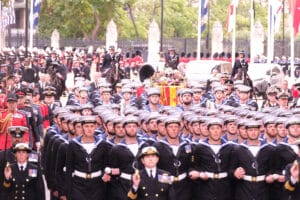
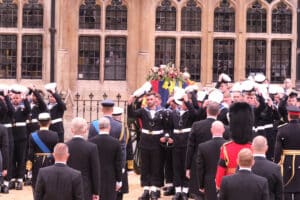
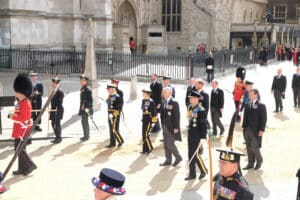
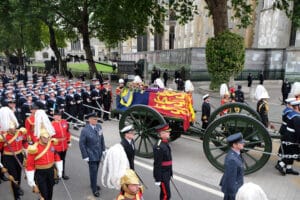
    At 10:42AM on the 19th of September 2022, the coffin of Queen Elizabeth II left Westminster Abbey. It was the start of a procession which would be seen by over one million people who lined the routes to say a final farewell, and it was the end of an intriguing era in history.

    Finito World’s own Sam Pearce was there at the Abbey to document the momentous occasion, and she has furnished us with the beautiful photographs you see here. I caught up with the experienced photographer after the ceremony in an attempt to vicariously experience the landmark event as it happened on that day.

    “No one knew the protocol. I mean, I didn’t know either, but people did a mix of staying quiet or clapping or cheering. People didn’t know, but it was done respectfully irrespective of how they did it. It was all done with the greatest amount of respect,” Pearce says, “I think people really did feel that it was a story of a lifetime. People were a bit apprehensive and nervous and intrigued, and they were also watching as the events unfolded because no one quite knew what was going to happen. But I know everyone was thinking about the last time there was a state funeral and pictures from that, and how this was going to compare. And, you know, it was just a really interesting atmosphere. The police call it a ‘sterile area’ when they have really high security, and it was a bit sterile because there was no public around. But it was completely fascinating, because the whole procession passed straight by you. With the royal family, the Queen’s coffin, the soldiers, and all of the pageantry, everyone was sort of just watching and waiting quite calmly,” she says.

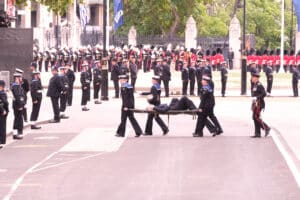
    Pearce captured the above photograph of a soldier who had to be tended to by paramedics during the ceremony, and when I asked her about that picture, she recalled another soldier who fell ill.

    “There was a young naval officer, a young girl, and she didn’t collapse but she obviously didn’t feel very well. She was supposed to be part of the team of naval officers that pull the coffin up to Wellington arch, but she had to be taken to the paramedics. It often happens in these processions,” Pearce says, “To me it wasn’t a very hot day, but I suppose when you’re dressed in those uniforms, they’re quite heavy, and you’d have to be standing for hours and it can’t be that comfortable. I felt really sorry for her actually, because that was supposed to be a big moment.”

    A lot has changed in the 70 years since Queen Elizabeth II’s coronation, especially surrounding the world of work. It is known that the Queen did not understand or approve of the frequency with which people change jobs today – and that is understandable considering the landscape of work when she was in her 20s. Pearce, too, has seen the way things have changed from when she got her start at Mirror Group Newspapers.

    “I got into photography, because I worked as a PA, to the Managing Editor at Mirror Group Newspapers. I mentioned that I wanted to learn how to use a camera, and my boss at the time organised me to go out and train with the photographers on the Sunday Mirror. So I would go out with the photographers on Saturday. It was all on film, and we all used to have to go to the office at that time. I don’t think anyone goes into an office anymore, but we had to turn up at eight in the morning, and then we’d be assigned jobs, and I would be sent out with another photographer. It was an apprenticeship really, and I would just go out and ask lots of questions. I’m sure they wanted me to go away at points, but the photographers were really nice and quite patient with me,” Pearce says.

    “I think with like any job, including photography, you have to really want to do it, and therefore you’ll go around and take pictures all the time and hope to find where you want to be. There is a lot of competition. Years ago it would be a six-week period before you could actually go in and speak to a picture editor at a newspaper, so I think you just have to keep pushing,” Pearce says.


    More of Sam Pearce’s captivating photos will be featured in the next print edition of Finito World. Read the current edition as a PDF or request a hardcopy here

  • Queen Elizabeth II: 1926-2022

    Christopher Jackson


    In September 1928, Winston Churchill went to shoot stag and grouse with King George V at Balmoral. There he met not only the Duke of York – who would in time become King George VI – but also a certain Princess Elizabeth. He wrote back to his wife Clementine of the young girl: “She is a character. She has an air of authority and reflectiveness astonishing in an infant.”

    Here we see the very young Elizabeth playing as a girl at the place of her death nearly a century later. It is a reminder of what the death of the monarch yesterday severs us from. In time Elizabeth’s first prime minister would be Churchill himself, and, as she carried out the obligations of her long life she became more and more a link back to the past.

    Elizabeth worked with 15 prime ministers from Churchill to Liz Truss, who she asked to form a new administration as recently as Tuesday. She also knew 14 US presidents, not to mention countless other world leaders. By nature not particularly intellectual, she nevertheless was in a position to take everyone’s measure: her experience of eminent people, though it may often have come through the distorting lens of her fame, is likely unmatched in the history of the world.

    Much has been written of the symbolic value of her tenure as monarch: Elizabeth was a reminder that the great changes in society have, from a certain perspective, a trivial nature. The latest iPhone update comes into a human hand which evolved 1.8 million years ago and our brains, aided by every imaginable technology, still crave the old affections. Not only did Elizabeth know that, she devoted her life to that principle of continuity as she saw it embodied in centuries of monarchy.

    What is the idea of monarchy? Really, it is a mystical notion – perhaps our last remaining popular mysticism. To understand it properly – and therefore to comprehend what Elizabeth Windsor stood for – it is necessary to go to the Tower of London. There you will find the Crown Jewels, but also an object still more interesting: the 12th century coronation spoon which is used for anointing the sovereign during the coronation ceremony. It will be in use soon to anoint King Charles III.

    That spoon can also be seen in footage of Elizabeth’s own coronation in 1953. It links her – and us – to the deep past, tying us to people who have long since departed, the precise meaning of their lives unknown to us. At this point of Elizabeth’s own departure, we feel the weight of this history as we too rarely do in our busy and exciting lives. By being historic, she asks us to consider what that history entails – and she does this especially in death.

    A lot is being written today about her admirable sense of duty, and, of course, the facts of her life show this to have been among her prime virtues. The vast number of assignments, trips, meetings, openings, occasions and obligations which she carried out over the years are testament to a work ethic which, during the pandemic era of working from home, has gone slightly out of fashion.

    Sometimes we talk of her dedication to duty as if we might immediately emulate it. This is difficult. The Queen’s role in life unfolded according to the known rhythms of Sandringham, Windsor, Buckingham Palace, and Balmoral as she partook in the ancient life of the nation. Our own duties, without those ceremonial structures, are sometimes less evident. What exactly do we wish to do? Where do our duties lie?

    This isn’t an easy question to answer, as we see every day in the mentoring we give to people. But this doesn’t mean the life of Elizabeth II has nothing to teach us on these important questions. One of her most-quoted phrases, referring to her tendency to be out and about as monarch, is: “I have to be seen to be believed.” In this, she presents herself as a believer in a proactive form of carrying out tasks: to work hard is to make oneself ubiquitous and to give full embodiment to whatever role you are called upon to do. That degree of endeavour might apply in any role.

    Sometimes our role will involve sacrifice; all forms of activity cause some deficit elsewhere in our life. The Queen’s humour is often attested by those who knew her in private, but the public persona was reliably straight-faced, and to her critics, could seem a little dour. To suppress a twinkle is hard, but her sober approach meant that she herself was rarely the meaning of a given occasion, though she might augment it with her presence. Fame, for her, was something to be put to use, never something to revel in for its own sake.

    Elizabeth is also on record as having lamented the regularity with which people change jobs today. When she came to the throne, it was usual to spend one’s working life at the same firm, amid the same people, conducting – and honing – similar tasks. Today’s gig economy seemed flighty to her.

    The whole question of a successful career can be boiled down to deciding what you want to do and sticking at it. When I recently encountered the clockmaker Keith Scobie-Youngs, who is currently restoring Big Ben, he referred to clockmaking as ‘a narrow pond but deep’. Similarly, when I have encountered those who work in wine, or coffee, or some small but intriguing area of finance or law, I have found them to be among the happiest people with regard to their careers. Elizabeth, with her staying power, would have understood this.

    The royals also, of course, are inspiring to young people, because they are surrounded by people doing their jobs well. Walk into Berry Bros, where the Queen purchased her wine, and you’ll see that same quality and commitment to service which you’ll find if you’re ever lucky enough to meet the solicitor Mark Bridges, who for years handled her tax affairs at Farrer & Co. The Royal family has long stood for excellence, and the Queen was always at the apex of that. It is another aspect of the inspiration which attaches to her.

    Her influence is especially difficult to gauge since it was subtle and exercised behind closed doors. Among the tributes issued by former prime ministers, Sir John Major’s strikes me as the most resonant. He wrote: “I think people would have been extraordinarily surprised if they realised the depth of information the Queen had about the lives of people in every conceivable part of the United Kingdom. She was always extraordinarily well briefed. And on foreign affairs, she would always say if there was a difficulty of a foreign leader, ‘Well I met him many years ago’ or ‘I knew his father’. There was always a wise word to be had. And those meetings with the Queen were always the better part of a prime minister’s week.”

    The Queen married a constant hunger for information with a certain unobtrusive watchfulness. Her prime ministers are unanimous that this accumulated to considerable wisdom.

    There were points during her reign, especially around the time of the death of Diana, Princess of Wales, when she was written off as irrelevant, or boring or unfeeling. Sometimes the joke was on her critics who simply couldn’t discern her relevance, or see why she was interesting, or understand why dignity is always to do with what you decide not to say. ‘A bore’, wrote Proust, ‘is someone who tells you everything’. Elizabeth often said little, but only because it wasn’t her place to be voluble. One of the threads, and it is a golden one, among the memories of her, is what a good listener she was.

    And now we listen to the silence of her passing, and must seek solace in a rainbow over Windsor Castle, the words of the new King, and the words of a new Prime Minister. If there is anything to be learned, it is that some lives have a sort of grandeur and symmetry which feels important in ways we can’t quite discern.

    Elizabeth knew it was her duty to see out her Platinum Jubilee, and to see the Prime Minister on Tuesday. One can see how another winter would have been too much, and that life without Prince Philip was always likely to be hard for her. Those who die in September have known the summer, and are spared the winter.

    Yesterday in London, if I read the crowds rightly outside Buckingham Palace, there was already a sort of solemn gaiety in the air which had to do with an appreciation of a monumental life.

    Gaiety was more an aspect of Elizabeth than we might realise. I read that Sir Alan Lascelles, Elizabeth’s first private secretary, wrote in his diary in relation to Churchill’s weekly audiences with the young Queen Elizabeth: “When Winston had his weekly audience in the Bow Room at Buckingham Palace, I, having shown him in, would sit next door till he came out, when we shared whiskies and soda for half an hour. I could not hear what they were talking about, but it was, more often than not, punctuated by peals of laughter.”

    It is an image which encapsulates her life: joy in a room we can’t visit. It might also serve as an image of what one would hope for her in death. But these are uncertainties and Churchill was on another occasion more specific about the young monarch: “All the film people in all the world, if they had scoured the globe, could not have found anyone more suited to the part.”

  • In Memoriam: a new poem by Todd Swift

    In Memoriam

    The storm has taken down
    the tree, which stood
    seventy seasons by four,
    to leave the arbour restless,
    without a roof’s rising crown,
    almost without a floor,
    so skittering leaves flood
    about, revealing lost acorns;
    the forest is aghast, forlorn;
    a tossed tempest grown out;
    it is horrible emptiness.
    There is a legacy that lasts
    past loss, the quick torn apart –
    roots only deepen to be flown.