Tag: Professional Growth

  • Tom Pauk: Meet the Mentor

    Finito World caught up with Finito Education’s likeable and passionate senior mentor, Tom Pauk


    Tell us about your career before you joined Finito.


    After studying drama, my efforts to become an actor ended with a whimper rather than a bang, and I retrained as a solicitor. The career that followed was a “game of two halves”, half-time marked by the global financial crisis of 2007-08. In the first half, at City law firm Allen & Overy, then in-house at American bank Citigroup, I’d specialised in large cross-border lending transactions.

    In the second, I helped restructure loans borrowers had taken out in more prosperous times but were now struggling to repay. After leaving the bank in 2017, I began mentoring young men in prison, returned to Allen & Overy, now in a role mentoring lawyers in the early stages of their careers, and began writing plays. My professional life, it seems, had come full circle!


    Did you feel your education prepared you for the workplace?


    A degree in drama could not have prepared me better for the cut and thrust of commercial law, an above-all collaborative endeavour with a diverse cast list of characters, long “rehearsals” with unfeasible deadlines we somehow always managed to meet. At the conclusion of an especially high-profile deal there was the added satisfaction of reading the “reviews” in the financial press.

    The practise of law is essentially an exercise in problem-solving. In my case, a love of modern languages and playing the violin had also prepared me for the intellectual rigour of law, and I was even able to use my mother tongue Hungarian in transactions with Hungarian clients. So to anyone reading this wondering whether a knowledge of an obscure language might prove useful one day, the answer is a resounding Yes!


    Did you benefit from mentorship during your career?


    When I’d started out, mentoring was still very much in its infancy. Fortunately, I was able to benefit from the law firm equivalent, the “seat” system, under which trainee solicitors move from one department (or seat) to another every few months to build up expertise in different areas of a firm’s practise. Each seat is supervised by a senior lawyer — part mentor, supervisor and critical friend — overseeing a trainee’s professional development.

    Over the course of my training contract I was exposed to a variety of mentoring styles, which then shaped my own approach when I assumed the role. But I continue to benefit from ongoing, less formal mentoring in the shape of the extraordinary people I encounter and who inspire me with their wisdom. So in actual fact I’ve never really stopped being mentored.


    What are the most common misconceptions about a career in the law?


    I think there’s a general (mis)perception that law is a dry, bookish occupation, and that lawyers are aloof from the rest of society, be they pin-striped solicitors in their ivory towers or wigged-up barristers bowing obsequiously in courtrooms. In fact lawyers are widely dispersed throughout society, in the public sector (civil service, local authorities, regulatory bodies), in companies and banks, charities and NGOs. If you’re a young person considering a career in law you’ll be able to select from a wide range of specialisations that play to your unique skills and interests.


    Mental health is a particular passion of yours. Can you describe how your interest in that area came about?


    There were occasions, especially early on in my career, when my mental health was impacted under the pressure of work. Symptoms included poor sleep, high anxiety and irritability, and a compulsion for checking work emails 24/7. Back then, there was a stigma around discussing one’s mental health, let alone seeking help when you needed it. Worse, it was regarded as a sign of weakness, possibly even career-limiting, to self-disclose. So one’s natural instinct was simply to keep quiet and soldier on.

    Thankfully, we’ve evolved to a more enlightened view of wellbeing in the workplace, with a plethora of interventions designed to promote a healthy mind as well as body, including mental health first aiders, mindfulness, and discouraging staff from checking work emails after hours. Eight years ago, the memory of my own experience led me to train as a volunteer at a mental health charity. At The Listening Place I’ve seen vividly for myself how poor mental health can quickly escalate into crisis, and how being truly listened to can be life-saving. Literally.


    Work-life balance is something you’ve been vocal about. What are the most common pitfalls people fall into there?


    Most people understand the importance of achieving a sensible work-life balance, at least intellectually,  And it’s hard to argue against. But here’s the challenge: we’re not necessarily aware of the pendulum as it is swinging in the wrong direction. Whether it’s staying ever-later in the office, checking, or worse, responding to emails at weekends  (“because it’s already tomorrow in Tokyo”), before we know it life is work and work is life. Of course we tell ourselves that it’s only temporary, that as soon as we’ve broken the back of whatever it is we’ll take our foot off the accelerator.

    But it isn’t that simple, for we may unwittingly have recalibrated our benchmark of what a normal working day is. We’ve trapped ourselves into believing our own indispensability (“If I don’t do it no-one else will). We assume that working harder improves performance, demonstrates commitment to our employer and enhances our prospects for promotion. I’d counsel anyone reading this to challenge these assumptions and to listen out closely for the whirring of your inner pendulum!


    You obviously have a passion for mentoring. What are the most common challenges you’re seeing among your current crop of mentees?


    I’m certainly seeing the longer-term impact of the pandemic. This is the generation whose educations, family and social lives were disrupted by successive lockdowns. And I’m in awe of just how well they’d adapted to remote ways of studying and working. Another challenge is the sheer number of high-calibre applicants vying for limited places on the graduate recruitment schemes of investment banks, accountancy firms and corporations. Training contracts in City law firms are similarly over-subscribed, and with increasing candidates achieving top grades there’s now a far greater reliance on critical reasoning and situational judgement tests, presentations, written assignments and long assessment days.

    However I’m also sensing some really positive new trends, with mentees less motivated by achieving huge salaries than they are by finding a fulfilling career. And finally, one positive legacy of the pandemic: Finito mentees are often engaged in volunteering activities, whether it’s repurposing old computers and teaching older people how to use them, mentoring disadvantaged kids, or stacking boxes in foodbanks. Something, finally, to celebrate in challenging times.


    Do you vary your process for each mentee, or do you have a particular approach which you use with each candidate?


    Mentoring is a transformative tool for supporting the development of a mentee, and because no two mentees are the same the mentoring process does inevitably vary. Having said that, there are common features in my approach.  In the first place, it’s not about the mentor. Our prime responsibility as mentors is to listen attentively at all times to our mentees. Listening actively (as distinct from merely hearing) is a skill that one develops with practice.

    And it’s crucial we’re responsive to the stated needs of our mentees rather than clinging stubbornly to our own agendas. One unique aspect of mentoring is our willingness to share our own knowledge and experience to support the development of our mentees. A word of caution however, because this has nothing to do with being directive. What we’re aiming to do is empower our mentees to think and act for themselves. Finally, mentoring is a two-way street. At its most fruitful the relationship between mentor and mentee is one in which sharing and learning opportunities arise for both participants. I’m forever learning from my mentees.


    What do you know now in your career which you wish you’d known at its start?


    Hindsight being a wonderful thing of course, here’s three things I tell my mentees. Firstly, it’s important to pace yourself, especially when starting out in a new role and you’re trying to make a good impression. Keep something of yourself in reserve for when you really need it. Secondly, don’t plot out your entire career from the get-go. Life has a mischievous habit of opening new doors and leading you in new directions. And thirdly, know where you add most value, and focus your energies accordingly.


    Do you have any new challenges on the horizon?


    I’m excited to have just been appointed to the board of the Joseph Rowntree Charitable Trust, whose endowment supports people tackling the root causes of conflict and injustice. Along with my governance responsibilities, I’ll also be involved in grant-making decisions, an area entirely new to me.

     

  • Adam Page: ‘It’s indefensible to be involved in business and not understand finance’

    Adam Page


    This is the story of a fantastic journey.


    But first, I have to explain something. I’ve been in far more pitching sessions – either raising money myself or as a potential investor – than I can remember. I’ve met, worked with or employed innumerable consultants. I’ve watched hundreds of senior directors as they’ve sat in countless board meetings. I’ve written and read acres of financial reporting. I’ve worked with a few hundred wealth and asset management professionals. I’ve led a good few investment research teams.


    And the one question that has hung – unanswered – in the air over and over again has been this: “Why on earth is it that the majority of these people have clearly never bothered to educate themselves about the one matter that lies at the heart of all business: finance?” Why are they sitting here, so evidently naive and so clearly bewildered about even the most basic concepts that make finance tick? Are they really that unaware of how unprofessional, how much less relevant to the conversation, they appear compared to those folk in the room who have got their heads around finance?


    I’ve always believed that it’s not only indefensible to get involved with business without a sound understanding of how finance works, but that it bestows such a huge (and easy) career advantage. Moreover, it’s just not that hard to learn.


    And those are three dirty little secrets about finance. First, you’re handicapping yourself badly if you run away from it; secondly, it really quickly sets you apart from everyone else if you do understand it; and thirdly, it’s much easier to learn than most people think.


    But there’s a fourth. It’s subtler but probably even more powerful: to think of finance as simply being about accounting is to make a huge error. Accounting is one small part of finance. I’m not an accountant. I don’t have the disposition for it. But I do know finance, and to me and others like me, finance is up there with great marketing, or engineering or product design. It’s inventive. Creative. It’s future-oriented, and is all about building value, serious value, for yourself, and for the business (and about avoiding destroying value – something the financially illiterate are all too prone to do).


    So in this short series of articles, I’m going to argue that one of the most powerful things you can do – in terms of your own career development – is to take some time to learn about finance, to understand the principles and the language that preoccupy the great entrepreneurs, the great business leaders, the great consultants, in a million conversations a day, in every business environment around the world, and that by doing so you will present yourself in a whole different class from everyone else chasing the same roles, the same opportunities, and the same careers.


    Let me start off by painting a picture of my own career so far.


    How did I first get involved in finance? Pretty easy really. I was in my early-20s, drifting around a little, unsure of what to do with my life, when I had a life-changing conversation with my father. I’ll tell you his exact words at the end of this article but, broadly, he pointed out that in every domain of human endeavour, finance was involved. Made sense. So I enlisted on an evening program, two nights a week for a year in a post-graduate diploma in finance.


    At the time, I had just started working as a computer industry journalist – despite knowing nothing about the computer industry (in my first week my editor bought me the Ladybird Book Of Computing to help things along).  But just by virtue of choosing to study finance, by committing to it, my editor made me the finance editor of that publication.

    Fast forward about nine months, and I was recruited by another publishing company to be the editor of a publication that wrote about investment in technology companies. My salary doubled. Fast-forward a year from that, and I was recruited by Union Bank of Switzerland to be one of their securities analysts specializing in UK and European technology, telecoms, software, that sort of thing. My salary quadrupled.


    But then a year later I was then made head of Small Caps research which meant I could poke my nose into any industry I was curious about. And, boy, I did. I dived right in and spent time looking into a huge range of businesses and questioning the Chairmen, the CEOs, the COOs, and the CFOs about how those different industries and their companies worked. (And my salary went up about 50%.)


    I looked at computing, software, telecommunications, electronics, biotechnology, power and optical cabling, defence electronics, estate agency, open clay mining, furniture manufacture, lace manufacture, lingerie manufacture, the music industry, the funeral industry, health & medical businesses, publishing companies, and many more.


    Endlessly curious, after seven years I left the investment banking world – having also worked with UBS and Natwest Securities) and then spent a decade flying between London, Hollywood and the Cannes Film Festival, financing the film industry. That in turn led me again into the music industry, animation, digital content, television and from there into live entertainment.


    By this time I was operating in more entrepreneurial environments, too, better described as venture capital and private equity, more complex financial engineering. I got involved in financing food businesses, more in health and medical technology, restaurants, bars and clubs, into fintech, insurance, sports, and time in renewables (wind energy, solar energy, anaerobic digestion etc.), countless start-ups in countless fields, then most recently in life sciences, artificial intelligence and educational technology.


    It’s been an extraordinary journey and an incredible education. And throughout all of that, I’ve seen and been involved in some spectacular moments of artful, clever, inventive financing that have elevated ordinary businesses, that have made the difference between founders abandoning their own business or becoming spectacularly wealthy.


    And, remember, I’m not an accountant. But certainly I studied, although it was only after leaving investment banking that I studied an MSc in Finance at the London Business School.


    The point is finance has opened countless doors, created countless opportunities, shown me countless fascinating situations, and it’s been vibrant and creative and endlessly refreshing.


    So in the next few articles I’m going to show you how easy finance actually is. How it breaks down into 12 basic – and entirely common sensical concepts – that individually or in combination lie behind every aspect of finance. They just require familiarity and a confidence with the language. (Oh and some very simple arithmetic.)


    So, to come back to what my father said to me all those years ago, “Get your head around finance, son. It’s everywhere, not enough people understand it, it will open endless doors, and I guarantee that no matter where you are or who you’re with, you’ll never, ever be the dumbest guy in the room”.


    Adam Page is CEO of Adam Page Training. Go to adampagetraining.com.  

  • The Rise of Portfolio Careers: Could this be the era of the new Renaissance Man?

    Christopher Jackson


    I’ve been lucky enough to go often to Florence, more than any other the city of the Renaissance man. Each summer the crowds gather outside the copy of the Michelangelo David beside the Palazzo Vecchio, and I wonder how many people there know that its creator also wrote poetry, and designed the stairs to the Laurentian Library about half a mile away. They queue around the block for the Ufizzi galleries, and when they’re inside they long to see Leonardo’s Annunciation. But it isn’t widely known that Leonardo was also a fine musician and for his time, a mean palaeontologist. People often feel they are dreaming when they come to Italy, because the past has such a strong pull. But we must also ask ourselves why they have that pull. It’s because these figures have a reach and potential that, however clever we might think we are, demonstrably exceeds our own: they were the Renaissance Men.

    For myself, sometimes I’ve taken a moment to sit on the benches in the square Santa Maria Novella, the façade of which was produced by the man who is sometimes said to have started it all Leon Battista Alberti (1404-1472). Alberti might be better known if one were better able to pinpoint who he was – but that’s just the point, he was the original owner of what today we call the portfolio career. However he seems to have gone out of his way to make his identity as difficult to define as possible. He was by turns an author, artist, architect, poet, priest, linguist, philosopher, and cryptographer. Alberti is probably now a little in the shadow of Leonardo Da Vinci and Michelangelo, both of whom could do almost anything, and perhaps you might say, could do all those things a little better than Alberti. But there is a daring about Alberti which is part of the Florentine spirit. Perhaps he is more fitting emblem of the Renaissance that Michelangelo and Leonardo, those superb outliers. Alberti embodies the opportunities of doing lots of little things, but perhaps in a way some of the drawbacks.

    It is sometimes said that Goethe, who died in 1832, was the last person alive to know the entire state of human knowledge as it was at that time. Nobody who has studied him can ignore that for Germany’s most famous poet he knew an awful lot about physics – and architecture, art, plants, geology and everything else. Others have observed that Joyce’s Ulysses, that massive work published in 1922, showed that its author had arrived at something close to a complete knowledge of the world as he found it at the start of the 21st century.

    Received wisdom is that this is no longer possible. The story goes like this. In the 21st century it became quite impossible to arrive at any overall view of things, because everything from poetry to mathematics became almost outrageously specialised. You might just about get your head around Nils Bohr’s physics, but it would come at the cost of not being able to understand The Wasteland. I must admit that I have rather tended to dislike this reductive and unambitious way of living. It was Saul Bellow who in The Adventures of Augie March (1953) had its hero say: “This is an age of specialisation and I am not a specialist.” In my own life, I’ve found myself writing books about figures as disparate as Theresa May and Roger Federer – and also had a stab at a long book on American democracy, and fiction and poetry too. I’ve also wanted to mentor, start magazines, edit, paint, and play piano. It is a moot point as to whether I have ever done these things well: but I know this tendency within myself to lie so deep as to amount to a fact of my life.

    This restlessness, you might say, or perhaps inquisitiveness, can be punished by the world. It doesn’t make one easily categorizable. It was something which the late Clive James, who insisted on his write to appear on television, while also translating Dante and learning the tango (and speaking about ten languages), used to complain about. Today it can still look rather peculiar on CVs to have wheeled about continually: he speaks of lack of staying power, and can raise doubts (often justified ones) about the extent of one’s commitment to any one thing.

    One such person is Anushka Sharma, the founder of the London Space Network, who tells me of her own portfolio career. “I worked in politics but then left in 2012 to work in the Olympics,” she recalls. “I then went into self-employment and began working in the start-up ecosystem, before realising my passion was space. I was building up a network, doing a lot in the space sector, and people would say: ‘You’re doing so much in space but not telling anyone.”

    Life for Anushka was somewhat unpredictable. She recalls: “I was straddling one six-month contract with one and then another, getting a break in between, getting access to the space community. I was network mapping and looking at the opportunities. I’ve definitely had a portfolio background.”

    But this, she says, has brought both huge benefits and certain costs. “I’ve followed what I love and what I’m passionate about. My CV was rejected by so many jobs. Prospective employers would assume I’d get bored, or they’d say they didn’t understand my story. It’s only now in retrospect that all this makes sense.”

    Finito mentor Sophia Petrides has seen this regularly with her candidates: “I see this a lot in my work as a coach. Clients who are feeling burned out and stuck often come to me for help in navigating this difficult time and figuring out their next career move. In many cases, a portfolio career can be a good solution. It allows them to leverage their skills and experience in a way that is more fulfilling and sustainable.”

    She attributes the trend to a range of factors. The first is a desire for flexibility. “Many individuals seek greater flexibility in their work lives to pursue multiple interests and accommodate personal commitments,” Petrides explains. “A portfolio career allows them to design a work schedule that fits their lifestyle.” This, she continues, carries with it possible financial benefits, in particular diversification of income: “With the rise of the gig economy and freelance opportunities, individuals may choose a portfolio career to diversify their sources of income. This can provide greater financial stability and resilience against economic downturns or job loss.”

    Of course there’s risk attached too in that one’s roots across different sectors may somehow be shallower than is the case with somebody who becomes highly expert in a single, durable career. People with portfolio careers are best advised to make sure that they are following their passion – or passions – otherwise the risks of this path may not seem worth it. Petrides continues: “A portfolio career allows individuals to pursue multiple interests and passions simultaneously, leading to a more fulfilling and varied work life. This can lead to greater job satisfaction and a sense of purpose. Furthermore, some people have a diverse set of skills and interests that may not be fully utilized in a traditional career path. A portfolio career allows them to leverage all their talents and expertise across different roles or industries.” We’re also, she points out, at a point in time where all this is possible and so why not give it a try? “The nature of work is evolving rapidly with technological advancements and globalization,” she explains. “A portfolio career offers individuals the opportunity to adapt to these changes by continuously learning new skills and exploring different opportunities.”

    However, while these benefits are real, they will likely fit a particular sort of person – and even that sort of person might want to be aware of certain potential drawbacks. “On the downside of a portfolio career, juggling multiple roles or projects can be challenging and may lead to income variability as you constantly chase the next job,” Petrides adds. “Balancing different commitments can also be overwhelming, potentially leading to stress and burnout if not managed effectively. Additionally, you may lack benefits such as health insurance or retirement plans.” All in all, like everything in life, it’s a choice: “In today’s uncertain times, having a portfolio career can offer advantages by making individuals more agile, resilient, and adaptable to change. It allows them to find joy in life by pursuing diverse interests and maintaining a flexible work-life balance.”

    But how to know whether this path is for you? Petrides outlines certain personality types who might be particularly suited to a portfolio career. Her first category are those who are curious and creative, adding that “those who enjoy finding new solutions and exploring different ideas are likely to thrive in a portfolio career. The variety of work can help them stay engaged and motivated.” But she’s also keen to point out that this is no walk in the park. She adds that you’ve got to be self-disciplined (“managing multiple projects and clients requires strong time management and organisational skill” as well as adaptable (“the ability to learn new skills and adjust to changing markets demands is essential for success in a portfolio career”). It’s also important to work on your networking skills.

    So are we perhaps evolving in this direction? Dr Paul Hokemeyer, an admired psychologist who has built up an impressive practice and client base, thinks that’s possible.  “Human beings are born to evolve,” he tells me. “In 1859, Darwin noted that it wasn’t the strongest species that survived, but rather the ones who could adapt to changing circumstances. Over a half a century later, Sartre wrote eloquently about how existence precedes essence. In our modern world, this applies to one’s professional successes and fulfilment in life as well. In my experience in working with young adults and nascent professionals, I’ve found in our rapidly changing world, people are best served by developing a well-diversified set of professional credentials that change over time.”

    So are we therefore in the era of Renaissance Man 2.0?  Hokemeyer is enthused by the idea. “I love the promise of Renaissance Man 2.0. In it, we recognize that life is meant to be lived, relationships nurtured and our earth, honoured.  One of the central features of the original Renaissance Man was that it was grounded in an ethos of abundance, a recognition that the world contains more than enough resources to provide a safe and equitable place for everyone. Given that today science has turned its attention to issues relating to longevity and reversing the aging process, I welcome a renewed focus on issues relating to an embrace of all knowledge and an intentional focus on developing one’s capacity to their full potential.”

    However, as exciting as all this is, I’ve also sometimes wondered whether my own tendency to do lots of different kinds of things might perhaps open up onto fear of failure. It was Sir John Mortimer who was amusingly open about this. As both a barrister and a writer – and a writer across many genres – he only have jokily observed that having lots of projects on the go was a useful wager against failure. Hokemeyer finds this plausible: “There is of course the potential that adopting a scatter shot approach to life is grounded in unhealthy personality and mental health issues. Typically, these include things like imposter syndrome, commitment issues related to poor self-concept and low self-esteem, and issues such as ADHD, bipolar disorder, depression, anxiety and addiction issues. For people who suffer from these aforementioned conditions, their ability to attain success in or mastery over a professional area will be compromised due to their reactive rather than intentional nature.”

    So perhaps it can really be a sort of ‘covert laziness’? “I think there is something to it for sure but I don’t really see the archetypical ‘layabout’ trying different things. They tend more towards the victim mentality. They lay about bemoaning the ills of the world rather than doing anything to change them.”

    Sophia Petrides is not so sure that the motivations for the portfolio career are usually bad. “While restlessness might play a part for some, the core of a portfolio career lies is taking control of your work and shaping it to fit your goals and aspirations.” However, she does concede that there is ‘a danger in not specialising.” Why is this? Petrides explains: “Specialisation allows you to develop a deep understanding and expertise in a particular area. This can make you more valuable to employers and can help you to advance your career. However, there is also a danger of overspecialising. The world is constantly changing, and the skills that are in demand today may not be in demand tomorrow. If you are too specialised, you may find it difficult to adapt to these changes.”

    All of which means there’s a necessary balance to be struck. We no longer expect to spend our lives at the same firm or even in the same profession for our entire working lives. We now have the ability to move about and try different things, and as curious creatures, we are naturally inclined to explore these now opportunities [1]. However, as the world develops swiftly in this new direction, we must also be aware of the need to pursue a portfolio career with a certain measured caution, and be sure above all that we’ve embarked upon it for the right reasons.


  • What the architect Frank Lloyd Wright teaches us about adversity in our careers

    Christopher Jackson


    When we look at the famous or the successful, graciously hosting television cameras in their comfortable homes, it is easy to assume that they have found themselves inoculated from what Hamlet calls ‘the shocks and arrows of outrageous fortune’. There is the sense that all that is difficult or troubling has been brought to heel somehow.

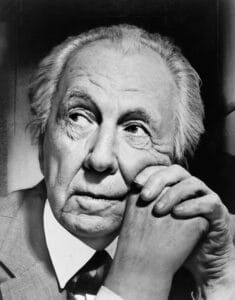
    One early example of this genre concerns the architect Frank Lloyd Wright approached in 1953 with the reverence with which someone in medieval England might approach a King by NBC Chicago’s Hugh Downs. This interview is in many respects a ridiculous affair. Wright is treated – and clearly regards himself – as not just a great artist but a seer and a sage.

    He may well have been all those things, but he is also plainly a self-regarding one. Throughout the interview, he sits with a large book inexplicably on his lap, like some vast Bible, which the viewer is invited to assume must be a compendium of his drawings. His answers are philosophical and one can never be sure if he is definitely looking Downs in the eye – certainly the impression is that Downs has come to Parnassus to address a higher form of life.

    Many will perhaps agree with Frank Lloyd Wright’s estimation of his own abilities while thinking he could have been more modest about them. Wright is one of those few architects who we can certainly say changed architecture, though it could sometimes be a bit tiresome to hear him point this fact out so often. It suggested perhaps that he had something to hide, and I think he did: his moral self, which was, biographers agree, by turns slippery, cunning, abusive, untrustworthy and arrogant.


    This queasiness one feels about Wright is something we need to get out of the way before we discuss his genius, which is far more interesting and surprising than the news that well-known people often behave badly.

    More interesting – and it is especially worth considering for anyone who happens to YouTube the NBC Chicago interview – is Wright’s vulnerability, arising out of a lifelong familiarity with tragedy. In fact, looked at closely, Wright’s career involved a regular collision with adverse circumstances – some of them fairly typical and at least one of them unthinkable, which we shall come to in a moment. A book published in 1993 The Seven Ages of Frank Lloyd Wright, written by Dennis Hoppen, observed that Lloyd Wright had a remarkable ability to absorb reversals and over time convert them into new periods of creativity.

    It is this which makes Wright worth studying. The patrician who was never short of a word of self-praise ought not detain us. These traits probably had to do with a difficult upbringing: trauma created a sort of outer person which was secondary to the much more interesting inner creative life by which he really lived.

    In interview, we meet this outer self; in his work the far interesting central force. Regardless, his life has a fascinating rhythm to it: Hoppen’s book shows that Wright experienced surges of creativity which were routinely checked by disaster. But these disasters seem to have gone deep into him, and by some mysterious creative process, engendered over time great leaps forward in his art.

    Wright would often state that he didn’t decide to be an architect, his mother made that decision for him. She declared while Frank was still in the womb that he would grow up to create beautiful buildings and was so proactive in what was then a distant likelihood as to adorn his nursery with pictures of the great English cathedrals. Wright would later make it clear that he didn’t think anybody had taught him architecture telling Downs with his usual slightly prim arrogance:


    I’m no teacher. Never wanted to teach and don’t believe in teaching an art. Science yes, business of course..but an art cannot be taught. You can only inculcate it, you can be an exemplar, you can create an atmosphere in which it can grow. Well I suppose I, being an exemplar, could be called a teacher, in spite of myself. So go ahead, call me a teacher.


    Wright’s initial degree was in civil engineering but his ambition was to make it to Chicago; in fact, he left university just before completing his qualification. He may not have felt he needed a teacher. But a mentor, one feels, can be a quite different thing and in Louis Sullivan, of the firm Adler & Sullivan, that is what Wright found in spite of his own irascibility and the perennial failure to get on with people which would often crop up in his career.

    Though Wright would make a habit of disparaging his contemporaries, Sullivan would be remembered fondly by Wright – though by no means so fondly as to make anyone think Wright himself was anything other than number one, or in his own confident estimation, “the greatest architect who ever lived, or will live.”

    The trouble with Wright’s arrogance is that the architecture does tend rather to bear out his own high assessment of himself. Even as a young man he had already by 1900, almost single-handedly, invented prairie architecture, with a series of four houses which showed a completely undaunted sense of the possibility of American architecture, and by association American life. The European ideal, from Wright’s perspective, was all very well, but the greatness of European art had been arrived by being true to the history and values of that continent. Mightn’t something new be possible in this vast country?

    And if something was possible, then what distinguished the American case from the European? The first thing was the sheer size of the country and therefore the space assigned to each individual. Europeans, and especially British people, have long since found themselves living on top of one another. Any visitor to the towns of America feels how different the demographics are: we feel the country’s enormity, its abundance, and tied to these things, the sense that Americans can live differently, which of course means in different buildings. Prairie architecture was Wright’s first attempt to be true to what now seems to us a fairly obvious reality. Many of these houses still stand today as he always said they would.

    The great innovation here is the horizontal line which mirrors the great outstretched nature of America. For Wright, European architecture was pre-democratic or even anti-democratic and characterised by boxed rooms, which are ideal for establishing hierarchical systems. One thinks of the servants’ quarters, or the cut-off luxury of, say, the master bedroom in a typical European castle. Wright’s houses are different: the open floor plan which would go onto dominate, in another setting, office life, is really his invention.

    But these insights were built on a deeper intuition which had to do with the need to respect landscape, making Wright the purveyor of what he called organic architecture. This meant that his architecture was meant to embody the essence of the land. Most famously, he once expounded his views on hilltop or hillside architecture: “No house should ever be on a hill or on anything. It should be of the hill. Belonging to it. Hill and house should live together each the happier for the other.”

    Wright’s architecture belongs to the land – and he accentuated this idea by building often in stone and wood. The prominent central chimneys in these houses are intended to relate to the human heart – and there is perhaps the sense that Wright’s buildings correspond not only to the landscape they’re in but to human beings themselves: they are, perhaps, attempts to create functional counterparts to the American soul.


    It all amounted to a great vision of democracy by a man who in his life was actually rather authoritarian. It is possible to find a contradiction in his life between his sense of himself as the isolated Great Man, and his oft-stated belief that American architecture cannot thrive unless it takes into account its founding principle of democracy.

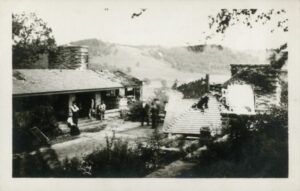
    These promising – indeed, exceptional – beginnings were soon to be upended by unthinkable tragedy. Wright, though married, had conducted a controversial affair with a married woman – and the wife of one of his clients – Mamah Borthwick. The press got wind of it all, and Wright built Taliesin in its the first incarnation in order to shield Borthwick from the press. Then on August 15, 1914, Julian Carlton, a male servant from Barbados, set fire to Taliesin, and then murdered seven people, including Borthwick and her two visiting children. It is hard to imagine what this must have been like for Frank Lloyd Wright, who happened to be away on business. But in time his reaction was remarkable:


    There is release from anguish in action. Anguish would not leave Taliesin until action for renewal began. Again, and at once, all that had been in motion before at the will of the architect was set in motion. Steadily, again, stone by stone, board by board, Taliesin the II began to rise from Taliesin the first.


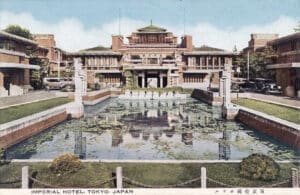
    It is a splendid lesson about how to deal with setback: creatively. As Taliesin II was rebuilt, Lloyd Wright was working on a new phase in his career, when he accepted a commission to design the Imperial Hotel in Tokyo. This looks so different as to not seem to be from the hand of the same architect, but of course it’s in a different country and Wright was committed to an architecture which, to a near obsessive degree, took into account place.

    Wright had thought through the viability of the structure – although sometimes this has been exaggerated a little. The structure did survive the Great Kantō earthquake of 1st September 1923 which and Baron Kihachiro Okura sent Wright the following telegram:


    Hotel stands undamaged as a monument of your genius hundreds of homeless provided by perfectly maintained service congratulations[.] Congratulations[.]


    Wright being Wright, he wasn’t about to keep this telegram from the press and the story did a fair amount to embellish his legend. In actual fact the central section had fallen through, and several floors bulged. It certainly wasn’t the least damaged building the earthquake.


    But Wright had moved onto another phase, which is sometimes characterised as ‘monumentality’. His block houses such as Ennis House fall broadly into this category. One wonders whether in their scale and grandeur they reflect a growing awareness of America’s imperial destiny: they feel like houses which belong to a powerful people, and in the wake of the First World War, where American involvement had decisively tipped the scales towards the Allies, America’s self-image had shifted. It would be the world power, and here was the architecture to prove it.

    But further disaster was round the corner, in the shape of another fire at Taliesin. On April 20th 1925, Wright noticed smoke billowing from his bedroom, and though on this occasion he was on site and able to call for help quickly, it was a night of high winds, and Taliesin II was destroyed along with much of the superb art collection which its owner had acquired while working in Japan. But again he was undaunted and took this loss as inspiration for Taliesin III which still stands today:


    And I had faith that I could build another Taliesin! A few days later clearing away the debris to reconstruct I picked up partly calcined marble heads of the Tang-dynasty, fragments of the black basalt of the splendid Wei-stone, Sung soft-clay sculpture and gorgeous Ming pottery turned to the colour of bronze by the intensity of the blaze. The sacrificial offerings to — whatever Gods may be. And I put these fragments aside to weave them into the masonry — the fabric of Taliesin III that now — already in mind—was to stand in place of Taliesin II. And I went to work.


    There is something magnificent about the simplicity of that sentence: “And I went to work”. In its confident forward movement we get very close to the essence of the man. From here, Wright would go on to his so-called ‘desert architecture’ phase – it was a difficult time for Wright personally and financially and he was forced to take on smaller projects such as Ocotilla and San Marcos in the Desert. This must have been relatively humbling, and of course the 1929 Great Depression was round the corner to humble him further.

    By 1929, he could have been forgiven for thinking he’d had a life entirely comprised of setbacks. This huge decline in productivity led to another fallow period and then a period of low cost architecture characterised by his Usonian houses – small houses very private from the front and open at the back usually aimed at the middle class. The first such house is usually considered to be the Herbert and Katherine Jacobs First House.

    Though this house, with its horizontality, and little carport, was perhaps a rather humbling project for a man to undertake who considered himself the equal, and indeed the superior, to the architects who made the Pyramids, Wright couldn’t quite refrain from couching it in the grandest terms possible: “The house of moderate cost is not only America’s major architectural problem, but the problem most difficult for her major architects.

    As for me, I would rather solve it with satisfaction to myself and Usonia than build anything I can think of at the moment.” Usonia, incidentally, was Wright’s somewhat ludicrous term for America, but these houses are extremely beautiful and subtle. They feel as though they contain an earned wisdom. Indeed, perhaps as one looks at the wonderful Usonian houses, one can reflect that humility wasn’t a bad thing for Frank Lloyd Wright to get to know a little.

    But humility wasn’t to be for the architect in the long run. The second half of his life contains fewer setbacks and much of his greatest work, especially the magnificent Fallingwater was still ahead of him, and that superb office space the Johnson Wax Headquarters, with its famous lily pad columns. Wright always said that it increased productivity.

    As impediment fell away, and a greatness exactly like the one imagined for him by his mother was assured, Lloyd Wright settled into the grand and arrogant persona which Hugh Downs would come to visit in 1953, some six years before his death. But what’s more interesting than the man at the summit he became is the way in which he surmounted so many obstacles to get there.