Tag: Productivity

  • Opinion: Why Hybrid Working is the Future

    Ever wondered why hybrid working is the future? Finito World looks at a question likely to be of perennial interest well into the future


    Hybrid working is proving itself remarkably flexible and popular.

    New research from IWG shows that hybrid working has led a boom in ‘active commuting’, with increasing numbers of workers travelling to local flexible workspaces via foot and bike.

    That’s good for our health, both physical and mental and is just another reason why employees seem to be voting with their feet nowadays.

    The study found that commutes to local workspaces are 38% more likely to be active than commutes to city centre locations. Workers aged 55-64 have reported a 109% increase in active commuting, the most of any age group.

    Health benefits


    That also has a significant knock-on effect. This follows recent census data which revealed that those who walked or cycled to work face a lower risk of mental or physical ill health, lowering their risk of admission to hospital for any illness by 10-11%.

    The increased use of local flexible workspaces by hybrid workers has been central to this shift. Almost two thirds (62%) of commutes to local workspaces are now mostly or entirely active. This is a 38% increase compared to commutes to city centre offices.

    The study was conducted by International Workplace Group (IWG), the world’s leading provider hybrid working solutions. It included brands such as Regus and Spaces, and included more than 1,000 hybrid workers. It found that walking (88%), cycling (34%), and running (28%) were the most common forms of active commuting. Workers travel on average 324 km via walking, 366 km via running, and 418 km on bike to a local workspace annually.

    The research also revealed some more novel forms of active transport, including travelling to work by scooter (7%), skateboards (6%), and rollerblades (4%), as workers cut long daily commutes by train or car and take advantage of workspaces closer to where they live.


    Rise of the “silver strollers”

    Hybrid work creates generation of “silver strollers”

    The research also reveals that older workers have made the most significant increases to the time they spend exercising as part of their commutes. Those aged between 55 and 64 reported a 109% increase in active commuting when travelling to a local workspace instead of a central office.

    Two thirds (67%) said they are more likely to incorporate physical activity into their commute when travelling to a local workspace instead of a city centre location. Meanwhile, more than three quarters (79%) have reported improvements to their physical health as a result.

    The most popular form of exercise for this “silver stroller” generation is walking, with workers aged 55-64 travelling an additional 259 km a year on foot by active commuting.
     

    Why hybrid working is the future
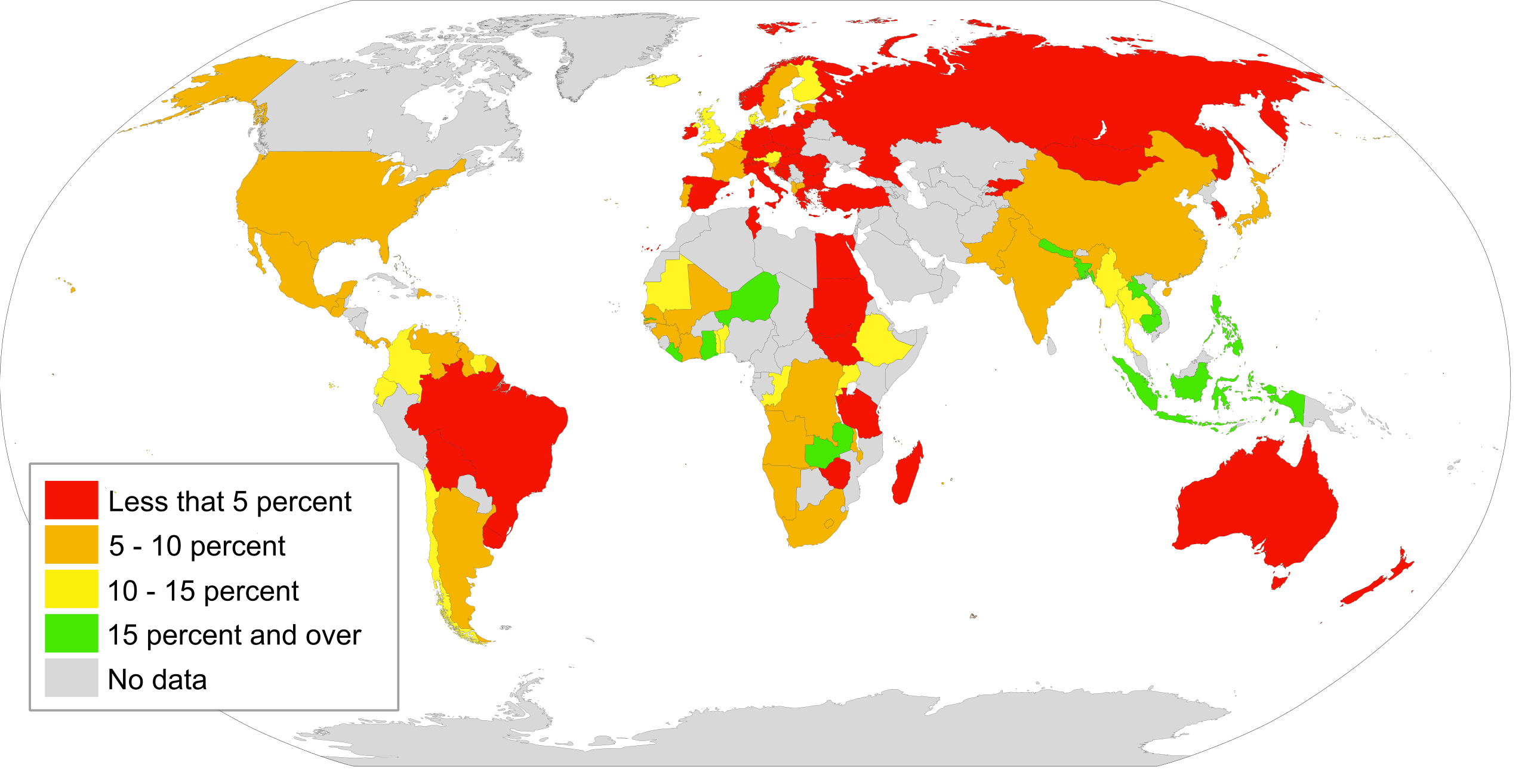
    This map shows the percentages of hybrid working by country


    A Question of Productivity

    Active commuting fuels mental health and productivity gains

    Beyond the obvious physical health benefits for all generations, active commuting to local workspaces has improved mental wellbeing, productivity and work/life balance. More than four in five (82%) of those that active commute said that incorporating exercise into their commute improved their mental health, with three in five (60%) reporting increased productivity at work.


    This is supported by additional research from International Workplace Group which found that three quarters (75%) of workers experienced a dramatic reduction in burnout symptoms, after transitioning to a hybrid model***.

    The improvements to work/life balance have resulted in 85% of hybrid workers saying they are more satisfied in their jobs and 75% reporting higher levels of motivation.
     

    Why hybrid working is the future
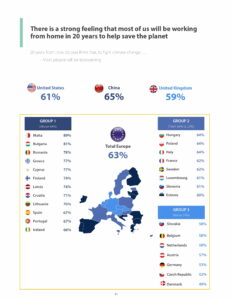
    This chart shows strong consensus around the ecological benefits of working from home


    Closer to Home

    Given the clear health benefits of active commuting, it’s no surprise that nearly three in five (59%) of workers want their employers to provide access to local workspaces closer to home, so they can fit in more exercise – as three quarters (75%) say they are more likely to incorporate physical activity into their commute when using a local workspace.

    It appears that business leaders are listening to their employees. Recent research among more than 500 UK CEOs found that three quarters (75%) said that returning their employees to a central office five days a week isn’t a business priority. Two thirds (65%) said they would lose talent if they insisted on their employees being present in a central office every day.

    IWG locations in rural, suburban, and commuter areas have seen a surge in foot traffic since the lifting of Covid-19 restrictions. Towns like Uxbridge (up 1839%), High Wycombe (up 1412%) and Maidenhead (up 1186%) experienced significant growth in footfall between June and August compared to the same period in 2021, when Covid-19 restrictions were in place.


    Win/Win

    To help meet this demand, IWG has opened more than 300 new locations in the first half of 2024, with the majority in rural, suburban and commuter areas closer to where workers live.

    Mark Dixon, International Workplace Group CEO stated: “The growing use of workspaces closer to where employees live, allowing them to reduce long daily commutes, is contributing to major improvements in worker’s physical and mental wellbeing.

    “This research demonstrates that hybrid working is a win/win for everyone. Business leaders are seeing substantial productivity and financial gains, while employees enjoy a better work/life balance and higher job satisfaction.

    Companies are increasingly appreciating that they will not only will they have a happier, healthier workforce when they allow people to work flexibly, but people actually feel more productive and motivated.”


    Need mentoring about hybrid working and the future of work? Go to finito.org.uk


    See also these artices:

     

    The Power of Motivation in the Workplace


    An Interview with revered clinical psychotherapist Dr. Paul Hokemeyer about Get Back and workplace toxicity


  • The cost of office miscommunication

    Patrick Crowder

    We’ve all done it. Missent emails, unfortunate autocorrects, and missed messages seem to be a natural by-product of the way that we communicate at work. These small gaffes are usually harmless, but some can cost employees their jobs and the respect of their colleagues, as well as costing businesses large sums of money.

    To see the common ways we miscommunicate at work, the telecommunications company TollFree Forwarding surveyed 1,000 employees about their workplace blunders.

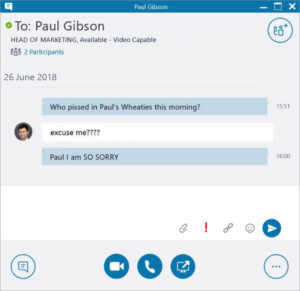
    A slight autocorrect error.

    Office miscommunications are often not as humorous as the example above – and some can be costly. A study from the Independent Director Council found that large companies (over 100,000 employees) lose about $62m (£45,640,990) per year because of miscommunications.

    Stephen Hart, CEO and founder of the B2B credit/debit fee comparison toll Cardswitcher explains how simple miscommunications can cause chain reactions leading to serious issues.

    “Say your customer service team isn’t passing on customer feedback. Well, that’s going to cause problems for your sales, who don’t know how to tweak their approach. And your business development team, who won’t know how to improve the business. And your marketing team, who won’t understand your customer base,” Hart says, “Bad communication has a tendency to cause compound issues and spread to other business areas.”

    When it comes to remote communication, mistakes are common. 56% of employees surveyed said that they had sent a work-related email or text to the wrong person at some point in their careers. 70% of men surveyed admitted to miscommunicating at work, which is 21% more miscommunication than the women surveyed reported.

    These sorts of miscommunications can have social consequences, and may even lead to termination.

    While many managers will laugh off truly accidental miscommunications, if the message sent is offensive or sexual in nature then employers are usually within their rights to fire the employee who sent it. Tom Simeone, who is an attorney and adjunct law professor, explains.

    “Many employment contracts state that an employee can only be fired for “good cause.” Some contracts then go on to define a good cause, but others do not. So, insulting a manager, for example, could be grounds for termination, if the employer desired.”

    Miscommunications are not always accidental, nor do they always happen through remote communication. Sometimes, an office dynamic can lead to employees being afraid to speak up or voice concerns. Tracey Julien, who is VP of marketing at the retirement planning company Guided Choice explains how this situation occurs.

    “Many employees feel intimidated and even too embarrassed to ask their manager a question to clarify what is being asked of them. This is probably one of the easiest issues to combat and yet it still occurs time and again,” Julien says.

    Steven Hart suggests a way to combat miscommunication called “the daily stand-up”. These short meetings ask employees to answer three questions; What did you do yesterday? What did you do today? And what impediments or problems do you have?

    Hart explains how this practice can boost productivity.

    “The communication and productivity benefits are immense,” Hart says, “If someone is planning work that will disrupt someone else’s, you learn about it at the start of the day and can mould your day around it. Another huge benefit is that it highlights problems, issues, and impediments so someone can address them before they start causing problems.”

    Simple, mostly harmless miscommunications happen to us all, but it is important to address the roots of more serious miscommunication before it reaches dangerous levels. If businesses want to increase productivity and avoid social problems among employees, miscommunication is a top item to address.

    https://tollfreeforwarding.com

  • Why you need to have a happy workforce

    Ann Dowdeswell

    The average British person spends 3,507 days at work over a lifetime– that’s close to 10 years of our whole life. Given how much time we spend at the workplace, it’s important to love what we do.

    Your employees are the face of your company. They dictate the course of the workflow and the overall brand image. If your employees are unhappy, your business will suffer the most. Here is why it’s important to keep your workforce satisfied.

    Happy employees increase productivity

    A study conducted by Oxford University’s Saïd Business School showed that employees are 13% more productive when they’re happy. The research was based on a case study of the workforce at BT, a British telecommunications firm. Those employees who were happier made more phone calls per hour worked and converted more calls to sales.

    Happy employees foster a stress-free environment

    Not only that but happiness reduces stress. Research shows that fatigue in the workplace can lead to longer reaction times, decreased concentration, reduced task motivation, and lower vigilance. This leads to decreased productivity, poor communication, irritation, and even accidents in the workplace. With the festive period approaching, it’s common that your staff might feel more stressed and overworked than usual.

    Moreover, stress at the workplace can lead to an increase in absences, mainly due to ill mental health. 

    Happy employees boost customer satisfaction and company image

    Stressed and unwelcoming staff can put customers off, whereas a smile at the checkout point can go a long way in increasing customer loyalty. 

    Unhappy employees can still act professionally and politely. However, their dissatisfaction will still affect the quality of customer service they offer. When your staff are happy, they’re more likely to engage with customers, upsell, think of creative solutions, and pay more attention to their workflow. This results in a positive company reputation and higher customer retention.

    Employee attitudes are changing

    What’s more important for employees: happiness or salary? A survey conducted by Wildgoose UK shows that 58% of respondents prioritise happiness over salary in 2021. That’s a slight decrease from 2017 when 61% of respondents considered happiness over salary.

    Of course, the monetary component is still vital in terms of employee satisfaction, but money isn’t all. In fact, according to the Mercer global engagement scale that includes employee data from the UK, US, Japan, India, Germany, France, and China, “base pay” is towards the bottom in the list of motivating factors for employees.

    Intriguingly, the leading motivator is “respect”, followed by “type of work”, “providing good service to customers”, “the people you work with”, and “good work-life balance”.

    How can you boost your employees’ happiness?

    Now that you know what the general key motivators for your workforce are, it’s important to integrate them into your employee wellbeing initiatives. There are many ways you can spread a little joy at the workplace and thrive as a business but here are some starting points.

    Show your staff you value them

    Is the monthly salary enough to showcase your appreciation for the efforts your employees are putting in? Oftentimes, it’s best to boost the monetary reward with additional bonuses and prizes. Christmas is the ideal time to organise little competitions or simply give away gifts on a daily basis in the countdown to the holidays.

    It’s important to remember, however, that appreciation isn’t only manifested through physical gifts. As a leader, it’s your responsibility to motivate, encourage, and congratulate your staff on wins both big and small. Send them a “well done” email, talk about their strengths regularly, and position yourself as a person they can trust with any issues. Additionally, provide an array of training and courses in areas where your staff want to improve. This will show them that you’re interested in their career growth.

    Create a bigger sense of purpose

    People are motivated to work towards a company goal when they know that what they’re doing matters. Initiate them into the company strategy and keep them updated about your business’ performance. 

    It’s important to foster a sense of belonging and purpose, also referred to as “epic meaning”. That is, the bigger picture in which each employee is a superhero working to benefit the company rather than themselves. One tool that can help you foster a sense of belonging is workwear clothing

    Ann Dowdeswell, Sales and Marketing Director at Jermyn Street Design, a global specialist in corporate clothing, commented: “Uniforms not only promote unity and equality at the workplace, but they’re also a great way to uplift team spirit and enhance corporate social responsibility.”

    When your employees feel like they’re vital to the business, they are more likely to be engaged with the work. A recent survey by Market Inspector shows that 72% of the respondents think of their role as a job and only 28% perceive it as a career.

    Encourage friendships

    A survey conducted by Wildgoose UK showed that 57% of the respondents feel like having a “work best friend” makes the workplace more enjoyable, and 22% feel that they are equally or more productive. As an employer, you can nurture these positive relationships at the workplace.

    As a start, it’s important to have a dedicated social/break room at work, where employees can bond over conversations and games, such as darts and pool. It’s also a good idea to organise team-building activities and socials, such as yoga classes, bowling, and drinks after work.

    Being happy at work is a state of mind which employers can significantly contribute to. Boosting your company culture, introducing bonding activities, and simply being there for your employees will help you create a healthy work environment. In return, the happiness of your employees will help to position you as a leading organisation.

    Sources:

    https://www.independent.co.uk/life-style/british-people-work-days-lifetime-overtime-quit-job-survey-study-a8556146.html

    https://www.ox.ac.uk/news/2019-10-24-happy-workers-are-13-more-productive

    https://www.ncbi.nlm.nih.gov/pmc/articles/PMC4525425/

    https://wearewildgoose.com/uk/news/friends-happiness-in-the-workplace-survey/

    https://www.theguardian.com/money/2011/jul/15/happiness-work-why-countshttps://www.market-inspector.co.uk/blog/2018/03/happiness-in-the-workplace-in-the-uk

  • Opinion: Gavin Williamson’s proposed school phone ban misses the point

    Opinion: Gavin Williamson’s proposed school phone ban misses the point

    Patrick Crowder

    Gavin Williamson has been criticised over his suggestion that mobile phones should be banned in schools, but are mobiles even the problem in the first place?

    The Education Secretary penned a comment for the Telegraph last week launching his Behaviour Hubs programme and calling for “firm and fair” discipline in schools. He cites a lack of discipline and focus during the lockdown and seems to fear that it will carry on through students’ return to the classroom. 

    Despite the fact that mobile phones are already banned in most schools across the country, Williamson laid the blame for behavioural issues on their use during school hours.

    Geoff Barton, general secretary of the Association of School and College Leaders, told the Times that Williamson had “not done his homework” on pupils’ behaviour following lockdown. He stated that students are showing a “sense of calm and cooperation that is deeply impressive,” and that “behaviour has never been better.”

    For better or worse, mobile phones are a part of our daily lives. We are a society on call – to friends, relatives, neighbours, spouses and – if clear boundaries are not set – to jobs that were once nine to five. Sheltering children from this reality may be the kind thing to do, but it will not prepare them for the real world.

    The issue with phones and productivity is that the option for entertainment and socialisation is ever-present. The key is learning self-control. If the CEO of a company had to place their phone in a time-locked safe to get any work done, they would be seen at best as eccentric, and at worst as an internet addict.

    Williamson states that phones in school act not only as a distraction, but as a “breeding ground for cyberbullying” and “anonymous Instagram accounts where students are ranked on appearance”. 

    Cyberbullying is an issue which must be taken seriously. According to the Office for National Statistics, almost one in five students have experienced online bullying in the form of name calling, exclusion from social activities, harmful rumours, or other bad behaviour in the past year. 

    According to that same survey, only 19% of online bullying took place exclusively at school. 28% occurred exclusively while the students were out of school, and 53% of students reported that it took place both at home and in school. Therefore, Williamson’s phone ban would be ineffective in stopping the sorts of social media accounts he referenced.

    Leaving mobile phones aside for a moment, it would be wise to examine the reasons behind Williamson’s perceived lack of student discipline during lockdown. It seems far more likely that poor behaviour stems from the stresses of the global pandemic, online learning which leaves students unengaged and unmotivated, and the lack of socialisation with other students their own age to serve as a pressure valve for these stressors.

    According to Geoff Barton, students are “relaxed and pleased to be back at school”. If this is true, it serves as proof of the toll online learning must have taken on our young people. Coming down hard on students now with new, more militant restrictions and disciplinary styles will only remind them of the reasons they shouldn’t be happy to return.

    If the pandemic has shown children that in-person school is not so bad, then let’s take that as a win and try not to ruin it.

    Photo credit: John Tuesday on Unsplash

  • More than just immunity: what getting the vaccine means for the young

    More than just immunity: what getting the vaccine means for the young

    Georgia Heneage

    With the spring finally upon us, it feels like there’s much to be optimistic about: the vaccine rollout is heavily underway – nearly a third of adults have already been vaccinated to date – and the arrival of warmer weather seems to have injected an ounce of energy to what has been a lethargic, heavy winter.

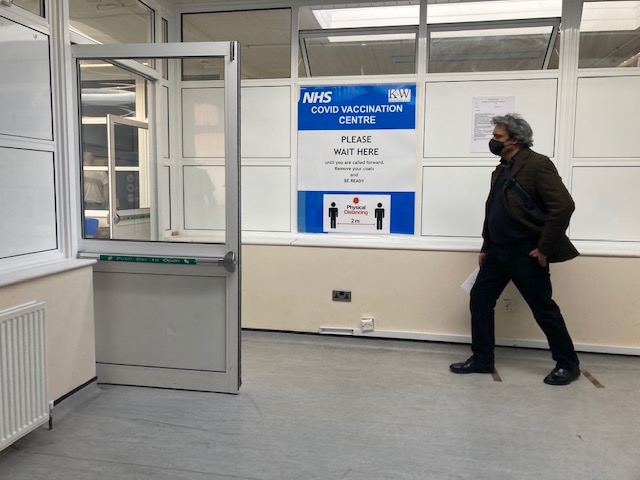
    This was certainly the flavour in the air yesterday, as I queued for a vaccine outside an old converted school in Harlesden. As high-vis staff shepherded us through a maze of empty school classrooms and into small white cubicles, where the deed was done in literally minutes, I’ve never felt more like a character in Contagion. Yet for the first time since this pandemic began, it heralded a glimmer of hope on what has been a bleak horizon.

    Being a 23-year old asthmatic, getting the vaccine so early brought with it a concoction of different emotions- excitement, trepidation, and definitely a bit of guilt. But as someone who has recently started a new job, getting the jab felt like a lot more than just immunity. Working remotely can be incredibly lonely, and most young people – me included – have felt like they’ve missed out on those fundamental face-to-face experiences which are so important in shaping your career at an early age.

    So the jab signalled the start of a new dawn, and a brighter future; it opened up the possibility of going back to the office and returning to some kind of normality – something we’ve all missed as we’ve entered the jobs world for the first time. It also gestured towards a return to some kind of social normalcy and an escape from the state of boredom, inertia and melancholy in which so many young people have found themselves this winter.

    Economists have argued for decades that confidence is a fundamental ingredient in economy growth; as people start to feel more secure in their jobs investment soars and spending increases. As Forbes journalist Tim Worstall puts it, “more economic activity is the definition of economic growth…people wandering down the street and in general thinking “Hey, yeah, I feel good!” means that the economy does in fact grow.”

    The rolling vaccine programme and the arrival of the sunshine may just give our economy the confidence booster it needs to bring us out of this winter depression.

  • ‘The sacrificial lambs of Covid-19’: self-employed parents

    ‘The sacrificial lambs of Covid-19’: self-employed parents

    Alice Wright

    Many parents filed their tax returns on the 31st January. A fun day for no-one, but for many salt in the wound followed when Prime Minister Boris Johnson sent a letter of support through the letterbox the following Monday. The letter was intended to thank parents for their stellar work in filling the education void left by the closure of schools for the second time in twelve months. Some received this with hostility, others with annoyance, many with exhausted ambivalence. 

    Johnson’s well-intentioned letter changed nothing. Parents have been left to pick up the slack left by online provision from schools and yet there has been no direct financial support from the state for their doing so. Some parents have demanding jobs; others struggle to make ends meet while they’re on furlough. Meanwhile the self-employed are hemorraghing productivity in order to care for little ones. One business-owner described sole trader parents to me as ‘the sacrificial lambs of Covid-19’.

    It’s no surprise then that with the half-term slog now in full swing, it’s not uncommon to hear parents wondering – only half-jokingly – when their salary for half a term’s education is coming. But it’s a more serious issue than many realise. There is a strong government that as Rishi Sunak’s budget day approaches, he should be considering a tax rebate – especially for self-employed parents.

    One self-employed writer, Iris, 40, and who has two children, told me: “For the self-employed, productivity is synonymous with income. The self-employed can’t and don’t claim furlough, and are some of the most affected by homeschooling as they have no work support structure when they are unable to cope.” She continued: ‘They’re by nature entrepreneurial people, the sort of people the Conservatives are meant to admire. In addition they have to pay 150% of annual tax in their first year of moving to self-employed status. Individuals that did this in 2019-20, unknowing of what was to come, are particularly hard hit now.” 

    Freelancing support has indeed been poor from the government, but further to this it also has a gender aspect. The leading charity Pregnant Then Screwed was set up to fight against the discrimination women face during pregnancy and after having children. The organisation recently took the government to court, with the help of law firm Leigh Day and Doughty Street Chambers, to challenge the discrimination inherent in the Self-Employment Income Support Scheme.

    The basis of their argument is that the calculation of the grant does not exempt periods of maternity leave when calculating average earnings, leaving around 69,200 women affected. When questioned, the Chancellor compared taking maternity leave to taking a sabbatical or ill-health. The charity lost their challenge yesterday and are considering grounds for an appeal. 

    While all this unfolds, out there the pain is real. One single mother, Susan, who is also self-employed, tells us: “I feel constantly torn, all I want is to do the best for my daughter, whether that be helping her with her studies or staying afloat financially. Whenever I’m working to do that I feel neglectful of her education and future, when I’m helping with homework I’m anxious to get back to work.” 

    Further inconsistencies include the fact that nurseries are open, yet reception is not. This opens the possibility that a business run by a self-employed parent with a child born in August 2016 would be at a competitive disadvantage to a business run by a self-employed parent with a child born in September of that same year. Such cut-offs are perhaps in the nature of this unprecedented situation, but the government hasn’t so far recognised the disparity.

    The Prime Minister’s letter offers a vague commitment to an education recovery programmes which many feel will be too little too late, if they happen at all. The lobby group UsforThem has a membership base of tens of thousands of increasingly concerned parents arguing for the reopening of schools. The group stress that they support the vast majority of precautionary hygiene measures proposed by the Department for Education but that the damage to children and families of closing schools is too great. 

    Molly King, the organisation’s founder and mother of two, told me that the government must “extend the furlough scheme so that parents can concentrate on their children without fear of losing their jobs. There needs to be explicit acknowledgment that it is impossible to do both well and that children need their parents like never before.” 

    Liz Cole, the other co-founder of Pregnant but Screwed, agrees: “Parents are on their knees. Many are telling us that they are barely keeping their heads above water financially and in terms of their own mental health. Combined with the pressures of juggling homeschooling and employment, a growing number of families are now at breaking point. It is deeply concerning.”

    One such parent is Peta Swindall, a puppeteer and executive director of the Little Angel Theatre, who explains: “It has been a challenging time, particularly for freelance workers, and puppetry is no exception. Where possible we have tried to support our freelance family, with well over 100 employment opportunities and paid representation on the industry wide Freelance Taskforce, but the scale of the work has been much reduced, with many of those we work with losing their whole roster of work overnight.”

    Molly King is also desperately worried about the mental health of children not in the classroom, as well as increasing concerns about many children’s physical safety. Indeed, a Prince’s Trust report in January 2021 revealed that one in four young people now say that they are “unable to cope with life” since the start of the pandemic. Something King describes as “shaming.” 

    “We are also starting to hear some very troubling things on the safeguarding front,” King continues. “School governors and heads are telling us they are aware of significant increases in safeguarding referrals. Families really are now at the end of their tether and for the most vulnerable children and families this will be the grim result. From what we are seeing, we believe there’s a tsunami of mental and family breakdown ahead.” 

    Liz Cole agrees: “What parents most need from the government is a commitment to reopen schools and keep them open – allowing us to give our children the certainty and hope they desperately need. The combined impact of these current two status quos amounts to a declaration of war on childhood.” The campaign has received the support of 28 MPs so far, and they insist that number is growing each day. 

    According to Kevin Peachey of BBC News, more than five million people have fallen into a fragile financial position during the pandemic. That’s in addition to an estimated 14.2 million people, who are vulnerable to a financial shock. The Financial Conduct Authority data only covers the impact from February to October last year and they estimate that the impact will now be greater, after a further four months of restrictions, and counting. 

    The government must act now to help struggling parents, for families’ sake and for the sake of the next generation. It is true that the strain of this will lift if the schools return on 8th March. Education spending came in at 92.3 billion in 2019/20. Tax-paying self-employed parents traditionally find consolation in the thought that their payments to their Revenue are part of their contribution to the broader social contract.

    It goes without saying that the Covid-19 pandemic has radically altered that. The Treasury has been helped those affected in many instances, and his is to be applauded. But it is only right that we draw attention to the self-employed parent.

    But how might the situation be remedied? The reality is that this is an area which isn’t being sufficiently explored by the leading think tanks – a fact in itself symptomatic of an issue which has fallen through the cracks.

    Mark Morrin, Principal Research Consultant at Respublica, said: ‘For years the self-employed have been encouraged to go that way, but when the crisis came they were ignored.’ He added that this gap speaks to the fact that the Conservatives ‘used to be entrepreneurial under Thatcher,’ but that now ‘the Red Wall Tories don’t look at the world that way. There is a major piece of research to be done here. You might not admire Hungary and Poland for obvious reasons but they have more sophisticated approaches to family policy. Singapore is also miles ahead in this area.’

    Parents are tired of being called the ‘heroes of this crisis’ without having any recognition from the government about their contribution in stepping in for the state at this difficult time. And if you’re self-employed that lack of recognition may well go hand in hand without any recognition from where it would most help: the Treasury.

  • How to be productive in the age of Covid-19

    How to be productive in the age of Covid-19

    Robert Peake

    “I must create a system, or be enslav’d by another man’s”

    -William Blake

    In my work as an effectiveness coach, I have had the pleasure of working with some of the brightest and busiest people throughout the UK. Whether they are senior leaders of global companies, cutting-edge academic researchers, top surgeons or hit record producers, I have found that successful people all have one thing in common: they have their own systems to help keep them focused and on track.

    The combination of new remote working practices, huge shifts in marketplace demand, and global economic uncertainty means that focus has never been a more precious commodity than in the COVID-19 era. That is, whether you are just entering the workforce or building the A-list teams of tomorrow, you must be able to navigate change without losing sight of what matters most.

    One of the most popular systems for maintaining focus, and the one that I teach, is called Getting Things Done® or simply “GTD®”. It was invented by David Allen, whose book on the topic has sold more than two million copies and been translated into thirty languages. The methodology is comprehensive to one’s work and life, and I have been practicing it for more than twenty years.

    Yet certain elements of GTD can be implemented right away to great effect. According to a recent survey, 86% of people practicing some aspect of GTD feel that it enables them to be more productive in the current environment despite an explosion of virtual meetings, conflicting priorities, and other challenges to maintaining work-life balance. [ref.: https://www.next-action.co.uk/new-world-of-work-survey/ ]

    The fundamental principle is simple: you need a good system, and your brain isn’t one. Trying to keep and prioritise all of your commitments in your head is both ineffective and stressful. The proof is already in front of you in the form of your calendar. However, while most people acknowledge that they need an external system to manage their appointments, surprisingly few people have equally effective systems to orientate themselves in between meetings. 

    Yet figuring out what to focus on when it is just you and your laptop alone in a room is actually one of the most important parts of your job.

    The modern workplace is one wherein success must be defined and redefined in relation to constant change. Furthermore, many of the traditional company-wide approaches to keeping focus such as open-plan offices and face-to-face meetings have been upended by COVID restrictions. Having a system of your own is therefore key to being able to trust that you are making the right choices–for yourself and for the company–without anyone looking over your shoulder. So how do you get started?

    The first major mindset shift that successful people make is to start capturing their commitments in as few places as possible. For example, anytime they agree to do something, they write it down. I have never met a highly successful person who didn’t take notes in meetings (or have notes taken for them), which they later review not just for content, but to understand who agreed to do what by when.

    Likewise, out of the barrage of emails, texts, chat messages, and Zoom calls that await you at the start of each working day, you must identify what is actionable for you, get it “captured” as quickly as possible, and make sure it ends up in places that you will regularly review (out-of-sight, out-of-mind in a “notes” app on your phone, for example, doesn’t count).

    These basic notes and lists, however, are not enough on their own. Most “to-do” lists, while better than nothing, are incomplete and poorly stated by the standards of the GTD methodology. This is because when you consult them to decide what to do, you have to re-think what the next step is, and what will be true when it is fully done. The same goes for email, where the subject lines almost never read: “Here is your next step and here is what ‘job done’ looks like for you.”

    Instead, those two key elements–what’s next, and what the finish line looks like–are your job to figure out. Once you have done so, GTD suggests that you write it down in a way that won’t require re-thinking when you come back to read it later on. Whether that is done on a paper list or in a sophisticated digital tool is up to you. It is the thinking (and not having to re-think) that matters most.

    More than anything, what I notice about high-performing people is that they are internally motivated, and that they care about doing what they said they would do. This, in fact, is an excellent definition of integrity, one of those character traits that goes hand-in-hand with leadership. By contrast, those who rely on external motivators alone–such as looming deadlines and reminders from the boss–and especially those who think it unavoidable to let things “slip through the cracks”–are often left wondering why they never seem to get ahead.

    Sifting out the “signal” of your commitments from the “noise” of information overload is entirely practical. Yet as a practice, it can take time. Likewise, we are not trained in traditional schooling to define successful outcomes and clear next steps when a problem comes our way. We are often told to think about problems, but rarely told how. 

    The best way I have found is to simply think of problems as projects yet to be defined and done. That is, for every difficult situation there is an outcome on the other side of it that you want to be true. Identifying that outcome, and then taking a next step, is a key to bouncing back from most setbacks.

    Companies are looking for “self-starters” to hire, and managers are looking for “can-do” people to promote. Beyond attitude, though, the reality is that you need tools that work for you to get things defined, organised, and ultimately done. The GTD book is an easy read and, to my mind, a complete manual for staying effective in the COVID age.

    Many people are recognising that how they work needs to fundamentally change in order to thrive in the present climate. They need to work on how they work rather than just working longer and harder. As a result, I have never been busier.

    My hope is that we will all emerge from the COVID-19 pandemic stronger and more capable. What I know for sure is that those who create good systems have the best possible chance of doing just that.

    For practical tips on how to work smarter and live better, and further information on GTD seminars and coaching, visit: next-action.co.uk/working-from-home

    GTD and Getting Things Done are registered trademarks of David Allen Company. Next Action Associates is the licensed partner of David Allen Company for the UK and Ireland.

    Photo credit: Isaac Smith on Unsplash