Tag: photo essay

  • Finito Candidate Phil Verney Looks Ahead to 2024

    Phil Verney


    Us humans are interesting creatures, aren’t we? On the face of it, one could argue that the changing of a year is merely a second changing on a clock. Yet, for many humans, it signals the opportunity for reflection and change, especially when thinking about our careers.

    On New Year’s Eve, I was lucky enough to have a guest pass to photograph London’s ever-impressive firework’s display. Standing opposite this world-renowned landmark, listening to revellers discussing their plans for 2024 and seeing technicians rehearse the countdown, I found myself reflecting on my own achievements, lessons learned, and plans for the future.

    Embarking upon a career change can feel a daunting one. Technological leaps, such as AI and a post-Covid work dynamic have resulted in a rapidly changing job landscape. Through Finito’s career change mentoring program, I have gained vital knowledge, skills and insights. For me, their attention to detail, structure and step-by-step approach has been incredibly helpful in preparing me for the next steps. I have also noticed improvements in my personal life too which was an unexpected, but most welcome benefit.

    Now, as the festive lights, trees and echoes of Auld Lang Syne disappear and 2024 gets into full swing, my own excitement is building once again to find my next role.

    I’ve been really fortunate to have had a number of incredible experiences throughout my career, notably during my time at Google, so I know the importance of a job not feeling like a chore. I very much subscribe to what Mark Twain said; “Find a job you enjoy doing, and you will never have to work a day in your life.” I remember distinctly when working on an exciting role within the Google Earth team that I couldn’t really tell much difference between a Wednesday morning and a Saturday afternoon, because of how much I was enjoying the work. This notion is what I always strive for because it’s a win-win scenario for myself and a company’s progression.

    I became aware of Finito through a previous role and had met with Ronel on a couple of occasions. I was really taken by the work of Finito and so when I decided that it was time to undertake the next steps in my career, I knew there was only one place to start.

    As mentioned, I found Finito’s step by step approach incredibly beneficial. Time keeps us all marching to a quick step, and having access to the team of experts that Ronel put together really supported me in organising all the pieces of the jigsaw required to begin a career change.

    Our starter for ten begins with me meeting Finito mentor, Claire Coe to put together my credentials and design them as a powerful, but succinct summary of my skills and experience. Everybody to whom I have shown this CV has been impressed and commented how much it stands out.

    The next stage was to meet up with Finito’s resident photographer, Sam Pearce to have some headshots taken. I had never had headshots done before, so I was a little apprehensive about this. I needn’t have been worried though as Sam did a wonderful job of putting me at ease.

    A strong LinkedIn profile is an integral part for anyone looking to network and seek opportunities, and for this part, I met a few times with Amanda Brown, whose insights and attention to detail really helped me to spruce up my LinkedIn profile, and most importantly, make it useful for others.

    Working with Finito’s presentation and body language expert, Merrill Powell was an absolutely fascinating journey for me. Whilst I had never found interviews particularly intimidating, I knew there were areas on which I wanted to improve. Merrill’s ability to offer constructive criticism was incredibly helpful and I feel as though I learned so much about myself as a whole.

     

    Establishing a really strong connection with a primary mentor is a key aspect of Finito’s approach, which I have found incredibly useful. I meet regularly with Robin Rose to explore strategy, contacts and how best to position myself. The wealth of insights that Robin has been able to impart really has been priceless.

    I met briefly with Angelina Giovani and Mike Donoghue too as Ronel felt that their insights would be beneficial.

    This multi-pronged approach has also been an excellent reminder for my own self of how much I have to offer an employer. I’ve always found that combining a career path with a long held passion is key for me. I would love to find a role where there’s a strong visual component, such as the space industry, photography or lighting/art shows.

    My plan would be to find a role that had a business development “let’s get stuck in, there’s much to do” theme to it, where I can position myself as someone to really help an organisation achieve and further its goals, and become a leader within that company. I know I’m in a good position to do all this now, thanks to the Finito programme.

  • Photo essay: Architecture in the Time of Covid

    Photo essay: Architecture in the Time of Covid

    During the pandemic, we published Will Purcell’s fantastic photographic essay on architecture during the pandemic. With the streets full of people once again, it’s interesting to look back.


    Will Purcell  

    While it is easy to wallow in the emptiness of this pandemic there is a lot to celebrate in the architecture of the city and its surrounding suburbs. One long year ago, silent buildings were normally associated with being readied for demolition or redevelopment. Now silence can mean only one thing: the virus.

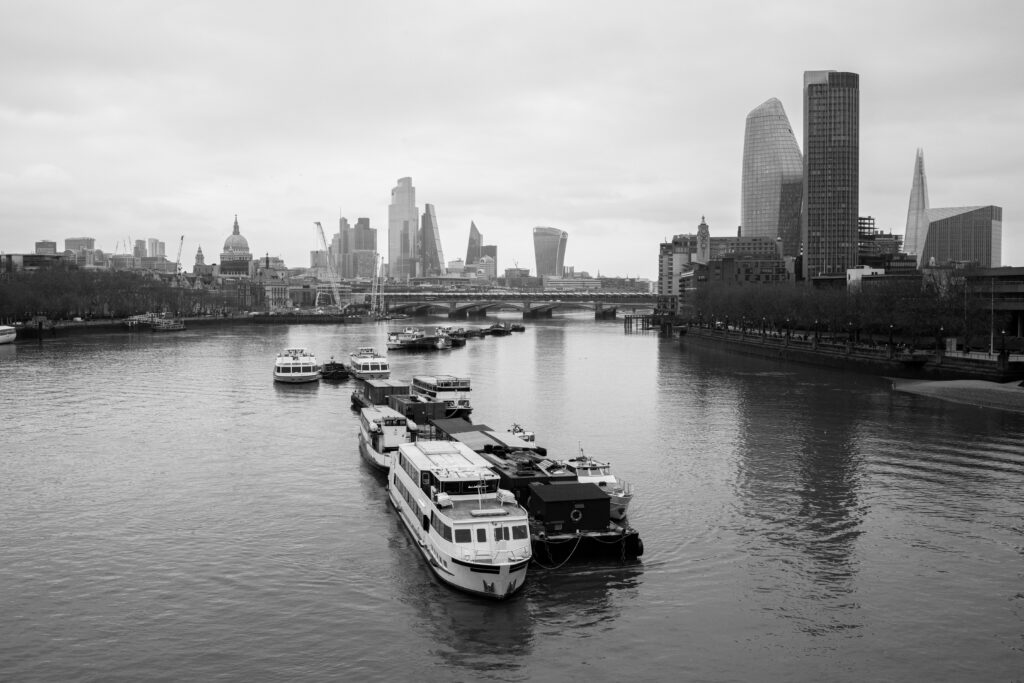
    It’s fascinating how architecture designed for people stands up when the footfall is removed. The City of London certainly looms ominously in the quiet with tall glass structures, curved and reflective, towering over the old London banking lanes and largely empty passageways.  

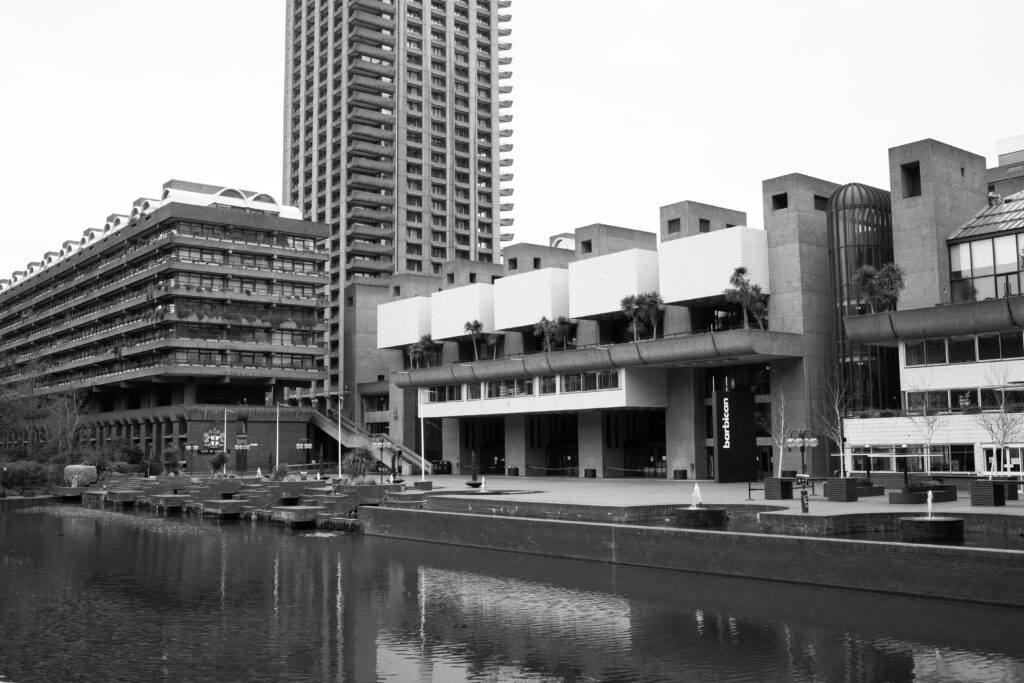
    The neighbouring Barbican with its closed theatre and eerily muted walkways with Wyndham-esque pods somehow manages to retain a sense of warmth. Although deserted, save for the odd body at a desk in an adjacent block, it keeps the interest of the observer. It is a hard development surrounded by equally gritty high rises but in its textured and rough industrial concrete balconies there remains, even with everyone tucked away and hidden, a consoling sense of presence, even warmth.  

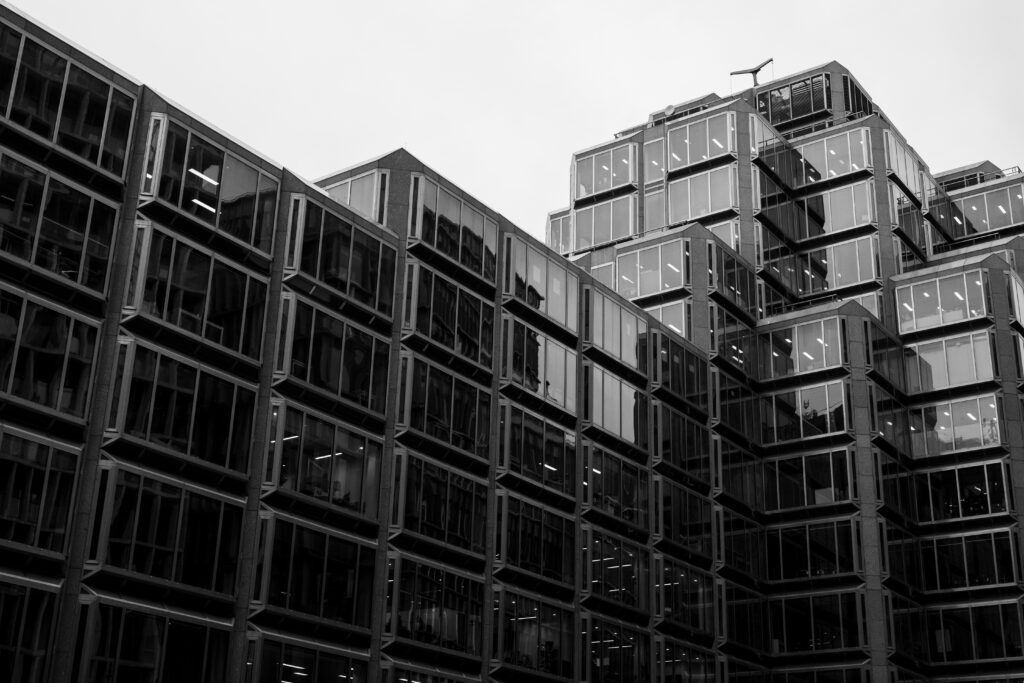
    South of the river, the National Theatre with its Brutalist layered concrete feels more than ever cold and alone. In sunlight, filled with people and life it can really soar, but during the winter of our pandemic it can appear an inexplicable relic. It is not alone, but just like the office blocks that surround Victoria Station, and which are usually lit up and full, the glass panels lie in darkness reflecting the world outside its walls.  

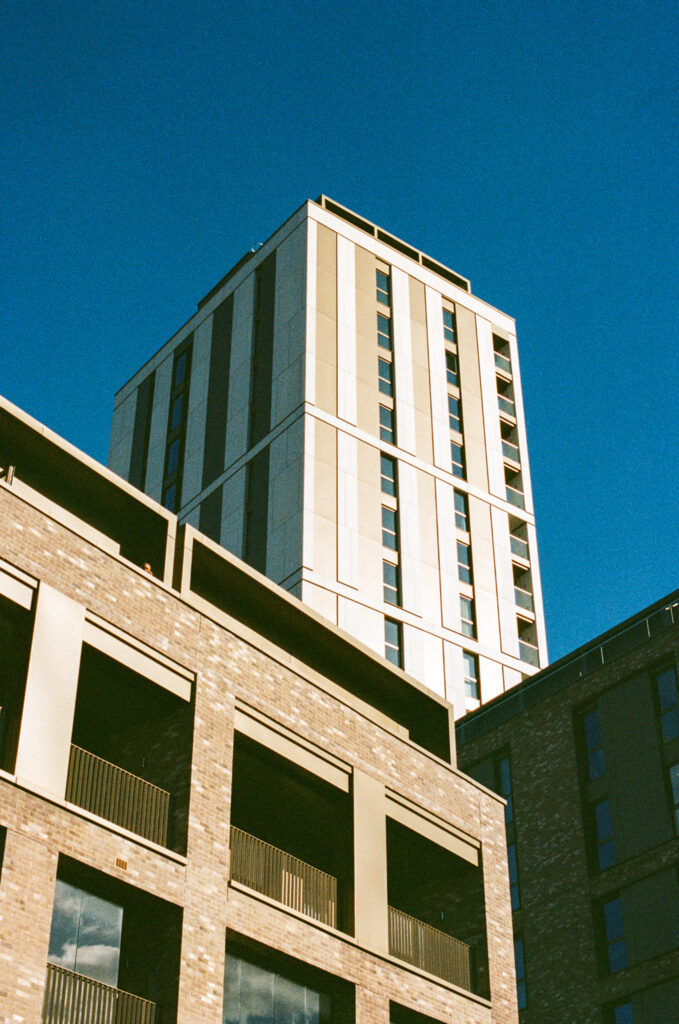
    In contrast, as habits change, people work from home and exercise and socialise near to where they live. Residences that sit in the middle of the action come to the fore. The suburbs are no longer the exclusive realm of the terraced house. High-rise flats demand attention on the horizon. Floor to ceiling bedroom windows overlooking community parks  look like fixtures of the future.  

    Deprived of so many people, London becomes a myriad of lines and angles. With the softening sounds of chatter, footsteps temporarily suspended, and with the constant noise of the cars, buses and aeroplanes also reduced, it is an opportune time to explore the silent shadows of the city’s architecture and search out the little pockets of hope and colour that still exist across the boroughs waiting for the return of laughter and light switches. 

    A New Build in SW London shows that the direction of travel is most definitely up when it comes to finding space in an already overcrowded city. 
    London – all angles and shapes and static boats.
    The timeless Barbican, empty and imperious at once from both the past and the future. 
    125 Victoria Street
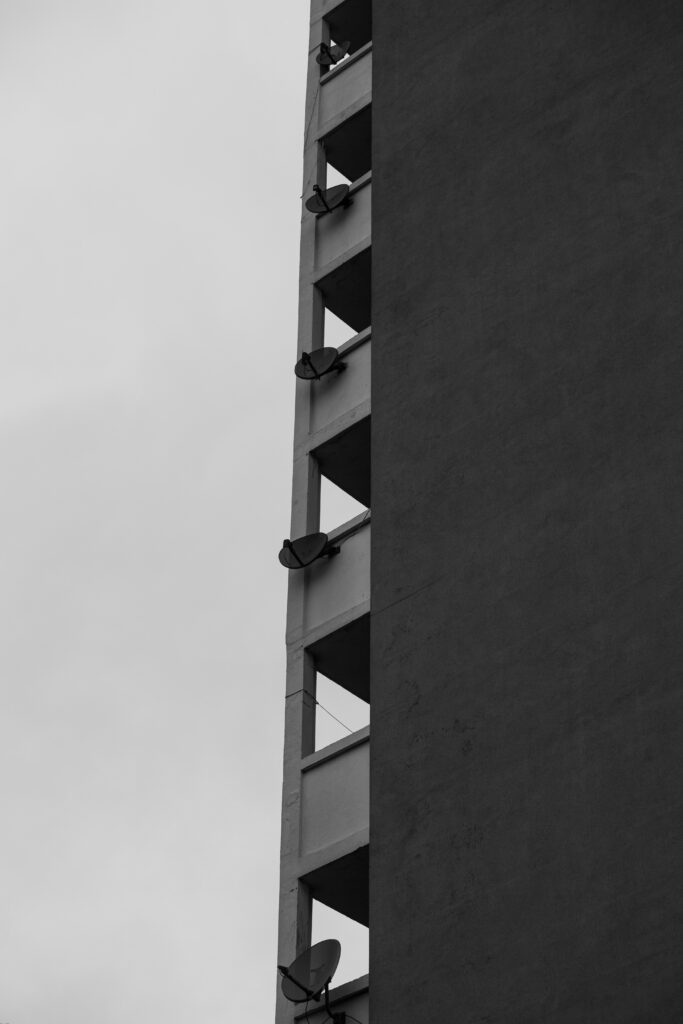
    Satelite dishes adorn a tower block in Loughborough Junction in SW London in a visual nod to the Netflix and other providers of TV that we have been at home devouring over the last year. 


  • Photo essay: The Teachers’ Strikes

    Christopher Jackson


    I’ve often thought that spring has its secret pitfalls, but in 2023, when the season turned, it seemed to have more than usual. Every time the moment of the clocks going forward comes round, I always think, remembering Shakespeare’s Julius Caesar: “Beware the Ides of March.” And it was TS Eliot who wrote of April as ‘the cruellest month’ when the promise of spring cedes instead to rather a different reality.

    So it went in 2023. I woke to Budget Day on the 15th March to what seemed on the surface good news: the government would extend the free 30 hours of childcare to those with children aged one and two. However, given that I have a daughter who has just turned three, this development put me in mind of the Philip Larkin couplet: “Sexual intercourse began in 1963/ (which was rather late for me)”. Many parents woke to news that the money which had essentially constituted a second mortgage was not money they’d have had to spend had they elected to have children a few years later. As Kurt Vonnegut put it: So it goes.

    Even so, the policy won’t come in until 2025. While it’s not immediately clear whether a Keir Starmer administration would keep to a promise made by the other lot, the suspicion remains that he’d be hard-pressed not to. The policy is a generous one, representing a possible alleviation for many households where the incentive to work is dramatically reduced by the cost of nursery fees. When my daughter turned three, I filled out my forms with Southwark Council with the sort of passion and alacrity which, to put it mildly, I never attack my annual tax return.

    I should add that the policy, announced by Jeremy Hunt, also represents a personal triumph for the brilliant MP for Stroud Siobhan Baillie; Baillie was rightly thanked in the Chancellor’s speech.

    But progress is always incremental. While the policy was delayed until 2025, there was another irony in play. The commitment by Chancellor of the Exchequer Jeremy Hunt was aimed at encouraging work, since the 30 free hour entitlement is available only to households where both parents work.

    But on the day of the announcement, the teachers’ strikes meant that for those with children in reception or higher, it was another day – after so many during the pandemic – where work needed to be set aside by at least one parent in order to create a day for a child – or children – not in school.

    And so what do working parents feel about the strikes? It’s possible to imagine a world where there is widespread moaning about the fact that teachers have secure jobs, and that if they have elected to enter the profession then they ought to be there for the children.

    Most people, including the teachers on strike, know that striking is undesirable, even wrong. For many teachers it’s the lesser evil; the greater evil being not to speak up about an intolerable lack of funding in the system. But, in general, when parents give vent to resentment it isn’t aimed at teachers so much as at the situation itself: pandemic parents might rightly feel that they have just had too many bad breaks these past few years.

    But more often than not the mood on the front line is overwhelmingly pro-teacher. Most parents learned when homeschooling during the pandemic that they are useless teachers. It follows from here that teaching, far from being something that anyone can do – as the tone of the public discourse leads you to expect – is, in fact, a highly specialised profession. When you get magnificent teachers – as my children luckily do – everything about your family life is better. These are people whose excellence is told in patience, intellect, decency, and commitment.

    That’s why the parents I speak to worry about the effect on their children’s education of their teachers being in a state of anxiety over wages. At our children’s school in South East London we adore our teachers, and though we sometimes do experience stress because of the strikes, we are also aware of what it’s like when bills go up but wages remain stagnant: there is a helplessness to that situation when you work in the public sector which, in theory at least, you don’t have if you work in the private sector where there is meant to be more elasticity on salary.

    What also doesn’t get reported is that for the teachers strikes were never only about salary – very far from it. In fact, it was to do with disquiet about how the government for much of 2023 expected their own salary rise to be met. The government’s initial position was for those increases to be largely met out of schools budgets, and it was their ceding this point which led to a settlement which might have been there much earlier in the year – at far less cost to education, and less strain to parents and teachers.

    Schools budgets and children’s well-being are essentially synonymous and there’s not a teacher I’ve spoken to who would ever have wanted more money at the expense, say, of after-school club provision. Such provision is the beginning of a child’s encounter with the riches of civilisation: art, music, sport, theatre, dance. No teacher, believing as they do in the development of children, wants extra money to come to their bank accounts at so high a cost to the pupils they care about.

    But of course, the misery of the situation extended beyond the plight of teachers and children. It was also about parents who are on zero hours contracts and so really couldn’t manage a strike day in the same way which many workers, typically those in the middle classes, with understanding bosses could. It’s also about the whole ecosystem of the school which, underfunded as it sometimes is, is still the heart of the life of the community.

    As always when hardship comes along, there are heartening stories. Some parents managed friendship-deepening play dates in central London – but again they were the lucky ones who have flexible jobs, understanding employers, and the funds to do so.


    Near where we live, East Dulwich Picturehouse screened cartoons throughout the strike days on 15th and 16th March at affordable prices. Many parents also became engaged in thinking of creative ways to help their community; whether it be through playdates, fund-raising activities, or just simple words of support to teachers. Many joined them on the picket lines.

    Of course, the private schools remained open throughout this year, and this led to an acute sense of a two-tier system where children from backgrounds who can’t afford it are being left behind unable to learn. Meanwhile, fee-paying schools can be seen continuing as usual: the lines are drawn vividly on strike day between the haves and the have nots. One sometimes wonders if the future is already being won and lost on such days, even if you have very young children, as I do.

    Of course, while there’s life there’s hope, and a strike day can be as good as a school day if you can take your child to a museum, or some other activity.

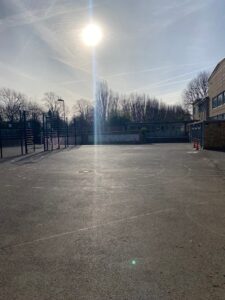
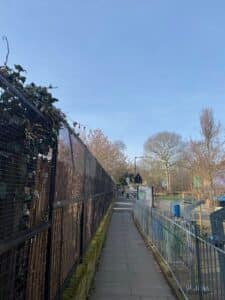
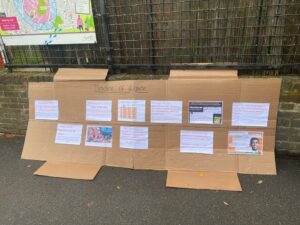
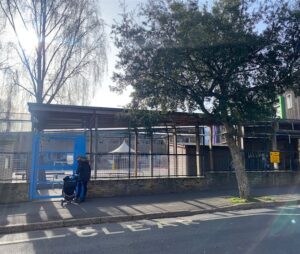
    Even so, all these problems seemed so intractable that they are crying out for the clarity of photography. In the photographs which accompany this essay we hope to cut through the complexity to arrive at images which show the simple truth of our times. We see the empty classrooms where light from a beautiful spring day falls not on the faces of children but on empty furniture; we see the thoroughfares of a local school, usually frantic with parents in the rush for drop-off now vacant, the trees almost seeming to ruminate on an unexpected quiet; we see a lone parent doing nursery drop-off, as testament to the way in which schools and nurseries sometimes feel like separate ecosystems in our society.

    It is an image of a struggling country. Gillian Keegan – a likeable and impressive Education Secretary – deserves credit for the eventual settlement, but it should have come sooner, and some of the fault lines which the strikes showed remain with us today. And with that it isn’t Shakespeare who springs to mind, but Yeats with his line that; “Things fall apart/the centre cannot hold.” This is a country which hasn’t fallen apart, but there is the sense that without smart moves from the Sunak government, it soon could.

  • Photo essay: Pivoting and life in the new now

    Photo essay: Pivoting and life in the new now

    By Will Purcell

    We live in a time of stolen moments and as human interactions are increasingly restricted and often frowned upon when witnessed, little pockets of old city traditions raise their hands and prosper. The butchers, bakers, greengrocers and fishmongers who have survived the almost all encompassing tentacles of the supermarkets find themselves propelled into the spotlight, shining lone but defiant strip lights on otherwise shuttered streets. 

    The triangle of roads surrounding Electric Avenue in the heart of Brixton bustle with a respectful defiance, flourishing in the celebration of old village style traditions. Surrounding businesses and individuals inspired to adapt and succeed are a refreshing positive during these times of change.

    Part homage, part documentary, these photos hold a candle to the prosperous little pockets of normality where human interaction remains joyful, bartering still exists and wheeled shopping trolleys and reusable bags are yet to be replaced by the delivery vans that lurk in the shadows on residential roads from dawn until nightfall and beyond. 

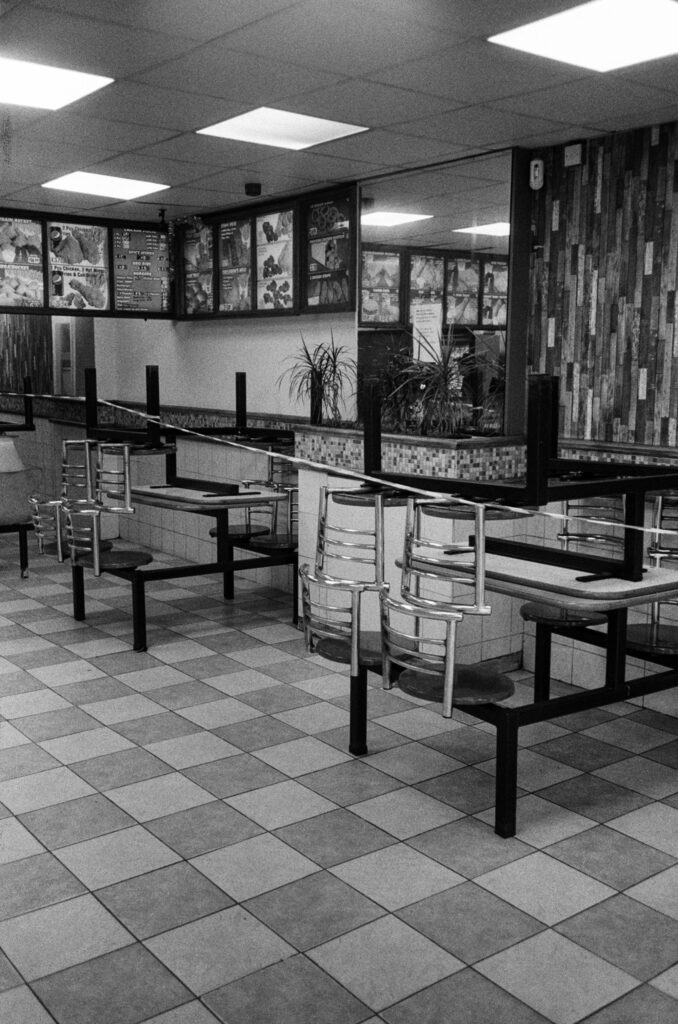
    Whilst a local fishmonger in South London won’t make headlines for continuing to serve the community their thriving independence is reflected in other businesses across other sectors, especially in the hospitality industry. Chicken shops on high streets have taped off their tables to keep the takeaway side of their businesses alive and as larger pubs tied to breweries mothballed their taps and closed their doors, independent owners used the rules to stay open and keep their heads above water. In becoming take away establishments for their neighbourhoods they have created little pockets of considered normality in these abnormal times. 

    Just as businesses have pivoted and changed direction to survive over the last ten months so individuals affected by the pandemic have had to change direction and embrace new adventures and careers.

    From becoming Deliveroo drivers instead of going to University, learning new technology to keep previously cash dominated businesses alive to rediscovering local shops and regrowing previously lost relationships with neighbourhood suppliers these portraits also reflect a changing community that has often had to pivot to survive and in some cases now thrive in the new now.

    The images were shot on both 35mm film and a Leica SL modern digital camera. The small unassuming Olympus Mju 35mm film camera I find not only to be a great conversation starter but also much less imposing than a larger digital body and puts more subjects at ease. What is lost in mega pixels I find is more than made up for in warmth and openness.

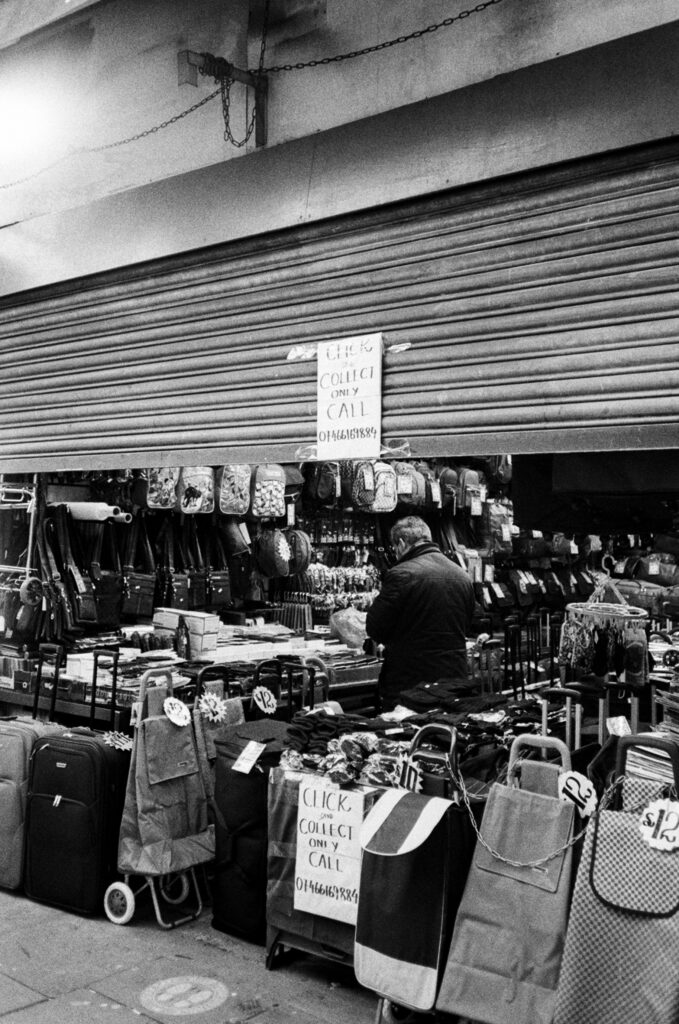
    A local luggage salesman with his shop half shuttered turns to ‘click and collect’ and uses Whatsapp to confirm sales and stay open during Lockdown 3

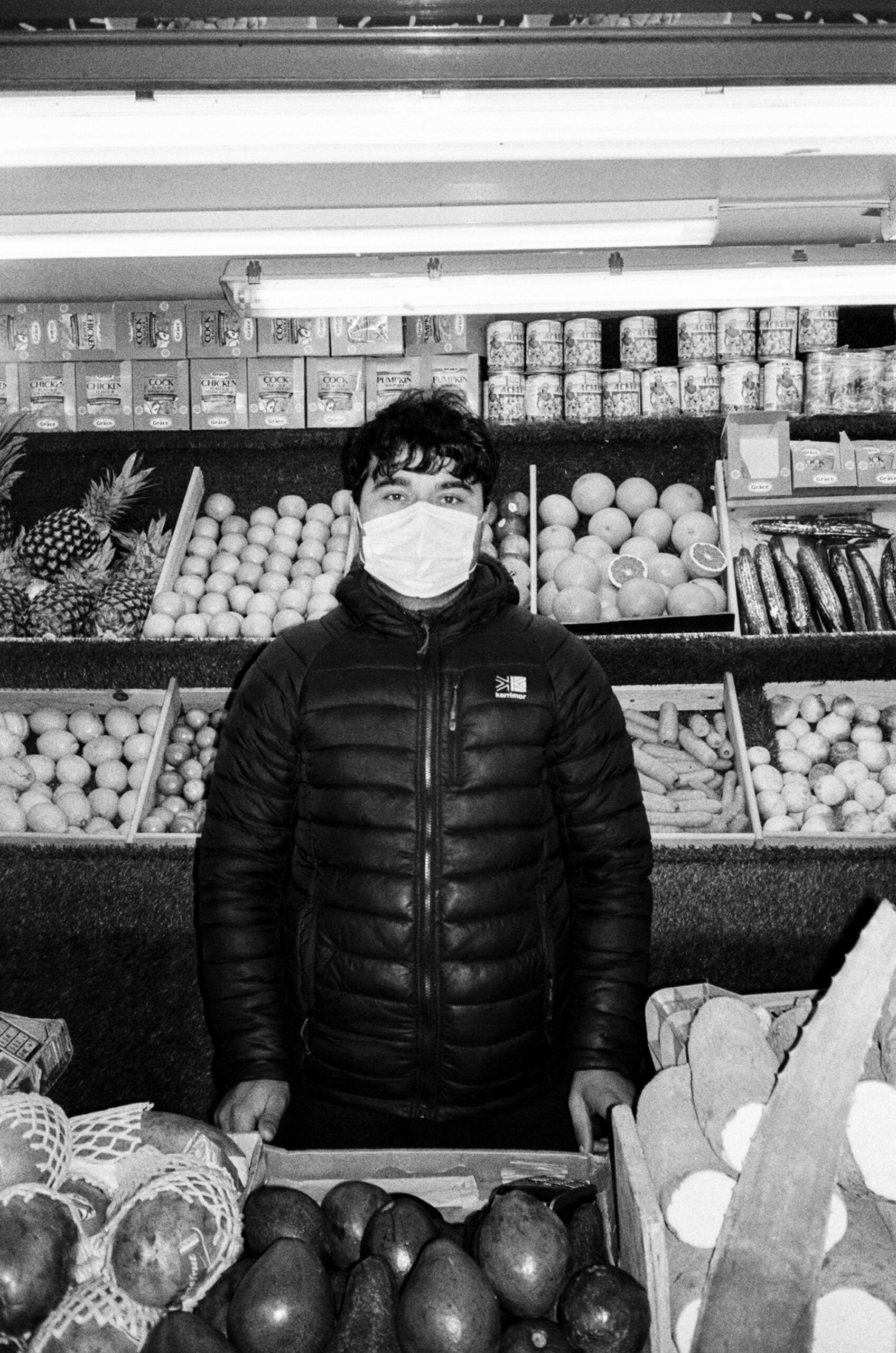
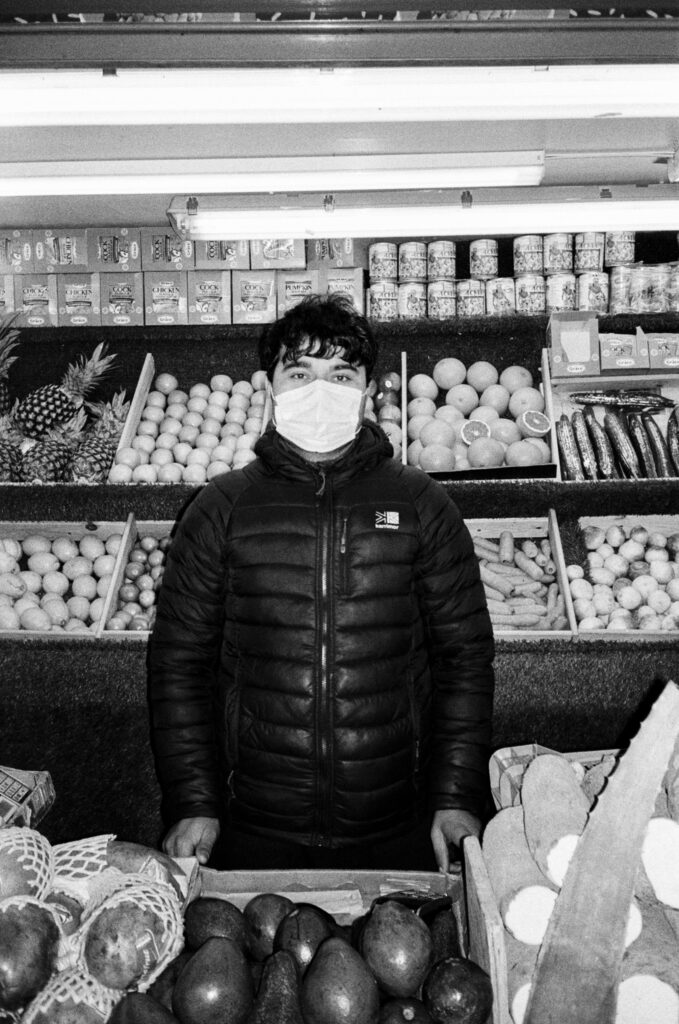
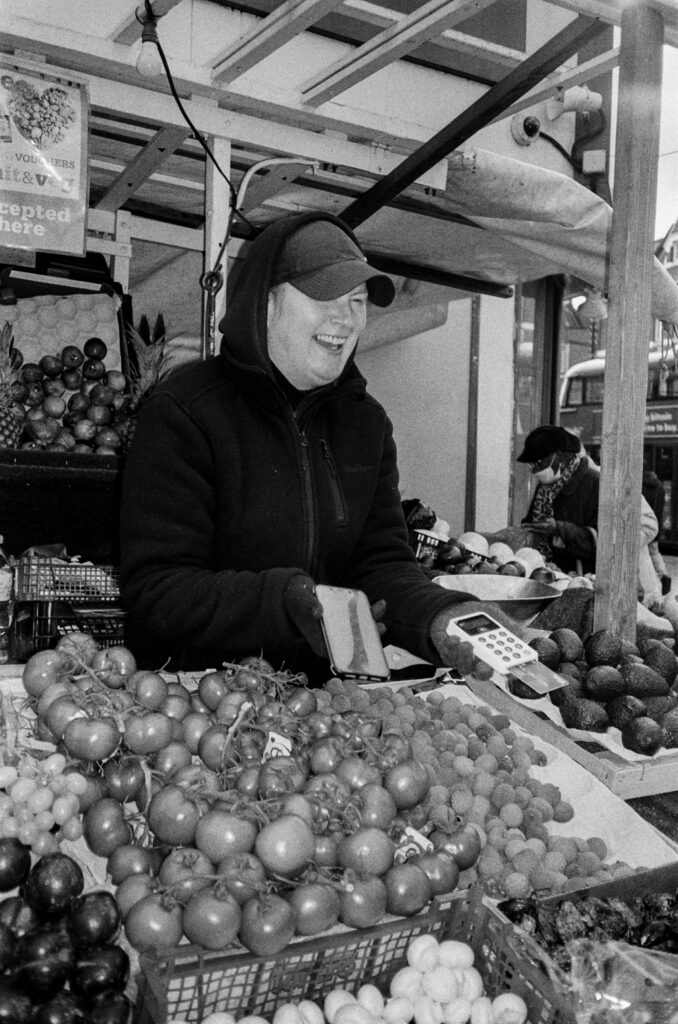
    A local greengrocer wearing multiple layers and a face mask during a long shift in mid winter is typical of the current situation we find ourselves in
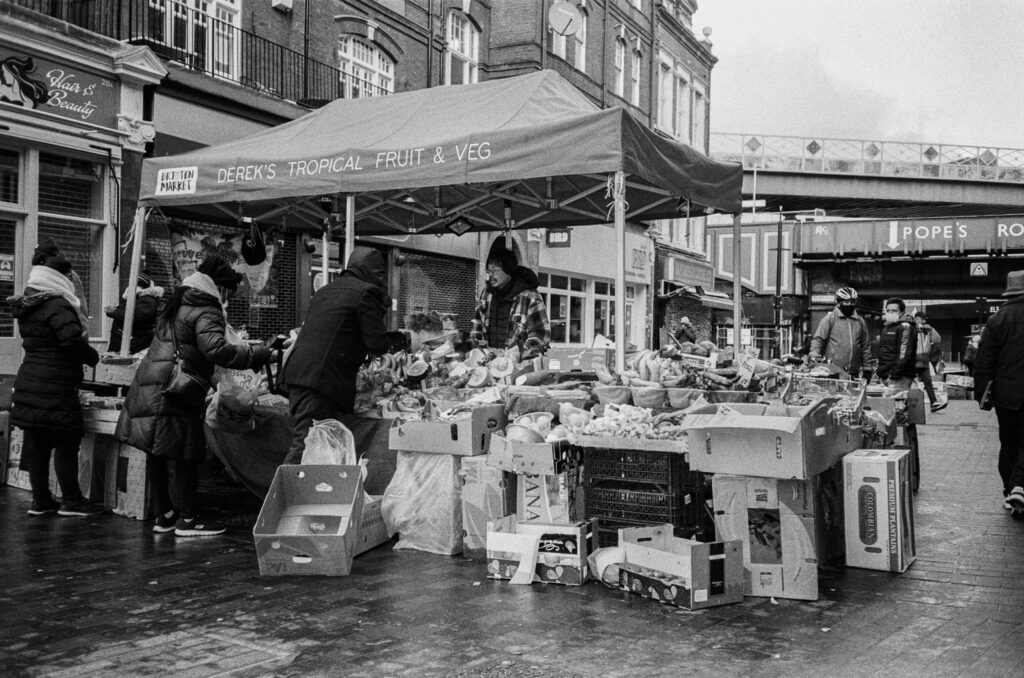
    Derek’s Tropical Fruit and Veg is a wondrous establishment made up of fruit and veg boxes and a single gazebo that come rain or shine sits proudly in the middle of Electric Avenue 
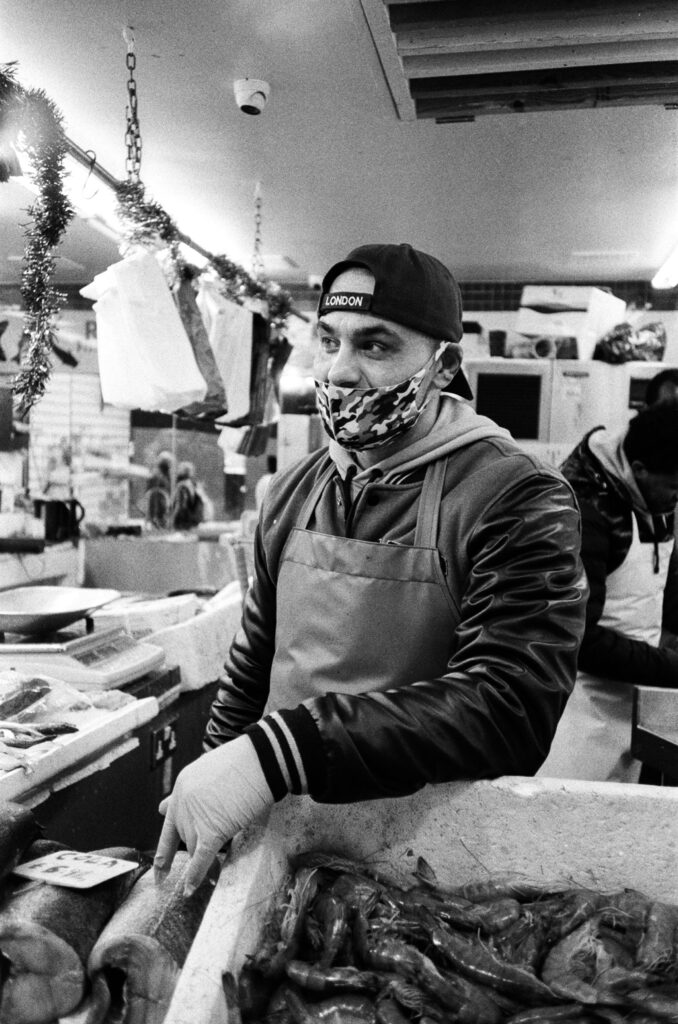
    A local fishmonger wearing his London pride front and centre, wraps up warm against the winter chill. There is a real satisfaction in people taking the wearing of masks and gloves seriously in the food industry, protecting everyone along the chain from supplier to eater.
    A greengrocer uses her phone and a card reader to minimise contact during sales and ensure that previously preferred cash transactions are not lost in this brave new technological world.
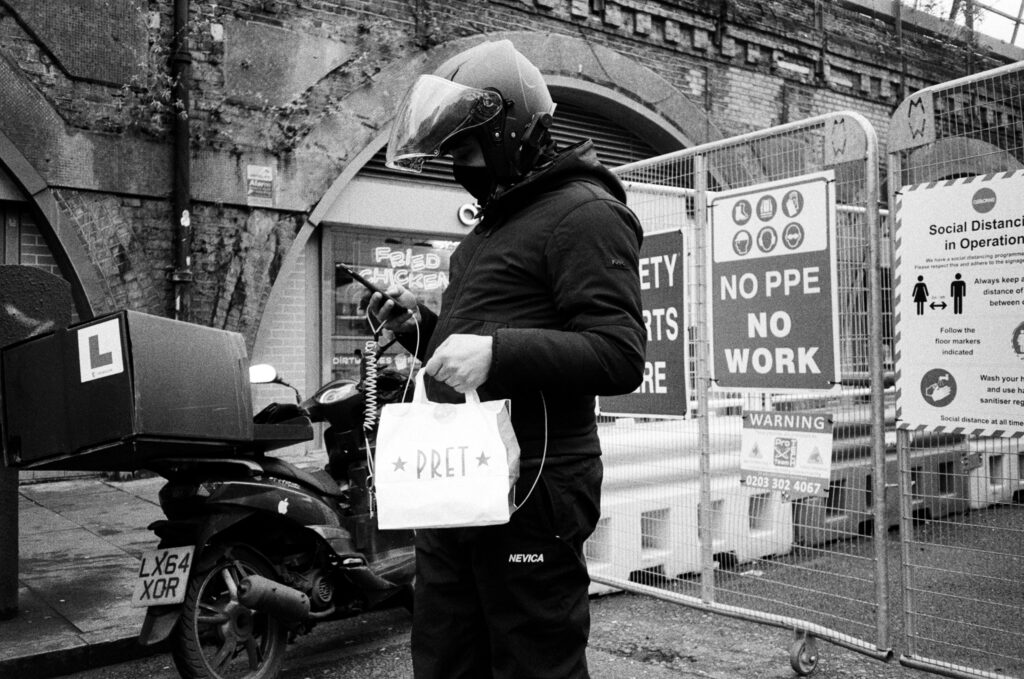
    A Deliveroo driver collects someone’s lunch surrounded by signs of the time
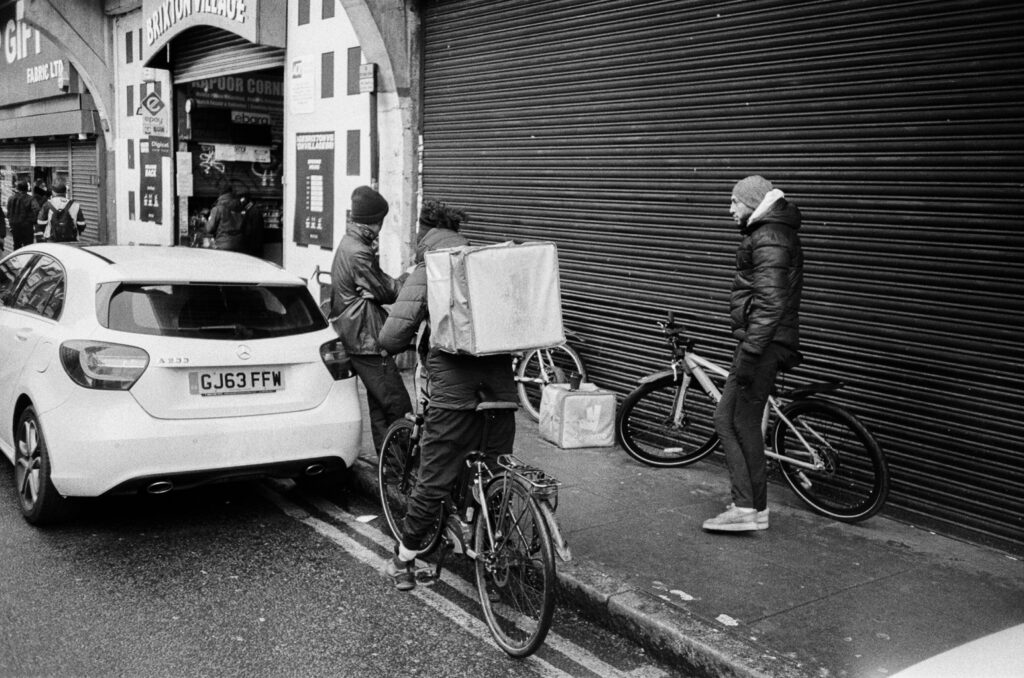
    A group of three Deliveroo drivers grab a break and a chat as they wait for their next order. After finishing education and with traditional job paths curtailed by the pandemic, joining deliveroo has become a good, if slightly longer than intended, stop gap.
    A chicken shop on Brixton Road tapes off the seating area and continues to trade as a takeaway only.