Tag: Pandemic

  • Exclusive: Sir David Attenborough interview

    Exclusive: Sir David Attenborough interview

    This week Sir David Attenborough’s new series Asia airs. We look back at Robert Golding’s exclusive interview with the great man at the start of the pandemic


    ‘This is a man who answers his phone,’ a mutual friend has told me, and Sir David Attenborough doesn’t disappoint. He picks up after just one ring.

    The voice at the other end of the phone is the one you know. But it’s gravellier and without quite that voiceover theatricality it carries on Blue Planet. Those are performances; this is real life.

    This is Attenborough on down time, conserving energy for the next program. His work schedule might seem unexpected at his great age. But Attenborough, 94, exhibits more energy in his nineties than many of us do in our forties. ‘I’ve been in lockdown, and it does mean I’ve been a bit behind on things. But I keep myself busy.’

    To interview Attenborough is to come pre-armed with a range of pre-conceived images. Part-benevolent sage, part-prophet of doom, is this not the unimpeachable grandfather of the nation? Perhaps only Nelson Mandela towards the end of his life had comparable standing within his own country.

    In 2016, when the Natural Environment Research Council ran a competition to name a research vessel, a very British fiasco ensued whereby the unfunny name Boaty McBoatFace topped the poll. This was plainly unacceptable, and so in time the competition reverted, with an almost wearisome inevitability, to the RRS David Attenborough.

    Which is to say they played it safe and chose the most popular person in the country. One therefore has some trepidation in saying that these assumptions don’t survive an encounter with the man. It is not that he is rude or unpleasant; it’s just that he’s not as one might have expected.

    ‘Yes, this is David. What would you like to ask me?


    Perfectly Busy


    Though he has agreed to talk to us, the tone is adversarial. But there are strong mitigating circumstances to this. This is a man who is aware of his mortality: our conversation has a not-a-moment-to-lose briskness to it. He could also be forgiven for sounding somewhat tired. He can also be especially forgiven for having long since grown weary of his National Treasuredom. Throughout our call, he will refer to the claims on his time, of which I am one of many. ‘I get around 40 to 50 requests a day,’ he explains, adding that he seeks to hand-write a response to each. ‘I have been shielding during lockdown and am just coming out of that.’

     But there’s another reason he’s busy: habit. The stratospherically successful enjoy a pre-established momentum, and continue to achieve just by keeping up with their commitments. So what has he been up to? ‘I decided to take this as a moment to write a book on ecological matters and I continue to make television programs,’ he says, referring to A Life on Our Planet: My Witness Statement, but not in such a way that makes you think he wishes to elaborate on either. He refers to a ‘stressful deadline’ and when I ask for more information about the book, he shuts it down: ‘Just ecological matters.’ There is a hush down the phone where one might have hoped for elaboration.

    Nevertheless, Perfect Planet, one of his upcoming programs, is being filmed in his Richmond garden, and it has been reported that he is recording the show’s voiceovers from a room he made soundproof by taping a duvet to the walls.

    Generation Game


    In his courteous but clipped tone, he asks about Finito World and I explain that it goes out to 100,000 students. ‘I am often heartened when I meet the younger generation,’ he volunteers. ‘Their attitude to the climate crisis is very responsible.’

    This is the paradox of Attenborough: a man of considerable years who has found himself aligned with the young. He’s that rare thing: an elderly revolutionary.

    Perhaps we underestimate the sheer importance of his presence within the landscape. He is the benevolent sage who its bad form to disagree with, and he’s single-handedly made it harder for anyone in power to pitch the climate change question as a quixotic obsession of the young.

    But he’s a revolutionary only in the face of drastic necessity, and refuses to be drawn on the question of our sometimes underwhelming political class. ‘I wouldn’t necessarily say that: we actually have some very good politicians.’ He declines to mention who these might be – but it suggests that Attenborough doesn’t want to ruffle unnecessary feathers.
    Instead, he wants progress.
     

    What has Sir David Attenborough done


    Transparent Medium


    ‘The thing about David is he prefers animals to humans,’ says another person who has worked with Attenborough for years. I ask him if the coronavirus situation will accelerate change. Again, he is careful: ‘I don’t know about that. On the one hand, I can see that our skies are emptier now and that’s very welcome. I suppose the extent to which the aviation sector will return will depend on the price points the airlines come up with.’

    I suspect that some of his reluctance to be drawn into detailed discussion is that he doesn’t wish to claim undue expertise on areas outside his competence. There’s an admirable discipline at work, alongside a refusal to please

    Bewilderingly honored – Attenborough has a BAFTA fellowship, a knighthood, a Descartes Prize, among many others – he has learned that the only proper response to fame is self-discipline. At his level of celebrity – up there with prime ministers
    and presidents but with a greater dose of the public’s love than is usually accorded to either – he is continually invited for comment, and has learned when to demur.

    ‘I am sometimes asked about the well-known people I’ve come across in this life – the presidents and the royalty.

    I’ve been lucky enough to meet,’ he says. ‘I say, “Look, if you saw my documentary with Barack Obama then you know him as well as I do.” Television is very intimate like that. My job is to create transparency.’

    So instead of what one half-hopes for – backstage anecdotes at the White House or Buckingham Palace – one returns time and again to the climate crisis. This is the prism through which everything is seen, and our failure to follow his example, he says, shall ultimately be to our shame.

    He will not be drawn into negative comment on Boris Johnson or Donald Trump. Instead, he says: ‘Overall, I’m optimistic. All I can say is we have to encourage our political leaders to do something urgently about the climate situation. We have to all work hard to do something about this.’


    The Fruits of Longevity


    For Attenborough everything has been boiled down to raw essentials. And yet his career exhibits flexibility. His success must be attributed to open-mindedness about a young medium which others might have thought it beneath them. It would be too much to call him a visionary. But he was in the vanguard of those who saw TV’s possibilities.

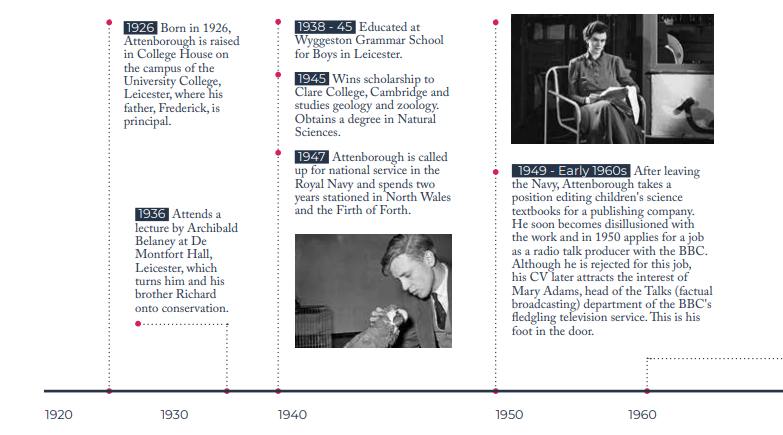
    Fascinated by wildlife as a child, he rose to become controller at BBC Two and director of programming at the BBC in the 1960s and 70s. ‘Television didn’t exist when I was a young man, and I have spent my life in a medium I couldn’t have imagined. It has been a wonderful experience,’ he says.

    The very successful glimpse the shape of the world to come, seize that possibility and enlarge it into something definite, which they then appropriate and live by. What advice does he have for the young starting out? ‘My working life has taken place in television. I don’t know how we will see that change over the coming years as a result of what’s happened. Communication has proliferated into so many forms. It is very difficult to get the single mass audience, which I had something to do with creating, thirty or forty years ago.’

    There is an element of well-deserved pride about this. Attenborough’s original commissions at BBC2 were wide-ranging. The included everything from Match of the Day to Call My Bluff and Monty Python’s Flying Circus. One can almost convince oneself that he was a BBC man first and an ecologist second. ‘The world has become very divided in a way,’ he continues. ‘We prepare for a world when we’re young that’s gone by the time we arrive in it. To that I say, ‘It depends what your life expectancy is!’

    But all along it was nature that thrilled and animated him. Attenborough is one of those high achievers who compound success with longevity. His is a voice that speaks to us out of superior experience – he has seen more of the planet than any of us. He speaks with a rare authority at the very edge of doom – his own personal decline, as well as the planet’s.

    Urgent Warnings

    He says: ‘Whatever young people choose to do with their life they must remember that they’re a part of life on this planet and we have a responsibility to those who will come after us to take care of it.’

    I ask him what we should be doing to amend our lives and again he offers a simple thought: ‘We’ve all got to look to our consciences. Inevitably, some will do more than others.’

    He sounds at such times very close to washing his hands of the human race. But then everyone in their nineties is inevitably about to do just that.

    What Attenborough has achieved seems so considerable that one wishes to ask him how he has managed it. ‘I am sometimes asked about how I manage to do so much, but I don’t particularly think of it like that. I just reply to the requests that come my way: you can accomplish a lot by just doing one thing after the other.’

    Again, the simplicity of the answer has a certain bare poetry to it: Attenborough is reminding us that life is as simple as we want to make it. Interviewing him at this stage in his life is like reading a novel by Muriel Spark: no adjectives, no frills, just the plain truth.

    In his curtness is a lesson: there is no time for him now for delay, but then nor should there be for us. We must do our bit – and not tomorrow, now.

    He is interested in Finito World and very supportive of our new endeavor: ‘This is a time when the circulations of magazines and newspapers appear to be falling. A lot of newspapers are aware of the climate emergency and the way in which we disseminate ideas has diversified.’

    A thought occurs to me that stems from my lockdown time with my son, where we have been in our gardens like never before. Should gardening take its place on the national curriculum? ‘It’s obviously very important,’ he says, although he also adds – as he does frequently during our conversation – that he knows little about the topic. (Opposite, we have looked into the matter for him.)

    Hello, Goodbye

    I will not forget this interview with a man whose voice will always be with us. Part of Attenborough’s power is that he continues to warn us in spite of ourselves. He deems us sufficiently worthwhile to continually renew his energy on our behalf.

    I mention that we watch his program with our four-year-old in preference to the usual cartoons on Netflix when possible.

    At that point, perhaps due to the mention of my young son, he sounds warm: ‘Thank you very much, sir. It does mean a lot when people say that.’

    It’s a mantra in journalism not to meet your heroes. Attenborough in extreme old age is brisk and sometimes even monosyllabic. This in itself tells you something: the world is full of the canonized but in reality saints are rare. Conversely, I have met those whose reputations were fairly low, but who turned out to be generous beyond expectation. We should never be disappointed when the world isn’t as we’d expected. It is an aspect of the richness of experience to meet continually with surprise.

    But age will come to us all. If it finds me in half as fine fettle as David Attenborough I shall be lucky indeed. Furthermore, if it finds me on a habitable planet at all that shall also something I’ll owe in part to him. ‘Good luck,’ he says as he puts the phone down. This isn’t the man I had expected to meet. But I can persuade myself that he means it.

    ‘David prefers animals to humans’. Afterwards, it occurs to me that he saw me not so much as an individual, but a representative of that foolish ape: man. While Attenborough has been acquiring hundreds of millions of viewers, what he really wanted – and urgently required – was listeners.


  • Review: Matt Hancock’s Pandemic Diaries

    Christopher Jackson


    This is a strange book to review since it has been almost entirely superseded by the actions of its ghostwriter. It is axiomatic among book reviewers that you must review the book and nothing external to the book, but that turns out to be impossible here.

    For anybody living without Internet access these past months, here is the sequence of events.

    Matt Hancock was a busy Health Secretary, and former prime ministerial candidate with ambitions to digitise the health service. In late 2019, he began getting reports from Wuhan about a virus which would upend his and all our lives. He was a cheerleader for lockdown, and also – as he goes to considerable lengths to point out throughout this book – a driver of the vaccination programme. In May 2021, he began a marital affair with his aide Gina Coldangelo, and when an embrace between them was somehow – we still don’t know how, or by whom – photographed, Hancock was forced to resign.

    Post-government he famously appeared on I’m a Celebrity, Get Me Out of Here, where he made more friends than some had expected. Pandemic Diaries was intended to continue his rehabilitation. However, it was written in a spirit of what now seems gullible collaboration with the journalist Isabel Oakeshott. In the writing of the book, Oakeshott was given access to all of Hancock’s What’s Apps. After the book was released, Oakeshott, pleading the importance of journalism, handed all the messages over to The Telegraph, who proceeded to publish a series of immensely unflattering stories about Hancock which undid much of the painstaking work of rehabilitation.

    As a result, the book has acquired a sort of unexpected intertextuality, whereby we can now see that what is said in the book is a pared-down and smoothed-over version of what was said in real time, now there for all to see in the pages of the Telegraph.

    The juxtaposition between the two can often be comic. For instance, on the unhappy day to which we all know this book is building – the disastrous day when Hancock’s affair is broken by The Sun – Hancock begins his entry with a knowing dissertation about love.


    What price love? I’ve always known from the novels that people will risk everything. They are ready to blow up their past, their present and their future. They will jeopardise everything they have worked for and everything that is solid and certain.


    The tone is of an earned, rueful wisdom, and we are invited to consider Hancock as a sort of modern Antony or Othello, undone by human failings, one who ‘loved not wisely, but too well’. Perhaps he is but he comes across differently to readers of The Telegraph in the following What’s App exchange on what was presumably the same day:


    Hancock: How bad are the pics?”

    Special adviser Damon Poole: It’s a snog and heavy petting.

    Hancock: “How the f— did anyone photograph that?”

    Gina Coladangelo: OMFG

    Hancock: “Crikey. Not sure there’s much news value in that and I can’t say it’s very enjoyable viewing.”


    It is The Telegraph version, sadly, which in all its awkwardness has the real flavour of lived experience. Incidentally, I find huge sadness and a sort painful dignity in Coladangelo’s acronym, and I suspect many readers will feel especially sorry for her.

    Perhaps in a ghoulish way it is good to have both versions, but there is an overriding sense that we know more than we’d like or ought to about the whole thing. Anyone who enjoys reading about the destruction of other people’s lives and imagines themselves immune from similar treatment has ceased to think themselves fallible on another day.

    Of course, the question of government by What’s App has now been taken up as a live issue in direct response to the Oakeshott leaks. It seems unlikely that it’s any worse as a form of government, to paraphrase Churchill, than all the others which have been tried. In fact, the real thing at issue has always been between responsible and irresponsible government.

    How does Hancock, and how does the political class, come off in Pandemic Diaries? It’s a mix. The book conveys Hancock’s Tiggerishness very well in the clip of its prose. Developments are often greeted with a one word exclamation. “Stark,” he writes on hearing news that the NHS could have a deficit of 150,000 beds and 9,000 ICU spaces. “Fuck,” he says, on hearing that Nadine Dorries has tested positive early on in the pandemic. “Amazing,” he exclaims when he hears that 4,000 nurses and 500 doctors have rejoined the NHS in 24 hours on 21st March. This turns out to be his favourite word and is levelled at good news on the vaccination programme and at the exploits of Captain Sir Tom Moore. Its obverse: “Very sobering” is deployed when the Covid deaths spike, as they do saddeningly throughout the book.

    The style conveys someone in a hurry, and one is left in no doubt that Hancock had the energy and ability for the job. In fact, he probably had every right to imagine he had a good chance of being prime minister one day. Although his official mentor is George Osborne, who crops up occasionally in the book, Hancock feels more reminiscent of Blair; in fact, he sometimes seems to have self-consciously modelled himself on him. Blair’s astonishing electoral success marked the younger Conservative generation who began to imagine that power would never come their way if they didn’t somehow emulate him.

    It was Clive James who said of Richard Nixon that he could handle the work; Hancock was the same. You can feel that the Health Department, unwieldy and daunting a brief as it is, was in some way too small for his ambition, and that he role wasn’t too much for him. He was equal to the task, and throughout you have a sense of him moving his agenda forward: he comes across as a skilled and astonishingly hard-working minister.

    Even so, I don’t think the book is likely to make people especially eager to enter politics. This might be because we all know that whatever is going on in the book, our hero is hurtling with alarming pace towards downfall and public humiliation.

    But this isn’t the only reason. In the first place, large sections of the book seem to detail something like a toxic work environment which few would wish to join. The undoubted villain of the book is a certain Dominic Cummings, which are the passages I most enjoyed reading, since he seems to get under Hancock’s skin very easily, leading to some entertaining and quite astute rants: perhaps we are never more insightful than when we hate. On March 31st 2020 we get the beginnings of a theme which will recur:


    Amid all this, Cummings’s morning meetings have turned into a shambles. I can’t say I’m shocked. The feedback is that no one really knows who’s meant to be talking about what, to whom, or indeed whether they’re supposed to be at that meeting or the one an hour later….Managing No. 10 is a massive and extremely frustrating part of my job.


    As much as one can sometimes feel a bit frustrated with Hancock himself, this rings true, and there is real relief in the book which you suspect must have been felt by all the characters in the book, including Boris Johnson, when Cummings leaves.

    Government itself seems ad hoc, and Boris himself very often reactive. Of course, this might be an effect of the genre: we only see Boris when Hancock goes to see him, and then as it’s all being told through Hancock’s eyes. But there seems to be a sort of fatal passivity about Boris, the ramifications of which played out in March 2023 before the Privileges Committee.

    Above all, we’re beginning to realise that these were just very unusual times. That is perhaps the biggest hindrance towards enjoying this book: the events it describes were both appalling and recent. What a terrible thing the virus was and is; how terrible lockdown was. There is no doubt for this reader that Hancock found a single-minded groove over lockdown which to some extent kept him sane and able to function under pressure. It was this coping mechanism which led to some of the worst What’s Apps in the Oakeshott leaks, including the infamous one where he considers threatening to block a local MP’s disability centre. By a certain point, he had come to believe in lockdown as, to use another infamous phrase, a ‘Hancock triumph.’

    The reader is left with the sense that perhaps Hancock went a little bit mad. But one feels that somewhere in his make-up is a man of admirable energy and commitment. He’s not quite in the Randolph Churchill, Joseph Chamberlain and Ken Clarke category of almost Prime Ministers, but a couple of rungs down, with Nick Clegg for company.

  • Study reveals work from home gender discrepancy

    The SEO agency Clickslice has found that men and women work from home at different rates, and in different ways. Analysis of ONS data reveals that 8% of men have not worked from home in the past seven days, although their employer allows it, compared to 10% of women choosing the office.

    Not all of this comes down to choice, however – women are more likely to be allowed to work from home than men. Of the 2,850 people surveyed, 34% of the women said that they are not allowed to work from home, whereas 42% of the men said that they had to go to the office. Clickslice CEO Joshua George commented on the difference.

    “It’s interesting to see how gender plays a role in working from home behaviours. While more women are working from home either all or some of the time, more men are choosing to work from home if they have the choice between that or the office,” George says, “Further research shows that Brits are planning to continue working from home. ONS data from February 2022 revealed that 84% of workers who had to work from home because of the coronavirus pandemic said they planned to carry out a mix of working at home and in their place of work in the future.”

    The pandemic opened up new possibilities for those looking to work remotely, and many are taking the opportunity. However, there is a discrepancy between the way that workers and bosses view working from home. Employees generally believe that they are more productive home workers, while bosses are not convinced. George highlights the issue this may raise.

    “Research shows that bosses and workers disagree about productivity when working from home. In a recent survey by Microsoft of over 20,000 people, bosses worry about whether working from home is as productive as being in the office. 87% of workers felt they worked as, or more, efficiently from home, yet 80% of managers disagreed. This discrepancy is something that both business owners and workers should be aware of to ensure that there is no confusion or resentment about where people choose to work,” George says.

    There is no question that a mixture of working from home and going into the office is rapidly becoming more accepted, whether bosses like it or not. Due to the labour shortage, potential employees who are told they cannot work remotely will not have a very hard time finding an employer who will allow it. Therefore, it is more important than ever for businesses to be open-minded and flexible.

  • Entrepreneurs abandon years-long careers, start businesses

    Patrick Crowder


    New entrepreneurs are choosing to start their own businesses after careers lasting over ten years, and the businesses they start are often in an entirely different sector. The research from GoDaddy suggests that people are making the switch for increased flexibility and follow their dreams.

    The survey of 1,000 business owners found that 70% of them started businesses in an entirely different industry than their previous career.

    Julie Daly spent 20 years at an oil company before deciding to start her own interior design business, Verano Interiors. She says the pandemic gave her the opportunity to reflect and choose a new path.

    “After working in an oil company for 20 years, lockdown allowed me to re-evaluate my life and I realised I couldn’t see myself doing it for another 20 years, so I decided to change direction entirely. I enrolled myself onto The Professional Interior Design course at the College of Interior Design and I’ve recently graduated with a diploma,” Daly says.

    Daly is not alone in her pandemic-driven change. 17% of people surveyed say that the pandemic caused them to reflect and make the shift, while 10% say that they started their own businesses because they had been made redundant during Covid. Starting a new business without prior experience can be a major challenge, but Daly is rising to the occasion.

    “I’m completely new to the business world so I’ve been spending hours learning, going to webinars, reading books, and studying,” Daly says, “As a business owner you’ve got to understand everything from marketing to finances, so it’s been a massive learning curve for me but I’m enjoying the challenge.”

    The most common reason for starting a new business is the desire for flexibility, according to the survey. 41% say they want more flexibility, while 36% say that they are tired of working for someone else. 35% say that they are following a lifelong dream, and 30% say that their decision was driven by a desire to make more money than at their previous job.

    Maxine Jones has also joined the long list of people who have left their previous jobs for a new independent venture. As founder of Maxicise, she describes how she started her now-thriving online dance workout business.

    “At the age of 40, I quit my job and launched my own Zumba classes in the local community centre. I moved away from Zumba musically and morphed into MaxiciseTV, and in 2018 I started to livestream my classes online direct to my clients so that they could workout with me from the comfort of their own home,” Jones says, “My website was therefore crucial to my success. Clients use it to workout live with me once a week and on demand. I change over the workouts every week so that they don’t get bored, and I’ve introduced 20-, 30- and 40-minute bitesize sessions. The website is ‘all singing, all dancing’ literally.”

    This growing trend of entrepreneurship following the pandemic can be seen everywhere. Students are increasingly skipping university and jumping right into the working world. The rising cost of living has made many re-evaluate their life paths, and the pandemic gave them time to ponder the many opportunities which await them. If you are considering a new venture, don’t panic – you’re certainly not alone.


  • Worried about the cost-of-living crisis? Coldplay can fix you

    Ronel Lehmann


    And so we enter yet another doom and gloom period as the cost of living crisis tightens. This follows on from other uncertainties such as Brexit, the Covid pandemic, Vladimir Putin’s invasion of Ukraine and the jockeying for position which always accompanies a Conservative Party Leadership election. All this is probably why I have been thinking about ways to gain some perspective.

    Fortunately, help has been at hand. When I attended the 8th annual Global Family Office Conference, it was the guest speaker Sir Anthony Seldon who summed up best what really makes us happy.

    Seldon explained that it wasn’t having money but enjoying a purpose in life and good friends which provides the stability we crave during troubled times. It was obvious that his comments resonated with all the guests.

    Purpose, of course, can encompass many things – not just job satisfaction, but also passions and interests, and the belief that life has meaning.

    Towards the end of his 82 years, Johanna Wolfgang Goethe totted up the pros and cons of life. He found when he had completed his ledger that it was music which tipped the balance in favour of life having been worth it. This point was driven home at the weekend when I went to Wembley Stadium to watch Coldplay live in concert.

    As an employability expert, I find Coldplay inspiring. Here are four student friends who studied at UCL, Chris Martin (Greek & Latin), Will Champion (Anthropology), Jonny Buckland (Mathematics) and Guy Berryman (Mechanical Engineering). They followed their passion and love of music.

    In my field, we find that many of our students are afraid of what their parents think a sensible career should be. The daughter of a forensic accountant didn’t want to join her parent’s profession but was passionate about teaching. Another wanted a career in the creative arts. Both sets of parents confided in their concerns about what salary their offspring would earn. But there is always more to life than this. What also matters is whether children will be happy or fulfilled.

    Had Chris Martin’s parents been a client of my business, would they have shared their salary concerns with me as their son began to take his first steps into the industry? Very likely, they would. But with over 100 million albums sold worldwide, Coldplay are the most successful band of the 21st century and one of the best-selling music acts of all time. He followed his passion.

    Of course, the creative arts can be a difficult career, but people forget that prior to Covid, according to the Policy and Evidence Centre, the creative industries contributed £116 billion and grew twice as fast than the UK economy as a whole.

    At Wembley, Martin entertained an audience of nearly 100,000 people. As you arrived at the Stadium, you were given a wristband. This is all about audience participation, and we soon discovered that the bands flashed to the beat of the music. It was quite emotional to view all the coloured lights, not to mention confetti, balloons and fireworks.

    Popular music is essentially democratic. Coldplay’s music is not reserved for the few. There were audience members straight from work, those who had travelled from overseas, old and young people, a multitude of different cultures, ethnicities and religions, all brought together by music.

    Upon my return home, I was honestly happier than I have been in years. I think Anthony Seldon would approve – and thank goodness for those who follow their passions in life. It’s bravery which really drives the economy forward and will get us through.

  • IT industry worst affected by pandemic, study finds

    Finito World


    We’re more than halfway through 2022, and the pandemic appears to be behind us. Restrictions have been lifted, and many industries are now getting back on their feet. However, it is clear that there are lingering effects of the pandemic in some sectors, so the training hub School of Marketing set out to find which industries are still struggling.

    By analysing ONS data regarding the number of new businesses created and the number of businesses which closed in each sector, both pre and post-pandemic, it is clear that the information and communication industry has taken the biggest hit. Before the pandemic, 92 IT businesses closed for every 100 created. Post-pandemic, 173 IT businesses close for every 100 which open.

    This is most likely due to a combination of factors, including the industry’s reliance on overseas consumption, global supply chain disruption, and shipping and delivery bottlenecks.

    The second most affected industry is finance and insurance, which saw a 50% increase in the number of businesses closing post-pandemic. Pre-pandemic, about 40 businesses closed for every 100 created. Post-pandemic, that number is up to 72.

    CEO of School of Marketing Ritchie Mehta points out that the stagnating number of new businesses makes skilled employees extremely valuable in the post-pandemic market.

    “As entrepreneurs look to protect themselves against a harsher business environment, the value of skilled employees has never been higher,” Mehta says, “This data shows how much more difficult it has become to survive as a business since the pandemic. In the two years before the impact of Covid-19 on average more businesses were created than closed each quarter, but now the numbers of company births and deaths are basically equal.”

    Across the board, businesses are now closing at a slightly higher rate than they are being created – 101.5 for every 100. Before the pandemic, about 87 businesses closed for every 100 created. It is unknown how long these effects will last, but it is clear that it will take time to reach those much sought after ‘normal’ levels once again.

    Source: https://schoolofmarketing.co

  • Pandemic led to increased whistleblowing, report finds

    Patrick Crowder

    Whistleblowing is an important driver of change. When legislation fails, or when companies fail to follow legislation, whistleblowers are often the last line of defence against unsafe, immoral, and unfair working practices.

    The whistleblowing hotline provider Safecall has analysed data from over 2.5 million employees to find out how the pandemic has affected the number of whistleblowers and the methods they use. Greg Ogle, Safecell’s client account manager who authored the report, explains why the research is necessary.

    “The data is designed to inform and help organisations make better decisions when it comes to establishing whistleblowing arrangements. It should help HR and health & safety managers or departments to determine and measure performance of their organisation against their peers.”

    Safecall found that HR was the most commonly reported department, making up 55% of all reports in 2021. While the complaints included instances of bullying and racism, the most common reason for HR-related reports was ‘unfair treatment’.

    Tim Smith, who is Safecall’s operations director, says that he has seen a shift towards whistleblowing as a result of the pandemic.

    “The pandemic seems to have accelerated different patterns of working and behaviour. This, in turn, has made more employers look at culture change and that has prompted greater interest and use of whistleblowing services,” Smith says.

    Culture change certainly had an impact, but there is also the simple reason that there were more health and safety concerns during the pandemic than normal. Beyond the threat of the virus, new ways of working led to different challenges in terms of both health and safety and fair employee treatment.

    The number of health and safety reports is still elevated, but there are still fewer reports than in 2020 when we began to see the pandemic’s affect on the workplace.

    https://www.safecall.co.uk/en/

  • UK pilot programme reignites four-day work week conversation

    Patrick Crowder

    Last year, Finito World published an opinion piece urging companies to trial the controversial four-day working week. Now, 30 companies in the UK have launched a pilot programme testing out the new way of working and evaluating its effects on productivity and employee happiness.

    Research conducted by Instant Offices has shown a 110% increase in Google searches related to the four-day work week since the pilot programme launched, which suggests an interest far beyond the companies taking part in the trial. The research has also found that 51% of UK workers would prefer the shorter but more intense period of work which would allow for three-day weekends.

    Mainland European countries are ahead in the race towards the widespread acceptance of the four-day week, with a number of countries trialling reduced hours. Germany now has a national average of 26 hours worked per week, with the Netherlands and Norway close behind working around 27 hours per week.

    It is important to remember that a four-day work week does not mean a reduction in overall hours worked – rather the existing hours are redistributed throughout the shorter period. This has the benefits of cutting down on commute time, encouraging more focused work, and allowing for a better work-life balance. However, it also comes with fears of burn out and a more stressful environment.

    In order to allow for the possible challenges that come with the new schedule, Instant Offices suggests a variety of measures. By reallocating hours gradually rather than cutting a full day immediately, companies will be able to see the effects of the change slowly without risking a shock to employees and a loss of productivity.

    Automation may also be key, as when employees are free from the more menial tasks in work, they are free to spend the extra time working on problems which require human brainpower. Additionally, rotating schedules can reduce the risk of any single employee working beyond their capacity leading to burn out.

    Perhaps most importantly, any change to the work schedule must come with ample opportunity for employee feedback and flexibility. As we have explored before, every employee works differently, and allowing for these differences is crucial in maintaining a happy, effective workforce.

    The four-day work week is designed to give employees more free time and foster a good work-life balance, not to compress the stress of a normal work week into four unbearable days. The pandemic has fundamentally changed the way that many of us think about work, and that is generally a good thing – but it is important to avoid making changes overnight.

    Many workers are looking for a change, and a four-day work week may well be a good solution. As these pilot programmes continue, we will be able to fully see the benefits and drawbacks of this new work schedule. Given flexibility, gradual change, and clear expectations, it seems that much of the UK workforce is ready to take on a new way of working. It won’t come overnight, but the four-day work week might be the next in a long line of new normals.

    Source: https://www.instantoffices.com/blog/featured/the-four-day-work-week/

  • Why hybrid-working represents the future of work

    Patrick Crowder

    The pandemic has made working from home the norm rather than the exception, and for many employees this is a dream come true. In jobs where specialised equipment is not necessary, it seems natural to continue the trend towards online meetings, limited office hours, and working mostly from home. However, there may still be advantages to keeping some office space, especially in city centres.

    Research from the property consultant Cluttons shows that the finance and insurance industries are most suited to hybrid working, as over 75% of activities are able to be conducted remotely. Cluttons’ Head of Research Sophy Moffat explains how new patterns of working are emerging.

    “Much has been discussed about new working patterns in the city in particular, with anecdotal evidence suggesting that the city is quieter on Mondays and Fridays as people commute Tuesdays to Thursdays and make use of the days either side of the weekend,” Moffat says, “While some reports suggest Wednesdays to Fridays are the new working week. Either way, the usage of office space is less that pre-pandemic where, on average, workers spent four or more days predominantly based in the office.”

    So, if office time is decreasing, why not ditch the extra space? First of all, working from home is not for everyone, and many feel that they can only be productive when working in an office with their peers. Because of this, employers must give their people options in order to increase employee happiness, thereby increasing productivity. Additionally, Cluttons predicts that there will still be a need for some office-based activity involving high numbers of staff, which companies will need to have properties large enough to accommodate during these peak activity times.

    The time of large numbers of non-central, lower quality office buildings may be coming to an end, as there is decreasing need for spaces which house basically the same technologies and amenities employees are likely to have at home. Head of Office Agency Ralph Pearson says that balancing the costs vs. the rewards of office space will boil down to the type and quality of the space in question.

    “The fallout from the pandemic will bring to a head the ultimate balance of the office as a value generator, or cost centre. On the ground the limited evidence from committed movers points to a long-term shrinkage in floor space of circa 30% based on home working, but also far less dense desking and a strong flight to high grade, flexible spaces,” Pearson says.

    By decreasing the overall square footage of office space, while upgrading the spaces that do remain, businesses may be able to not only cut costs but also increase the productivity coming out of their offices. 18 million square feet in office space has come on to the market due to the pandemic, which Pearson believes is too much for future demand. He explains how the conversion of these spaces could change the housing market in major cities.

    “In the medium to long term a significant proportion of non-prime office stock will need to convert to other commercial, medical, educational, and social uses,” Pearson says, “But the biggest gain may go to the residential sector, potentially making city centre living more affordable and economically sustainable”.

    The way companies approach office space is undeniably changing, and many spaces will be left vacant awaiting conversion and further development. What exactly these changes will bring remains unseen, but as Pearson suggests, it could be a change for the better.

    Credit: https://www.cluttons.com

  • The top five groups most affected by the pandemic

    The pandemic has brought untold suffering to people across the globe. Many have lost their lives, or those of friends and family members. To examine the purely economic effects of Covid-19 without addressing that fact would be tasteless at best. However, it is important to measure the lesser effects of the virus in order to determine which groups require more support in terms of work and life.

    The HR tech platform Connectr has drawn up a list of the five groups most affected by the emotional hardship and economic losses which have come with the pandemic. On the economic side, they considered factors such as lost salary, missed employment opportunities, and time wasted. On the emotional side, they considered increased stress, discrimination, and additional time pressures.

    They found that the most affected group has been unrepresented talent, meaning people who have had less access to support networks and technology who may also face discrimination based on race, gender, sexual orientation, and socio-economic background. Connectr has found that people from lower socio-economic backgrounds will take 25% longer to develop their careers than others. The problem gets worse when race is considered. For example, the research shows that career development takes an average of 32% longer for black people of lower socio-economic backgrounds.

    The hospitality industry is the second most affected group, as long-term furloughs drained the industry during 2020 and 2021. Facing increasing customer abuse, changing guidelines, and an uncertain future, many of these employees have found new fields of work, leaving a shortage in the hospitality industry.

    University and school students ranked third and fourth, respectively, as learning in both groups was severely interrupted by Covid-19. For university students, online classes meant fewer networking opportunities and a lesser depth of learning. Coupled with the fact that many internships and recruitment opportunities were cut, the classes of 2020 and 2021 have been left at a disadvantage. For school students, the face-to-face interaction with peers and teachers disappeared. The soft skills learned through human interaction during this crucial period of development are oftentimes some of the most important things one learns in school, and these were lost during the pandemic. Even worse, students who did not have access to quality internet and necessary technology were often left behind.

    The fifth and final group on the list is new starters, or those who had recently moved into a new role when the pandemic hit. Because learning through action and experience is extremely important for a greenhorn employee’s progression in their chosen field, advancement has been slowed for those who have started their careers from home.

    As we continue to manage and live with the pandemic, it is hoped that these disadvantages can be reversed, and those lucky enough to escape this period without facing physical and severe emotional losses will undoubtably do their best to persevere. But for many, Covid-19 is not over, and the effects will be long-lasting.

    Source: www.connectr.com.