Tag: Music careers

  • Sir Paul McCartney’s Lyrics: “geniality and humility”

    Christopher Jackson

    I once commissioned Paul Muldoon for a poem for a magazine for which I was editing the poetry section. He was very responsive to the idea that the readers of a high end luxury magazine ought to have some poetry in their life. I made it clear I would pay £100.

    Muldoon sent a poem which was really a song lyric and I still remember it’s refrain: “It’s been an uphill battle to go downhill all the way.”

    Incidentally, when I tried to pay Muldoon he went mysteriously dark, though his home address was on his email. When I was next in New York, I took a hundred dollars down to his apartment on the Upper West Side, and gave it to his wife, Muldoon being out of town in New Jersey.

    I later discovered that he was financially secure many times over. He simply didn’t need the money and wasn’t interested in it.

    In that he was a strange kind of poet. I didn’t know then that this was the same apartment which Paul McCartney had begun occasionally visiting in order to have the conversations which make up this book. Had I known, I might have stayed around a bit.

    This book, writes McCartney in the foreword, was a far more feasible project than a straight autobiography: the songs, in any case, tell the story of his life better than a prose book. The book is the product of a series of enviable conversations between Muldoon and McCartney, but with Muldoon’s contributions elided.

    In some respects, this is a shame as I expect the back and forth would in some ways have been more interesting than what we are presented with here. Muldoon is one of the greatest poets of our time, and would be greater still if he could always bring himself to write comprehensibly. I expect some of what we have here would be more exciting if we could hear the pair of them sparking off each other.


    With the conversations divided into chapters centred around songs, some of them can seem a bit perfunctory – a couple of pages for ‘A Day in the Life’, that remarkable work, about which books could be written. There is much that could be said about McCartney’s contribution in the second part of the song after the titanic crescendo of the orchestra, which isn’t touched on here.


    McCartney has in the past said it was a song he’d had lying around. It would have been interesting to know the process by which the two were yoked together. Though the truth is, for most of the time in songwriting, the songwriter is in receipt of forces he won’t understand and there is a sense in which McCartney can sometimes seem a baffled visitor on his own songwriting past.

    But this is to carp about what we don’t have instead of to celebrate what was actually managed. We should be grateful for this: McCartney is a world-historical figure who is far busier than most, and it’s good that he found the time for us at all.

    Besides there are some moments of real insight. For instance, in ‘All My Loving’, McCartney points out that it is an epistolary love song in the vein of Fats Waller’s ‘I’m Gonna Sit Right Down and Write Myself a Letter’. But it is also to do with being on the road and not being able to see your love. That makes Lennon’s triad chords in the rhythm guitar all the more suitable because it mimics train tracks, and the rickety motion of transport.

    I’ve always liked McCartney. Lennon could be cruel in a way unthinkable for McCartney, and cruel to McCartney too. I think it probably stemmed from work ethic. Lennon had a sort of lazy streak which probably irked McCartney who, born with a gift which often seems to emanate from some other dimension, seems to have been born with a kind of duty to be true to it.

    He’s still hurt, of course. Things turned out better than they might have with Lennon, because at least they weren’t actively warring with each other. Apparently they had a nice conversation on their final meeting about baking bread.

    Strange forces brought these two together. It continues to feel marvellous that in Liverpool at that time, these four boys were permitted to meet, that their music found its audience. They then hit upon, and at the same time had a share in creating, a historical moment which we are only just beginning to understand.

    It was freedom: the freedom to experiment and to find out who and what one loved. And it was love, as McCartney has often pointed out, which underpinned it all. Over eight wonderful years, ‘Love Me Do’ became ‘And in the end/the love you take/is equal to the love you make’.

    After that, McCartney got lucky domestically with Linda Eastman, and here and there the music falls off a bit. That seems to be a law of popular music: the energy of youth can only come once. It is invisible in those simple chord sequences which gave us She Loves You: there is a primal urge driving it forward which could only come once.

    Sometimes a magnificent song would come along: ‘Maybe I’m Amazed’, ‘Band on the Run’, and much later, ‘Beautiful Night’.


    But something went out of McCartney’s life forever when John, with the malicious glee which sometimes characterised him, announced that he was leaving the Beatles. It appealed to John’s wrecking ball nature to destroy the thing he loved.

    It never appealed to McCartney – and still doesn’t. Every time we have a new initiative with the Beatles today – such as the AI project Now and Then, you feel that McCartney is the driving force. He wants to be back in Abbey Road again. Perhaps he wants to be young again.

    Yet this is to paint him as more melancholy than he actually is: optimism has always marked McCartney – a sense that somehow or other everything will be alright. His songs almost always insist on a good outcome, sometimes amidst sadness. Jude will make it right if he lets it be. Even Yesterday, on the face of it a very sad song, seems to resolve that sadness by the end: perhaps yesterday in that song is a place where the singer will one day comfortably reflect. It is a place he will one day revisit.

    That is what this book is, a kind of reckoning. It would have been possible to have done it differently and just published the transcripts as Seamus Heaney did in Stepping Stones and as Nick Cave did with Faith, Hope and Carnage.

    But it’s good to have this book. It doesn’t really alter McCartney’s reputation too much since he was already in the stratosphere anyway: it simply proves that genius can sometimes go hand in hand with geniality and humility. And if that’s the case with McCartney, it certainly had better be the case with us who, whatever our virtues, never had it in us to write ‘’Eleanor Rigby’.

  • Coldplay’s ‘Moon Music’: the virtues of “surmounted cliche”

    Christopher Jackson reviews the latest Coldplay release


    Every now and then I find myself considering the fine margins between major and minor success. I remember, for instance, a gig I attended at the turn of the millennium at the Nottingham Arena performed by the band Travis. In those days, like their rivals Coldplay, they could easily fill a stadium of 10,000 people. We may have turned up with a certain scepticism but ended up shouting out the lyrics to ‘Sing’, our cynical side assuaged by the fun of the evening.

    Today, rotating on Apple Music, Travis’ songs have a power of nostalgia which the songs of Oasis lack. ‘Wonderwall’ has never really gone away. Travis, by contrast, have had a quiet few decades: this fact creates the gap in our experience which can make for a genuine revisiting not quite possible with the Gallagher brothers. And Travis’ songs stand up reasonably well. ‘Why Does it Always Rain on Me?’ ‘Sing’. ‘Driftwood’. ‘Flowers in the Window’. I hope they have a comeback.

    But had you asked me in the year 2000 which band, Travis or Coldplay, would in 2025 break the record for the most consecutive gigs played at Wembley Stadium, I would have probably plumped for Travis. Coldplay at that time were mainly known for ‘Yellow’, which, lovely as it was, seemed to be a melancholic dead end. Travis’ songs seemed to have more complexity: they even sounded a bit like standards. One could imagine people covering them: there was more to explore.

    I was wrong, of course. I’m not sure if Travis can still fill Nottingham Arena, but I know that it would be too small a venue for Coldplay. When A Rush of Blood to the Head came out in 2002, I was on the frontlines of the backlash, feeling that Coldplay represented not something new and lasting, but some form of decline from the greater cleverness of Blur and Pulp, those high spots of Britpop. Coldplay, I felt confident, represented the blandification of the British scene.


    Change of Heart

    I now see I was wrong in this reasoning – and wrong perhaps precisely because I would have been reasoning and not experiencing the emotion of the music.

    All this came back to me recently when Coldplay returned to my life by a series of accidents. Our family’s enjoyment of ‘Something Like This’ in the car on holiday, led me to the Coldplay Essentials playlist on Apple, and via that to a discovery of all that Coldplay had been up to in the intervening decades since I had loftily decided that they would have no future. I note also that I never bothered between the years 2002 to 2024 to check in on whether my predictions had proven false or not.

    At least I am not alone. As I read the other reviews of Moon Music, the album recently released to an almost Swiftian excitement, I realise I am not alone in having underestimated Chris Martin and all his works.

    Almost any broadsheet review of a Coldplay album will begin with some disclaimer, making it reasonably clear that though the reviewers themselves have not written ‘The Scientist’ – or indeed any song of any description – that they are obviously above the task which has befallen to them: namely to review the latest Coldplay album.

    Usually, there will be some sniping at the lyrics, and a general keening about Chris Martin’s perennial failure to be Gerard Manley Hopkins. From here, the reviewer, having restored themselves to intellectual respectability, will then go on to relate what I suspect might be their real feelings: namely, a few carefully caveated points of praise. It turns out that one or two of the songs are actually ‘not bad’ or in fact, in some cases, surprisingly good. It is then sometimes observed that this is true of most and perhaps all Coldplay albums. The eventual rating – usually three stars – seems to conceal a certain embarrassed enthusiasm.

    If we take the typical reviewer’s estimation at face value that there are, say, two good songs on each album then it must be pointed out that this still amounts at this point to around 20 songs which even the naysayer would wish to preserve.

    What is often forgotten is that this in itself is a high number. If we look at the amount of a celebrated pop act’s catalogue which we actually want to keep it usually turns out to be very small. We would probably be content with rescuing around 10 of Fleetwood Mac’s songs, and Fleetwood Mac is an excellent band. I’ve often thought the Rolling Stones really amounts to around 20 songs (they have released hundreds). It’s only when we get into the major acts, the Beatles and Paul Simon that we top 50 songs – and only in relation to Bob Dylan that we clear 100.

    All this is to say that even if we take a negative estimate of Coldplay’s output then the band’s work is to be approached with respect and not derision.


    The Ghosts of Modernism


    Of course, one shouldn’t have to say this – and one wouldn’t have to say it at all if it weren’t for the peculiar way in which the 20th century turned out in terms of art. Really, it is an inheritance of modernism where people began to feel that things must be complicated, and even incomprehensible, to be good. This view would have surprised many artists and writers who university professors like to exalt, Shakespeare among them, who always took care to have a ghost or a murder – and ideally both – in his plays.

    What appears to have happened by 2024 is that we have realised more or less unanimously that we quite dislike modernism, and wish to keep it at a safe arm’s length. We want to enjoy life, and that for most of us, means not reading The Wasteland or listening very much at all to Schoenberg.

    This is not to say that Moon Music is full of ageless poetry: if written down, the lyrics can indeed be banal. But then this album never claims to want to be experienced in that way: it claims instead to be joyful – and joy-inducing – music. This has two ramifications at the level of the lyrics which are worth examining.


    One is the propensity for simple and grand statements which at the level of language, a child could write. In the third single of this album ‘All My Love’, the lyric reads:


    You got all my love
    Whether it rains or pours, I’m all yours
    You’ve got all my love
    Whether it rains, it remains
    You’ve got all my love


    Now, we can certainly surmise that if T.S. Eliot were writing that as poetry that he might not be top of his form, and even having rather an off day. Bob Dylan, a different kind of songwriter to Martin, especially when writing in the 1960s, would if writing this song no doubt cram in additional internal rhymes around ‘pours’ and ‘yours’ with available words being ‘floors’ ‘pause’ and ‘cause’. He would glut the listener with ideas – and with every idea crammed in one can imagine it getting significantly less likely that the song would ever be sung in a stadium. The song would become more intellectual – would become another kind of song.

    Martin doesn’t do this, and I think at this stage in his career we must give him the benefit of the doubt that he does it deliberately. To firm ourselves in this concession, let me pick almost at random an interview excerpt to show the intelligence of the man. This is Martin talking to The New Yorker in an article released to promote Moon Music:

    “I’m so open it’s ridiculous,” he said. “But, if you’re not afraid of rejection, it’s the most liberating thing in the world.” Well, sure—but who’s not afraid of rejection? “Of course,” Martin said, laughing. “To tell someone you love them, or to release an album, or to write a book, or to make a cake, or to cook your wife a meal—it’s terrifying. But if I tell this person I love them and they don’t love me back, I still gave them the gift of knowing someone loves them.” Martin noticed a slightly stricken look on my face. “I’m giving this advice to myself, too,” he added. “Don’t think I’ve got it mastered.”

    Now regardless of the ins and outs of the philosophical point here, I think most will agree this is obviously an intelligent man speaking who is probably in person wise, funny and kind. Furthermore, it seems unlikely that he should become less so when doing the thing he loves to do which is songwriting. In short, there is something forgivable about the lyrics when we consider the man.

    So given the deliberate nature of his music, what is it which Martin is trying to do with a song like ‘All My Love’? With this kind of song, everything comes down to the sincerity with which it is sung. Sometimes, reviewers will accuse Martin of issuing song lyrics which are like Instagram self-help posts. This is intended to wound him, and perhaps it does.


    Chris Martin by Roger Woolman

    However, even if this is admitted to, we have to say that there are two kinds of platitude: that which is meant sincerely and genuinely designed to help people, and that which isn’t really intended to help at all but which is really a kind of show, and therefore a sort of con.


    On Sincerity

    Having listened to Moon Music for the last few days, I don’t think it is at all the latter. I think Martin is someone who genuinely cares about his fellow human beings, and that his music is, by and large – with admitted peaks and troughs which are entirely human – a fair method of conveying what he feels about life. It was Emmanuel Swedenborg who wrote of insincere feeling that it were as if ‘a liquid were, on the surface, like water, but in its depths putrid from stagnation’. A certain kind of commercialised pop music is like this: it is, in its depths, false.

    The impression one has of Coldplay is different. Probably it wouldn’t catch so many people, and cause such widespread delight, if it weren’t.

    It was his friend Nick Cave who wrote of Chris Martin’s ‘songwriting brain’. Now that we have admitted that he has one, we can see what Martin is able to do in his songs. The interesting point about this is that the correct measure of true feeling does away with artistic doubt. Moon Music is full of what we might call surmounted cliché.

    If I sing that I feel like I’m feeling falling in love, and I have – as one might in adolescence – no real sense of what that feeling means, I will sound rather silly. I will probably not convey that feeling with sufficient experience. Almost certainly, I shall sound immature and insecure, and if the girl is rejecting me, self-pitying.


    But if I sing, as Martin does on the second track here ‘feelslikeimfallinginlove’, about falling in love with full consciousness of what that means – the fear as well as the joy, the vulnerability as well as the force of it – then the words, simple as they are, come hitched to meaning. In that scenario, the music has some sort of potential which exists completely independently of what has been written down on the page.

    Similarly, if I pray for a better world as in the third track here ‘We Pray’ and with every fibre of my being, I really do wish for peace for my fellow human beings, and feel the genuinely awful corollary of war and all its disasters as I sing it, then I am able to bypass the literary concerns of even a music journalist for The Independent around a line like “Pray that I don’t give up/pray that I do my best’.

    That journalist may write at length that I am using cliché, but will be missing the fact that in pop music, if I mean what I sing, and see the glory of peace and the horror of war in my mind’s eye as I sing it, their objections simply don’t carry. In this art form, to mean what one says is a sort of de facto defeat for the naysayer because no matter what The Independent might say, peace is really a very important thing, and praying for it is a very good thing to do.

    At a certain point, Martin realised he could do this sort of thing again and again and that people hugely needed it. He is not Dylan or Cohen, and never intended to be. Musically, his chords progressions are extremely simple, and so he is also to be differentiated from the greatest player of stadiums Freddie Mercury. Mercury’s musical vocabulary was borrowed from jazz and classical. A song like ‘All My Love’ with its straightforward chord sequence from Am to D7 to G and Em shares nothing musically with Mercury’s ‘My Melancholy Blues’ with its complex diminished chords. In fact, Mercury’s songs would generally be a bit outside Martin’s ability as a piano-player.


    Don’t Panic

    But again, in a world of difference, there is no need to fret about any of this if the music can be made to convey good things honestly. It might all be summed up by the presence of an emoji of a rainbow as a track title on Moon Music. A rainbow is a cliché of course – but I know few people who don’t pause and point when they see one in nature. A rainbow then, like peace, or love is not just a cliché. It is also a vital thing which needs to be re-experienced.

    There has been a lot made about Martin’s saying that there shall only be 12 Coldplay albums. With this being the 10th, we are therefore approaching the end of the band’s career. We should remember that it’s a career that has caused enormous amounts of pleasure to many people because of a certain fearlessness about finding ways to refresh us in relation to the obvious.

    How has he done this? I think he has done it by trusting to the origins of songs. A few years ago, Martin explained that he was going through a hard time dealing with the inheritance of an evangelical upbringing. One’s sense is that like so many in the Western world, his struggle has been with the structures of religion – what we might call its exoteric aspects. In short, many people are vexed by things like churches and prayer-books, and desire to reconnect with the wonder of ‘skies full of stars’ or ‘good feelings’.

    Music is one way in which this can be done, and it really means connecting again with the inner self – that is, the esoteric. Coldplay might seem an unlikely messenger of some sort of revolution of the inner self. One begins to say that they don’t take themselves sufficiently seriously for that to be possible – and yet, the moment one thinks in that way, one realises that this is itself what frees people up. In Coldplay, a woman dreams of ‘para-para-paradise’ – and for many this brings paradise itself nearer than a Eucharist or a monk’s chant.

    It would be a shame to miss out on all this in the mistaken belief that a song is a poem, and that a pop concert is meant to be an opera. Life isn’t like that, and I think we owe more to Chris Martin than many realise for not only knowing this but for enacting this knowledge.


    Like this article? For more music content go to:


    Essay: Paul Simon’s Strange Dreams

    Nick Cave and the Bad Seeds’ ‘Wild God’: ‘a song of planetary importance’


    ‘Steppin’ out into the dark night’: a review of Bob Dylan’s Shadow Kingdom


  • Essay: Paul Simon’s Strange Dreams

    Christopher Jackson


    What do you need to make a musical career? I’d say it comes down to one thing: a talent for immediacy. If you don’t have it, the chances are you’ll lose out to someone who does. I remember when I first listened to ‘The Sound of Silence’ in that wonderful Dustin Hoffman film The Graduate (1967): I was only 15 and as blank a listening canvas as can be imagined. But the effect was immediate: that day I went down to the old record store in Godalming and bought Simon and Garfunkel’s Greatest Hits.

    I’ve been listening to Paul Simon on and off ever since, so much so that it is hard to imagine my life without his consoling voice, his cunning lyrics, and his explorations of international rhythm. Now, with Seven Psalms released in 2023, and the two-part documentary In Restless Dreams released the same year – and updates regarding his Beethoven-esque hearing loss in one ear following in 2024 – we have an opportunity to consider the last act of Simon’s career.

    Late works are a subject of perennial interest. Something seems to happen when the grave nears: there can be a sharpening of perception, and a sense even of the material veil about to be lifted. In literature, Shakespeare’s The Tempest (1610-11) with its world of fairies and valedictions is perhaps the most notable example of a viewpoint shifting as this world’s impermanence becomes increasingly evident to the writer. In poetry the famous lines by WB Yeats in the poem ‘Sailing to Byzantium’ might be taken as a sort of mantra for the ageing artist:


    An aged man is but a paltry thing,

    A tattered coat upon a stick, unless

    Soul clap its hands and sing, and louder sing

    For every tatter in its mortal dress…


    That is what Simon is doing in Seven Psalms – singing for every tatter in his mortal dress. In music, the most obvious touchstone is those great late string quartets by Beethoven, where we feel the composer to be inhabiting a sort of ethereality. What appears to happen as mortality rears up is that the artist feels a heightened sense of the beauty of things and the fragility of the life they are about to leave. At the same time, we sometimes find the shape of intuitions about what may or may not come next, and Seven Psalms is a little like this.

    The album comes up on Spotify and Apple Music as one long track 33 minutes long, but it also consists of seven interconnected tracks beginning with ‘The Lord’. Every track feels wispy and valedictory –  like someone taking a last look around a house which they have just sold and are about to vacate for the last time.

    But throughout, a certain confidence underpins it and somehow or other, as shown by the title of the album, this seems to have to do with some sort of faith. This is a little unexpected since it isn’t something which Simon has spoken about much in his highly secular career, and in fact he has stated in interview that he isn’t religious at all.

    All one can say to this is that any cursory listen of this album makes you think he’s doing an excellent impression otherwise. In fact, the powerful nature of the testament Simon is giving us here makes one wonder whether it’s possible to be religious without knowing it – indeed perhaps it’s a far more common condition than we realise. Here’s a sample lyric from the opening track ‘The Lord’:


    I’ve been thinking about the great migration

    Noon and night they leave the flock
    And I imagine their destination
    Meadow grass, jagged rock

    The Lord is my engineer
    The Lord is the earth I ride on
    The Lord is the face in the atmosphere
    The path I slip and I slide on

    This is the language of the metaphysical poets, and is as religious as it gets. Even more interestingly, Simon has stated in interview that the idea for the album came to him in a vivid dream, where he received this clear instruction: “You are writing a piece called Seven Psalms”. Simon woke up in the middle of the night and wrote the title down at a time when he claims he didn’t even know what the word ‘psalms’ meant. This is odd since it’s quite a common word which one might expect an educated octogenarian to know about. Not since Paul McCartney woke up humming ‘Yesterday’ has music emanated so definitely from dream like this.

    It sometimes feels as though this album therefore has some sort of special validity; it is certainly quite different from all his other albums. In ‘The Lord’ Simon continues:


    And the Lord is a virgin forest
    The Lord is a forest ranger
    The Lord is a meal for the poorest
    A welcome door to the stranger


    The Covid virus is the Lord

    The Lord is the ocean rising
    The Lord is a terrible swift sword
    A simple truth surviving


    This achieves the sort of compression and reach which isn’t usually to be found in Simon’s songs – nor is it to be found generally in pop songs full stop. Here compression is allied to a sort of visionary certainty about the nature of divinity which may indeed have come through Simon, as an inspiration quite separate from the Paul Simon who presumably goes about his daily life.

    But there’s more. It turns out that the whole album was written by dream prompts. In the CBC interview he continues:

    Maybe three times a week, I would wake up between the hour of 3 a.m. and 5 a.m. with words coming, and I would just write them down…If I used my experience as a songwriter, it didn’t work. And I just went back into this passive state where I said, well, it’s just one of those things where words [were] flowing through me, and I’m just taking dictation. That’s happened to me in the past, but not to this degree.… I’ve dreamed things in the past — I didn’t necessarily think that they were worth noting. That’s why it’s unusual that I got up and wrote that down.

    Simon, then, appears to have entered into some process of communication with the psychological process which makes dreams: since this process also occurs in the wider universe and is impossible to divorce from it, we can say that he was also in some form of cosmological engagement which was wholly unusual for him. It was a reckoning of sorts – and one also that was presumably occurring, since people don’t live much longer than 80, fairly near to death. All in all, one cannot help but feel that this album amounted to a new kind of creative opportunity presented to Simon – and without being morbid, a last ditch one at that.

    We can further guess that this new sort of creativity may have been linked to some sense of inadequacy at all that he had achieved up until that point in his career. In the quote above he references how his previous songwriting practice felt irrelevant to this new project: I would guess that this is the manifestation of a certain dissatisfaction with the way in which he has gone about his creative life, no matter how successful and laurelled he is.

    Perhaps, despite his enormous achievements, there could even be said to be a certain justice about that verdict which, depending on how we view the meaning of dreams, was coming through him, or from him. As odd an admission as it may be for the person who wrote ‘The Boxer’, Simon has sometimes in interview expressed a sense that he is somehow in the second tier. In particular, he has always come in second to Bob Dylan. In 2011, Simon told Rolling Stone:


    I usually come in second to Dylan, and I don’t like coming in second. In the beginning, when we were first signed to Columbia, I really admired Dylan’s work. ‘The Sound of Silence’ wouldn’t have been written if it weren’t for Dylan. But I left that feeling around The Graduate and ‘Mrs Robinson’. They [my songs] weren’t folky any more.


    And why was Simon always runner-up like this? Simon continues:


    One of my deficiencies is my voice sounds sincere. I’ve tried to sound ironic. I don’t. I can’t. Dylan, everything he sings has two meanings. He’s telling you the truth and making fun of you at the same time. I sound sincere every time.

    This is worth unpacking. The truth is that Dylan came to songwriting almost weirdly fully formed. There was a specific reason for this: that he was drawing from the past, and often, frankly, copying it. That’s why there’s no juvenilia by Dylan: he comes straight out of the gate with ‘Blowin’ in the Wind’ and ‘Girl from the North Country’. These songs are sponsored by, it can sometimes seem, a great chorus of American experience.


    Well, if you’re travelin’ in the north country fair
    Where the winds hit heavy on the borderline
    Remember me to one who lives there
    She once was a true love of mine


    ‘Winds hit heavy on the borderline’ is excellent, but the song has both a fresh and ancient sound – and Dylan had the voice to convey those ideas simultaneously. The same was never true of Simon’s early work. We might take ‘Homeward Bound’ as an example:


    And all my words come back to me

    In shades of mediocrity

    Blank emptiness and harmony

    I need someone to comfort me.


    This amounts to an immature complaint about life on the road which Dylan would never have permitted himself. It is part of that unlovely genre: rich rock stars moaning about having to be away from home a bit to make their money. These deficiencies – though they are offset in ‘Homeward Bound’ by some nice chord changes, particularly in the verses – appear to have stayed with Simon throughout his life.

    There is a story of Simon playing a gig in Greenwich Village in the early 1960s, and noticing when up on stage that Dylan was sniggering about his performance with his own future biographer Robert Shelton. I’ve never been sure about the truth of that story, although Dylan could undoubtedly be harsh. Is it not more likely that they were laughing about something else?

    In fact, whether it happened precisely that way or not, the story touches on Simon’s insecurity in relation to Dylan: what really matters is that he thought Dylan was laughing at him whether he was or not. Why might Simon feel this way? It’s because he knows his inadequacy in relation to Dylan.
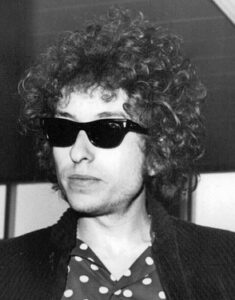
    Simon states in the Rolling Stone interview that this inferiority has to do with Dylan’s ability to apply layers of meaning not just in his lyrics, but to his vocal delivery. Simon is being hard on himself – as all artists need to be, provided that self-criticism doesn’t stymie creativity. But there is nevertheless truth to his verdict, and it is useful to have Simon articulate so clearly the central mystery of what makes Dylan uniquely compelling.

    How does Dylan achieve it? It is very difficult to say but my own sense is that Dylan’s immersion in the past – and really in life generally – has been so deep that he has come out so entirely soaked in art and experience that his singing is never entirely for himself. His experience is multifarious: he is many. His art can at times seem to have almost nothing to do with him. One never feels that there is any stability in the word ‘I’ in Dylan’s songs: nothing can ever be traced reliably back to him.

    The same isn’t true of Simon: in his songs, even the very best of them, there’s always a slight air of solipsism amid all the lovely melodies and the beautiful ideas. He is writing in order to unburden himself; Dylan is doing nothing less than carving out, or reimagining, nationhood in song.

    There are many ways in which this smaller tendency can illustrate itself in Simon’s career. The principle one is in being too clever. This exists across his canon. It is there in the Joe DiMaggio line in ‘Mrs Robinson’ which is probably too arbitrary; when Dylan namechecks people it is always as a way of going back to some definite idea, emotion, or set of principles, as in his great song ‘Blind Willie McTell’. Furthermore, this is a deficiency which Simon is aware of. There is also video footage in the 1990s of Paul Simon listening back to his magnificent song ‘Graceland’. He is being filmed listening to the words:


    And my travelling companions

    Are ghosts and empty sockets

    I’m looking at ghosts and empties.


    Listening back to this, his facial features twist with regret: “Too many words,” he says, genuinely berating himself. “Too many words”.

    He is right. And too many words is always a symptom of trying too hard which in turn is to do with lack of self-confidence. By contrast, we might note how the whole magnificent universe of Dylan’s “Mr Tambourine Man” unfolds effortlessly, without any ambition intervening.

    Dylan has superior knowledge about the world, which is really another way of saying that he understands himself better. Incidentally, Simon never wrote a line as good as: “I know that evening’s empire has returned into sand,” which shows a true poet’s innate perception of evenings – not to mention of empires and sand. I’m not sure Simon is ever seeing things so clearly as this; his ego, in the shape of his cleverness, keeps coming in between him and the thing he is trying to describe.

    This lack of self-confidence in Simon might have to do with an absence of historical roots. This was, to put it mildly, never the case with Dylan who has travelled the world on his Neverending Tour, but always as an American mining his Americanness. Lack of a real centre meant that Simon went journeying, first to South Africa to record his best solo album Graceland (1986) and then to Brazil to record his second best Rhythm of the Saints (1990).

    These albums were made in a completely different way – one might say that they have to do with avoidance regarding the core reasons for a restlessness which Simon has always felt. He recorded the rhythm track first and then recorded the melodies over the top. It was a fascinating exploration of another country, and produced some songs which border on being standards: ‘Boy in the Bubble’, ‘Graceland’ itself, ‘Diamonds on the Soles of Their Shoes’, although it might be that ‘You Can Call Me Al’ is marred by some slightly silly lyrics.

    But the only real limit on the Graceland album is tied to its core concept: the lyrics feel like journalism, and make one think of Sir Tom Stoppard’s joke in his 1978 play Night and Day, that a foreign correspondent is “someone who flies around from hotel to hotel and thinks the most interesting thing about any story is the fact that he has arrived to cover it.”

    Something like this appears to apply to Graceland and Rhythm of the Saints. There is a shallowness to his observations about poverty in South Africa for the very simple reason that Simon doesn’t live there, and can’t really know what’s going on. Damon Albarn faced a similar problem when he came to make his album of Mali Music.

    Surrealism in Simon has its limits too. In Dylan’s surrealism – especially in Blonde on Blonde – we experience the excitement of the poet’s discovery of Baudelaire and Rimbaud. It is probably true to say that Dylan doesn’t always make definite sense, but there is something vast and brave about the exploration being undertaken; and very often one senses a large world of meaning bordering the difficulty of the language – a world of dream-like correspondences. But in Simon surreal language too often goes in the direction of archness.

    Lyricists mustn’t let the listener know that they’re clever; what needs to be communicated instead is that they love truth, and then that they love language – and in that order. At the highest peaks of the Dylan songbook these two are in the right order – and of course, married to the music. With Simon, something is ever so slightly out of kilter and I think it must have been, despite his huge achievements, a frustrating career in some ways.

    I should say that these deficiencies have been minor, and they make very little dent in most people’s enjoyment of Paul Simon. But they have, it seems, made a dent in Paul Simon’s enjoyment of Paul Simon.

    For the rest of us we have a body of work which is full of charm, occasional wisdom – and almost always, a beautiful gift for melody which actually surpasses Dylan, and is probably only dwarfed in post-war song by Paul McCartney. Simon has always had the knack of writing a song which you can grasp on first listen but which you want to listen to again. We are extremely lucky to have a lullaby like ‘St Judy’s Comet’, which can still get my son reliably to sleep as he enters his ninth year; that perfect (except for the last verse) gospel song ‘Bridge Over Troubled Water’; ‘Mrs Robinson’ and many others.

    But if we take Paul Simon at his own estimate as in some way second tier, it strikes me to be of enormous interest that Seven Psalms came to him in the way it did – as something gifted through dream.

    We cannot say how this may have happened – and it is beyond the scope of this article to consider satisfactorily why we dream, and what dreams may mean. All we know is that dreaming is psychologically necessary. There have been experiments where people have been woken up just before REM – the period twice per night when we dream – and though they have slept, they have been denied dream. Such people have very quickly drifted into psychosis. From this we can realise that dreaming is psychologically necessary – a vital sorting of the day’s information.

    But there have long been thinkers, including Carl Jung, who have argued that dream is a form of essential communication, and that this isn’t best understood as a purely internal process. For such thinkers, our mind is open when we dream to the stream of external life, and it is this which constitutes the real necessity about dream.

    Be that as it may, we can see in Simon that something utterly essential has happened in Seven Psalms: we can see that his career would simply not have made any sense without it – though we noted no particular gap before. This is the wonderful thing about living a long time. A Paul Simon who had for some reason died in his 70s, without having done this, would be a completely different and inferior Paul Simon. Something similar happened to the Australian poet Clive James: he was a completely different creature at 80 to 70 and even 75.

    Seven Psalms then is an album which should give us all hope that if we continue to live we will continue to learn – and perhaps something may just land in our laps which we weren’t expecting. This might not be something as big as Seven Psalms – it doesn’t need to be.

    In fact, for all of us, in whatever career or task we’re chiefly working at, life is usually giving us little indications which might be seen as microscopic versions of these larger realisations. The lesson from the life of Paul Simon is to stay alert for the big change in direction, the essential shift in the self. It may just come your way – and if it does, you’ll know how much you needed it.



  • ‘Steppin’ out into the dark night’: a review of Bob Dylan’s Shadow Kingdom

    Christopher Jackson

    Geniuses never do what we want them to: if they did, they’d be just like us. There’s recompense for the dismay we sometimes feel at the trajectory of our heroes. After the initial confusion comes comprehension, forgiveness, and awe – followed by amnesia about the traversal of that progression. Soon you forget why you ever struggled; they’ve normalised a place you’d never have got to under your own steam.

    Such phases – capped with delight – apply to the work of those of high achievement whose output we get to follow in real time. Imagine a fan of the Picasso blue period confronted with the invention of Cubism eight years before the outbreak of the First World War; or the Portrait of the Artist as a Young Man devotee faced in 1922 with the mystifying beauties of Ulysses.

    Bob Dylan is the chief perpetrator today of this kind of rewarding bafflement. He’s been outmanoeuvring us for 60 years.

    When we were used to Elvis’ platitudes, he gave us poetic song. When we demanded more folk, he smiled and gave us skirling Rimbaud-esque electric guitar; when we asked for more of that, he more or less invented Christian rock. By the mid-1980s we wanted to hear his hits as on his records, so he played them out of time and out of tune for around 30 years.

    It didn’t stop there. When we didn’t care whether he painted or sculpted at all, he did both – and well. By the 1960s, when we were advising him to write something comprehensible, he eventually handed down from on high the wild madness of Tarantula (1971). Later, when we didn’t solicit his recollections, he wrote Chronicles Vol. 1 (2004).

    Having greatly enjoyed that, we pleaded for a second volume, but he didn’t give us one, despite the logic that a first volume implies and necessitates a second.

    In 2016, we gave him a Nobel Prize for Literature, to nudge him along in that endeavour. That didn’t work either. He didn’t accept the prize with any degree of normality, and instead delivered a speech with a backing track which turned out to be the beginning not of anything literary, but instead a prototype for ‘Murder Most Foul’. This 17-minute song (which always seems to me to finish in about four, as if Dylan has bent time) was then released at the start of the pandemic, making sure we paid attention to a completely new kind of song just when we had nowhere to go and couldn’t avoid listening to it.

    But back in the late 1990s, when silence had seemed to be the best that could be hoped for, he gave us a masterpiece Time Out of Mind. Even that was complicated: it was produced by Daniel Lanois in a murky swampy sound which meant Dylan had to release a re-recorded version earlier this year, which many fans – this reviewer included – now consider to the be the right one.

    By 2023, the strangenesses keep forking across our vision like some sort of improbable laser system. Last year, Dylan gave us The Philosophy of Modern Song (2022), which turned out to have no philosophy in it, and even less modern song. He then matter-of-factly released a new whisky. What will he do next? Become the world’s first 82-year-old ballet-dancer?

    But every time you learn to be content, and to want more of what you didn’t need to begin with. Everything’s a phase, a stop, a navigation point. His career is all movement, restlessness, energy – for the listener, it’s a process of constant addled reconciliation to puzzlement.

    All of this accounts for the particular note of coverage which attaches itself to everything Dylan does: it is the sort of excitable speculation which would make sense only in anticipation of a thing. Instead, the debate is occurring at the tangible – an album, a book, a painting – which is there in plain sight.

    Shadow Kingdom was initially an esoteric streamed film released last year for the cheeky ticket price of $25. It entailed Dylan and some actors performing in a fictional Casablanca-style bar called The Bon Bon Club. The music percolated around the Internet, but here is the official release.

    Instead of naming it Bootlegs Vol. 18 as he might have done, Dylan has allowed these nostalgic recordings to stand to one side under this title.

    This decision draws additional attention to the title itself. Readers of Richard Thomas’ study Why Dylan Matters – a moreish work which shows definitively how Dylan has lately been drawing on the classical world – may think of Homer’s and Virgil’s underworlds, and embark on the futile process of defining what the direct connotation might be.

    It doesn’t matter. What’s clear is that at the peak of cultural achievement at the age of 82, Dylan is reaching into pockets of forgotten time and doing some crucial rearranging, and possibly purifying. Inversions, reflections and opposites: it’s Dylan through a distorting mirror – a negative.

    So how does that sound? First up, he has chosen his set list cunningly. Though billed as a release of Dylan’s early hits, none of these – with the possible exceptions of ‘Forever Young’ and ‘It’s All Over Now, Baby Blue’ – is really first-tier Dylan in terms of being well-known. An album of his actual hits would have included ‘Blowin’ in the Wind’, ‘Don’t Think Twice, It’s Alright’, ‘Mr. Tambourine Man’, ‘Like a Rolling Stone’ and ‘Lay, Lady Lay’.

    Instead find ourselves in obscure suburbs of the songbook, and perhaps that’s part of the exercise: to remind us of those corners of the greatest oeuvre in post-War music which we might not have been listening to. So we get a balladeering ‘Tombstone Blues’, an almost entirely rewritten ‘To Be Alone With You’, and a deliciously slow ‘Pledging My Time’.

    The other way in which the ‘Shadow Kingdom’ effect is achieved is through the absence of drums. The album in fact prompts an interesting thought experiment: what would the history of recent music have been like without drums, and therefore without the centrality of the animalistic and Dionysian figure of the drummer? Without drums we can still have rhythm – as these tracks do. But Dylan appears to be saying that other worlds – other kingdoms – are possible.

    The opener is ‘When I Paint My Masterpiece’ which, like the album’s promotional single ‘Watching the River Flow’, was written in 1971. Both songs were first recorded by The Band later that same year, making them twins of a kind. These fine and underrated songs were written during that quiet period when Dylan was predominantly raising children. That ‘domestic happiness’ phase, when child-rearing swerved in to diminish his output, not only proved him mortal but proved him gratifyingly subject to the laws of parenting.

    It’s of great interest that he feels the need to return to these two compositions, as if to reconsider the implications of a lost tranquillity. A lyrical change which dates from October 2019 nowadays occurs in the first stanza of ‘When I Paint My Masterpiece’. He’s no longer going back to his Rome hotel room for a date with Botticelli’s niece. Instead he’s:


    gonna wash my clothes,

    scrape off all the grease

    gonna lock my doors

    and turn my back on the world for a while

    and stay right there ’til I paint my masterpiece.


    Which is marvellous. The original line about ‘Botticelli’s niece’ – though a good rhyme, and amusing idea – probably didn’t quite fit, the painter having been a Florentine, and the song is meant to be set in Rome (I’m not sure I particularly like that towards the end it relocates to Brussels). But then Cicero’s niece might have been too remote and improbable a notion – better to think of another rhyme altogether.

    There are hundreds of moments like this on Shadow Kingdom. Gore Vidal once wrote a memoir called Palimpsest (1995) a title which might also have suited this album. We are in permanent dialogue here between Dylan’s octogenarian self, and the younger succession of selves who wrote these songs.

    This conversation across time takes three forms. Occasionally, we get a lyrical rewrite. Most notably ‘To Be Alone With You’ is almost entirely rewritten and is therefore the most important recording here, essentially amounting to the first new work by Dylan since 2020’s Rough and Rowdy Ways.

    It has been noted that late Dylan contains an alarming number of instances of violent language, and there is probably more work to do to understand precisely what he’s doing here. This stanza in the otherwise lovely ‘Soon After Midnight’ from 2012’s The Tempest might be taken as representative:


    They chirp and they chatter

    What does it matter?

    They lie and dine in their blood

    Two-timing Slim

    Who’s ever heard of him?

    I’ll drag his corpse through the mud

    We naturally suppose that this stanza isn’t autobiographical unless the next chapter in this storied career is to be The Trial of Bob Dylan. What seems to be happening is that he is admitting the possibility of murder into the consciousness of his characters: right next to all the grand and lyrical feelings of love and romance, we get the strange static of murderous resentment.

    This does in fact happen in the human mind – and most particularly, in the jealous human mind – but it is still tremendously bold of Dylan to admit this into the world of popular song. It’s probably the chief development in late Dylan: it would be odd, for instance, if the singer were to start dreaming of murder in the middle of ‘Lay, Lady, Lay’.

    All of which makes the rewrite of ‘To Be Alone With You’ – from the same album as ‘Lay, Lady, Lay’ – fascinating. On the 1967 Nashville Skyline recording the final words were relatively anodyne in keeping with that – intentionally? – tame album:


    They say that nighttime is the right time

    To be with the one you love

    Too many thoughts get in the way in the day

    But you’re always what I’m thinkin’ of

    I wish the night was here

    Bringin’ me all of your charms

    When only you are near

    To hold me in your arms

    I’ll always thank the Lord

    When my working day is through

    I get my sweet reward

    To be alone with you


    When Dylan wrote that he was trying to put clear water between his latest work and the complex poetry of the great mid-1960s albums which culminated in Blonde on Blonde (1966). Now, in 2023, the whole thing is completely rewritten:


    I’m collecting my thoughts in a pattern

    Movin’ from place to place

    Steppin’ out into the dark night

    Steppin’ out into space

    What happened to me, darlin’?

    What was it you saw?

    Did I kill somebody?

    Did I escape the law?

    Got my heart in my mouth

    My eyes are still blue

    My mortal bliss

    Is to be alone with you

    My mortal bliss

    Is to be alone with you


    The way Dylan sings ‘my mortal bliss’ – especially the second time, full of gravelly yearn – is his great vocal moment on this album. But why are we suddenly talking about killing? We can be sure that if the narrator had killed somebody, he would remember. Assuming therefore that he hasn’t, it seems likely that his love is ignoring him for no clear reason, and he’s asking rhetorically, and half-jokingly: “What, did I kill somebody?” But it expands the emotional range of the song for death, and the whole darker side of life, to be incorporated into what used to be a sweet and straight love song.

    More generally in Shadow Kingdom, the words are intact and the real shift is in Dylan’s vocal delivery – now a reliable sandpapery croon. In ‘Watching the River Flow’, there’s a marvellous moment:


    What’s the matter with me?

    I don’t have much to say.


    Dylan rasps the word ‘say’ – and it feels like an old man’s emphasis somehow. This repeats more tellingly on ‘Pledging My Time’, where the word ‘time’ is given repeated aching inflection, making us acutely aware that what time means to a twentysomething, when he wrote the song, is necessarily different to what it feels like to an 82-year-old. It feels like Dylan has walked round the song and seen something else, as a Cubist painter might do.

    Finally, some of the songs – as happens day in day out on the Neverending Tour – have very different melodies, and none of them is anyway near identical to what we heard on the original albums. My favourite of these is ‘Forever Young’, which has grown a descending bass line in its introduction, and has an additional gentleness to it in the famous lines: “May you build a ladder to the stars/and climb on every rung’. It’s one of two great songs about parenting which Dylan wrote; the other being ‘Lord Protect My Child’.

    That song isn’t on this album. And how many people know it? How many also know ‘Blind Willie McTell’, ‘Angelina’, ‘Lay Down Your Weary Tune’, ‘Girl from the Red River Shore’ and scores of others which were deemed inadequate for album inclusion when they were written. This is the enormity of Dylan: he could record a hundred Shadow Kingdoms and we’d still need to visit them.

    I don’t think this is a major album, except in the sense that everything by Dylan, being by him, is part of the gigantic edifice of his work. The slowed down songs feel more successful – especially ‘Tombstone Blues’ and ‘Pledging My Time’. In the former, I can now hear, which I couldn’t on Highway 61 Revisited (1965) that mama’s not looking for food in the alley but for a ‘fuse’. This makes for a nice full rhyme with ‘shoes’ and ‘blues’ which surround it; but I’ll always imagine her looking for a snack of some kind. The sped-up track ‘I’ll Be Your Baby Tonight’ is less successful for me, like someone trying to jumpstart a car which doesn’t want to move.

    Dylan’s place in the pantheon has been secure for half a century. But he’s still in the game; who’s he competing with beside himself now? To find his equal among polymaths you have to go back past Picasso, and leapfrog your way over several centuries to Michelangelo.

    This isn’t to say Dylan is flawless, or that he has ever done anything as well as Michelangelo sculpts – in fact, he’s probably the most untidy great in the history of culture. This is why there are still legions of people, with no known achievements to their names, prepared to testify solemnly that he’s no good at all. But the Australian critic Clive James was right when he complained that there’s no song where you don’t wish he’d done something differently.

    But that’s because there’s never been an energy like this: already moving onto the next thing even while in execution of the present task. We have to take the greatness we get, not the kind we might have authored ourselves. Because we didn’t do it ourselves; Dylan did, and so he gets to decide.


  • Christopher Jackson reviews Bob Dylan’s Philosophy of Modern Song: “A great career has its basis ultimately in enthusiasm’

    Christopher Jackson


    ‘Curioser and curioser,’ said Alice.” The lines come from Lewis Carroll’s Alice in Wonderland but might easily have been describing the career of Bob Dylan.

    In Dylan’s world nothing is ever what we might expect, and it’s this quality of oddity which has created the obsessiveness of so-called Dylanologists. And now, just as his recording career has settled down into the possible endpoint of 2020’s Rough and Rowdy Ways, and his art career seems also established in a comfortable retrospective – called Retrospectrum – at the Frost Art Museum, we get something altogether different again. Indefatigability is an underrated character of high achievers: Dylan is stubborn and remorseless, able to find an audience while remaining tied to deliberate mystery.

    His literary career is brief, and occasional – a fact which alone makes it peculiar to consider that he was awarded the Nobel Prize for Literature in 2016. But his output in books shows in microcosm his essential strangeness. First comes an incomprehensible novel Tarantula, released during the height of 1960s mayhem. Dylan then releases in 2003, a magnificent memoir Chronicles Vol., only to eschew publication of a second. Now we have something altogether different to what we were expecting – except if we had recalibrated our expectations to anticipate the improbable.

    Strangeness will not always amount to genius, but it is impossible when reading this latest offering The Philosophy of Modern Song not to remember Schopenhauer’s remark that talent hits a target no other can hit, and genius a target none can see.

    There’s never been a book like this. The book consists of 65 essays on songs which have influenced Dylan, mainly by men – as numerous reviewers have pointed out – and predominantly emanating out of the 1950s of his youth. Most of them have essays in the second person. Many feel oddly pertinent. This riff, for instance, on Elvis Presley’s ‘Money Honey’ feels relevant to the inflationary status quo:


    This money thing is driving you up the wall, it’s got you dragged out and spooked, it’s a constant concern. The landlord’s at your door and he’s ringing the bell. Lots of space between the rings, and you’re hoping he’ll go away, like there’s nobody home.

    Dylan recently sold his back catalogue to Universal for around $300 million, but there is somehow an authentic note to this – a wisdom which has come his way through songs. It was Eddie Izzard who joked that fame tended to injure comedy as you can’t begin a joke with ‘My butler went to the supermarket.’ Dylan doesn’t always get it right; after this book was published, it emerged that copies of this book masquerading as possessing his unique signature had in fact been signed electronically. It was unacceptable, but in this book, the writer gives the impression of being able to get to the core of things, even when looking at the world through the tinted glass of a limousine.


    Sometimes, as in the extended riff on ‘Blue Suede Shoes’ – Dylan writes about the Carl Perkins and not the Presley version – the predominant note is comic:


    You get on with most people, and you put up with a lot, and you hardly get caught off guard, but your shoes are something else. Minor things may annoy you but you rise above them. Having your teeth kicked in, being pounded senseless, being dumped on and discredited, but you don’t put any weight on that, none of it’s as real to you as your shoes. They’re priceless and beyond monetary worth. 

    The chapter only grows more absurd until Dylan writes of these shoes: “They neither move nor speak, yet they vibrate with life, and contain the infinite power of the sun.” It’s writing which is a joy in itself but also transforms your listening. Spotify already has several playlists featuring the songs in this book: it is a transformative listen as well as a transformative read.

    Another aspect to this book is the curation of its splendid photographs which makes the book a luxury object and also ups the price to £35 at the same time. The collection is prefaced by a fascinating portrait of a young Elvis browsing in a record store; ‘London Calling’ by the Clash is illustrated by a picture of bobbies breaking up a riot; ‘Cheaper to Keep Her’ by Johnnie Taylor, includes an ad for a divorce law firm.

    That chapter also contains an intriguing invective against the divorce law profession which, having been through several marriages, is a topic close to Dylan’s heart. It’s not the only passage which feels autobiographical. Dylan’s love of London is brought out when discussing The Clash:


    London calling – send food, clothing, airplanes, whatever you could do. But then, calling is immediate, especially to Americans. It wouldn’t be the same as Rome calling or Paris calling or Copenhagen calling or Buenos Aires, or Sydney, or even Moscow. You can pass off all these calls with somebody saying, “Take a message, we’ll call you back.” But not with London calling. 

    Likewise a dissertation on the little known singer Johnny Paycheck delivers this thought from the man who began life as Robert Zimmerman: “And then there are those who change their own names, either on the run from some unseen demon of heading toward something else.”

    It all amounts to a new kind of colloquialised, aestheticized and poeticised music criticism. It’s a homage to all that Dylan has known and loved, and perhaps in that sense has a valedictory feel: but then once you’re 81 everything feels like a goodbye. Yet you’re also reminded that the book is at the same time a hello, and a gift. It reminds you of Dylan’s explanation of his songwriting: “Every song I’ve ever written is saying: ‘Good luck, I hope you make it’.”

    Despite a bit of padding here and there, taken in the round the book has the feeling of necessity: Dylan’s long career appears to have taught him to wait on the vital inspiration. His latest records, now spread further and further apart to the extent that one wonders whether to expect another, have the same quality this book has of things which had to be done, since they could only be done by Dylan – and only done by him at the moment when they were carried out. All great artists are opportunists in that then they end up claiming all the prizes going.

    Greed is an aspect of Dylan’s life – or perhaps hunger. Because alongside this selectiveness of projects is also the other side to him: profusion, growth, energy, and restlessness. These qualities are all encapsulated by the Neverending Tour which has just swung through the UK during the publication of this book.

    There are limits to this book: you can sense that by the last 10 songs or so, the exercise has been largely spent and that some of the tropes have become repetitive. But this sense is more than offset by the enormous impact which the first half has: it feels regenerative, and makes you want to listen again not just to these songs, but to all music.

    A great career has its basis ultimately in enthusiasm. What we glimpse here is the power of that early passion for music which the young Dylan had: it was this which propelled him forwards, changing popular culture along the way, and eventually entering the annals of the true greats. The value of this book is that it needn’t necessarily apply to budding musicians: its lessons are transferable across sectors.

    We also sense that it is just a tiny corner of a voluminous mind. Artists who Dylan knew well – most notably Leonard Cohen and The Beatles – don’t feature at all. So this books suggests other books which will likely remain unwritten – at least unwritten by Dylan.

    This is a book which doesn’t mind who you are or where you are. It only wants to grip you and never let you go until you succeed. In another sense it doesn’t mind what you do, provided you listen to the music.


    The Philosophy of Modern Song by Bob Dylan is published by Simon and Schuster (£35)


  • Film review: What does the case of Elvis Presley tell us about work?

    Christopher Jackson

    We sometimes talk as a society as though being successful were somehow the be-all and end-all – as if it were somehow all that mattered in and of itself. Some time in the 21st century, the cry went up that fame was all, and that a particular set of metrics mattered. In the world of music, it would mean that marvellous Holy Grail: the hit, the platinum disc.

    The history of rock and roll seems on the face of it to make it clear in bold italics that this entire thing was always a gigantic folly. Success as a musician, especially in an era of drug-taking and alcoholism made respectable, has with astonishing regularity meant premature death.

    In the light of the 2020s, the life expectancy of the rock star seems sometimes to veer wildly between those who die very young, such as Moon, Hendrix, Brian Jones, Michael Hutchence and so on, to the recent spate of octogenarians, including Bob Dylan, Paul Simon, Paul McCartney, and Brian Wilson. It is as if, if you can somehow manage not to die, then a hedonistic lifestyle can shade by gradations of mellowing into a pampered one, until a kind of creased longevity is achieved.

    Elvis, of course, did die – or rather didn’t manage not to. In fact, his death lacks the Chatterton-esque Romanticism of some of his peers, since he declined physically to such an extent before his eventual demise.

    But the fact that the Elvis legend persists is all to do with the enormity of his impact, and Baz Lurhmann’s excellent film, evokes that like no other biopic about Elvis.

    Listening to Elvis today can be a perplexing, even tame experience. Though we still to some extent inhabit the world of Elvis, we don’t always realise it: for one thing recording technology has come a long way since that time, robbing his sound of its original shock and immediacy. This state of affairs is to some extent exacerbated by the way in which the typical Elvis mix on Spotify or iTunes is a bewildering mix of his early stuff, which really was revolutionary, with the later Vegas work, which seems schmaltzy today.

    What lessons does the film have for a music career? In the first place, we see in the early scenes that great achievement is very often to do with being open to influence and to new information. Elvis’ real legacy was to listen to the great black music of the 1950s, and to open himself up to its influence – and insodoing to further it.

    There is a tremendous scene where the boy Elvis, is peeping through a window, and sees a black rock and roll band, and experiences the thrill and pulse of that music as a thing which he must have in his life – and the only way to do that will be to emulate it. It is often said that when Elvis first came on the radio, people assumed his vocal chords belonged to a black singer.

    In all our careers, there is knowledge which may have a forbidden quality; Elvis is a reminder of the potential benefits of running roughshod over that kind of prohibition, and of imbibing influence wherever it can be found.

    In the film, this idea that Elvis sounded black on the radio is conveyed to us through Tom Hanks’ performance of Colonel Tom Parker. The question of Tom Hanks in this movie is worth a small essay in itself. Hanks, an actor – and to the extent that one can be sure of these things – probably a man to admire is nevertheless the main problem with this movie. Some critics have pointed to his disastrous accent as the principal issue with Hanks’ performance and it is indeed a strange mishmash.

    I think the problem with the performance runs deeper in that Hanks, among major artists of our time, seems to me to be someone with an innate relationship to goodness. In this, he is similar to Paul McCartney, who can never keep optimism out of his songs: his inherent tendency is towards consolation. If you look at his performance in A Beautiful Day in the Neighbourhood (2019) you can see him exploring a terrain – in that case, saintliness – which he feels a natural kinship with.

    Here, in Elvis, he is fatally severed from the subject matter of human evil, meaning that he is at an odd distance from the essential topic of the performance. It is like a singer choosing to sing out of range, or a writer with no ability for dialogue switching from novel to the drama.

    The resulting performance doesn’t quite derail the movie, though it comes close. Elvis himself seems to have been born with something opposite: an innate capacity to know what could and couldn’t be done with a song on stage. Luhrmann’s movie shows that this ability was something that he first had to learn to wield: nervousness is something everybody must overcome at some point, and it is interesting to see Austin Butler convey Elvis’ tentative first steps into his gift.

    The greatest question for anyone with a creative bent is how to make money from it. It’s quite rare that an ability with the arts comes hand in hand with a talent for administration; the two aptitudes must occupy different parts of the brain, and where the one is accentuated the other is likely to be in deficit. So it was with Elvis; an outsize performative gift opened him up to exploitation, and he met, in the shape of Parker, a master exploiter.

    The film consistently shows Elvis seeking his authentic self in the teeth of the man committed to falsifying that self – and to commercialising the image he has created. A TV show, which looks like it will be an embarrassment of Christmas cliché perpetrated by the Colonel, is pushed back at by Elvis. Later, we see him inaugurating his big sound in Las Vegas.

    Elvis sometimes appears here as a great artist – a man with an unfailing sense of what audiences want, but able to enact something at some farther point just beyond that vague idea.

    In one sense, Elvis is still with us. We still have our popstars identifiable by one name – Beyoncé, Drake, Jay-Z, and so on. They are, to some extent, his inheritors. But not entirely. In another sense, the world has moved past his obsessions, or begun to wise up to the danger of self-indulgence. Today’s young people are often teetotal, and as likely to wear sneakers and design an app as they are to pick up a guitar and take drugs: they’re the better for it. Some of the 1960s susceptibility to self-indulgence was probably an inheritance of the Second World War: when life has been constricted and dangerous for so long, who could resist that bright day when it came along? It was not a time for the stricture of virtue. It was time to live again.

    This is a film which does more than listening to Elvis’ records can to describe his greatness. It shows how the compulsion of the performer can rise to art, and how if that performance can be captured in sound, a memory lingers on.

    What Luhrmann ultimately does is regenerate Elvis, and remind us what he did. He dragged the past with him into the future, and though he died along the way, he is as much an aspect of our lives today as the atomic bomb, or Winston Churchill, or Martin Luther King, or any of the other seismic things of the 21st century.

    The film ends with footage of a magnificent performance by Presley himself of Unchained Melody. Desperately overweight, and sweating under lights, he nevertheless finds the notes as only the great entertainers do – the more so when the chips are down, and the world is difficult. They find the right notes because they have to, because it’s what they do – and because of decades of practice at doing so.