Tag: Music

  • Coldplay’s ‘Moon Music’: the virtues of “surmounted cliche”

    Christopher Jackson reviews the latest Coldplay release


    Every now and then I find myself considering the fine margins between major and minor success. I remember, for instance, a gig I attended at the turn of the millennium at the Nottingham Arena performed by the band Travis. In those days, like their rivals Coldplay, they could easily fill a stadium of 10,000 people. We may have turned up with a certain scepticism but ended up shouting out the lyrics to ‘Sing’, our cynical side assuaged by the fun of the evening.

    Today, rotating on Apple Music, Travis’ songs have a power of nostalgia which the songs of Oasis lack. ‘Wonderwall’ has never really gone away. Travis, by contrast, have had a quiet few decades: this fact creates the gap in our experience which can make for a genuine revisiting not quite possible with the Gallagher brothers. And Travis’ songs stand up reasonably well. ‘Why Does it Always Rain on Me?’ ‘Sing’. ‘Driftwood’. ‘Flowers in the Window’. I hope they have a comeback.

    But had you asked me in the year 2000 which band, Travis or Coldplay, would in 2025 break the record for the most consecutive gigs played at Wembley Stadium, I would have probably plumped for Travis. Coldplay at that time were mainly known for ‘Yellow’, which, lovely as it was, seemed to be a melancholic dead end. Travis’ songs seemed to have more complexity: they even sounded a bit like standards. One could imagine people covering them: there was more to explore.

    I was wrong, of course. I’m not sure if Travis can still fill Nottingham Arena, but I know that it would be too small a venue for Coldplay. When A Rush of Blood to the Head came out in 2002, I was on the frontlines of the backlash, feeling that Coldplay represented not something new and lasting, but some form of decline from the greater cleverness of Blur and Pulp, those high spots of Britpop. Coldplay, I felt confident, represented the blandification of the British scene.


    Change of Heart

    I now see I was wrong in this reasoning – and wrong perhaps precisely because I would have been reasoning and not experiencing the emotion of the music.

    All this came back to me recently when Coldplay returned to my life by a series of accidents. Our family’s enjoyment of ‘Something Like This’ in the car on holiday, led me to the Coldplay Essentials playlist on Apple, and via that to a discovery of all that Coldplay had been up to in the intervening decades since I had loftily decided that they would have no future. I note also that I never bothered between the years 2002 to 2024 to check in on whether my predictions had proven false or not.

    At least I am not alone. As I read the other reviews of Moon Music, the album recently released to an almost Swiftian excitement, I realise I am not alone in having underestimated Chris Martin and all his works.

    Almost any broadsheet review of a Coldplay album will begin with some disclaimer, making it reasonably clear that though the reviewers themselves have not written ‘The Scientist’ – or indeed any song of any description – that they are obviously above the task which has befallen to them: namely to review the latest Coldplay album.

    Usually, there will be some sniping at the lyrics, and a general keening about Chris Martin’s perennial failure to be Gerard Manley Hopkins. From here, the reviewer, having restored themselves to intellectual respectability, will then go on to relate what I suspect might be their real feelings: namely, a few carefully caveated points of praise. It turns out that one or two of the songs are actually ‘not bad’ or in fact, in some cases, surprisingly good. It is then sometimes observed that this is true of most and perhaps all Coldplay albums. The eventual rating – usually three stars – seems to conceal a certain embarrassed enthusiasm.
    If we take the typical reviewer’s estimation at face value that there are, say, two good songs on each album then it must be pointed out that this still amounts at this point to around 20 songs which even the naysayer would wish to preserve.

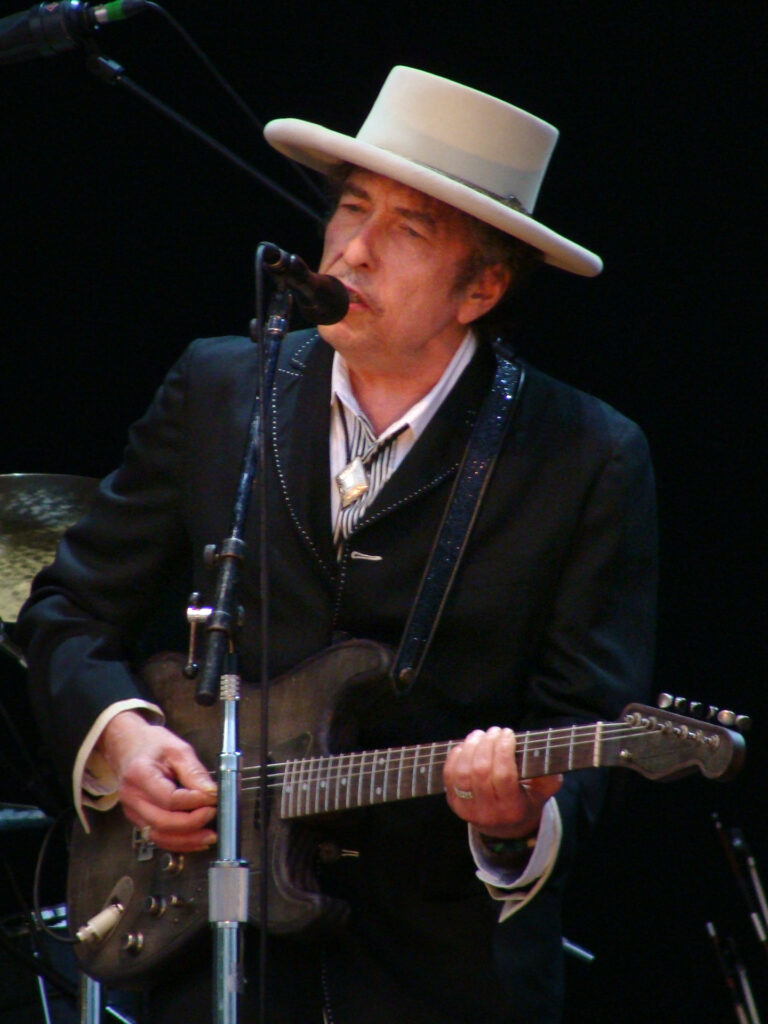
    What is often forgotten is that this in itself is a high number. If we look at the amount of a celebrated pop act’s catalogue which we actually want to keep it usually turns out to be very small. We would probably be content with rescuing around 10 of Fleetwood Mac’s songs, and Fleetwood Mac is an excellent band. I’ve often thought the Rolling Stones really amounts to around 20 songs (they have released hundreds). It’s only when we get into the major acts, the Beatles and Paul Simon that we top 50 songs – and only in relation to Bob Dylan that we clear 100.

    All this is to say that even if we take a negative estimate of Coldplay’s output then the band’s work is to be approached with respect and not derision.


    The Ghosts of Modernism


    Of course, one shouldn’t have to say this – and one wouldn’t have to say it at all if it weren’t for the peculiar way in which the 20th century turned out in terms of art. Really, it is an inheritance of modernism where people began to feel that things must be complicated, and even incomprehensible, to be good. This view would have surprised many artists and writers who university professors like to exalt, Shakespeare among them, who always took care to have a ghost or a murder – and ideally both – in his plays.

    What appears to have happened by 2024 is that we have realised more or less unanimously that we quite dislike modernism, and wish to keep it at a safe arm’s length. We want to enjoy life, and that for most of us, means not reading The Wasteland or listening very much at all to Schoenberg.

    This is not to say that Moon Music is full of ageless poetry: if written down, the lyrics can indeed be banal. But then this album never claims to want to be experienced in that way: it claims instead to be joyful – and joy-inducing – music. This has two ramifications at the level of the lyrics which are worth examining.


    One is the propensity for simple and grand statements which at the level of language, a child could write. In the third single of this album ‘All My Love’, the lyric reads:


    You got all my love
    Whether it rains or pours, I’m all yours
    You’ve got all my love
    Whether it rains, it remains
    You’ve got all my love


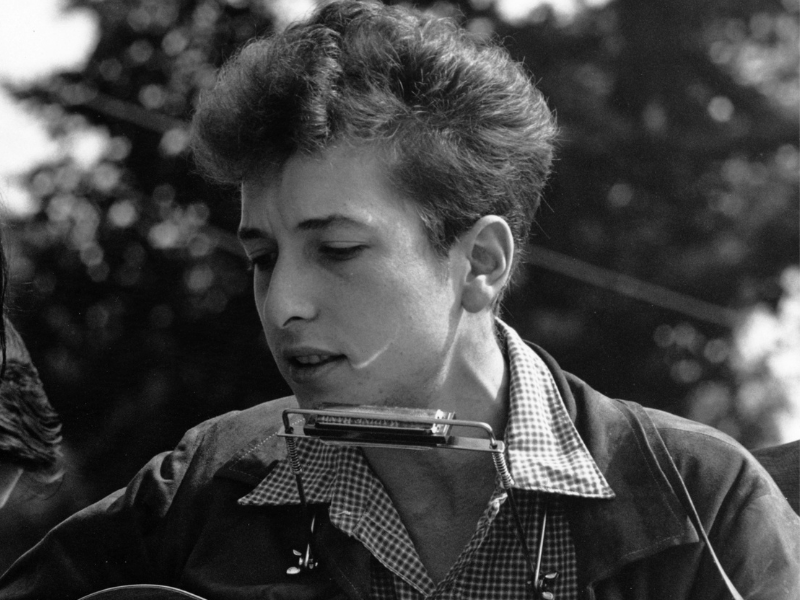
    Now, we can certainly surmise that if T.S. Eliot were writing that as poetry that he might not be top of his form, and even having rather an off day. Bob Dylan, a different kind of songwriter to Martin, especially when writing in the 1960s, would if writing this song no doubt cram in additional internal rhymes around ‘pours’ and ‘yours’ with available words being ‘floors’ ‘pause’ and ‘cause’. He would glut the listener with ideas – and with every idea crammed in one can imagine it getting significantly less likely that the song would ever be sung in a stadium. The song would become more intellectual – would become another kind of song.

    Martin doesn’t do this, and I think at this stage in his career we must give him the benefit of the doubt that he does it deliberately. To firm ourselves in this concession, let me pick almost at random an interview excerpt to show the intelligence of the man. This is Martin talking to The New Yorker in an article released to promote Moon Music:

    “I’m so open it’s ridiculous,” he said. “But, if you’re not afraid of rejection, it’s the most liberating thing in the world.” Well, sure—but who’s not afraid of rejection? “Of course,” Martin said, laughing. “To tell someone you love them, or to release an album, or to write a book, or to make a cake, or to cook your wife a meal—it’s terrifying. But if I tell this person I love them and they don’t love me back, I still gave them the gift of knowing someone loves them.” Martin noticed a slightly stricken look on my face. “I’m giving this advice to myself, too,” he added. “Don’t think I’ve got it mastered.”

    Now regardless of the ins and outs of the philosophical point here, I think most will agree this is obviously an intelligent man speaking who is probably in person wise, funny and kind. Furthermore, it seems unlikely that he should become less so when doing the thing he loves to do which is songwriting. In short, there is something forgivable about the lyrics when we consider the man.

    So given the deliberate nature of his music, what is it which Martin is trying to do with a song like ‘All My Love’? With this kind of song, everything comes down to the sincerity with which it is sung. Sometimes, reviewers will accuse Martin of issuing song lyrics which are like Instagram self-help posts. This is intended to wound him, and perhaps it does.
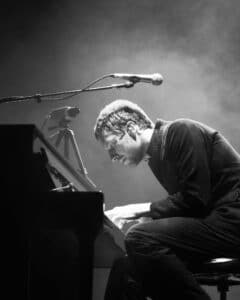
     

    Chris Martin by Roger Woolman

    However, even if this is admitted to, we have to say that there are two kinds of platitude: that which is meant sincerely and genuinely designed to help people, and that which isn’t really intended to help at all but which is really a kind of show, and therefore a sort of con.


    On Sincerity

    Having listened to Moon Music for the last few days, I don’t think it is at all the latter. I think Martin is someone who genuinely cares about his fellow human beings, and that his music is, by and large – with admitted peaks and troughs which are entirely human – a fair method of conveying what he feels about life. It was Emmanuel Swedenborg who wrote of insincere feeling that it were as if ‘a liquid were, on the surface, like water, but in its depths putrid from stagnation’. A certain kind of commercialised pop music is like this: it is, in its depths, false.

    The impression one has of Coldplay is different. Probably it wouldn’t catch so many people, and cause such widespread delight, if it weren’t.

    It was his friend Nick Cave who wrote of Chris Martin’s ‘songwriting brain’. Now that we have admitted that he has one, we can see what Martin is able to do in his songs. The interesting point about this is that the correct measure of true feeling does away with artistic doubt. Moon Music is full of what we might call surmounted cliché.

    If I sing that I feel like I’m feeling falling in love, and I have – as one might in adolescence – no real sense of what that feeling means, I will sound rather silly. I will probably not convey that feeling with sufficient experience. Almost certainly, I shall sound immature and insecure, and if the girl is rejecting me, self-pitying.

     

    But if I sing, as Martin does on the second track here ‘feelslikeimfallinginlove’, about falling in love with full consciousness of what that means – the fear as well as the joy, the vulnerability as well as the force of it – then the words, simple as they are, come hitched to meaning. In that scenario, the music has some sort of potential which exists completely independently of what has been written down on the page.

    Similarly, if I pray for a better world as in the third track here ‘We Pray’ and with every fibre of my being, I really do wish for peace for my fellow human beings, and feel the genuinely awful corollary of war and all its disasters as I sing it, then I am able to bypass the literary concerns of even a music journalist for The Independent around a line like “Pray that I don’t give up/pray that I do my best’.

    That journalist may write at length that I am using cliché, but will be missing the fact that in pop music, if I mean what I sing, and see the glory of peace and the horror of war in my mind’s eye as I sing it, their objections simply don’t carry. In this art form, to mean what one says is a sort of de facto defeat for the naysayer because no matter what The Independent might say, peace is really a very important thing, and praying for it is a very good thing to do.

    At a certain point, Martin realised he could do this sort of thing again and again and that people hugely needed it. He is not Dylan or Cohen, and never intended to be. Musically, his chords progressions are extremely simple, and so he is also to be differentiated from the greatest player of stadiums Freddie Mercury. Mercury’s musical vocabulary was borrowed from jazz and classical. A song like ‘All My Love’ with its straightforward chord sequence from Am to D7 to G and Em shares nothing musically with Mercury’s ‘My Melancholy Blues’ with its complex diminished chords. In fact, Mercury’s songs would generally be a bit outside Martin’s ability as a piano-player.


    Don’t Panic

    But again, in a world of difference, there is no need to fret about any of this if the music can be made to convey good things honestly. It might all be summed up by the presence of an emoji of a rainbow as a track title on Moon Music. A rainbow is a cliché of course – but I know few people who don’t pause and point when they see one in nature. A rainbow then, like peace, or love is not just a cliché. It is also a vital thing which needs to be re-experienced.

    There has been a lot made about Martin’s saying that there shall only be 12 Coldplay albums. With this being the 10th, we are therefore approaching the end of the band’s career. We should remember that it’s a career that has caused enormous amounts of pleasure to many people because of a certain fearlessness about finding ways to refresh us in relation to the obvious.

    How has he done this? I think he has done it by trusting to the origins of songs. A few years ago, Martin explained that he was going through a hard time dealing with the inheritance of an evangelical upbringing. One’s sense is that like so many in the Western world, his struggle has been with the structures of religion – what we might call its exoteric aspects. In short, many people are vexed by things like churches and prayer-books, and desire to reconnect with the wonder of ‘skies full of stars’ or ‘good feelings’.

    Music is one way in which this can be done, and it really means connecting again with the inner self – that is, the esoteric. Coldplay might seem an unlikely messenger of some sort of revolution of the inner self. One begins to say that they don’t take themselves sufficiently seriously for that to be possible – and yet, the moment one thinks in that way, one realises that this is itself what frees people up. In Coldplay, a woman dreams of ‘para-para-paradise’ – and for many this brings paradise itself nearer than a Eucharist or a monk’s chant.

    It would be a shame to miss out on all this in the mistaken belief that a song is a poem, and that a pop concert is meant to be an opera. Life isn’t like that, and I think we owe more to Chris Martin than many realise for not only knowing this but for enacting this knowledge.


    Like this article? For more music content go to:


    Essay: Paul Simon’s Strange Dreams

    Nick Cave and the Bad Seeds’ ‘Wild God’: ‘a song of planetary importance’


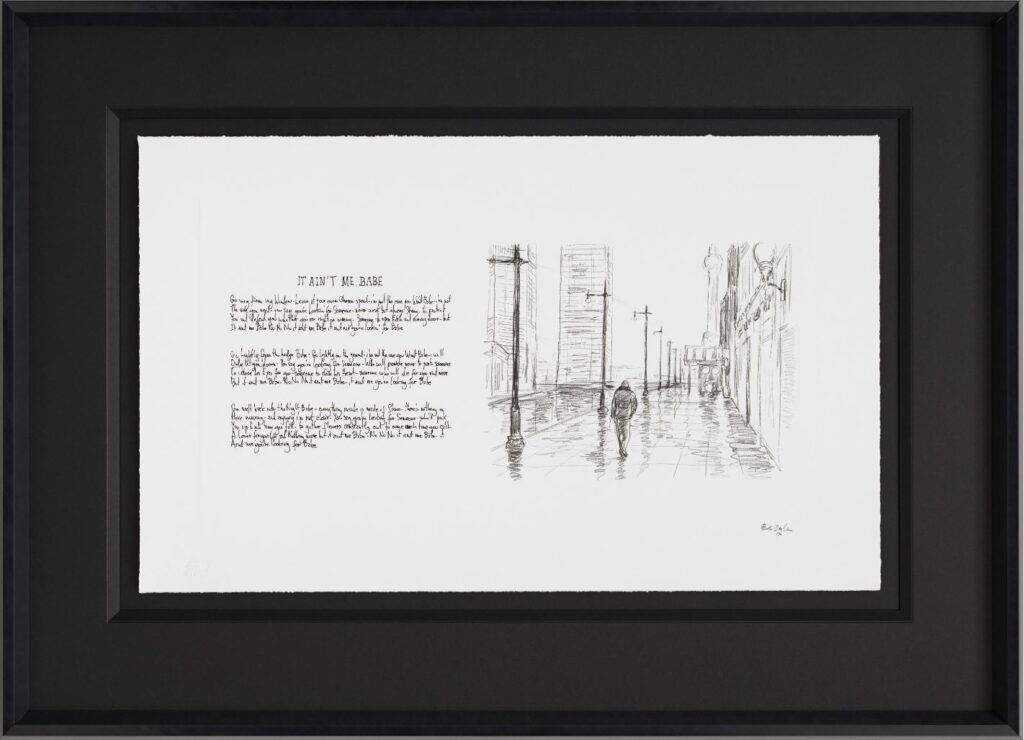
    ‘Steppin’ out into the dark night’: a review of Bob Dylan’s Shadow Kingdom


  • Nick Cave and the Bad Seeds’ ‘Wild God’: ‘a song of planetary importance’

    Nick Cave’s Unique Journey, Christopher Jackson

    It used to seem to me that rock and roll was a young man’s game, possessing within it the iron law of inevitable decline. It went like this. After the euphoria of one’s ‘breakthrough’ there would be a period of ‘maturity’, usually conducted in one’s late 20s (a point in life when nobody can really be said to be mature).

    Around this point, various complications would arise as part of the rock star’s grim pact with the genre: drugs, band break-ups, and, in many instances, death. But as all this unravelling occurred, the fan could at least look back on that sunny time before the alcohol had really kicked in and listen to the first fine careless rapture of the early hits.

    This does, of course, happen – but it is a lie to say it has to happen. In fact, the only reason it occurs so often is because the conventions of the industry lead to self-destruction, and because fame puts the famous person in a false relation to other people, and therefore to the universe in general. Not many musicians, asleep as to the impact of all this harm, are able to go against the herd and dilute their ego sufficiently to lead a normal, productive life.

    A rock star is therefore a curious and often unhappy specimen. On the one hand they are full of marvellous inspiration, walking around in privileged access to the fine substances of music. At the same time, their lives can seem predictable, rote, and mechanistic. Though they can do something which millions would love to be able to do, and have an infinite art potentially before them to explore, they are more likely than a whole range of other people – plumbers, lawyers, accountants and so forth – to self-destruct in completely appalling ways.

    But it’s not all doom and gloom. Fortunately, several examples run in the opposite direction, and so it turns out that rock stars don’t have to die young, or decline. They can grow, mature, alter and reach enlightenment.

    So how might that happen? The first important hurdle is not to die young and if that is achieved, then it also helps if one’s initial period of great fame subsides a little. In the marvellous cases of Bob Dylan and Leonard Cohen, longevity eventually created the conditions for a productive old age. It is good when stadiums cede to arenas, and the rock star’s sense of proportion will be improved by the arrival on the planet of billions of people who have little inkling of their former importance.

    The rock star with ambitions to be fruitful beyond their fifties will also be helped by mortality, that universal corrective to pride. In the case of Dylan and Cohen, the presence of death directed them away from their celebrity back towards themselves – into that deeper sense of fragile life where art comes from. The results were astonishing: ‘Murder Most Foul’, “You Want it Darker”, “Mississippi”, “Samson in New Orleans”, “Standing in the Doorway”, to name only a few. In each of these songs, and in many others, we can feel the necessity of the creative process: the impression is of music as an expression of an entirely healthy approach to life.

    Cave has followed a similar progression to these masters, but with the release of his new song ‘Wild Gods’ it even seems to me that he is surpassing them, entering some new circle of higher life all his own.


    For those who don’t know his work, Nick Cave and his band the Bad Seeds have been around since 1983, and for many years produced intelligent albums with a post-punk sound. Right from the beginning, Cave was different to his peers. He has always admitted religious imagery to his work: ancient wisdom has long since coursed through his lyrics, meaning that the vying sounds of the contemporary city – drums and electric guitars – were always juxtaposed with an intellectual inheritance of sacred books stretching back thousands of years.

    It is not too much to say that two kinds of time have always inhabited his work: the urgency of the present moment rushing over, or contending with, the permanence of ancient thought.

    Even before his recent run of magnificent albums, his work was hugely valuable. He has always been one of a small number of songwriters who bestows immense care on his language, and who understands that songwriting is a symbiotic form whereby what is said must be profoundly intertwined with musical texture to form a viable unity.

    Cave’s fame arrived in a less intrusive fashion than Dylan’s, and maybe than Cohen’s, but a drug problem arose in the form of heroin addiction nonetheless. Fortunately the rehab which Amy Winehouse said she would never attend was attended by Cave and he has for some time been ‘clean’. All this will seem relatively predictable so far.

    But the usual and expected arc towards septuagenarian mellowness was in this case bucked by a terrible and unthinkable event: the death of his 15-year-old son Arthur on 15th July 2015 after a fatal fall off a cliff in Brighton.

    It is not surprising to find that Cave was altered irrevocably by this appalling event, as would be the case with anyone. The astonishing thing is the direction in which it altered him, and the authenticity with which he communicated his pain – and, crucially, all that he had learned from his pain. He has given bulletins from his zone of suffering via every avenue available to him: in songs of ever-increasing beauty and glory; in his online community The Red Hand Files, a project of enormous spiritual generosity; in ceramics; and in his peerless book Faith, Hope and Carnage (2022), which takes the form of a series of conversations with the journalist Sean O’Hagan.

    Nick Cave’s news is not what one might have expected: not only has Arthur’s death not been all bad, sometimes it has been the cause of immense blessings which he wouldn’t want to be without.

    The aftermath of Arthur’s death is described in hallucinatory detail in Faith, Hope and Carnage, and it would be a hard-hearted person who could read of what happened without feeling all at once a love and sympathy for Cave and his wife Susie. In time, Cave would keep going as an artist. Some of Skeleton Tree (2016) was retrospectively rewritten to take into account the loss of Arthur, but most of the album had been written beforehand.

    His first full foray into post-grief creativity came with Ghosteen (2019), which was followed by Carnage (2021), which is not a Bad Seeds album, since it is the work solely of Cave and Bad Seeds member Warren Ellis, a very important person in Nick Cave’s Unique Journey.

    It is possible now at a certain distance of time from Arthur’s death to allow oneself to feel that Cave was well-placed to make some good out of a situation which would have been a purely negative experience in those who lack his spiritual and musical resources. This is the man who said in ‘Mercy Seat’ (1988) that he wasn’t afraid to die, and who vaguely entertained the idea of an interventionist God in 2011’s ‘Into My Arms’. The words which open that song – probably still his most popular – look now as if they were written epochs ago, out of a provisional soul:

    I don’t believe in an interventionist God

    but I know darling that you do.

    What is important in these lines is the sense that the connection with the lover is so strong that her faith has to impact on him, and be shared in some way. Cave has distanced himself from this song, the main reason being that he now does believe in an interventionist God. Arthur’s death either introduced something new into the equation, or else it accelerated a process which was already under way in him.

    For Cave, as is the case for many of his contemporaries, the Bible has never been a book to be roundly mocked or cheerfully ignored: it has always been a vital part of his toolkit as a songwriter, conferring also a set of obligations on him as a man. But it is one thing to play with religious imagery, and quite another to believe that the imagery may stand for a truer reality than the one we generally appear to inhabit.

    Why did Arthur’s death make Cave reassess his attitude to religion? Surely there could be no clearer exhibition of the futility and randomness of life than this poor boy’s accidental end? Curiously, the exact opposite proved to be the case. What seems to have happened is that Arthur’s death over time simply did not present itself to Cave as conclusively bad news: in fact, it told a completely different story.

    After the terrible months which followed Arthur’s departure, the Caves became aware of Arthur as a living presence within their lives. Arthur seemed – and many grieving people find the same about their loved ones – an acutely living force. Some will simply call him mistaken in this, but the art testifies, as we shall see, to the vivid nature of this experience. If we listen to these albums, we will see why these suspicions and experiences sent Cave back towards the eternal questions in a wholly altered state.

    The profound pain of Arthur’s death triggered a mysterious metamorphosis which somehow made it impossible for Cave to sing those lines from ‘Into My Arms’. They simply weren’t true for him anymore. One way to look at life is that if we really pay attention, it has a way of continually disabusing us of pessimism: it seems too solicitous of our attention for that. We are too free, too blessed, too tangible, and just too hopeful to feel futile or accidental.

    The Cave family soon found that life has a curious way of offering up peace. True, it very often does this in the most peculiar ways – in half-seen fragments, in whispered rumours, and in fleeting correspondences. But it seems it does do this, and it certainly did so for the Caves.

    When the death of a loved one happens, our capacity for paying attention ramps up. It is perhaps rather like the experience of watching a crunch moment in a tennis match, when, knowing what’s at stake, we receive a heightened awareness of where the ball is landing in relation to the line and what strategies are really being attempted by both players.

    We know a crisis is nearing for one player, and a triumph for the other, and this focuses our attention. In our actual lives, grief cajoles out of us a new level of interest in things, because pain is such a jolting thing and we really want to know why it happened, and we really want it to go away.

    This has to be utterly crushing in the first instance; we are face-to-face with certain facts about the universe which we are completely out of tune with in the seeming comfort of our modernity. To be blindsided by our lack of belief in immortality would be shock enough in itself. But there is a parallel shock which has nothing to do with the physical facts of death: it is the sudden realisation that we have been living in misshapen ways. In Cave’s case this process would lead to the absolute transformation of his art.

    ‘Wild God’ again makes it clear that this process is of enormous creative value. It is not too much to say that in Cave the redemptive possibilities of art have now taken on stupendous proportions, giving the listener access to a world of delight amounting to revelation. As we shall see, this song has such power within it that it can instantly render us taller, and far more likely to be equal to our own situation, whatever circumstances we might find ourselves in.

    Of course, it is quite clear that the previous albums Ghosteen and Carnage are the products of the same mind and heart as the person who wrote, say, The Boatman’s Call (1997) on which album ‘Into My Arms’ appears; there is a thread of personality running through all these songs. But in truth the similarities now feel superficial: the ruction of 2015 was great and that made the subsequent flowering so extraordinary as to make one feel that Cave is now a quite different person altogether. Dante called this ‘la vita nuova’ – the new life. It is this altered state which Cave has been giving expression to over the past four or five years.

    Ghosteen was the first part of a process of reconciliation to the grief-world which Cave was so suddenly thrust into. That album may be understood as a form of waking up – of coming into fuller consciousness. To listen to these songs, which have the flavour of something completely fresh and new, is like seeing the most lovely field of flowers growing out of terrain which one had thought utterly scorched and given over to hopelessness.

    Soon the flowers grow in such abundance that one cannot seriously entertain a set of circumstances where the original devastation didn’t happen. In this instance, what happened to Arthur came to seem necessary. Its essential purpose would remain hidden (though it seems unlikely that any such purpose must include Cave’s new songs) but he was now not in doubt that Arthur’s death was asking to be understood as some form of gift – counterintuitive as that might seem.

    What has followed has been a journey with numerous staging-posts, and it would require a more detailed study than this to do justice to that journey. But Cave has given us the myth-making of ‘Spinning Song’ and the magnificent yearning of ‘Waiting for You’. He has found Arthur speaking through him in ‘Ghosteen Speaks’ assuring the mourning father of his substantiality and his generous proximity: “Look for me/I am beside you.”

    By the time of ‘Wild God’ this yearning feels as though it has in some way subsided to be replaced by an absolute joy at what each moment of life can offer. It is important to remember that this later development has also been caused by the beautiful figure of Arthur and surely continues to contain him: I am sure Cave shall never write another note of music which isn’t in some way a message to Arthur (or a message from him), and which doesn’t also relate to his other dead son Jethro who he tragically lost in 2022.

    2024 finds Cave sufficiently strong in himself to bring in a vast system of myth and thought, which is of overwhelming truth and beauty, and goes beyond his previous work. This is not in any way to denigrate those beautiful previous albums: it was all a natural process and Cave has given us a profound testament to that process – a sort of map of the grieving and hopeful heart.

    Suspicions have been crystallising in Cave these past years. In ‘Hand of God’, the opening song on Carnage, we feel as in no music I can think of since Bach, the astonishing otherness and strangeness of religious experience – the way it can arch down on you, pinning you to itself and refusing to let you go. This sense of being tied to an experience which turns out to be good for you beyond your wildest imaginings pervades that album.

    It all leads to the tremendous revelation in ‘Balcony Man’ that ‘this morning is beautiful and so are you’. What we have here is the successful arrival of the outside-inside life where the external beauty of the world is married to the inner joy of love and the world returns to a state of order which must have seemed absolutely impossible in the aftermath of Arthur’s death.

    And so to ‘Wild God’. I hope the reader will forgive a small personal anecdote in order for me to illustrate its potential power. I put this song on iTunes in my car, just before the daily struggle of getting my children’s seat belts on. This meant that in the grapple for order, the song almost entirely passed me by, and yet once it had played out, and the children were safely strapped in, I found myself pausing in complete surprise once the song was finished, open-mouthed.

    I was suddenly aware that the music had rushed in to alter me entirely even though I thought I hadn’t been paying attention. This song has enormous capacity potential to change us in ways we do not yet know.

    It begins with a shadow of itself – like a radio trying to tune up. It is as if the song begins with a floating representation of its own birth. We are then ushered into the territory of fairytale, told in Cave’s crooning tones, one of his abiding strengths, and which will always be a form of loving homage to Elvis Presley:

    Once upon a time a wild god zoomed

    All through his memory in which he was entombed

     
    It was rape and pillage in the retirement village

    But in his mind he was a man of great virtue and courage


    These confident stanzas open up onto the many ways in which we make ourselves inadequate vessels or receptacles for the true energy of life. Our own wild search for truth might land on the wrong things leading to a completely false image of ourselves: we think our happiness is to be found in power over others, in money, or in sexual conquest. When we live by these precepts, the divine – or ‘the wild god’ – has nothing to attach itself to. In this song, not only do we feel that as a lack but the ‘wild god’ does too.

    This state of affairs, where there is no reciprocity between human beings and the forces which created them, will in turn lead to the rule of ego, and all the typical tropes of unhappy humanity: a world of ‘rape and pillage’ and in the next stanza ‘a dying city’. The evidence for this state of affairs is so wide-ranging as to feel dominant nearly all of the time. Put simply, no polity on earth bears very close inspection precisely because of this constant misfiring in human beings.

    But the wild god doesn’t give up its search. In this song, it never once relents in its desire to find people with whom its energies can fuse in order for the world to fulfil its purpose. For ourselves, our own search is almost wholly blind and usually presents as chronic dissatisfaction and frustration at the incomplete state of things.

    Luckily, our own quest also has its own inviolable energy: all of us walk around knowing deep down that we can do much better with ourselves and wanting that to be so. Yet we are inadequate to the task of making ourselves suitable: and so as a general rule, nothing very interesting happens to people. We are asleep, and so we can’t fuse with the wild god. This dismays the wild god, who, according to Cave, is constant in his own desire for a better world:

    So he flew to the top of the world and looked around

    And said where are my people to bring your spirit down?

    The wild god then is a sort of stray divinity in search of activation. But in our current condition – perhaps the same condition Cave was in before Arthur’s death – we’re no good to him, and so nothing ever detonates. Instead we’re mechanistic and caught up in rote aspects of life, making a mess even of our blessings – or as Cave says in the second verse, ‘making love with a kind of efficient gloom.’ In other words, we are perpetually committing a complete inversion of our purpose: we ought to be efficiently grateful, kind, loving and honest. Instead, we use our capacities for the wrong ends: to be gloomy, sullen, acquisitive, angry, ungrateful and many other regrettable things.

    And yet according to this song, we know deep down that we’re getting it wrong, that somehow we’re in a dense confusion. We might be caught up in the most heinous disaster and we might not know how to get out of it but most of us keep getting up in the morning, refusing to give up. Funnily enough, the way out into clarity and truth turns out to be simple:

    And the people on the ground cried when does it start?

    And the wild god says it starts with the heart, with the heart, with the heart

    This is very beautiful and true: the repetition of the word ‘heart’ reminds us of the need for discipline and the virtue of repetition when it comes to improving our relationship with life. The Desert Fathers, for instance, used to repeat the same short prayer: “O God, do not leave me. I have done nothing good in your sight, but according to your goodness, let me now make a beginning of good.” I think Cave is saying that you can say this and not mean it and it won’t get you very far at all. But if you say these things ‘with a heart’ astonishing things can happen.

    This is a definite first step: the realisation that our goal is in front of us and, in fact, not intellectually complicated at all: there’s no need to turn over half a library to find it. In fact, such a plan would almost certainly make matters worse given the sort of books which are usually found in libraries nowadays. Instead, what’s required is to find the affections behind things and to unite ourselves with them in a completely reciprocal spirit.

    But this work, though it isn’t hard as to the mind, is very hard as to the will, and accordingly cannot be undertaken in the course of a spa weekend. It is endless and you have to enter into it for the long haul. What Nick Cave is proclaiming here is the difficult nature of correcting wrong life – as I take it he has been doing – and introducing instead better patterns of behaviour:

    And the people on the ground cried when does it end?

    The wild god says well it depends, but mostly never ends

     ‘Cause I’m a wild god flying and a wild god swimming

    And an old sick god dying and crying and singing

    Bring your spirit down

    At this point – Bring your spirit down – the choir joins in, and the song is completely transformed – and if you’re listening with attention, your world will be too. What has happened in the realm of this song is that there has been an infinitely delightful fusion between the wild god and the individual, whether it be us or Nick Cave. It is similar to the famous picture by Michelangelo on the Sistine Chapel ceiling, where Adam and God’s fingers touch, bequeathing a sort of Big Bang energy, mirroring the start of life itself. This instead is the creation of a new self.

    It was Emmanuel Swedenborg (1688-1772) who argued that as you get more remote from the source of creation, a sort of density arises and that it is our duty to cut through all that fog and activate our innermost being in harmony with causational love. At the same time, we might reach a lasting understanding that love is the organising principle behind life, the basis on which things exist at all.

    By this interpretation, human beings are unique because they can give back testimony of lower realms – in this song, the realms of ‘rape and pillage’. If we do this then we show ourselves to be integral to the universe since we are launching a crucial process of reconciliation which augments the overall level of love. Whether or not this is actually going on in life or not, each reader will have to decide for themselves, but something of that nature is happening in this song: from this point on, everything awakens into the most marvellous consciousness. It is not too much to say that the whole world wakes up.

    It was the 20th century Armenian philosopher and mystic G.I Gurdjeff who once observed that if 200 people were to wake up then there would be no more war. This song shows you what can happen if one person does – but I hope its implications will be broader than that and cause a chain reaction in many people who will feel immediately that a song of this power has to have some true foundation.

    It is comprehensible why a song like this should have come into being in this way. If there is any hope for humanity at this point it might well be for people with considerable audience like Cave to undergo just such a transformation as the one we can see he has undergone. This is because only celebrities can communicate in the numbers needed to remake the world.

    On the day after I first heard this song, the annual madness of the Oscars was occurring: another terrible round of backslapping whose cringeworthiness seems to increase like some graph charting doom every year. But it occurred to me that I can imagine Nick Cave attending the Oscars (perhaps he was even invited), though I find it difficult to conceive of him enjoying the experience. Even so, he comes out of that milieu of celebrity, where huge numbers of people will listen to what he has to say.

    All of which makes the last two minutes of this song potentially of planetary importance. We see how it might go if humanity really were to change and wake up, how the chain reaction might occur, and how a new understanding might move through every country and political system (the ‘flames of anarchy’ as well as the ‘sweet, sweet tears of liberty’). These astonishing moments are also a call to every listener to join Nick Cave in this journey.

    What would that entail? It would entail an end to every form of dullness and unthinking life, a new form of alertness to goodness, beauty, truth and so on. This will seem so gigantic to many as to be unfeasible, but it is also true to say that if we cease to hope for something like this to happen then the likely result is extinction for the species.

    Nick Cave is casting a very wide net here. Crucially, he tells us that it might be especially your moment to join with the wild god, ‘if you’re feeling lonely and if you’re feeling blue’. Not everyone knows as Cave does what it is like to lose a child (let alone two), and so he is talking here from knowledge of the darkness. This makes the call of this song all the more authentic.

    By the end of the song, Cave is wholly united with the ‘great, big, beautiful bird’ of the wild god. Everything foolish and wrong-headed has fallen away and Cave announces himself a wild god. He doesn’t do so with any arrogance or dogmatism. He has made this announcement to the world in the most superb and nuanced art imaginable. He is telling us that our predicament isn’t hopeless, and that there is a moment, which is now, when justice might suddenly swerve in, love rise up, and truth suddenly live in the corridors of power.

    Many people will say that none of this is likely to happen and they may be right. But such people wouldn’t have been able to imagine such a song as this, and shouldn’t have any decision-making power. In fact they don’t because they have closed themselves off to miracles, of which this song is just one of many.

    In fact, what this song shows is that we all do have that opportunity to decide a new course of action. This capacity lies lodged within us, waiting for the prompt of a voice, an utterance, a sight, or a song just like this, sent to change you while you’re ineptly strapping your children into their car seats. That’s when the world can sometimes change – just when you thought you weren’t paying attention. Fortunately someone else was – and the moment you get wind of that, things start to get interesting.

  • The Sound of Productivity: Clockwise COO Alexandra Livesey on music in the workplace


    Alexandra Livesey, COO of Clockwise, leading flexible workspace provider across the UK, talks about their experience in using music to create productive spaces across their spaces.


    Post-COVID hybrid working policies are now standard across most industries, and we have seen a steep rise in the need for flexible workspaces. At Clockwise, we give businesses and individuals the opportunity to come together on a flexible basis, in line with this new working model.

    This is how it works. For the days that the team do come together in an office environment, it’s important to have the right spaces to do so. We pride ourselves on creating environments that inspire and generate a sense of community, drawing together people from different industries and market sectors, while also providing spaces without distraction. We consider all senses across key member touch-points; the look and feel, the scent, the temperature and of course the music; which all impact how people experience the space. We then optimise these to support productivity.


    That can mean many things but lately we’ve been focusing on the sounds of our work spaces in particular, for which we have partnered with music specialists Music Concierge, who use science to help with their curation process. They have created bespoke playlists for our buildings that drive productivity, motivate and inspire our members throughout the day.


    We have considered many elements including the changing mood of music across our spaces at different times of the day and different days of the week. We want not only to support our members in their working life, but in their social life too, and create spaces where they can connect and create with fellow Clockwise members, something that is hugely important to us as a host to many entrepreneurs and start-ups. For example, on a Monday morning it’s all about getting your head down and into gear as opposed to a Thursday or Friday afternoon, where music can aid us by stimulating social connection.


    We have also ensured that the mental wellbeing of our members has been considered and prioritised in our work with Music Concierge, and we have investigated ways that we can enhance the mental health of our members throughout the workday through music.


    It’s fantastic to be working with Music Concierge and manipulating music in a way that creates another medium through which we can look after our members and improve their lives.”


    Rob Wood, Creative Director and Founder of Music Concierge, dives deeper into the science behind office music choices.


    “We have been working closely with Clockwise to bring their flexible workspaces to life in a way that focuses, excites, motivates, connects and calms members depending on the time of day. Clockwise offices are multi-dimensional spaces that hold a buzz of activity in so many different forms, and we use music to support this. A working day often promises meetings, solo work, reading, talking on the phone, socialising and so much more.  Spaces, times, days, specific moments and moods all come into play as we curate and streamline one of life’s greatest pleasures, to create an uplifting working environment.


    One of the first things we did when we started working with Clockwise, was to look at their different layouts and zones and how music would mirror their uses in sound format. For example, quiet workspaces require linear music that doesn’t change in pace or tempo too much, doesn’t have hugely prominent vocals, and doesn’t have too many different verses and choruses. This keeps the brain from becoming distracted, and actually stimulates our ability to focus and hone in on a task.


    In contrast, their reception area required welcoming but calming music that makes its members feel at ease as soon as they walk in door, and likely ahead of stepping into a meeting space. Whereas within a meeting room, music must be linear but can be slightly more enthused to forge a creative, collaborative environment amongst colleagues.


    Our work hasn’t just been confined to space but also the time of day is a hugely important factor to consider when curating music for a workspace like Clockwise. From the morning coffee to the afternoon cuppa or occasional glass of wine, our workdays alter in mood and activity, and we work on creating a space where music not only reflects this but supports the flow.


    As Clockwise members stroll in to embark on their day, we fill the communal spaces with invigorating music that brightens and awakens the mind, getting us ready to take on the day. As the day goes on, we fade into productivity stimulating tracks and calming tunes. When five o’clock comes around, and we begin to wind down after a hard day’s work, we start to feed in a more vibrant vibe, allowing members to decompress and let go of stress as they move into their relaxing evenings. For those connecting on a social level in the early evening, we pump connecting upbeat music through the Clockwise social spaces.


    We all know that Fridays are a whole different ball game to Mondays, and we must reflect that in the sounds we channel into the office space. We want to promote that end of the week feeling ahead of the weekend when Thursday or Friday afternoon come around.


    Music brings people together, creating a sense of community and promoting solidarity, friendship and trust. There is nowhere more important to nurture these values than the working environment, as teams work to foster a group dynamic. We ensure to choose music that motivates and connects while dropping in familiar favourites to bring people together.


    Social interaction is hugely important in a job, but it is just as important a creating an environment that stimulates and calms in equal capacities and makes for a mentally and emotionally fulfilling workday. One strategy we implement to promote this is by providing pockets of stimulation throughout the day, by creating meaningful moments. We disperse widely unknown songs throughout playlists, allowing members to discover something new that they enjoy and can revisit. It breaks up heads down work and allows a moment to decompress and step back into the moment.


    Self-care and mental wellness are instrumental to what we aim to do at Music Concierge, as we orchestrate music to work for our clients and their clients alike. This has become a large part of our work with Clockwise with it being a key value of theirs also. Motivating mindsets are a huge part of what we strive to create through our work. We also want to help people to understand ways in which they can tap into inspiring themselves through music. The next time you’re knuckling down for a hard day’s work (whether it be in the office or at home) and need that extra push, our recommendation is to queue some contemporary classical, instrumental electronica and relaxed jazz styles of music for ultimate productivity.


    Clockwise are implementing motivating music across their workspaces up and down the country and they are blazing the trail in the workplace industry, setting the standard for how offices should be run. We hope to see more businesses in the industry follow their practises to promote individual and team wellbeing.”


    Founded in 2017, Clockwise provides contemporary private offices, shared workspace and meeting rooms with flexible membership plans in key business locations across the UK and Europe. They have 13 sites across the UK and recently launched their newest site in Bromley, which is their first mixed-use site alongside a restaurant and hotel offering. Their most recent site in Europe also opened in Brussels which aids their expansion plans as they hope to grow to over half a million square feet of office space in total by next year. For more information, please visit https://work-clockwise.com/.


    For more information about Music Concierge please visit www.musicconcierge.co.uk.


  • Tim Jackson: I Learned it in a Band: How to apply transferable skills to just about anything

    Tim Jackson

    I have a theory: much of the value you bring to your work comes from elsewhere. It could be from a previous job or maybe a hobby. Personally, I learned so much about myself and how to build teams from my time in bands growing up. In this series, I will explore some lessons I learned as a professional musician and how I apply them to large transformations.

    I picked up a guitar for the first time when I was about ten years old. A friend down the road had an old classical guitar that I borrowed, and I spent hours learning how to play songs by ear. This was long before YouTube and the internet was certainly not mainstream.

    My initial progress was quite quick, but after a few weeks, I started to plateau. My parents saw enough to warrant buying me a cheap electric Stratocaster that looked like the one that Eric Clapton played, and the new sound took me to a new level, but then the dreaded plateau started to develop. I started to have lessons and –although I didn’t know it at the time – my teacher introduced me to Deliberate Practice.


    Deliberate Practice

    I’m sure you’ve heard Malcolm Gladwell’s theory that 10,000 hours, or ten years, is the magic number for greatness. The debate about nature vs nurture has been going on for centuries –I’ll delve into that another day. Deliberate practice suggests that it is not just the number of hours, but how you spend that time that makes the most difference to your ability to improve at just about anything.


    The steps to deliberate practice are as follows: to identify an area of weakness; break down what you want to accomplish; set a challenging goal for yourself; get fast feedback; repeat.

    The process is the same whether you’re learning a simple piece as a beginner or a professional musician learning to play a solo by Jimi Hendrix. The time that it takes will vary based on where you are in your musical journey. You start by taking the first few bars and slowing them down, get the first few bars under your fingers, and then gradually speed it up to the right tempo. Then simply repeat the same process with the next bit and then the next. Eventually, you will find that you can play just about anything.

    The key is to be intentional about your mindset as you practice. When playing the guitar, I’m not just thinking about the notes but also the tone and how well I’m playing them. The key is to record yourself regularly and listen with a critical ear to look for opportunities to improve.

    I started playing in bands in my late teens and went to music college. There, I met the drummer in my band, who took the process of deliberate practice to another level. We knew just how good we needed to be to be successful: the landscape was extremely competitive, and we simply wouldn’t get good gigs unless we were at the top of our game.

    As our musical aspirations grew, we devoted hours to every aspect of our playing. We wouldn’t have gotten very far if we just showed up to practice and mindlessly played our songs. Instead, we would practice everything to a metronome, ensuring that we weren’t just playing in time but that the grooves were effortless. We recorded ourselves and played the recordings to our friends and family for feedback, no matter the quality. Over time, the hard work paid off, and we developed a following and got to play some great gigs!

    How does this relate to working with teams?

    When I work with new teams, I often find they are keen to ‘do Agile’ or deliver with Agile ways of working. Many teams start to have stand-ups, demos, and retrospectives, but the mindset and discipline to look for improvements are often lacking. Sometimes, like my new electric guitar, they get a new tool, and the transparency helps them to improve. Over time, they plateau as they lose their discipline; the tickets or stories aren’t updated.

    Using the theory of Deliberate practice, we can be encouraged to make significant progress regardless of where we are in our agile journey. The mindset we need to embrace is similar to learning to play an instrument. We need a clear vision of where we’re going and what we want to achieve; we strive for greatness and set goals that will put us just outside our comfort zone.  As we progress, we need to measure our performance and be curious, looking for opportunities to improve at every turn.

    In SAFe – the leading framework for agile development – the fourth pillar of the House of Lean is Relentless Improvement. We mustn’t be complacent and be happy with the status quo, but rather be intentional about what we can to improve in anything and everything we do. There is always something that we can do to expand our knowledge and capabilities as a team.

    We need the same mindset and approach to learning our Jimi Hendrix solo, but if we only ever learn one song, we become nothing but a party trick and will never achieve greatness.

    Imagine, if you will, a team applying deliberate practice to their work. We want to create a culture within the team where they are disciplined to develop muscle memory so that they are nor just operating on a cadence but are in a groove.

    When I reflect on my days playing bands, I realise how important it is to surround yourself with people who challenge you and help you become the best version of yourself. Having a common vision of what you want to achieve and breaking it down into concrete next steps is important. It is easy to get overwhelmed if you try to boil the ocean and conquer the world all at once!

    Whether you’re working in a team or a band, it is crucial to support each other and reflect on how things are going. We are imperfect humans with more opportunities to improve than many of us care to accept. So often, when people offend or let us down, it is because they’re dealing with something. So start with a cup of tea and ask them how they’re doing.

    What experience can you take from your interests to apply to your world? How do you think you can use these principles to bring your unique take to whatever you do?

    It is not rocket science; I learned it in a band.


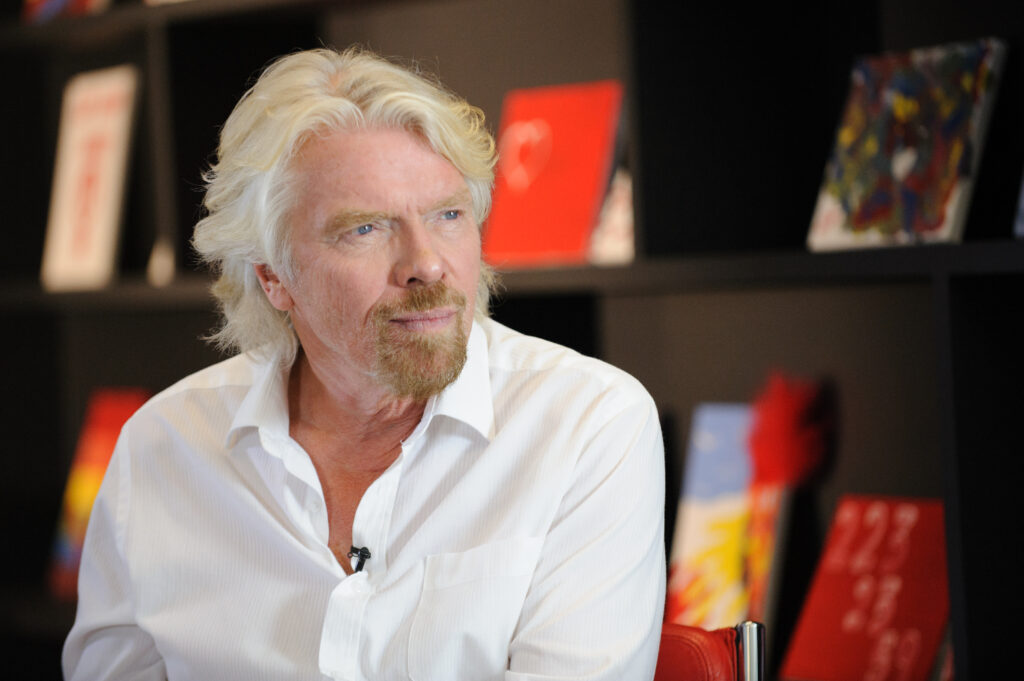
  • Sir Richard Branson Exclusive: “If you get knocked down, get back up. Over and over again.”

    Sir Richard Branson Exclusive: “If you get knocked down, get back up. Over and over again.”

    Christopher Jackson interviews the legendary Virgin founder as he navigates the choppy waters of the pandemic

    Fame will sometimes have a blurring effect. Public presence sustained over a long period of time can create a confusing image. During a long and varied career, so much is attempted and commented on, it is as if longstanding celebrity contains geological layers. To get to the truth of what made someone famous in the first place is a form of excavation. 

    At 70, Sir Richard Branson has reached this level of fame. We think we know him, but he has come to mean different things to different people. The range of his businesses interests makes his precise contribution to the world difficult to pin down: from trains, music, journalism, space travel, healthcare and – what has given him many headaches during the pandemic – aviation, there is little he hasn’t attempted. 

    Indeed the three words ‘Sir Richard Branson’ are themselves a sort of paradox, the first word suggestive of establishment accommodation, and the latter two synonymous with daredevilry, rebellion and harmless fun. 

    Branson was born in Blackheath, London to soldier and barrister James Branson, and Eve, an entrepreneur. Eve sadly died of Covid-19 in January 2021, aged 96. When we caught up with Branson shortly afterwards, he was happy to engage extensively, and submitted to our questions always in good humour, making sure we had what we wanted.

    Virgin Mother

    When I offer my condolences, he replies that it’s his mother’s spirit he prefers to recall: “I don’t believe in mourning, I believe in celebrating incredible lives – and my mum really did lead quite a remarkable life,” he explains. “She had such a zest for life – and even at 96-years-old, she had the same energy and wit she had when I was a boy. When I was growing up she was always working on a project; she was inventive, fearless, relentless – an entrepreneur before the word existed.”

    Eve’s example gave the young Branson an ingredient the entrepreneur cannot do without: gumption. Educated at Scaitcliffe School in Egham, and then at Stowe in Buckinghamshire, Branson would give the UK educational system short shrift, famously leaving school at 16. Partly due to his dyslexia, and partly because of inherent restlessness, one gets the sense that he never felt comfortable in educational institutions. With a can-do spirit the world would later come to associate with his companies, he simply set about creating structures better suited to his gifts. 

    The values that my mum and dad instilled in my siblings and I are lessons that have lasted a lifetime

    SIR RICHARD BRANSON ON HIS PARENTS

    Parental support empowered him in that decision: “The values that my mum and dad instilled in my siblings and I are lessons that have lasted a lifetime,” he recalls. “They taught us the importance of hard work, of not taking yourself too seriously, of treating people how you wish to be treated, of entrepreneurship, and so much more. They showed us how family is the most important thing in the world and surrounded us with love and encouragement.”

    Of course, it was never plain-sailing. Not long before James’s death, Branson mèreand pèregave an interesting interview to the Wall Street Journal where Eve in particular eschews diplomatic language: “Let’s say he [Richard] was unusual at school. We didn’t know whether he was 99 per cent stupid and one per cent rather exceptional. We hung onto that one per cent.”

    Eve Branson in 2013. Sir Richard tells us: “I was inspired by how my mum used her entrepreneurial energy to help others.” Photo credit: Foreign and Commonwealth office

    This is the sort of joke only an affectionate mother would make and there’s no doubting Branson as he recalls: “I was inspired by how my mum used her entrepreneurial energy to help others. I spend a lot of time now working with the Virgin Group’s foundation Virgin Unite to challenge the unacceptable and to try and find entrepreneurial solutions to some of the world’s biggest problems. My mum is always an inspiration, spurring me on and encouraging me to think bigger.”

    School’s Out

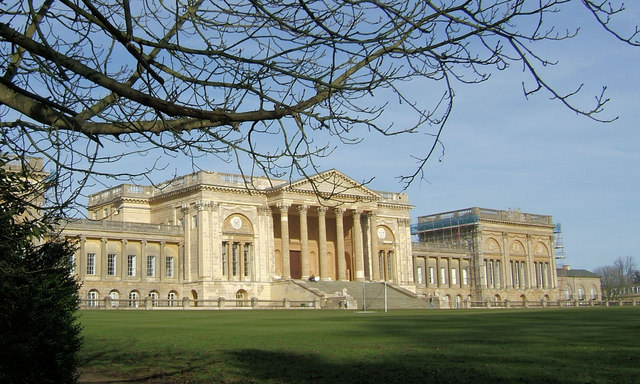
    At first, thinking big meant leaving school. Many who have been to Stowe school, with its spreading Capability Brown gardens, will feel they could happily walk there forever. It is telling that Branson was immediately restless: even at this distance, knowing what he went on to achieve, you can sense his itchiness to get on. 

    I’m only where I am today because I’ve failed along the way.

    Sir Richard Branson

    In 1967, Branson founded Student magazine – a magazine not dissimilar in intention and readership to the one you are reading. It still seems an odd choice of first venture for someone with professed dyslexia. At the time, he thought it would be the making of him. In reality, it turned out to be something as important: his first mistake. “I’m only where I am today because I’ve failed along the way,” he tells me. “That’s a failure which always stands out to me, failing to convince a major publishing house to invest in Studentmagazine. Even as a teenager, I had a huge vision for a whole host of new Student enterprises, from magazines to travel companies to banks. Unsurprisingly, they ran a mile.” 

    Stowe School which Branson famously left at 16. Photo credit: Kevin Gordon under Commons licence 2.0

    Was that beneficial to him in the long run? “I didn’t know it back then, but this was the seed of an idea that grew into becoming the Virgin brand. I carried on building businesses I loved and believed in. Fast-forward half a century and Virgin spans even more sectors than I dreamed of as a teenager.”

    You get the sense that these failures give him perspective now during the difficulties of the pandemic. When Branson founded the Virgin record store in Oxford Street in the early 1970s, there was a dicey episode when Branson’s parents had to re-mortgage the family home after Branson ran into difficulty with the tax authorities, having been caught selling discount records for export only. Eve would later tell the Wall Street Journal in her brisk way: “That was pretty horrifying.”

    Over time Virgin Records – whose value had been increased by the signing of numerous artists, including Mike Oldfield and his Tubular Bells album – would go global and eventually sell for around £560 million. Even then, Branson wasn’t completely out of the woods. Libel litigation lay ahead between the newly founded Virgin Atlantic and British Airways. Branson won a record payment of $945,000 in damages, famously sharing the award with the employees.

    Good Company

    As significant as his financial success, Branson had created a style of doing business which caught the public imagination. In time, column inches accrued in a way not wholly dissimilar from the way in which on the other side of the Atlantic they accrued for Donald Trump. Different in numerous other respects, both were perfect magazine fodder for the excesses of the 1980s.

    While it’s been the most challenging year for all businesses, what has kept me going is the spirit and resilience from our people across the Virgin Group

    Sir Richard Branson

    However allegedly shy, Branson was a natural front man for his businesses. Keen to find out more about his business ethos, I ask him how he keeps his staff happy and motivated. “I’ve always said, take care of your employees and they’ll take care of your business,” Branson replies.

    And that’s a principle still true in the age of Covid-19? “While it’s been the most challenging year for all businesses, what has kept me going is the spirit and resilience from our people across the Virgin Group. Our people really are the thing that makes our brand different and special, we are lucky to have a brilliant group of people who believe in what they’re trying to do, which is to change business for good.”

    Photo credit: Owen Billcliffe

    Of course, most businesses will parrot that line. With Branson you sense his sincerity – partly because he was among the first to talk like this. “Over the years we have always tried to give our people the freedom to be themselves and to treat them like adults,” Branson elaborates. What does this mean in day-to-day? “One example is our unlimited holiday policy at Virgin Management. We introduced this a few years ago and the response has been very positive. The assumption behind it is that people will only take leave when they feel comfortable that they and their team are up to date on every project and that their absence won’t damage the business.”

    What does he think of keeping regular office hours? “We should focus on what people get done, not on how many hours or days they work. We don’t need a vacation policy,” he says. 

    The reality of Virgin is pretty close to what you’re seeing or reading. It’s a progressive company that is looking to change the way people work so it becomes more human and less corporate – and at the same time trying to do corporate things.

    Oliver Osgood, CEO of Masterplant, and formerly CEO of Virgin Pure

    I’m keen to find out if this is corroborated by people who have worked for Branson. Oliver Osgood, formerly CEO of Virgin Pure, and now the CEO of Masterplant, a fast-growing portfolio of cannabis brands and assets, tells me: “The reality of Virgin is pretty close to what you’re seeing or reading. It’s a progressive company that is looking to change the way people work so it becomes more human and less corporate – and at the same time trying to do corporate things. There are companies where the outside is a reflection of the inside and I’d say that’s a fair comment here.”

    Osgood is one of many who feel a loyalty towards Branson, having seen his operation from the inside. 

    With that in mind, I ask Branson about the new trend for flexible working. In fact, Branson was running Virgin like a pandemic-conscious company before anyone had heard of Wuhan or the South African variant: “We’ve offered flexible working at Virgin Management for many years, long before the pandemic,” he explains. “I’ve never worked in an office, or ‘nine to five’ for that matter. Obviously, this doesn’t work for every single role across our businesses, for example a pilot, but we try and encourage it where it’s possible.”

    Poolside Tales

    With Branson, I keep finding myself reminded of the Noel Coward dictum: ‘The thing about work is, it’s so much more fun than fun.” Branson is sufficiently retiring not to be too garrulous about his lifestyle; on the other hand he’s gregarious enough to own a private island and invite celebrities to it. 

    Never go round a swimming pool when Richard’s there, you’ll end up in the pool whether you’ve got clothes on or not

    Travel consultant, Fred Finn

    If you want to know the real stories about Necker, the private island he has owned since 1978, you have to talk to those around him. 

    In person, Branson is light-hearted, even goofy. Fred Finn, travel consultant and old friend of Branson, warns me: “Never go round a swimming pool when Richard’s there, you’ll end up in the pool whether you’ve got your clothes on or not.”

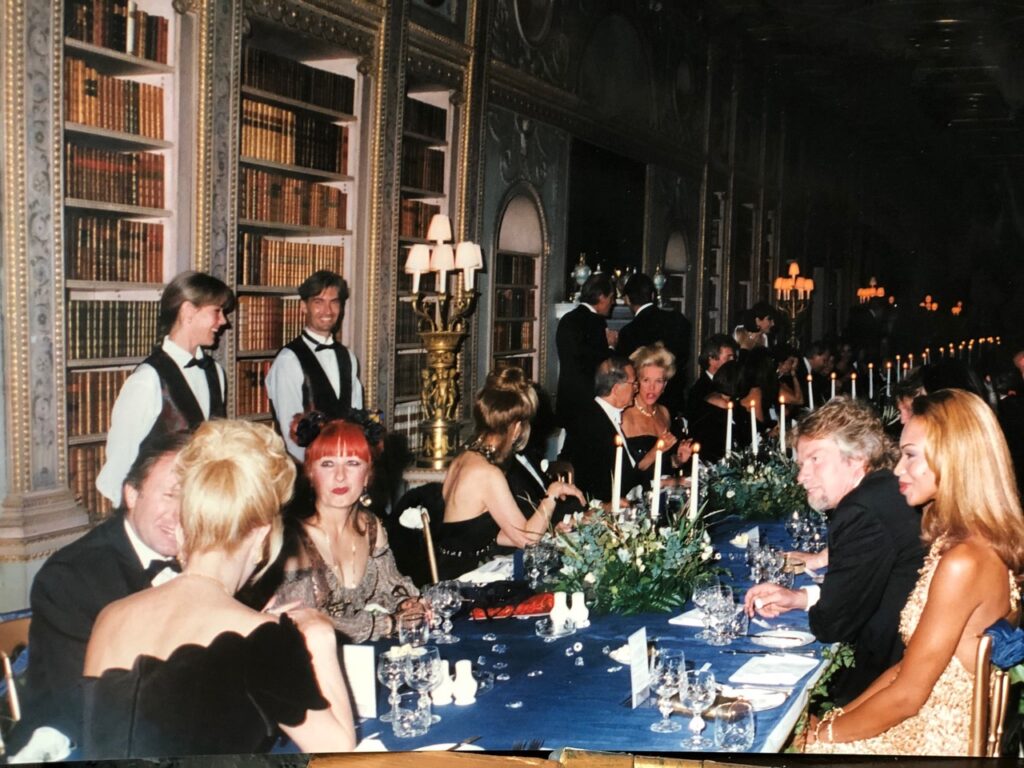
    If you were imagining there’s a hierarchy as to who ends up in the pool and who doesn’t, you’d be mistaken. Liz Brewer, the noted impresario, recalls:“I had to heal a rift between Ivana Trump and Richard after he cheekily performed his ‘party trick’ at the Business Traveller of the Year Awards at the Hilton Park Lane, turning her upside-down.” This appears not to have gone down well with Trump wife no.1. To fix the matter, Brewer resorted to shuttle diplomacy conducted through cunning table placement: “I placed him at Ivana’s end of the 120-guest table at the engagement party I arranged at Syon Park before her marriage to her then future husband Riccardo Mazzuchelli. All was healed from then on and Ivana returned to flying Upper Class Virgin.”

    Branson has an impish streak. Here reconciled with Ivana Trump after throwing her in the pool. Photo credit: Liz Brewer

    I cannot help asking whether the 45thPresident of the United States was there at any of those occasions? “I seem to recollect that Richard had lunch with the Donald once, having been invited by him to his home, when one of Trump’s ventures had gone under,” Brewer replies, adding: “These two in personality were poles apart, both in motive and manner.”

    It is difficult even so, not to conjure an image of Trump rotating through the air, an orange whirl of confusion turning into resentment, as a sniggering Branson scutters away. More seriously, it is worth noting that while Trump has his name on many things – sometimes, it seems, on everything– Branson’s publicity is undertaken for Virgin as a brand. 

    Presidents and Lions

    Presidential friendships turn out to be a leitmotif of Branson’s life. In particular, he became friends with former South African President Nelson Mandela. 

    Branson tells me: “Nelson Mandela remains one of my biggest heroes and a global symbol of liberation, hope and equality.” What memories does he have of the great statesman? “I have many lovely memories of spending time together. From working on human rights issues together to forming The Elders [a group of global leaders working independently for peace], his humour and humility always stood out to me. He redefined what it means to be a great leader and taught us all how powerful forgiveness can be.”

    Branson with his great friend Nelson Mandela. “His humour and humility always stood out to me.”

    Another figure he got to know well is the 44thPresident of the United States Barack Obama: “I have had the privilege of spending some time with Barack, too,” Branson tells me. “It was a huge honour to be able to invite him and Michelle down to the British Virgin Islands for a break after Barack finished his second term as President and the family left the White House.” So what’s he like? “Barack has an insatiable curiosity for information and is always keen to learn. He also approaches every situation with a natural optimism, humour and warmth. All of these things makes him a great listener and a great leader.”

    President Donald J. Trump shakes hands with the 44th President of the United States, Barack H. Obama during the 58th Presidential Inauguration at the U.S. Capitol Building, Washington, D.C., Jan. 20, 2017. Shortly after this photo was taken Obama would head to Necker Island to be with Branson (DoD photo by U.S. Marine Corps Lance Cpl. Cristian L. Ricardo)

    In addition to this sociable side, there is also Branson’s much chronicled fearless streak. Fred Finn recalls: “I took him on safari with his kids for two weeks at Ol Pegeta ranch, then owned by Tiny Rowland. There were 18 lions in a three-acre chicken-wire cage. We turned up just as they were about to throw meat towards this rugby lineout of lions. Richard crouched near the fence and took a photograph of one lion. Then another jumped at Richard through the fence, and Richard reeled back, ending on top of the Land Rover. Instead of being frightened, he said, “Put my son on my shoulders, let’s do that again.” 

    So fearless then? Finn replies: “Either that or publicity! After that he asked Tiny Rowland to buy the place and Tiny said: ‘When you’re good enough in business you can talk to me’.”

    Rowland died in 1998, but if he were alive today would he think Branson ‘good enough in business’? The figures don’t look too bad. Branson’s net worth is estimated by Forbes at $6.5 billion. Inevitably for someone of his stature he has had his detractors. In 2019, he attracted criticism for suing the government over Chris Grayling’s decision to disqualify Virgin Trains from tendering for the West Coast route. At issue was the question of whether Branson would take on a significant share of liability for paying out pensions to some 346,000 staff while running the services. The High Court took the government’s side. 

    Turbulent Skies

    When I approached Grayling for a comment, he kindly declined, but added that he is spending his time on the back benches working with the aviation sector to keep it alive during the tribulations of the pandemic. One would assume that Grayling backs the £1.2 billion rescue deal Branson secured on behalf of Virgin Atlantic with the government in June 2020.

    Resilience comes from failing and learning from those failures – and learning to still move forward. We all fail. Making mistakes is part of being human.

    Sir Richard Branson

    That, too, was a difficult time PR-wise. As part of the negotiations, Branson offered to put Necker Island forward as security. At a time when many were struggling with lockdown in small flats, it was irritating for some to be reminded that he had a private island at all. 

    The resulting deal is a reminder too that the Virgin empire is by no means owned entirely by Branson. 49 per cent of Virgin Atlantic is owned by Delta; Forbes recently reported that Virgin owes the minority shareholder £200 million. 

    But the fact remains that Branson has done what entrepreneurs do: survived. How has he managed during such a difficult time? “Resilience is a lesson we can all learn every day,” Branson tells me. “Resilience comes from failing and learning from those failures – and learning to still move forward. We all fail. Making mistakes is part of being human. If you can pair your failures with an openness to learn, curiosity and a sense of humour, you’re on your way to discovering resilience.”

    This feels like earned wisdom and it’s something he’s keen to pass on. What would he say to the younger generation of entrepreneurs? “I always encourage them to try and find opportunities in challenges and if you get knocked down, to get back up. Over and over again.” There is quite a lot packed into that ‘over and over again’. Branson, I’m reminded, is very seasoned now; his youthful approach almost makes you forget that he has reached his three score and ten. 

    He continues: “It’s also important to learn to rest when you need to, rather than quit. In the face of great challenges, sometimes you just need some downtime to reassess and look at the problem from a different angle. I often have my best thinking time when I’m doing some exercise that I enjoy, like kitesurfing or cycling. Resilience isn’t a constant show of strength, it’s lots of little steps in the right direction that all eventually add up.”

    Social Network

    Branson is also enlightening on the question of social media. “It’s changed everything,” he says. “When I first started out in business, things were a lot different – I used to reply to letters and if it was urgent, I’d be on the phone. I enjoy checking on my social media feeds and find it really interesting to see everyone’s views on what’s going on in the world. I often blog and post about the issues I care about, from celebrating achievements in the Virgin family to trying to end the death penalty or working to encourage drug policy reform.” 

    Resilience isn’t a constant show of strength, it’s lots of little steps in the right direction that all eventually add up.

    Sir richard branson

    Is there anyone whose social media use he particularly admires? “One of the biggest benefits of social media is brands now have a direct link to their customers and communities. Look at brands like Gymshark; the founder, Ben Francis, has used social media to build the brand from the very beginning. They have a truly digital-first approach, and were ahead of the curve.” Does he feel kinship with Francis? “Ben started the business in 2012, and thanks in part to its rapid growth on social media, it’s recently been valued at £1 billion. Ben started the business when he was 19 from his parents’ garage in Birmingham, while juggling studying at university in Birmingham, and evening shifts delivering pizzas.” That certainly reminds me of a young Branson. 

    Virgin Limited Edition, Richard Branson, The Great House, Necker Island, 2018

    Branson gives no signs of slowing down. How does he see technology fitting into Virgin’s path forward? “We’ve always used technology to elevate the experience for our customers wherever we can. From Virgin Atlantic being the first to offer seatback entertainment in all classes back in the early 90s, to Virgin Money recently launching a digital bank in Australia, or personalising your stay at a Virgin Hotel through its Lucy app, to earning and spending rewards across the Virgin Group with our loyalty programme Virgin Red. The opportunities are endless.”

    In the Penalty Box

    Of late Branson has become particularly interested in the death penalty. “It’s inhumane and barbaric, fails to deter or reduce crime and is disproportionately used against minorities and other vulnerable and marginalised groups,” he explains. When did he become interested in the issue?” “It was after hearing powerful personal stories of miscarriage of justice, such as Anthony Ray Hinton, who spent 28 years on Alabama’s death row for crimes he couldn’t have committed. Unfortunately, there are many harrowing stories similar to his.”

    Branson believes that business doesn’t do enough to rally round on these key issues. What sets his latest endeavour apart is precisely this sense of the powerful joining forces on behalf of the public good. “I’m proud to have joined a global group of executives, supported by the Responsible Business Initiative for Justice, in launching the Business Leaders’ Declaration Against the Death Penalty. Together, we are highlighting the case for abolition and calling on governments to end the practice. If you are a business leader reading this – I would urge you to join our movement.” 

    So what is Branson’s legacy likely to be? Osgood is particularly insightful on what the group has achieved: “Virgin Galactic is the first time he’s tried to start a new industry. Usually the group targets overweight, inefficient industries.” Osgood starts to list them: “Doing trains better, doing phones better, doing broadband better, doing flights, doing banking better, creating Virgin Money lounges, rather than those horrible branches with people behind glass.” Then he hits on it: “Creating an environment where the customer feels happy. It’s the stewardess who makes you sure you have a comfortable flight and doesn’t bug you about your baggage allowance.”

    That seems an impressive contribution in its own right, and you can feel Osgood’s enthusiasm – one of many aspiring CEOs who has learned much from Branson’s approach. 

    Meanwhile, Liz Brewer recalls a magnetic friend: “Richard is a truly refreshing ‘ideas man’, entrepreneur, humanitarian and someone who always impressed me with his positive attitude and the ability to stay firmly focused.”

    So having dug beneath the geological layers of his fame, what is Branson really like? Uniqueness is never far from a discussion of him. 

    To interview a billionaire can be a mixed experience. I recall the unhappy obsequious acolytes around a certain aviation entrepreneur I once spent several days with, but all of Branson’s people seem happy. I recall the shifty banality of a media mogul of my acquaintance, but the Virgin Group feels transparent, and fundamentally benevolent. Above all, there is sometimes the sense that wealthy individuals aren’t enjoying life in some fundamental way; the opposite must be said about Branson. The only way for a rich man to be saved from the corruption of wealth is for money to be tethered to purpose. Branson’s life isn’t in the end primarily a story about the acquisition of money: it is about doing good, attempting the difficult or even the impossible, and doing it in the sunshine. It is this which makes him a hero to many. 

    Osgood recalls: “When he’s in the room, everyone’s excited. He claims to be a shy guy but I don’t believe that for a minute. He does get nervous. It’s more the aura, and the way he conducts himself. Lots of people see him cynically. He takes risks, and his intentions are good. But the businesses have a purpose: they’re good for people, and good for planet.” 

    Good for people, good for planet. That’s not a bad epitaph – and it’s certainly one he’s earned. 

  • The Power of Music: Building mentally stimulating and thriving workspaces through sound

    Alexandra Livesey, COO of Clockwise, leading flexible workspace provider across the UK, talks about their experience in using music to create productive spaces across their spaces.

    “Post-COVID hybrid working policies are now standard across most industries, and we have seen a steep rise in the need for flexible workspaces. At Clockwise, we give businesses and individuals the opportunity to come together on a flexible basis, in line with this new working model. For the days that the team do come together in an office environment, it’s important to have the right spaces to do so. We pride ourselves on creating environments that inspire and generate a sense of community, drawing together people from different industries and market sectors, while also providing spaces without distraction. We consider all senses across key member touch-points; the look and feel, the scent, the temperature and of course the music; which all impact how people experience the space. We then optimise these to support productivity.

    We have recently been focusing on the sounds of our work spaces in particular, for which we have partnered with music specialists Music Concierge, who use science to help with their curation process. They have created bespoke playlists for our buildings that drive productivity, motivate and inspire our members throughout the day.

    We have considered many elements including the changing mood of music across our spaces at different times of the day and different days of the week. We want to not only support our members in their working life, but in their social life too, and create spaces where they can connect and create with fellow Clockwise members, something that is hugely important to us as a host to many entrepreneurs and start-ups. For example, on a Monday morning it’s all about getting your head down and into gear as opposed to a Thursday or Friday afternoon, where music can aid us by stimulating social connection.

    We have also ensured that the mental wellbeing of our members has been considered and prioritised in our work with Music Concierge, and we have investigated ways that we can enhance the mental health of our members throughout the workday through music.

    It’s fantastic to be working with Music Concierge and manipulating music in a way that creates another medium through which we can look after our members and improve their lives.”

    Rob Wood, Creative Director and Founder of Music Concierge, dives deeper into the science behind office music choices.

    “We have been working closely with Clockwise to bring their flexible workspaces to life in a way that focuses, excites, motivates, connects and calms members depending on the time of day. Clockwise offices are multi-dimensional spaces that hold a buzz of activity in so many different forms, and we use music to support this. A working day often promises meetings, solo work, reading, talking on the phone, socialising and so much more.  Spaces, times, days, specific moments and moods all come into play as we curate and streamline one of life’s greatest pleasures, to create an uplifting working environment.

    One of the first things we did when we started working with Clockwise, was to look at their different layouts and zones and how music would mirror their uses in sound format. For example, quiet workspaces require linear music that doesn’t change in pace or tempo too much, doesn’t have hugely prominent vocals, and doesn’t have too many different verses and choruses. This keeps the brain from becoming distracted, and actually stimulates our ability to focus and hone in on a task.

    In contrast, their reception area required welcoming but calming music that makes its members feel at ease as soon as they walk in door, and likely ahead of stepping into a meeting space. Whereas within a meeting room, music must be linear but can be slightly more enthused to forge a creative, collaborative environment amongst colleagues.

    Our work hasn’t just been confined to space but also the time of day is a hugely important factor to consider when curating music for a workspace like Clockwise. From the morning coffee to the afternoon cuppa or occasional glass of wine, our workdays alter in mood and activity, and we work on creating a space where music not only reflects this but supports the flow.

    As Clockwise members stroll in to embark on their day, we fill the communal spaces with invigorating music that brightens and awakens the mind, getting us ready to take on the day. As the day goes on, we fade into productivity stimulating tracks and calming tunes. When five o’clock comes around, and we begin to wind down after a hard day’s work, we start to feed in a more vibrant vibe, allowing members to decompress and let go of stress as they move into their relaxing evenings. For those connecting on a social level in the early evening, we pump connecting upbeat music through the Clockwise social spaces.

    We all know that Fridays are a whole different ball game to Mondays, and we must reflect that in the sounds we channel into the office space. We want to promote that end of the week feeling ahead of the weekend when Thursday or Friday afternoon come around.

    Music brings people together, creating a sense of community and promoting solidarity, friendship and trust. There is nowhere more important to nurture these values than the working environment, as teams work to foster a group dynamic. We ensure to choose music that motivates and connects while dropping in familiar favourites to bring people together.

    Social interaction is hugely important in a job, but it is just as important a creating an environment that stimulates and calms in equal capacities and makes for a mentally and emotionally fulfilling workday. One strategy we implement to promote this is by providing pockets of stimulation throughout the day, by creating meaningful moments. We disperse widely unknown songs throughout playlists, allowing members to discover something new that they enjoy and can revisit. It breaks up heads down work and allows a moment to decompress and step back into the moment.

    Self-care and mental wellness are instrumental to what we aim to do at Music Concierge, as we orchestrate music to work for our clients and their clients alike. This has become a large part of our work with Clockwise with it being a key value of theirs also. Motivating mindsets are a huge part of what we strive to create through our work. We also want to help people to understand ways in which they can tap into inspiring themselves through music. The next time you’re knuckling down for a hard day’s work (whether it be in the office or at home) and need that extra push, our recommendation is to queue some contemporary classical, instrumental electronica and relaxed jazz styles of music for ultimate productivity.

    Clockwise are implementing motivating music across their workspaces up and down the country and they are blazing the trail in the workplace industry, setting the standard for how offices should be run. We hope to see more businesses in the industry follow their practises to promote individual and team wellbeing.”

    Founded in 2017, Clockwise provides contemporary private offices, shared workspace and meeting rooms with flexible membership plans in key business locations across the UK and Europe. They have 13 sites across the UK and recently launched their newest site in Bromley, which is their first mixed-use site alongside a restaurant and hotel offering. Their most recent site in Europe also opened in Brussels which aids their expansion plans as they hope to grow to over half a million square feet of office space in total by next year.

    For more information, please visit https://work-clockwise.com/.

    For more information about Music Concierge please visit www.musicconcierge.co.uk.

  • Bob Dylan at 80: what the great songwriter tells us about making our way in the world

    Bob Dylan at 80: what the great songwriter tells us about making our way in the world

    A look back at Bob Dylan’s 80th birthday in 2021, when Robert Golding looked at the career of the Nobel laureate and asked what his life can teach us about making our way in the world 

    ‘Twenty years of schoolin’ and they put you on the day shift.’ So sang Bob Dylan with typical humour and exasperation in his 1965 classic ‘Subterranean Homesick Blues’. It is a line that may resonate with many young people beginning their working life in the Covid-19 era. 

    Since arriving on the scene in Greenwich Village in 1962, the Nobel Laureate, who turns 80 today, has attracted continual reassessment. The brilliant opaque words, combined with a sense that in Dylan words matter to an unusual degree, have caused an immense critical literature to grow up. It’s difficult to think of a living figure more discussed. 

    Commentary has tended to focus on Dylan’s extraordinariness, and one can see why: he has achieved remarkable things, all while retaining his aloofness. When I asked singer-songwriter Emma Swift, who recently recorded an album of Dylan covers Blonde on the Tracks (2020), whether Dylan had been in touch about her album, she said: ‘I’m often asked that. But Dylan is to me a mythical figure. I’d be just as surprised if Samuel Taylor Coleridge called.’ 

    Too often then, Dylan is treated as prophet and sage, and not as someone who hustled his way through the world – as we might do too. Our admiration for him might preclude us from seeing what he can teach. 

    “Dylan to me is a mythical figure. I’d be just as surprised if Samuel Taylor Coleridge called.”

    Emma Swift

    Get born, keep warm 

    It helps to remind ourselves that Dylan’s upbringing was distinctly unpromising – so much so that, even at the time, it seems to have struck him as a cruel joke. Raised in Hibbing, Minnesota – a dead-end mining town – he told Martin Scorsese in the film No Direction Home (2005): ‘I felt like I was born to the wrong parents or something.’ We ought not to draw the conclusion from this that it is wise to be contemptuous of one’s elders; one might instead say that we should have the gumption to imagine our way into the life we want – and be brave enough to take steps to secure it. 

    The Zimmerman family home in Hibbing, Minnesota. Photo credit: Jonathunder

    It remains difficult to imagine Dylan in Hibbing. His life is a powerful example of a refusal to be defined by where you’re born: our knowledge of his subsequent success makes it vexing to imagine him ever having been there at all. Hibbing consisted of the typical Main Street, dreary parades, small businesses and shops, all bound up in strict mores: a life Dylan must have found predominantly redundant. But thanks to the invention of the gramophone, another world was able to seep through to the young Dylan. This was the astonishing revelation of rock and roll.  

    Like so many who go onto achieve great things, one can sense the constraints that early life placed on him – and also that those constraints were lifted rather arbitrarily. Rerun the movie with slightly different conditions and you’d have another narrative.  

    Specifically, Dylan’s life would have been different had he never encountered Little Richard. ‘His was the original spirit that moved me to do everything I would do,’ he would write on May 9th 2020 at the singer’s death. Though Dylan is a hero to many, he is also a man adept at having heroes. He admires people – but only as a way of discovering a way to become himself.  

    Dylan’s childhood hero Little Richard. “I am so grieved,” Dylan wrote upon the singer’s death on 9th May 2020.

    Dylan’s first known performance was in 1958 at the Hibbing High School’s Jacket Jamboree Talent Festival. In Volume 1 of Bob Dylan: Performing Artist Paul Williams, Dylan’s finest biographer, explains how in this performance ‘Dylan followed the rock and roll music to a logical conclusion that was in fact quite alien to the music of the day: play as loud as possible. Not just wild. Not just raucous. Not even just loud, but AS LOUD AS POSSIBLE, preferably in a context that will allow for maximum outrage.’ 

    It is an image of the natural iconoclast. At this young age, Dylan was allied to a true energy; he had made a decision that couldn’t be reversed to devote his life to music, and was already seeking to stand out within his chosen sphere. Soon he would graduate from being the loudest musician to other superlatives: most thoughtful, most literary, most enigmatic, most laurelled.  

    In the process, he was clearing more obstacles than we perhaps realise, now that we inhabit a world where they were so convincingly traversed. One fact is not the less important for being so widely cited: Bob Dylan wasn’t born Bob Dylan but Robert Zimmerman. Interestingly, a letter recently surfaced where Dylan explains that his decision to change his name was based on fears of anti-Semitism. ‘A lot of people are under the impression that Jews are just money lenders and merchants. A lot of people think that all Jews are like that. Well, they used to be cause that’s all that was open to them. That’s all they were allowed to do.’ 

    “Dylan followed the rock and roll music to a logical conclusion that was in fact quite alien to the music of the day: play as loud as possible.”

    Paul Williams

    Some, including Joni Mitchell with whom Dylan has had (at least from Mitchell’s side) a somewhat abrasive and competitive relationship, have held up the decision to change his name as a mark of inauthenticity. But the decision might equally remind us of the importance of flexibility and finding a way around obstacles.  

    Try to be a success 

    Dylan’s early years exhibit a fearlessness which we might do well to emulate. As a young man, having briefly enrolled in Minnesota University in 1960, he again exhibited that same restlessness which would manifest itself eventually in his celebrated Never Ending Tour.  

    By this time, he had decided that rock and roll wasn’t enough, and that folk music offered a richer philosophical experience. It was the first of many twists and pivots and reinventions. 

    In time, he would merge the folk and rock genres – going electric in 1965 to what now looks like a rather quaint indignation from the folk establishment.  

    For now, seized with the urgency of the eternally confident, Dylan took a train to New York, intent on meeting his hero the folk singer Woody Guthrie. Guthrie was already suffering from Huntingdon’s Disease, which would eventually kill him in 1967. No matter, Dylan sought him out at his sick-bed in a New Jersey hospital and played him his homage ‘Song to Woody’ one of only two original compositions on what would become his debut album Bob Dylan (1962). A torch had been passed.  

    Woody Guthrie. Dylan sought his hero at his sick bed in New Jersey. Image credit: United States Library of Congress

    It was a deft negotiation of what has been called ‘the anxiety of influence’. Young people will often underestimate the availability and flesh-and-bloodness of those at the top: fear stymies them from exposure to examples of success. By being in close proximity to our heroes – even if the encounter doesn’t go well, and we betray our nerves – we may usefully humanise them and open up the possibility of the heroic in ourselves. 

    This trait of Dylan’s finds its corollary in a story told by former President Barack Obama in his memoir A Promised Land (2020). When Dylan played at the White House during the Obama administration, at the end of the performance Dylan simply shook the then president’s hand and left, saying nothing. ‘Even the president of the United States sometimes must have to stand naked,’ as he put it in ‘It’s Alright, Ma (I’m Only Bleeding)’. One suspects that Bob Dylan has never been afraid of anyone. 

    Bob Dylan shakes President Barack Obama’s hand following his performance at the “In Performance At The White House: A Celebration Of Music From The Civil Rights Movement” concert in the East Room of the White House, Feb. 9, 2010. (Official White House Photo by Pete Souza).

    The Guthrie story is a reminder that we tend to get to where we need to be by being out in the world and meeting people; we never achieve in a vacuum but by the dint and say-so of others. Music journalist Tom Moon tells me that today ‘the Bob sphere is weird even in “normal” times’ but at the outset of Dylan’s career, when it mattered, the young singer made all the right moves, charming the crowds in Greenwich Village, signing with Columbia Records, and submitting to the aegis of manager Albert Grossman.  

    “The Bob sphere is weird even in ‘normal’ times”

    Rock critic, Tom Moon

    In time he would assemble a band whom he could trust and who were inspired to get better over time. His 1975 tour the Rolling Thunder Revue was, among many things, a celebration of friendship. And it’s thanks to his capacity as a bandleader we now have that highly underrated achievement the Never Ending Tour, which began on June 7th 1988 and ended – or paused – with the advent of the Covid-19 pandemic in the early part of 2020.  

    In reference to his longevity, Emma Swift says: ‘There’s a counter-narrative in our culture that says that music is for young people – that if you haven’t made it as a musician by 13 you should just stop. Dylan’s career runs counter to that and though he was working very much as a young man, he’s continued that throughout his entire life. He makes a very persuasive argument that the time for art is always now.’ 

    From the vantage-point of today, Dylan’s career might seem to be to do with longevity – but longevity must be teed up when young, and it helps to have made the right decisions from a young age.  

    Emma Swift has recently recorded an album of Dylan covers. “[Dylan] makes a very persuasive argument that the time for art is always now’. Photo: Michael Coghlan

    Dylan has never grown bored; his energy remains astonishing. Richard Thomas concurs that Dylan’s career showcases ‘resilience, energy, adaptability, mystique, humour’ – qualities that would not have been sustainable had his original decision in Hibbing to pursue music not been the right one. ‘I’ll know my song well before I start singing,’ as Dylan sings in ‘A Hard Rain’s a-Gonna Fall’ – yes, and to know that singing is what we should be doing in the first place.  

    In a March 2020 interview, Gina Gershon confirmed Dylan’s boyish love for what he does: “He read me some lyrics he was writing and he was all excited…,” she recalled. “I was thinking, ‘Oh my God, this is so cool.’ You could see why he still loves doing what he does and why he’s excited…”

    “He only ever repeats himself valuably, somehow anew, which is not true of the rest of us”

    Christopher Ricks, author of Dylan’s Visions of Sin

    When I speak to the great Dylan critic, author of Visions of Sin (2004), and former Professor of Poetry at Oxford University Christopher Ricks, he agrees with Swift: ‘He only ever repeats himself valuably, somehow anew, which is not true of the rest of us.’ This remains true in his touring, where Dylan – famously, and sometimes to fans’ perplexity – will never perform a song in the same way twice. 

    His Back Pages 

    Throughout this life of performance, of course, Dylan has been compiling the greatest songbook of any American songwriter in the post-war period. It is a vast corpus, where wisdom sits alongside glorious nonsense – and where solemnity and comedy, yearning and rage, all equally have their home. 

    It must be said that the idea of plucking contemporary jobs tips from the Dylan oeuvre can seem an exceptionally unpromising avenue of enquiry. Dylan himself has sometimes been self-deprecating about the idea of extracting meaning from his songs. As he wrote in ‘Mr. Tambourine Man’, ‘If you hear vague traces of skipping reels of rhyme/it’s just a ragged clown behind.’ Dylan here appears as something like Charlie Chaplin’s Little Tramp: Don’t pay him any mind.  

    Few have taken him at his word there. More problematically, the songwriter’s reliance on the folk repertoire means that the economy he is describing in his songs tends to predate ours. One might seek in vain in the Dylan canon for direct advice about how to make it in the professions, or hints about how best to make LinkedIn work for you.  

    But this leaning so heavily on a rich hinterland of American song, might amount to another lesson. His work shows a remarkable respect for the past – as well as a willingness to question the present. Dylan’s second studio album was called The Freewheelin’ Bob Dylan (1963). Paul Williams once said that Dylan’s songs essentially teach us that when a man learns to be free only then can he be in with a shot of happiness. 

    Dylan in 1966. Dylan’s oeuvre, according to Paul Williams, teach us that only when a man is free can he begin to be happy. Photo credit: image in the public domain.

    But we can only be free in relation to others. As much as he would distance himself from the label ‘protest singer’ over time, Dylan’s repertoire contains songs of high-minded hatred towards the establishment. ‘Masters of War’, ‘Only a Pawn in Their Game’, ‘Pay in Blood’: these songs warn us off a career bereft of a healthy scepticism about the way things are. Dylan’s songs tell us that to question the status quo is a first step towards our finding a place in it.  

    This freedom is not only something that Dylan exhibits; it is something he bestows on the characters in his songs. Dylan’s is a world of freely moving drifters (‘The Drifter’s Escape’), wronged boxers hurtling unimpeded towards their fates (‘Hurricane’), mafiosi (‘Joey’), and a whole range of po’ boys and girls, who seem almost liberated by their impoverishment. Everything – everyone – is in continual motion: ‘Only one thing I did wrong/stayed in Mississippi a day too long.’ Even William Zantzinger, the murderer in ‘The Lonesome Death of Hattie Carroll’ is defined by his freedom.  

    “His actual experience is tempered by what the folk tradition, always where much of his songs go back to, dealt with’

    Professor Richard F. Thomas

    The Harvard professor and author of Why Dylan Matters Professor Richard F. Thomas explains: ‘‘Workingman’s Blues #2’ is in part about working’ but he agrees the middle class doesn’t feature. ‘His actual experience is tempered by what the folk tradition, always where much of his songs go back to, deals with.’ 

    All I Really Want to Do 

    And yet there are few, if any moments of sloth in Dylan’s life. ‘Lay Down Your Weary Tune’. ‘Watching the River Flow.’ These are songs about pausing, but they are also moments of expression – of activity – for Dylan himself.  

    While Dylan turns a sceptical eye on ‘the masters of war’ who too often prosper in the present, he teaches an intense respect for the wisdom contained in the folkloric tradition.   

    This resonates in other professions. Anyone who has spoken to Sir Martin Sorrell will find him as passionate about advertising as it used to be as much as it is now. Likewise, readers of Andrew Marr’s survey of journalism My Trade (2004), will note that secreted in the BBC man adept in a modern medium, is a historian. Success is to do with a sense of how this moment fits into the preceding and those which will come; this can only be achieved by hard study, and utter commitment.  

    It is apt that while Dylan’s milieu is the past, he has nevertheless managed to prosper within the contemporary moment, and there is no-one alive today whose works seem more assured of a future audience. This fact was especially brought home in late 2020 when Dylan sold his songbook to Universal for a reported figure in the $300 million range.  

    This respect for tradition is a lesson he bequeaths to his musicians. As Professor Thomas explains: ‘The musicians he has worked with are in awe of him as a teacher of the musical traditions he wants them to be up on.’ So would Dylan have made a good teacher? Thomas says: ‘While I can’t see him in a classroom (“the mongrel dogs who teach” (‘My Back Pages’), though that’s some time ago), I believe he cares deeply about what matters to him, and that is the first ingredient of a good teacher.’ 

    Fleetingly, and perhaps jokingly, Dylan once imagined in an interview with AARP an alternate route for himself: ‘If I had to do it all over again, I’d be a schoolteacher.’ In what subject? ‘Roman history or theology.’  

    When I Paint My Masterpiece 

    It might be hard to imagine the Dylan energy contained in a school. In fact, it isn’t even contained within music.  

    In recent years, Dylan-watchers have become increasingly aware of the scope of their man’s achievement in the visual arts. A recent episode of the HBO drama Billions shows hedge fund billionaire Bobby Axelrod with some of Dylan’s work in his home. During the COVID-19 pandemic – according to insiders at London’s Halcyon Gallery – Dylan was not only commissioned to produce a metalwork sculpture for Ronald Reagan Airport, but delivered some 20 works to the gallery. 

    Dylan’s brilliant metal sculptures show another side of Dylan’s creativity

    The appreciation of Dylan as artist and as sculptor is still in its infancy.  

    Emma Swift tells me: ‘Dylan has taught me a lot about the interconnectedness of art forms. I used to think about poetry and music and visual art separately. Now I don’t. All the video clips for my Dylan record are animated, so they’re very much a celebration of the visual to go alongside the music.’ Dylan’s career here again emerges as an exercise in creative freedom – both within his own art form and in an interdisciplinary sense.  

    I head up to central London, for a behind-the-scenes tour of the Halcyon’s Bob Dylan Editions show. In many of the pictures, the influence of Edward Hopper is paramount. This is an America which has to some extent lapsed. We find motels and diners, parking-lots, cinemas and burger-joints. It is an image of everyday America, which isn’t meant to feel contemporary. Like his music, these are artefacts of collective memory; the paintings feel like acts of nostalgic preservation.  

    Most marvellous of all are the metal-sculptures. Upstairs, Georgia Hughes, an art consultant at the Halcyon, shows me a blown-up picture of Dylan in his California studio. Wiry and tough-looking even in old age, he stares eagle-like on his metals, the materials of his art. Hughes explains how Dylan rescues the metals from the scrapyards around California. I quote back at her the lines of ‘When I Paint My Masterpiece’: ‘Well, the streets of Rome are filled with rubble.’ She replies: ‘Dylan’s art has to do with finding what lies near to hand and transforming it.’  

    One I particularly like is a wall-hanging (see opposite), where the pieces of metal, the discarded spanners and wrenches feel somehow like a sea-creature peculiarly adapted to its environment.  

    Dylan’s illustrated lyrics with signature now cost £2,000

    Dylan’s art career shows us that his is a porous existence where all options are on the table. Whenever one thinks of the successful, they always seem free of the doubts which seem to constrict others. If their lives often feel peculiarly uncompartmentalised, then perhaps it is because they proceed in freedom. 

    “He does all kinds of things that are kind of shocking, and I think it opens it up for everybody else”

    Emma Swift

    Money doesn’t talk, it swears 

    Of course, if we wanted direct lessons about our lives from Dylan then his business interests are there for all to see. Put simply, Dylan has not been afraid to monetise himself.  

    Bobdylan.com, in addition to providing information about tour dates and the artist’s songbook, is primarily a shop, hawking everything from key rings and hip flasks, to tote bags and his new Heaven’s Door whiskey. In the past he has let Apple, Chrysler, Cadillac and Pepsi use his songs.  

    Emma Swift gives her reaction: ‘He does all kinds of things that are kind of shocking, and I think it opens it up for everybody else. You know, if Dylan puts his song in an ad…okay, I guess it’s fine.’ Again, there is fearlessness here – he is prepared to risk being labelled a sell-out and happy to let the songs speak for themselves in whatever context they happen to be used. 

    When I ask Thomas what lessons Dylan’s life ultimately has to teach, he replies: ‘Read, listen, read, enquire, don’t be presentist!’ 

    If one were to ask oneself why Dylan’s work is richer than that of his contemporaries then it has something to do with the range of reference brought to bear in a setting where one might not normally expect it. This is the case even when his work is compared to that of literary contemporaries such as Paul Simon and Joni Mitchell, though there will always be some – the late Clive James among them – who would prefer the poetry of Leonard Cohen.  

    And not being ‘presentist’? On the face of it, this might not seem to fit Dylan. Joni Mitchell had this to say about him: ‘Bob is not authentic at all. He’s a plagiarist, and his name and voice are fake. Everything about Bob is a deception.’ 

    Harsh as this is, it is a frustration Paul Simon has also aired: ‘One of my deficiencies is my voice sounds sincere. I’ve tried to sound ironic. I don’t. I can’t. Dylan, everything he sings has two meanings. He’s telling you the truth and making fun of you at the same time. I sound sincere every time.’  

    But one suspects that Dylan would have no audience at all, if there wasn’t truth at the core of his work. It is rather that he has been true to his nature by being opaque. He hasn’t let his desire to tell the truth get in the way of being mysterious – and vice versa. At the Halcyon exhibition there is a wall of magazine covers devoted to Dylan. It doesn’t matter how much we photograph or try to know him; his eyes won’t let us in entirely.  

    As Dylan enters his ninth decade, he is among those rare American artists who seems to have fulfilled their talent. Photo credit: By Alberto Cabello from Vitoria Gasteiz – Bob Dylan, CC BY 2.0, https://commons.wikimedia.org/w/index.php?curid=11811170

    Forever Young 

    As Dylan enters his ninth decade, there is much his career has to teach those who are embarking on their own lives. It’s true that there is dispute in literary circles about the extent of his literary achievement. But Dylan has been plausibly compared to William Shakespeare and to John Keats. We know far more about Dylan’s life than we do about the Elizabethan, and Dylan has lived out his talent far more than Keats, who died at 26. 

    In spite of the singularity of his achievement, Dylan continues to repay study. Besides, the man who wrote ‘Don’t follow leaders./Watch your parking meters’, isn’t so much telling us what to do, as inviting us in. Once we accept his invitation, we find we become richer, wiser. There is a generosity somewhere near the core of his art. Dylan once said: ‘Every song tails off with “Good Luck, – I hope you make it.” 

    He never said where – but he didn’t have to. As often with Dylan, we sort of know what he means, but we have to fill in the gaps ourselves.  

  • Emma Swift: ‘As a musician, you’re essentially a small business’

    Emma Swift: ‘As a musician, you’re essentially a small business’

    These past few years have taken everybody for a spin. In some ways my job’s been easier because I don’t have to try and tour and I’ve mainly done my record Blonde on the Tracks, a collection of Bob Dylan covers, online. I studied English literature at the outset, and then I became a journalist and also worked in a government department. But I quit all that and moved to Nashville, Tennessee to do music. 

    I was always a bookish kid and then grew up into a bookish woman. One of my songs on the new album is a cover of Bob Dylan’s ‘I Contain Multitudes’ – and I think I was responding to the references to Walt Whitman, and to Edgar Allen Poe. I can still recite ‘Annabel Lee’ – so my education gave me the foundation to what I do now. 

    I’m often asked about the direction of the music business. With Blonde on the Tracks I chose not to stream it at the beginning of the release, because we’re in a pandemic year. I play essentially Indie folk, and at my age in the 1960s, I would have been playing the folk clubs – and today for people like me the bulk of our income is made touring. But when touring stopped that has meant mass unemployment in my sector. So I decided to make this an online-only release.

    What I would say to anybody interested in a career in the arts is just to be flexible and be open to change, because the music industry is always revolutionising itself. People will tell you that it’s all streaming now – but it’s not always going to be all streaming forever. It will pivot to something else. The music business does that constantly: 20 years ago the advice would have been that all vinyl is a total waste of time; nowadays vinyls are outselling CDs. The best thing to do as an artist is just to trust your instincts, and realise that you’re essentially a small business. There’s no right or wrong way to run your small business: there’s a multitude of ways that you can operate as a creative person.

    It’s also good to be persistent as a creative person, but also good to be able to take break if you’re feeling burned out by your art – because it can be exhausting. Give yourself permission to take time off. 

    But perhaps the most important thing is just because you do work another job that doesn’t make you any less of an artist. TS Eliot worked in a bank. A lot of people in the music business now have to have other gigs, because that’s the best way to survive and that’s okay.

    Of course, people who are creative are not very good at administration – it can be challenging and deeply boring. I find it very difficult to switch gears and it’s really hard for me to write if I’m also thinking about record distribution and invoices. But it definitely doesn’t hurt to know a little bit about all that – and anyway you’ve got to do it. I’m capable of organisation and chaos – depending on the day of the week.

    The other thing with music is that you have to be so present on social media. You have to really go out there and spend an hour at least. For an artist at my level, had I not been ubiquitous on the internet, the record would have disappeared. The fact that it didn’t is likely due to the fact I spent an enormous amount of time on Twitter.

    I would also advise engaging with other people’s music. If you’re not buying CDs, why would anybody else? I do have some regrets about the latest album. If I did it again I would span a broader cross section of Dylan’s work. I skipped over the 80s and the 90s, but all of these Bob Dylan songs have made me a better songwriter.

    That’s not to say I’ll be doing another album called ‘More Blonde, More Tracks.’ I now realise that what I’ve done is to put myself under an enormous amount of pressure to follow up a Bob Dylan with my own songs. When I look at that now, I think: “Gosh, that’s insane. Why would anybody do that?”

    Emma Swift’s latest album is Blonde on the Tracks

    Image courtesy of Emma Swift

  • The Luthier’s Tale: Inside the Guitar Repair Industry

    The Luthier’s Tale: Inside the Guitar Repair Industry

    Veteran guitar tech John Armitage shares his thoughts about life on tour, professionalism, and getting started in the industry

    The music industry conjures up images of spotlights, adoring fans, and late nights on the tour bus, but behind the scenes there is a world of technicians who keep the show running smoothly.

    John Armitage began repairing guitars in 1978. Since then, the job has taken him all over the world with groups such as Iron Maiden, King Crimson, and the Manic Street Preachers. Now he operates Guitar Hospital, which has workshops in London and Whitstable.

    Armitage got his start in guitar repair at 17 when he saw a problem and took the initiative.

    “I started off as a drum tech for bands, then everyone went to America and didn’t take the drum techs,” Armitage says. “I was playing bass in a band by this point and they said, ‘I’ve got a guitar guy who can’t come’. I said, ‘I can do that’.”

    Armitage also recalls a show in New York where the guitar player requested a new nut – a piece of dense material that the strings rest on at the top of the neck. “I didn’t know what a nut was, but I headed down to Sam Ash (music shop) and said, ‘I need a nut for a Fender Strat’.”

    The man behind the counter asked him, “Do you want pre-cut, bone, carbon, brass, graphite, what gauge do you want it cut to?” Thoroughly confused, Armitage told the guitarist that the store had run out of the part he needed.

    Taking this experience as a sign that he needed to learn more, Armitage took a trip to his local library where his excitement led him to some light crime. 

    “There was this big tome of a book with pictures, a real 70s masterpiece, and I wanted it forever,” Armitage recalls. “So I put it in a garbage bag and threw it out the window. It’s my eternal shame, I stole the best book because I was so eager to learn.”

    Thankfully, there are other ways to enter the world of guitar repair. Schools such as Guildhall and the Totnes School of Guitar Making offer months-long traditional classes, while short workshops are a more cost-effective option.

    Armitage advises people who are interested to “do a short course” to “get a taste” of the work, before committing to a more extensive programme. He also pointed out that business sense is every bit as important as technical skill.

    “Knowing how to repair guitars is 50 per cent of it and knowing how to deal with customers and administrate your business is the other 50 per cent of it,” Armitage says. “I did a business studies course when I was younger which really helped me.”

    Talking about the touring life, Armitage says that it is an incredible opportunity, even if it is not for everyone. “It’s about being constantly relocated, waking up never knowing where you are. It’s more of a young person’s game. It’s brilliant if you can get into it and cope with the constant relocation.”

    A touring guitar technician will have their travel and accommodation paid for and can expect to be paid for every day they are away from home. The demanding, exhausting schedule comes with the benefits of free travel and unforgettable experiences.

    “I have lifelong friends who I met in 1980,” Armitage says. “I met my wife on tour. There’s a whole world out there that you can see for free – but it’s not a vacation.”

    According to Armitage, a good guitar tech on tour with an in-demand group can expect to earn £80,000 to £100,000 a year. If the touring life isn’t for you, base pay starts at about £30,000 a year according to Glassdoor. Armitage says that success in the industry is based on time served and word of mouth.

    A touring technician needs to exude a sense of calm, confident control to be successful, and sometimes even take on the role of a counsellor. “I’ve listened to divorce stories, people going off the rails, you kind of have to be a sounding board,” Armitage says. “Nothing can phase you, no matter how weird the request is. They’ve hired you to take away their stress, not add to it, so you can’t buy into panic.” 

    After years on tour, maintaining and repairing guitars for bands on the go, Armitage decided to open his own repair shop. “I started the Guitar Hospital about 10 or 12 years ago. It was a side hustle then, because I was touring a lot more working for big bands. Gradually I knew I couldn’t do that forever.”

    He describes his current day-to-day work in a peaceful way, saying that now, “It’s just me, a cup of tea, a radio, and a pile of guitars that need attention.” 

    Photo credit: Jonny Swales on Unsplash

  • Mark Padmore on what’s next for the classical music world

    Mark Padmore on what’s next for the classical music world

    by Fiona Sampson

    In July 2020 the government announced £1.5bn funding to help the arts and entertainment sector recover from the Covid pandemic. This means that the books, films, music, TV streaming and gaming we relied on during lockdown will still get made. And we’ll be able to enjoy live performance – theatre, musicals, bands, festivals, concerts – in the years ahead.

    Lockdown underlined just how much we rely on these things. We need the distraction, glamour and excitement – even, sometimes, the consolation – they offer. What isn’t necessarily so obvious is that the arts and entertainment are an industry, one which in Britain alone employs around 364,000 people and is worth £10.8bn annually to the economy. Indeed, it’s economically vital, every year generating a further knock-on £23bn and contributing £2.8bn to the Treasury. All of which means there are thousands of jobs in hundreds of different roles in the sector, and you don’t have to be either well-connected, or wildly lucky, to break in: as our inspiring interview guest shows. The world-leading tenor Mark Padmore is a musical ‘star’, used to touring internationally all year round. But, as he reveals here, he’s risen to the summit of his profession without elitist hothousing – although helped by public education structures that aren’t currently in place.

    So what does his career look like? Mark Padmore collaborates with the world’s leading musicians and directors, opera houses and orchestras to worldwide acclaim. He performs across genres, creates new roles in key contemporary work, and directs the St Endellion Summer Festival. A list of highlights includes his Artist in Residency at the Berlin Philharmonic Orchestra 2017-18; his extensive discography has received numerous awards, including Gramophone magazine’s Vocal Award, the Edison Klassiek Award (Nederlands), and the ECHO/Klassik 2013 award (Germany). Voted 2016 Vocalist of the Year by Musical America, he was awarded an Honorary Doctorate by the University of Kent in 2014 and appointed CBE in 2019. We asked him to talk us through life as a contemporary performer right now.

    Can you tell us how you got interested in music?

    I received a recorder from Santa Claus when I was four and immediately took to the excitement of learning to play. From there I was given the opportunity to learn another instrument and chose the clarinet. My parents weren’t particularly musical nor well off but they understood that I had a particular passion for music.

    Fortunately the Kent County Music Service was very strong and offered opportunities to children who showed some talent. From the age of 12 I was supported by the Kent Junior Music School and each Saturday morning was enabled to travel to Maidstone, the county town, for intensive lessons. I also joined the Kent County Youth Orchestra and each school holiday attended week-long courses. These provisions have long been reduced and had I been starting out now I may well not have become a musician.

    When did you first know you wanted to be a musician – and did you always plan to be a singer?

    Singing was always something I enjoyed but there was no opportunity to attend a choir school. Playing the clarinet and then the piano had developed my sightreading skills and it was through this that the possibilities of singing opened up. I had decided that I didn’t want to be a professional clarinet player – the competition was very tough and I was not really good enough – but someone in the Youth Orchestra suggested I try for a choral scholarship to Cambridge. Getting in to King’s College choir was the first step to realising that I could become a professional singer.

    That’s a lot of commitment from an early age. Has music ever become a chore for you?

    There are definitely moments when perseverance is necessary – courage and determination are vital. Even now there are times when I can be daunted by the task ahead and need to grit my teeth to make progress.

    What did you feel was your first big professional success?

    My Chinese horoscope sign is the ox, and I have always been a plodder. Fortunately I have plodded on and on and have caught up with a hare and even a tortoise or two! I have really tried to do my best at each stage and although there have been moments of satisfaction they are fleeting. I guess my first real experience of success was being asked to appear in Charpentier’s Medée with Les Arts Florissants at the Opéra Comique in Paris playing Jason to Lorraine Hunt’s Medée. Being on stage with Lorraine was thrilling.

    You do extraordinary work across a whole range of fields: opera, oratorio, lieder & chamber music. Could you share some favourite experiences with us?

    I have always felt an urge to escape pigeon-holes. I love moving between genres and exploring new territory. My favourite opera experiences have been Billy Budd at Glyndebourne and Death in Venice at Covent Garden along with creating roles in Tansy Davies’ Cave and Harrison Birtwistle’s Corridor and The Cure. I also loved being in two Katie Mitchell productions – Handel’s Jephtha at WNO and Bach’s Matthew Passion at Glyndebourne.

    The Bach Passions with Simon Rattle and the Berlin Philharmonic in stagings by Peter Sellars were some of the most profound and thought-provoking experiences I have had. In lieder and chamber music it is the collaborations with great musicians that have given the most pleasure.

    Can you talk about the advantages and disadvantages of such an international career?

    We live in a culture of celebrity and sometimes the performer is disproportionally the focus of attention. I have had wonderful experiences travelling as an ‘international’ soloist but I am beginning to question the desirability and viability of this way of life. I have, along with my colleagues, used up an unsustainable number of air miles and whilst I understand the huge benefits of cultural exchange I also believe that we need to engage more deeply and meaningfully with our local communities. Days away vary each year and I have tried to avoid being away for longer than about two weeks at a time.


    As one of the world’s leading tenors, you’re at the forefront of international music-making, and its disruption by the pandemic. What does it mean for performers themselves?

    Covid-19 is causing a reassessment of how we access music. Having done just two concerts in the last four months – both to empty halls for streaming services – I miss the buzz of looking out at an attentive audience.

    Music-making is essentially a communal activity that needs interaction between performer(s) and audience. This period is full of uncertainty but also full of possibility – both reassessment of what performance has been in the past and what it can be in the future. As the cancellations came in, my first instinct was to take the opportunity to reflect on what it is I do and why and to explore thoughts of how I might do things differently. Creatively,

    I have been liberated from the need to prepare a large repertoire – I normally have between 70 and 80 performances a season. This has meant I can take time to practice in my studio and go back to basics with pieces that I have known well for many years without the urgency of having them available for immediate performance. Financially, I have had to extend my mortgage and face the possibility of no significant income for many months and a realisation that I will probably have to accept that my income will remain at a much lower level than before. Emotionally, it has been up and down. The adrenalin of performing has been sorely missed.

    On what platforms do you listen to music, when it’s not live?

    Any recorded performance is in some ways mediated and therefore more distant. I find myself less engaged when listening to a performance I can interrupt at anytime to take a phone call or make a cup of tea. Music is ‘heard’ rather than ‘listened to’ – a distinction similar to John Berger’s notion of the difference between ‘seeing’ and ‘looking at’. I use all the methods above but none comes close to the experience of being in amongst an audience.


    How much does a musician get paid for a performance downloaded on a digital platform such as Spotify?

    I have received no money direct or through a record company for Spotify even though at least one track has had more than 3 million plays. I also get paid less for recording than I did in the 1980s. If musicians are to survive in a new digital era this will have to be addressed urgently.

    What does this shift away from paying for the music we listen to mean for musicians working in Britain?

    State subsidy in the UK has diminished greatly over the last ten years and all arts organisations are expected to generate something like 80 percent of their income from ticket sales or sponsorship. Without a paying public this model is unsustainable. Other countries, particularly in Europe, are much more generous. I fear for the viability of the arts unless the UK government has a change of approach. Music-making is essentially collaborative, and the better the conversation between performers and composers/writers the better the resulting work. This will be true also for innovative ways of producing performance in the future. Discussions are already happening about how best to film ‘concerts’ so as to deliver the best possible experience for audiences. One thing we have been able to do during lockdown is talk to one another and I am excited by some of the ideas that are beginning to emerge.

    What are your hopes and fears for the future of international music-making?

    Many of the models for international music-making are teetering on the brink of collapse. Will opera houses and large symphony orchestras, concert halls and international music festivals survive? These were the main producers of classical music. They initiated most of the engagements and artist agents acted as intermediaries. I think we may be looking at a very changed world in the next few years.

    The positive side may be a much greater investment in community and nurturing a local and loyal audience. Climate change and travel restrictions will also make the jet-set lifestyle much less attractive. What I hope will not be lost is the passionate engagement of performers and audiences with the wonders of the classical music repertoire

    Fiona Sampson is a leading British writer, whose latest book Come Down is published by Corsair. www.fionasampson.co.uk

    You can read more about Mark Padmore at www.markpadmore.com