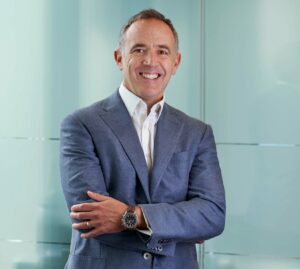
Finito World caught up with Finito Education’s likeable and passionate senior mentor, Tom Pauk
Tell us about your career before you joined Finito.
After studying drama, my efforts to become an actor ended with a whimper rather than a bang, and I retrained as a solicitor. The career that followed was a “game of two halves”, half-time marked by the global financial crisis of 2007-08. In the first half, at City law firm Allen & Overy, then in-house at American bank Citigroup, I’d specialised in large cross-border lending transactions.
In the second, I helped restructure loans borrowers had taken out in more prosperous times but were now struggling to repay. After leaving the bank in 2017, I began mentoring young men in prison, returned to Allen & Overy, now in a role mentoring lawyers in the early stages of their careers, and began writing plays. My professional life, it seems, had come full circle!
Did you feel your education prepared you for the workplace?
A degree in drama could not have prepared me better for the cut and thrust of commercial law, an above-all collaborative endeavour with a diverse cast list of characters, long “rehearsals” with unfeasible deadlines we somehow always managed to meet. At the conclusion of an especially high-profile deal there was the added satisfaction of reading the “reviews” in the financial press.
The practise of law is essentially an exercise in problem-solving. In my case, a love of modern languages and playing the violin had also prepared me for the intellectual rigour of law, and I was even able to use my mother tongue Hungarian in transactions with Hungarian clients. So to anyone reading this wondering whether a knowledge of an obscure language might prove useful one day, the answer is a resounding Yes!
Did you benefit from mentorship during your career?
When I’d started out, mentoring was still very much in its infancy. Fortunately, I was able to benefit from the law firm equivalent, the “seat” system, under which trainee solicitors move from one department (or seat) to another every few months to build up expertise in different areas of a firm’s practise. Each seat is supervised by a senior lawyer — part mentor, supervisor and critical friend — overseeing a trainee’s professional development.
Over the course of my training contract I was exposed to a variety of mentoring styles, which then shaped my own approach when I assumed the role. But I continue to benefit from ongoing, less formal mentoring in the shape of the extraordinary people I encounter and who inspire me with their wisdom. So in actual fact I’ve never really stopped being mentored.
What are the most common misconceptions about a career in the law?
I think there’s a general (mis)perception that law is a dry, bookish occupation, and that lawyers are aloof from the rest of society, be they pin-striped solicitors in their ivory towers or wigged-up barristers bowing obsequiously in courtrooms. In fact lawyers are widely dispersed throughout society, in the public sector (civil service, local authorities, regulatory bodies), in companies and banks, charities and NGOs. If you’re a young person considering a career in law you’ll be able to select from a wide range of specialisations that play to your unique skills and interests.
Mental health is a particular passion of yours. Can you describe how your interest in that area came about?
There were occasions, especially early on in my career, when my mental health was impacted under the pressure of work. Symptoms included poor sleep, high anxiety and irritability, and a compulsion for checking work emails 24/7. Back then, there was a stigma around discussing one’s mental health, let alone seeking help when you needed it. Worse, it was regarded as a sign of weakness, possibly even career-limiting, to self-disclose. So one’s natural instinct was simply to keep quiet and soldier on.
Thankfully, we’ve evolved to a more enlightened view of wellbeing in the workplace, with a plethora of interventions designed to promote a healthy mind as well as body, including mental health first aiders, mindfulness, and discouraging staff from checking work emails after hours. Eight years ago, the memory of my own experience led me to train as a volunteer at a mental health charity. At The Listening Place I’ve seen vividly for myself how poor mental health can quickly escalate into crisis, and how being truly listened to can be life-saving. Literally.
Work-life balance is something you’ve been vocal about. What are the most common pitfalls people fall into there?
Most people understand the importance of achieving a sensible work-life balance, at least intellectually, And it’s hard to argue against. But here’s the challenge: we’re not necessarily aware of the pendulum as it is swinging in the wrong direction. Whether it’s staying ever-later in the office, checking, or worse, responding to emails at weekends (“because it’s already tomorrow in Tokyo”), before we know it life is work and work is life. Of course we tell ourselves that it’s only temporary, that as soon as we’ve broken the back of whatever it is we’ll take our foot off the accelerator.
But it isn’t that simple, for we may unwittingly have recalibrated our benchmark of what a normal working day is. We’ve trapped ourselves into believing our own indispensability (“If I don’t do it no-one else will). We assume that working harder improves performance, demonstrates commitment to our employer and enhances our prospects for promotion. I’d counsel anyone reading this to challenge these assumptions and to listen out closely for the whirring of your inner pendulum!
You obviously have a passion for mentoring. What are the most common challenges you’re seeing among your current crop of mentees?
I’m certainly seeing the longer-term impact of the pandemic. This is the generation whose educations, family and social lives were disrupted by successive lockdowns. And I’m in awe of just how well they’d adapted to remote ways of studying and working. Another challenge is the sheer number of high-calibre applicants vying for limited places on the graduate recruitment schemes of investment banks, accountancy firms and corporations. Training contracts in City law firms are similarly over-subscribed, and with increasing candidates achieving top grades there’s now a far greater reliance on critical reasoning and situational judgement tests, presentations, written assignments and long assessment days.
However I’m also sensing some really positive new trends, with mentees less motivated by achieving huge salaries than they are by finding a fulfilling career. And finally, one positive legacy of the pandemic: Finito mentees are often engaged in volunteering activities, whether it’s repurposing old computers and teaching older people how to use them, mentoring disadvantaged kids, or stacking boxes in foodbanks. Something, finally, to celebrate in challenging times.
Do you vary your process for each mentee, or do you have a particular approach which you use with each candidate?
Mentoring is a transformative tool for supporting the development of a mentee, and because no two mentees are the same the mentoring process does inevitably vary. Having said that, there are common features in my approach. In the first place, it’s not about the mentor. Our prime responsibility as mentors is to listen attentively at all times to our mentees. Listening actively (as distinct from merely hearing) is a skill that one develops with practice.
And it’s crucial we’re responsive to the stated needs of our mentees rather than clinging stubbornly to our own agendas. One unique aspect of mentoring is our willingness to share our own knowledge and experience to support the development of our mentees. A word of caution however, because this has nothing to do with being directive. What we’re aiming to do is empower our mentees to think and act for themselves. Finally, mentoring is a two-way street. At its most fruitful the relationship between mentor and mentee is one in which sharing and learning opportunities arise for both participants. I’m forever learning from my mentees.
What do you know now in your career which you wish you’d known at its start?
Hindsight being a wonderful thing of course, here’s three things I tell my mentees. Firstly, it’s important to pace yourself, especially when starting out in a new role and you’re trying to make a good impression. Keep something of yourself in reserve for when you really need it. Secondly, don’t plot out your entire career from the get-go. Life has a mischievous habit of opening new doors and leading you in new directions. And thirdly, know where you add most value, and focus your energies accordingly.
Do you have any new challenges on the horizon?
I’m excited to have just been appointed to the board of the Joseph Rowntree Charitable Trust, whose endowment supports people tackling the root causes of conflict and injustice. Along with my governance responsibilities, I’ll also be involved in grant-making decisions, an area entirely new to me.
As Kamala Harris loses the 2024 Presidential race, we look back at Christopher Jackson’s cover story about the woman the US has just rejected
If Kamala Harris’ people are worried about the perception that she has been sidelined in Joe Biden’s White House, then they’ve chosen a curious room in which to conduct an interview.
It’s a shadowy out-of-the-way chamber which looks like it’s seldom used. Kamala Harris sits on a chair in a maroon pantsuit; beyond her, are two ship models in glass cases which are difficult to make out in the shadows. On the other side of the room, also behind her, is the obligatory but casual display of patriotism: an American flag peeping out of the dark.
“Everyone has to get vaccinated. The vaccines are free,” she says. “They are safe and they’ll save your life. Get the booster shot. Against Omicron it almost guarantees that you are unlikely to have to go to the hospital much less – God forbid – that you die because of this virus.”
It’s a sombre setting – appropriate perhaps for what is increasingly proving to be an unhappy historical moment. That’s the case both in respect of the current state of America with its high proportion of unvaccinated peoples and looming inflation, and in relation to Harris’ own approval ratings. At time of writing, according to an average on RealClearPolitics, these stand at 39 per cent, though they have been quite a bit lower than that.
When Margaret Brennan, the CBS interviewer, asks her about the economy, Harris does a typical politician’s trick and reels off statistics which show the Biden administration to good advantage: “First of all, as an administration, as we look at the end of the year, there are specific facts that we are proud of on the issue of the economy.” And what are those? “We have reduced unemployment down to 4.2 per cent.
The economists predicted that we wouldn’t get there for another couple of years, but here we are.” And the deficit? “We have reduced that by over $300 billion. We have created over six million jobs, so there are good things that happened – have happened – as it relates to the strength of the economy.”
The interview continues. Is Senator Joe Manchin, who torpedoed the administration’s $3 trillion Build Back Better Plan, playing fair with Biden and Harris? “This is too big to be about any specific individual.”
It’s a tense encounter; in everyone’s minds – and especially, you suspect, in Harris’ – is the fact that Harris has been criticised for her media performances, especially on account of her nervous laughter when she gets a difficult question. According to Freddy Gray, writing in The Spectator, “Harris’s laugh, which she deploys a lot, is widely recognised as the most irritating noise in America.”
2CB8TXK Washinton, United States. 11th Aug, 2020. Democratic presidential candidate Joe Biden announced today that he has chosen Sen. Kamala Harris, D-Calif., as his running mate for the 2020 presidential election, both seen in this file photo during a Democratic presidential primary debate, Tuesday, August 11, 2020. Biden and Harris will face off against President Donald Trump and Vice President Mike Pence. File Photo by Richard Ellis/UPI Credit: UPI/Alamy Live News
To Harris’ supporters there is a note of misogyny here which is both regrettable and to be expected for a political “trailblazer” who is serving not just as the first female Vice-President, but as the first Asian-American to reach that office. But to her critics, Harris does embody much that is irritating about the left: a self-righteousness allied to a thin understanding of basic economics, and even a certain ‘wokeness’.
Which is she then? In reality, everything about the interview makes you long for more depth. We want to go back in time to learn more about her, since everything about Harris – telegenic, prepped, responsive to the zeitgeist – is suggestive of meme, a person entirely tethered to the present.
But also we long to know what really motivates her – who she is, and above all what the administration she serves really signifies for the virus, the economy, for civil rights, and for the US-UK ‘special relationship’. Above all we want to know if we’re looking at the 47th President of the United States. For this cover story, Finito World spoke to everyone from leading opinion formers in the UK, to political insiders, and working Californians, to discover just that.
Howard’s Way
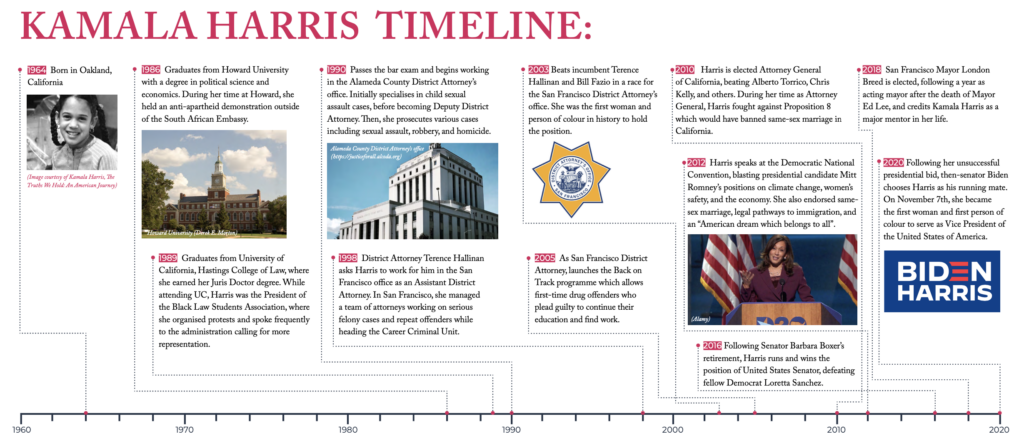
Born in Oakland in 1964, Harris was the daughter of Shyamala Gopalan, a biomedical scientist and Donald Harris, an economics professor. Having experienced segregation during her childhood, it was a formative moment to attend Howard University, from which she would graduate in 1986 with a degree in political science and economics. Reading her memoir The Truths We Hold, you sense it gave her confidence.
Howard University is a historically Black college in Washington D.C. which was founded in 1867 following the American Civil War. Pertinently for Harris, who would seek an initial career in the law, its former alumni include Supreme Court Justice Thurgood Marshall, in addition to Nobel Prize-winning novelist Toni Morrison, civil rights activist Vernon Jordan, and the late actor Chadwick Boseman.
It would prove a formative experience for the future Vice-President. Harris writes of feeling that she was in heaven when she first walked in there: “Every signal told students that we could be anything – that we were young, gifted, and black, and we shouldn’t let anything get in the way of our success.”
Mentoring also came into her life at this point, when she took on a role working as a tour guide at the U.S. Bureau of Engraving and Printing. Harris recalls: “Once I emerged from my shift to find Ruby Dee and Ossie Davis [both famous actors] in the main area, waiting for a VIP tour after hours. They projected an aura like the luminaries they were, yet they made a special point of engaging me in conversation and telling me that it made them proud to see me as a young woman working in public service.”
This is the Harris tone, as agreeable as it is anodyne. We can see immediately that it doesn’t seem particularly likely to bridge the divide in America which has grown over the last decade or so: her language lacks the complexity of Obama’s, the persuasiveness of Bill Clinton’s, the folksiness of George W. Bush and Joe Biden, and the sheer oddity and punch of Donald Trump’s.
If you talk to Californians today you’ll find that Harris’ innate assumptions – that Harris’ journey is de facto good and virtuous – are echoed, showing that she at least has some support there. Talk to people in her home state, and sometimes one finds a patriotism on display difficult to distinguish from a certain piety. Kevin Buckby, a partner of Carbon Partners, tells us: “She’s our local lass from Oakland and I live about five miles from there, so I’m happy to see her success. You need a Kamala equivalent over there as an antidote to Boris.” In such remarks, one finds the validity of the Democratic project unquestioned. To her critics, these plaudits will feel all-too-easy and insufficiently earned.
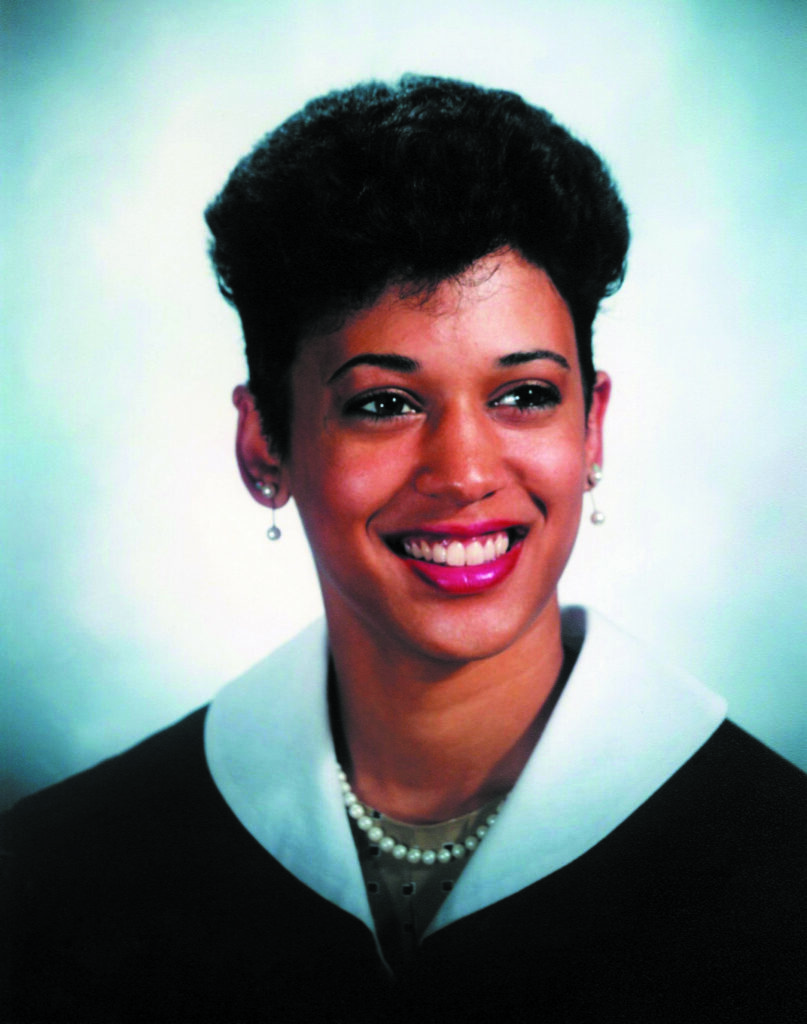
2F3FXTW 1986 ca , Washington D.C. , USA : The american politician and attorney KAMALA HARRIS ( born 20 october 1964 ) when was a child aged 22 at Howard University in Washington . From 20 january 2021 the Vice President of the United States of Democrate President of United States Joe BIDEN . She is the United States’ first female vice president, the highest-ranking female official in U.S. history, and the first African American and first Asian American vice president . Unknown photographer . – Vice Presidente alla presidenza Presidente STATI UNITI AMERICA – POLITICO – DONNA POLITICA – POLITIC – per
Amee Parekh has recently been promoted to head of HR for Uber Freight and Finance from her previous role as head of HR for UberEats US. She, too, is not in doubt of the need for Harris, or someone Harris-like at the top of American politics: “Kamala Harris is absolutely leading the change in the political arena, because we haven’t had a female Vice-President or President ever, and she’s the first woman to make it into office.” So she sees Kamala Harris as a role model? Parekh is effusive: “Kamala Harris is a good role model. I think that change absolutely needed to happen. It needed to happen 20 years sooner, but here we are, and we’ll work with that.”
This might be called the Kamala-Harris-as-role-model narrative. There is something to it. When Barack Obama ran for the presidency in 2008, he noted how much harder the process was for rival Hillary Clinton: “She was doing everything I was doing, but just like Ginger Rogers, it was backwards in heels.”
The same is true for Harris. What she has achieved has been done to some extent against the grain. Harris, in this telling, is a pioneer. Her admirers would add that she’s a welcome voice calling for social justice, greater help from the federal government, fewer wars in the Middle East of an essentially unwinnable nature, a kindly border policy, and improvement in voting rights for African Americans.
For such people, Harris comes readymade as both politician and symbol. Dana Williams, Ph.D., dean of the Graduate School at Howard and professor of English says: “It wasn’t just a situation where it’s good to have a Kamala Harris elected; it’s a situation where we absolutely needed a Kamala Harris to be elected.”
Despite this, even her champions would probably stop short of seriously comparing her to Barack Obama, whose talents under any fair reading seem to outstrip hers. Even so, the argument runs that she is in that mould.
The trouble is it can seem a fairly short step from there to saying, or implying, that her faults must be overlooked. Her low approval ratings as Vice-President under such a view are either unfair, and a result of sexism or racism, or they might be put down to the inherently tricky nature of the vice-presidency, an office once described by John Nance Garner, FDR’s Vice-President from 1933-1941 as “not worth a bucket of warm piss.”
For Harris’ critics, it’s not racist to criticise her, it’s racist not to. Besides, her detractors would argue that she raises the question of racism all too readily as a rebuttal to criticism that isn’t racist at all, but entirely justified in a free country.
A representative statement might be that of former Harris staffer Sean Clegg, as reported by The Washington Post: “I’ve never had an experience in my long history with Kamala, where I felt like she was unfair. Has she called bulls—? Yes. And does that make people uncomfortable sometimes? Yes. But if she were a man with her management style, she would have a TV show called The Apprentice.” Clegg seems to imply that Harris is taking necessary blows for all those African American women who will follow her path.
2FP00XB United States Vice President Kamala Harris speaks at the Asian Pacific American Heritage Month Unity Summit from White House in Washington, DC on Wednesday, May 19, 2021.Credit: Jemal Countess/Pool via CNP /MediaPunch
But nobody seriously doubts that Harris is in a difficult and sometimes frustrating job. The LBC radio presenter Iain Dale has just finished editing a marvellous collection of essays The Presidents about each occupant of the White House from Washington to Biden, and has been deeply immersed in the American political system.
“The office of VP is quite a difficult one,” he tells me. “As most people who have been Vice-President will tell you, it has no power but it has influence, but that influence is entirely at the discretion of the president.”
Which brings us onto the question of Harris’ relationship with President Joe Biden. Dale notes that Harris and Biden seem rather distant. He deems that a puzzling trend.
“Some presidents really bring their Veeps in,” Dale explains. “Others seem to ignore them – which is weird when you think of it, because the job of president is all-consuming, and you get to choose your Veep – they’re not elected. You’d think if you get someone you trust you’d want them to take over some of the functions of the presidency. That happens rarely. From Eisenhower onwards, can you find a president who really trusted their Veep?”
In the Brennan interview there’s an awkward attempt to dispel the feeling that Biden and Harris don’t get on: “In fact, the president and I joke and when I leave one of our meetings to go break a tie, he says, ‘Well, that’s going to be a winning vote.’ Whenever I vote, we win. It’s a – it’s a joke we have, but – the stakes are so high.”
Quality Street
For others, she’s just not up to the job. This view is best encapsulated by Dr. Randall Heather, who has been involved in British, American and Canadian politics for over 40 years. He pulls no punches whatsoever.
First up, he wants to put Harris’ Vice-Presidency into context for a UK audience: “If you weren’t in America in 2016 during that presidential campaign, you missed two things,” he explains. “One was a matter of intensity rather than knowledge: it was how deeply upset working class white Americans were about everything. And you can’t understand the pull of Trump, unless you understand that intensity. On the other side, it’s hard to gauge how intensely disliked Hillary Clinton was.”
The implication is that Clinton may have deserved some of this opprobrium – and that Harris does too. This, Heather explains, is something the UK just doesn’t understand. “Brits love Democratic presidents because they don’t have to live with the outcome of the decisions which are made on a lot of domestic issues.”
But this is only the beginning. Heather continues: “There are two numbers about Kamala Harris. One is one per cent. The other is 28 per cent. The 28 per cent is her current approval rating [Harris’ approval rating has recovered a bit since we spoke with Heather]. One per cent was the support she got running when she launched her 2020 campaign when she was considered one of the top two or three potential people. She ran an awful campaign. Her team was from California, and the thing to know about California is that it’s really a different planet. It was a shambolic campaign and she crashed before she even made the primary.”
When I ask if Harris has any positive attributes, Heather is frank: “She has none.”
This has the virtue of clarity, but something in me wants to push against it. It seems inconceivable, even in today’s fractured America, that someone could rise so high without talent or any personal qualities.
2FP00XB United States Vice President Kamala Harris speaks at the Asian Pacific American Heritage Month Unity Summit from White House in Washington, DC on Wednesday, May 19, 2021.Credit: Jemal Countess/Pool via CNP /MediaPunch
The harsh assessments you hear about Harris seem to emanate out of an America so bifurcated that no nuance is possible. All the main players – Trump, Biden, Harris, Obama – are either good or evil, geniuses or idiots, heroes or villains. America is a place no longer permitted shades of grey. This seems to go against one’s day-to-day observations of human nature where human complexity comes at us from every quarter; it can’t be, surely, that the United States has successfully disinvented our right to hold more than one opinion about a person.
This Manichean view of the world also seems unhelpful since the problems which America faces – from Afghanistan to inflation, to infrastructure, voting rights, and urban crime – are complex and probably can’t be solved if the atmosphere in which they’re discussed is reductive, and in some areas of the media, puerile.
But equally, Heather surely has a point that Harris is struggling hugely in the office.
Even so, the only way to see past this somewhat Manichean argument is to delve further – and especially into what actually happens when Kamala Harris has been in charge of something.
Orders from the DA
By 1989, Harris had graduated from University of California, Hastings College of Law, where she earned her Juris Doctor degree. During that time, the future Vice-President was the President of the Black Law Students Association. Her decision to work in the DA’s office, which by this time she had come to deem her ‘calling’, was met with incredulity by friends and family. “I had to defend my choice as one would a thesis,” she recalls in The Truths We Hold.
Why might Harris have had such a difficult time in defending her choice of career? She herself gives the answer: “America has a deep and dark history of people using the power of the prosecutor as an instrument of injustice.”
But Harris had found her metier. In 1990 she began working in the Alameda County District Attorney’s office. She initially specialised in child sexual assault cases, before becoming Deputy District Attorney. Then, she prosecuted various cases including sexual assault, robbery, and homicide.
At this time, Harris was moving in exalted circles. By 1993, Willie Brown, a noted lawyer and civil rights leader, was the speaker of the California assembly and regarded as one of the State’s most influential legislators. By 1996, he had become Mayor of San Francisco, the first African-American to hold that office. Though he was still married at the time (though separated), he was known to be going out with Harris, which has incurred negative comment in some quarters, with Harris accused of sleeping her way to the top. The accusation may be a sensitive one; Brown isn’t mentioned at all in Harris’ memoir.
By 2004, Harris was the District Attorney in California, a post she would hold until 2011. In time it would prove a sound basis from which to launch her political career. How did she do?
Seth Chazin has been a criminal defence lawyer in San Francisco for 35 years and serves on the board of directors of the National Association of Criminal Defence Lawyers. What are his memories of Harris’ stint as DA? “When she was District Attorney, I didn’t find her to be overly progressive in terms of policies towards criminal defendants.
I didn’t see much change from prior District Attorneys.” In the context of Californian politics then, Harris has always seemed moderate – and it was partly this which informed her struggles in the 2020 primary. “She found it hard to raise money in California – that should tell you something,” says Heather. “It’s the most moneyed state in the country, and she was out-raised by Pete Buttigeig, the Mayor of the fourth largest city in Indiana.”
So what would Chazin hope Harris could do now? Chazin is unequivocal: “She needs to push for abolition of the death penalty at the Federal level. What happened at the end of the Trump administration was horrific, they were killing one person after another.” Chazin continues: “There is a moratorium on the death penalty in California, but we need abolition. Another governor could come in with a different opinion, and the moratorium could end in a heartbeat.”
No less a figure than Sir Richard Branson is prepared to agree with Chazin on this: “The death penalty is inhumane and barbaric, fails to deter or reduce crime and is disproportionately used against minorities and other vulnerable and marginalised groups,” he tells Finito World.
Harris also disappointed Chazin on another front: “In terms of racial disparities, I saw no affirmative effort to handle the disparity in sentencing in drug cases, and I was dealing with a lot of drug cases at the time. Most people being prosecuted for drug offences in San Francisco were black and brown people during her tenure as District Attorney.”
Dr Randall Heather adds: “Kamala Harris was considered overly authoritarian as Attorney-General, and this upset a lot of people on the more progressive side of the party – the group called The Squad. They do not particularly like Kamala Harris.”
This is part of the difficulty Harris faces: she has set considerable expectations on account of the ‘historic’ nature of her election, but, like Barack Obama, she must govern – co-govern – in prose. It’s a reminder that the first generation of Black leaders had something profound to convey about equality and racial disparity which will always echo through history, and rightly so.
After that, it was up to Barack Obama to prove that African-Americans could serve at the top of government. Harris has proven that too. But of course, there are diminishing returns here, as each glass ceiling is broken. It becomes harder to identify a moral imperative of similar force once a gigantic moral ill has been remedied. As a case in point, Kamala Harris’ portfolio of voting rights in the Biden administration has met with the intractable fact that the Democrats have neither the votes for the legislation, nor the votes to remove the Senate filibuster in order to navigate that fact.
Harris is defiant in interview: “I think we have to continue to elevate the conversation about voting rights,” she tells Brennan. “Given the daily grind that people are facing, this may not feel like an immediate or urgent matter when in fact it is.” And yet, as important as the issue undoubtedly is, barring some sort of carve-out of the filibuster, Harris looks to be struggling to deliver.
Allied to these problems is the enormous question of whether the fundamental economic principles which Democrats espouse – spending, essentially – really work. This brings us onto the gigantic question of inflation in relation both to the pandemic and to Biden and Harris’s flagship legislation.
The Economy, Stupid
Biden and Harris have so far passed two large spending bills. First up was the American Rescue Plan Act, a $1.9 trillion stimulus bill, which saw the government mailing cheques of $1,400 dollars to families affected by the virus. This was followed by the vast Infrastructure and Investment Act which came with a similar price tag of £2 trillion. This development might have been specifically designed to annoy former President Donald Trump who had wanted to sign a similar bill into law but had failed.
These are big numbers, but the bills found controversy when leading economists, including Larry Summers, the former Secretary of State to the Treasury under Obama, wondered whether such high spending would prove inflationary. In short will this legislation work?
If you want to know what’s actually going on in the global economy during the Biden-Harris era, you need to talk to one of the masters of it. Formerly of WPP, Sir Martin Sorrell is the longest-serving FTSE 250 CEO. He now heads up S4 Capital, his fast-growing venture which is securing impressive market share, and employs some 5,500 people across 33 countries.
Sorrell is clear that inflation will be the main discussion in 2022: “It will be big,” he tells us. “Clients will look for price increases to cover commodity increases. But the real question is whether inflation is endemic.” And is it? “We clearly have shortages in the labour supply and supply chain disruption. A lot of companies will be looking to cover that up with price increases, and I expect inflation to be well above trend.”
That certainly sounds like more than a bump in the road. So what does Sorrell think will happen in the crucial mid-term elections towards the end of 2022? “Biden and Harris say the mid-terms will go well for Democrats,” says Sorrell. “I don’t think that will happen. We’ll get deadlock after the midterms so all significant legislation will need to have been passed before that point.”
That doesn’t bode well for serious action in Harris’ portfolio, especially in respect of voting rights, and it’s a reminder that there’s limited time for Biden and Harris to pass their massive spending plan Build Back Better – originally mooted as having an impossible $3 trillion figure attached to it – which so far has been held by up by conservative Democrat Senator Joe Manchin from Virginia.
Despite the likelihood of a tough road ahead, Sorrell isn’t critical of every move that Biden and Harris have made. “The infrastructure spending was needed,” says Sorrell. “If you look at infrastructure spending as a portion of GDP, the US doesn’t feature well.”
So does Sorrell think that inflation as a problem is one of the administration’s own creation? “If you look at these bills, they are by their nature inflationary,” Sorrell replies, adding: “Inflation is not transitory. I hesitate to say it’s endemic as that’s a bad analogy with Covid-19, but I don’t think it will soften this year. I just get the feeling from clients that where they can get price increases they will go for it.”
That doesn’t bode well for the global economy in 2022. In addition, other commentators are prepared to add their voices to the criticisms of Bidenomics. The macroeconomist Robert Barro, the Paul M. Warburg Professor of Economics at Harvard University, is concerned about the trend of governments printing money: “Biden and Harris’ monetary policy is remarkably expansionary.
It involves short term nominal interest rates of essentially zero, while continuing with the Quantitative Easing (QE) policy of buying $120 billion a month.” So what is the administration buying? “Mostly Treasury securities, but they’ve also bought some mortgage-backed securities. Corresponding to that, they’ve accumulated about $8 trillion dollars on the balance sheet of the Federal Reserve.
You’re talking about a GDP of $20-21 trillion, so $8 trillion is a serious number, even though we’ve had inflation now for over 12 months they haven’t cut back on this. They should have moved a long time ago towards tapering their purchases and raising interest rates, and of course they haven’t done either of those.”
For Barro this is out of control stuff: “Basically, the Treasury is issuing bonds to finance a lot of the expenditure – that’s the fiscal deficit part – then the Federal Reserve is turning around and buying a lot of those bonds and accumulating those on its balance sheet.” And on the other side of the Fed’s balance sheet? “That’s where you would find something that looks like money, and that’s a combination of currency and reserves held by financial institutions. So those have correspondingly gone up to close to $8 trillion dollars. It’s classic inflationary finance.”
By this reading, government policy has created a genuinely inflationary economy that can’t be attributed solely to the circumstances of the pandemic. If you want to curtail that, the only honest response is to raise interests and stop spending – two things the Biden administration seems reluctant to do.
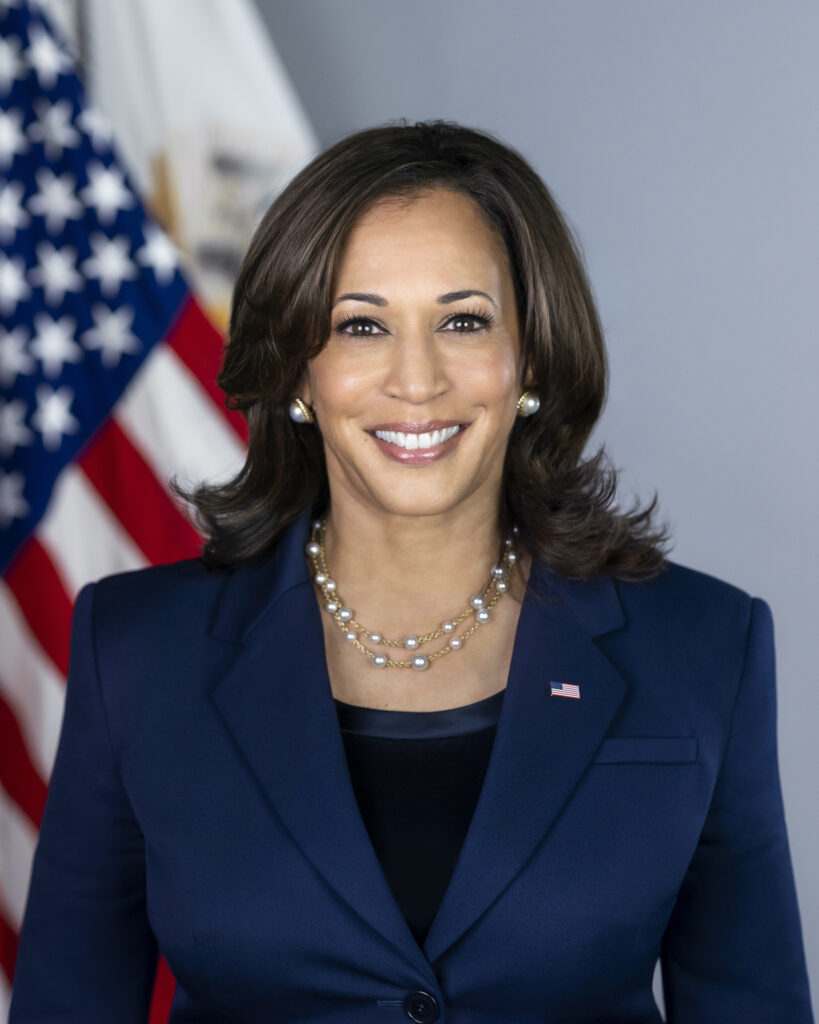
Vice President Kamala Harris takes her official portrait Thursday, March 4, 2021, in the South Court Auditorium in the Eisenhower Executive Office Building at the White House. (Official White House Photo by Lawrence Jackson)
All of which makes Joe Manchin’s refusal to commit to Build Back Better look wise. When asked about this, Harris digs in: “Goldman Sachs just today said that actually, we know that Build Back Better will strengthen the economy,” she tells Brennan. “Not only is it morally right to say parents shouldn’t have to struggle to take care of their basic needs like caring for their children and their parents – and their parents and their elder relatives. But it actually makes economic sense to do that and it brings down the cost of living.”
Yet there are no real signs that Biden or Harris take inflation seriously. Barro is particularly unconvinced by Biden’s decision to reappoint Jay Powell to be Head of the Federal Reserve: “What he really needed was a tough person oriented towards the banking system and to the idea that keeping inflation low is a major mission of the central bank.
A figure like Jamie Dimon from JP Morgan would have been a remarkable signal that they’re finally getting serious. Even Larry Summers, who I disagree with on many things, we’re in agreement on this inflation problem and how it interacts with the monetary authority, so Larry Summers could have been named head of the Federal Reserve. Something like that could have been a great signal.”
Dr Randall Heather agrees with all this, pointing out that the Producer Price Index (PPI) is now at a thirty year high. He also notes that in November, the Consumer Price Index (CPI) had risen by 6.8 per cent from the year earlier, the biggest 12-month jump in 39 years. “Despite that, the Biden administration is acting as though Covid is still going full blast and we need trillions more. The infrastructure bill you can get Republicans to support. But Build Back Better is pork-laden. There’s $400 billion for child tax credits which won’t have a lasting impact – it’s money you’ll burn through.”
For Heather there’s a difference between government spending for a road, and government spending for a child going to nursery for a day: the day will pass; the road, if it’s built well, should still be there for future generations. Likewise, plenty of Covid cheques from both Trump and Biden simply went into people’s savings accounts: the problem is one of corporate and government debt, not personal debt. “The trouble is you can’t deal with inflation too strictly or else you crash the stock market. So they’ll have to let it run,” he explains.
The Special Relationship
So what does the situation in the US mean for the UK economy? In the first place, inflation seems to be catching: for instance, some energy economists argue that Biden’s climate change policies are being felt at the pump in prices in the UK.
But in other respects, the broader outlook is one of continuity when it comes to US-UK relations. Iain Dale says: “If you look at presidencies, there’s a surprising degree of continuity between them. There are a lot of similarities, for instance, between Barack Obama’s foreign policy and Donald Trump’s – and between Donald Trump’s and Biden’s.”
Duncan Edwards, the CEO of BritishAmerican Business, argues that there’s an inherent stability in the US-UK relationship, which neither a good nor a bad president can easily unpick. “In general, the US-UK relationship is in good shape,” Edwards tells me. “There are always bumps in the road under any administration, but there are things which connect the US and the UK – such as security and intelligence co-operation – and these things underpin the Special Relationship. The Pentagon and the Department for Defence work incredibly closely together.”
Or as Kamala Harris said in a joint press conference with Prime Minister Boris Johnson on 21st September 2021: “The relationship between our two countries is a long and enduring one, based on shared priorities.” But since the FDR presidency, it would be difficult to find a single president or vice-president who hasn’t felt it necessary to trot out similar platitudes at some point in their tenure.
Even so, that doesn’t stop Harris’ assessment being true. Edwards also explains the economic ties between the two nations are greater than any presidency. “The economic relationship is very strong because of the sheer scale of the trade in goods and services and, of course, the huge capital that has been committed by American companies in the UK – and UK companies into the US.”
So far, so good. But not all that’s happened under Biden and Harris has been good for UK business. For instance, Trump’s willingness to strike a trade deal – the 45th President’s Anglophilia has often been underplayed by a critical UK media – has now been replaced by Biden’s reluctance. Edwards explains: “The UK made significant progress on a trade agreement before the 2020 election, but trade agreements are not a priority of this administration, since they’re aiming for a heavy agenda domestically.”
That’s a major shift. Edwards adds that, living in New York, he’s seen UK ministers come and go during the Biden-Harris administration – and to little avail. “We’ve had Anne-Marie Trevelyan, Penny Mordaunt and Nadine Dorries, and all these visits are about trying to move the ball on trade, and I don’t think they’re going to make much progress.”
This reminds us of how a simplistic view of Trump – whose Scottish ancestry, and his Scottish golf courses, made him an eager partner with Britain – can lead to a simplistic view of Biden and Harris.
Edwards continues: “Trump was much more pro-trade than Biden, but unfortunately most of the commentary on this is pretty surface. The reason why Trump was seen as anti-trade was because he condemned the behaviour of China, which doesn’t behave according to the rules – a belief which Biden shares. Trump was also critical of the EU, which is a highly protectionist organisation. If you don’t like Trump for other reasons, that was way too simplistic an analysis.”
So for all Trump’s talk of Making America Great Again, he was far less protectionist than Biden and Harris. Edwards adds: “One of the first things Biden did was sign an Executive Order, making it difficult for foreign companies to win government contracts in the US. By nature, the left tends to be more protectionist than the right. Their emphasis is on protecting jobs, and that’s why with the Biden administration it’s America first.”
Madame President?
None of this is necessarily Kamala Harris’ fault since many have noted her own powerlessness in the Biden administration. As against this, it must be said that Biden’s policies are echoed throughout Harris’ The Truths We Hold so it seems unlikely that economically she’d prove much different from Biden.
But it will matter hugely to her personally, since by 2024, it’s likely – barring any further ‘variants of concern’ – that the state of the economy will decide her political fate at some stage.
Some of the people we spoke with held out hope that Harris might improve if she were to make it all the way to 1600 Pennsylvania Avenue: “I don’t have any reason to predict that she would be massively different from Biden in policy,” says Robert Barro. “She hasn’t excelled as Vice-President, but I can’t tell if that’s because she’s been given opportunities and blown them or if she hasn’t been given those opportunities.” That at least seems to give her some wiggle room.
So how will this all play out? I ask Iain Dale whether he thinks Harris will assume the presidency. “There are three ways this is going to go,” he tells me. “Either she becomes president because Biden dies or is incapacitated in some way which is entirely possible. That’s one possibility. The other is that they make it to 2024 and she runs; and then either she wins or she doesn’t. I cannot conceive Biden can run for a second term. He’d be 82. I just can’t see it.”
And so she’ll have to fight for the nomination? “There’s no way the Democrats will let her walk into it. I suspect she wouldn’t – which would be a bit of a disaster in terms of people thinking, ‘Ah well, America’s not ready for a woman, and not ready for a black woman’. So she needs to up her game a bit over the next year – well, a lot.”
For Sir Martin Sorrell, Harris’ weakness and the lack of ready alternatives, is a clear opening for Donald Trump to return: “I think we’ll see a Trump in 2024 – either Trump himself, or personally I wouldn’t underestimate Ivanka. Of course, it’s a puzzle. Things can change. It’s still very early on, Kamala’s ratings can change over time, but people are negative at the moment.”
As a man who understands the online world extremely well, Sorrell is especially interested in the launch of Trump’s platform Truth Social which is scheduled for 24th February 2022. “It’s interesting what he’s doing – he’s creating an echo chamber. Those who wrote Trump off are going to be surprised. The trouble is we talk to one another in our own echo chamber – people on the East or the West coast.
But I was talking the other day to a CEO of a leading packages company who’d just gone through the South on his motorbike. He’d been through Alabama, Kentucky and Mississippi, and everywhere there were Trump signs.”
Former Minister of State for Universities, Science, Research and Innovation Sam Gyimah puts her chances a little higher: “She’s vice president which means if Biden isn’t running she will seek the nomination. That’s how Hillary ended up being the candidate. She will have a strong claim. But if her poll numbers are bad she might not make it through the primaries.”
So in a sense, though she mightn’t like it, everything will depend on her own performance as vice-president – her showing, if you will, in the famous bucket of warm piss.
Dale is among those who argue that Harris needs to grasp the nettle if she’s to stand a chance: “If you judge by the poll ratings so far, she’s performed pretty disastrously. That might be partly her fault; it might be Biden’s fault for not carving out a role for her. But if you’re VP without a job description, it’s up to you to carve out your job description yourself and I’m not sure she’s done a very good job of that.”
So is her position salvageable? Dale thinks that she must learn not to air grievances that she has been given difficult portfolios especially when compared to Pete Buttigieg – her likely rival in 2024 – who is perceived to be having a better time as Transportation Secretary than Harris is as Veep. “If you’re seen as a whinger that’s not a good place to be,” continues Dale. “You’re there as a politician to solve difficult issues. Pete Buttigieg is the Transportation Secretary and therefore that does come within his remit. What she needs to do is knuckle down to the jobs she has been given because nobody’s going to have any sympathy for him.”
For Heather, the signs for Harris are bad. He argues that the 44th President Barack Obama still effectively controls the party, since he is by far the best at raising money. He adds that Harris’ difficult portfolio is a reflection of the fact that the powers-that-be – all of them Obama-ites – don’t view her as presidential material. “You have to ask why she was given these things. Immigration is hard – because it’s fricking hard. Voting rights is hard because it’s the states and not the federal government which control the voting rules unless they want to overturn the constitution. She was deliberately given these things – she got two hospital passes they don’t expect her to do well on.”
On the other hand, there are still plenty of people who wish her well, and not just Californians. A profound patriotism still exists in the American soul. John Updike’s character Rabbit Angstrom in the famous Rabbit tetralogy was always inclined to love the person who happened to be President at whatever time. There are plenty of Americans like that today who would wish Harris well were she to assume office – and would like her to do better now.
So the stakes are high and the jury’s out. It’s only a year in from her time in the Vice-Presidency, and the clock is already ticking for her to prove she has what it takes to make it all the way to the Oval Office.
One sometimes hears someone called a ‘black sheep’ of a family as a pejorative term. It needn’t be like that. Most people who look inward in any concerted way find some surprising differences between their own hopes and dreams and their outward circumstances. Knowledge of this difference can open surprising inner capacities and point the way to a fruitful life. In the best cases, it is possible to strike out in a different direction from one’s family, and to feel no sense of alienation whatsoever – but instead to feel a sense of loving journey, which ultimately all members of the family will accept and profit from in understanding.
Something like this appears to be happening to Finito candidate Leah Houston. I ask her about her upbringing: “I’m from very humble beginnings,” she tells me, her accent distinctively Northern Irish. “Education was never pushed for me. It wasn’t the world I was in. I’m the first in my close family to be interested in my studies, and then to want to pursue them, and then to go onto university at the Belfast Bible College in Dunmurry, Belfast.”
Despite this, Houston is aware of many similarities between herself and her family. “On the other hand, working hard was pushed on me – it was a question of financial necessity. I’ve had a part time job since I was 14. After school you went to work: food had to be placed on the table somehow. In hindsight, I wouldn’t have changed a thing at all.”
So what did her parents do for a living? “My Dad is typical Northern Irish. He is a part-time farmer and he sells animal feed from a local agricultural shop. My mum worked in office work all her life – then she had me. She felt that to stay at home was her calling, but then she started looking after other peoples’ kids and soon she had her own childminding business.” This seems to amount to a strong entrepreneurial streak in the family. Houston agrees: “You have your hands and you can do something about it – so go work,” she says, simply.
This innate understanding of business was already becoming apparent in Houston’s choices. “Business makes sense to me,” she explains, “seeing something through from 0 to 100. You’ve got to see what you’re good at and make something of it. I studied Business through to A-Level and initially thought I would study that subject at university as well. But I had a bit of a change of heart.”
This brings in another side of Leah – her religious belief. “I grew up in a strong Christian household,” she recalls. “It wasn’t pushy but it was fostered. So I studied religion and law at university which was a major change.” Throughout our conversation she will talk about her faith in the relaxed, confident way which people do when their beliefs are deeply embedded.
I am interested to know how this degree was structured. She explains: “The main aspect of it was theology, but with world studies, policy and law examined. It was all to do with how one’s faith works out in the public sphere. I was focused predominantly on Christianity but I also did world religion modules.”
This decision garnered a mixed reaction at home. “My extended family – my cousins and so on – weren’t sure. Firstly, because I’m a woman – that didn’t go down well, and led to some opposition. Some also thought I would lose my own faith, and question what I believe.” And has she? “I haven’t. Growing up in a Christian country, Christianity can be ugly because it’s political. There have been civil wars in the name of Christianity in my country. I came out the other end with a wider appreciation of all religions and the part they can play.”
Houston loved her degree, but like most humanities degree, the gain of doing something one loves had a flipside: such courses don’t lead to such clear destinations as vocational courses. “I didn’t want to go into the Church, so in hindsight it was a much harder option. For the first few years I thought it was all amazing, but I’m not philosophical – I’m much more practical. My interest is in thinking how faith values can be implemented. During the three years of my degree, I did some time with a charity at home called the Evangelical Alliance. That organisation tries to bridge the gap between Church and politics. In hindsight, my time there planted the seed for politics and the public sphere.”
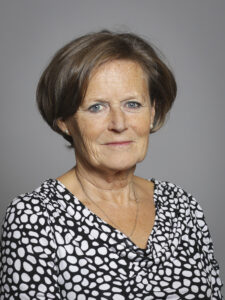
This seed came to fruition when Houston began working for Baroness Anne Jenkin in the Houses of Parliament. “When I finished university, I thought: ‘What the heck am I going to do next?’ I came across Christian Action Research Education (CARE) a charity which seeks to facilitate getting a job as a Christian in politics in addition to offering training in thinking about politics. Anne Jenkin is extremely kind and said she’d take me for a year.”
And what were her impressions of the role? “Anne is so hard-working – no two days are the same for Anne,” Houston recalls, laughing perhaps at the remembered bustle of it all. “I was involved in diary management, speeches and organising meetings she would host. It was general ad hoc stuff and I was an extra pair of hands.” Leah brought a very clear sense of purpose to the role. “I was there to serve Anne – to allow her to do her job better. That could be sending letters, or photocopying, or making a cup of tea. I also became immersed in the question of gender ideology, which is one of the key issues for Anne.”
And what was the culture like in Parliament? “As a practising Christian myself, I was interested to discover the APPG, Christians in Parliament, that is a cross-party group of Christians. As long as you were a passholder you could be a part of that: MPs, kitchen staffers, it didn’t matter. It brought a sense of community, with weekly services held in the Chapel of St Mary Undercroft. Politics is so polarised and tends to be all or nothing. It is meaningful to have something that unites: at election time we prayed for whoever was in leadership.”
Through Baroness Jenkin, Leah met Finito Education CEO Ronel who saw Leah’s potential. “Ronel is a great supporter of Anne and he took me under his wing. I was with Finito for half a year and the investment in me was incredible.”
This is good to hear and I ask her what the impact has been. “Besides all the practical things such as the LinkedIn training, the CV writing and the mentoring, I especially value the confidence that the Finito service gives to someone in my circumstances. It was as if I was being seen for the first time. This was so encouraging for me especially given my upbringing, where my wanting to succeed was perhaps sometimes considered a bit weird. My extended family would wonder why I was in London, and why I’m in the job I’m in. This was an organisation which wanted me to succeed.”
This process of building confidence in an individual is integral to the mentoring process. It begins from our first encounter with a new student. Houston recalls: “I remember vividly the first meeting with Ronel where I brought him my CV. When I had been in parliament I had co-founded a network for the protection of gender-critical views. I showed my leaflet to Ronel and it was an incredibly important moment, because someone was looking at my work, and taking an interest in me. It brought me an overwhelming sense of pride.”
Mentoring is to do with becoming reoriented in one’s life by coming into one’s essential self. Houston recalls that her being photographed by in-house photographer Sam Pearce continued this process. “I spent an afternoon with Sam and I noticed that she took the time to make me feel comfortable. She also took time to ask questions between pictures – it was not a transactional photoshoot, it was more an investment in who I was.”
Following on from there, Leah had her LinkedIn training with Amanda Brown (‘incredibly helpful’) and then began work with her lead mentor Tom Pauk. “He was so lovely and I was telling my heart and how I feel things deeply. He said: ‘I think you need to go into the charities sphere’. I said: ‘ I think you’re correct.’ And now I’ve landed a job with a charity which is a start-up. Tom was amazing, and gave me contacts.’
From Pauk’s perspective, Houston made an excellent impression. He recalls: “Leah struck me as a highly intelligent, articulate and values-driven young woman, seeking a position where she can employ her myriad skills to improve the lives of others, especially those of women and children.” Pauk noted early on that her priority was ‘to use her lobbying skills to help bring about changes and social impact,” adding that “she is not driven by earning a high salary, though she’ll need a sustainable one.”
When the job came along it all happened very quickly ‘in the space of a week’. Houston brings me up to speed: “I now work for a charity called Forum which is based in London and has launched in America too now. Its purpose is to serve leaders and influencers from all sectors of society. It tries to link up like-minded people. I’m a data manager and administrator, which is important for Forum, as someone’s name in the database is like gold to the business. I’m also EA to the founder David Stroud, who is married to Baroness Stroud.”
So how does she see the future? “I actually don’t know,” she admits. “My life these past few years has been full of uncertainty, but I can see myself settling here for a good while. It’s a start-up with huge potential for growth and now the whole past five years makes sense.”
At the end of our interview Houston reflects a little on her journey so far. “It’s strange to be in London and not be money-driven. Wealth to me isn’t money. It’s what I had growing up: I had family and friendship and relationships and that to me is wealth. Marriage and education is wealth.” And are her family beginning to understand the nature of her journey now? “My parents have been massively supportive, but we don’t always speak a common language. My cousins have their own convictions and they don’t necessarily agree. But the relationships are there and really there’s so much love and support.”
One is tempted to call this attitude mature except that many people live their whole lives without realising the importance of things which Leah innately understands. She also has an immense capacity for empathy and understanding. Houston is someone whose narrative is not to be judged by the usual metrics of success: money, or position or anything else – though there’s nothing to stop her acquiring these. But she is in such a strong position because she isn’t a materialist. She is someone who will make her own way – and in fact is already doing so.
The help which Finito gave to Leah would have been impossible without the generous help of the Stewarts Foundation. The firm’s managing partner Stuart Dench says: “In a perfect world comprehensive career guidance would be available to all regardless of their background. The Stewarts Foundation is delighted to support the important work of Finito via its bursary scheme.”
When it comes to someone like Leah, the importance is difficult to measure because it has to do with ineffable things like confidence, connectivity, and the unleashing of possibilities within a person who may not yet know how capable they are. In her case, it is also to do with helping someone to arrive at the realisation that the place they’re born in need not be a limiting factor. Ultimately it’s for us to make our own way – though it is right that we do so with the help of others.
In an age where almost everywhere we look we hear lament about declining standards, let’s consider some good news from the front lines of mentoring: it’s remarkable how intelligent the young are. It’s hard to say this without sounding patronising, so it needs to be bound up with a couple of relativistic statements. They are, seemingly without exception, more intelligent than I was at that age – and always know things I do not know. In short, there’s always two-way learning to be done, and I’d distrust any mentoring process that didn’t have this understanding as a sort of guiding principle.
We have the word ‘precocity’ for this and I think generally we can say today: the young are precocious. Whether this is because the Internet, with its moreish flow of information, has democratised intelligence, I don’t know. But one thing it definitely hasn’t democratised is the work ethic. That is now the rare thing; to know what to do with intelligence.
This last point is what sets Max Liebmann apart. When I heard that a mature young man was joining our Finito Bursary scheme, I initially underestimated the extent to which that would be true. This mandate would see Finito help take Max all the way to Cambridge University and in time, we hope to be part of his journey beyond that point. It’s definitely an example of a story where the candidate’s initial excellence was central to the mandate’s success.
Liebmann came to the Finito bursary scheme fully formed in certain crucial respects. He knew for instance that he wanted to work hard and succeed. More than that, he had known from a very young age that he wanted to be a lawyer. “I have known that I wanted to become a lawyer since primary school,” he recalls. “I have always enjoyed logical problems, participating in Maths Olympiads during secondary school.
I initially developed a passion for languages, taking both French and German at A level. This logical thinking I used to apply in maths evolved into a love of applying the law to problems. I like the ever-changing nature of the law which keeps it exciting and intellectually challenging.”
Sometimes an appetite for the law is a hereditary bequest, but not in this instance. “My mum currently works as a teacher in primary school, helping SEN and less-able students. I am also very close to my grandparents, and they have had a significant influence in my life,” Liebmann explains.
Liebmann attended at Parmiter’s School in Watford and, as he came to maturity, began to stand out. He was successfully elected Head Boy for the year 2021-2022: “I was incredibly fortunate to have been elected to that position. During my time as Head Boy, I represented the school at events, sought to improve the school, and I organised prom.”
This appointment gave Liebmann huge confidence, and it reminds us how maturity can often lead to a higher grade of experience which deepens a maturity which was already far advanced. Liebmann recalls: “Being Head Boy strengthened my leadership, time-management, and public-speaking abilities, and it showed me the importance of giving a voice to students from underrepresented backgrounds. Working in a large and diverse community to bring about change, I learned how to synthesise multiple standpoints to determine a common objective.”
It was at this point that the world beyond Parmiter began to loom, and Liebmann decided he would apply for Cambridge. At this hinge point, he was introduced to Finito, and assigned to our bursary scheme: “I try to make the most of every opportunity that I am offered,” Liebmann recalls. “I want a career where I can constantly learn new skills and face new challenges. I think it’s important that you do things that you enjoy in life. A career needs to be fulfilling, and I find law really exciting.”
So what were his impressions of the bursary scheme? “I first came across Finito during lockdown. Finito was excellent, helping me out in every way it possibly could. I was given mentors, each of whom helped me out with different things. I was advised how best to present myself to the business world, and Finito helped me set up a LinkedIn account. Finito helped me practise my interview skills and develop my legal thinking.”
LinkedIn training is all to do with the way we present ourselves to the world and is absolutely vital at the outset of our careers; it might be the unglamorous side of mentoring but that doesn’t make it any less important. Clair Marr, one of Finito’s experts, recalls Max’s mandate: “I suggested that Max think about who he wants to be on LinkedIn as well as on other social platforms. We looked at three other barrister profiles and considered what we could learn from them, and also discussed keyword strategies.”
Liebmann was already beginning to develop a strategy for posting content based around keywords: ‘team player’, positive’ and proactive’ – words which, this writer can attest, do indeed encapsulate Max’s strengths. More broadly, what this approach shows, is that Finito were already thinking beyond the entrance examination to Max’s eventual career.
Meanwhile, it was necessary to prepare an all-star prep team consisting of Lumos Education and Bonas Macfarlane. This is an opportunity to thank Lumos Education and Johanna Mitchell for their own sponsorship of the Finito bursary scheme.
Mitchell recalls: “We were delighted to be asked to support Max Liebmann to prepare for his Cambridge law interview. Monica, Lumos Education’s tutor, worked with Max for three sessions. Prior to the tutoring, she read through Max’s UCAS personal statement. This helped her to understand the type of questions he might be asked, based on the specific fields of law in which Max was particularly interested. Interviewers are almost certain to make reference to the applicant’s academic interests set out in their personal statement.”
And what else did Monica cover? “Monica also discussed with Max the law specialisms of the dons who were interviewing him, so Max would be aware of their particular stance and bias.” A successful interviewing strategy was born.
Meanwhile, Bonas Macfarlane tutor Sam Williams went deep into the detail of how to impress – even taking Liebmann deep into first principles. Williams explained to Liebmann: “The law often works like grammar: the parties are like the subjects and the objects in a sentence. The verb is the action that occurs between them. Other grammatical elements of the scenario will give you more information about the syntax and significance of that relationship.”
Max was also advised by Williams to ‘focus squarely on the question asked; try not to introduce extraneous or abstruse counterfactuals. Ask your interviewer if you need clarification on the facts of the scenario to develop your answer.”
The advice throughout the report is admirably specific and shows how thorough Liebmann’s interview prep had become. At one point, Williams wisely urges: “Don’t hedge: you do not generally need to give a yes no/answer, but your discussion of the principles needs to be confident. Try to avoid “possibly”/”might be argued that”/depending on the circumstances” type-answers. If you are using the word “depends”, do so sparingly and to refer to precise circumstances.”
Another piece of advice should resonate for all students preparing for the highly demanding entrance interview: “Be open to the tutor guiding you to reconsider and reframe your position. They are looking for intellectual exibility and teachability.”
Not wanting to leave anything to chance, Liebmann was also hooked up with a senior figure in politics, whose identity is to remain confidential, but whose initial sense of Liebmann is worth quoting in full: “Max is up for the intellectual journey which is needed to get into Oxbridge. He has set his ambitions at the highest level when it comes to any arts degree in this country. Without help he is looking at a one in eight chance of getting in – but with help can get to a one in two or three chance.
He has no doubt got command of his school subjects and leadership – but lacks the extra yard needed in that his application has no evidence of entrepreneurial or world-leading academic courage. It’s not expected to be world-leading in standards, but his paperwork should be screaming that he’s fearless while being modest and that this man is not just going go nail his degree but will take St John’s around the world in reputation.”
The senior figure began identifying weaknesses: he was intent on stress-testing Liebmann’s candidacy. He recalls: “When asked why he wanted to go to St. John’s he replied that the squash court is a major attraction for him. He won’t get close with this.” The mentor advised Liebmann to lead with academia, and also ‘to be alive to conferences where his supervisors have spoken out big.” He was also advised to be ‘current’ and, when it came to the question of immigration law, for instance, to be in contact with community groups.
This first session with his senior mentor would clearly bring out the best in Max. As the sessions went by, our mentor became more and more impressed by his pupil culminating in this assessment: “Max aspires to serve society as a barrister, to ask questions of the law and appreciate human circumstances. Being from a single parent household on free school meals, Max is acutely aware of sensitivities and vulnerabilities.
He knows what makes people human. As such he has become a leader through understanding people, commanding the respect of his entire school to become Head Boy. He doesn’t lead to gain followers, he leads to create leaders – of their own choices and of society. With his breadth he has the potential to be at the vanguard of the legal profession. He was exceptional today – had a huge range of societal awareness and his subject in great shape. He has all the information to write his statement.”
It was time for the interview itself: the big day. So how did that go? The day after the interview, Max spoke with Lumos Education’s founder, Johanna Mitchell. “He said that he felt that the interview hadn’t gone well at all and that, the more he reflected on it, the more he felt his answers should have been better,” Mitchell recalls. “Knowing Max’s considerable capabilities, and how daunting Cambridge interviews can be, I wasn’t convinced that the interview had gone badly. I reassured Max that he had probably done better than his own assessment of the situation led him to believe.
And Liebmann’s own recollections? “The entrance exam went quite well, and I was not particularly nervous about it. I took the Cambridge Law Test, which meant that I had to write a legal essay in an hour. I was more worried about the admissions interviews, and Finito really helped me with that. I had many mock interviews, but even that did not change my sense of doubt afterwards.”
In the end, Liebmann’s fears were misplaced: he was offered a place to read law at Sidney Sussex College. “I couldn’t believe it,” recalls Liebmann. “The first thing I did was get someone else to verify that I had actually read the email correctly! I then called my family and celebrated with my friends. The offer day was full of mixed emotions; it was difficult in school, since many people were sad about the outcome of their application.”
So to fast forward to the present time, what has the course been like? “I cannot lie – the course is really intense. The short terms in Cambridge mean that term time is hectic and the workload is heavy,” Liebmann says. “I haven’t had the option to properly explore the law yet, since I could not choose which modules I studied in my first year. Nevertheless, it is manageable and can be a lot of fun. I am lucky to have made so many friends at Sidney.”
Meanwhile, Max has continued to benefit from the Finito bursary scheme. Liebmann has been connected with people at the highest levels of law – most notably with Sir Rupert Jackson. Max now also has work experience over the summer with Carter-Ruck – again through the bursary scheme.
All this would have been impossible without the support of The Stewarts Foundation. This began as a result of the support of the outgoing managing partner John Cahill who has said: “In a perfect world comprehensive career guidance would be available to all regardless of their background. The Stewarts Foundation is delighted to support the important work of Finito via its bursary scheme.” We are thrilled that this support is now continuing under the leadership of Stuart Dench. We will continue to support Max as he continues his journey, and report back on developments.
Finito World sat down with Sophia Petrides to talk about how we communicate effectively in workplace settings
FW: I am fascinated by communication and the workplace – how it works and how is sometimes misfires. What are the factors which sometimes lead to unclear communication?
SP: Communication is the currency of connection, serving as the essential tool for building and maintaining relationships in all areas of life. It allows for the sharing of ideas, navigating problems, and building trust, all of which are crucial for success in work and personal relationships. Without effective communication, misunderstandings and conflicts become inevitable. By mastering this skill, you unlock the potential for stronger bonds and smoother interactions in everything you do.
Factors that lead to unclear communication include:
Cultural Differences: Varying cultural backgrounds can result in different interpretations of the same message. Tailor your message to your audience to ensure clarity.
Language Barriers: Misunderstandings can occur if the sender and receiver do not share a common language or have different levels of proficiency.
Assumptions and Biases: Preconceived notions can affect how messages are sent, received, and interpreted.
Emotional Interference: Emotions like anger and frustration can cloud the clarity of communication. It’s best to respond thoughtfully and review your message to ensure the right tone.
Complexity of the Message: Overly complex messages can be difficult to understand without proper context. State your message clearly and concisely, avoiding unnecessary technical terms.
Poor Listening Skills: Ineffective listening can lead to misunderstandings. Confirm your understanding by restating the message in your own words.
Environmental Factors: Distractions or physical barriers can interfere with message transmission and reception.
When you’re mentoring, presumably the most important thing is to establish the most effective communication methods with your mentee. I imagine that must vary from one mentee to the next – can you talk a bit about how this plays out?
When mentoring, it is crucial to establish the most effective ways of conveying information tailored to each mentee’s unique needs and learning styles. This approach requires understanding that each individual processes and retains information differently. Here are some ways to ensure effective communication in mentoring:
1. Assess Learning Styles: Determine whether your mentee is a visual, auditory, reading/writing, or kinesthetic learner. Visual learners benefit from diagrams and visual aids, auditory learners from discussions, reading/writing learners from written materials, and kinesthetic learners from hands-on activities.
2. Set Clear Goals and Expectations: Establish mutual goals and expectations at the beginning of the mentoring relationship. This clarity helps both parties stay focused and aligned on the desired outcomes. It also teaches mentees to set boundaries in their lives.
3. Personalize Communication: Adapt your communication style to match your mentee’s preferences. Some mentees may prefer detailed explanations, while others might benefit from concise, to-the-point information.
4. Active Listening: Practice active listening to understand your mentee’s concerns, questions, and feedback. This shows respect and ensures you address their specific needs.
5. Provide Constructive Feedback: Offer feedback that is specific, actionable, and encouraging. Focus on areas of improvement while also acknowledging strengths.
6. Encourage Questions and Dialogue: Create an open and psychologically safe environment where mentees feel comfortable asking questions and engaging in discussions without judgement. This interactive approach promotes better understanding and retention of information.
7. Use Real-Life Examples: Relate concepts to real-life situations or past experiences to make the information more relatable and easier to grasp. Storytelling keeps mentees captivated and focused and helps them see things from a different perspective.
8. Regular Check-Ins: Schedule regular check-ins to review progress, address any issues, and adjust the mentoring approach as needed. This ongoing support helps maintain momentum and motivation.
9. Empower Self-Directed Learning: Encourage mentees to take initiative and seek out additional resources. This fosters autonomous thinking, taking ownership and accountability, independence, and continuous learning.
10. Be Patient and Supportive: Recognise that learning is a process and be patient with your mentee’s pace. Offer support and encouragement throughout the journey.
By taking these steps, you can effectively convey information and support your mentees in a way that aligns with their individual learning styles and needs, ultimately fostering a productive and positive mentoring relationship.
One thing I am aware of in bad managers is verbosity, which may perhaps be allied to nerves on the part of the person doing the communicating? Similarly, is an excess of terseness to do with shyness?
While a manager’s communication style can offer clues about their personality, it can also create challenges. A manager who relies on excessive talking might come across as nervous or lacking confidence, while one who is overly terse could be perceived as cold or dismissive. Both extremes can hinder clear communication and team morale. The key is for managers to find a balance, adapting their style to the situation and their team members.
In addition to this we have the method of communication – the written word which might be conveyed now by email or WhatsApp; and speech which might be in person, down the phone or over Zoom? I know we have discussed these things a little in the past, but it seems that we are faced all the time with such a variety of options to communicate that we may either choose the wrong one in some fundamental way – or perhaps choose the wrong one for the occasion?
While a multitude of communication channels can bring versatility to the workplace, it can also create a labyrinth of confusion. Employees can get bogged down by information overload from emails, instant messaging, project management tools, and video conferencing. Without clear guidelines on which channel to use for what purpose, chaos ensues, wasting time and hindering productivity. Conversations scattered across various platforms make it difficult to track discussions and ensure everyone is on the same page.
Security concerns also surface when sensitive information is inadvertently shared on unsecured platforms. The constant barrage of notifications from different channels can further disrupt focus, making it difficult to delve into tasks requiring deep concentration. In essence, while options are valuable, clear communication strategies and intentional use of channels are essential to avoid getting lost in a maze of information.
One thing we need to be aware of is mechanical speech – in short, it’s very difficult really to be conscious of what one is saying at any one time. For much of the time we are on autopilot – we babble. Assuming that it is undesirable, what can we do to combat it?
Mechanical speech, where we speak on autopilot, often leads to ineffective communication and misunderstandings. To address this, practice mindfulness to stay present during conversations and pause to reflect before responding. Focus on active listening and slow down your speech to choose your words more carefully. Practice empathy by considering the listener’s perspective and prepare key points in advance for important discussions. Seek feedback from colleagues to improve, monitor your speech patterns, encourage interactive dialogue, and continually enhance your communication skills through learning. These strategies will help you communicate more intentionally and effectively.
Recently, Finito Education held a fascinating mentoring roundtable at a major bank in the City. Around the table for the discussion were 20 or so very bright young things, all the children of clients of the firm, as well as former Universities minister Sam Gyimah. It was an impressive discussion where young people aired their dreams and their doubts.
Afterwards I was approached by a young man who wasn’t sure whether he wished to do postgraduate studies at Edinburgh or to go straight into employment. It was a very interesting conversation, but I could see also that whatever this person decided to do he would likely be successful: this was because he was asking all the right questions, and ready to hoover up any new information I might be able to offer up.
Soon the conversation turned to my journalism career and the people I have been lucky enough to interview during its course. Due the nature of the roles I’ve been lucky enough to have I’ve interviewed people from the world of business (Sir Martin Sorrell, Sir Richard Branson, Lord Cruddas), sport (Andre Agassi, Jonathan Agnew), entertainment (Sir David Attenborough, Sting, Simon Callow, Guy Ritchie), literature (Sir Tom Stoppard, William Boyd) and across many other sectors.
This intelligent young man asked me what he felt it was that had united all these people. Once you stripped away the inessential, the question was a very simple one. What causes success?
I must admit I’d never given the matter huge thought before that moment – except in the general way in which one is always trying to gauge what excellence is on the off-chance of emulating it in one’s own life. Even so I found myself – almost to my own surprise – offering up the unhesitating reply: time management.
But these two words tend to be bandied about a bit and are arguably bland; accordingly, I found myself enlarging on the point. All these successful people, in their different sectors, show a constant – even obsessive – awareness of the absolute value of time. All of them, even the wealthy ones, value it more than money.
This awareness takes many forms, but the impression is always of time as being the medium by which – and through which – success is going to happen, a realisation which in these people generates the utmost care when it comes to organising their days. I remember talking once to the financier Andrew Law about an interview we wished to do with him about the late Ian Taylor. He wondered whether a few lines would be suitable, but when I suggested he write a bit more, he said: “I see, so I’m going to have to devote time to this.” I loved the intonation on the word ‘time’: it told you all you needed to know.
Sometimes of course, it shows itself as impatience for the interview to be over and done with – something which journalists of every stripe must get used to and accept. I remember interviewing Attenborough during the pandemic, and feeling at the other end of the phone the need to get on to the next thing, which, in his case, in his mid-90s and with a planet to save, one could excuse, though I still wish he had been slightly less rude.
Often though, a successful person has ordered their lives with such impeccable care that they appear to give you their time almost infinitely once it is secured. One such was William Boyd who I spoke to for some three hours in his Chelsea home. He was so convivial and generous that at one point I wondered aloud whether he didn’t want me out of his hair. “It’s okay, Chris,” he said, “I’ve set aside this time.” Again, I was aware of time as a valuable commodity, and one could easily imagine that the morning taken up with me would cede to a productive afternoon of work.
Organising our time well can often turn out to be in some sense a moral boon for ourselves and others. It was CS Lewis who observed that a true Christian – in our secular world, we might think instead in terms of a highly successful person – will seem to have more time than other people. It is always an impressive thing to hear of those very busy and important people who make time for others – time which, we might have assumed, they didn’t have.
In fact, we always have it. As we make our choices in our careers, we may face any number of forks in the road, and sometimes we cannot control those outcomes. But here is something we can control – and the sooner we learn to master it the better.
I have a theory: much of the value you bring to your work comes from elsewhere. It could be from a previous job or maybe a hobby. Personally, I learned so much about myself and how to build teams from my time in bands growing up. In this series, I will explore some lessons I learned as a professional musician and how I apply them to large transformations.
I picked up a guitar for the first time when I was about ten years old. A friend down the road had an old classical guitar that I borrowed, and I spent hours learning how to play songs by ear. This was long before YouTube and the internet was certainly not mainstream.
My initial progress was quite quick, but after a few weeks, I started to plateau. My parents saw enough to warrant buying me a cheap electric Stratocaster that looked like the one that Eric Clapton played, and the new sound took me to a new level, but then the dreaded plateau started to develop. I started to have lessons and –although I didn’t know it at the time – my teacher introduced me to Deliberate Practice.
Deliberate Practice
I’m sure you’ve heard Malcolm Gladwell’s theory that 10,000 hours, or ten years, is the magic number for greatness. The debate about nature vs nurture has been going on for centuries –I’ll delve into that another day. Deliberate practice suggests that it is not just the number of hours, but how you spend that time that makes the most difference to your ability to improve at just about anything.
The steps to deliberate practice are as follows: to identify an area of weakness; break down what you want to accomplish; set a challenging goal for yourself; get fast feedback; repeat.
The process is the same whether you’re learning a simple piece as a beginner or a professional musician learning to play a solo by Jimi Hendrix. The time that it takes will vary based on where you are in your musical journey. You start by taking the first few bars and slowing them down, get the first few bars under your fingers, and then gradually speed it up to the right tempo. Then simply repeat the same process with the next bit and then the next. Eventually, you will find that you can play just about anything.
The key is to be intentional about your mindset as you practice. When playing the guitar, I’m not just thinking about the notes but also the tone and how well I’m playing them. The key is to record yourself regularly and listen with a critical ear to look for opportunities to improve.
I started playing in bands in my late teens and went to music college. There, I met the drummer in my band, who took the process of deliberate practice to another level. We knew just how good we needed to be to be successful: the landscape was extremely competitive, and we simply wouldn’t get good gigs unless we were at the top of our game.
As our musical aspirations grew, we devoted hours to every aspect of our playing. We wouldn’t have gotten very far if we just showed up to practice and mindlessly played our songs. Instead, we would practice everything to a metronome, ensuring that we weren’t just playing in time but that the grooves were effortless. We recorded ourselves and played the recordings to our friends and family for feedback, no matter the quality. Over time, the hard work paid off, and we developed a following and got to play some great gigs!
How does this relate to working with teams?
When I work with new teams, I often find they are keen to ‘do Agile’ or deliver with Agile ways of working. Many teams start to have stand-ups, demos, and retrospectives, but the mindset and discipline to look for improvements are often lacking. Sometimes, like my new electric guitar, they get a new tool, and the transparency helps them to improve. Over time, they plateau as they lose their discipline; the tickets or stories aren’t updated.
Using the theory of Deliberate practice, we can be encouraged to make significant progress regardless of where we are in our agile journey. The mindset we need to embrace is similar to learning to play an instrument. We need a clear vision of where we’re going and what we want to achieve; we strive for greatness and set goals that will put us just outside our comfort zone. As we progress, we need to measure our performance and be curious, looking for opportunities to improve at every turn.
In SAFe – the leading framework for agile development – the fourth pillar of the House of Lean is Relentless Improvement. We mustn’t be complacent and be happy with the status quo, but rather be intentional about what we can to improve in anything and everything we do. There is always something that we can do to expand our knowledge and capabilities as a team.
We need the same mindset and approach to learning our Jimi Hendrix solo, but if we only ever learn one song, we become nothing but a party trick and will never achieve greatness.
Imagine, if you will, a team applying deliberate practice to their work. We want to create a culture within the team where they are disciplined to develop muscle memory so that they are nor just operating on a cadence but are in a groove.
When I reflect on my days playing bands, I realise how important it is to surround yourself with people who challenge you and help you become the best version of yourself. Having a common vision of what you want to achieve and breaking it down into concrete next steps is important. It is easy to get overwhelmed if you try to boil the ocean and conquer the world all at once!
Whether you’re working in a team or a band, it is crucial to support each other and reflect on how things are going. We are imperfect humans with more opportunities to improve than many of us care to accept. So often, when people offend or let us down, it is because they’re dealing with something. So start with a cup of tea and ask them how they’re doing.
What experience can you take from your interests to apply to your world? How do you think you can use these principles to bring your unique take to whatever you do?
The pensions industry is very similar to the thoroughbred horse breeding industry in that both businesses are long term industries which tie up a lot of long-term capital.
With the thoroughbred horse you breed the best with the best, and hope for the best.
When I started my business life as a trainee inspector (salesman) with Scottish Equitable in 1974, I was hoping for the best. The Edinburgh-based insurer had an excellent pensions pedigree and a long-term goal to breed their own sales force to acquire business levels to support their ambitions to be a major player in the pensions industry.
The Scottish Equitable had developed a structure, a training manual and programme with a training manager in situ to recruit and develop staff replacements for staff who left from a pool of trainees.
Aiden O’Brien operates a similar programme so that when a Galileo son retires to stud, he is replaced by another son of Galileo.
Aiden’s strategy works because looking at past performance Aiden has won eight Derbys and countless numbers of group one races including the Prix de L’arc de Triomphe.
I was recruited with others and sent into training with John M McKay, the Glasgow manager who was an Edinburgh man and like Prince Philip, a Royal Navy man.
McKay treated all his sales staff as officers and for four years guided me through my apprenticeship.
McKay sent me on sorties to friendly insurance brokers to deliver quotations and collect new business for me to see what was involved.
Please remember that senior officials wore bowler hats in these days to appointments and there was no such thing as a dress down Friday. McKay insisted that our appearance was appropriate for the job consisting of a pressed dark suit, shirt and dark tie and black polished shoes.
McKay would tell us all at branch sales meetings to get our hair cut once a week and polish our shoes every day. Shoe polish with a brush and duster was available in the gents’ toilets.
The discipline and organisation of being in the right hotel worked for me just as it does for racehorses. A coordinated training programme works for the young trainee inspector, so this inspector has much to thank his mentor John M McKay for.
Four years in Glasgow under McKay tutelage was essential and rewarding for me and Glasgow was a nursery for the big branches in the South of England and London.
McKay would organise training days on a regular basis and extra days if needed. McKay’s training days were conducted jointly where he would accompany me to see banks, building societies, CAs, lawyers and insurance brokers.
After each call a kerb side sales debriefing would follow, a bit like when a horse trainer speaks to a jockey after a race to establish what can be learned from a race.
My senior colleagues in Glasgow branch thought it was fun because I kept Mr McKay out of the office all day and out of their way.
After leaving Glasgow branch, I was promoted to Liverpool and returned to Edinburgh before joining Scottish Widows as assistant marketing manager for pensions. I left Scottish Widows to set up as an IFA in 1987 just before October ’87 financial collapse when equities fell by around 33%. My timing might have been better.
My IFA business grew using organisational skills and by relying on people and not computers, just as McKay had taught me, to expand the business.
When the business was sold in 2018, funds under management were about £200 million, not bad from a standing start. It is said that this could not be achieved today because of the obstacles to business with Government obstacles imposed on the financial service business.
I do not dress down Fridays when on business because to be part, you must look the part.
Mentors work in all types of business. I was lucky and as my golf partners would say, it is better to be lucky than good and you need to bounce over bankers and not into the sand, and a good pedigree helps.
Finito mentor Andy Inman explains the birth of new arm of the Finito Bursary scheme
Those who believe in mentoring tend to have a personal story about how they came to understand its importance. That’s certainly the case for me. Born to a loving middle-class family on the island of Jersey, I suspected even then that I was lucky. I just didn’t know how much.
But even these fortunate circumstances weren’t enough to make success certain. When I was young, I dreamed of becoming a helicopter pilot in the army. But there was a problem – and it lay in me. At first, I didn’t find the resolve within myself to work as hard as I should have done at school to make that a reality. I left school at 16, and had to face a harsh truth: my dream was unlikely to be realised.
It was at this point that a family friend took it upon himself to open my eyes to what is possible with direction and application. His mentoring made all the difference to the outcome of my future working career – better than that, his example stuck in my mind.
Looking back over the 37 years that have passed since then, I am incredibly fortunate to have achieved my career dreams and accomplished more professionally than I would have ever thought possible. I couldn’t have done it without mentoring. It’s this experience that has brought me to mentoring in general – and to Finito in particular.
The mentoring and networking we deliver within Finito is tailored to each mentee. What we aim to do is unlock the talent and potential of each person. That means that there are as many different outcomes as there are Finito candidates. Everyone’s different, and as a business, we love celebrating that uniqueness which lies in each of us.
However, there is one common thread for every introduction: all our mentees come from families who care enough to buy into the Finito service. That fact alone got me thinking. Over the course of my first year or two with Finito, I began to see that our work could produce a life-changing difference to talented young people who come from families who can’t afford our fees. I pitched the idea to Ronel Lehmann, the company’s founder and CEO: thankfully, he saw the idea as a credible realistic project. He invited me to make it happen.
Sometimes you have to be careful of what you wish for. As an ex-military pilot now running an international defence training company I found myself in a totally new environment. On the one hand, I had the task of finding talented young people from underprivileged backgrounds, who would be interested in joining a fledgling Bursary program. On the other, I had to drum up interest from fellow mentors who would be willing to volunteer some of their time pro bono to a scheme which had no financial backing – yet.
As it turned out, I needn’t have worried. During my research, the Landau Forte Academy in Derby came onto my radar. The school immediately caught my attention on account of its holistic approach to education, and its academic success in one of the most deprived areas of the country. Significant sums of money donated by Martin Landau and Sir Rocco Forte had produced an educational environment across a number of campuses where young people were being enabled to reach their potential.
I sensed it would be a fit. Finito could take some of the most deserving individuals at the Landau Forte Academy, and work with them as they left their school environment and moved to the next stage of their lives. Whether students might wish to attend university, or secure an apprenticeship or immediate employment, we’d be able to help.
Portraits of Andy Inman, Finito. 15.09.2021 Photographer Sam Pearce
Fortunately, the senior management team at Landau Forte saw the benefits and worked with me to identify our first students. These were then matched with Finito mentors who had offered their time for free to help me start the program.
Six months on and how’s it going? Well, it’s been incredibly exciting. Our students so far have come from a broad spectrum of backgrounds. We’ve also had some notable early successes which motivate me – and everyone at Finito – to expand the program.
When I speak to Sarah Findlay-Cobb, the CEO of the Landau Forte Charitable Trust, I am keen to get her feedback as to how much it’s helped the school. I am touched by how effusive she is: “I can’t get over what an amazing opportunity this is for our students,” she says. “We’ve had some huge successes from people who needed that extra push. It’s made a significant difference to their life chances.”
The successes Sarah mentions are a promise of what’s to come. For instance, one of our mentees has been given significant time and support to move to university and happily settle there. That outcome might sound reasonably normal to most of us but for a number of reasons it was thought unlikely to happen before that young person joined the program.
Another early success involved support through advice and coaching for a young person who had been offered a fantastic apprenticeship, but in a location that the school thought the mentee would decide not to relocate to – again, for several complicated reasons. In that instance, our mentor worked hard to support the individual, giving them contacts and advice as well as talking to agencies on their behalf in the new city.
Again this may sound like no big deal, but the young mentee would have had no help or guidance in making the apprenticeship a reality without the help of the Bursary. In the event of it, the school was both delighted and amazed that the young person in question had decided to take up the position. Findlay-Cobb says: “It was one of those students where we thought it could have gone either way. He’s been utterly changed – and hugely for the better.”
Another Landau Forte Academy mentee, Yassen Ahmad, talks to me about his own quest to be a software engineer, and how Finito has helped with that. He explains what the experience has meant to him: “For me, Finito mentoring has meant a lot more to me than just becoming employable. It is also about both growing and developing myself beyond the confines of my limited perception of the world.”
Had Yassen had prior experience of mentoring? “Previously, before I was being mentored, I had regimented myself to believe that university was the only viable pathway for my chosen career. As a naive young adult there’s only so much experience and knowledge that I have about careers and the world of work.”
So what did Yassen learn from his mentoring? “Flexibility is one of the major lessons I have gained from my sessions. My mentor shone a light from a different perspective and guided me to discover a plethora of alternative routes that I had previously isolated, such as apprenticeships, degree apprenticeships or even entering directly into the workforce with the right company.”
And does Yassen feel ready for the world of work? “The Finito mentors have also allowed me to understand how I can become more of an asset and of value to an employer, knowing what skills they look for within their company. I think these prospects have drastically helped me hone my current skills so I can become a more appealing applicant as well. I firmly believe I would not have so easily understood all these things on my own.”
Yassen’s is a moving story, not least because there are too many young people like him who don’t have access to the sort of opportunities we’re providing – and which the company now aims to expand. Yassen explains: “Coming from a background where finance has been difficult, I am very thankful for the monetary grant provided to me. It has aided in breaking down unnecessary financial barriers that I came across in my journey and exploration of my career. Allowing me to access online courses, books and other resources that were previously restricted to me, these opportunities have been able to maximise my current potential and performance like no other.”
Findlay-Cobb adds: “When you break that cycle of poverty you don’t just help that one person: it affects other family members, and it can last generations.” Yassen seconds that: “This is merely the start of my career journey, the benefits of the long-term investment with my mentor will only grow as time passes. That for me is why I love the mentoring with Finito.”
The notion that mentoring is a gift which grows in time is both an exciting thought intellectually, but also a profound motivation to those of us at Finito who now want to use the coming years to help break that poverty cycle for as many young people as possible.
Our support of Yassen and others shall continue well beyond the present moment. As these young people develop in the marketplace post-education, the Finito network will come into action. We shall introduce all our mentees to key figures in the industry and work arenas in which they seek employment. We shall not rest until they are fulfilled. We are expert at securing work placements, internships and helping prepare for interviews. All candidates who come to Finito have an advantage – that is why the business is successful. But imagine a world where that privilege were extended to those who can’t afford it.
The Bursary is good for the mentees. It also happens to be the case that it’s good for the mentors as well. In fact, one unexpected side effect of the Bursary is to have stretched the Finito mentors, in each instance developing a stronger and more effective mentor for the organisation in general. Most of the Finito mentors are senior individuals in their own profession, from senior bankers and lawyers to high-flying media execs. While experienced in their professional worlds, all our Bursary mentors have reported that some of the social and welfare challenges that they have faced in working with our young Bursary mentees have taken them into new areas and broadened their perspective.
So as with so many good ideas, there turn out to be many hidden benefits to this. That’s why Finito has been seeking Bursary donations – and excitingly, some household names have already come forward to help.
One of those is John Griffin, the founder of Addison Lee, and Chairman of Finito Education who says: “In my long career mentoring young people, it fills me with enormous pride that I created employment for thousands of people at Addison Lee. Finito continues this important work and I am delighted to be a part of their team.”
Meanwhile, the businessman and philanthropist Mohamed Amersi tell us: “After completing their education, many students still flounder trying to secure a meaningful career. As an entrepreneur, philanthropist and thought leader, I have always felt a burden of responsibility to help champion and inspire the next generation. We have long supported young people to increase their employment chances across the world and at this time, we are proud to support Finito for the outstanding work it does in facilitating opportunities for young people.”
Other donors include Dr Selva Pankaj, the CEO of the Regent Group, who hails the scheme as being particularly relevant in the “current volatile landscape of the pandemic”. The famed surgeon Professor Nadey Hakim tells us: “Finito really makes things happen and it is incumbent on me to support you and to encourage others to follow my lead.” Simon Blagden CBE, the Chair of Larkspur International Ltd., adds: “I served the Government’s advisory panel reviewing the future of technical education. During the two year process we met with hundreds of young people all over the country. I am delighted to support the work of Finito. The valuable work which you do strongly resonates with both students and their parents.”
These are marvellous endorsements, and I am confident that there will be many more in the years ahead. It’s almost enough to make me pleased that I needed mentoring at the age of 16. At any rate, our goal now is to move forwards and have as many young people like Yassen benefiting from our services as possible.
For a roll call of honour on those who have donated to the scheme, go to: https://www.finito.org.uk/contact/finito-bursary/
Sophia Petrides outlines how to tackle a hidden problem within our society
Where are we with new talent? As we know, 24-39 year-olds have become known as the “hopping generation”, on account of the fact they tend to change jobs frequently. This is causing problems within organisations because of the high cost of employment, which includes high costs for recruitment and training and development. That’s before you even take into account the loss of knowledge within an organisation from high employee turnover.
In fact, job-hopping is costing the UK economy an estimated £71 billion and the US economy $30.5 billion annually, according to Gallup. The cost for employing someone new into an organisation is an average of £11,000 per person in the UK and $20,000 in the US.
So what accounts for this trend? First, it’s a question of annual remuneration and promotion in an era where middle-ranking jobs are declining. Technology means we don’t need so many middle managers, project managers and administrative jobs. That means there’s often little hope of promotion within organisations.
Nowadays, if you want a salary increase or a promotion, you need to leave the company and apply for another job. I experienced this situation first-hand many years ago, when I was leading a business within investment banking. Even though I was in a director role, the excuse I was given for not being promoted was that the organisation had surpassed the number of director promotions for that year and I would have to wait for another year. Following this conversation, I started working on my exit plan.
But it’s not just the money. There’s also a clear lack of respect and authentic communication from leaders and management. Today’s organisations often fail to create “safe” environments, where people can openly express their ideas without judgement.
In order for leaders to retain and attract new talent, they need to demonstrate empathy and compassion – a vital ingredient when it comes to humanising workplaces. In addition to that, visibility is important: today’s leaders shouldn’t let their workforce face adversity alone. This must go hand in hand with authentic communication, and clear training and development programmes.
In 2020, we have seen a surge in businesses collapsing and ongoing redundancies within organisations. All this has pushed global unemployment to record high. The good news is that once the economy starts to bounce back, we are going to see an increase in talent hiring. Even so that still means organisations will lose their talent to other organisations, and experience a drop in productivity in the process. Leaders need to act now, by investing in learning and development, and by deploying the wisdom in the older workforce to nurture talent.
Demographic trendlines also need to be taken into account. Birth rates are decreasing over the last quarter century, so much so that we’ve now reached a 20-year low. This means in turn that less talent will come into the future market. It also means we need our middle-aged workforce more than ever to stay in jobs and support the economy by contributing towards taxes for the financial support of the older retired generation.
So now is not the time to stop hiring the 50+ age group or to be pushing towards early retirement, as some professional services have the tendency of doing.
This issue of organisations failing to hire certain age groups is causing another ripple effect which has led to the increase of mental health difficulties. This is a global problem. Since Covid-19 struck, mental health has taken secondary priority, and it’s costing global economies billions. In the UK, the annual estimate of loss is £34.9 billion and in the US $53 billion.
Another group we need to take into consideration for the ongoing growth of our economy is returning to work mothers. They are insufficiently supported by organisations, even though they’re a huge asset. During times of adversity, they’re able to support leaders by staying close to employees and nurture them through the challenging times by putting into practice their agility, adaptability and resilience – traits they’ve learned and enhanced during motherhood.
In order to achieve a smooth return of women back into the workplace, organisations need to create appropriate training and development programmes. These need to build trust and respect, develop technological skills and also instigate clear communications around project management and deadlines.
There’s a lot to do. But if we’re successful, it will be a recipe to inspire significant growth in the global economy.