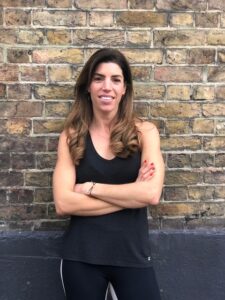
I grew up in North Yorkshire in a tiny village in a fairly remote part of North Yorkshire. I went to Bristol University and really thrived there; I read French and loved it and lived in France for a year as part of that degree. I then went straight into the world of advertising and worked both agency side and then, more latterly, on the client side.
I spent about a decade in advertising, but got to a point of burnout. I started to neglect myself and invest a bit too heavily in the slightly hedonistic lifestyle that advertising involves. I was leading Ikea’s advertising strategy at the age of 24 and managing multimillion media and production budgets. It was a huge upward learning curve and I thrived on that but it was also a lot of pressure.
I moved sideways out of advertising for a little while, and joined a social enterprise called We Are What We Do. Their whole ethos was about engaging people in small actions. It was a wonderful organisation and felt so much more fulfilling, but I still hadn’t really found my groove.
I ended up taking a U-turn and going into the fitness industry largely because I had discovered this incredible method called Barre based on ballet movement which literally transformed me physically. Barre is a strengthening and conditioning component of ballet, and essentially consists of all of the movements that a ballet dancer would do in order to prepare themselves to dance and to develop, build and maintain the right kind of structures and posture in their bodies.
I stumbled on this methodology and was completely hooked. With my advertising hat on, I realised that more people needed to know about this incredible methodology and if it could change me and my physique then it could also change the lives of other people.
I therefore took a bit of a gamble on setting up a studio here in London in Richmond and that was the first dedicated Barre studio in the UK. Nobody had ever heard of Barre and I was taking a huge risk. I took on an old office space in Richmond and created a studio that felt like a home from home. People came – and they queued around the corner to be a part of it. I ran that business for 12 years.
However, over the course of that 12-year period I left a very long term relationship. I had been in that relationship for 20 years, married for 12 and I found the relationship stifling, and more latterly quite coercive. It didn’t enable me to be the best version of myself and it took a really long time for me to get the courage to leave. My childhood had conditioned me for that kind of relationship. I grew up thinking I had to live up to a certain narrative and stay in my lane and live quite a gendered expectation of how I would go on to live my life.
After I left the relationship, I heard that SAS: Who Dares Wins was inviting women to apply for the programme. I mentioned this to a few people and I was encouraged to apply for it which I did and then I ended up on that programme and really discovering what my capabilities were. It was quite a life-changing experience and I got through to the final stages of the show.
There was a lot of press surrounding it because it was the first year that women participated so there was a lot of expectation and speculation about how we would be treated and whether it was right or not. Even the team of special forces operatives who run the show weren’t quite sure how it would all work out. I had to face fears I had had throughout my life, such as heights and water. I had to really believe in myself.
What I realised from doing the show was that embracing vulnerability is a very powerful thing. The idea of facing my fears became quite intoxicating and I entered this phase in my life where I said yes to everything. I was at a press event for Who Dares Wins and someone asked me if I would like to row an ocean and I just instinctively said yes. I had grown up with this fear of deep open water as I had had a near drowning incident when I was 12 with my sister and just avoided going in deep water my whole life.
To take on this new task, I ended up doing cognitive behavioural therapy and open water swimming coaching. I had various panic attacks along the way trying to deal with the underlying reason for that fear in the hope that my fear responses wouldn’t threaten my life or the lives of others that I was on the boat with. Then I embarked on this huge campaign to row across the pacific from San Francisco to Hawaii for a distance of 4,000 kilometres. We got the boat ready, and raised £70,000 worth of sponsorship. We packed our boat up with all of the kit and supplies that we needed – and then Covid happened and the race was cancelled.
That was soul-destroying. The two crew mates who I was meant to row with, and who I had known for a significant period of time, didn’t defer their places so they weren’t able to do it at any further point in the future. I had the choice either to walk away from the whole thing or to find new crew mates. There were too many people involved to let down. It’s not easy to find people with the resources and capabilities and flexibility to do something like that but I did eventually find them. Since we were in lockdown, I didn’t meet one of them until we got to the start line in 2021.
We had to go through all the processes of taking on skills and assimilating knowledge that you need to do an ocean row through lockdown. The gyms were all closed so we trained in our living rooms. You have to learn chart navigation, you have to master radio communication, you have to do first aid at sea courses. All sorts of courses were required for participation so we did a lot of that on Zoom.
We set off at the end of May 2021 and we arrived 60 days, 17 hours and 6 minutes later. Sadly, the team dynamic from the start was really problematic. There was some really bad behaviour – a lot of psychological game-playing, stonewalling, and bullying isolation tactics. I found it a very difficult experience. It’s important to remember that in the run up to the row we also hadn’t had the opportunity to spend time together, and therefore to explore our reasons for doing it, and to share our insecurities and fears. It was a really hostile environment.
I was also seasick for 23 days which was very debilitating. When I was off the oars I felt horrendous. The truth is that you can’t let conflict escalate on a tiny boat in the middle of an ocean so I really had to just tolerate and accept the situation I was in. It wasn’t particularly enjoyable but we did pull together as a team at times and ultimately we got the world record.
I learned a lot through that process, not least about how to manage your thoughts and emotions and how to tolerate really emotionally challenging situations where there is literally no way out. As a result of my experiences, I have become a stress and resilience coach. I am a qualified coach of a mind-set methodology that was developed for the All Blacks Rugby team back in 2001 when they kept losing at World Cup Finals.
I have become really fascinated about how our brains work with thought and fear and stress and how we are more in control of that than we think and how important choice and autonomy is. For people in toxic environments it is helpful to be reminded of the fact that we are ultimately in control of our lives however difficult and challenging our situations might be. One thing that we are always in control of is how we think about things and therefore how we influence our emotional responses.
The thing I try to make really clear is I am not advocating that emotionally challenging workplace situations should be tolerated but if there is a situation that you can’t get out for a period of time – as I couldn’t on that boat – then there are some really useful strategies that you can employ to get on top of your thoughts.
It’s about understanding how our stress responses work. We can regain perspective, take a step back, and choose what kind of head state we want to be in in a given situation. That’s a skill. You have to practice it. It’s not something that you master and conquer and become an expert in for the rest of your life.
What makes a difference is having that little bit of biological literacy, and understanding of basic neuroscience. If we don’t do that, we can be really hard on ourselves. These days, we get extremely stressed about things that are not life threatening at all so our stress responses are completely at odds with reality. If we understood that, we would be able to cut ourselves a lot more slack.
After I did the row I was left with a sense of lost faith in teamwork, and brought the whole campaign to an end. I made myself a promise that I wasn’t going to become this person who had to keep doing more and more crazy things but apparently I have become that person. I just kind of knew that I needed to put some things right.
So I asked a friend if she would run across the Arctic with me. We did a 250 kilometre footrace carrying everything that we needed to survive and it was an incredible experience in minus 35 degree temperatures. You literally couldn’t stop or you would get hypothermia or frostbite so it was very much about regulating your pace, and not getting too hot, or getting too cold. I have also done another ultra-distance run another 250 kilometres across Kenya – in obviously, completely different conditions.
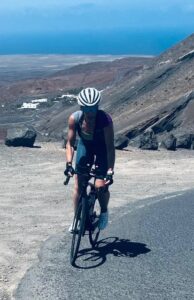
I am now training really hard to do The World’s Toughest Bike Race (The Race Across America) which is a 3000 mile West to East Coast race. It’s quite established in the US, but not that well-known in the UK. We are a team of four women, and hoping to beat the world record which is 6 days 15 hours.
That’s fast. We have to do an average of 19.3 miles per hour, so it’s non-stop 24 hours a day, with the four of us on a shift rotation pattern. We will get to sleep a bit but only in vehicles that are constantly moving. I am not a cyclist any more than I was a rower so for me it’s all about showing people that they can do anything and train capabilities that perhaps they didn’t think they had.
Finito World caught up with Finito Education’s likeable and passionate senior mentor, Tom Pauk
Tell us about your career before you joined Finito.
After studying drama, my efforts to become an actor ended with a whimper rather than a bang, and I retrained as a solicitor. The career that followed was a “game of two halves”, half-time marked by the global financial crisis of 2007-08. In the first half, at City law firm Allen & Overy, then in-house at American bank Citigroup, I’d specialised in large cross-border lending transactions.
In the second, I helped restructure loans borrowers had taken out in more prosperous times but were now struggling to repay. After leaving the bank in 2017, I began mentoring young men in prison, returned to Allen & Overy, now in a role mentoring lawyers in the early stages of their careers, and began writing plays. My professional life, it seems, had come full circle!
Did you feel your education prepared you for the workplace?
A degree in drama could not have prepared me better for the cut and thrust of commercial law, an above-all collaborative endeavour with a diverse cast list of characters, long “rehearsals” with unfeasible deadlines we somehow always managed to meet. At the conclusion of an especially high-profile deal there was the added satisfaction of reading the “reviews” in the financial press.
The practise of law is essentially an exercise in problem-solving. In my case, a love of modern languages and playing the violin had also prepared me for the intellectual rigour of law, and I was even able to use my mother tongue Hungarian in transactions with Hungarian clients. So to anyone reading this wondering whether a knowledge of an obscure language might prove useful one day, the answer is a resounding Yes!
Did you benefit from mentorship during your career?
When I’d started out, mentoring was still very much in its infancy. Fortunately, I was able to benefit from the law firm equivalent, the “seat” system, under which trainee solicitors move from one department (or seat) to another every few months to build up expertise in different areas of a firm’s practise. Each seat is supervised by a senior lawyer — part mentor, supervisor and critical friend — overseeing a trainee’s professional development.
Over the course of my training contract I was exposed to a variety of mentoring styles, which then shaped my own approach when I assumed the role. But I continue to benefit from ongoing, less formal mentoring in the shape of the extraordinary people I encounter and who inspire me with their wisdom. So in actual fact I’ve never really stopped being mentored.
What are the most common misconceptions about a career in the law?
I think there’s a general (mis)perception that law is a dry, bookish occupation, and that lawyers are aloof from the rest of society, be they pin-striped solicitors in their ivory towers or wigged-up barristers bowing obsequiously in courtrooms. In fact lawyers are widely dispersed throughout society, in the public sector (civil service, local authorities, regulatory bodies), in companies and banks, charities and NGOs. If you’re a young person considering a career in law you’ll be able to select from a wide range of specialisations that play to your unique skills and interests.
Mental health is a particular passion of yours. Can you describe how your interest in that area came about?
There were occasions, especially early on in my career, when my mental health was impacted under the pressure of work. Symptoms included poor sleep, high anxiety and irritability, and a compulsion for checking work emails 24/7. Back then, there was a stigma around discussing one’s mental health, let alone seeking help when you needed it. Worse, it was regarded as a sign of weakness, possibly even career-limiting, to self-disclose. So one’s natural instinct was simply to keep quiet and soldier on.
Thankfully, we’ve evolved to a more enlightened view of wellbeing in the workplace, with a plethora of interventions designed to promote a healthy mind as well as body, including mental health first aiders, mindfulness, and discouraging staff from checking work emails after hours. Eight years ago, the memory of my own experience led me to train as a volunteer at a mental health charity. At The Listening Place I’ve seen vividly for myself how poor mental health can quickly escalate into crisis, and how being truly listened to can be life-saving. Literally.
Work-life balance is something you’ve been vocal about. What are the most common pitfalls people fall into there?
Most people understand the importance of achieving a sensible work-life balance, at least intellectually, And it’s hard to argue against. But here’s the challenge: we’re not necessarily aware of the pendulum as it is swinging in the wrong direction. Whether it’s staying ever-later in the office, checking, or worse, responding to emails at weekends (“because it’s already tomorrow in Tokyo”), before we know it life is work and work is life. Of course we tell ourselves that it’s only temporary, that as soon as we’ve broken the back of whatever it is we’ll take our foot off the accelerator.
But it isn’t that simple, for we may unwittingly have recalibrated our benchmark of what a normal working day is. We’ve trapped ourselves into believing our own indispensability (“If I don’t do it no-one else will). We assume that working harder improves performance, demonstrates commitment to our employer and enhances our prospects for promotion. I’d counsel anyone reading this to challenge these assumptions and to listen out closely for the whirring of your inner pendulum!
You obviously have a passion for mentoring. What are the most common challenges you’re seeing among your current crop of mentees?
I’m certainly seeing the longer-term impact of the pandemic. This is the generation whose educations, family and social lives were disrupted by successive lockdowns. And I’m in awe of just how well they’d adapted to remote ways of studying and working. Another challenge is the sheer number of high-calibre applicants vying for limited places on the graduate recruitment schemes of investment banks, accountancy firms and corporations. Training contracts in City law firms are similarly over-subscribed, and with increasing candidates achieving top grades there’s now a far greater reliance on critical reasoning and situational judgement tests, presentations, written assignments and long assessment days.
However I’m also sensing some really positive new trends, with mentees less motivated by achieving huge salaries than they are by finding a fulfilling career. And finally, one positive legacy of the pandemic: Finito mentees are often engaged in volunteering activities, whether it’s repurposing old computers and teaching older people how to use them, mentoring disadvantaged kids, or stacking boxes in foodbanks. Something, finally, to celebrate in challenging times.
Do you vary your process for each mentee, or do you have a particular approach which you use with each candidate?
Mentoring is a transformative tool for supporting the development of a mentee, and because no two mentees are the same the mentoring process does inevitably vary. Having said that, there are common features in my approach. In the first place, it’s not about the mentor. Our prime responsibility as mentors is to listen attentively at all times to our mentees. Listening actively (as distinct from merely hearing) is a skill that one develops with practice.
And it’s crucial we’re responsive to the stated needs of our mentees rather than clinging stubbornly to our own agendas. One unique aspect of mentoring is our willingness to share our own knowledge and experience to support the development of our mentees. A word of caution however, because this has nothing to do with being directive. What we’re aiming to do is empower our mentees to think and act for themselves. Finally, mentoring is a two-way street. At its most fruitful the relationship between mentor and mentee is one in which sharing and learning opportunities arise for both participants. I’m forever learning from my mentees.
What do you know now in your career which you wish you’d known at its start?
Hindsight being a wonderful thing of course, here’s three things I tell my mentees. Firstly, it’s important to pace yourself, especially when starting out in a new role and you’re trying to make a good impression. Keep something of yourself in reserve for when you really need it. Secondly, don’t plot out your entire career from the get-go. Life has a mischievous habit of opening new doors and leading you in new directions. And thirdly, know where you add most value, and focus your energies accordingly.
Do you have any new challenges on the horizon?
I’m excited to have just been appointed to the board of the Joseph Rowntree Charitable Trust, whose endowment supports people tackling the root causes of conflict and injustice. Along with my governance responsibilities, I’ll also be involved in grant-making decisions, an area entirely new to me.
Ever wondered why hybrid working is the future? Finito World looks at a question likely to be of perennial interest well into the future
Hybrid working is proving itself remarkably flexible and popular.
New research from IWG shows that hybrid working has led a boom in ‘active commuting’, with increasing numbers of workers travelling to local flexible workspaces via foot and bike.
That’s good for our health, both physical and mental and is just another reason why employees seem to be voting with their feet nowadays.
The study found that commutes to local workspaces are 38% more likely to be active than commutes to city centre locations. Workers aged 55-64 have reported a 109% increase in active commuting, the most of any age group.
Health benefits
That also has a significant knock-on effect. This follows recent census data which revealed that those who walked or cycled to work face a lower risk of mental or physical ill health, lowering their risk of admission to hospital for any illness by 10-11%.
The increased use of local flexible workspaces by hybrid workers has been central to this shift. Almost two thirds (62%) of commutes to local workspaces are now mostly or entirely active. This is a 38% increase compared to commutes to city centre offices.
The study was conducted by International Workplace Group (IWG), the world’s leading provider hybrid working solutions. It included brands such as Regus and Spaces, and included more than 1,000 hybrid workers. It found that walking (88%), cycling (34%), and running (28%) were the most common forms of active commuting. Workers travel on average 324 km via walking, 366 km via running, and 418 km on bike to a local workspace annually.
The research also revealed some more novel forms of active transport, including travelling to work by scooter (7%), skateboards (6%), and rollerblades (4%), as workers cut long daily commutes by train or car and take advantage of workspaces closer to where they live.
Rise of the “silver strollers”
Hybrid work creates generation of “silver strollers”
The research also reveals that older workers have made the most significant increases to the time they spend exercising as part of their commutes. Those aged between 55 and 64 reported a 109% increase in active commuting when travelling to a local workspace instead of a central office.
Two thirds (67%) said they are more likely to incorporate physical activity into their commute when travelling to a local workspace instead of a city centre location. Meanwhile, more than three quarters (79%) have reported improvements to their physical health as a result.
The most popular form of exercise for this “silver stroller” generation is walking, with workers aged 55-64 travelling an additional 259 km a year on foot by active commuting.
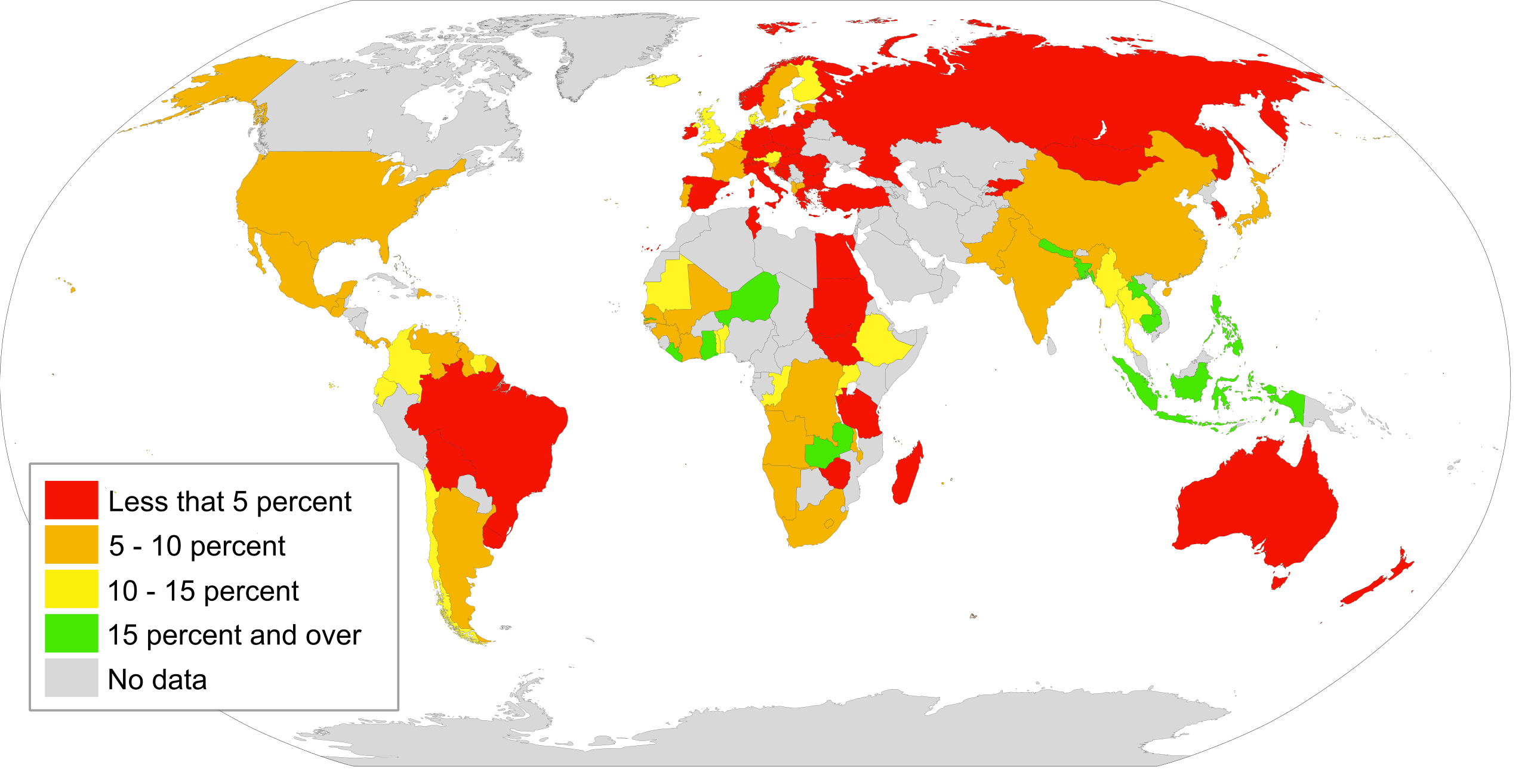
This map shows the percentages of hybrid working by country
A Question of Productivity
Active commuting fuels mental health and productivity gains
Beyond the obvious physical health benefits for all generations, active commuting to local workspaces has improved mental wellbeing, productivity and work/life balance. More than four in five (82%) of those that active commute said that incorporating exercise into their commute improved their mental health, with three in five (60%) reporting increased productivity at work.
This is supported by additional research from International Workplace Group which found that three quarters (75%) of workers experienced a dramatic reduction in burnout symptoms, after transitioning to a hybrid model***.
The improvements to work/life balance have resulted in 85% of hybrid workers saying they are more satisfied in their jobs and 75% reporting higher levels of motivation.
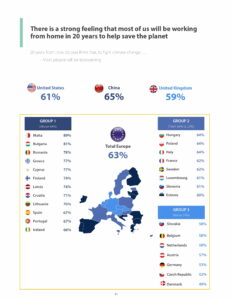
This chart shows strong consensus around the ecological benefits of working from home
Closer to Home
Given the clear health benefits of active commuting, it’s no surprise that nearly three in five (59%) of workers want their employers to provide access to local workspaces closer to home, so they can fit in more exercise – as three quarters (75%) say they are more likely to incorporate physical activity into their commute when using a local workspace.
It appears that business leaders are listening to their employees. Recent research among more than 500 UK CEOs found that three quarters (75%) said that returning their employees to a central office five days a week isn’t a business priority. Two thirds (65%) said they would lose talent if they insisted on their employees being present in a central office every day.
IWG locations in rural, suburban, and commuter areas have seen a surge in foot traffic since the lifting of Covid-19 restrictions. Towns like Uxbridge (up 1839%), High Wycombe (up 1412%) and Maidenhead (up 1186%) experienced significant growth in footfall between June and August compared to the same period in 2021, when Covid-19 restrictions were in place.
Win/Win
To help meet this demand, IWG has opened more than 300 new locations in the first half of 2024, with the majority in rural, suburban and commuter areas closer to where workers live.
Mark Dixon, International Workplace Group CEO stated: “The growing use of workspaces closer to where employees live, allowing them to reduce long daily commutes, is contributing to major improvements in worker’s physical and mental wellbeing.
“This research demonstrates that hybrid working is a win/win for everyone. Business leaders are seeing substantial productivity and financial gains, while employees enjoy a better work/life balance and higher job satisfaction.
Companies are increasingly appreciating that they will not only will they have a happier, healthier workforce when they allow people to work flexibly, but people actually feel more productive and motivated.”
Need mentoring about hybrid working and the future of work? Go to finito.org.uk
Christopher Jackson updates readers about progress on Finito’s work with a particular student from the Landau Forte Academy
At Finito, we are sometimes asked why it is that one-to-one mentoring works: one possible answer is that people are complex.
During our lives – and especially our early lives – experience can often feel bewildering. Things come at us fast, and contradictory impressions are arrived at. Soon the world can seem insoluble.
There is no better way of tackling all this than the concerned help of a mentor. At Finito we take it a step further and make sure that our candidates have the benefit of numerous mentors: the reality is that it takes time and a degree of luck to establish the right kind of mentor-mentee relationship. This means that students often need to try several mentors before discovering the right one.
At Finito, not all we do is aimed at those punch-the-air moments: the place secured at a top university, the new job, the promotion. These are rewarding, of course, but they’re very far from the whole story.
More typically, mentoring is full of small wins – it can open up onto a world of quiet reward, and subtle attainments. Sometimes when you look back at the road travelled, you can be surprised by how far you came by small steps. But it usually happens that in these more mundane things might be contained the seeds of some important revelation.
All these factors are present in the fascinating story of Joseph McDonald, a Bursary candidate of whom we at Finito World are proud.
McDonald is one of our mentees on the outstandingly successful Bursary Scheme, which we continue to conduct in partnership with the Landau Forte Academy. Finito mentor Andy Inman, who was instrumental in setting up this arm of the bursary, remembers his first impressions of Joseph when he was introduced to us.
“Joseph is, by his own admission, not particularly social. He doesn’t like groups and crowds, and has very little home support to speak of. The important thing to realise when you have a candidate like that, is that small tasks become big things.”
When Joseph joined our programme, he was about to leave to take a computer science degree at Lancaster University; he was already in a state of anxiety about what life would be like for him. “I was nervous about making friends and finding the right friendship group when I first came to university,” he tells us. “This is something that I struggled with in the past at school. It was definitely my number one priority upon arrival.”
Inman decided that Joseph required a caring, nurturing mentor and he couldn’t have made a better selection in this than Coco Stevenson. “I knew that Coco would look after him,” Inman recalls. “What was required might sound insignificant but they were not to Joseph: we’re talking about things like packing lists, and so forth – all the pre-university tasks which you have to do before the leap to university. Some of these things, of course, a parent should do – but for whatever reason Joseph doesn’t have that.”
Inman’s remarks are a reminder that as we go on in life, we typically come to know the world and forget what it was like not to be sure about things we later come to regard as obvious. Inman recalls: “It was mentoring at its most granular, in a way – all about the detail. How would Joseph get to university? How would he make applications for student loans? Where would he shop for a duvet and for cutlery?”
But what Joseph most feared was Fresher’s week. “Most people would love that, but for Joseph it’s really the antithesis of what he enjoys – so he had to be talked through that.”
Stevenson stepped up and in time developed a profound relationship with Joseph. She tells us she was mindful of the magnitude of Joseph’s achievement in getting to university at all: “Joseph is the first in his family to go to university and we should remember that Lancaster University has one of the best Computer Science courses in the UK,” she tells us.
But Stevenson also never lost sight of the difficulty for Joseph: “Going to university is a major transition in a young person’s life and is all the more difficult coming out of a pandemic – especially when you are a neuro-diverse person, as the world is not always set up for people who are not neurotypical,” she continues.
Stevenson gives us her first impressions of Joseph: “My mentee was not especially confident in the months leading up to moving to university and there were a number of worries and concerns.”
Difficulties of this kind must be tackled head-on, and together, Coco and Joseph began to explore the issues: “Working regularly together, we were able to ‘workshop’ issues, come up with strategies and plan for eventualities,” she recalls. “Planning and strategizing helped enormously in accomplishing tasks and not being derailed by unforeseen things.”
Stevenson used her experience of university life to begin to create a plan for Joseph. Joseph now recalls this fondly: “We discussed the kind of activities I could get up to, including the structure of academic events and the social events I could engage with outside of my studies. Coco encouraged me to convert my ideas of involvement into a more solid plan that helped me find my grounding as I began living away from home for the first time.”
Soon the pair of them had alighted on a strategy: “Coco explained that societies are fundamental to finding people with similar interests and a great place to make friends. She advised me on how many societies to attend, and how to approach the problem of deciding which societies I would continue attending. This was how I became part of the Sober Society, and I am so grateful to Coco for this.”
Gradually, Joseph began to feel confident, oriented in his new location, and in time able to feel at home. Stevenson looks back with satisfaction at the way in which Joseph’s sense of self developed in those early months at Lancaster University: “Each small step led to successes which in turn led to increased confidence and satisfaction. My mentee went from unsure and nervous to confident, assured and assuming various leadership roles, as well as achieving academic and social success.”
One of the core principles of Finito’s mentoring is that we want to be there for the long haul for our candidates. Coco and Joseph remained in touch as Joseph settled in, and Joseph still talks today of how the checklists and preparation that they made together helped him focus on his lecture content.
But then, a chance came up, and Joseph joined the Sober Society. Joseph remembers: “The Sober Society isn’t a recovery program and does not require you to never drink alcohol but provides a safe space for non-drinkers to have fun and an alternative for those taking a break from alcohol. I was enjoying participating in the events the Society had put on such as game and film nights.”
By regular attendance, Joseph soon discovered another opportunity: “It was announced at one of the events that the Society would soon be holding its annual hustings for the executive positions in the society,” he recalls. “As a new society formed only in that October of 2021, there were only two full time members of the executive, so they were looking for more to fulfil other roles. It was suggested by a friend of mine that I should apply for treasurer. I was uncertain of this since I was concerned it would create more work than I would be able to handle at this early stage of my university life.”
By this point the mentor-mentee relationship was far advanced. “Upon a call to Coco, I was reminded of the advantages of holding such a position. Such positions are seen positively by future employers as it shows leadership, commitment, and initiative. As one of the two candidates up for the position, I won the vote.”
Joseph’s tenure as Treasurer of the Sober Society was a huge success. He presided over a period of expansion: “By the end of the first term, we had over 150 members. This meant we were already one of the larger societies on campus. Issues surrounding alcohol are close to our hearts within the executive, so we were ecstatic at our success.”
And this success in turn began to be noticed: “After the end of the 2021-2022 academic year, our president was contacted via our Instagram account by student blog Student Beans. They were interested in the values of our society and studying Sober Societies across the country. This was representative of our success.”
Joseph began to create plans for the future of the Sober Society and for his own future, even planning a collaboration with other sober societies at Manchester Metropolitan University with trips scheduled to destinations such as Edinburgh. In addition to this he also got a girlfriend.
But this is where the story shifts: unfortunately towards the end of his first year Joseph got into an incident at the university, an altercation in which a door handle was accidentally snapped, when Joseph reacted to something a fellow student had said about his girlfriend. Joseph wasn’t at fault – indeed had shown admirable judgement – but the situation sadly rattled him and he decided not to intercalcate.
It was at this point that Finito deepened its involvement still further, as Coco voiced concerns with the Finito management about Joseph’s mental health. Mental health has been a core aspect of Finito World and we sought immediately to have him assessed by Paul Flynn, the brilliant CEO of leading mental health organisation AddCounsel.
Flynn explains: “When I spoke with Joseph he was on antidepressants, and my sense was that he had better support from Lancaster University than people usually get in these situations.”
Flynn then relayed his advice to us: “One of the challenges Joseph has is around resiliency: whether that links back to the way he’s wired up or not, it’s something that needs to be looked at. If it isn’t taken care of, then it will resurface. A very good CBT-based therapist should be able to support but so could a coach with expert knowledge of resilience skills.”
Before setting this up, we asked about Joseph’s desire. “When you get a coach you’ve got to be sure there’s that level of desire, and a wish to sort out a situation. I think that’s there or he wouldn’t have gone on the phone with me. But his plan is to go back home, and there’s no real work plan. He needs structure.”
Enter Finito mentor Talan Skeels-Piggins, who is ideally-placed to help students in this kind of situation. Skeels-Piggins’ story is unique and makes him an ideal fit for Joseph. Having been a PE teacher Skeels-Piggins suffered a terrible setback when he lost the use of his legs in a car accident. This, however, was the prelude to an astonishing display of fortitude, and he has gone on to be a Paralympian Olympic gold medalist in both motorcycling and skiing. He recently published a book The Little Person Inside which describes his extraordinary life.
Skeels-Piggins has been able to find meaning in a situation which would have defeated many others, and he seemed an ideal mentor for someone like Joseph struggling with mental health issues.
This means that Joseph has now embarked on a second mentor-mentee relationship, following on from his continuing association with Coco. Talan has begun to deepen his understanding of what Joseph actually wants, and been able to uncover too that some of the origins of his difficulties came during the pandemic when he spent less time in school than he would have liked.
In terms of the future Skeels-Piggins’ sense of Joseph’s future has crystallised during their sessions: “He needs to realise that he is enough by being Joseph, and not having to prove himself to be loved. This leads him onto the issue of not knowing what he needs to do for his future as he is only doing the current course because he felt pressure to go to Uni in order to please parents.”
After a later session, this began to deepen: “Joseph is not interested in the corporate world but wants to do something; tangible, real, that you can see, be proud of, helps others and makes a difference in the world. He admits he is not interested in computers and would not want to get a job related to computers once out of Uni. When we were talking about litter-picking, pond cleaning projects and other ecology-based activities he had done in the past he began to show interest and smiled whilst reflecting about the events.”
Joseph therefore has a momentous decision ahead of him: whether to return to university or whether to choose another path altogether and look for a future related to the environment or sustainability.
When such things are at stake, it’s our experience at Finito that people are will struggle to make a choice when they don’t have enough information at their fingertips. At such crucial moments, it can never be a bad thing – and will almost always be a good thing – to look for more information about what might work best.
Joseph’s stated interest in the environment and climate change caused us to think about people in our network who might be of use to Joseph and we approached the former Green Party leader Natalie Bennett to ask if she would be prepared to take a call with Joseph to take him through the options. She very generously assented and though the call will take place after this magazine has gone to press it is a measure of how far Joseph has come that the boy who was worried about Fresher’s week is soon to talk to the former leader of a major political party. Joseph should be proud of that.
Joseph’s story is evolving all the time, but the support so far provided him would have been impossible without the commitment of two Bursary donors in particular, whose generosity has been matched to Joseph’s needs.
In the first place, we would like to thank, Simon Blagden, CBE, Chair of Building Digital UK and former Chair of Fujitsu UK. Blagden says: “I served the Government’s advisory panel reviewing the future of technical education. During the two year process we met with hundreds of young people all over the country. I am delighted to support the work of Finito. The valuable work which you do strongly resonates with both students and their parents.”
Secondly we would like thank Dinesh Dhamija, who says: “I have been helping entrepreneurs through coaching and mentoring over the past 17 years. Finito’s focus on young people is admirable and I am proud to join their group in support. My own expertise is in the fast growing online Business to Consumer sector, and the green energy solar and Hydrogen fields.” We hope to use this expertise in future when it comes to Joseph’s story.
Joseph has already come a long way. The way ahead isn’t clear, but is becoming clearer all the time. What’s certain is that we stand shoulder to shoulder with him as a business, and as a bursary, and are committed to his success.
I meet Fatima Whitbread at a restaurant in Westminster and immediately warm to her kindly down-to-earth manner. Whitbread is one of our best-loved athletes, having won the World Championship in the women’s javelin in 1987, and a former world record-holder in that event.
We sit in a corner and order our food, which prompts reminiscences about Whitbread’s relationship to diet when she was a top athlete: “You are what you eat – for me, when I was a competing athlete I was constantly working three times a day training. Most of my competitors were six foot and I’m 5 foot 3 so my diet had to be right. I was on a diet of about 8,000 calories a day which is a huge amount, usually women are on 2,500-3000.”
But Whitbread’s story isn’t an ordinary one. Her childhood is enough to make you fight back tears. She was abandoned as a child and spent her early life in care. “I was left to die,” she recalls. “A neighbour heard a baby cry and called the police. They rammed the door down and rescued the baby. I spent the next seven months in hospital with malnutrition and nappy rash – I’m pleased to say I’ve recovered from that.”
Whitbread says this matter-of-factly and I find it hard to feel that there is residual trauma: she is serene, and I will come to learn that this has to do with the rare sense of mission she feels about fixing the social care system. “The reason it’s been my ministry is that I was made a Ward of Court by Hackney Borough Council. I spent the next 14 years of my life in children’s homes. These were institutions with large numbers, all run by matrons – and our emotional needs were not really being met.” Whitbread then gives me a heart-breaking detail: “My first five years were spent in Hertfordshire.
I spent a lot of time in the playing room which faced the car park. I remember whenever I saw anyone come in I’d say: ‘Is that my mummy coming?’ A lot of us children felt that way. Nobody ever really sat me down to discuss things. There was nothing at Christmases – nothing to indicate there was anybody out there for me.”
One day Whitbread’s mother did turn up, when the future World Champion was five years old, and this led to an unspeakable set of events. “That morning I sat in the foyer. There was an opaque glass window and the matron opened the door and a large lady with curly hair came in – but she never looked across to me or made eye contact. Then there was a lady with mousy hair, duffel coat on, smiling and engaging and I thought: ‘That must be my mummy’.”
But of course, her mother was the lady with the curly hair: “In all the journey down to the next home in Hertfordshire, I sat in the car and nobody spoke to me. The biological mother never spoke to me. We got to the next home, a small residential place, and I was told to go through to the garden. There was a little girl of four there, and I started playing with her. I was about to go down a slide, and then I felt a hand on me: “You look after your sister otherwise I will cut your throat.’ Those were the first words my biological mother said to me.”
Another appalling episode occurred when Whitbread, aged nine, was taken out of the home and raped “at knifepoint” by her mother’s then boyfriend. There seems to be no other word for this than evil. But incredibly, the story has a happy ending. “Sport was my saviour. I was at a netball match and I saw a javelin on the floor and it seemed interesting to me. Then a voice behind me said: ‘I see you looking at that javelin. Would you like me to teach you to throw it?’ This would turn out to be her surrogate mother. “Through that I discovered the love of the Whitbreads,” she recalls.
All this amounts to a damning indictment of the social care system as it was in the 1970s, but more worrying than that is that it isn’t necessarily leagues better today. In fact, it seems an issue which governments don’t want to go near. “In many respects it’s the same. I’ve seen governments come and go, and the care system really is broken. It’s not serving the children well.”
To say that Whitbread is a passionate campaigner is to riot in understatement: throughout our conversation I can sense the intensity with which she used to throw a javelin has been transferred to this admirable mission. She is also, of course, a loving advocate as she knows exactly what she’s talking about – precisely what it feels not to have your needs met as a child. Knowing the terror these children are experiencing, she knows the dimensions of love required to fill these gaps. “I’m a great believer that children are our future, and that what they become will define what our society will become.”
So what’s the goal of Fatima’s campaign? “I want to build happy lives, better communities, and a better society, and the only way we can do this is with collaborations,” she tells me. “I’ve confirmed a two day summit next year for the 23rd and 24th April at the Guildhall in London. We’re non-political but we do need cross-party support. We want to harness the power of one voice and bring the four nations together. There’s a lot of good work on the ground level but there’s no collaboration.”
The summit will include young people (‘they’re at the forefront of everything’), as well as decision-makers, charities and donors. What Whitbread is aiming at is nothing less than “the rejuvenation of the system” through strategic partnerships. “I want to bring the private sector in too,” she says with her bright, kindly eyes flashing.
“We’re looking at employability initiatives for our young people who are between 18 and 25 year olds to help upskill our young people. 27 per cent of our young people suffer from mental health problems too – and affordable housing is another issue which we need to tackle. The people in the system don’t have Mums, Dads, aunts and uncles to advise them and, appallingly, the government wipes its hands of it. In addition to all this, when they leave the system, 33 per cent of them in their first two years end up homeless.”
But the forces of darkness likely haven’t reckoned on the astonishing energy of Whitbread. “It’s down to me to use my lived experience and Olympic platform to meet people, to get through doors, and get the campaign together.”
Fatima’s UK campaign is seeking private funding in order to roll out an ambitious scheme across the country. For only £20 a week – which translates to £1000 a year – individuals or companies can sponsor a child in care to take part in weekly activities around technology, sport or art – according to what the individual’s interests are. “I want to make sure every child has the chance I had to become an Olympic champion.
I want to put them on a human path to reaching their potential and their goals. Every child has a right to a safe and happy childhood, but if they do end up in the care system, they need to have a safe, secure pathway to come out of that system, to be educated properly, and to feel secure that there’s a proper foundation for the future. In that way, they can break that cycle and live a proper independent life so that history won’t repeat itself when they have a family. I believe we can manage that: it’s not impossible – in fact it’s very doable.”
Others agree and have pledged their support – especially those in the new Starmer administration. “We have a charity dinner on the first night where Lord John Bird, the founder of The Big Issue will speak. Sir Keir Starmer has pledged his support as have members of his government such as has Yvette Cooper. The Timpson family do a lot of work in prisons and they are also on board.”
Prisons are very important to the campaign. “I do a lot prison visits,” Whitbread says. “I want to engage with young people so they have something to go to. That’s half the problem for young people when they come out: there’s nothing to come to. Then they realise they’ve got a warm cell, food and friends inside and it’s a wasted opportunity for life. We have these collaborators but who don’t talk to each other, which is a shame. We’re all in it together.”
Whitbread is one of those rare people who has found a second act in life – and she is pursuing it with the same passion that she did the first. There is a possibility that if we heed her call, we can all hand on a better life to the children of the future.
The remarkable Chairman and CEO of The Kusnacht Practicetalks about the pandemic and his business philosophy
It was the French philosopher Jean-Jacques Rousseau who said that anyone peering into the heart of man would want to travel down in life, not up. In crude terms what he meant was that to be successful you have to make accommodations, and become in some way unpleasant.
I’ve often wondered whether he had it exactly wrong. He should, for instance, have talked to the immensely successful CEO and Chairman of The Kusnacht Practice Eduardo Greghi.
Brazil-born Greghi is one of those people in life who emanate goodness – and he reminds you that the kind can prosper, and that you don’t have to be Machiavellean to get on in life. He explains right from the outset his admirable business ethos, and is all bonhomie and transparent openness: “I want to display to the world, and to my clients, exactly what they will get. I only ever take money from clients if they’re benefitting from our treatment.”
The Kusnacht Practice is at the high end, but then for people whose lives have come to a very difficult crossroads, the price tag is definitely worth it. At The Kusnacht Practice, confidentiality is paramount, but Greghi gives me an example: “We had a couple come in. They’d got married and had two children straight away, one after the other. Immediately, everything changed for them. Hormones had changed, they weren’t sleeping and they’d gained weight. And what happens then? Anxiety kicks in, and then depression. As a couple you start to argue and have relationship issues – even if you’re wealthy. They came to me and said: ‘We want to reset. We need help’.”
At The Kusnacht Practice all needs are met so that clients can focus on their well-meaning
This makes you realise what’s at stake for the families which The Kusnacht Practice treats: it’s nothing less than your whole life. At that point, the practice brings about a complete change. “They come with the children and the nannies, and we organise everything. They have individual treatments and couple treatments – whatever they need.”
When Greghi says everything, he means it: “I reinvest continuously in the quality of the client experience. This year, I’ve added three properties that are on another level. One of them is five times bigger than our largest property before. It’s modern and beautiful and well-located.”
You can feel that his enthusiasm isn’t to do with any crass delight in luxury for its own sake: this is all about how a suitably comfortable environment can help the client improve and eventually recover. Greghi continues: “For this latest one, we went with an Art Deco theme, so we have 1920s furniture. We’re not just going to put Ikea furniture in the rooms and hope it’s okay.”
Of course, what the luxury environment does is to make room for the client to focus on their treatment. It’s an aspect of what really sets The Kusnacht Practice apart: Greghi’s commitment to helping each individual in a tailored way.
Prior to the March 2020 global lockdown, Greghi would travel a lot. “I had been in England and then I was coming back to Switzerland. I had plans to go to Russia, Kazakhstan and then several countries in the Middle East. These trips were all cancelled because of Covid.”
Greghi continues to refine the client experience and makes sure everything is state of the art.
In this, you glimpse the international nature of the practice – and Greghi, who is multilingual in English, Italian, Brazilian Portuguese, German and Spanish, is the ideal front man for such an organisation. But it also takes you back in time. The Kusnacht Practice has ended up having a good pandemic, but it wasn’t clear in March 2020 how things would pan out.
Greghi takes me back to the situation, and is obviously moved by the way in which the staff pulled together. “Immediately, I decided that if I wasn’t going to be able to have clients for a few months I wouldn’t think of that as losing money. I would think of it as reinvesting. That’s what I did.”
Like many people in his position, he realised that he was responsible for the livelihoods of 100 people and their families. How did react? “My first thought was: ‘Wow, we really had a good thing going here’. I remember that time well. My brother had a business and it had to close down – and some of my entrepreneur friends, their businesses were wiped out completely.”
The injustice of the situation also hit him: “We’re not in this position out of bad management or because of lack of resilience, love, care, dedication, integrity or competence – just because of this virus.” The situation was complicated by the fact that though the businesses could offer emergency services under the new Covid regulations, a lot of the work which The Kusnacht Practice carries out doesn’t quite fall into that category. As it turned out, the team was able to secure special permissions from the government and conduct quarantined treatment as the pandemic wore on.
As things went by, Greghi showed extraordinary leadership skills: “I thought, ‘If we go down, we go down together. I’m the leader of this business, and I was really heartened by the way everybody was cracking positive jokes together – it helped keep people calm.” In addition to thinking of himself as a re-investor in his business at a difficult time, he also began telling his staff: “A good farmer doesn’t eat his seed corns”.
Greghi’s emotion is palpable and you realise that his paternalistic approach to his workforce is deeply felt. “Luckily, you know, I saved the seeds. I get emotional about it because I love this team.”
One suspects though that luck didn’t have much to do with it: Greghi had worked himself into a strong market position, and like other businesses who have done well during the pandemic, therefore had flexibility to use the time to improve The Kusnacht Practice client experience. “I told everyone that when a tsunami comes, all the plants get affected in the same way, but it’s the ones with strong roots which come back. So I brought forward renovations which we had scheduled for earlier in the year and I continued with the hiring I had planned before the pandemic.”
It’s this awareness and profound respect for other people which, I suspect, makes Greghi a cut above most business owners. “I’m the leader, you know, but I cannot achieve anything by myself,” he recalls. “But everybody rolled up their sleeves. If they had wanted to kick me, that would have been the moment, but we all stood behind each other.”
Did this whole experience deepen his connection to the under pressure CEOs who form a part of his customer base? I strongly suspect so, but Greghi gives a different answer: “I come from very humble beginnings. I grew up in a house without windows. I arrived in England in 2002 with £50 in my pocket. My family is very humble, very loving, and very hardworking. As a business-owner and as an entrepreneur, I’m used to holding risk. You have to be fearless but at the same time be loving and caring towards your team. Actually there’s only stress if you care.”
Of course, CEOs often talk up their team like this – but there can sometimes be a sense that mere lip-service is being paid. Things are different with Greghi. If you speak to some of his employees – whether it be Dean Gustar or Melissa Nobile – they display similar qualities of kindness and commitment to high quality. They have plainly been inspired by him.
Greghi, like Gustar and Nobile, exhibits a profound understanding of the condition of the wealthy. “You always have lots of things going on as a business leader,” he tells me. “You always have lots of problems to solve and decisions to make, and that causes insomnia, stress –burnout. Then some people start to self-medicate with drugs, alcohol, prescription drugs, or overeating. Then, you’ll start to have conflicts in your private life with your spouse, or with your relatives and it downward-spirals from there.”
What Greghi is describing is fast becoming the story of our times. Part of the pleasure of talking to him is to know that somewhere there are people who know how to address problems which are now so rife in our society.
Greghi says: “I believe if you keep the highest levels of quality, and the best client experience, people will get value from their treatment.”
At one point, he tilts his computer to show me the view out of his window, and I see a beautiful vista, including a lake, trees, and attractive houses. It immediately makes me feel calmer, as patients no doubt do when they check in.
At the centre of what the clinic offers are The Kusnacht Practice Standards, which have been so successful as to spark imitation from other competitors in the space. One of Greghi’s insights is that group therapy, though it can be successful for some, isn’t sufficiently tailored to the individual’s needs really to work in many instances. Greghi explains: “I believe that if you keep the highest levels of quality, and the best client experience, people will get the value for their treatment and they will come back when they need you or they’ll refer you further. As long as you keep these two things and you keep listening to your client, you find out what they need, and you give it to them.”
That sounds simple, but it’s hard to deliver – and in any event there’s more to it than that. Discretion is important, as are the facilities on offer, but really everything keeps coming back to his staff. “They’re extremely altruistic. We’ll talk to a client at 1am, or go to their house to help them. It’s not a job – it’s a passion, a mission, a calling.”
Given this, I’m fascinated to know about Greghi’s hiring processes. Greghi feels like a man who goes with his gut, and I can’t really imagine the sort of AI algorithm-driven processes one sometimes sees on the FTSE 100 at The Kusnacht Practice.
That turns out to be the case, and Greghi places great onus on trust, but he also emphasises the professional nature of the HR operation he’s developed, particularly in the last two years. “Nowadays, I don’t interview everybody, thanks to the growth we’ve seen,” he says. “Obviously if you need, let’s say, a chauffeur, he needs to have a driving licence. That’s going to make a lot of sense. And we have to check their background, as our clients are in sensitive situations and we don’t want anyone who could do harm, or might have a history of doing dishonest things. But beyond that basic criteria what I’m looking for is whether they have the heart, and will fit the culture. The reality is that if somebody comes here with just like a nine-to-five mentality, they will not survive.”
Greghi’s has been astonishing journey from his humble upbringing in Brazil to where he is today and he brings experience both in the property sectors (‘I love good hospitality and we’ve perfected it here’) and the financial sectors. This second thing obviously helps him, but again he is keen to stress the broader depth of talent at his business: “My finance team are a lot better than me.”
Greghi is a remarkable man, and for a while I find it difficult to pin down what makes him such an infectious personality. At one point, he says something telling: “If I was asked to clean this table, no matter whether I was being paid or not, I will do the best I can.”
There are few people I’ve met who deserve their success more. So what’s his advice to those who are struggling in today’s society? His reply has the feel of hard-earned wisdom: “I say to clients: ‘I cannot work with you if you die. You have to use everything in your control to improve. You have to look at your lifestyle. You look at your family life. Your diet’.” Then he pauses, and hits on it: “You know, you should just try and do one thing better today than you did yesterday. And also don’t do anything that will make it worse – that’s the best beginning. Then we try one little thing – maybe it’s only five minutes in a day. And then we go from there.”
With that, he’s called away. People need him – and they’re lucky to have him.
Eduardo Greghi was talking to Christopher Jackson. Go to kusnachtpractice.com
As part of our special on the Duke and Duchess of Cambridge, we asked leading thinker Dennis Stevenson to give his view on what is really under discussion
Mental health has come into the open over the last ten years aided among other forces by some strong royal support.
But what are we really talking about? If you get up from wherever you’re reading this and stop the first person you meet in the street and say “How’s your mental health?”, 10-1 that person will think you’re talking about an illness! If you say “how’s your physical health” they will answer the question as it should be answered. All of which is to say that we all have mental health. It can go up and down – and, as with physical health, we need to work out ways of dealing with any problems.
It is not an exaggeration to say that I didn’t realise properly that I along with every other member of the human race had mental health until I was in my 50s. It took me some time – and the injection of some mental ill health – to realise that it would be a good idea to learn how to manage my mental health for the better. And I’m still at it.
Unfortunately, by then my children had gone out in the world so they, poor things, were not brought up to believe they have mental health as well as physical health. But my grandchildren are being properly brought up. I very much hope and believe that every single one of them is aware that they have mental health and is learning tricks of the trade to deal with it.
I was given a cruel awakening on this at around my 50th birthday at a time when everything in my life was wonderful. I went away to our cottage in the country in the summer and woke up one morning with what I can only describe as a “pain in my tummy”. That pain became something worse and without boring the reader with the detail I descended into something which would be described as clinical depression for which there was no obvious cause.
I came out of it after some months having – wrongly – rejected any help from pills and indeed any other source. I have been “hit” by it happily not very often but several times over the 25 years since then and on each occasion there has been no obvious reason for it. And I believe I’ve learnt one or two tricks of the trade of how to deal with it.
That’s my story. What else have I learnt apart from the fact that I have mental health and I need to pay attention to it?
First and foremost, the human race is at an early stage of understanding mental health. You might compare it with our understanding of cancer 50 years ago.
An eminent psychiatrist told me 20 or 30 years ago: “So, Mr Stevenson, you are somewhere on the bipolar spectrum”. The use of “spectrum” is widespread and in most cases a rather dodgy use of English!
As it happens I have discovered that I am almost certainly not on the bipolar spectrum whatever that is. I am an extrovert in-your-face sort of human being but not manic. I do, however, have what my excellent GP at the time described as “dips” in mood. Is that depression? I don’t know – but then neither does anyone else.
Even so, I am very clear that we are getting nearer to being able to define depression, schizophrenia, ADHD, bipolar and all illnesses attributed to mental ill health. A professor at Cambridge, Ed Bullmore, wrote a book a few years ago arguing that depression is a physical illness and related to internal inflammation. The book is very compelling. We’re getting closer to being able to define these illnesses. A lot of research is going on but we’re still some way off.
How does one cope with mental ill health? The first thing that I have learnt is that as with many illnesses there are ways of dealing with depression that work and we don’t need to understand why they work. Too many of us despair that nothing can be done and suffer needlessly. What is true of many physical illnesses is also true of mental illness: drugs and therapies have developed without a clear understanding of why they work – but if they work, they work. So don’t ever let anyone persuade you that antidepressants don’t work. It’s just not true.
It is, however, a good idea to be in the hands of a psychiatrist who has a deep knowledge of antidepressants since there are horses for courses, as in most things. In the same vein “talking therapies” have been one of the major breakthroughs over the last 20 years. For every good therapist, there are several who are well-meaning but hopeless. However, it doesn’t alter the fact that they work.
In this context, there’s an absurd fault line in education in the UK. Psychiatrists who are medically trained, tend to be sceptical of talking therapies – although less so than they used to be. Equally, psychologists and psychotherapists are inclined to be sceptical of drugs, and are not allowed to prescribe them.
This division is ridiculous. If you go to a cardiologist he or she might have a different diagnosis than another one but they will work from the same toolkit. So a word of advice: if you have mental health problems and you can find a physician who encompasses both medical and psychological approaches, that is the ideal. Happily, there seems to be an increasing number of them.
The approach to “caring” is also important. If I walk out of my house today and break a leg, I will be in pain and be miserable. With a bit of luck my wife and children will want to make a fuss of me and soothe me! They won’t diminish the pain but I will feel good about what they say.
But the terrible reality is that if I move into what I will call “depression”, their sympathy will mean nothing to me. This is a big subject hardly ever dealt with, but it’s hugely important that carers understand this and are not demotivated by being rejected.
The last time I had a major “depression”, the symptom was that I felt that my wife was only staying with me because she was a decent person but she didn’t love me. I can remember being in bed and her saying “doesn’t 40 years (our marriage) mean anything to you?” And then at another time saying: “You’re like an extra arm on my body”. These are very wonderful things to say, but she got no reaction out of me at all –
and I know it was horrid for her. Yet they have stuck with me.
If you’re a carer for someone who has got mental health please do not be put off if they appear to reject you or take no notice.
I’ve one other tip that works for me. Particularly if you are an over-achieving type as I am, a natural reaction to a mental health problem is to try to get on top of it, solve it and cure it. My wife said to me years ago: “You should be more accepting.” It took me about ten years to realise what she meant: I must face up to the fact that as with many physical illnesses, it will never go away entirely but I must learn how to deal with it and expect it to return.
That is my current position. As it happens, my really bad “depression” has not reoccurred since 2007. I’m clear that it will reappear at some point before I meet my Maker. I am equally clear that the fact that I’ve got a much more accepting relaxed attitude to it is a major reason why it does not reappear more.
To say it’s Vincent Van Gogh season in London might be to overstate the case: it always is. Every day people come from all over the world to see Sunflowers in the National Gallery – that great tour de force which reinvents the colour yellow for all time.
The artist’s fame would have seemed odd to his contemporaries, especially those who knew his eccentric habits in Arles, in southern France towards the end of his life. There was a time when Vincent Van Gogh couldn’t get anyone to look at his paintings. Today, it’s hard to get in front of one long enough to have a proper look without a tourist straying in to spoil the view.
But great fame is often reductive: in loving his pictures so much, we’ve tended to simplify him. We attribute his current reputation to ‘madness’ – as if Starry Night were primarily an expression of insanity. It’s true that Vincent struggled all his life with what we would probably label today ‘bipolar disorder’, but the truth is that Vincent was always sane when he was painting, and that painting was in fact his best method of staving off episodes which occurred throughout his life. These were frequent and he was heartbreakingly honest about them in letters to his brother Theo: “It appears that I grab dirt from the ground and eat it, although my memories of these bad moments are vague,” he once confided.
It is an arresting image: the great painter literally eating the earth. It might even serve as a metaphor of his achievement: Vincent was always imbibing real life, insisting on it to an unusual extent. His is a world of peasants and down-and-outs: he might be the only great painter in history whom it’s impossible to imagine as a courtier.
If you look at the popular image of the artist, you could almost imagine that Vincent is a completely separate case, someone we can’t expect to learn from at all, because we are not mad and he was. But his greatness cannot in the end be assigned to insanity, but instead to skill, vision and application. This means that we have more to learn from Vincent and his methods than we might think: this is true if we want to work creatively, but true also no matter what we wish to do with our working lives.
The first thing we mustn’t do is think him a uniquely hopeless case as a man in order to consider him a uniquely remarkable artist. As the pandemic has brought into focus, the world is always liberally stocked with mental ill-health. We might be deluding ourselves if we consider ourselves well, and Vincent not. It may even be that the reverse is the case more than we might realise or wish.
Secondly, we mustn’t forget how much hard work underpins Van Gogh’s achievement. The popular caricature of Vincent’s life still seems to invite us to imagine the world binary, divided between the sane and the insane. In actual fact, his life increasingly makes me think that we are instead divided between those who are committed and those who are not.
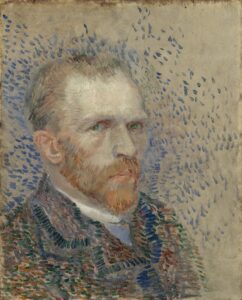
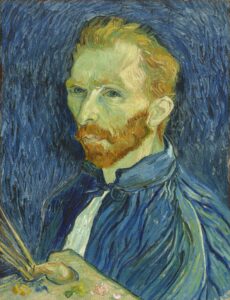
With all this in mind, I have come to the Courtauld Institute to see a remarkable exhibition housing 27 Vincent self-portraits collected together across two rooms. The Institute has spent a fortune renovating itself, and emerged on the other side of £57 million in expenditure looking almost identical to what it looked like before.
Anyone who wishes to get upset about this financially alarming decision however, can seek solace in being restored to one of the great collections of the world. Among them is Vincent’s famous Self-portrait with Bandaged Ear, which he made after the terrible and incomprehensible incident in Arles which most people know about: after experiencing increasing tension in his friendship with Paul Gauguin, he cut off his own ear and delivered it to a prostitute with a cryptic note attached.
The exhibition may be said to build towards this picture as towards a crisis. But there is another way of looking at it: here, spanning over a decade of helter-skelter work, is a celebration of the joy of discovery. We might be disinclined to cut off our own ear, but we should certainly leave open the possibility that there is an activity waiting for us in life which we can grow into over time: a room we might walk into without ceilings or impediments where we might become more and more richly ourselves. By that measure this exhibition is extraordinarily valuable: it shows the sheerness of Van Gogh’s application to the art of painting and might even unlock something within ourselves.
The early pictures, drawn in his native Holland, are sombre affairs compared to what he would later produce. As such, they are a very precise measure of how far he would develop. By the vigour and the colour they lack, these pictures imply both an openness to doing things in a different way and also state an uncompromising desire to make his craft secure before he did branch out. The dominant influence here is Rembrandt. Here again there is a lesson which might apply to other disciplines: seek the best in what you wish to do, learn from it respectfully, and only then stake out new territory.
There’s another lesson, stemming from the fact that so many self-portraits exist. Vincent was a little unnerving as company, partly due to his physical appearance which was by no means prepossessing, and partly because of his unpredictability. As a result, throughout his short life, he found it difficult to find models willing to sit for him. The only model always willing to do so was himself.
This points to his resourcefulness and to his determination. In his letters to Theo – some of the loveliest documents in the history of art – we get a lot of detail about materials Vincent is buying. Here again, he is always sensible with money, frugal with what he’s able to afford, and a fortunate beneficiary of his brother’s generosity. Unfortunately, because Theo’s letters weren’t kept, and Vincent’s were, we rarely get a sense of Theo’s view of Vincent, though what we do know points to fraternal adulation. But this absence further augments the sense of Vincent as a man alone.
The Courtauld exhibition shows that Vincent always left himself free to experiment, without ever losing the intensity of work ethic which always marks out his pictures. He studied his own face from every angle. He told us his every mood. By the end of this exhibition, we feel we know him. It’s this intimacy – together with the perennial simplicity of his signature – which makes us comfortable (think Don Maclean’s song of the same name) enough just to call him ‘Vincent’. We do not call Cezanne ‘Paul’ or still less Monet ‘Claude’. Vincent is touching in a way few great artists are. One of his virtues was always humility. It’s this which has brought him so many posthumous champions. Knowing what it was to be despised, he never despised anyone. He is always in the trenches of life with us. It is difficult to think of another artist who cared so much for the downtrodden and the outcast.
In these self-portraits we see always the same determined mouth, the slightly watery eyes, the hooked and even austere nose, and the receding hairline. But this is where the similarities between each picture end. Given that the same subject recurs throughout, it is an exhibition so various in its mood and techniques as to cause astonishment.
The main reason for this versatility is that Van Gogh had made himself open to the gigantic discovery of the age, Impressionism, and then moved swiftly forward, making out of it a unique and wholly personal achievement.
But here again we must be careful. The truth is that in a pre-Internet age, Vincent never could have discovered Impressionism without having been immersed in the art world through Theo’s work as an art dealer. He couldn’t google Seurat; he had to meet Seurat.
In actual fact, if we might look at the matter objectively Vincent made all the right moves, which makes his achievement no accident at all. In fact, he often foresaw in his letters that his victory would have to be posthumous. There was a worldly, even calculating side to him at odds with the stock image of the freewheeling madman.
Other lessons can be found in his life. He moved away from a career in the priesthood to which he was unsuited, though he took what he had learned there – the importance of the numinous in life – and applied it to his art. Nothing was ever wasted. He then applied himself with rigorous dedication to painting, and connected himself in that world, making sure that he was working not according to some outdated understanding of his craft but to its latest developments.
As he carried out all this he was frugal, careful, and utterly committed. He also had an unfailing instinct for the next subject, and was prepared to subject himself to upheaval in order to pursue those instincts to their logical conclusion. The most famous example of this is his decision to leave Paris and move down to Arles in southern France.
He did so because he craved another light. It was a masterstroke – when what Vincent calls that ‘high yellow note’ has entered his pictures, we feel he has come home somehow. It looks like something which had to happen. But this again is an illusion: he made it happen. Again, because his life ended tragically, we forget that he was possessed of exceptional self-reliance to have got as far as he did.
Of course, a more organised person would have found somewhere less depressing than Arles to settle. It’s true that it had a few places going for it – the old Roman amphitheatre and some decent museums in towns nearby. But one senses that almost anyone else would have pressed on to Italy – or to Tahiti, as Gauguin did and follow their decision to relocate to its logical conclusion and find their way to a more appealing town.
It was his hyperactive fascination with what he saw which made him stay. The fields, the café, his chair, his room: these were enough for him, because he realised that just by going to Arles he had learned to see things in a way which nobody before him had been able to do.
No-one has seen like that since – and it must be that no artist has communicated to so many people with such immediacy. In fact, his work has the immediate comprehensibility of photographs: it is mass art in the way in which magazines are. And yet it stands up.
This is abundantly clear at the blockbuster Vincent Van Gogh: the Immersive Experience now touring the world where huge crowds, including children, experience Vincent ‘interactively’. At times the exhibition – as in its roomful of sunflowers – feels somewhat gimmicky, but sometimes it astonishes.
The centrepiece of the exhibition is a vast, almost cubist cinematic experience, where we see the familiar story of Vincent’s life written in subtitles while music contemporary to Vincent’s life plays and his paintings are shown in detail on large screens. The fascination of the show is that it’s impossible to see all of it at one go, and we’re reminded of what a complicated thing a life is, and especially a creative life like Vincent’s.
But the principal reflection is this: it’s very hard to imagine a show on this scale for any other artist dead or alive. Picasso, perhaps. Hockney, just maybe. But in each case, I doubt that their work and life has the deep appeal of Vincent. Picasso is at heart too grotesque and misogynistic; Hockney’s work is probably not quite good enough, especially in the last 20 years or so.
What accounts for this? It is that Vincent truly loved the world and truly loved all people. In his life, he imagined creating an artists’ colony alongside Gauguin and others where the world would be righted. Sometimes, Vincent had little self-awareness: he had neither the organisational skills, nor the money, nor really the personal magnetism, to make such a thing happen.
But it happens today at any Vincent exhibition where people gather in a kind of loose arrangement of fascination, seeing the world again through his eyes. Of course that arrangement dissolves swifter than Vincent had in mind when he imagined a colony of artists. But it is something – more than something.
And with every passing year we need to understand that Vincent’s popularity isn’t a quirk of madness. It was because his life in its way was exemplary, and there is much we can learn from him.
Van Gogh. Self Portraits runs at the Courtauld Institute until 8th May 2022
Consider this. The background at Kensington Palace looks no different to a luxury hotel. A fern behind Prince William’s blue-blazered right shoulder cedes to another plant over his right. Between The Duke and Duchess of Cambridge, there is a picture which might be Prince George although the photograph blurs slightly – a suggestion of the room’s scale. Normally, in Zoom calls, in our smaller homes, you don’t have this kind of receding perspective. In the distance a mirror reflects back the high window which must be sitting ahead of the couple: it is a room full of light.
The Duke of Cambridge says: “Something I noticed from my brief spell flying the Air Ambulance is when you see so much death and so much bereavement – it does impact how you see the world. That is what worries me about the frontline staff at the moment – you’re so under the cosh and seeing such high levels of trauma and death, that it impacts your own family life.”
I have seen the two of them many times – as we all have. Their prominence in our lives makes them paradoxically difficult to comprehend. But I’ve never looked at them like I’m looking at them now.
The Duchess of Cambridge adds: “Mental health is so important. For people in the front line it’s needed more than ever. Often you forget to take care and look after yourself.”
To be seen and not to be looked at; to be considered morning, noon and night but never to be understood: this so far has been the fate of this couple.
For this cover story, Finito World engaged extensively with the mental health community. We spoke to those who have known the couple, to those who have worked with them, and – most importantly – those who have been involved in working on their central passion: mental health. Kensington Palace has also been extremely helpful with this piece, verifying facts where we had our doubts, and providing us with vital information which has helped us immeasurably. We would like to take this opportunity to thank them.
What emerges is, like all stories about the Royal Family, as much a tale about our collective identity as it is the story of these two people who everybody is meant to have some kind of opinion about.
On 23rd July 2020, the Duke and Duchess of Cambridge announced that the Royal Foundation would give £1.8 million to various mental health charities as part of its Covid relief fund. The ten named organisations were: Mind, Hospice UK, the Ambulance Staff Charity, Campaign Against Living Miserably, Best Beginnings, The Anna Freud Centre, Place2Be, Shout 85258, The Mix, and YoungMinds. Finito World approached each for comment for this article, and received a range of replies which inform this piece.
In order to understand what is being achieved now, it is worth going back to the formation of the Heads Together campaign which was embarked upon at a time when Harry and William were still working closely together.
The Line of Duty
One former member of the Royal Household recalls that it was a ‘small tight-knit household’ which formed the original decision to focus on mental health. Led by Miguel Head, the then private secretary to the Duke of Cambridge, who is now a senior partner at communications advisory firm Milltown Partners, the household reportedly worked in a “highly collaborative” fashion. At that time, before the advent of Meghan Markle, the private secretary to the Duchess of Cambridge Rebecca Deacon (now Rebecca Priestley) and the private secretary to Prince Harry, Ed Lane Fox worked as a quartet, alongside the then Head of Communications Jason Knauf.
Another former member of the household recalls the sense of necessity which permeated Kensington Palace at that time. “The Royal Foundation was set up really with the wedding funds, the booty and the gifts which had come out of the wedding. What’s interesting is you have to do something with it and we kicked ideas around. There was a sense of ‘We’ve got this charitable vehicle – now what do we do with it?’”
The inner circle cast around for examples, and turned to William’s father for inspiration. “Everyone was saying: “The man on the street knows what Clarence House stands for. It’s the environment basically, and sheep farming. But what do we stand for?”
The answer came piecemeal but, once arrived at, would prove remarkably durable. “The first tranche was on wildlife conservation, and another was to do with sport and the community. And Harry had his inner city kids up in Nottingham. But it was a bit tentative – everybody was looking around for a good idea.”
The Wedding Fund was administered by The Royal Foundation and distributed grants to a number of charities. These were selected by The Duke and Duchess of Cambridge.
The first major grants awarded by The Royal Foundation were to ARK (an education initiative) and Fields in Trust (protecting green spaces for young people to play). The first major initiatives of The Royal Foundation of The Duke and Duchess of Cambridge and Prince Harry were Coach Core – (2012) launched at the time of the Olympics, Endeavour Fund (2011) and United for Wildlife (2013).
It was mental health which ended up joining up the dots. Another former member of the Household remembers: “Mental health was bubbling in the arena at that time. But I think it was William’s work with the air ambulances which made the crucial difference. It chimed also with Harry’s work with Invictus.”
Important insight came from the private secretaries. “It was Miguel Head who said, ‘Yes, we’ve got these communities like wounded servicemen who have mental health issues, but actually there’s a broader message here.’ One statistic I remember being trotted out was that the biggest cause of death in men under 30 was suicide.” It chimed with everyone: with William and Harry because of their experiences in the military, and with Miguel – or “Mig” as he was known – and Jason Knauf who also took a keen interest in the issue.
J20K7Y The Duke and Duchess of Cambridge with runners representing the charity ‘Heads Together’ before officially starting the Virgin Money London Marathon in Blackheath.
But whatever the contribution of the staff, all are agreed that the Duchess of Cambridge played a critical role. The issue chimed with her. “She soon got to know those issues, with things like post-natal depression – all that side of it she could relate to – and her morning sickness too.”
In fact, it was The Duchess of Cambridge who proposed mental health as the common thread that united all their work. The Duchess had previously worked extensively on mental health through her work with patronages Place2Be, The Art Room, Anna Freud Centre, and in her work with Action on Addiction’s MPACT Programme. A naturally empathic individual, it was the Duchess who recognised the common theme running between each of Their Royal Highnesses’ work. She seized the initiative and today is rightly credited by all the principals as a vital driver of a campaign which has had remarkable success.
At the launch of Heads Together, William would give his wife appropriate credit: “It was Catherine who first realised that all three of us were working on mental health in our individual areas of focus. She had seen that at the core of adult issues like addiction and family breakdown, unresolved childhood mental health issues were often part of the problem.”
Of course, contingency also played its part. When the opportunity presented itself through The Royal Foundation of being charity of the year for the London Marathon, it was time to act. Their Royal Highnesses instructed their Private Secretary Team to work on mental health. A campaign had been born.
Cause Célèbre
This time the room is non-descript and the pair seem to be staring down from an odd angle. They’re more casually dressed – Kate in a zebra-striped top, and William in a turquoise sweater and blue shirt.
William says in relation to the pandemic: “A lot of people won’t have thought about their mental health – maybe ever before. Suddenly this environment we’re in catches up quick. The most important thing is talking – it’s been underestimated how much that can do.”
It is the day of the pledge on mental health and it’s notable that one of the least palatial rooms in the palace has been chosen. With William, whenever he talks of trauma it is with real authenticity. We all know what he has suffered.
He continues: “Trauma comes in all shapes and forms and we can never know or be prepared for when it’s going to happen to us. People will be angry, confused and scared and those are all normal feelings, and unfortunately all part of the grieving process.”
When Kate is asked about how she handles childcare there is also an air of authenticity about her: “You don’t want to scare them or make it too overwhelming. I think it is appropriate to acknowledge it in simple and age-appropriate ways.”
Of course, the way in which we hear these straightforward remarks has been altered by media coverage, with some sections of the media taking a perverse pleasure in trying to twist their lives into a tale with greater jeopardy in it than it can likely bear.
That’s not to say everybody is completely sold on mental health – and some of those we spoke with raised legitimate questions around royal involvement in charitable causes. When I speak to Lord Stevenson, one of the leading thinkers in this area, who submitted the Thriving at Work report alongside Mind CEO Paul Farmer to May administration, he initially laughs that he doesn’t like to get too involved in anything the royals are doing, feeling that it is a case of “good intentions.” He continues: “I remember Prince Harry giving money to charities involved with the army. Presumably it was based on the presumption that serving soldiers have worse than average mental health. Curiously enough, the evidence is that they don’t.”
And yet these misgivings are expressed lightly, and with a certain humour: they are not intended to cut very deep. They are instead a cheerful warning which might be levelled at anyone thinking about wading in to this area without deep understanding. Stevenson also explains in his exclusive essay in this issue that the area has benefited from some “strong royal patronage”.
Meanwhile, the journalist Toby Young argues that the mental health crisis is ‘complete balls’ but will not say more than that because he considers it “a good stick with which to beat governments over lockdown”. But another lockdown sceptic, Emily Hill, who writes regularly for the Mail and whose novel Love and Late Capitalism publishes next year, says: “I can’t quite believe that Toby Young – of all people – thinks there is no mental health crisis due to Covid and lockdown. People are still so terrified they are wandering about in the open air wearing facemasks as if the virus exists in the air. If that isn’t evidence of a mental health crisis I don’t know what is.”
This shows that the couple has found a cause which resonates across every section of society. They have been successful in alighting on the cause célèbre of our time.
The Inner Circle
So what has been the reaction? It’s remarkable how popular and durable the campaign has already proven, and across the political spectrum. Paul Farmer, the CEO of Mind, and co-author with Stevenson of ‘Thriving at Work’ tells us that “The Duke and Duchess of Cambridge do an incredible amount of charity work, raising awareness for important social and health issues, and we are delighted that they have chosen mental health as an area to which to lend their considerable profile.”
Victoria Hornby, the founder of Mental Health Innovations which powers Shout 85258 told us: “The support we have received from the Duke and Duchess of Cambridge has been phenomenal. Not only are they both passionate advocates for mental health, their continued dedication to Shout has helped to raise awareness of the service as a vital lifeline for anyone in the UK who is struggling to cope.”
Tom Madders, Director of Communications at YoungMinds wrote to us: “As a children and young people’s mental health charity, it is really important for their voices to be heard and the Duke and Duchess have spent time with us as a charity to really understand the issues that young people and their families face. Stigma around mental health can prevent young people from getting support or recognising when they are struggling. The profile of the Duke and Duchess means we can reach more young people and parents and make a real difference.”
R1586P The Duke and Duchess of Cambridge attend the first Global Ministerial Mental Health Summit. The summit is being co-hosted by the UK Government and the OECD. Featuring: Prince William, Duke of Cambridge, Catherine Duchess of Cambridge, Catherine Middleton, Kate Middleton Where: London, United Kingdom When: 09 Oct 2018 Credit: John Rainford/WENN
Alistair Campbell and Fiona Millar meanwhile, who worked on Heads Together, tell us: “The younger royals’ focus on mental health is a good thing. We were involved in Heads Together and know, from the reaction that we got, that it gave people a lot of confidence to speak out about their own mental health issues when they hear others in the public eye (royal or not) doing likewise. Mental health issues can touch people from all backgrounds.”
Millar continues: “I particularly respect the Duchess of Cambridge’s work on the early years as the impact early childhood has on later mental health is too often overlooked. I believe she got criticised by some for getting involved in an area where there is already a lot of expertise, but if she can raise the profile of that vital phase, then we should only be pleased.”
Finally, there are those who have been in government who praise the royal commitment. Baroness Nicky Morgan, who has served as both Education and Culture Secretary, and now chairs the mental health charity The Wellbeing Café Project in Loughborough, tells us: “Their patronage, particularly of an issue like mental health which we really didn’t hear anyone talking about just a few years ago, is a real game changer and very welcome.”
Marlborough Light
Of course, in another sense, the campaign dates further back to the creation of two highly empathic individuals who might choose mental health as their chief charitable cause. The Duke and Duchess of Cambridge are the same as the rest of us: they cannot be separated from their past, which means that their story is impossible to divorce from their education.
This isn’t just the case because they met in an educational setting, but because both individuals were shaped in similar educational environments – William at Eton College and Catherine at Marlborough College.
There is, of course, a marked difference in their two educations. At Marlborough, which Kate Middleton attended in the mid-1990s, nobody who knew her then particularly thought to notice her, for the obvious reason that nobody imagined they were going to school with the future Duchess of Cambridge. Whereas from birth, William has never known anonymity – and he will not know it. As Miguel Head told The Harvard Gazette in 2019: “The princes took the view that they were going to be in the public eye from the moment they were born to the moment they died and with that level of interest in them, the only way of coping with that would be to detach themselves from much of what is said about them.”
But among the old Marlburians we spoke to for this piece, some found it hard to remember Kate at all – and you get the sense that they’d been racking their brains ever since. Those who did, remembered a kind and unshowy girl, who fitted what Marlborough was turning into more than what it had been.
Oliver Osgood, 41, now an entrepreneur, explains that when Kate Middleton attended the place it was in transition: “At that time, the school had moved away from its spiritual philosophy of fun, freedom of expression and individuality. It had begun its shift from a sex, drugs and rock-and-roll approach in the 1970s to a ‘we’ve-got-to-get-great-grades approach’.”
Rosemary Cochrane, 40, who is now successful in healthcare recruitment at Oyster Partnership, feels that the shift took a little longer to come about: “There was nothing about mental health in those days. It was still a very druggy school, and wasn’t particularly academic. It was about building an all-rounder.” And how did Middleton fit into this? “She was definitely in the sporty gang. She was perfectly nice, and pretty – as was her sister, Pippa, and it makes them perfect for what they do today. She was just a very nice girl who played lacrosse, and who you didn’t come across at nightclubs. She was very lovely. She was never going to be loud and never put herself out there too much and would never be too in your face, or too loud – and never drunk. She’s not outspoken; she just does everything subtly.”
Sport remains an important aspect of the couple’s bond. Middleton was well-known for her athleticism. One former colleague recalls long car journeys with William where football was the predominant topic of discussion. “It wouldn’t occur to him to ask if you’re interested in the topic; his background makes him assume you are.”
Interestingly, sport plays an important part in any vision of a mentally healthier society. Mental expert Dr. Paul Hokemeyer, the author of Fragile Power: Why Having Everything is Never Enough, explains its relevance: “Leisure is critically important to our emotional and physical well-being. This is especially important for people who live in the intense heat of the public spotlight. Leisure, and sports in particular, provides us with an opportunity to get out of ourselves and to connect with a community of other human beings around a common interest and goal. This is because mental illnesses thrive in isolation, but retreat when we find meaningful relationships with other people and our natural environment.”
What most strikes you about the reminiscences of Old Marlburians is that even those who had little natural affinity with her do not talk ill of her. One, who asks not to be named, says she attended parties with Kate but “never got to know her”. It is a note of unknowability which might be deemed, along with her kindness, the leitmotif of her life.
An instructive simplicity comes across. Later on, people would paint her and her family as ruthless for falling in love with William – but it feels significant that they never do when they knew her beforehand. If she ever had peculiar plans of a royal marriage in those days which meaner elements of the press would come to imagine, then she hid them very well at the time.
Eton Mess
Over at Eton, William had a similar experience. Eton, despite its apparent pre-eminence, is an ecosystem interlinked with the other great public schools – particularly Charterhouse, Harrow, Repton and Marlborough. We might say that when the couple met they would share a set of common assumptions.
The unanimous view of contemporaries is that the school changed fundamentally once William arrived. Xavier Ballester, a contemporary of William’s, who now works in angel investment, recalls the shift: “He had about 28 bodyguards on different rotations – but in spite of that, he was integrated. He would be in the classes but there would be guards standing outside. They were always checking the bins, checking for bombs, and all this kind of stuff.”
2G1B097 File photo dated 15/09/1989 of Prince Harry (left), five, joins his brother Prince William, seven, on his first day at the Wetherby School in Notting Hill, West London. The young princes are pictured with their mother, the Princess of Wales (left), and the school Headmistress, Frederika Blair-Turner. The Duchess of Sussex gave birth to a 7lb 11oz daughter, Lilibet Lili Diana Mountbatten-Windsor, on Friday in California and both mother and child are healthy and well, Meghan’s press secretary said. Issue date: Sunday June 6, 2021.
Mike Lebus, who now works with Ballester at the Angel Investment Network, agrees: “It sounds strange saying it now, considering that he was obviously going to be our future king, but we genuinely did just see him as one of our housemates – another guy to chat with, watch TV and play sports with.”
Ned Cazalet also recalls the shift in the school. “We had prayers one evening where the housemaster also reads notices out, and a kid had pulled out a water pistol while walking behind Prince William and almost got himself shot. And throughout the school at that time, there was police and CCTV. It was a big shift.”
But what kind of an effect did Eton have on William? “It had an effect on him – it had an effect on everyone,” Ballester says. “It gave him confidence. He was a protected kid – and to make your way there you have to develop some confidence no matter how protected you are.”
What most emerges from all this is that in environments against which young people are inclined to rebel, neither William nor Kate did. In William’s case, one might initially think that there’s no mystery as to why William didn’t do so; he felt he couldn’t. But of course the example of Prince Harry – and before him, the examples of Princess Diana, Princess Margaret and the Queen Mother – makes one realise that it is perfectly possible for people to possess a privileged position and develop character traits which might not fit the expected pattern.
EN980E Prince William arrives at a photocall before his first day at Eton College Public School. 6th September 1995.
Cazalet also perceptively notes how the experience of public school is often impacted by who your housemaster is. In this, William was particularly lucky. Cazalet recalls William’s mentor the author and historian Dr. Andrew Gailey. “I remember he was quietly spoken. He seemed to have affection for his students. Some of the housemasters were chaotic, others were drunk, or tired or bored, or had some chip on their shoulder. But he was one of the best ones.”
Another old Etonian describes Gailey: “He was an excellent housemaster, a wonderful man and someone who I will respect for the rest of my life. He ran the house with a fine balance of responsibility and accountability that allowed us boys to thrive. He gave us enough of a leash to develop ‘autonomy’ but if this was teetering out of control he was excellent at recognising this and reining in. He was supportive and passionate. Andrew also taught me history at A-Level, but it is the way he led us in Manor House that I will forever be grateful for. I am sure my experiences of Eton would have been very different had I been in another house.” William couldn’t have found a better mentor.
Today Marlborough College has become focused on mental health. There is a tab labelled ‘Pastoral’ on its website with a ‘mental health and well-being’ sub-heading in the dropdown. In this the text reads: “We…believe that the skills which young people learn in adolescence, in terms of sustaining good mental health AND in terms of taking appropriate action when things go wrong, are skills which can be taken forward into university and well beyond, into adult life.”
One notes the capitalised ‘and’ which perhaps conveys a certain desperation to be on the right side of an issue which nowadays – and partly due to the most famous Old Marlburian – you can’t afford to be on the wrong side of. In a sense the school today has been Middletonised.
One former pupil, who was asked to leave due to a drink and drugs problem, told us: “I definitely think if my case came round today they would have got me counselling, and sought to look at why I was behaving as I was, rather than punishing me.”
Similarly, many of the old Etonians we spoke with continue to be shadowed by the bullying they saw, or experienced. One Etonian recalls: “You are in a very class-obsessed place where you have to tread carefully to not be exposed as a pleb and then derided for it. I was lucky in that I got a small scholarship and was in the top sets with others who had money off their fees too. I was also good at sport which helped a lot but some people were sent to Eton and got mercilessly tormented (a northern guy in my year springs to mind).”
Cazalet gets to the heart of the chilliness of the place: “Years later, when I decided to leave university early, my father said: ‘I hope you didn’t do anything to reflect badly on Eton’.” Another bemoans the presence of “casual, classist bullying” – although, all added that they were talking about the Eton of William’s time and that things might be better today.
We can see how sensitive young people like the future Duke and Duchess of Cambridge wouldn’t forget what was lacking in their schooling – even if that schooling was the best that money could buy at that time.
Dog Days
On Catherine’s side, there are other possible areas of motivation. The Middleton family, though it has sometimes been unfairly portrayed as grasping, has a strong compassionate streak.
Emily Prescott has interviewed Kate’s brother James Middleton about his work as a mental health advocate and feels that having a brother with depression may be a source of Kate’s inspiration in tackling the issue. “It was very moving to talk to him,” she recalls. “I can imagine that having that passion for dogs [Middleton is an ambassador for the charity Pets as Therapy] across the family dinner table must have had an impact on her outlook.” Prescott remembers discussing a famous quote by Milan Kundera during their conversation: “Dogs are our link to Paradise. They don’t know evil or jealousy or discontent. To sit with a dog on a hillside on a glorious afternoon is to be back in Eden, where doing nothing was not boring – it was peace.” Prescott adds: “He sounded almost in tears as he spoke about his dogs. He was a very sensitive person. Once I told him I wasn’t asking about Kate he seemed relieved.”
This sensitivity is also to be found in the Windsor family. One former member of the household who worked closely with William for many years, when asked what makes the royals special, tells us: “You’ll see the Duke and Duchess at a function, let’s say for families of those who have fallen in Afghanistan or Iraq. You can see them do the line-up, or circle the room, and you know that each person will have only 45 seconds with them as it’s a crowded gathering. And you’ll know that they all need something from that encounter. What’s amazing is that they always get that something. Everybody comes away feeling better, and lighter somehow. It’s a gift, and I think William and Harry both have it from Diana.”
We have to remember that Diana was there at the beginning of William’s schooling – but tragically, not at its end. Lebus recalls: “I remember his first day at school when he moved into the house. My sister and I passed his mother on the staircase while she was carrying a plant up to his bedroom, and it was surprisingly (but refreshingly) normal. We just smiled at each other and said “Hi”, as you would with anyone else’s mum and dad.” It is a touching image, especially in light of what would happen subsequently.
Hungry Gaze
Two media appearances by Kate Middleton. In one she is standing on stage, and launching the Heads Together campaign. “We know mental health is an issue for us all, children and parents, young and old, men and women of all backgrounds and all circumstances. What we’ve seen first hand is that the simple fact of having a conversation – that breaking the silence – can make a real difference. But starting a conversation is just that, it’s a start.”
Starting a conversation. That is a difficult thing to do when everybody is gawping at you. In a famous – and much-misread – article, which also contained some discussion of Kate Middleton’s predicament – the novelist Hillary Mantel recalls seeing Queen Elizabeth at a function at Buckingham Palace: “…the queen passed close to me and I stared at her. I am ashamed now to say it but I passed my eyes over her as a cannibal views his dinner, my gaze sharp enough to pick the meat off her bones…and such was the hard power of my stare that Her Majesty turned and looked back at me…”
And how does Elizabeth look when she turns back to Mantel? Does she look regal? Does she look different to how we would look if we were being stared at? No, she looks human, or as Mantel says, “as if she had been jabbed in the shoulder; and for a split second her face expressed not anger but hurt bewilderment. She looked young: for a moment she had turned back from a figurehead into the young woman she was, before monarchy froze her and made her a thing, a thing which only had meaning when it was exposed, a thing that existed only to be looked at. And I felt sorry then. I wanted to apologise. I wanted to say: it’s nothing personal, it’s monarchy I’m staring at.”
It is a novelist’s insight – that the paraphernalia of monarchy may in the end, whatever the tenor of our national discourse, amount to far less than we might imagine. And the Duke and Duchess of Cambridge are in the same predicament.
After that speech by the Duchess, there was some criticism that she had mumbled – and yet on the YouTube video she speaks perfectly clearly. Whatever she says or does, there will be criticism from some quarter or other.
Miguel Head continued to the Harvard Law Review: “It was actually quite liberating, because it meant that we as a team could concentrate on what we wanted to say about them. In essence, what we were trying to do was focus the interest in them on particular aspects of their public life, of their work in their early 20s as they were beginning to find their feet and experimenting with different topics, different careers.”
And yet it cannot only be liberating. This experience must also be suffocating. Furthermore, we cannot absolve ourselves from that since, as Mantel implies, it is us who are doing the suffocating.
The second appearance is on the podcast Happy Mum, Happy Baby, which aired in February 2020. The presenter Giovanna Fletcher says she is nervous after her introduction and the Duchess says: “Don’t worry -I’m nervous too.” For the listener, as for Fletcher, a gap is closed, a common humanity noted.
Later in the interview, the Duchess continues: “I had a very happy childhood, I was very lucky. I have a strong family. My parents were very dedicated. They’d come to every sports match and would be on the sidelines shouting.”
Some reminiscences ensue with Fletcher about her own childhood visits to Curry’s, and Kate interposes with a kind of agile empathy, “How about you? What was your childhood like?” This leads to a brief discussion of the bullying Fletcher experienced as a child. It is a very simple thing, you might think, when you’re being interviewed to mind at all about the life of your interviewer. Except to say that, in the experience of this interviewer, very few do – and many of them have far less profile than Catherine does.
Whenever you speak to anyone who knew Kate or William growing up the tone is different. It is matter-of-fact – above all, it is sane. The respondent almost seems to pity you for wanting to know – because if you have known them, there is no mystery. But for those who haven’t known them, there is the mystery of our looking so much to so little purpose. What we are peering at is our own frustration. Like Mantel at Buckingham Palace, we are somehow unable to accept that we are looking on human material, and that the answers to all the questions we might have about the couple do not lie outside us; they’re within, in our very need to know.
And the couple’s mental health campaigns seem to open up onto the idea that we could all do with a dose of sanity in our own lives, not just in relation to what we’re dealing with, our own strains and stresses – but in relation to them.
A Scotland Romance
This sense is brought home for me when I begin to look at the couple’s time at St Andrew’s University. I speak with Stephanie Jones, now a successful brand manager, who attended St Andrew’s at the same time as William and Kate – and in taking art history, did the same course as both, though William subsequently changed to geography.
“It was all discreetly done,” Jones recalls. “I remember walking down the street and tripping and then looking up and seeing Prince William quite near and thinking that this wasn’t the impression I wanted to make! But he had no bodyguards around him. I remember seeing him in the pub too and if he had a security detail it was entirely made up of hopeful girls!”
Of course, this isn’t the whole truth. If things seemed normal to contemporaries, they sometimes seemed to be spinning out of control. Around this time, once the relationship broke, Middleton became ‘Waity Katie’ in the media – a horrible moniker. And of course, there is nothing to make you think about the question of mental health quite like running into the reality of the tabloid press.
It is as if St Andrew’s, in its size and remoter location, were better able to accommodate William’s arrival than Eton had been. Jones says that the principal change she remembers with William’s arrival at St Andrew’s was that the year William joined, there was a marked increase of blonde American girls: “But whenever I saw him, he seemed normal. We all felt this responsibility to sort of let him get on with it, and enjoy the university and not feel hounded.” Once again, we near the suspicion that William may not only be projecting normality – that he may actually be “normal”.
The Diana Effect
But of course, there is one area in which William isn’t normal and this is in the terrible fate that his mother met on 31st August 1997 in the Paris car accident.
Jones continues: “We were protective about what happened with Diana. I would walk past charity shops and see books about her in the window and think how tacky that was and how hard it must have been to walk past if you were William. His pain was being commercialised.”
This is empathetic – and today, we still feel it. An observer of the palace who has known William for years says that it infuses coverage surrounding the boys. “They’ll always on some level be the boys traipsing behind the coffin.”
So grief enters the story – a wound so painful that we almost think it might be an impropriety to discuss it. But Dr. Paul Hokemeyer argues that we cannot avoid it when discussing William and Kate’s mental health campaigns. “Prince William is a brilliant example of the healing power of two key psychological traits known as resilience and grit,” he explains. “The first, resilience, refers to our capacity to make meaning out of tragic events and to move ourselves and the world around us in a repairative direction after the event.”
This feels relevant as it is something like this “repairative direction” in which William now seeks to steer us all with his mental health campaigns.
And the second trait? Hokemeyer is clear: “Grit enables us to tolerate short term discomfort to attain a long term goal. As this relates to Prince William, he had to sit not just with the crushing pain of losing his mother, but with also being an obsession of the public; and he had to do this without devolving into a tragedy himself. His capacity to do this with dignity and grace is exceptional. Not only has he navigated that terrain brilliantly, he’s gone on to create a family that reflects the class, dignity and nobility of decades of British royalty.
Hokemeyer continues: “The trauma of losing a mother at an early age sets a child up for a journey down the path of meaning and repair (resilience and grit) or of wandering through the brambles of life, lost and emotionally alone. The individuals who travel on the first path have what is known as a robust ‘internal locus of control’. They’ve internalized a healthy sense of self. As this relates to picking a life partner, people with a healthy internal locus of control pick mates who compliment them in their journey of healing and providing hope to the world around them.”
Another psychologist, Dr. Jonathan Garabette, a private consultant psychiatrist who also specialises in mental health, is less sure about the whole question: “Our choice of partner is a complex and enigmatic area. I think it’s important to consider that we are living in the internal world just as much as (or even more than) we are living in the external world and our internal worlds are populated by memories, relationships, people, infantile childhood, adolescent and different parts of us and all of this exerts a much greater effect on our psychology and our choices than we may consciously be aware of.”
And how may that have affected William? “Many people, especially after being affected by trauma, are searching for a relationship that provides meaning, and a sense of safety and connectedness and we will each find this in different ways in different aspects of others. It’s also important to remember that what we see on the surface, particularly on public figures, is just that – it’s a surface impression and we should remind ourselves that they and their partners are complex three dimensional human beings and the connection that people may have between them may not be easily apparent to those on the outside.”
So is there anything we can say about the choice of life partner someone might make who has been through trauma? “When I speak to people, especially those who have been traumatised, about how they came to end up with their partner, it’s often because that person has managed to touch upon a very deep and intimate part of that person that others might not even have had the opportunity to be aware of.”
Trauma and grief make William an immensely plausible campaigner for mental health. It is possible to imagine him in his current role without the awful loss of his mother, but hard to imagine him being so effective in it. Garabette’s remarks sensibly distance us from William and Kate, and indeed they remind us of the essentially unknowable nature of other people.
This fact, so simple and non-negotiable, is something about which contemporary commentators of the couple seem in denial: a typical Mail or Tatler article today is full of a bogus desire for an insider’s light bulb moment which will suddenly open everything up – hand them to us on a platter. This cannot happen; and shouldn’t happen.
But Garabette also reminds us that their internal worlds are similar to ours and that if we really want to know what they think, we need to know what we think. It isn’t too much to suppose that this is one aspect of the conversation the couple wants to start with their campaigns. Again we return to the notion that a really wide-ranging national conversation surrounding mental health would also necessitate a fundamental restart of our relationship with them.
Action Figures
But as the couple has pointed out, it isn’t just a conversation that needs to start; action has been pledged. The £1.8 million which the couple pledged to charities is already making a tangible difference to some of the charities under discussion. In the box opposite we highlight some of the work that has already been done with the money pledged by the Royal Foundation.
But how does the allocation of funds work in practice? One former colleague, who attended numerous meetings at the beginning of the process, explained the ethos surrounding the mental health campaign: “The Duke and Duchess are very private necessarily, but absolutely committed and passionate about their work. Their initiatives take a long time to evolve as they don’t want to put their name to anything that will fizzle out. It has to be long-term and sustainable across a large swathe of society, so they can get their teeth into it.”
This feels, then, like a new approach to royal patronage? “It is a bit of a departure,” the former household member continues. “Look at the Queen. She has 900 patronages, and it used to be that as long as you weren’t doing anything stupid you’d get a patronage. Now they’re careful about what they want to get behind: it’s there with you for life, and they’re very keen to make sure their causes are followed through on.”
So what happened? It’s important to note that in giving the monies, the Duke and Duchess haven’t become patrons of those charities. The £1.8 million was granted by the Royal Foundation through a bespoke fund set up as part of the organisation’s response to COVID-19: it included, but was not limited to, support for Heads Together partners. Decisions on allocation of funds was taken by The Royal Foundation, whose current CEO is Jason Knauf, in line with expectations of Their Royal Highnesses, donors and trustees.
The impression then is that this was a team effort, with Their Royal Highnesses demonstrating real leadership. Others Finito World spoke with also praised the wisdom of private secretaries past and present and the role of trusted people in the sector, such as Paul Farmer, now CEO of Mind, and Victoria Hornby, who runs Mental Health Innovations.
It has been an extremely fruitful and productive relationship: Hornby would be instrumental in establishing Shout 85258 in 2017 with the Royal Foundation’s largest ever grant of £3 million. Meanwhile Mental Health at Work was established in partnership with MIND. Other projects also came to fruition, most notably Mentally Health Schools in concert with The Anna Freud Centre, Place2Be and Young Minds. This is no casual dabbling in the sector, but a profound engagement with a societal problem.
All those we spoke with emphasised the personal commitment of the principals. Hornby explains that the Duke “went above and beyond when he became a Shout Volunteer. After undertaking rigorous training, he joined our army of 2,800 volunteers who provide anonymous, in the moment, mental health support to people in urgent need of support. Our volunteers were absolutely thrilled when Prince William revealed, via a video call, that he was on the Shout platform with them.”
Farmer also spoke to Finito World extensively for this piece. We asked him what impact the Duke and Duchess’ campaigns had had: “Heads Together has sparked millions of important conversations about mental health” – again the importance of starting conversations – “and the Royal Foundation has raised money to support innovative projects to tackle the challenges we can all face in talking about, and seeking support for, our mental health in the workplace,” he explains.
But Farmer also highlights areas for improvement. In particular, he argues that the country needs to think fundamentally about the nature of the workplace: “All employers – including government – should be reflecting on how work can be undertaken moving forwards. Within many workplaces, the sources of poor mental health at work are often cited as including unrealistic demands, excessive workloads and problematic relationships with colleagues and other stakeholders.”
And how has the pandemic altered these causes of stress? “They were prevalent even before the pandemic, but research suggests mental health among staff has worsened further. Data from 40,000 staff working across 114 organisations taking part in Mind’s Workplace Wellbeing Index (2020/21) found two in five (41 per cent) employees said their mental health worsened during the pandemic.”
Farmer is also disappointed that, after the Theresa May administration welcomed the Thriving at Work report, its recommendations haven’t been properly implemented by the Johnson administration: “They have failed to improve protections from discrimination in the workplace in the Equality Act 2010 for people with mental health problems. Although they consulted on making improvements to Statutory Sick Pay (SSP), including phased returns to work and expanding SSP to the lowest paid workers, last month the UK Government announced they would be making no changes to SSP.”
When we asked Farmer to describe the effect of this recalcitrance, he was blunt: “As a result, many people with mental health problems have been left without access to the protections they need, and risk being pushed out of the workplace. We believe that the UK Government can and should do more – in the case of SSP, this is a recommendation that four years on, has still not been actioned.”
A spokesperson for the Department for Work and Pensions said: “The pandemic was not the right time to introduce changes to the rate of Statutory Sick Pay (SSP) or its eligibility criteria. This would have placed an immediate and direct cost on employers at a time where most were struggling and could have put more jobs at risk. We instead prioritised changes to the wider welfare system which is the most efficient way of providing immediate financial support.”
The spokesperson added: “As part of our £500 million mental health recovery action plan we are also helping people with a variety of mental health conditions, including though the expansion of integrated primary and secondary care for adults with severe mental illness.”
Asked for positives, Farmer had this to say: “We’ve now seen over 1250 organisations – including most Government departments – sign the Mental Health at Work Commitment, demonstrating their commitment to better protecting, supporting and promoting the mental health of their employees.” This is a tangible achievement and shows the impact of which Kensington Palace is capable.
But the failures of the Johnson administration on this front open up onto the thorny question of Kensington Palace and its relationship to government.
Nicky Morgan, a former member of Finito’s advisory board, who has deep experience of government, explains how she never worked with the Royals while in office – and this turns out to be the norm, even among senior experienced politicians. Asked what government could do to help on mental health, Morgan said: “As the founder and now Chair of Trustees at a small mental health charity and social enterprise in Loughborough, I can say that keeping on top of all the paperwork is quite a task and we have really had to make sure it doesn’t distract us from the mental health support work we do and the activities we provide.”
The Turning of the Key
So is there a role for government in this area? “I definitely think it should be left to local communities and groups to identify where charitable support is needed and that this shouldn’t be coordinated by government,” Morgan continues. “The one area government could help is in encouraging the NHS to work in a more systemic way with local charities: too often at the moment it is purely down to whether local individuals happen to meet and can build good working relationships.”
Fiona Millar adds: “From my own time working in government, and subsequently as an activist, I would say that focussing on one specific issue and becoming “expert” in that issue is much more effective than dipping in and out of different causes.”
There is food for thought here. Dennis Stevenson tells me that ‘mental health doesn’t really need government at all anymore”. On the other hand, the likes of Farmer are clear that there is more to do.
The likelihood is that Kensington Palace will continue to work its own terrain. One former member of the Royal Household, who worked for the couple around the time of the London Olympics, recalls: “We might work with government a bit on the sport side of things, and have Hugh Robertson (the then Minister for Sport) to the Palace. But, in general, for big projects, if we wanted guidance on the NHS, say, in relation to mental health, we wouldn’t go to the Health Secretary but to the NHS itself. In general they prefer to keep politics out of it.”
Another source agrees with this and adds that this attitude is to do with “wariness about how the Prince of Wales was drawn over the coals for black spiders and so forth. Kensington Palace now wants to make it clear that what it’s doing is completely apolitical.” The source adds: “The role the Palace really plays is the power of convening. Everybody will take a meeting, and so they can get different people together in the room.” With their mental health campaigns, that’s exactly what the couple has done.
Band of Brothers
Government turns out not to be a thorny issue at all compared to two things which have turned out to be particularly headachey. The first is Harry, and the second is the press. But the more you look at that problem, the more they come to seem one and the same thing.
In the first instance, I speak to Nicky Philipps, the brilliant society portrait painter whose picture of William and Harry hangs in the National Portrait Gallery. Philipps recalls painting the commission with great fondness, although she admits that the picture was painted under considerable pressure. “It was very nerve-wracking – until I met them,” she tells me.
Again, the sense arises that these people we think about so much, turn out to be so much like ourselves up close. “Harry was so sweet. The person I knew is not the man in California whingeing about his setup. I don’t know what’s happened now. He was so lovely.”
Philipps explains some of the complexities of organising a royal portrait: “The light is all wrong at Clarence House,” she recalls. “I was determined to have proper north light, but the sun was pouring through and changing the colour and causing havoc so I asked if they could come to my house.”
And what was that like? “They organised it and the police came.” (Again, the police: harbingers of the royal presence). But when the principals arrived, everything changed. “They were just like everybody, very natural and fun together and they created their own pose. I didn’t have much to do – they arranged themselves.”
Today Philipps, who has also painted the Queen on three occasions, looks back on that 2008 sitting and says she’d have liked more time. “They were in uniform so I had to take photographs of the uniform and the medals and couldn’t get much down there. I had five sittings – which sounds a lot but it isn’t when you’ve got to do two heads.”
It’s worth looking at this painting closely. Over time, the picture has changed – one thinks of Oscar Wilde’s Picture of Dorian of Gray, where a picture changes because the world around it cannot remain static. “What’s quite weirdly prophetic,” continues Philipps, “is that I couldn’t find a way to arrange them with William in a doorway and still have Harry to be looking at him. There’s this lintel going down the middle, and I have an awful feeling it’s slightly off centre. Now I look at it and it’s the Great Divide.”
If you look at the picture, it’s true – the two princes are looking at each other fondly, but they are also irrevocably separated, each inhabiting separate fields of energy, as they sadly do today in real life.
“Never in a million years would I have thought it would have ended like this,” Philipps continues. “Harry was more casual, and William was more on it – but they were one. They were lifelong friends so far as I was concerned.”
There seems little doubt that the press must bear some of the blame for the deterioration in their relationship. One person who used to work at Kensington Palace was worried at the time about the drip effect of negative stories about the princes: “They would definitely get hurt by what they read in the press about each other.”
Philipps has also painted the Duchess: “Kate’s absolutely sweet and extraordinarily graceful. I never met anyone who carries themselves so well and is so patient.”
Nicky Morgan is among those who understands the difficulty ranged against the couple when it comes to the media: “You have to learn to ignore much of the commentary directed at you, decide whose opinions really matter to you, and realise that social media is both a great way of communicating a message about your work but can also be a source of great abuse and distraction.”
Tattling Tales
None of this will be remotely news to William and Kate, who deal – and will deal forever – under a greater scrutiny than any Cabinet minister. But the dynamics are the same – and again they always work against narratives of simplicity and happiness, since it has been decided that such stories lack the ghoulish jeopardy which we apparently expect from our newspapers.
Once again, there is a simpler interpretation of their story. Philipps adds: “I think it’s been a fantastic revelation to see how a middle class family can be so cohesive. Although the Royal Family is a very solid block in a way, I think to be taken under their wing would be a lovely thing to experience.”
This brings us to the unpleasant story in Tatler which published earlier in the year under the headline ‘Catherine the Great’. This story, run under the editorship of the Duchess’ contemporary at St Andrew’s Richard Dennen is an example of the kind of journalism – full of insinuation and straightforward unkindness – which this publication opposes. Dennen appears to have befriended the Duchess of Cambridge while at St Andrew’s, and is remembered by Old Carthusians as a shy boy, whose subsequent transformation into a society gadfly has always caused considerable perplexity.
The story posits a Duchess who is tired of the stress, when her work ethic according to those we spoke with is impressive. Meanwhile Carole Middleton appears as a snob, when the reality is different. A source said: “Nobody reading that Tatler article who knows the family would recognise the description of Carole which it contains. In reality she is a straightforward decent person. In my experience successful business people do not have time to be snobbish – they’re too busy. And Carole is very successful and has been a great role model for the Duke and Duchess of Cambridge. There was never any need to spin any of this negatively.”
The Throne of Reason
What should the Royal family do in relation to the media? Michael Cole, who formerly worked for the BBC as royal correspondent, tells us unequivocally: “The British media are not the enemy of the Royal Family. As I have said to more than one royal personage, the time for the Royal Family to worry about the media is when the media is no longer interested in the Royal Family because that will mean the game is up because the Great British Public is no longer interested either.”
It will indeed be a sad day when a belief in good journalism departs Kensington Palace, although Miguel Head is among those who attests to Prince William’s belief in the enduring importance of the Fourth Estate when it is doing its job properly.
But Cole’s remarks also overlook the possibility that the onus may lie with us to look differently, as I suggested at the beginning of this article.
Covering William and Kate, one begins to sense that too often we overcomplicate life. Their story is simple just as their mental health campaigns are admirably straightforward. They were born into well-to-do families, and fell in love, and one of them was set to be the King of England – and in our system someone always will be monarch. In time, the pair found that if they were to do good it must come out of the gift each had, and which each had seen in the other: empathy.
And so it went. “Too often, people feel afraid to admit that they are struggling with their mental health,” the Duchess of Cambridge has said. “This fear of judgment stops people from getting the help they need, which can destroy families and end lives. Heads Together wants to help everyone feel much more comfortable with their everyday mental wellbeing, and to have the practical tools to support their friends and family.” It is a perfectly simple message, and we might call it bland – but equally we might call it true.
Perhaps in the last analysis, the couple’s mental health campaigns ask us to correct our attitudes to class and to celebrity. If we were to do away with our obsession with the trivial, we might find we suddenly have room for what really matters: the creation of meaningful lives where we don’t seek to tear one another down, but to look out for one another.
Alexandra Livesey, COO of Clockwise, leading flexible workspace provider across the UK, talks about their experience in using music to create productive spaces across their spaces.
“Post-COVID hybrid working policies are now standard across most industries, and we have seen a steep rise in the need for flexible workspaces. At Clockwise, we give businesses and individuals the opportunity to come together on a flexible basis, in line with this new working model. For the days that the team do come together in an office environment, it’s important to have the right spaces to do so. We pride ourselves on creating environments that inspire and generate a sense of community, drawing together people from different industries and market sectors, while also providing spaces without distraction. We consider all senses across key member touch-points; the look and feel, the scent, the temperature and of course the music; which all impact how people experience the space. We then optimise these to support productivity.
We have recently been focusing on the sounds of our work spaces in particular, for which we have partnered with music specialists Music Concierge, who use science to help with their curation process. They have created bespoke playlists for our buildings that drive productivity, motivate and inspire our members throughout the day.
We have considered many elements including the changing mood of music across our spaces at different times of the day and different days of the week. We want to not only support our members in their working life, but in their social life too, and create spaces where they can connect and create with fellow Clockwise members, something that is hugely important to us as a host to many entrepreneurs and start-ups. For example, on a Monday morning it’s all about getting your head down and into gear as opposed to a Thursday or Friday afternoon, where music can aid us by stimulating social connection.
We have also ensured that the mental wellbeing of our members has been considered and prioritised in our work with Music Concierge, and we have investigated ways that we can enhance the mental health of our members throughout the workday through music.
It’s fantastic to be working with Music Concierge and manipulating music in a way that creates another medium through which we can look after our members and improve their lives.”
Rob Wood, Creative Director and Founder of Music Concierge, dives deeper into the science behind office music choices.
“We have been working closely with Clockwise to bring their flexible workspaces to life in a way that focuses, excites, motivates, connects and calms members depending on the time of day. Clockwise offices are multi-dimensional spaces that hold a buzz of activity in so many different forms, and we use music to support this. A working day often promises meetings, solo work, reading, talking on the phone, socialising and so much more. Spaces, times, days, specific moments and moods all come into play as we curate and streamline one of life’s greatest pleasures, to create an uplifting working environment.
One of the first things we did when we started working with Clockwise, was to look at their different layouts and zones and how music would mirror their uses in sound format. For example, quiet workspaces require linear music that doesn’t change in pace or tempo too much, doesn’t have hugely prominent vocals, and doesn’t have too many different verses and choruses. This keeps the brain from becoming distracted, and actually stimulates our ability to focus and hone in on a task.
In contrast, their reception area required welcoming but calming music that makes its members feel at ease as soon as they walk in door, and likely ahead of stepping into a meeting space. Whereas within a meeting room, music must be linear but can be slightly more enthused to forge a creative, collaborative environment amongst colleagues.
Our work hasn’t just been confined to space but also the time of day is a hugely important factor to consider when curating music for a workspace like Clockwise. From the morning coffee to the afternoon cuppa or occasional glass of wine, our workdays alter in mood and activity, and we work on creating a space where music not only reflects this but supports the flow.
As Clockwise members stroll in to embark on their day, we fill the communal spaces with invigorating music that brightens and awakens the mind, getting us ready to take on the day. As the day goes on, we fade into productivity stimulating tracks and calming tunes. When five o’clock comes around, and we begin to wind down after a hard day’s work, we start to feed in a more vibrant vibe, allowing members to decompress and let go of stress as they move into their relaxing evenings. For those connecting on a social level in the early evening, we pump connecting upbeat music through the Clockwise social spaces.
We all know that Fridays are a whole different ball game to Mondays, and we must reflect that in the sounds we channel into the office space. We want to promote that end of the week feeling ahead of the weekend when Thursday or Friday afternoon come around.
Music brings people together, creating a sense of community and promoting solidarity, friendship and trust. There is nowhere more important to nurture these values than the working environment, as teams work to foster a group dynamic. We ensure to choose music that motivates and connects while dropping in familiar favourites to bring people together.
Social interaction is hugely important in a job, but it is just as important a creating an environment that stimulates and calms in equal capacities and makes for a mentally and emotionally fulfilling workday. One strategy we implement to promote this is by providing pockets of stimulation throughout the day, by creating meaningful moments. We disperse widely unknown songs throughout playlists, allowing members to discover something new that they enjoy and can revisit. It breaks up heads down work and allows a moment to decompress and step back into the moment.
Self-care and mental wellness are instrumental to what we aim to do at Music Concierge, as we orchestrate music to work for our clients and their clients alike. This has become a large part of our work with Clockwise with it being a key value of theirs also. Motivating mindsets are a huge part of what we strive to create through our work. We also want to help people to understand ways in which they can tap into inspiring themselves through music. The next time you’re knuckling down for a hard day’s work (whether it be in the office or at home) and need that extra push, our recommendation is to queue some contemporary classical, instrumental electronica and relaxed jazz styles of music for ultimate productivity.
Clockwise are implementing motivating music across their workspaces up and down the country and they are blazing the trail in the workplace industry, setting the standard for how offices should be run. We hope to see more businesses in the industry follow their practises to promote individual and team wellbeing.”
Founded in 2017, Clockwise provides contemporary private offices, shared workspace and meeting rooms with flexible membership plans in key business locations across the UK and Europe. They have 13 sites across the UK and recently launched their newest site in Bromley, which is their first mixed-use site alongside a restaurant and hotel offering. Their most recent site in Europe also opened in Brussels which aids their expansion plans as they hope to grow to over half a million square feet of office space in total by next year.