Finito World interviews Katia Luna Benaï on her Amazigh heritage, her design vision and her plans for the future
Your grandmother was clearly a very important figure for you – can you talk about your upbringing? Was it an aesthetic culture which laid the groundwork for your future career?
My upbringing in Algeria, deeply rooted in my Amazigh heritage, was where my journey as an artist truly began. Living with my grandmother and aunts, I was surrounded by a world where every element of life was infused with vibrant colours, patterns, and stories—each one shaping my essence as an artist. The silver jewellery we crafted was more than just adornment; it was history gleaming in every piece, with stones whispering tales of identity. Our tattoos, symbols etched into flesh, represented a tradition now fading, yet they carried deep significance, a connection to our past. Even I carry one of those tattoos, symbolizing five generations of women.
The architecture of our region, shaped by influences from the Roman and Ottoman Empires, was another source of inspiration, with arches that seemed to embrace the sky and courtyards that echoed with communal songs. Music, dance, and the act of sharing within the community were integral to our way of life, bonding my soul to the instruments of time and land.
As I travelled later in life with my father, experiencing different cultures and their unique traditions, this early immersion in my heritage continued to influence me. It deepened my fascination with the arts and stories that connect us all as humans. These experiences laid the foundation for my work with Luna Benaï, where I strive to create artefacts that not only capture beauty but also tell multi-layered stories rooted in cultural and historical research.
Through Luna Benaï, each piece I create is a tribute to the communities and traditions that inspire it. I am deeply committed to ensuring that our work gives back to these local communities, preserving the very cultures that have shaped my identity and continue to inspire my creative vision.
Your father was a diplomat – has growing up in lots of different places deepened your sense of commitment to the Amazigh culture?
My father was a man of the people, a true polyglot who spoke eight different languages and was an intellectual deeply respected in Algeria. His work with the UN took our family to many places, and each new city or country we visited was embraced with enthusiasm and a deep commitment to understanding the local culture. This passion for learning and cultural exchange was a fundamental part of our family life.
The Amazigh people have historically been diplomatic and open-minded, known for their ability to share cultures and live harmoniously with others throughout the centuries. Although not widely recognized, the Amazigh are indigenous to the Mediterranean region and have played a significant role in history, mythology, and culture, with connections that trace back to ancient Egypt and continue to the present day.
Growing up in diverse environments only deepened my commitment to the Amazigh culture. I see it as part of my mission to represent their essence through the arts, bringing their rich heritage to the forefront and ensuring that their stories and traditions are not forgotten but celebrated and shared with the world.
Were there creative challenges to be surmounted when it came to negotiating any feelings of rootlessness growing up which diplomats’ children often have?
It’s a bittersweet symphony, indeed. Growing up as a diplomat’s child often brings a sense of rootlessness, but with that comes a profound thirst for understanding and a deep compassion for the world around you. The feeling of being displaced at times fuels a desire to connect with others on a more meaningful level, to truly understand the nuances of different cultures and perspectives.
For me, this has been both a challenge and a gift. Art and creativity have become my signature tools for navigating these feelings, allowing me to express the complexities of my experiences and communicate across cultural boundaries. This ever-evolving journey has enriched my work, infusing it with a depth and authenticity that comes from a life lived between worlds.
Have you had a mentor who gave you the confidence to create?
Pursuing my postgraduate studies at the Royal College of Art was a transformative experience that truly pushed my boundaries. The philosophy there of deconstructing everything and then rebuilding it, blending academia, research, and art practice, gave me a profound new perspective on identity and communication. Being at one of the finest art institutions in the world, I found a space where intellectual freedom was not just encouraged but expected. This environment allowed me to explore and redefine my creative voice, giving me the confidence to push the limits of my artistry and to trust in my vision.
I’m fascinated by your process. You have said that you want to think about creating things which stand the test of time. How do you go about sifting your inspirations to make sure that it is likely to produce work which has that sort of longevity?
At Luna Benaï, we take a vertical approach to creation, guided by the belief that “every object has a story,” and those stories must endure through time. To ensure that our work stands the test of time, I collaborate closely with museums, scholars, and architects from the initial concept to the final creation, always prioritizing absolute authenticity.
My process involves immersing myself in artefacts that are often 2,000 to 4,000 years old. I fall in love with these pieces and bring them back to life, blending their ancient essence with modern mediums and technology. Through masterful artisanal craftsmanship, honed by decades of experience, we create objects that not only resonate with historical depth but are also built to endure.
By taking history and completing a full circle—much like our Luna Benaï logo—I strive to ensure that each piece we produce is timeless, capable of supporting its own story across generations.
Your collaboration with Sotheby’s was obviously a wonderful moment in your career. How did you come to think in terms of the rhombicuboctahedron and what does that particular shape mean to you?
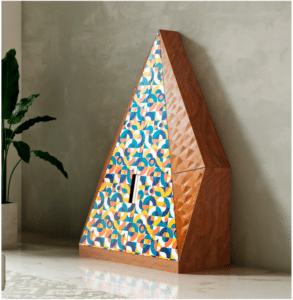
Geometry is the visible manifestation of math, embodying themes of continuation and infinity. When I was commissioned by Tiffany Dubin, a curator at Sotheby’s, to create a bespoke jewellery box for the “Art as Jewellery as Art” exhibition in New York, I wanted to design something that embodied these timeless concepts. The exhibition aimed to reintroduce jewellery and accessories by famed masters of the 20th century and beyond, placing them in a unique juxtaposition with contemporary visionaries and modern artists.
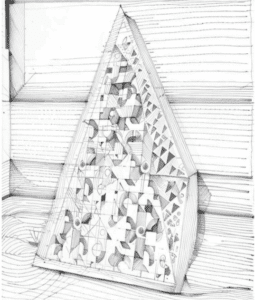
The specific shape of the Atlas Box, a rhombicuboctahedron, was chosen for its symbolic resonance. The rhombicuboctahedron, with its harmonious blend of triangles and squares, represents balance and unity—qualities that are deeply connected to the myth of Atlas, the Titan who bore the weight of the heavens. Just as Atlas symbolizes strength and endurance, the shape reflects the idea of holding together different forces in perfect harmony.
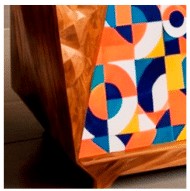
The carvings and metalwork on the Atlas Box are traditional Amazigh designs, merging ancient craftsmanship with a contemporary vision. This fusion of geometry, mythology, and cultural heritage makes the Atlas Box not only a functional object but a piece that tells a story of harmony and timelessness.
I think it’s wonderful that you give 15 per cent of your earnings to charitable projects. Was that something that you resolved to do from the beginning? How do you go about choosing the causes that you give to?
Creating synergy with the local community has always been a core value for me, and it’s something I resolved to do from the very beginning. When we embark on a project, we actively engage with the local communities, seeking out grassroots causes that create visible, tangible impact. It is important to us that these initiatives are ones we can track, interact with, and even participate in directly.
For instance, with our Sotheby’s piece, we chose to support the UK-based charity Hannan School, which has a genuine and significant impact on improving education for remote communities in the Atlas Mountains. This hands-on approach ensures that our contributions not only make a difference but also align closely with the values and needs of the communities we aim to uplift.
What would you say to young people looking to work in the luxury sector? What do you look for in a hire?
Look beyond superficiality. If you pursue what you truly love, you will excel, and don’t be afraid to make mistakes—they are an essential part of the learning process. For young people choosing a career path in the luxury sector, I would advise prioritizing knowledge and experience over superficial gains. Think long-term and focus on building a solid foundation of skills and understanding across different sectors.
If you eventually decide to embark on your own entrepreneurial journey, believe in your vision and stay committed to it. Your vision will be tested repeatedly, but perseverance is key. Over time, you’ll start to see the building blocks come together, and that’s when your dedication will truly pay off.
Luna Benaï are entering the Middle Eastern market. Can you describe that journey and tell us more about the thinking behind it?
The Middle Eastern market is currently undergoing a significant transformation, with new initiatives aimed at diversifying tourism, enhancing arts and culture, and promoting their rich and vibrant heritage. I find this cultural renaissance absolutely captivating, and it’s a landscape I can easily immerse myself in.
As a British, French-Algerian artist, I have a deep understanding of both Western and Middle Eastern worlds, which has uniquely positioned me to contribute to this evolving market. This strategic expansion is an exciting chapter for Luna Benaï, and I’m thrilled to be embarking on this journey with my business partner, Denise Ricci. Denise is my right-hand woman—a former Goldman Sachs professional with an incredible background rooted in Italian culture and the film industry. She’s a polyglot and a true powerhouse, bringing her diverse expertise to our team.
This cultural renaissance in the Middle East aligns perfectly with our vision as a woman-led team, allowing us to make a powerful impact. Together, Denise and I are committed to deepening our engagement with the region through bespoke cultural and artistic commissions. This expansion represents not just a business opportunity, but a chance to bridge cultures and celebrate the region’s rich heritage through the arts.
Which cultural figures most inform your aesthetic? Do you find inspiration in other art forms, whether it be literature, film, music or the visual arts?
I’m a bit of an eccentric, and there isn’t just one figure that drives my inspiration. My aesthetic is informed by a diverse range of cultural figures across history. The artistic legacy of ancient Greek sculptors and the intricate mosaics of Byzantine artisans have always captivated me. In the modern realm, Zaha Hadid’s groundbreaking architectural designs, which challenge conventional forms and spaces, serve as a major inspiration.
I’m also deeply influenced by the Bauhaus movement, which revolutionized design with its emphasis on functionality and simplicity, merging art with everyday life. Sonia Delaunay’s bold use of color and geometric abstraction, Hilma af Klint’s exploration of spiritual abstraction, and Dana Awartani’s meticulous blending of cultural traditions with contemporary expression all resonate deeply with me. These varied influences, spanning ancient to contemporary, each contribute to the unique narrative I aim to express through my work.
What are you working on at the moment?
We’re entering an incredibly exciting phase at Luna Benaï as we expand into a full-fledged atelier and bespoke design studio. We’ve joined forces with our esteemed Italian partners, who bring over four decades of master artisanal experience. This collaboration enhances our ability to work across various mediums, all while preserving the integrity and creative DNA that defines Luna Benaï.
Our first atelier collection, Tessellation, is set to launch this winter. This 11-piece, post-modern inspired collection draws from the rich aesthetics of Middle Eastern and North African design, reimagined through a contemporary monumental lens. Each piece in the collection marries fine art and architecture, making a distinctive statement in the world of interior design and bespoke furniture. Made-to-order, Tessellation seamlessly blends timeless cultural influences with modern innovation. We’re thrilled to introduce this next chapter in our journey, where tradition and cutting-edge design converge.
For more information go to: http://lunabenai.com