Tag: Liz Truss

  • Opinion: James Cleverly, like Sunak after losing to Truss, will be back

    Christopher Jackson argues that James Cleverly isn’t done yet


    Sometimes it matters hugely how you lose. “We didn’t do it,” said James Cleverly at the low point in his career on Wednesday just after finding out he had failed in his bid to be leader of the Conservative Party.

    I was very struck by the nature of this video. It exuded confidence and, in fact, leadership. How was he able to do this? Although Cleverly admitted that it was disappointing for him personally, one had a sense in his concession video and throughout his leadership campaign that he wasn’t running solely out of personal motivation.

    Speaking to a Finito event last month, he spoke movingly about his love of the Conservative Party, and recalled staying up late as a young man on General Election night, going through the constituency results. His immediate thought after losing this week was to remind the Party that ‘we’re all Conservatives’.


    This was gracious in the same way that Sunak’s concession to Sir Keir Starmer was gracious. It might seem a small thing, but this sort of generosity in defeat is the mark of true leadership.


    There was no hubris involved incidentally in Cleverly’s defeat, contrary to bogus media speculation. Speaking to members of his team, the instructions were quite clear on Wednesday: all the MPs who wanted Cleverly as leader were instructed in no uncertain terms to vote for him.


    With surreptitious stupidity, a handful of MPs took the matter into their own hands, with the consequence that the membership will now not have a centrist candidate to vote for.


    In the pub afterwards, Cleverly was reportedly somewhat subdued following the defeat – as who wouldn’t be. But campaign members said he gave each a big hug – as is his style – and thanked them meaningfully for their work.


    Another campaign staff member recalled: “He is always like this. He always knows what to do – and power never changed him.” To rise so high, and to retain this core decency is a rare achievement – it is, in fact, worth more than the Conservative leadership, since it is to do with the inner being.


    Another recalled starting out as a young political operative. She wrote hundreds of emails to MPs and politicians. Only one replied: James Cleverly.


    I once asked the wonderful former Skills minister Rob Halfon which members of the then Cabinet were nice to their staff. He didn’t miss a beat in naming Cleverly and Mel Stride. It is unfortunate that the Conservative MPs, shark-like as always, failed to represent these two bastions of civility in the last two.


    Sharks, of course, are unable to swim backwards, and I think there is now something of this trait about the Conservatives. They are rushing forwards on one-dimensional momentum, supposedly for a brilliant kill.


    Will they hit the rocks? It seems more than possible. If they do, there seems a real possibility they’ll turn to Cleverly, just as they turned back to Sunak after the Truss fiasco. A list of history’s victors is also a list of those who were at one time or another good losers.


    Either way, my suspicion is that Cleverly’s stature has risen irreversibly as a result of the past few weeks.


    It was Theresa May who spoke of the Conservatives as the Nasty Party, and eventually became Prime Minister. If the British public were to decide that this new Conservative Party is a trifle abnormal, might not even knuckle-headed Conservative MPs revert to the man who told them so memorably to be normal all along?


    Similar articles:


    Last Chance Saloon: Can Rishi Sunak win the next election?

  • Jon Sopel’s fascinating take on January 6th, the Starmer administration – and why he left the BBC

    Jon Sopel


    I am sometimes asked about why I left the BBC. I remember the corporation went through this spasm of asking themselves how to attract the young. If you watch the news, by and large you’re over 60. The same is true of the Today programme.

    The editor of the 6 O’Clock News was thinking about how we get more young people. Do we need younger presenters? Or do we need old people like me talking about young people’s issues? This was at a time when LPs were making a comeback. We sent a young reporter down to Oxford Street, and said to a teenager, holding up an LP: “Hello, I’m from the Six O’Clock News. Do you know what this is?” The teenager replied: “Yes, it’s an LP. What’s the Six O’Clock News?”


    Thinking back to January 2021, I can’t forget the day after the inauguration when Joe Biden was finally President. Washington DC that day was less the elegant neoclassical city that most people remember from the Capitol through to the Supreme Court and the great museums that go to down the Mall. It was a garrison town, the place was absolutely sealed off. There were rolls and rolls of barbed wire because of what had happened on January 6th. I will never forget the shock of that.


    Jon Sopel book launch in aid of Hospice UK and hosted by Finito at The East India Club, London. 17.9.2024 Photographer Sam Pearce / www.square-image.co.uk


    January 6th is also inscribed on my mind. I’ve been in situations where I’ve faced greater personal danger, when you’re in a warzone and you’ve got a flat-jacket one, and there’s incoming fire. But I’ve never seen a day more shocking than January 6th when the peaceful transfer of power hadn’t happened. I went on the 10 o’clock news and the mob still had control of Congress and Joe Biden’s victory still hadn’t been certified. That’s the starting point for my new book Strangeland: I wonder how safe our democracies are. My experiences in America made me realise that we cannot be complacent in the UK.


    Another thing happened the day after January 6th. The Capitol had been sealed off by razor wire and I went as close as I could, and went live on the 6 O’Clock News. There were lots of Trump supporters around and they heckled me throughout so that the anchor Sophie Raworth had to apologise.

    It soon morphed into a chant: “You lost, go home! You lost, go home!” I was trying to figure out what that meant. At the end of my live broadcast I said to this guy: “What on earth does this mean?” He poked me in the chest and said: “1776.” I thought: ‘Do I explain that my family was in a Polish shtetl at that stage?”


    Peter Hennessey, the great chronicler of government in the UK, talks of the good chap theory of government – you rely on people to do the right thing otherwise the system falls apart. I came back to the UK at the beginning of 2022 after eight years in America. The first election I voted in was 1979. For the next three years I knew three prime ministers: Margaret Thatcher, John Major and Tony Blair. In 2023 we had three in one year – that’s a reminder of the volatility of the times we live in. In many ways in 2016 – with Brexit and with Trump – the world jumped into the unknown.


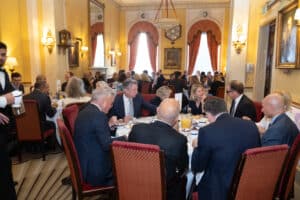
    Jon Sopel book launch in aid of Hospice UK and hosted by Finito at The East India Club, London. 17.9.2024 Photographer Sam Pearce / www.square-image.co.uk


    It’s always seemed to me that the Labour Party finds power a really inconvenient thing to happen. They much prefer it when they’re forming Shadow Cabinets and discussing the National Executive. Then you’d get pesky people like Tony Blair who come along and remind them it is about power. The Conservative Party was always the ruthless machine of government: there is an element in which the Conservative Party is in danger of going down the Labour Party route. It was the Conservative Party membership, for instance, who gave us Liz Truss, the patron saint of our podcast The News Agents. We launched in the week she became Prime Minister – and my God, she was good for business.


    What would Britain look like if there were 10 years of Starmer? He’s done the doom and gloom, and how everything is the Conservatives’ fault. That’s fine – but so far, he’s not set out what the future is going to look like under him. Is it Rachel Reeves’ vision of the growth economy? Or is it Rayner’s vision of increasing workers’ rights. I think Starmer is an incrementalist and simply doesn’t know. If he has any sense at all he will look at the centre of political gravity in the electorate and go for growth because that’s what the country needs.


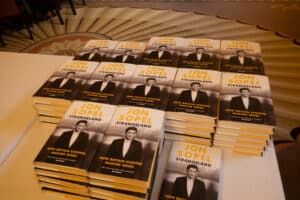
    Jon Sopel book launch in aid of Hospice UK and hosted by Finito at The East India Club, London. 17.9.2024 Photographer Sam Pearce / www.square-image.co.uk


    Hospice UK do the most amazing work. The book I’ve written Strangeland deals with the challenges facing Britain at the moment. Hospice UK do the most amazing work. Strangeland deals with some of the huge challenges facing the . Hospice care is one area where something urgent needs to be done.


    Jon Sopel was talking at a Finito event given in aid of Hospice UK. To donate, go to this link: https://www.hospiceuk.org/support-us/donate


  • Diary: Sir Anthony Seldon on on Liz Truss, AI and why the unions are in the wrong

    Diary: Sir Anthony Seldon on on Liz Truss, AI and why the unions are in the wrong

    Sir Anthony Seldon

    The short tenures of recent prime ministers is becoming as unmissable as it is noteworthy. If you look back we’ve had Gordon Brown (three years), David Cameron (six), Theresa May and Boris Johnson (again with three years apiece) and then Liz Truss, who lasted barely a month. But I would say all this has nothing to do with social media; it’s because they have no inkling how to be Prime Minister. The office itself isn’t impossible, it’s just the way they operate makes it seem so.

    I was asked recently if I’d write a book about the Truss administration or whether it would be too short; the person in question told me they thought it might be novella-length. I explained that the opposite is the case; in fact there’s so much to say I doubt it could be contained in a short book at all!

    When I think back on how I became a teacher, I remember how growing up I was struck by the thought that education had lost its enchantment. It had been stripped of joy, stripped of discovery and self-reflection. And obviously, that’s what lead to problems. When I was younger, I was often in trouble. I didn’t want to cause hurt; but I couldn’t be myself in school since it seemed to be trying to make me what I wasn’t. When advising pupils and students and parents about the big moments which come about: choices at GCSE, A-Levels, and work, I say to them that you must let the child decide and let them be driven by what they love not what you think they need.

    There’s been a lot of talk about Chat GPT recently. I began writing The Fourth Education Revolution in 2017 before it was a topic, and I still think AI has the potential to make the plight of the teacher far better if it’s harnessed early and in the right way. In many respects we still have a 19th century system where the teacher’s at the front of the class, students sit passively and everyone moves at the same pace at the same time of day. That means teacher workload gets worse with the effects we all see today. AI can change that and free up teachers for their role: to teach children how to live and be happy.

    I am sympathetic to teachers, but it’s wrong for the unions to be striking, because it harms young people. It’s not just that they miss out on their exams but it’s also showing young people that if you don’t like what you’ve got you’ve got to make innocent people suffer; that’s what young people are internalising. That said, the government is utterly at fault. If you have 10 education secretaries in 13 years, many of whom don’t understand schools and listen to the wrong people, it’s not very surprising that we have this situation. Usually it shows the contempt of prime ministers for education. The role is used as a berth to help solve a political problem of patronage by the PM of the day, and rarely given to anyone who might do something good with it.


    Amanda Spielman is highly intelligent, but Ofsted can’t continue in its current form as a judgmental external body. At the moment, it’s more than 20th century – it’s 19th century. But frankly it’s not a question of whether it will change, but of when. This isn’t a question of whether we have inspections or not, it’s about the nature of the those inspections. The process needs to be supportive and lead to improvement – it’s as simple as that.


    I’ve just finished my latest book on Boris Johnson and it makes me think back to founding the Institute of Contemporary British History with Peter Hennessy in 1986. It’s important you don’t abandon the recent past to partisan actors and partisan actors. You need to bring the skills of the academic historian to bear in analysing the past – and that’s more important than ever during a time of culture wars. What we need now is what we always need: understanding.


    Sir Anthony Seldon’s latest book Johnson at 10 is available from Biteback Publishing

  • Are we in the Age of Pointless Jobs?

    Christopher Jackson


    It is one of the most astonishing remarks ever attributed to a UK prime minister. The story, as told, by Harry Cole and James Heale in the recent book Out of the Blue: The inside story of the unexpected rise and rapid fall of Liz Truss, is that as Truss’ mayfly premiership wound to its helter skelter conclusion, Downing Street aides were crying as the then PM prepared her resignation statement. But Truss was in philosophical mode and not about to cry over spilt milk. “Don’t worry I’m relieved it’s over,” Truss said. “At least I’ve been prime minister.”

    With all due allowance given for the possible casualness of the remark, this is nevertheless revealing. It seems to mark the apotheosis of political ambition whereby holding a position is good in and of itself, regardless of one’s suitability for the role, and what one was able to accomplish in it. One might read the remarks aloud and place particular emphasis on the words ‘I’m’ and ‘I’ve’ and thereby better arrive at the truth of the matter.

    Truss aside, do the remarks tell us something broader about who we are, and what we’ve become? Of course, it is important to proceed with trepidation. It was Leo Tolstoy who, in War and Peace, pointed out that anytime you hear the words ‘These days’ prepare to hear a lie. There have always been people ambitious for position; in fact, it’s a safe bet that every prime minister of the past had precisely that same kind of ambition which animated Truss. As Gore Vidal once noted: “Any American who is prepared to run for president should automatically by definition be disqualified from ever doing so.” Sometimes when one sees a politician assume the highest office, one notices a range of emotions, but often a certain relief is there: a remorseless itch has finally been scratched.

    It’s not just presidents who have ambition, but those who surround them. Reading Carl Sandburg’s magnificent biography of Abraham Lincoln, we find the president issue the poetry of his first great inaugural speech and then settle into the prose of governing. In that spring of 1861, job-seekers descend on the President in to the extent that Lincoln invented the humorous salutation: “Good morning, I’m very pleased to see you’ve not come here asking for a position.’

    Sandburg picks up the narrative: “Of a visit of several days in Washington Herndon wrote that Lincoln could scarcely cease from referring to the persistence of office seekers. They slipped in, he said, through half-opened doors; they edged their way through crowds and thrust papers in his hands when he rode.” On another occasion, Herndon quoted Lincoln directly: “if our American society and the United States Government are demoralized and overthrown, it will come from the voracious desire for office, this wriggle to live without toil, work, and labor, from which I am not free myself.”

    In these words it might be said, is squirrelled away a far-sighted prediction of the Truss administration, where the PM knows only one thing: that they want to be PM.

    Lincoln was too wise not to include himself within his own criticism, but also too humble to differentiate himself from all those office-seekers who hemmed him in during those first months of his presidency. History has shown abundantly that Lincoln did have a reason for being there: he is one of those people, like Churchill, with a historical mission to fulfil. In Churchill’s case, he was always the preserver the British Empire and the foe of Hitler before he was Prime Minister. Lincoln, meanwhile, was always the defender of the Union and the enemy of slavery before he was President.

    It’s possible that an advocate for Liz Truss might argue that she was the evangelist of lower taxes before she was the occupant of Downing Street, but it seems likely that this won’t quite wash. In a sense Truss also represented the real life embodiment of the comedy of Armando Iannucci, the leading satirist of our times. Iannucci is the creator of not only The Day Today but Alan Partridge, The Thick of It, Veep, In The Loop and latterly a satirical prose poem Pandemonium. The common thread of Iannucci’s comedy is that people in his world occupy roles which seem to lack real meaning: Alan Partridge wants to be TV star while having no talent to entertain or inform; the civil servants and spads in The Thick of It, are rushing around Westminster bereft of real political beliefs; in Veep, an entire position – the vice-presidency of the United States – has no discernible function.

    It is as if the world has itself turned into satire – making it increasingly difficult for satirists to mock. This sense of futility regarding the roles we need to carry out is far worse beyond Westminster than in Westminster itself. In his 2018 work of sociology Bullshit Jobs: A Theory, the late writer David Graeber identified the way in which numerous jobs have cropped up in contemporary society whose fundamental value is highly questionable.

    Graeber’s point is not just that many contemporary roles are pointless, but that their pointlessness is known even to those who carry them out. Furthermore, this lack of meaning is made to rub along with the contemporary tendency to tie work to status. He writes of ‘a form of paid employment that is so completely pointless, unnecessary, or pernicious that even the employee cannot justify its existence even though, as part of the conditions of employment, the employee feels obliged to pretend that this is not the case.’

    This, Graeber says, in what amounts to a searing indictment of contemporary life, is ‘profound psychological violence’. So what kind of jobs is he talking about? Firstly he refers to ‘flunkies’ whose purpose is to make important people feel more important: he is discussing the whole raft of receptionists, assistants and assistants’ assistants who populate the typical corporate setting. Graeber’s second category is ‘goons’, those who set out to deceive or do harm on behalf of their employers: he is thinking of lobbyists, some lawyers, telemarketers, and the like.

    Thirdly, there are ‘duct tapers’ – those who fix temporarily something which ought to be fixed permanently, like software engineers, or those working in computer science. Fourthly, there are ‘box tickers’ who create the appearance of utility without actually doing anything such as compliance officers, or survey administrators.

    Finally, Graeber refers to ‘taskmasters’, those whose primary function is to create unnecessary tasks for others: Graeber is thinking of the whole realm of middle management which is often blamed, with a degree of justice, on the Blair years.

    None of these calls to mind the prime ministership. Is it then that during the Truss administration we temporarily saw the Graeberisation of 10 Downing Street – a strange, fleeting glimpse of what happens when the highest office of state somehow cannot be injected with any particular meaning? This probably cannot be complete because the affairs of state will always have inherent meaning and so it is hard to see how the role of prime minister could ever become as numbing as Graeber’s other listed roles. Nevertheless the fact remains, that insofar as is possible, the spectacle of Truss holding the position of prime minister, predominantly for the pleasure of holding it, represented a nadir in the office, and makes one realise that a position isn’t a static thing, but a space which one fills – above all, an opportunity, around which one needs to deploy initiative.

    In general, it should be said Graeber’s target isn’t the public sector, where one imagines a fair number of ‘taskmasters’ not to mention ‘flunkies’ and ‘box tickers’ reside, but the private sector. And I think his reticence on that question is probably related to his solution for all these problems: universal basic income. This, in one (expensive) swoop, would get rid of the need to work for those who don’t want to, and in theory free people up for more meaningful activity.

    The jury is out on how sensible this is. We had a glimpse of how it might look like during Covid-19 when something almost resembling Universal Basic Income had a morbid parody of a trial run. The results for productivity are already there to see with the economy in recession, and some businesses struggling to find momentum amid the pervasive malaise. It would also likely lead to inflation, since earnings would increase while productivity would remain the same, or even decline.

    Therefore there has probably never been a time less propitious for UBI than the present one. It would appear we need an alternative.

    Happily, a recent film suggests it might all be rather simpler than we think. This is Living, starring Bill Nighy and written by Kazuo Ishiguro. This is remake, deriving from Kurosawa’s ‘Ikiru’ and tells the story of a middling civil servant, Mr Williams, played by Nighy, who discovers he hasn’t long to live. He is one of Graeber’s taskmasters. In the opening scenes, some women turn up lobbying to change a dilapidated part of East London, by building a playground in a disused slum. There follows a tragicomic scene where the women are – as they had been on the previous day – taken from department to department all of whom absolve themselves of responsibility. The playground won’t be built, not because it’s not a genuine possibility but because nobody is using initiative in their roles.

    But as Mr Williams begins to accept his diagnosis, it becomes clear that he hasn’t been granted so much a death sentence, as a heightened sense of life. In fact, he seems strangle in possession of a kind of superpower, all the more vivid because it is contrasted with what he had been before.

    He comes to realise that with the right mindset and creativity his role can be put to use. He begins to lobby for the playground with a mixture of persistence and smarts until, without giving anything away, his sense of himself and his role’s potential is transformed.

    It seems to me that many of us enter our roles in life with too much passivity, and that if we are significantly vigilant we can actually make a difference to those around us no matter what our title, or even our function might be. What if the right answer isn’t to unpick the whole world of work with a vast social safety net which might then be expensive and difficult to administer, but to find it within ourselves to do the jobs we do have with the right spirit and creativity? Living suggests that such a thing is possible. It’s also, of course, free.

    It can’t be a complete solution. Some people do jobs which beat them down, and the answer to that will be a mixture of technological advance and education. But the Truss administration, mercifully brief for both the country and, one senses, for Truss herself, has perhaps as much to teach us as a more successful administration. It asks us to look inside ourselves and ask what we’re fit for, and then to wonder what we’re capable of. It’s a reminder not to attempt what we cannot do; by getting that decision right, and with the right measure of modesty, we just might nudge the world a little in the right direction.