Finito World caught up with Finito Education’s likeable and passionate senior mentor, Tom Pauk
Tell us about your career before you joined Finito.
After studying drama, my efforts to become an actor ended with a whimper rather than a bang, and I retrained as a solicitor. The career that followed was a “game of two halves”, half-time marked by the global financial crisis of 2007-08. In the first half, at City law firm Allen & Overy, then in-house at American bank Citigroup, I’d specialised in large cross-border lending transactions.
In the second, I helped restructure loans borrowers had taken out in more prosperous times but were now struggling to repay. After leaving the bank in 2017, I began mentoring young men in prison, returned to Allen & Overy, now in a role mentoring lawyers in the early stages of their careers, and began writing plays. My professional life, it seems, had come full circle!
Did you feel your education prepared you for the workplace?
A degree in drama could not have prepared me better for the cut and thrust of commercial law, an above-all collaborative endeavour with a diverse cast list of characters, long “rehearsals” with unfeasible deadlines we somehow always managed to meet. At the conclusion of an especially high-profile deal there was the added satisfaction of reading the “reviews” in the financial press.
The practise of law is essentially an exercise in problem-solving. In my case, a love of modern languages and playing the violin had also prepared me for the intellectual rigour of law, and I was even able to use my mother tongue Hungarian in transactions with Hungarian clients. So to anyone reading this wondering whether a knowledge of an obscure language might prove useful one day, the answer is a resounding Yes!
Did you benefit from mentorship during your career?
When I’d started out, mentoring was still very much in its infancy. Fortunately, I was able to benefit from the law firm equivalent, the “seat” system, under which trainee solicitors move from one department (or seat) to another every few months to build up expertise in different areas of a firm’s practise. Each seat is supervised by a senior lawyer — part mentor, supervisor and critical friend — overseeing a trainee’s professional development.
Over the course of my training contract I was exposed to a variety of mentoring styles, which then shaped my own approach when I assumed the role. But I continue to benefit from ongoing, less formal mentoring in the shape of the extraordinary people I encounter and who inspire me with their wisdom. So in actual fact I’ve never really stopped being mentored.
What are the most common misconceptions about a career in the law?
I think there’s a general (mis)perception that law is a dry, bookish occupation, and that lawyers are aloof from the rest of society, be they pin-striped solicitors in their ivory towers or wigged-up barristers bowing obsequiously in courtrooms. In fact lawyers are widely dispersed throughout society, in the public sector (civil service, local authorities, regulatory bodies), in companies and banks, charities and NGOs. If you’re a young person considering a career in law you’ll be able to select from a wide range of specialisations that play to your unique skills and interests.
Mental health is a particular passion of yours. Can you describe how your interest in that area came about?
There were occasions, especially early on in my career, when my mental health was impacted under the pressure of work. Symptoms included poor sleep, high anxiety and irritability, and a compulsion for checking work emails 24/7. Back then, there was a stigma around discussing one’s mental health, let alone seeking help when you needed it. Worse, it was regarded as a sign of weakness, possibly even career-limiting, to self-disclose. So one’s natural instinct was simply to keep quiet and soldier on.
Thankfully, we’ve evolved to a more enlightened view of wellbeing in the workplace, with a plethora of interventions designed to promote a healthy mind as well as body, including mental health first aiders, mindfulness, and discouraging staff from checking work emails after hours. Eight years ago, the memory of my own experience led me to train as a volunteer at a mental health charity. At The Listening Place I’ve seen vividly for myself how poor mental health can quickly escalate into crisis, and how being truly listened to can be life-saving. Literally.
Work-life balance is something you’ve been vocal about. What are the most common pitfalls people fall into there?
Most people understand the importance of achieving a sensible work-life balance, at least intellectually, And it’s hard to argue against. But here’s the challenge: we’re not necessarily aware of the pendulum as it is swinging in the wrong direction. Whether it’s staying ever-later in the office, checking, or worse, responding to emails at weekends (“because it’s already tomorrow in Tokyo”), before we know it life is work and work is life. Of course we tell ourselves that it’s only temporary, that as soon as we’ve broken the back of whatever it is we’ll take our foot off the accelerator.
But it isn’t that simple, for we may unwittingly have recalibrated our benchmark of what a normal working day is. We’ve trapped ourselves into believing our own indispensability (“If I don’t do it no-one else will). We assume that working harder improves performance, demonstrates commitment to our employer and enhances our prospects for promotion. I’d counsel anyone reading this to challenge these assumptions and to listen out closely for the whirring of your inner pendulum!
You obviously have a passion for mentoring. What are the most common challenges you’re seeing among your current crop of mentees?
I’m certainly seeing the longer-term impact of the pandemic. This is the generation whose educations, family and social lives were disrupted by successive lockdowns. And I’m in awe of just how well they’d adapted to remote ways of studying and working. Another challenge is the sheer number of high-calibre applicants vying for limited places on the graduate recruitment schemes of investment banks, accountancy firms and corporations. Training contracts in City law firms are similarly over-subscribed, and with increasing candidates achieving top grades there’s now a far greater reliance on critical reasoning and situational judgement tests, presentations, written assignments and long assessment days.
However I’m also sensing some really positive new trends, with mentees less motivated by achieving huge salaries than they are by finding a fulfilling career. And finally, one positive legacy of the pandemic: Finito mentees are often engaged in volunteering activities, whether it’s repurposing old computers and teaching older people how to use them, mentoring disadvantaged kids, or stacking boxes in foodbanks. Something, finally, to celebrate in challenging times.
Do you vary your process for each mentee, or do you have a particular approach which you use with each candidate?
Mentoring is a transformative tool for supporting the development of a mentee, and because no two mentees are the same the mentoring process does inevitably vary. Having said that, there are common features in my approach. In the first place, it’s not about the mentor. Our prime responsibility as mentors is to listen attentively at all times to our mentees. Listening actively (as distinct from merely hearing) is a skill that one develops with practice.
And it’s crucial we’re responsive to the stated needs of our mentees rather than clinging stubbornly to our own agendas. One unique aspect of mentoring is our willingness to share our own knowledge and experience to support the development of our mentees. A word of caution however, because this has nothing to do with being directive. What we’re aiming to do is empower our mentees to think and act for themselves. Finally, mentoring is a two-way street. At its most fruitful the relationship between mentor and mentee is one in which sharing and learning opportunities arise for both participants. I’m forever learning from my mentees.
What do you know now in your career which you wish you’d known at its start?
Hindsight being a wonderful thing of course, here’s three things I tell my mentees. Firstly, it’s important to pace yourself, especially when starting out in a new role and you’re trying to make a good impression. Keep something of yourself in reserve for when you really need it. Secondly, don’t plot out your entire career from the get-go. Life has a mischievous habit of opening new doors and leading you in new directions. And thirdly, know where you add most value, and focus your energies accordingly.
Do you have any new challenges on the horizon?
I’m excited to have just been appointed to the board of the Joseph Rowntree Charitable Trust, whose endowment supports people tackling the root causes of conflict and injustice. Along with my governance responsibilities, I’ll also be involved in grant-making decisions, an area entirely new to me.
Finito World takes a look at what employability skills are the most important and how it can improve your career prospects
Employability skills might seem to be a bit of a mouthful. But the world is becoming more competitive. A phrase which takes as long to say as to make a cup of coffee is becoming increasingly important.
Why are employability skills so essential? It’s do first of all with the global economy, an inheritance of the settlement after the end of the Second World War. Borders are becoming more porous and businesses more international. The pool of talent competing for jobs has radically increased.
The only way to meet that reality is to up your game. Gone are the days when you could stroll into Dad’s friend’s bank or law firm without an interview. Now is the time of AI interviews, and fierce competition for every role. Even roles which may not seem all that desirable are competitive.
Tips for career employability
So what’s necessary? First of all you need to work on your communication skills. That will be verbal and in-person, and in written communications.
Sir Winston Churchill famously wrote of the importance of short, sharp memoranda that go to the point. The same is true when we are speaking aloud. Anyone starting out on their career would do well to learn to calibrate what they say. You need to put your hand up, but not seek to dominate.
All that entails good listening skills, and that in turn implies teamwork. How well can you read the emotions of others? Are you able to see your way round corners? When it comes to employability skills which employers need, teamwork is important. We need to make sure we fit in.
Most roles also entail some form of problem-solving. The world very rarely runs smoothly. Employers want to know that employees can engage in critical thinking and analyse situations. They need to work to the advantage of the overall organisation.
Why teamwork matters
One must become adept at not thinking primarily about oneself. You must ask yourself each day what you can do to further the good of a particular organisation.
But no employer expects you to get everything right all the time. Setbacks and disappointments are built into business as they are into life. In a changing, rapid world mistakes happen. Employers want to see that employees have resilience and a willingness to learn.
All of us has capacity for growth: career employability is to do with seeking to foster those capacities. You must not turn your back on any notion of self-improvement at the first crisis or letdown.
If you can do that, you’ll be well on the way to developing leadership skills within yourself: employers often say they’re looking for self-starters. You must demonstrate over a reasonable period of time that you are able to arrive at the answer to difficult questions on your own. Then management will start to consider you for a leadership role.
That will take time – and perhaps that will imply patience. But at the same time, it is to do with work ethic. That is an area where young people can really differentiate themselves. The famous West Coast lawyer John Quinn used to take his cohort of new arrivals down to the lake on his estate. He would say: “Swim to the other side!” The first two to enter the water would get jobs at the end of it.
You need to be the first in that lake to succeed: if you don’t someone else will. It was said of the tennis-player Tim Henman that he wasn’t the best tennis player in his class at Reed’s School. But if the coach said: “Go and hit a ball against the ball for ten hours” would go and do it.
Working hard
Fostering that work ethic can lead you to surprising places. Doing things over and over again might seem boring from the outside, but commitment leads to deeper understanding.
But none of this should be at the cost of the bigger picture. When it comes to career employability, you need to realise you’re in a globalised economy. You must also seek to understand the variety of functions which your organisation carries out.
Above all, career employability is about never stopping learning. It is an avenue to a rich and fulfilling career, and therefore to a productive life. You might find that the employability skills important to an employer are also important to you.
No matter how hard the King’s lighting team tries, it is difficult to create an intimate space. He speaks in front of a picture of his late mother – he is addressing the nation as a son in grief as much as a new monarch – but behind him the room recedes into marble pilasters, state-of-the-art rugs: the scale proper to a King.
Charles says: “Queen Elizabeth’s was a life well-lived; a promise with destiny kept and she is mourned most deeply in her passing. That promise of lifelong service I renew to you all today.”
Perhaps the most important word in that passage is ‘all’. King Charles III is, whether people like it or not, the King of not just England, but of Wales, Northern Ireland and Scotland too. Perhaps there has long been a degree of tension in this fact: it is a leitmotif of any biography of the Royal Family that the subject must preside over a United Kingdom peppered with nationalist sympathies.
Charles has known this from first-hand experience since the stressful day of his investiture at Carnarvon which took place amid rumours of an imminent bomb, and on which occasion a member of the public threw an egg at the Queen’s carriage.
His position, while it remains this nation’s main marker of stability, also has its uncertainties. These might partly be to do with being pelted with eggs – the same thing recently happened to Charles himself – but are just as likely to be felt as unease about the monarchy’s own relevance in the modern era. In an age of acronyms – of AI, AGI, NFTs, and LMAO – what relevance can the elaborate language of a court circular have?
It doesn’t end there. In a time of iPhones, of TikTok and Snapchat, what do we feel, if anything, about the deep past from Charles acquires his position and authority? And is palatial opulence permissible in an age of strikes amid a ‘cost of living’ crisis? In a time of drones and clones, can we experience emotion at all at the sceptre and the anointed oil? In short, what does history mean in the present?
Personally, I think the answer is that it means a great deal. But it is a question every monarch must answer.
Charles continues: “In the course of the last 70 years we have seen our society become one of many cultures and many faiths. The institutions of the state have changed in turn.”
When the speech is shown again on the ITVX documentary The Real Crown, we see him from a different angle: one of those images which shows the cameras and the soundman’s booms, and what it’s like for the King to be filmed. Then we see just how big the room is, tapering off, like Las Meninas, towards other rooms, and corridors and flights of stairs.
The King, with his bent, careful septuagenarian tread moves across a room larger than many people’s houses, to become framed in a doorway far larger than one might have imagined: he waves at the assembled camera crew, but also at us: his nation.
Streamlining
Since Queen Elizabeth II reigned for such a long time, we have almost forgotten that a change of monarch has a bearing on how we feel as a country. Since we are all citizens as much as we are individuals, the accession of Charles III therefore impacts in surprising ways on one’s own identity. We are used – all too used – to experiencing this with respect to the current prime minister is. This information, though it is clearly an external matter, also turns out to be vital to our own lives: we feel differently when Rishi Sunak is prime minister to how we felt when Liz Truss ran the country.
The question then of what kind of man the King is, turns out to be strangely shaping in terms of our own lives. This fact alone is the best barometer one has of the power of monarchy to alter and affect us, and to matter. For this article we spoke to those who have worked with and for him, those who have known him since childhood, and even those who know him only from his handwriting, to seek to understand our new monarch.
What emerges is a man of unusual sensitivity and empathy; someone kind, but also capable of obstinacy. Despite a certain fastidiousness – some will remember his frustration over being given the wrong pen at a signing ceremony early in his time as King – this is not a monarch without imagination or creativity. Perhaps above all, he is – in a rather refreshing way – an unusual man.
He is also a man of unusual experience. With tens of thousands of state visits to his name, the King knows the country better than anyone. Of course, there are severe constraints placed on the nature of his experience. His visits must all be conducted through the prism of the fame conferred by his role: his is a life of people on their best behaviour, a world to some extent cordoned off from unguarded human experience.
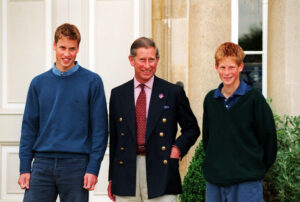
B4TNT6 Prince Charles with his two sons Prince William left and Prince Harry at Buckingham Palace July 1999
This state of affairs is something Charles has long since railed against. According to Jonathan Dimbleby’s masterly The Prince of Wales: A Biography, as early as November 1978 the future King would write pleadingly to his then assistant private secretary Oliver Everett: “I want to consider ways in which I can escape from the ceaseless round of official engagements and meet people in less artificial circumstances.’
Even so, the sheer range of his experience of the world even at a ceremonial level is one possible reason for the empathy he’s shown as King so far. In an age where most of the public sector is on regular strike, and with the rest of us experiencing rising inflation, Charles has already given an intelligent lead. Opulence is out, and frugality – insofar as is possible in such a gilded situation – very definitely in. This means that we are experiencing a decidedly ‘scaled back’ Coronation year. Meanwhile, for those who work for the Royal Household, the era of the grace-and-favour home is over.
For Michael Cole, the royal writer and broadcaster, and former BBC TV Court Correspondent, the King has begun his reign wisely: “The King is right. Slimming down the Royal Family is in tune with the tough times faced by millions in Britain and his 14 overseas realms,” he tells us.
So what is the reason for this approach? “The King is responding to the realities of the world. It is nonsense with royal knobs on to suggest that the King’s eminently sensible proposal to focus on the direct line of succession, Prince William and nine-year-old Prince George, will bring the monarchy to “the brink of collapse”, as a recent study by the think-tank Civitas ludicrously suggests.”
This Civitas report, authored by Frank Young, created a minor storm, claiming that without Princes Harry and Andrew working for “The Firm” the Royal Family “will disappear from public view”.
In disagreeing with this, Cole explains how the new slimmed down Royal Family will look: “Never again will we witness more than 20 members of the Royal Family on the balcony at Buckingham Palace. The King knows instinctively that this sends the wrong message. And he’s right.”
For Cole, Charles has taken inspiration from the past: “A keen student of his family’s history, he’s following the lead of his grandfather, King George VI, who led this country through war and economic austerity. He said the Royal Family was best when it was “Just us four” – himself, Queen Elizabeth and their daughters Elizabeth and Margaret.”
It is a reminder that Charles has always loved History and English as subjects. For Cole, this puts His Majesty in good stead: “The King has read the national mood and correctly decided “less is more”, which the late Queen certainly believed. Civitas 0, King Charles 5 – himself, William, George, Charlotte and Louis, in that order.”
Keen Interests
After Charles conducts that characteristic hunched pivot to wave goodbye to the cameras, and walks on to his next engagement, I am reminded that it is sometimes rumoured that both the King and the late Queen have been said to dislike Buckingham Palace, with each preferring their country residences. Balmoral has been particularly loved by both monarchs.
In the Queen’s case, this preference might be put down to a sheer love of the great outdoors. In respect of Charles, a more complex and intellectual figure, I am reminded of Sir Kenneth Clark’s observation that nobody in the history of civilisation has had an interesting thought in a Palace; that requires, Clark said, a room of one’s own, of the sort Virginia Woolf pined for. That’s precisely, of course, what Charles hasn’t had: privacy, and the ability to shape a distinctive personal destiny without the encumbrances of duty.
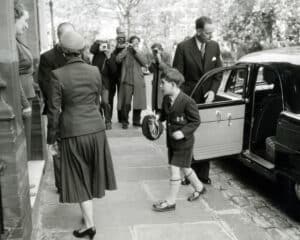
EJ9JGE PRINCE CHARLES arrives at Hill House School in Knightsbridge, London, in 1957
But the people we spoke to for this article attest that he has worked through these difficulties, with many emphasising the help of the Queen Consort. In fact, Charles has done something rather more interesting than complain about his lot in life. He has continued his intellectual passions while carrying out his duty. If one considers the success of the Prince’s Trust, it could be argued that nobody – with the possible exception of his mother – has done more good in this country over the past half a century.
One has always been conscious of Charles’ intellectual curiosity. It is the trait which most defines him, and which propels his astonishing work ethic which now percolates the Royal Household and which all courtiers must now get used to. It is this restlessness which was at his elbow when he wrote the famous Black Spider Memos to the Blair government in the 1990s on everything from the armed forces, to arcane aspects of agriculture and education.
He is always well-informed – sometimes, in fact, to a nearly ludicrous extent. It was said of Bach that his genius is tragic in that his cantatas were far better than they needed to be for a regional kappelmeister to justify his position. Charles is a little like this: his energy can’t quite be contained by the position he has; it keeps spilling out.
One representative story is of Lee Elliot Major OBE, the country’s first social mobility professor, who was honoured by the King at Buckingham Palace. “When I received my OBE, it was Prince Charles who was presenting the medals,” he tells me. “I was in a long line of recipients and I was doing a lot of reflection about what it meant in terms of my own life.”
It is a reminder that whenever Charles meets anyone for the first time, it is always in this context: it is for him to help his subjects navigate the sheer oddity of the moment. “He asked me about the Sutton Trust, and he knew about my social mobility work,” continues Major. “In the end, they had to prise me away because we were chatting so much. Now you could say he was simply well-briefed by the officials around him, but I think it indicated a personal conviction.”
Of course, it’s likely the case that a double whammy is in play: the King is both well-briefed and speaks from personal conviction.
All of this makes one wonder a little about his education. Was there some germ in the deep past which sparked the King’s curiosity, or was it innate, even a sort of Royal anomaly? Interestingly, when Kings and Queens have considered their offspring’s education, they have generally plumped for precisely what Elliot Major advocates for the rest of us: one-to-one tutoring. “When done well it is the ultimate in education,” he continues. “I would argue that the rates of learning you get from one-to-one tutoring are the best you ever get. You’re never going to match that in a classroom: provided you get the chemistry right.”
In fact, the future King was educated for a brief while by a governess: Catherine Peebles. But when it came to prep school age, he became the first monarch not to be educated by private tutors, instead attending a variety of schools. It might be that this exposure to his subjects has created in him a more empathetic persona than we’re used to as monarch.
If so, he suffered a little for his people. It is widely known that Gordonstoun was an unhappy experience for him. At Gordonstoun, it seems that the injunction for Charles not to be treated any differently from other pupils led to an appalling bullying culture which is horrible to read about today, with the then Prince deliberately picked on during rugby matches and so forth. As the Coronation ceremony approaches perhaps there are a few privileged people in their late seventies feeling shame for the way they treated the King some six decades ago.
As the novelist William Boyd, who was educated there alongside the King, has said: “Being educated over a 10 year period at a single-sex boarding school in the north of Scotland has a massive effect on your young personality and nature. What is then required is an equally massive process of re-education.”
This, of course, is precisely what Charles would do. But what receives less press than the King’s unhappy time at Gordonstoun, is his education at Hill House School, presided over by the redoubtable Colonel Townend. This turns out to be rather more interesting. The restauranteur Philipp Mosimann, who also attended Hill House, recalls: “It was a very simple ethos. The Colonel believed in life skills.
He believed you should learn to swim before you learn to read and write, because that would actually save your life. He was also a huge advocate of team-building. His father had been a priest and he had fought in World War Two; he used to show us videos of A Bridge Too Far. He went on to win two gold medals in the Empire Games. He was a real hero.”
One can immediately glimpse the parallels between this ethos and the values of the Prince’s Trust, Charles’ great contribution, which he would found a quarter of a century later.
Mosimann continues: “I remember these massive sermons the Colonel would give which the parents would attend; they’d just sit there enthralled. If you were well-behaved, you’d be invited to go up the mountains at weekends. It was fantastic; it was a child’s dream of education. It was all about getting out there, becoming friends and creating camaraderie. Townend believed strongly in becoming an all-rounder. Music was very important; it was mandatory to play one – if not two – musical instruments.”
And can Mosimann recall what effect all this had on Charles? “There is a wonderful picture of Charles when he arrived in Knightsbridge with the Colonel. It really was marvellous; and it imbued you with the idea that you had one education from your parents but they won’t give you everything. For the right reasons, the King became quite humbly confident.”
Looking at this picture, I feel similar emotions to what I feel whenever I see images of the young Prince William or Prince Harry, and indeed when I meet any young child: one has a sense of rooting for the young, and half-wishing the adult world won’t ever encroach upon them. One feels the same when one sees images of Charles as a young man: slender, slightly reminiscent of Gussie Finknottle in the PG Wodehouse Jeeves and Wooster series. Whatever one thinks of his privilege, one cannot ignore his vulnerability.
Philipp Mosimann says: “I think it’s very difficult to be King. When it comes to friendship, you have to be cautious with regards to your position, and they don’t have any choice about that. It’s a huge amount of responsibility for life, and you owe that responsibility to millions around the world.”
Most of us, even prime ministers, seek development, the forward steps of a career. Charles hasn’t had that. As Mosimann says: “If you take that decision seriously and do good – which Their Royal Highnesses really are doing – there’s not much rest. It’s a full-time job. You could say: ‘I’m okay financially and I’m off’. But they don’t – they uphold their duty. I think in terms of friendship, that may suffer in terms of time, so they need to have a close circle of friends from a very young age.”
Baron Levene of Portsoken, the former Chairman of Lloyd’s of London, who has interacted regularly with the King throughout a long and successful career, adds: “You can’t compare members of the Royal Family to the rest of us, even to prime ministers. A member of the Royal Family is always going to be in their position and will try hard to keep out of anything controversial. Members of the Royal Family are all trained and brought up in the same way but are all entirely different characters.”
In our lives, we wonder how to gain a position, and then how to develop that position towards greater fulfilment – the succession of steps which we call a career. A Prince or King must decide what to do with the position they have. Mosimann explains: “If you know you have a guaranteed position, how do you go about resonating your presence?” This question has been percolating Charles’ mind since youth, and no doubt still does even now. It is the conundrum of his life.
The High Seas
But he has had a career of sorts, somewhat apart from his Royal role. Over time, after attending the University of Cambridge to read Archaeology and Anthropology, the future King chose to carve out a role in the Royal Navy. These experiences, together with what he had learned at Hill House, would also impact on the King’s thinking and shape his contribution.
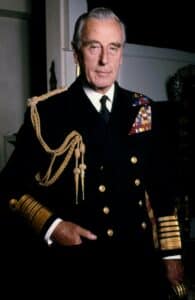
If Prince Charles had a mentor then one would have to name Lord Mountbatten, the maternal uncle to Charles’ father, Prince Philip. Dimbleby calls him “the great single influence on his life”. It was Mountbatten who, through his wife Edwina, came into the country house Broadlands, where Charles spent so much of his time in the 1970s.
Liz Brewer, the etiquette expert and contributing editor of Finito World, remembers this period: “The King founded the Prince’s Drawing School, which is now the Royal Drawing School. I would arrange for the school to go fishing on the River Test.” Founding things is a continual thread in Charles’ life. And Mountbatten? Brewer recalls: “Mountbatten was very dapper. He’d be very much at home in today’s world.”
Mountbatten was certainly an interventionist presence in the Prince of Wales’ life; most people know about his failed efforts to ensure that Charles would marry his granddaughter Amanda Knatchbull, now Lady Amanda Ellingworth.
Less well known is Mountbatten’s role in persuading Charles to join the Navy. For instance, Mountbatten wrote to the then Prince in no uncertain terms while he was still at Gordonstoun: “I would like to repeat…I am quite certain that you must have a “mother service” that you really belong to and where you can have a reasonable career. Your father, Grandfather and your Great Grandfathers had a distinguished career in the Royal Navy. If you follow in their footsteps this would be very popular…”
As ever with Charles, that’s a lot of footsteps to follow in. If anyone has ever felt nervous about starting some new chapter in their lives, then perhaps there will be a degree of comfort to know that their current King has known that trepidation too. Here he is on the eve of attending the Naval College: “I am beginning to pale at the thought of what Dartmouth is going to do to me. Whatever it is, it’s going to be far worse than the most excruciating tortures they could ever dream at Cranwell! [where Charles had spent five happy months with the Royal Air Force beforehand].”
Dartmouth in those days was a strict environment, and another challenge for someone of so sensitive a nature as the future King. After his first weeks, Charles reported back glumly to Mountbatten: “I have hardly had a moment to breathe since I arrived. We get up at six a.m. most days and have to suffer the early morning indignities of being bawled at by a Whales Island GI [i.e. gunnery instructor] with a voice like a horse. It’s either that or torture by Morse Code.”
This sounds, and probably was, fairly awful. But elsewhere in his correspondence, Charles strikes a more positive note. “Everywhere I look my eye catches some familiar face peering down at me from a portrait on the wall. Papa wrote and said I could console myself with the thought that I was serving ‘Mum and Country’! I hope I can and it fills me with pride to think I might be able to be of some service.”
Reading between the lines, more consolation was needed here than was provided for by his parents. Even so, it had its good effects. Today everybody reports on the King’s work ethic, and it is tempting to think that the lineaments of this may have been established at Dartmouth.
Either way, not everything went right for the King. When he eventually took his place on board Norfolk (‘this mighty vessel’ as he called it) he was self-deprecating about his abilities: “Chaos reigned in the charthouse. No sooner had I completed my artistic handiwork than the navigator appeared and proceeded to rub everything out…In the end the ship sailed in the direction of my revised lines and by some curious accident Plymouth hove into sight at approximately the right time in the morning. My relief was ill-concealed..!”
But to struggle in a strict environment is surely a good education for a future King. He didn’t have things his own way, and this experience has enabled him to imagine his way into the lives of others less fortunate than himself.
A former serviceman tells me: “I know he was very fond of his time in the Navy. He is a proud naval officer.”
The same interviewee tells me that the experience may have had its impact on the principles underpinning the Prince’s Trust: “I think, of all the services, the Navy – especially compared to the Army – is more of that collaborative working approach.” And why is that? “Everything has such a specialist role from your radar operator, to your torpedo-handler. It’s not just raw leadership – shouting at people, leading men over the wall – it’s training people to a high degree and empowering them to do the jobs they’ve been trained to do, and collaboratively being a team. It’s a different leadership style.”
Throughout his time in the Royal Navy, Charles grew in confidence. His career is a reminder of the salutary effect of having to test one’s potential against confines – and even to toil for some period at what one isn’t necessarily suited to. But he was beginning to feel that he could, in his own words, ‘be more useful elsewhere’.
Hard Slog
After leaving the Royal Navy, Charles began the relentless and essentially ceremonial life which he has kept up ever since. In 2022, at what for everyone else is retirement age, this has been ramped up again.
What sets him apart is that he has done all this, and yet given the impression that it isn’t quite enough for him. He can seem a sort of activist Prince Hamlet, somewhat at odds with what he has been born into.
The more you examine is life, the more you realise that what he craves is depth of experience in addition to the breadth of ceremonial experience he cannot avoid.
In the letter to Everett I quoted earlier, the then Prince goes on to say: “I want to look at the possibility of spending, say, 1. Three days in one factory to find out what happens; 2. Three days, perhaps, in a trawler (instead of one rapid visit); 3. Three or four days on a farm. I would also like to consider 4. More visits to immigrant areas in order to help these people to feel that they are not ignored or neglected and that we are concerned about them as individuals.”
This is a wholly admirable letter which I find it hard to imagine any other heir to the throne writing. Perhaps the most characteristic part of it is the request for that extra day on the farm, but all of it is shot through with a restless energy wholly his.
So what is life like for him? Baron Levene of Portsoken got to know the King when carrying out his stint as Lord Mayor of London. “I know him reasonably well,” he tells me. “He’s waited a hell of a time to do this job, even after such a short time. He’s very well-informed on many, many subjects.”
Levene is sympathetic to the enormously demanding nature of a life dominated by ceremony. “When I was Lord Mayor – not nearly as bad as being the King, of course – I shook hands with about 70,000 people over the course of the year. You have so many formal dinners and banquets and ceremonies. It’s very demanding – not intellectually, just physically. I used to get up at seven and go to bed at midnight every day.”
So is it possible to enjoy a life dominated by such a punishing schedule where you must always be on your best behaviour?
“I enjoyed it but it’s very tiring,” Levene replies. “When people at the end of it all asked me what I thought of it, I said a third of it was terrific, another third was okay – and the final third was ghastly.”
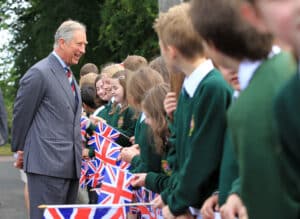
C8F12A Britain’s Prince Charles speaks with school children in Northern Ireland
This then is Charles’ reality – except in the crucial respect that he doesn’t get to finish after a year. Levene continues: “When I was Lord Mayor I went to a wedding in London of a member of the Royal Family, who I happened to know well. I was sat next to the Queen of a well-known country. She said: ‘Look, it’s alright for you, you can stop after a year’. And if you look at the Court Circular each day, they go to the most obscure places: it’s undeniably a hard slog,”
I decide to do this and land at random on the Court Circular for 5th April 2023. It reads:
The King and The Queen Consort this afternoon visited Talbot Yard Food Court, Yorkersgate, Malton, and were received by His Majesty’s Lord-Lieutenant of North Yorkshire (Mrs. Johanna Ropner) and the owners of the Fitzwilliam (Malton) Estate (Sir Philip Naylor-Leyland, Bt. and Mr. Thomas Naylor-Leyland).
Their Majesties, escorted by Mr. Naylor-Leyland, toured the Food Court and met local business founders and owners.
I note the plural ‘local business founders and owners’ and note how such an occasion might proliferate. I try to imagine how each of those business people is experiencing the highlight of their year, and perhaps of their lives, and how the King must be mindful of this, and cannot afford to put a foot wrong. But the day isn’t over yet:
The King later met representatives of local charitable organisations at York House, 45 Yorkersgate, Malton, and was received by the Co-Founder and Director of Circular Malton and Norton Community Interest Company (Mrs. Susan Jefferson).
It is an unending round whose ground note can hardly be anything besides banality.
The longest serving Foreign Secretary of Australia and former High Commissioner of Australia Alexander Downer has also seen all this up close. “When I was High Commissioner of London, with Australia being a realm country, I would deal with Buckingham Palace a lot, but also with the Prince of Wales, as he was then,” he tells me.
Had Downer met him before? “I’ve known Charles a long time, as he went to Geelong Grammar where I also went. I first met him here in London when I was 13 and he was a couple of years older, 15. I wouldn’t call it a friendship, but a friendly acquaintance. With someone as famous as the King of England, if you know him at all you might say you were great friends, but that wouldn’t be right!”
Downer describes for me the level of detail which goes into each event. “In general, I would meet him more at events. But on one occasion, the Prince of Wales and Camilla – now the Queen Consort – were planning a visit to Australia, so I went to talk to him at Clarence House about what he might do while in Australia, and then we had follow-up meetings.”
Was he good at assimilating information? “As the Prince of Wales, he had advisors and people he would learn from, and he read a lot as well –
a thoughtful kind of person. If you’re the King, you have to be interested in everything as best you can be. I’m not sure how interested he is in the weekend’s football. Would he watch a Formula One Grand Prix? Would he watch Chelsea drawing with Everton? My guess is he’s interested in horses, like his mother was.”
This predominantly ceremonial life sometimes yields amusing anecdotes. Royal Warrant Holder Wendy Keith, the eponymous founder of shooting stocking design firm, Wendy Keith Designs says: “I attended a Reception at St James’s Palace with my husband who was a Senior QC at that time. In conversation, His Royal Highness asked my husband what he was doing there. My husband replied: “I am merely a companion to my talented wife”, to which the reply came :“I know the feeling!”.
When smiling at such a remark, one must take a moment to remind oneself of the punishing routine of the man who made it.
Scenes from the Chase
In addition, all this activity must take place in the glare of the world’s most brutal tabloid media.
In light of what happened to his first wife Diana, Princess of Wales, this is naturally a painful topic. But it needs to be admitted that there are many excellent journalists in the UK whose aim is to report legitimately on an important part of our national life.
One such is Michael Cole, who recalls for me a visit made by Charles and Diana to the US in the mid-1980s, when he was the BBC royal correspondent. “In many ways, Princess Diana was a wonderful person and quite easy to report upon, and not just because she was the cameraman’s dream, incapable of “taking a bad picture” — i.e. she always looked wonderful,” he recalls.
“The Royal Family made big mistakes in the way they treated her and especially in not giving her a greater speaking role and much earlier. On her first visit to the United States, in 1985, there was a major news conference at the National Gallery in Washington. What is the point of a news conference? To ask questions that elicit answers and to record those answers for possible broadcast or other publication.”
This seems a reasonable enough assessment, but things didn’t quite transpire as Cole was expecting. “Just before the conference was due to start, Michael Shea (then press secretary) announced that the Princess would not be speaking and her husband, Prince Charles, would not be taking any questions at all about the Ball at the White House the previous evening when Diana had danced with John Travolta, among other lucky men.”
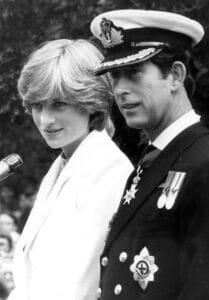
MPX798 PRINCE CHARLES AND LADY DIANA AT HMS MERCURY NEAR PETERSFIELD. PORTSMOUTH 1981
Something of a fandango ensued. “These were absurd restrictions and I told Michael that I would be ignoring them, not least because the White House official photographs of the Princess and the star of Saturday Night Fever were on the front page of every American newspaper that morning and had been shown and discussed on the major morning news shows.”
When questions were invited, I stood up and said: “Would Prince Charles be kind enough to let us know how the Princess is finding her first visit to the United States and in particular how she enjoyed dancing last night with John Travolta?”
Cole continues: “Prince Charles was livid. His face contorted with anger. He began by saying that he was not “my wife’s glove puppet” but then just about managed to offer a reasonable answer. The exchange is visible online.”
Cole took the following lesson: “It just proved how unwise it is for so-called PR professionals to try to shackle a free media, especially when there is not the slightest hint of a good reason for doing so; I wasn’t asking about State secrets or probing intrusive personal matters; I was asking for basic information about a story that was already well known and the point of conversations worldwide.”
Of course, he was asking – albeit tangentially – about the state of what we now know was an unhappy marriage, and so in retrospect one can imagine that Charles’ frustration on this occasion opened up onto the broader frustration of hi not being with Camilla.
The story has a sequel: “When they did start to allow the Princess to speak – or rather when she asserted her wise and instinctive wish to speak for herself – she did so very effectively and always made an overwhelmingly positive impression on her audience. It was just a shame that it wasn’t allowed much, much earlier.”
Cole says: “I have often reflected on this truth: if you stop running, they will stop chasing.”
Itsy Bitsy Spider
But chase they do – and chase we do. It strikes me that the desire to hunt for the King’s personality is especially absurd when one considers not just the expansive quotations in Dimbleby’s book but also the so-called Black Spider Memos released in the mid-1990s after a Freedom of Information request. Partly because the King expected these not to be made public, they are the best window we have into how his mind works.
When the Black Spider memos were released there was an attempt to treat them as scandalous. But really they’re a reminder that policy, when you get right down to the detail, is never scandalous. There is in reality something impenetrable about the memos, which renders them a non-story. The Prince was accused at the time of lobbying, but really one might as well accuse him of being extremely knowledgeable about certain topics: especially, agriculture, education, the condition of troops in Iraq, and, his guiding passion, the environment.
“You have certainly managed to bring together a powerful alliance of N.G.O.s and countries,” the future King writes in one letter to the then Minister for the Environment Elliot Morley. “I particularly hope that the illegal fishing of the Patagonian Toothfish will be high on your list of priorities because until that trade is stopped, there is little hope for the poor old albatross, for which I shall continue to campaign…” Morley’s reply isn’t readily available in The Guardian archive.
To the then prime minister Tony Blair, Charles writes: “The main issue that we talked about was agriculture. I mentioned to you the anxieties which are developing, particularly amongst beef farmers and to a lesser degree sheep farmers, of the consequences of the Mid Term Review. There is no doubt that decoupling support from production provides many opportunities, but it is also creating some real fears amongst the livestock sector.” The letter which ensues contains eight points full of closely argued detail; it resembles a legal brief. One is left in no doubt that this is a man who knows what he’s talking about, though the correspondence is very far from being a page-turner.
“As you know, I always value and look forward to your views – but perhaps particularly on agricultural topics,” replies Blair, possibly through clenched teeth.
My guess is that it’s this which makes Charles standoffish with the media: there is no scandal about him, but the questions he has to field always seem to suppose that there is, might be, or even should be, scandal. It is always annoying if you want to enact a change to agricultural policy to be asked about your divorce. Charles cares about other things and other people; but the media keeps wanting to turn things back to him.
There is a complexity about our current monarch. The Queen, with her stoicism and an intellect which didn’t range quite so widely as does Charles’, was perhaps more comfortable with the symbolic nature of the role she was called upon to enact. Charles isn’t like that, and so perhaps he will make us all look inwards and wonder what more we might be capable of. One can imagine a nation more analytical, perhaps even, in some positive sense, more curious with him as King.
A Question of Trust
Nevertheless, the fact that he is human is another non-story and therefore another inconvenient truth for journalists.
Philipp Mosimann tells me an excellent story which encapsulates this perfectly. “Mosimann’s has been very involved in the Prince’s Trust,” he explains. “We had a gentleman who became an apprentice on one of the cooking programmes, and we hosted him at an event with the King in attendance. The apprentice had written a long speech to thank the future King for what he had done for his life chances. But when he came to deliver his speech, the apprentice broke down and cried and the whole room was filled with tears.”
The next person to speak was Charles. “It caught him off guard and he welled up, laughing and crying at the same time, and it was a lovely down-to-earth moment. Literally, his eyes had filled with tears. I will never forget that. You realise why we’re all here.”
It was a moment of tremendous levelling. “We were all there in the same room and everybody was at the same level and having the same emotion, about the chance we all have to change people’s lives.”
It is a lovely story, and very revealing in its way, but I can’t imagine it being front page of the Mail. The unglamorous humanity of the King and his endeavours is also echoed in Lord Cruddas’ experience. “If you work with the Prince’s Trust, you meet people who have been in difficult situations – maybe members of gangs, or drug addicts who have pulled themselves together,” he tells me. “You meet people on the front line of society, and it’s very sobering and it keeps your thinking on track.”
Cruddas recalls one moving occasion: “I was at this exhibition and walking around with King Charles. Everyone was treating me as an important person as I was with him. At the end of it, a young woman called Gina came up to me and said: “Thank you for everything you do.” I thanked her. And she said: ‘You don’t know me. If it wasn’t for people like you, I’d still be in prison. Because of your work with the King, I’m now a florist and I can look after my three children every day’. It’s a very rewarding charity.”
Of course, no assessment of King Charles would be complete without an understanding of The Prince’s Trust, which Charles founded in 1976 – amid, according to Dimbleby, much scepticism from his parents.
It sometimes seems as though you have to try hard to find a senior business figure who hasn’t been involved with The Prince’s Trust.
In our tribute in this issue to Lord Young of Graffham, Sir Lloyd Dorfman explains the charity’s evolution. “Whilst the charity had been founded by the then Prince of Wales in 1976, David Young had helped accelerate its growth. He was supportive of the charity enabling young people from underprivileged backgrounds find jobs and also start businesses. As Secretary of State for Employment and then for Trade and Industry in the 1980s, he famously devised a matched fund-raising scheme to support the Trust’s enterprise work. The government ended up committing millions of pounds, much more than had been imagined, to the surprise even of his Prime Minister Margaret Thatcher.”
One of Britain’s best-known entrepreneurs is John Griffin, who founded Addison Lee. He famously began with one car and forty years later sold the Company for £350 million. He effuses praise about The Prince’s Trust. “As a young man, I watched my own employer and thought that I could do better. It wasn’t that I was unemployable but there was a burning desire to prove to myself that I could achieve anything that I wanted. To be an Enterprise Fellow for the charity is one of the best ways to inspire the next generation. I like their motto, “Start Something.”
“Even in my own octogenarian age, I am always looking to begin my next business,” continues Griffin, who is also Finito’s Advisory Board Chairman. “There are so many entrepreneurs who owe him a debt of gratitude for providing that early start and helping them on their way. I also commend King Charles III’s late father for The Outward Bound Trust, which teaches young people the two most important words in life “I can”.’
What is Cruddas’ assessment of Charles’ contribution? “If you look at King Charles, every single year he raises £100 million a year for good causes. He uses his status and position to help ordinary people and you have to admire that. He works hard at it. He’s not just a symbolic head of the Prince’s Trust.”
Finally, Elliot Major has this assessment: “When it comes to social justice, it’s not just about plucking academically able disadvantaged pupils and getting them to Oxford, Exeter, Cambridge or Durham. That‘s important, but what we want is diversity in the upper echelons of academia and society.”
For Elliot Major, the Prince’s Trust has the right focus: “In many ways, the bigger problem we have is the huge number of people who leave school without basic skills and often come from families who themselves have had a bad experience of education. I think what’s really good about their work is that it’s not just about academic talent, it’s about recognising that young people have different talents: it’s focusing on the unsexy side of social mobility.”
So along with the unsexy Black Spider memos, we have this unsexy charity. But there will always need to be people doing things which others haven’t the patience to grapple with. Elliot Major concludes: “Having interacted with them, I think that’s a laudable aim. It’s very practical in many ways; they definitely are doing good work.”
A United Kingdom
Since the late Queen’s death, everybody who works in the royal household, has had to get used to the King’s relentless pace of work: his curiosity, essentially admirable, isn’t passive. The Queen had a well-documented style of working, which in hindsight is already considered more relaxed than the new King’s. Meanwhile, the handover of staff must take place; those who used to work for the Queen are in many cases still in position, meaning that in some cases there’s more than one person doing essentially the same job. It is like a very high end company merger.
And, in fact, a merger where the main premises are undergoing a huge refurbishment (Buckingham Palace is receiving a one room at a time makeover), all while planning the first Coronation in most people’s living memory.
There’s a lot of work to do. The King waves in the doorway, and then walks off into the future. It is one that he has already done much to help shape.
What kind of country is he waving back at? It is a country which, in spite of the last few years, feels more united than one might have expected. It’s true that the new Prince of Wales, due to Welsh nationalist feeling, needs to decide what kind of investiture ceremony to have, if any. But one doesn’t get an immediate sense that Wales is about to leave the Union.
In Ireland, the ructions which Brexit caused have not only passed but the deal which may do a lot to create a return to power-sharing in Northern Ireland even has a Royal name: the Windsor Accords.
Finally, if Scottish independence is imminent after the travails of the SNP in 2023 then I am an avocado.
It is also a nation which is aligned in many ways with the new King’s values. Environmentally-concerned, aware of the importance of social mobility, and as his letter to Everett shows, mindful of the nature of modern Britain, and penny-pinching during a time of financial hardship, he may yet prove to be the right man for this historical moment. King Charles probably wouldn’t have chosen to be King had any choice been granted; and perhaps the nation, at various points, might have reciprocated this unease. But I suspect that over time, many will come to realise that we’re lucky to have him.
Richard Desmond, the successful publisher and founder of the Health Lottery on the next generation, the success of OK! magazine – and not switching off
Tell us a little about your upbringing. What do you think parents would say if they could see your success today?
Look, I think they’d be incredibly proud. My father was the managing director of a cinema advertising chain Pearl & Dean and he used to take me to meetings. I have been in a lot of interesting meetings since; I can tell you that.
You left school at 15 and have fought your way to the top. Do you think the university system has become less successful at preparing young people for the workplace?
Universities are good for some students – but I reckon they’re not always right if you want to start a business. Parents are better off carefully thinking about what kind of offspring they have: don’t just send them to university if they have entrepreneurial flair.
Did you have a mentor in your early days of business?
Yes, but I always made my own decisions. I have tried to inspire the next generation and tell them when they are wrong. The main reason people fail in business is just that – lack of clarity of purpose.
What advice would you give to young people today looking to start their own businesses?
It is tough out there and the sooner you realise that the better. You need resilience, the ability to sell and to champion your purpose – I can tell you that business is also a hell of a lot of fun when you win.
Why do you think OK! ended up surpassing Hello! in the market?
We were in tune with the markets: people wanted out product and we knew it. That meant that we were able to live and breathe it, knowing that with the right we would be successful. I also think we invested in the right features: never underestimate the value of good editorial – and when you see a good story, put your money behind it.
How do you feel about Sir Keir Starmer’s administration?
He claims to be the party of wealth creation. It is probably better for me not to say anything just yet, although I am known for my expletives. Sometimes the wisest course of action is for me to try and remain silent.
What did the writing of The Real Deal teach you about yourself and your past career?
No doubt about it – most absorbing experience of my life. I remember being very busy writing it. It’s a fascinating experience to draw it all together – the threads of your life. Some of my best friends and worst adversaries told me that they couldn’t put it down.
The Health Lottery is a passion of yours. What community projects are you most proud of having supported because of this initiative?
I’ve a very simple philosophy on this. Don’t do anything you’re not proud of. I don’t believe in going into any project without believing absolutely in its importance.
How do you switch off from work?
I never switch off – the lights never go out here!
What is your legacy and how would you like to be remembered?
It is far too soon to be thinking about that. However, allow me look back with great pride for my own part in ensuring the Battle of Britain Monument which I helped get built against all the odds!
Julius Ibrahim, founder of Second Shot Coffee, discusses homelessness, leadership, and finding solutions.
When I was 16, before I started university, I was part of a leadership academy which included a two-day residential course where you learn all about problem solving techniques, local group exercises, trust exercises, and team building – it was amazing. One day I was sitting down at breakfast with a mentor, who was from Future Foundations, and he told me about the amazing things that he was doing at Enactus KCL to tackle knife crime in London. That talk left me so inspired, and it sent me on this journey.
When I joined my Enactus team it was day one of freshers so I was super excited, and I was lucky enough to join immediately as a project leader of a consultancy project where we were helping a local community centre restructure to enable them to become financially resilient and continue all of the amazing things that they were doing. Thankfully, within a few months, we were able to turn them around. Straight away from there, I became team president. In that role I was facilitating impact, so I was advising team leaders, and doing that kind of work more than being actively involved in the day to day running of the projects. Sometimes I found it super frustrating because I wasn’t involved in the actual day to day activities, and we had so many projects that I wanted to have a handle on, but I wasn’t quite able to. For me, it was always a priority for myself and my team to have an impact within homelessness. We had a few projects that didn’t quite reach our desired impact level, so I decided to take it upon myself to see what kind of solution I could come up with.
I am of the belief that whatever solution you’re coming up with, whatever social enterprise you want to launch, you personally have to be able to execute it. It doesn’t matter how innovative or revolutionary it is if you can’t personally put it up, so place your strengths. For me, I’ve always loved hospitality. I worked in restaurants from the ages of 12 to 17, and I was that kid at school who would bake cookies and brownies to sell. I was also the head chef at a street food place when I was at university, so I felt comfortable that I could launch something in the hospitality space and make it successful. While going through the planning process, I realised that I could open a coffee shop which retrained and employed people affected by homelessness, and that idea became Second Shot Coffee.
There is no such thing as a homeless person, only people who are experiencing homelessness, and it can happen to so many of us at different points in our lives. Victor was 51 years old when, five days after moving to London, he found himself alone sleeping on the street. He didn’t have great English skills, and he was one of those people stuck in that unenviable position of isolation. He was homeless. But what Victor did have was an unrelenting belief that he could really improve his life, and that he deserved better than what life had given him so far. Victor was someone with an incredible work ethic, a super warm personality, determination, and perseverance. He was able to find temporary housing, and then he found Second Shot. When he started working with us, he stopped being all these negative things in other people’s eyes. He became a barista. He became a hub of his community, a person that people could look forward to seeing and sharing a conversation with every single morning.
Our concept, and the concept of our logo is that we’re trying to help people who are on one path get to a higher, more prosperous path. But there’s always this overlap between when one journey ends and another begins. It’s up to you to decide how you want the next phase of that journey to kind of pan out. Whether you’re working on projects now, thinking about launching a social enterprise, or working in an industry, you must know how to place your strengths, trust the process, show your resilience, and know that you can create amazing things and create an amazing impact.
Julius Ibrahim speaking to Enactus students at the ExCel Centre, London
When a new leader takes over an organisation it can be quite a worrying time. It can often be unclear what the new appointment means both personally and for the organisation. What should you be looking out for and how can you make the most of the appointment?
It is always reassuring to consider that new leaders come into organisations all the time. It is part of an organisation’s natural life cycle. New appointments can breathe life and ideas into the organisation, but poor appointments can be made as well.
As a new member of the team, such senior level changes can be quite disconcerting. It can though be interesting to consider the tone of the communication about the appointment. The communication can provide tell-tale signs about the future. If there is little change in tone or approach, then that would indicate ‘business as usual’ but strong messages about the future could indicate a change of approach.
There are three approaches that a new leader can adopt:
1) Operation continuation – little change in approach, which can often be the case when an organisation is performing well. New leaders in such scenarios are often chosen because of their ability to maintain an already established successful course.
2) Power to review – a new leader will want to put their fingerprints on an organisation but does not believe that wholesale change is required. Reviews may be undertaken, and these will have strong internal flavour in terms of who is leading them, and the questions posed.
3) All change – the new leader believes that radical, wholesale change is needed. This can often happen if it is failing or has recently had to deal with a crisis. There may be a reputation to rebuild. The questions posed in any reviews will be tougher and outside expertise in leading them can be expected. There is also a higher chance of churn, in terms of people as well.
None of these scenarios should prevent people, at all levels, from expressing their views. New leaders often like to hear from the teams already in place. What works? What could be done better?
So, always look at the positives and see having a new leader as a chance to impress. There could be formal opportunities for such engagement but grab those informal opportunities as well. The 5-minute introduction and discussion can make a lasting impression. That is especially the case in the office when few have yet returned. Try to grab some time with them, make an impression early and potentially convey your ideas to them.
All three scenarios also demonstrate the real value there can be in such formal processes as appraisals. Far from being a pointless exercise in administration, a good appraisal can improve personal development and set the objectives that can help stand-out from others. Exactly the sort of qualities new leaders will be looking for.
Rather than being a time to worry, change at the top should be viewed as an opportunity to grasp but that can only happen if you embrace the change rather than fighting against it.
Read Stuart Thomson’s take on the role of public affairs here
A look back on Sophia Petrides’ exploration of the problems CEOs faced during the pandemic. Originally published June of 2021.
By Sophia Petrides
Over the last three months I have beenspeaking with CEOs, leaders and entrepreneurs about leading through the pandemic and lockdowns of 2020 and 21. It will probably come as no surprise that the results show that the 50 leaders I spoke to all reported new challenges as they explored new ways of working remotely. They had to learn, as if from scratch, how to manage teams, and engage with clients and how to manage the group of CFOs, CTOs and CFOs sometimes know as the C-suite. The leaders I spoke to head up small, mid and large cap organisations across financial services, technology, healthcare, sports, consumer brands and manufacturing. I am grateful that they gave their time during a period when – as you will see – that is a commodity more valuable than ever.
Encouragingly, all of them shared an overwhelmingly positive outlook for their organisations and each expects to see a strong global economic recovery once our vaccination programmes are fully in place. At the same time most of these business leaders acknowledged that we are unlikely to return to pre-Covid-19 workplace norms anytime soon, if ever. All these CEOs took part on the understanding that my findings would be reproduced anonymously.
When it comes to the specifics of how they approached the lockdowns, it is clear that the direction of travel over the last decade towards a more people-centric employee experience, better communication across organisational hierarchies and more inclusive company culture has been greatly accelerated by the pandemic and the needs of working remotely. As one CEO put it, “The pandemic has a silver lining. It’s an opportunity to do things differently, with the time pressure needed to overcome complacency with the current way of doing things.”
Digital headaches
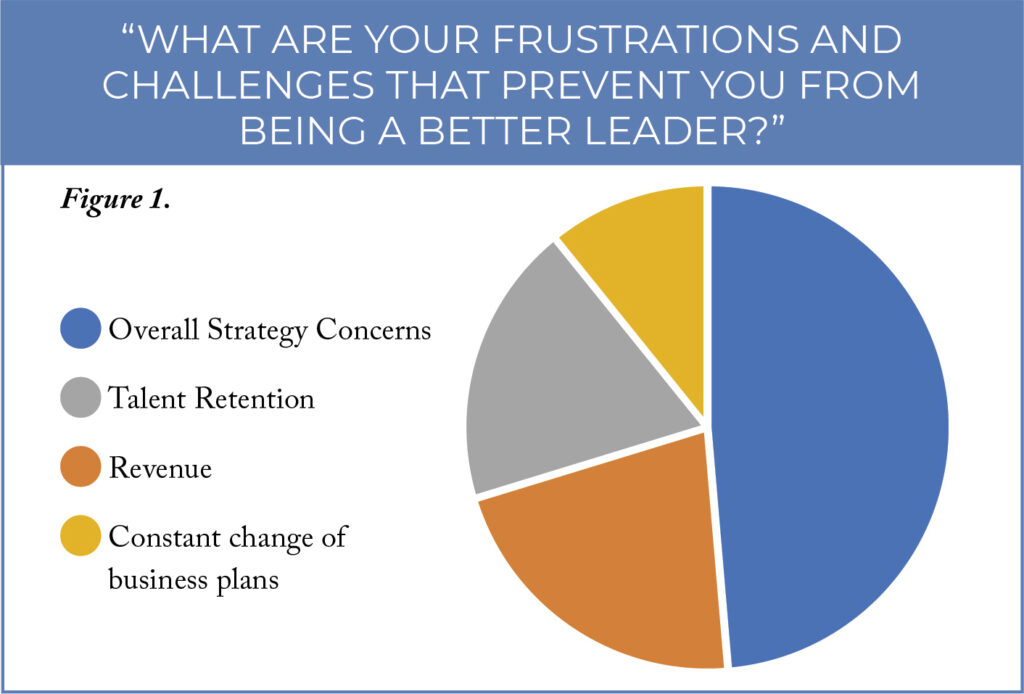
We asked the question: “What are your frustrations and challenges that prevent you from being a better leader?” and it yielded some interesting answers which show the most important friction points during the pandemic. These will likely also affect us all going forwards too. The results can be seen in Fig.1 below.
The fact remains that digital leadership is difficult. A large part of the leadership challenge has always been aligning the company and its stakeholders around a clear vision. However, in the age of virtual meetings such as Google Meet, Zoom, and other online meeting platforms it has become a more significant challenge. In many respects, engaging with teams digitally underpins most of the major frustrations of the CEOs I spoke to – the problem is the loss of those unplanned moments of interaction that are so important to create a sense of momentum and social cohesion behind the leadership team. There’s no office buzz online, and that informal energy is essential to align teams behind the leadership vision.
Another major headache – around 19% of issues – was retaining new talent in an age when many of the new hires hadn’t been able to meet their management and colleagues in person, or participate in any of the usual social, informal onboarding experiences that are a normal expectation of everyday working life. However virtual meetings were noted as providing positive experiences too, in that they also give a safe space where younger professionals can voice their views with confidence.
As one CEO put it, “I miss walking around the floor and connecting with people at all levels. You can’t connect on a human level through virtual meetings, there’s no spontaneity, no chit chat, no watercooler moments. People struggle with burn out, home schooling and not being physically together, you need to find a platform to support innovation because it is lost when people are 100% working from home.”
Also in relation to Figure 1, I found that around 11 per cent of leaders felt that reaction to the pandemic had caused a shift to short-term strategies and away from the big picture plans in place before. There was a sudden need to have a Covid-19 response, and this in turn triggered a slew of new HR policies. 22 per cent blamed the sudden disruption for the loss of normal KPI reporting and measurements, along with the loss of travel and sales activities, for reducing revenues and growth. One leader told me: “You are challenged by balancing staff well-being and HR policies with Return on Investment (ROI) and frustrated because you can’t spend time with clients like you used to.”
NO BOARDROOM BLUES
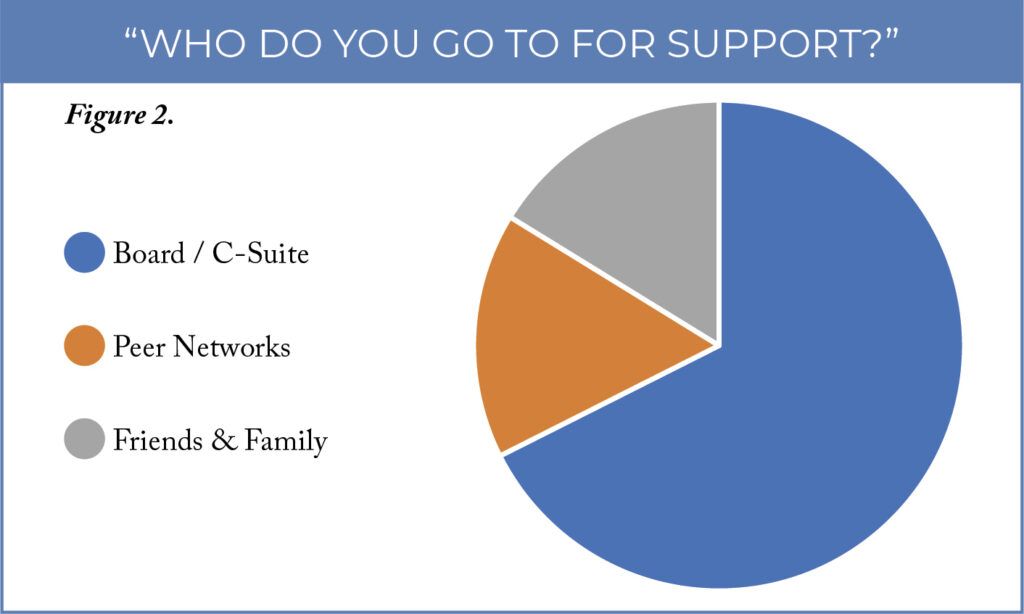
Secondly, I asked CEOs what support mechanisms they had found themselves seeking out during Covid-19. These results are displayed in Figure 2. One interesting – and unexpected – result of the survey was the overwhelmingly positive response to online board meetings. Over 68 per cent of my survey group immediately said their boards, trustees and non-executive directors were providing an extremely high level of support. This was attributable to the pandemic, as another unexpected silver lining, not just in providing support to CEOs, but offering mentorship and support to the organisation at a higher level than ever before. One leader was particularly enthusiastic about the reaction of their board: “Pre-Covid-19, it was challenging to get the board of trustees visible and engaged with the team. Now there’s 100 per cent visibility and presence through online meetings, which means the board has moved closer to employees.”
For those without a traditional board structure to fall back on, there was a fairly even split between two other kinds of support network. Firstly, many leaders sought out colleagues at a similar level who they could talk to about the challenges they were facing off the record. Secondly the role of friends – and in particular, family – in their lives became of increasing importance. In many cases, the opportunity to work from home came hand-in-hand with the chance to make a meaningful change to their work-life balance. Spending more time with the family has proven to be a positive way to recoup lost energy and online meeting fatigue.
The Human Side
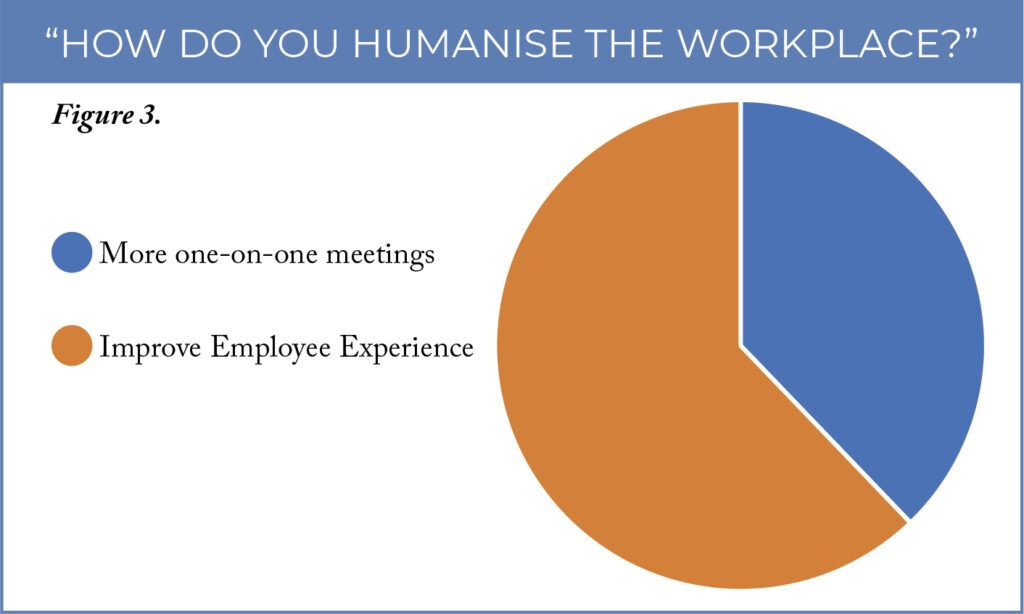
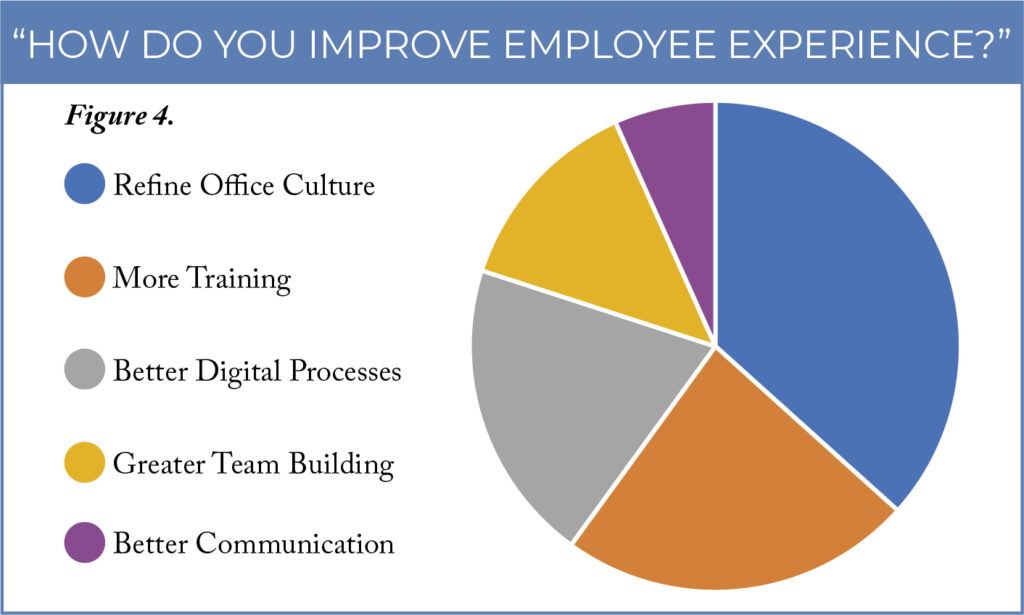
Thirdly I asked what the CEOs in question had done to humanise their workplace. There was a follow-up in the question whereby I also asked what the surveyed individuals had done to improve the employee experience. These results are collected in Figures 3 and 4.
The results were clear. Covid-19 has accelerated the importance of the employee experience. When I asked how to humanise the workplace there was a split between those who felt the emphasis should be on designing a better employee experience (62 per cent) and those who felt that what was required was more effective two-way communication across the traditional company hierarchy (38%).
When I delved into what an elevation of the employee experience might look like to these business leaders, many interesting initiatives were listed. These ranged from holding nutrition and exercise sessions for employees by providing free access to online personal trainers through to ensuring each employee took a scheduled 45-minute mindfulness break daily. A number of workplaces also prioritised in-office working options for people who were feeling lonely or isolated working from home. One CEO confided: “We delivered fresh food hampers, gym kit, games for kids and Amazon vouchers. It was about paying attention to mental and physical needs and connecting with everyone no matter what level.”
Leaders also emphasised the importance of creating a culture of fun within their teams. Many added that this required more organisation in the virtual meeting world, and included everything from introducing fun icebreakers in meetings to organised weekly virtual events. However, the most significant aspect of all the employee experience initiatives was limiting working hours, not sending emails over the weekend and ensuring staff took breaks throughout the day. Another CEO explained: “Burnout is an issue. There’s a temptation to work longer hours, but it’s not all about hours – it’s about your output, and that suffers if you don’t get the balance right.”
In addition, many leaders discussed the importance of making themselves accessible to all levels of staff, including scheduling one-to-one sessions weekly with new recruits to ensure they are settling in. This was especially on the mind of one CEO: “I am very conscious to have regular calls with the team. We have to bring all levels of people closer together and be more approachable and available 24/7.”
The Question of Morale
There are, of course, many different tools available to leaders for improving employee experience. The primary one was focusing on company culture (37 per cent) and trying to build better bonds between team members through the kinds of employee experiences we see outlined above. It is important to note that there are two other broad categories of tool for improving employee experience.
One is Continuing Professional Development (CPD). This is an essential aspect of making sure employees are staying true to their ambitions. This need for training and continuing development for teams represented 23 per cent of answers. As another put it: “Training and development are vital for sustaining a cohesive team and understand how they fit within an organisation.” There is a clear role for training to make employees feel respected and empowered, and many CEOs related this need to team performance. Another said: “Empowered means people who make better decisions more cohesively, without the need for constant supervision.”
In addition, 20 per cent of respondents talked about giving people the space to make their own digital processes, chats, support channels and online activities to boost team morale. 13 per cent suggested that the best employee experience was being on a winning team, and being rewarded as part of a growing business. However, there was a general sense that while digital was essential, automation had a negative effect on team experience because it isolated people during previously social activities like training. Another CEO confided: “We invest billions in making computers more human and making humans more automated. Then we spend billions more trying to humanise humans. Person-to-person contact is impossible to replicate.”
Hinges Off
It is fascinating to look back at the lockdown year and consider how much we have learned about working digitally. It brings new challenges in terms of burnout and a lack of team dynamism. The workplace spark, the spontaneity, the atmosphere of a team environment has not digitised effectively. However, there are clear benefits – and arguably greater long-term gains to come – not least in the way digital working has refocused leaders on authentic communications, a flatter hierarchy and better employee experiences.
It seems fitting to end on a quote from one CEO, who succinctly explained the need for better comms and experiences, as well as the advantages of working together in the same place. These remarks suggesting a new home-work hybrid might offer a renaissance for the modern workplace: “On my first day, I literally took the door to my office off its hinges. I needed to make a statement that everyone is welcome. Everyone deserves time and empathy. It is vital to feel the pulse of the employees, because that’s the pulse of the business.” It is a pleasant thought that, cooped up in our houses as we’ve been, that we might soon inhabit a working world which has become richer as a result of the pandemic.
As we move towards a return of some normality and potentially the end of social distancing, more of us are focusing on a return to the workplace. We all need to think about what we want from that return and recognise where careers could fall apart.
While most of us are celebrating being able to return to the office, see colleagues and attend networking events, few of us see ourselves back in the office full time. As employer policies on agile working start to be published, the vast majority are trying to strike a balance between home working and office working.
But that may not suit everyone, especially those at the start of building their careers.
The old ways of learning and gaining experiences from a team based in an office have, in effect, been demolished by Covid-19. The chance of working in a single team or alongside one person who would take responsibility to lead and mentor is much diminished. These people simply will not be around as much to learn from.
That is not necessarily all bad, as it could involve being exposed to a wider range of styles to learn from, but it will make it much more difficult to manage. For those starting out, they must try to grab more control, and responsibility for their own careers from the outset. We are all just starting to work through the new reality, and no one can claim to have all the answers.
So, what are some of the questions we should be thinking about?
Do you have the ability to manage upwardly? We all need to have a way of making our voices heard and not get left behind. Those in management roles need to be listening and action plans need to be developed as a consequence.
Are the reporting lines clear? If you end up in a situation where you work with whoever happens to be in the office that day, do you have a way to manage your time and capture feedback? No one person will see you in the way that would have been the case in the past.
How is work assigned to you and how do you maintain your visibility? Being in the office is one thing – people knowing that you are there is another. However, even when a manager is in the office, they will try to maximise the productivity of their time as they see it. That could mean spending time with papers they may not otherwise have access to or, more likely, trying to have meetings with those who are around. So, facetime could ironically be even more difficult to achieve.
There is a clear danger of an inequality emerging in the workplace between those who feel that they have to spend more time in the office and those more established members who see no real reason to be in the office that often.
I’ve often considered the virtual Covid world to be the easier part of the adaptation in the workplace. More difficult is the more hybrid approach of some in the office and some out. If we are all virtual that is one thing but how do workplaces cope with a ‘some in, some out’ position? Again, these pressures will be worse for newer team members.
If employers are not being clear about any of this then it is all our roles to hold them to account. Ask employers what they are proposing. They should be thinking about your interests and talking to you about their plans.
The writer is Head of Public Affairs at BDB Pitmans
One of the most remarkable things about the Salmond v Sturgeon split is that these two warring enemies were once close friends. Sturgeon told the Holyrood committee yesterday that “Alex Salmond has been for most of my life — since I was about 20, 21 years old — not just a very close political colleague,” but also “a friend, someone in my younger days who I looked up to and revered.”
The duo dominated Scottish politics for over a decade and brought Scottish independence from a fringe movement to the forefront of the devolved parliament. Now their field of gold is strewn with accusations of “conspiracies” and calls for resignation.
Yet, after yesterday’s commanding performance it does not seem that Sturgeon will be stepping down. The Scottish Tories also seem to have jumped the gun in calling for a vote of no confidence. This, of course, may change if Sturgeon is found to have directly broken the ministerial code by misleading parliament about when she first learned of the allegations against Salmond. That investigation is still ongoing.
Accusations of sexual harassment and bullying in the workplaces of our highest offices and institutions continue to come to the fore. Bullying allegations against the Duchess of Sussex have this week emerged from Kensington Palace, and again, only an inquiry will bring the true story to light. Meanwhile, infighting has been a regular feature of the Johnson administration.
Now an entire political movement is becoming defined by a rift in its former and current leadership that shows no signs of healing anytime soon. The questions at the centre of the case are about who, if anybody, has failed in their role as a leader.
There are lessons in the saga for our own work lives. In the first place, we’re reminded of the great importance of trust in our careers. Here, played out for us in Holyrood, is the sense of grief that attends the breakup of friendship. It is a reminder of how much can be preserved by going into business with the right people – but also how hard it can be to tell who those people are in advance. ‘There is no art/to find the mind’s construction in the face,’ as Shakespeare has it in Macbeth.
Sturgeon’s dignified appearance too was also a reminder that we must be careful not to rush to conclusions until we have heard all sides of a story. For years now, agree with her or not, Sturgeon has been the best player on the pitch in British politics. There is much to be learned from her presentational style: with the world watching her, she expressed herself relieved to be telling her side of things.
But we’re also reminded of the secondary nature of gossip. For years there have been questions about how Scottish independence would work economically, and recent economic data – showing that the country has underperformed relative to the rest of the UK – has certainly added to the sense that the Scottish economy would struggle if the country were to strike out on its own.
The nation’s finances remains worryingly tethered to the world’s oil price, and its growth has been sluggish. In that sense yesterday was a sideshow which didn’t change the fundamental questions the independence movement has to answer.
Whether or not the vote of no confidence passes, or Sturgeon resigns – neither looking likely at the moment – there may well be a considerable drop in public trust for the country’s leadership and this will likely dent support for independence. A reputation, so the saying goes, can take 20 years to build but can be destroyed in just five minutes.