Tag: journalism

  • Jon Sopel’s fascinating take on January 6th, the Starmer administration – and why he left the BBC

    Jon Sopel


    I am sometimes asked about why I left the BBC. I remember the corporation went through this spasm of asking themselves how to attract the young. If you watch the news, by and large you’re over 60. The same is true of the Today programme.

    The editor of the 6 O’Clock News was thinking about how we get more young people. Do we need younger presenters? Or do we need old people like me talking about young people’s issues? This was at a time when LPs were making a comeback. We sent a young reporter down to Oxford Street, and said to a teenager, holding up an LP: “Hello, I’m from the Six O’Clock News. Do you know what this is?” The teenager replied: “Yes, it’s an LP. What’s the Six O’Clock News?”


    Thinking back to January 2021, I can’t forget the day after the inauguration when Joe Biden was finally President. Washington DC that day was less the elegant neoclassical city that most people remember from the Capitol through to the Supreme Court and the great museums that go to down the Mall. It was a garrison town, the place was absolutely sealed off. There were rolls and rolls of barbed wire because of what had happened on January 6th. I will never forget the shock of that.

     

    Jon Sopel book launch in aid of Hospice UK and hosted by Finito at The East India Club, London. 17.9.2024 Photographer Sam Pearce / www.square-image.co.uk


    January 6th is also inscribed on my mind. I’ve been in situations where I’ve faced greater personal danger, when you’re in a warzone and you’ve got a flat-jacket one, and there’s incoming fire. But I’ve never seen a day more shocking than January 6th when the peaceful transfer of power hadn’t happened. I went on the 10 o’clock news and the mob still had control of Congress and Joe Biden’s victory still hadn’t been certified. That’s the starting point for my new book Strangeland: I wonder how safe our democracies are. My experiences in America made me realise that we cannot be complacent in the UK.


    Another thing happened the day after January 6th. The Capitol had been sealed off by razor wire and I went as close as I could, and went live on the 6 O’Clock News. There were lots of Trump supporters around and they heckled me throughout so that the anchor Sophie Raworth had to apologise.

    It soon morphed into a chant: “You lost, go home! You lost, go home!” I was trying to figure out what that meant. At the end of my live broadcast I said to this guy: “What on earth does this mean?” He poked me in the chest and said: “1776.” I thought: ‘Do I explain that my family was in a Polish shtetl at that stage?”


    Peter Hennessey, the great chronicler of government in the UK, talks of the good chap theory of government – you rely on people to do the right thing otherwise the system falls apart. I came back to the UK at the beginning of 2022 after eight years in America. The first election I voted in was 1979. For the next three years I knew three prime ministers: Margaret Thatcher, John Major and Tony Blair. In 2023 we had three in one year – that’s a reminder of the volatility of the times we live in. In many ways in 2016 – with Brexit and with Trump – the world jumped into the unknown.

     

    Jon Sopel book launch in aid of Hospice UK and hosted by Finito at The East India Club, London. 17.9.2024 Photographer Sam Pearce / www.square-image.co.uk


    It’s always seemed to me that the Labour Party finds power a really inconvenient thing to happen. They much prefer it when they’re forming Shadow Cabinets and discussing the National Executive. Then you’d get pesky people like Tony Blair who come along and remind them it is about power. The Conservative Party was always the ruthless machine of government: there is an element in which the Conservative Party is in danger of going down the Labour Party route. It was the Conservative Party membership, for instance, who gave us Liz Truss, the patron saint of our podcast The News Agents. We launched in the week she became Prime Minister – and my God, she was good for business.


    What would Britain look like if there were 10 years of Starmer? He’s done the doom and gloom, and how everything is the Conservatives’ fault. That’s fine – but so far, he’s not set out what the future is going to look like under him. Is it Rachel Reeves’ vision of the growth economy? Or is it Rayner’s vision of increasing workers’ rights. I think Starmer is an incrementalist and simply doesn’t know. If he has any sense at all he will look at the centre of political gravity in the electorate and go for growth because that’s what the country needs.
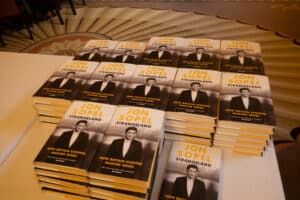
     

    Jon Sopel book launch in aid of Hospice UK and hosted by Finito at The East India Club, London. 17.9.2024 Photographer Sam Pearce / www.square-image.co.uk


    Hospice UK do the most amazing work. The book I’ve written Strangeland deals with the challenges facing Britain at the moment. Hospice UK do the most amazing work. Strangeland deals with some of the huge challenges facing the . Hospice care is one area where something urgent needs to be done.


    Jon Sopel was talking at a Finito event given in aid of Hospice UK. To donate, go to this link: https://www.hospiceuk.org/support-us/donate

     

  • Diary: Toby Young on journalism, diversity-crats and not oversleeping

    Toby Young


    Journalism is a great career for someone in their twenties and thirties, but it’s a very people are given proper employment contracts by newspapers with pension benefits and healthcare. So once you’re in your forties and you’re married and have a family, and mortgage contributions to make it’s a less attractive profession. Some people combine it with doing other things. Others use it as a springboard into marketing and PR.


    Something I found unsatisfying about being a journalist is that there’s not much sense of progression. If you’re a reporter or a columnist, you’re doing the same thing day in day out for decades at a time. Unlike an architect where you can look back and say: “I built that” with journalism there’s sometimes a lack of a cumulative sense of achievement. If you’re on the editorial track, and you shin up the greasy pole and become editor-in-chief, that can be a different thing though.


    One time I had to interview the film director James Ivory. I overslept and I got woken by the publicist about half an hour after it was meant to have started. The publicist said: “That’s not a good enough excuse to keep him there!” “Well what should I say?” “Car crash!” When I got there he quizzed me in great forensic detail about my car crash. He obviously knew it was a lie. I thought at the end of it he might hire me as a screenwriter so great was my imaginative capacity.


    I’ve always had an entrepreneurial streak. I set up my first magazine in primary school, so when I set up The Modern Review when I was 27 in 1991, I was able to say I’d been in the publishing business for 20 years. I eventually got involved in education and set up four schools, and then more recently The Free Speech Union. Setting up schools and institutions gives you a sense of leaving something behind. You have to think much more commercially if you start things, and if there’s a market for it, and if so, how to reach that market.


    As British universities have admitted more and more students and grown in size, they’ve attracted left-wing academics with a sense of social mission who want to change the world by evangelising and converting them to the cause of social justice. It’s a generational shift. Most academics were radicalised in the 1960s, or those who weren’t have hand-picked their successors. As these resources have grown, more has been spent on diversity-crats. As tuition fees have gone up, students have become more and more demanding that they be looked after by university administrators.


    The Free Speech Union is often contacted by students and academics who have got into trouble for exercising their lawful right to free speech – sometimes quite bad trouble. So a good example is Timothy Luckhurst, who’s the head of South College at Durham, which is the equivalent of an Oxbridge college, for inviting Rod Liddle to speak. He was placed under investigation, and the Free Speech Union had to look after him. Durham is one of the worst offenders, and we’re often contacted from people like Oxford and Cambridge. On the other hand, we don’t get too many inquiries from Birmingham, and only a few from Exeter.

    One of the reasons to be cautious about how quickly the spirit of liberty can be restored is it was revealed to be in a very decrepit state during the last two years. It was surprisingly easy for the government and various public health agencies, civil servants and the BBC to persuade people to exchange their liberty for safety, much more so than it had been in the Asian flu in the 1950s. That was true not just of Britain but of most liberal democracies. Today, when we look at the Draconian lockdowns in China, and people streaming from their windows for help, we think that’s what tyranny like, but two years ago people did the same. That was a sobering moment.


    Toby Young founded the Free Speech Union

  • The Industry 2.0: Journalist aspirants rival bankers for drama and drive

    The Industry 2.0: Journalist aspirants rival bankers for drama and drive

    Daphne Phillips

    I recently enjoyed the BBC’s new drama Industry, in which we follow five graduates that vie for a permanent job at the fictional investment bank, Pierpoint. The clashes, the deceit, the egos and the excess draw you into their storm in a teacup. Yet I couldn’t help but notice that none of this rivals the tempest that gathers around graduates trying to break into the world of journalism.  

    Being one of them myself, and on one of the most competitive and well-respected journalism courses in the country, I can say with confidence that they’re a maverick and driven bunch. Since we spent last semester enjoying in-person teaching but with very little social life outside of the course, the long days, intensity of work and shared dream have led to a sense of village community. 

    But as with any village, there is also drama and intrigue. There has been suspected ‘ideas stealing’ and the reckonings to follow. Meanwhile, the psychological warfare of group chats reveals how many grad schemes and jobs people have applied for. 

    Some want to infiltrate, investigate, and expose terrorist organisations, whilst others are fiends at trawling through suspicious MPs’ expense record. Others just want to write about cricket. There is depth and there is range to their pursuit to make a living out of words. 

    Then there is the world of freelancing – like banking, one with its own quirky words and rules. Freelancing can be very rewarding and is an excellent way to introduce yourself to publications you one day hope to work at full-time. It is also another way of quantifiably comparing yourself to your journalist peers. Some will already be working on documentaries; others are writing features for national outlets; and the relentless Twitter stream can all seem a bit much sometimes. 

    Investment banking may be competitive, but it’s got nothing on journalism. More graduates than ever are interested in journalism as a career-path, and unfortunately there are fewer jobs waiting for them. The result is a highly competitive but undoubtedly exciting atmosphere.  

    Photo credit: Austine Distel on Unsplash

  • Diary of a pandemic job-hunt

    Diary of a pandemic job-hunt

    Georgia Heneage left university in 2020 with the plan to become a journalist but is already widening her horizons 

    Leaving school or university and stepping into the category of the unemployed is daunting at best, terrifying at worst. As a generation born into a consumerist, perhaps even individualist society, we have been engineered to believe that our identities are irrevocably tied up in our career prospects: simply, we are led to believe that what we ‘do’ with our lives is central. 

    To some extent, that’s true. Jenni Russell recently wrote in a Times article: “Work is how society allocates so much of what we seek: money, status, social networks, mental challenges, companionship, prospects, marriageability, hope.” It’s hard to argue with that.  

    “Journalism – and print journalism, in particular – was a volatile and constantly shifting industry even before the pandemic.”

    But placing our work life on a pedestal can be damaging to the process of finding a job in the first place. There is overwhelming pressure on young people to achieve great things early on in their career and to hit upon the ‘perfect’ job straight away. This pressure can be stultifying, and creates an atmosphere of dog-eat-dog competitiveness which can hit hard as you enter the jobs market.  

    This has certainly been my experience as a postgraduate seeking an entry-level job in journalism: even at higher levels, it’s a ruthless and merciless industry, as seasoned journalists remind me all too often. As a graduate, that’s especially so.  

    Journalism – and print journalism, in particular – was a volatile and constantly shifting industry even before the pandemic. Now, newspapers are hardly hiring at all, and the few roles advertised are fiercely competitive.  

    That means that more and more journalists are forced to go freelance and accept a paycheck that is reliant on the next available commission. Much of the advice that I’ve been given has focused on freelancing, a process which can be demoralising and difficult for a little-known journalist finding her feet in the Grub Street world of the press.  

    The best advice that I have received so far has been to relax and remember that most careers are not a linear path to success, and that the concept of a ‘job ladder’ is a myth. 

    The direction of my career has altered slightly as a result, and I am now seeking the safety of a stable job and income. Having taken a moment of self-reflection, I realised that my knack for writing and researching and my interest in the big ideas shaping our world could land me a job which had similar characteristics to journalism, but which didn’t have to be confined to the industry. 

    I have now pooled my skills, values and motivations, and decided to broaden my job search to include the media as a whole and the publishing industry, which has resulted in my first interview with the How To Academy, an organisation which hosts talks and debates from some of the most influential speakers in the world. 

    The best advice that I have received so far has been to relax and remember that most careers are not a linear path to success, and that the concept of a ‘job ladder’ is a myth. Careers are twisting, fickle journeys, with unexpected bumps along the way which, once you’ve traversed them, come to look necessary in retrospect. Imagining my future in this way is liberating. It loosens societal expectations to dive head-first into the ideal job, and opens up the possibility of finding jobs which may not have been immediately appealing. 

    If I look at the data, I realise the scale of my challenge. The Office for Budget Responsibility reckons that unemployment more than doubled in 2020, and that 3.5 million are now affected. For young people entering the jobs market, this is disastrous. High levels of redundancy continue to mean that graduate-level or school-level jobseekers are now competing with a pool of skilled workers with years of experience and expertise under their belts.  

    It’s true that there are silver linings. For instance, the global transition to a remote-working culture and the development of the ‘gig economy’ may be what the future of white-collar working in a post-pandemic world looks like, and may provide more opportunities for those without work. Research has tended to find that working from home can have a significant positive impact on workers’ mental health and well-being, which in itself can improve productivity. A paper published in 2017 in the American Economic Review found that workers were even willing to take an 8 per cent pay cut to work from home.  

    But frankly, I find that cold consolation. The prospect of not going into an office every day strikes me as unnerving. The routine of commuting and mixing regularly with colleagues is attractive to me, and I don’t want to miss out through no fault of my own.  

    It has also been argued that the pandemic, for all its setbacks, presents an opportunity to rewire the world of work. Though this may be true for seasoned white-collar workers, at what cost does this come for those uneasy newcomers entering the workplace for the first time? 

    Georgia Heneage is an Oxford postgraduate and freelance journalist