Tag: JOBS IN ITALY

  • Review: Hotel Principe di Savoia in Milan

    Christopher Jackson


    Milan is a famous city, but it’s also in a catchment area where we find cities at their most beautiful and competitive: Italy. Within a relatively short distance, your other options include Rome, Bologna, Florence, and Venice, four of the greatest cities anywhere on earth. So that while it doesn’t quite qualify as a hidden gem, it might be that it still needs its cheerleaders – people to remind you that it’s more than just a place to watch football.

    Fortunately, help is at hand in the shape of this article. Milan is the wealthiest city in Italy, and trails only Paris and Madrid when it comes to being the richest city in the EU. To list its strengths in industries is to seem to list all industries: from fashion and art, to finance, law, chemicals and art, it might be that if it’s ever been your instinct to move to Italy to work abroad, that you’re more likely to work in Milan than any of the other great cities.
    But Milan’s a tourist location too – not just for its proximity to Lake Como and Cinque Terre, but also because of its own attractions. Venice is more beautiful; Florence has more art; Rome has more history; Bologna has better food – but Milan has something of each, and if you can look at what’s here rather than dream on what’s not, then you can find yourself enriched.

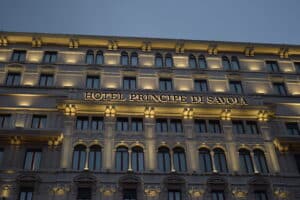
    You’ll be helped by this if you opt for the Principe di Savoia. The hotel, designed by the Milanese architect Cesare Tenca, opened in 1927, in a location near to the central station and Teatro alla Scala Theatre, one of the most famous opera houses in the world with long associations with everyone from Paganini, Verdi, Toscanini and Barenboim. This proximity is flagged by the hotel in many of the rooms which features pictures of scores by the great composers. It is a reminder that if you’re staying in an excellent hotel, you ought to be inspired.

    But you also ought to relax. On the top floor is one of the finest urban spas imaginable – a gym and pool with spa, steam room, jacuzzi, and so forth. That spa neighbours the famous presidential suite where Queen Elizabeth II and the Duke of Edinburgh have stayed, as well as people somewhat less admired than they perhaps once were: Woody Allen and Vladimir Putin.

    The feel throughout is of a modern city, where you’ll find the latest fashion and probably do well to look as presentable as possible. But it’s not quite so simple as that on inspection. The Duomo itself is deservedly famous, a building of almost unfathomable detail even when standing a hundred yards away from it. It is one of those works whose greatness is in its busyness. It was Voltaire who said that great works of art require quiet patches. Milan Cathedral from the outside at least appears to be a refutation of that: it is a thing so teeming that you wonder why it doesn’t seem too much. If you look closely at the sculptures along the east and west walls, you’ll find that the rhythms of the figures is subtly done so as to allow for cohesion – a miraculous given how many of them there are.
    Inside, things are different – the doctrine of detail is traded in for a echoic vastness where the forests of pillars give way to sculptures.

    If you want to know about the origins of the city, you can discover much in the crypt at the Duomo, where you see excavations which tell of the early baptistery founded by Ambrose, and which gives you a sense of just how old everything is deep down while everybody rushes around above you thinking of football, cars and fashion.

    Milan Cathedral also the option to go up and walk on the roof. Gardiner once said of Bach that his music is tragically good, insofar as they were better than they strictly needed to be for a regional capellmeister. Milan cathedral up here is the same: in the days before the invention of the lift, very few can have had the opportunity to come up into the skies and see these superb sculptures, so detailed and complex. They were done for their own sake: one of the best examples I can think of the importance of a true work ethic: to do things well because that is how they should be done regardless of reward.

    Of course, Milan has had its pull, and the names have kept coming here. In the Castello Sforzeca you can see a room which Leonardo da Vinci was working on; The Last Supper is also on view in an underwhelming refectory on the other side of town. It’s a reminder of that other person who upended things here: Napoleon Bonaparte. It’s Bonaparte who we have to thank for the poor state of the Last Supper, since the place was requisitioned as a stable.

    The Castle feels as large as the Louvre, and just as labyrinthine, involving a vast traipse around armouries and collections of porcelain which it would take a lifetime to assimilate. Here also is Michelangelo’s famous – and marvellous – La Rondinaia, one of those unfinished works of his where you can see the figure miraculously emerging from the marble.

    Getting about Milan is a straightforward matter: in truth there’s enough here to do to keep you busy for a week, but the city is large and so the metro demands to be mastered: a straightforward task as it turns out, tapping one’s card exactly as if this were Piccadilly.

    Beyond Milan, your easiest train journey is Bologna – that red-bricked foodie haven, which sometimes loses out to Florence, but which is in many respects its equal. It’s undeniable that some magic happens on the train from Milan down to Bologna: a sort of Tuscanisation of the landscape, where the light becomes warmer, and the gorgeous tracery of blue hills begins to weave its way about the sky.

    The train itself is very fast – beginning in Turin, it aims to get all the way to Naples in six hours, stopping at Florence, Rome and other places. Sometimes, remembering winter in the United Kingdom one envies one’s fellow travellers, whose lives can seem to have a superior flavour by virtue of carrying them out in a superior location.

    But it’s worth all the life envy to get to Bologna. The beautiful frescoes by Giovanni di Modena in the Bolognini Chapel in  San Petronio: an Inferno which would have terrified Dante, and a beautiful series of six pictures of The Journey of the Magi. Bologna has a magic about it; an iteration of Italy which I’ll not forget.

    But there is another side to Italy – it can be overwhelming. The beauties are so many, and so many are in the past that it can be sometimes you long for some straightforward escapism from the noteworthy and the sublime.

    This is where the Principe di Savoia comes into its own: I’ll not forget a morning I spent, attempting to teach my six-year-old son to swim in the pool on the roof. Sometimes, it’s best not to go to Lake Como, but instead to attend a spa.

  • Letter from Venice: ‘a relocation might be for you’

    Christopher Jackson


    Many a city which we call beautiful is by any objective measure not beautiful at all. Very often, as with London or New York, they’re simply gigantic and dynamic enough to admit opposites. Others are dystopias which we’ve trained ourselves to manage in by assigning them labels – enchanting, lovely, beautiful – which don’t apply.

    You realise this when you come to Venice: the City of Water is a separate case altogether. Any survey or poll taken regarding the question of The World’s Most Beautiful City, which didn’t show Venice the winner by a comfortable margin would be immediately suspect and void. No other city does terracotta reflected in the water and Gothic windows like this. But it’s also the place of the chance discovery: the Madonna above the doorway; the disappearing spire; the gondola yard; the washing on the balcony.

    It hits you rightaway. As you cross from Marco Polo airport towards the lagoon, a new standard presents itself. We can call it beauty, but it’s also to do with an unusual degree of respect for the past. The past, you continually reflect, as you tour Venice’s bridged intricacies and tucked-away glories, may simply have been better aesthetically. The difference between Venice and elsewhere is that Venice has kept its commitment to the past as close to absolute as a city can, while everywhere else has made significant accommodations.

    I recall coming here in the aftermath of the financial crisis in 2008. It occurred to me then that the very last city on earth to know that there was a recession on would be Venice – and the last person on earth, a Venetian hotelier. It comes as no surprise to learn that tourism is by far the biggest sector in Venice, though the region still has a lively shipbuilding sector, in addition to being the largest exporter of Italian luxury goods.

    Unemployment here remains high, meaning securing jobs is competitive. I recall another visit here in 2006, and on nights in the piazzas found the common thread among the young was their tendency to be living with their parents with no serious prospect of employment any time soon. Occasionally one wonders what happened to that generation: perhaps they had to go abroad; maybe they become part of the radicalisation of Italian politics either nationally or as part of the Venetian nationalist movement; or perhaps they inherited their parents homes, and still hear their footsteps echoing as they leave the bars of the Piazzale Michelangelo, now thirtysomethings their static lives having been spent taking all this for granted.

    For non-Italians who happen to be mobile, and perhaps looking to run their businesses from abroad, the property market is rather inflated in Venice itself compared to properties nearby in Padova and Vicenza. Everything’s Giotto in the first city, and Palladio in the second – and both are in easy reach of Venice.

    But relocating to Venice is not impossible, and there’s more life than you might imagine. Readers of Donna Leon’s excellent Commodore Brunetti series will know that the idea of Venice as mere museum and cultural fossil has tended to be exaggerated. In those books, we find a vivid, almost Dickensian cast of characters: the detached aristocrat, somehow managing to afford the upkeep of the palazzo; the shadowy criminals moving their money around; the owners of the gondola companies; the close-knit community which keeps La Fenice running.

    But Brunetti’s mysteries often take him beyond Venice itself onto the mainland, as if only there might the real network of relationships which lead to an intriguing crime be found. You sense that if Leon didn’t do this, too many of her stories would be centred on hotels, restaurants, or gelaterias.

    For those looking to relocate, I can recommend the Lido. Every night, the vaporetto from the mainland disgorges true Venetians from their day jobs in hospitality onto a sleepy promenade whose veneer is touristy, but which the longer your stay feels lived-in and viable as a home. Accordingly, the place has a sense of community which you only occasionally glimpse on the lagoon. Housing here is affordable – for the Londoner, almost laughably so – and so the international entrepreneur is in theory only a Visa application away from an affordable lifestyle with Venice on their doorstep.

    And what does it mean to have Venice on your doorstep? It’s to be among the very wonders of the world. Almost every church has at least something by Titian, Carpaccio, or Veronese and most have at least two of them. Then there are the big-hitters such as the Scuola Grande which is known as the Sistine of Venice, with its grand dramatic ceilings painted by that scrappy hustler Tintoretto. We don’t always like to hear it, but it was the product of a worldly ruse. When the possibility of the commission came up, there were four other artists in contention, including Tintoretto. When Tintoretto displayed his submission, he took the opportunity to announce that it was a donation, knowing full well that the regulations stipulated that all gifts had to be accepted: he went on to do 60 paintings, a large proportion of them deathless masterpieces.

    You could spend your life only looking at those – and scores of lifetimes inspecting all the glories elsewhere in the city. If you stand very still on the Ca d’Oro and pay proper attention, you can feel it moving slightly. Look down at the floor at the Basilica di San Marco, and you’ll notice that the stones are uneven and therefore hand-cut – nothing is ever completely even in the Venetian aesthetic, it always admits room for growth. In this beautiful untidiness, it mimics the laws of the universe itself.

    Of course, there is another side to Venice, which you can glimpse in the Doge Palace itself. Here you meet the truth that there’s such a thing as a painting which is too large – Tintoretto’s gigantic Last Judgement seems as though it must forever draw attention to its size, and therefore to the ambition of the painter. To paint on that scale you need a better reason than that you’d like to be considered great (and be paid in the process).

    Here too are some of the more forbidding prisons imaginable, reminding you that to fall foul of the Doge was never a particularly good idea. The famous Bridge of Sighs is named not, as many think, after the delighted exhalations of lovers seeing the possibilities of La Serenissima. Instead it refers to the regret of prisoners who saw this view on their way to their executions, to when all those possibilities had been closed.

    But perhaps there’s a lesson there. If Venice is infinite and we are not, then it’s always to some extent a mystery to anyone mortal. A relocation might be for you if you’ve come to the conclusion that the occasional scratching of the surface isn’t enough.