Tag: Jeremy King

  • Ronel Lehmann reviews Jeremy King’s new restaurant Arlington: “an inspirational overcoming of adversity.”

    Arlington Restaurant Review: A Delightful Dining Experience with Jeremy King, by Ronel Lehmann


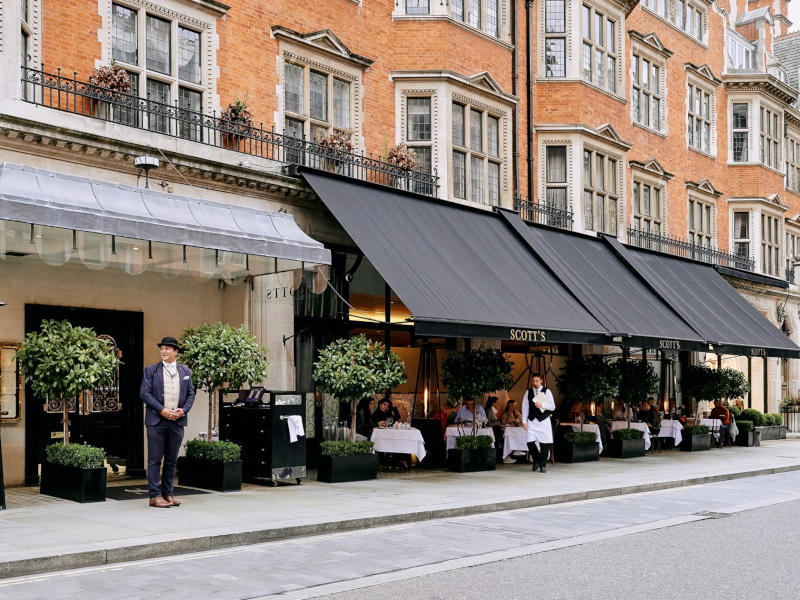
    When Karin Stark, wife of the late Dave Allen, described how life was without her comedian husband, she movingly said: “It’s like being a very long way from home.” Those words always struck a chord with me. To an avid restaurant goer, it felt the same, only this time on a happier occasion to be greeted by Jeremy King in his new abode, Arlington in St James’s.

    I had to research whether there had ever been a battle of Arlington. Indeed, there had, at the time of the American Civil War. The Arlington National Cemetery is also the final resting place for many of the United States’ greatest heroes, including more than 300,000 veterans of every American conflict, from the Revolutionary War to Iraq and Afghanistan.
     

    The reason for my own sudden conflict was learning that my own Editor had wanted to visit Arlington and write a review, and I had unintentionally usurped him.

    My marketing director guest had arrived just before me, although I wasn’t late, and she was by then well tucked into a small table facing other diners. I had the window outside view, although I was totally focussed on the dazzling finish of the interior, with its new tablecloths, black furniture, polished steel, mirrors, lighting and framed prints.

    The menus arrived and felt immediately comforting. It was a Monday lunch, the start of a new week and we both decided to decline wine. For our starters, we ordered Plum Tomato and Basil Galette and the Spinach and Ricotta Tortelloni. I felt the infusion of wild garlic in the tortelloni which was served warm.

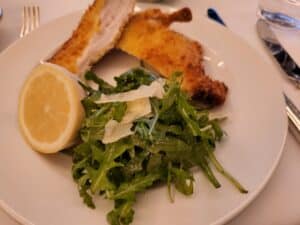
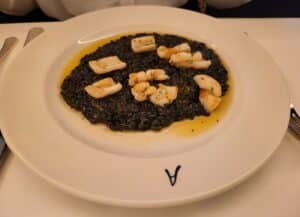
    The main courses of Risotto Nero and Chicken Milanese, Rocket, Parmesan followed suit. My own chicken was beautifully flavoursome. If I am honest, I struggled to finish the huge portion. It was at that moment that I noticed the teeth of my guest opposite. Her mouth had turned completely black. I felt that I needed to do the honourable thing and gently alert her. She was shocked and her white serviette also began to turn black as she delicately wiped her mouth to try and remove traces of the squid ink. At moments like these, we could only laugh together, as I thought that Dracula had arrived.
     

    After the drama of the risotto, we decided to pass on the puddings but enjoy an expresso coffee with some chocolate truffles. Readers will know that I have a sweet tooth and my big eyes noted the temptations of Cappuccino Crème Brûlée, Mousse aux Deux Chocolats, Hokey Pokey Coupe, Treacle Tart with Cornish Clotted Cream, Scandinavian Iced Berries with White Chocolate Sauce, Tarte Tatin with Cinnamon Ice Cream and Rhubarb Crumble with Custard.

    Leaving the restaurant was a bit like old times. You feel valued and don’t receive such a personal and caring gratitude expressed like it anywhere else. Jeremy and I reminisced about what happened to him before. I told him that he was inspirational overcoming adversity and making such a grand return. His long-standing commitment and service to his diners is legendary.

    As I walked away, I remembered Dave Allen again. He once said “You wake to the clock, you go to work to the clock, you clock-in to the clock, you clock out to the clock, you come home to the clock, you eat to the clock, you drink to the clock, you go to bed to the clock, you get up to the clock, you go back to work to the clock… You do that for forty years of your life and you retire — what do they fucking give you? A clock!”


    I hope the King of Arlington continues to reign over us and never retires.

  • Review: The Wolseley

    Lana Woolf

    During the pandemic, I found myself having a delightful conversation with Jeremy King – the King in Corbin King, the chain which owns The Wolseley, The Delaunay, Colbert and numerous other favourites in the capital. He told me that due to Covid-19, people had become ‘entombed in their homes’.

    It was the sort of intelligent phrase that makes you know you’re talking to an intelligent man. And, in fact, intelligence is the secret ingredient which makes Corbin King a cut above the rest.

    On arrival, I find that there are plenty of people who agree with me, many well-known. If you want to celebrity spot, I’d regard the Wolseley as a better bet than the Ivy. My eye lands on the former secretary Amber Rudd, and then at a different table ITV’s Robert Peston talking to someone who looks as though he might be Toby Young. As I deposit my bag, I look up to see the Earl Spencer gliding past me to his seat.

    This used to be a place where you wouldn’t deposit your bag; you’d make a deposit. My companion, well into his eighties now, recalls how it used to be an important branch of Barclay’s. This dispels some of the mystery surrounding the architecture of the place which has often reminded me of a chapel; in fact it was a kind of cathedral to our contemporary god, money.

    The place is happier as a temple to food. We move to a side table, passing half of Who’s Who as we go, and look at the menus. As we’re doing so Jeremy King comes over looking immaculate and cheerful and tells us the good news that business is back.  

    We select the oysters and I recall the portrait by Lucian Freud of Jeremy himself. Freud apparently always took the same table – not so far from the one where Rudd is sitting today. On the day of his death, Jeremy draped it in black crepe.

    We order oysters, and soon twelve Colchester natives come to us on an icy platter. They slip down perfectly with lemon and tabasco sauce. I could live a long time and never get over the glory of a Wolseley plate of oysters; my companion, in his ninth decade, confirms that it is indeed a reason to keep going. 

    The Wolseley continues to produce food of high quality without slipping into pretentiousness. For the mains, my companion plumps with a kind of cunning for the Kedigree with Poached Eggs. When it arrives, he pronounces it delicious in a voice which could live forever. I, meanwhile, opt for Roast Corn-Fed Half Chicken morels and Madeira sauce.

    This was a triumph. Most of all it is wonderful to think, after what the Wolseley team has been through, how decisively it’s come out the other side. Entombed in our homes no longer, we walk out, nodding cheerily at the Earl Spencer on our way out. Caught up in his own post-prandial happiness, he waves back.

  • Wolseley founder Jeremy King: “The British are really poor when they don’t know where they are”

    Wolseley founder Jeremy King: “The British are really poor when they don’t know where they are”

    by Jeremy King

    In many ways, the UK is now suffering from what I call a morbid culture, and there’s no doubt the pandemic has potentially drained the fun and positivity out of interaction. Despite all that, I also continue to feel we will return to an approximation of what happened before in the 50s – that whole sort of Mad Men having two or three martini lunches. We’ll congregate again.

    I’d argue that there’s a big difference between moaning and complaining. Complaining is a good thing within reason, whereas moaning is a negative and the British propensity to moan is very strong. 

    The human capacity to adapt is massive. I was talking recently to a large group of people about Brexit, a policy which I’ve been vehemently opposed to. I remember it well: it was all doom and gloom from the audience but I found myself saying that we’ll find a way through it. The British are really poor when they don’t know where they are, and that’s really been the issue with Brexit. If we don’t know what we’re up against, we as a country tend to descend into a morose state of moaning. I’d argue that there’s a big difference between moaning and complaining. Complaining is a good thing within reason, whereas moaning is a negative and the British propensity to moan is very strong. 

    Where we’re really good is when we know what we have to deal with – that whole Blitz spirit people talk about when we adapt quickly and innovate and reorganise, as with the vaccination programme. Everyone was saying at this talk that Brexit is going to be a disaster and I said to this large group, “No, we’ll get used to it.” 

    So if you’re at a hotel in London today, and there’s this massive blast half a mile away, or closer, and the windows rattle and possibly break – clearly there would be pandemonium. People would be screaming, shouting, panicking, rushing for the door. But go back 70 or 80 years in London during the war and we would all have looked out of the window, and turned to one another and said, “That was close. Let’s carry on.” You’d’ve adapted and made the most of it. 

    Pre-Covid, there was a danger we had become complacent in the restaurant business

    My mother said that to a degree the war was the happiest and most fulfilled time of her life. Adversity stimulates, and I suppose, pre-Covid, there was a danger we had become complacent in the restaurant business. But everything that’s happened has made an impact on how we go ahead, and how it is for the staff -but I have a feeling people will adapt.

    Sometimes I think of my regular customers, the amazing people I’ve met. Lucian Freud was an example – he would always dine with us at the Wolseley. Lunches tended to be near his studio at Clark’s. For dinners, he’d frequent other restaurants, or he’d stopped going because people were overfamiliar. For me, he was one of the types I like the most: he didn’t care who you were, he was interested in you as a person, and how people look. Yes, he spent a lot of time with aristocracy but he was also a very natural warm and caring person. 

    He would work of an evening and then come afterwards – often with the person who was sitting for him. As with the most prestigious tables in restaurants, it was easily protectable because you could always tell if anyone was heading towards a high profile person, and keep an eye on him and make sure he was looked after.

    We are fortunate that there is a long list of people who come very regularly to the Wolseley. We’ve had many a person who over the years we’ve seen eat a business lunch five days a week – the reason being people want the security and comfort of knowing what you want, that you’re not going to be troubled, and that things just happen. I always remember talking to Lord Norman Foster about a hotel, and asking him why he particularly liked it. He said: “After the first time I liked it, and I expressed to the staff what I liked about it. And from then on it just happened. There was no fuss, no self congratulatory acknowledgement.” I suppose a lot of us are creatures of habit. Personally, I like ritual, and I like habits. It builds a better contrast when I’m doing something completely different. 

    I feel sorry for Jamie Oliver, because he was doing it from the floor – and then the boardroom took over.

    I often wonder if we did a Venn diagram of our restaurants, how much overlap there would be between customers. The Colbert for example, in Sloane Square, is a very interesting place. It’s quite a particular crowd, and at the hub of that community. When we won the bid for that lease – the most hotly contested there’s ever been in London – we weren’t offering us much money as Richard Caring. We won it on our pitch.

    But I realised making it a sort of Wolseley-lite would be a mistake – it would be almost imperialist. It would be much better if we created a restaurant just for Chelsea. Sometimes I create an invented history for our restaurants. For Colbert, I imagined a Frenchman chased out of Paris because of an indiscretion with the owner’s daughter and setting up. He started with the bar as the first room, where he just served drinks and food. Then when the corner room became available, he took that one over, and then the next one, and did up all the rooms in a different décor. That’s why it feels so authentic. 

    Where restaurateuring goes wrong is when it’s done from a boardroom. I feel sorry for Jamie Oliver, because he was doing it from the floor – and then the boardroom took over. I feel very sorry for Pizza Express and Prezzo too: a lot of the problems they have, have been generated by the investors rather than the people running it: the need for expansion has forced them off a precipice. Pizza Express has been a dearly beloved brand and I think if it hadn’t been caught up in merger and acquisition, it would still be doing well. But then of course, we all have to adapt.

    Photo credit: By Jhsteel – Own work, CC BY-SA 3.0, https://commons.wikimedia.org/w/index.php?curid=35121735

  • Advice to a Young Restauranteur: Jeremy King

    Advice to a Young Restauranteur: Jeremy King

    by Jeremy King

    The funny thing is, I always thought 2020 might be a bit of a shakeout in the hospitality business. 2019 had been a year of the beginning of the collapse of the casual dining market and seen some very significant casualties – but of course I had no idea in what form it would come and had no anticipation about the damage perpetrated by Covid-19.

    But we were already up against it. I remain angry that we didn’t remain in the EU: I’m always immensely grateful to everybody who over the last 50 or 60 years has come to these shores and shown us how the business could be done. So many people associate restaurants with hot kitchens, swearing chefs, long hours, and not very good remuneration.

    Certainly, even as late as 1990, if you were in the restaurant profession you normally didn’t have a mortgage, you rented, didn’t fill in your tax returns, had no life insurance, and no pension. It was a transitory experience and not considered a career.

    There used to be shame and ignominy in being in the restaurant business. Now it’s as good as any there is – and in many ways even better.

    When it comes to employees, attitude is the main thing. There is no job anybody should do or will succeed at unless they have that. It’s what you make of it. If you start to think: ‘Who are these people coming in? What is the history of the building? Why do people know each other?’ that takes it all to another level. And then there’s the food, how it’s reared and grown, and the fantastic alchemy there is in cooking. By the same token, wine is an extraordinary subject. There’s a great joy in this profession – contrary to the Home Secretary’s opinion.

    And let’s not forget that it’s fun. I was always struck when Graham Norton was talking about how he had first come to London and worked in Covent Garden. He said, “I don’t think there should be National Service. Instead, everyone should be compelled to work in a restaurant. You learn about social skills interaction, disputes, reconciliation, any number of things.” He was right. For a generation which has become disconnected by the advances in technology, it really is something very special.

    People will return to restaurants. They will have missed the conviviality of community. Too many people are becoming almost entombed in their homes with the working-from-home phenomenon. And it’s interesting, having spoken to a lot of my staff over the last months, how much they yearn to return to work.

    It’s also interesting how many friends of my children – I have three all in their later twenties – have decided they don’t want to be in merchant banking or advertising. They’ve been setting up things and finding such happiness in working in restaurants to an extent that I’ve never seen before. With my generation, it was difficult to know what to do. You might have been ignorant but it was easy to find a job. This younger generation know what they want to do but it’s harder to get a job.

    I was someone who never quite knew what I wanted to do with my life. Did I want to create? Did I want to do languages? Did I want to be an architect? Thanks to the restaurant business, I’ve been able to do them all.

    Jeremy King is the co-founder of Corbin and King restaurant business