Tag: international

  • Dream jobs around the world

    Patrick Crowder

    What’s your dream job? It’s a question asked of most everyone, and often from a very young age. An individual’s goals and aspirations often change over time, so it is always important to keep one’s mind and options open. However, if you have a dream, there is nothing stopping you from finding out if it’s truly the right choice for you. A study from Remitly, which provides financial services for immigrants, has revealed the jobs held in highest regard by people around the world. With almost 1 million Google searches per year, becoming a pilot is the world’s top dream job.

    In most English-speaking countries, the top listed dream career is to become a pilot. By analysing Google search data, Remitly found that people in the UK, the US, Canada, Ireland and Australia are most curious about the difficult, rewarding, and highly regarded professions in the aviation sector. 20 additional countries are also interested in taking to the sky, including Cyprus, Moldova, Papua New Guinea, and Montenegro. High pay and frequent travel are likely factors driving this interest, not to mention the fact that pilots often receive generous pensions and benefits.
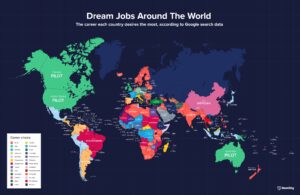
    Dream Job Map

    Image from Remitly

    The second most desired job worldwide is that of a writer. In general, a career in the arts is a popular dream job choice, with dancing and acting also ranking highly on the list. All of the Nordic countries show the most interest in writing for a living, as do Estonia, Latvia, and Lithuania. India, Pakistan, Myanmar, Bhutan, and Bangladesh all list writing as their top dream job, and a number of African countries including Kenya, Tanzania, and South Africa did the same. The freedom which a career in writing offers is unparalleled as it is often a career which can be built from home. Following the pandemic, we have seen an increased emphasis on job enjoyment, flexibility, and creativity, and a career in writing holds the unique position of offering all three.

    In addition to the more traditional creative careers, the new-age offerings of youtuber, influencer, and programmer were also represented. Mexico, Peru, Bolivia, Uruguay, and Chile place YouTube as their top dream career choice, as do Slovakia, Indonesia, and the Czech Republic. Columbia, Venezuela, Argentina, and the Dominican Republic are among the countries who chose the more general career of influencer, reflecting the growing number of non-YouTube platforms rising to prominence, including Twitch and TikTok.

    Jago McKenzie, Business Management Director at Remitly, says that the trends reflected by the study are consistent with his expectations.

    “People are getting used to the idea of changing careers at least once in their lifetime as the flexibility to work online and retrain increases. Some of the main reasons people seek a career move are for better work-life balance, higher pay and a more meaningful and fulfilling career. With that in mind, I wasn’t surprised to see so many people around the world showing clear search intent for a change,” McKenzie says, “We can see a huge range of different professions featuring prominently, including many that can be done solely online, from anywhere in the world. It’s clear that our desire for travel and exploration has not been dimmed by the past couple of years and, despite it being a tough time for the aviation industry, becoming a pilot remains a much sought-after lifestyle.”

    Whatever your dream may be, all is achievable with the right amount of dedication and tenacity. Of course, having a network of people to help you along the way is also a major boon to success, so always be on the lookout for mentors. Finito World wishes you the best of luck on your journey.
  • The WFH revolution is here, but the office is still the most popular option, finds YouGov poll

    Patrick Crowder

    New research conducted by YouGov Cambridge as part of their Globalism Project reveals the different ways people wish to work after the pandemic. Their survey of 27 countries asks where people would prefer to work if they had the choice – in the home or office – and how often they would like to do so.

    Denmark and Japan have the lowest desire to remove the office from work life completely, with only 8% of respondents in both countries stating that they would like to work from home full time. US, South African, and Brazilian workers are the most eager to ditch their commutes, with 27-28% saying that they wouldn’t like to work in an office at all.

    In the UK, the most popular option is to work in an office full-time with no work from home element. While 38% of UK workers don’t want to work from home at all, 23% want to work from home “most” of the time, and 21% want to work from home only “some” of the time. This desire for flexibility outweighs the nation’s desire to embrace the home office, with 18% of people saying that they would prefer full-time work in the home.

    As we have seen that Japanese workers have little desire to work from home, it stands to reason that Japan also has the highest number of people who want to work in the office full time, at 52%. Italian workers are second on the list for wanting to retain traditional office life at 48%, trailed closely by Spain and Germany which both saw 46% of workers wishing to keep their offices.

    Most workers in all of the countries surveyed are willing to work from home at least some of the time, with percentages for that option hovering between 20-40% across the board. Some countries, however, are resistant to working from home for most of the time, including Japan, Denmark, Spain, and France which all saw responses for that category falling below 15%.

    Across all of the countries surveyed, working in the office full time was the most popular choice at 32%. While 47% of workers are happy to work from home in some capacity at work (if we combine the respondents who chose to work from home “most of the time” and “some of the time”), only 17% are willing to make working from home their full time job. 

    However you like to work, it seems that there will always be someone else who would prefer something different – and with a bit of added flexibility and solid organisation, that’s not a problem. 

    Data: YouGov Cambridge https://docs.cdn.yougov.com/jgy6eyxvvs/Globalism21_CovidImact_AllCountries_WFHRebase.pdf

  • Denmark: Europe’s forgotten Covid-19 success story

    Denmark: Europe’s forgotten Covid-19 success story

    Patrick Crowder

    Denmark’s schools reopened on May 6th, alongside other indoor spaces including gyms, theatres, and some music venues.

    Restrictions on basic outdoor gatherings have been raised to allow up to 75 people, but there are no plans to allow large outdoor festivals or concerts with more than 2,000 attendees.

    Denmark’s cautious but fast-moving strategy has allowed them to greatly slow transmission of the virus while still keeping children in schools and the economy running, albeit at reduced capacity.

    Denmark’s primary schools were the first in the world to be reopened on April 15th 2020. By limiting the number of students in class and establishing small bubbles, Denmark’s schools were able to run in-person without causing an increase in Covid-19 cases.

    Students were instructed to wash their hands hourly and could not socialise with any other students outside their four-person playground bubble. Classrooms were split down the middle to help with social distancing, which meant that teachers had to deliver each lesson twice.

    Older primary school children over 14 years’ old were initially not allowed to return in order to keep the number of students on campus low and reduce the risk of spreading the virus. Now they will be able to return to class.

    These re-openings are mostly thanks to Denmark’s December lockdown efforts which allowed the country to avoid a third wave of Covid-19. The country is in some respects ahead of the UK which didn’t lock down over Christmas; the developments will bring home to some the costliness of the government’s policy-making in November and December 2020.

    Alongside social distancing measures and lockdowns, Denmark was the first to integrate a Covid passport system into its reopening strategy.

    A smartphone app which translates to “MyHealth” (MinSundhed) can be used to access nonessential businesses such as hair salons, restaurants, and museums. The app provides proof that the user has either been vaccinated, had Covid-19 in the past, or had a negative Covid test in the past 72 hours.

    The UK has dropped the idea of using Covid passports for non-essential businesses, reserving the possibility for larger events.

    The re-opening has been agreed upon at the same time that the Danish Health Authority has decided to pull the Johnson and Johnson (J&J) vaccine from circulation over concerns that it causes blood clots. While the risk of a vaccine-related blood clot is low, the Danish Health Authority stated that the “benefits do not outweigh the risk”. They did not rule out using the J&J vaccine at a later date if necessary.

    But the country isn’t ahead by every metric. According to Reuters, Denmark has vaccinated 17.5% of its population, compared to 37.5% in the UK and 44.9% in the US.

    Photo credit: Nick Karvounis on Unsplash