Tag: Hybrid working

  • Opinion: Why Hybrid Working is the Future

    Ever wondered why hybrid working is the future? Finito World looks at a question likely to be of perennial interest well into the future


    Hybrid working is proving itself remarkably flexible and popular.

    New research from IWG shows that hybrid working has led a boom in ‘active commuting’, with increasing numbers of workers travelling to local flexible workspaces via foot and bike.

    That’s good for our health, both physical and mental and is just another reason why employees seem to be voting with their feet nowadays.

    The study found that commutes to local workspaces are 38% more likely to be active than commutes to city centre locations. Workers aged 55-64 have reported a 109% increase in active commuting, the most of any age group.

    Health benefits


    That also has a significant knock-on effect. This follows recent census data which revealed that those who walked or cycled to work face a lower risk of mental or physical ill health, lowering their risk of admission to hospital for any illness by 10-11%.

    The increased use of local flexible workspaces by hybrid workers has been central to this shift. Almost two thirds (62%) of commutes to local workspaces are now mostly or entirely active. This is a 38% increase compared to commutes to city centre offices.

    The study was conducted by International Workplace Group (IWG), the world’s leading provider hybrid working solutions. It included brands such as Regus and Spaces, and included more than 1,000 hybrid workers. It found that walking (88%), cycling (34%), and running (28%) were the most common forms of active commuting. Workers travel on average 324 km via walking, 366 km via running, and 418 km on bike to a local workspace annually.

    The research also revealed some more novel forms of active transport, including travelling to work by scooter (7%), skateboards (6%), and rollerblades (4%), as workers cut long daily commutes by train or car and take advantage of workspaces closer to where they live.


    Rise of the “silver strollers”

    Hybrid work creates generation of “silver strollers”

    The research also reveals that older workers have made the most significant increases to the time they spend exercising as part of their commutes. Those aged between 55 and 64 reported a 109% increase in active commuting when travelling to a local workspace instead of a central office.

    Two thirds (67%) said they are more likely to incorporate physical activity into their commute when travelling to a local workspace instead of a city centre location. Meanwhile, more than three quarters (79%) have reported improvements to their physical health as a result.

    The most popular form of exercise for this “silver stroller” generation is walking, with workers aged 55-64 travelling an additional 259 km a year on foot by active commuting.
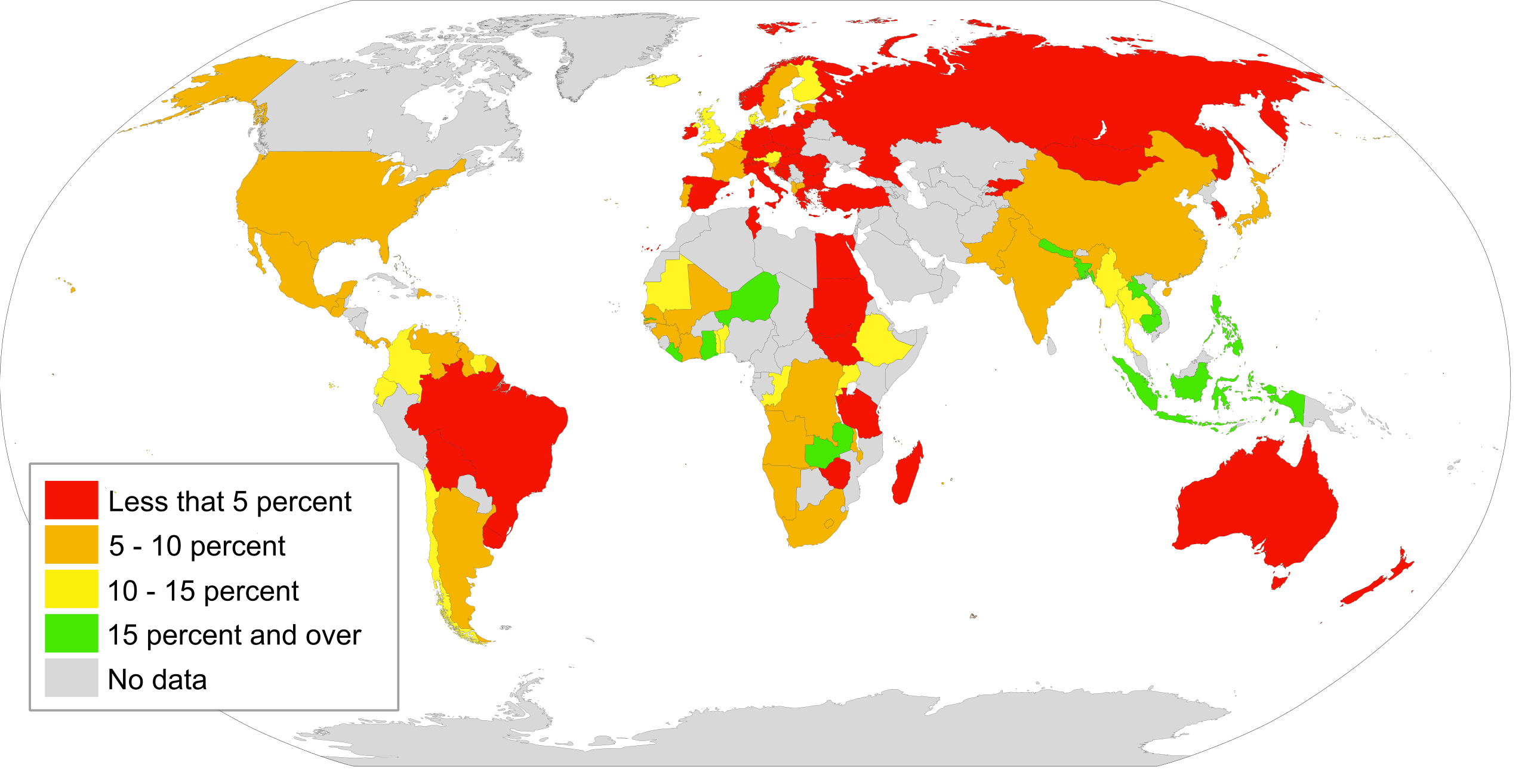
     

    Why hybrid working is the future
    This map shows the percentages of hybrid working by country


    A Question of Productivity

    Active commuting fuels mental health and productivity gains

    Beyond the obvious physical health benefits for all generations, active commuting to local workspaces has improved mental wellbeing, productivity and work/life balance. More than four in five (82%) of those that active commute said that incorporating exercise into their commute improved their mental health, with three in five (60%) reporting increased productivity at work.


    This is supported by additional research from International Workplace Group which found that three quarters (75%) of workers experienced a dramatic reduction in burnout symptoms, after transitioning to a hybrid model***.

    The improvements to work/life balance have resulted in 85% of hybrid workers saying they are more satisfied in their jobs and 75% reporting higher levels of motivation.
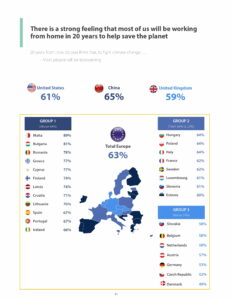
     

    Why hybrid working is the future
    This chart shows strong consensus around the ecological benefits of working from home


    Closer to Home

    Given the clear health benefits of active commuting, it’s no surprise that nearly three in five (59%) of workers want their employers to provide access to local workspaces closer to home, so they can fit in more exercise – as three quarters (75%) say they are more likely to incorporate physical activity into their commute when using a local workspace.

    It appears that business leaders are listening to their employees. Recent research among more than 500 UK CEOs found that three quarters (75%) said that returning their employees to a central office five days a week isn’t a business priority. Two thirds (65%) said they would lose talent if they insisted on their employees being present in a central office every day.

    IWG locations in rural, suburban, and commuter areas have seen a surge in foot traffic since the lifting of Covid-19 restrictions. Towns like Uxbridge (up 1839%), High Wycombe (up 1412%) and Maidenhead (up 1186%) experienced significant growth in footfall between June and August compared to the same period in 2021, when Covid-19 restrictions were in place.


    Win/Win

    To help meet this demand, IWG has opened more than 300 new locations in the first half of 2024, with the majority in rural, suburban and commuter areas closer to where workers live.

    Mark Dixon, International Workplace Group CEO stated: “The growing use of workspaces closer to where employees live, allowing them to reduce long daily commutes, is contributing to major improvements in worker’s physical and mental wellbeing.

    “This research demonstrates that hybrid working is a win/win for everyone. Business leaders are seeing substantial productivity and financial gains, while employees enjoy a better work/life balance and higher job satisfaction.

    Companies are increasingly appreciating that they will not only will they have a happier, healthier workforce when they allow people to work flexibly, but people actually feel more productive and motivated.”


    Need mentoring about hybrid working and the future of work? Go to finito.org.uk


    See also these artices:


    The Power of Motivation in the Workplace


    An Interview with revered clinical psychotherapist Dr. Paul Hokemeyer about Get Back and workplace toxicity


  • UK pilot programme reignites four-day work week conversation

    Patrick Crowder

    Last year, Finito World published an opinion piece urging companies to trial the controversial four-day working week. Now, 30 companies in the UK have launched a pilot programme testing out the new way of working and evaluating its effects on productivity and employee happiness.

    Research conducted by Instant Offices has shown a 110% increase in Google searches related to the four-day work week since the pilot programme launched, which suggests an interest far beyond the companies taking part in the trial. The research has also found that 51% of UK workers would prefer the shorter but more intense period of work which would allow for three-day weekends.

    Mainland European countries are ahead in the race towards the widespread acceptance of the four-day week, with a number of countries trialling reduced hours. Germany now has a national average of 26 hours worked per week, with the Netherlands and Norway close behind working around 27 hours per week.

    It is important to remember that a four-day work week does not mean a reduction in overall hours worked – rather the existing hours are redistributed throughout the shorter period. This has the benefits of cutting down on commute time, encouraging more focused work, and allowing for a better work-life balance. However, it also comes with fears of burn out and a more stressful environment.

    In order to allow for the possible challenges that come with the new schedule, Instant Offices suggests a variety of measures. By reallocating hours gradually rather than cutting a full day immediately, companies will be able to see the effects of the change slowly without risking a shock to employees and a loss of productivity.

    Automation may also be key, as when employees are free from the more menial tasks in work, they are free to spend the extra time working on problems which require human brainpower. Additionally, rotating schedules can reduce the risk of any single employee working beyond their capacity leading to burn out.

    Perhaps most importantly, any change to the work schedule must come with ample opportunity for employee feedback and flexibility. As we have explored before, every employee works differently, and allowing for these differences is crucial in maintaining a happy, effective workforce.

    The four-day work week is designed to give employees more free time and foster a good work-life balance, not to compress the stress of a normal work week into four unbearable days. The pandemic has fundamentally changed the way that many of us think about work, and that is generally a good thing – but it is important to avoid making changes overnight.

    Many workers are looking for a change, and a four-day work week may well be a good solution. As these pilot programmes continue, we will be able to fully see the benefits and drawbacks of this new work schedule. Given flexibility, gradual change, and clear expectations, it seems that much of the UK workforce is ready to take on a new way of working. It won’t come overnight, but the four-day work week might be the next in a long line of new normals.

    Source: https://www.instantoffices.com/blog/featured/the-four-day-work-week/

  • Why hybrid-working represents the future of work

    Patrick Crowder

    The pandemic has made working from home the norm rather than the exception, and for many employees this is a dream come true. In jobs where specialised equipment is not necessary, it seems natural to continue the trend towards online meetings, limited office hours, and working mostly from home. However, there may still be advantages to keeping some office space, especially in city centres.

    Research from the property consultant Cluttons shows that the finance and insurance industries are most suited to hybrid working, as over 75% of activities are able to be conducted remotely. Cluttons’ Head of Research Sophy Moffat explains how new patterns of working are emerging.

    “Much has been discussed about new working patterns in the city in particular, with anecdotal evidence suggesting that the city is quieter on Mondays and Fridays as people commute Tuesdays to Thursdays and make use of the days either side of the weekend,” Moffat says, “While some reports suggest Wednesdays to Fridays are the new working week. Either way, the usage of office space is less that pre-pandemic where, on average, workers spent four or more days predominantly based in the office.”

    So, if office time is decreasing, why not ditch the extra space? First of all, working from home is not for everyone, and many feel that they can only be productive when working in an office with their peers. Because of this, employers must give their people options in order to increase employee happiness, thereby increasing productivity. Additionally, Cluttons predicts that there will still be a need for some office-based activity involving high numbers of staff, which companies will need to have properties large enough to accommodate during these peak activity times.

    The time of large numbers of non-central, lower quality office buildings may be coming to an end, as there is decreasing need for spaces which house basically the same technologies and amenities employees are likely to have at home. Head of Office Agency Ralph Pearson says that balancing the costs vs. the rewards of office space will boil down to the type and quality of the space in question.

    “The fallout from the pandemic will bring to a head the ultimate balance of the office as a value generator, or cost centre. On the ground the limited evidence from committed movers points to a long-term shrinkage in floor space of circa 30% based on home working, but also far less dense desking and a strong flight to high grade, flexible spaces,” Pearson says.

    By decreasing the overall square footage of office space, while upgrading the spaces that do remain, businesses may be able to not only cut costs but also increase the productivity coming out of their offices. 18 million square feet in office space has come on to the market due to the pandemic, which Pearson believes is too much for future demand. He explains how the conversion of these spaces could change the housing market in major cities.

    “In the medium to long term a significant proportion of non-prime office stock will need to convert to other commercial, medical, educational, and social uses,” Pearson says, “But the biggest gain may go to the residential sector, potentially making city centre living more affordable and economically sustainable”.

    The way companies approach office space is undeniably changing, and many spaces will be left vacant awaiting conversion and further development. What exactly these changes will bring remains unseen, but as Pearson suggests, it could be a change for the better.

    Credit: https://www.cluttons.com

  • Flexible working – companies can’t risk falling behind

    The shift towards hybrid working is a welcome one for many, as the pandemic has made people re-evaluate their needs and priorities in the workplace. However, research from the real estate company JLL shows that 48% of workplaces in Europe, the Middle East, and Africa are not ready with future work plans that will fit the needs of their employees.

    88% of employees want hybrid working according to JLL, and with the current shortage of applicants companies need to do all they can to attract and keep quality talent. This will mean providing technology to keep workers connected, upgrading office spaces for those who choose not to work from home, and investing in programmes which put employee wellbeing first. JLL’s CEO of EMEA Work Dynamics Mark Caskey explains how workers’ needs are changing.

    “We’ve talked about wellbeing of the workforce before. It remains one of the top priorities of employees yet a third don’t have access to such an offering in the workplace. Organisations that create truly regenerative workplaces that make their people feel safe, energised, and motivated will have an edge. Spaces for collaboration and socialisation, relaxation, as well as healthy food and outdoor spaces present the biggest opportunities for employers to support their workforce,” Caskey says.

    Another consideration is the irrefutable issue of climate change. Companies should desire a movement towards sustainability for the simple fact that we all live on the same planet – and many do. For those that are not so convinced, it should be known that lack of meaningful action by property holders on this issue can have a major impact on the value of their real estate. Tom Carroll, who heads Real Estate and Strategy for EMEA at JLL realises that climate action is now a top priority.

    “Sustainability must be at the top of the corporate priority list. ​Organisations are motivated to act responsibly towards employees, communities and society at large​. We’re now in an era of responsible real estate,” Carroll says, “COP26 confirmed the scale of the challenge, and if I was to pick one trend that will have the deepest and most lasting change in our industry, it would be sustainability and the rise of environmental, social, and governance factors (ESG).” 

    Employees today demand a workplace dedicated not only to their own wellbeing, but that of the planet and their fellow humans. If companies want to have a flourishing, sustainable workforce full of the best talent their industries have to offer, they must also be committed to practices which allow their employees to flourish and which sustain the planet. Mark Caskey sums it up best.

    “Hybrid is here to stay and it’s now up to organisations to integrate and optimise flexible working into their future of work programmes,” Caskey says, adding that, “Today’s employees want more: technology that keeps them connected, buildings that are truly sustainable, and employers that prioritise their health and wellbeing. Forward-thinking organisations have already stolen a march on the rest of the competition by seeking to address this trend now.”

    Source: https://www.jll.co.uk

  • The future of the office

    The pandemic has made working from home the norm rather than the exception, and for many employees this is a dream come true. In jobs where specialised equipment is not necessary, it seems natural to continue the trend towards online meetings, limited office hours, and working mostly from home. However, there may still be advantages to keeping some office space, especially in city centres.

    Research from the property consultant Cluttons shows that the finance and insurance industries are most suited to hybrid working, as over 75% of activities are able to be conducted remotely. Cluttons’ Head of Research Sophy Moffat explains how new patterns of working are emerging.

    “Much has been discussed about new working patterns in the city in particular, with anecdotal evidence suggesting that the city is quieter on Mondays and Fridays as people commute Tuesdays to Thursdays and make use of the days either side of the weekend,” Moffat says, “While some reports suggest Wednesdays to Fridays are the new working week. Either way, the usage of office space is less that pre-pandemic where, on average, workers spent four or more days predominantly based in the office.”

    So, if office time is decreasing, why not ditch the extra space? First of all, working from home is not for everyone, and many feel that they can only be productive when working in an office with their peers. Because of this, employers must give their people options in order to increase employee happiness, thereby increasing productivity. Additionally, Cluttons predicts that there will still be a need for some office-based activity involving high numbers of staff, which companies will need to have properties large enough to accommodate during these peak activity times.

    The time of large numbers of non-central, lower quality office buildings may be coming to an end, as there is decreasing need for spaces which house basically the same technologies and amenities employees are likely to have at home. Head of Office Agency Ralph Pearson says that balancing the costs vs. the rewards of office space will boil down to the type and quality of the space in question.

    “The fallout from the pandemic will bring to a head the ultimate balance of the office as a value generator, or cost centre. On the ground the limited evidence from committed movers points to a long-term shrinkage in floor space of circa 30% based on home working, but also far less dense desking and a strong flight to high grade, flexible spaces,” Pearson says.  

    By decreasing the overall square footage of office space, while upgrading the spaces that do remain, businesses may be able to not only cut costs but also increase the productivity coming out of their offices. 18 million square feet in office space has come on to the market due to the pandemic, which Pearson believes is too much for future demand. He explains how the conversion of these spaces could change the housing market in major cities.

    “In the medium to long term a significant proportion of non-prime office stock will need to convert to other commercial, medical, educational, and social uses,” Pearson says, “But the biggest gain may go to the residential sector, potentially making city centre living more affordable and economically sustainable”.

    The way companies approach office space is undeniably changing, and many spaces will be left vacant awaiting conversion and further development. What exactly these changes will bring remains unseen, but as Pearson suggests, it could be a change for the better.

    Credit: https://www.cluttons.com

  • Opinion: it’s time to prepare for the post-Covid reality of hybrid working

    Opinion: it’s time to prepare for the post-Covid reality of hybrid working

    Stuart Thomson

    As we move towards a return of some normality and potentially the end of social distancing, more of us are focusing on a return to the workplace.  We all need to think about what we want from that return and recognise where careers could fall apart.

    While most of us are celebrating being able to return to the office, see colleagues and attend networking events, few of us see ourselves back in the office full time. As employer policies on agile working start to be published, the vast majority are trying to strike a balance between home working and office working.

    But that may not suit everyone, especially those at the start of building their careers.

    The old ways of learning and gaining experiences from a team based in an office have, in effect, been demolished by Covid-19.  The chance of working in a single team or alongside one person who would take responsibility to lead and mentor is much diminished.  These people simply will not be around as much to learn from.

    That is not necessarily all bad, as it could involve being exposed to a wider range of styles to learn from, but it will make it much more difficult to manage.  For those starting out, they must try to grab more control, and responsibility for their own careers from the outset.  We are all just starting to work through the new reality, and no one can claim to have all the answers.

    So, what are some of the questions we should be thinking about?

    Do you have the ability to manage upwardly?  We all need to have a way of making our voices heard and not get left behind. Those in management roles need to be listening and action plans need to be developed as a consequence.

    Are the reporting lines clear?  If you end up in a situation where you work with whoever happens to be in the office that day, do you have a way to manage your time and capture feedback? No one person will see you in the way that would have been the case in the past.

    How is work assigned to you and how do you maintain your visibility?  Being in the office is one thing – people knowing that you are there is another.  However, even when a manager is in the office, they will try to maximise the productivity of their time as they see it.  That could mean spending time with papers they may not otherwise have access to or, more likely, trying to have meetings with those who are around. So, facetime could ironically be even more difficult to achieve.

    There is a clear danger of an inequality emerging in the workplace between those who feel that they have to spend more time in the office and those more established members who see no real reason to be in the office that often.

    I’ve often considered the virtual Covid world to be the easier part of the adaptation in the workplace. More difficult is the more hybrid approach of some in the office and some out.  If we are all virtual that is one thing but how do workplaces cope with a ‘some in, some out’ position?  Again, these pressures will be worse for newer team members.

    If employers are not being clear about any of this then it is all our roles to hold them to account. Ask employers what they are proposing. They should be thinking about your interests and talking to you about their plans.

    The writer is Head of Public Affairs at BDB Pitmans