Tag: Hotel reviews

  • Review: Bodysgallen Hall in Wales: ‘luxurious peace’

    Christopher Jackson reviews Bodysgallen Hall and enjoys every minute of it


    It is always a curious thing to arrive somewhere at night: we experience a world without contours and landmarks – a dense dark which really could be anywhere, and yet we also know we are entering somewhere new.

    We arrived in northern Wales just in time for a storm to lambast Conwy, just as storms have been doing for millions of years: Wales always feels like ancient history.

    My main memory is of watching the windscreen wipers rushing back and forth in increasing desperation to rid the windscreen of rain, as if seeking some slightly higher setting than the maximum.

    We negotiated a long winding drive, unimpressed sheep crossing the pathway in their own time to move out of the way of our car. As we emerged from our vehicle, our bags immediately weeping with rain, we scaled some steps and the door peeled back magically: this was the greeting of the avuncular night porter Marion.


    First impressions


    As I glanced at the décor of Bodysgallen Hall – the fireplace, the 17th century panelling, the venerable portraiture – I thought: “Well, this is a whole better than the M6.” Better than the M6, and indeed better than more or less any hotel I’ve stayed at, as it would turn out.
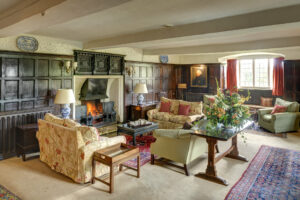
     

    Reception, Bodysgallen Hall
    Reception, Bodysgallen Hall

    We were shown upstairs to a warm upper room, and learned from Marion that the building was initially constructed as a tower house at some unspecified point in the Middle Ages. Its meaning was to serve as support for Conwy Castle, that marvellously preserved stronghold overlooking the bay: from Bodysgallen you can replay how a signalling system might have worked between this place and Conwy. One imagines Irish ships, a flame of warning, and then the bustle of preparation for whatever came next.

    What came next is what always comes: invasion, conquest, resistance, peace – the known variations of human life. It is, in fact, a marvellous place for a spa, as the history here is so rich you know precisely what it is you’re seeking to get away from.

    I had just enough time before I drifted into sleep to learn that Bodysgallen had once been a place where Cadwallon Lawhir, King of Gwynedd – the name means ‘long-fingered’ – had lived, when a luxurious peace enveloped me, which probably had something to do with not being on the M6 but also something to do with excellent bedding.

    Into Enchantment


    The following morning, the first amazing thing I did in what was to be an entirely enchanted day, was to open the curtains. This isn’t normally a particularly marvellous aspect of life in London: my curtains usually reveal Southwark Council branded bins and houses opposite which look identical to the house I have just woken in.


    At Bodysgallen Hall, the experience is very different: you look out onto an unbroken glory of horticulture, leading onto a still more beautiful and dreamy landscape: that masterpiece of nature which is Wales’ northern coastline.

    It must be admitted that Wales probably gets about three days of delightful sunshine per year: we got one of them, and in late October. The trees everywhere were having their annual rethink, deciding on russets and umbers. Their dying can sometimes seem peculiarly optimistic.

    Our first move was to eat a breakfast of champions in the tall-windowed breakfast room: a full English exactly as it should be done – heartily, and without any unnecessary complications. The food in the restaurant is Michelin standard.
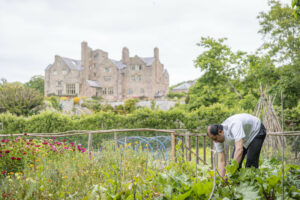
    Kitchen garden at Bodsygallen Hall
    Kitchen Garden at Bodysgallen Hall

    The views from the gardens are not to be forgotten. It was a day of bronze and misty light: Conwy seemed in shadow. The medieval folly can be seen in the distance, and it’s possible to walk up there for a better view of the coastline beyond the Orme and Little Orme headlands.

    The garden has a remarkable history. The original garden design dates from 1678 and is credited to Robert Wynn, son of Hugh Wynn, who was the first of that family to come into ownership of the Hall. A sundial bears that same date 1678. In that year Bunyan published the first part of The Pilgrim’s Progress, and the Battle of Saint-Denis was conducted between the French and the Dutch, with the verdict disputed by both sides, though its result all too clear to the 5,000 or so soldiers who lost their lives.

    In those days, everything was in the Dutch fashion: with high walls which make you want to know what lies beyond them. There is also a topiary maze, and a rose-garden which was still giving out a beautiful scent even in mid-October. The herb garden produces herbs and vegetables which form part of the menu in the first-class restaurant.

    Everywhere you go is beauty – and this was an unusually beautiful day. One could really spend a week walking these grounds, and not be near the end of it, but our time was more limited.

    The Spa

    Bodysgallen Hall is known also as a spa, and so we went there during children’s hour. Newspapers I would not have time to read were laid out in civilised fashion in the reception area.

    The spa itself consists of a warm swimming pool, a jacuzzi, steam room and sauna. My eight year old boy splashed around in children’s hour, which wasn’t quite long enough for him, and one sometimes wishes there weren’t such severe regulations around jacuzzi use when it comes to children.
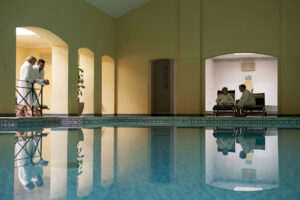
     

    Spat at Bodysgallen Hall
    Spa at Bodysgallen Hall


    After that we walked again up to the obelisk, which was built in 1993 and a landmark visible from all around. It is, like Kafka’s castle, a thing which one nears but never quite gets to. But the trying to get there yields acres of mushroomy woodland, and a sense of blessing at trying to get there at all.

    Lunch consisted of sandwiches taken in the crocodile alcove. Bodysgallen Hall is a place of little nooks and surprises. It is also a place of superb beef sandwiches. My son and I agreed we could quite easily have eaten 400 of them, but had to settle for eight.


    The Land Beyond


    As the afternoon began I sensed Conwy calling. We had been in the castle before on a previous visit: it is an extraordinary place which the first-time visitor will need to do. But the joy of second-time visits is to strike out in surprising directions, and so we decided instead on two churches.

    The first is Llangelynnin Old Church, which is to be found a 20 minute drive out of Conwy up a winding slope. It isn’t where you’d expect to find a church, amid the beginnings of the Welsh hills. We didn’t expect it to be open, but the door had an obliging give when we tried it: inside the side walls date from the 13th century and the impression is of a peace which is worth climbing up here for.

    Round the corner is St Mary’s church which is on the site of Aberconwy Abbey which was founded in 1172. Here, you begin to get to the nub of the matter: two yew trees older than Chaucer preside over the church, and there is information inside establishing the ancient nature of this site, where the Romans also had an outpost. Both these churches are supported by the National Churches Trust.


    This is the infinite nature of Wales: its wonder is to do with deep time, and the many layers it contains. Bodysgallen is the way to explore it and also to experience a luxury which is both classy and not too ostentatious. It is an additional pleasure that to come here is also to support the National Trust, which in addition to maintaining our nation’s heritage, also clearly knows how to run a hotel. A special mention must also go to the magnificent receptionists Catherine and Hayley who were helpful and kind throughout our all-too-brief stay.

    In our second swimming session, my son Beau, determined now and fortified by a fine day in Wales, swam his first length – a cunningly constructed amalgamation of front crawl and breaststroke. We might have arrived at night – but we left sensing a sort of dawn in ourselves.


  • Review: Harbour Hotel, Sidmouth: ‘a friendly, relaxing hotel’

    Christopher Jackson


    In early 2024, many parents looked at the calendar with a degree of confusion: the schools were going back on the 9th January, and not – as with the previous year – on the 2nd. The question of what to do with the children for that week, when they were beginning to get claustrophobic from Christmas reared up: it had to be answered one way or another.

    I had a plan up my sleeve. My children have begun to show an interest in fossils and I had read that the fossil-hunting reaches its zenith on the Jurassic Coast in the winter, especially in the aftermath of storms.

    Sidmouth, where the Harbour Hotel is based is an excellent location from which to explore: it is located at the end of a charming town dominated by a relaxing promenade with a sleepy Edwardian feel. It is probably the case that Covid-19 – with the humourlessness which characterised that particular disease – snookered many families into Larkinesque holidays they had mistakenly come to consider beneath them: Greece, Italy and the south of France were traded for Wales, the Lake District, and Cornwall.

    What seems subsequently to have happened is that many families found they disliked airports more than they had realised, and also that Larkin was a grouch who made England sound like a car park. In fact, although it has car parks it is also one of the most beautiful countries in the world. Many families now wonder why they should fly to an inferno in August and have begun to think of the risk of rain in England as being not only worth it, but a benediction of sorts.


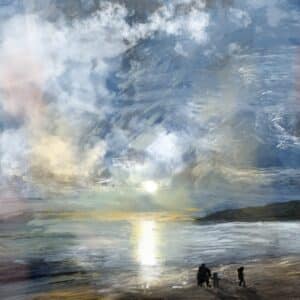
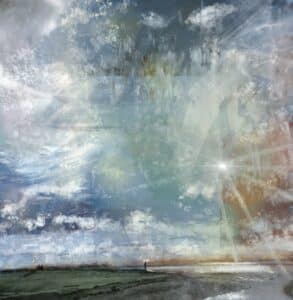
    Charmouth, 2024, iPad sketch by the author


    The Harbour Hotel chain is a good way in which to explore the entire southern coast. It has outposts at Guildford, Brighton, Chichester, and Southampton as well as a hotel in Bristol and three particularly lovely properties in Cornwall. The Sidmouth property is very beautiful: full of nautical decor, and nonchalant luxury.

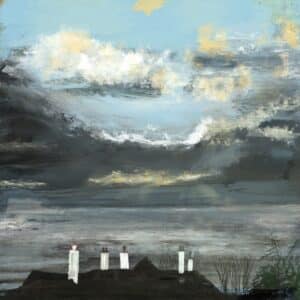
    Our room had a spacious balcony looking out onto the English channel. A few houses poke up towards the horizon, where the sky is continually producing masterpieces aimed at no one in particular: it can be a well-spent hour just to watch the clouds build an empire which they subsequently decide against. I found myself sketching the scene on my iPad throughout my stay, in a constant amazement at the loveliness of this part of the world.


    The view from Room 18, 2024, iPad sketch by the author

    We might think of January in England as a reasonably bitter destiny, but it has its austere beauties. Down at the excellent breakfast (pancakes and a fine full English) on our first morning, the sun kept bursting through the clouds, as if in the throes of its own private epiphanies. Sometimes it can be hard to distinguish sky from sea. In fact, you feel you’re being let in on the secrets of an interconnected system which London keeps from you.

    The beauty of the coastline can also be seen from the breakfast rooms: the first cliffs between Sidmouth and the little village delightfully named Beer recede beyond the High Street, which has an excellent ice cream shop called Taste and lots of boutiques. The Sidmouth coastline is beautiful in itself, but also recedes down towards the additional promise of Lyme Regis, Charmouth, Bridport, and Kimmeridge.

    It is all fossil territory. Apparently, due to a certain hidden toxicity about the waters, none of the creatures who died during the shift in climate following on from that famous asteroid impact some 65 million years ago have since been nibbled away at. As you look out to that glorious sea you are also considering a perfectly preserved time capsule. Sir David Attenborough is only the most famous person to be excited about this lucky anomaly: in fact, you don’t have to delve too much into the Jurassic coast to enter a welcoming community of fossil addicts and dinosaur lovers.

    To fossil-hunt here is to partake in a long story. As you drive down the coast from Sidmouth to Lyme Regis, you are heading in a sense towards the ghost of Mary Anning (1799-1847). Feted and famed, and even subject to the high contemporary accolade of a Little People, Big Dreams book, Anning became famous in the Victorian era due to her discovery of the first correctly identified ichthyosaur skeleton when she was a mere twelve years’ old. She subsequently went on to discover two nearly complete plesiosaur skeletons and the first pterosaur skeleton to be located outside Germany.


    Fossil-hunting, iPad sketch, 2024


    Throughout our first day, a storm raged around us – the sort that wants to take your umbrella with it – as we trudged submissively down to the museum. The museum which bears Anning’s name is also on the site of her house, and contains a treasure trove of fine fossils. It reminds you too of John Fowles’ long tenure in the area, as well as Jane Austen’s decision to locate the pivotal scene of Persuasion (1817) here. It is pointless to deny that the weather was adverse; but in this part of the world, a storm is also an opportunity because it whips up secrets which the sedate tides can’t: it’s possible to make remarkable finds in January on the Jurassic Coast.

    In Charmouth there is a little shop which is testament to this called The Forge Fossils. Run by Chris Moore, it is an unmissable place which we happened on the following day. Moore has recently been seen on television in that wonderful BBC documentary Attenborough and the Giant Sea Monster in his role as a local expert instrumental in extracting a giant skull of a pliosaur from the cliff-face at Kimmeridge. Pliosaurs were extraordinary beasts – the T-Rexes of the seas – who swam round this part of the world in a time when T-Rexes themselves stalked the land. They were devilishly smooth swimmers, and from what I can tell could have bitten a decent chunk out of a football stadium.

    Moore is friends with Attenborough – one lovely thing about the BBC documentary is to see Attenborough’s unfeigned joy at being in the fossil community. Moore’s is one of those enviable careers which are tied to a specific place; they are the chance necessities of a birthright. We saw Moore’s studio, and watched Moore himself examining his fossils, the rest of the world a happy irrelevance to someone as happy in his work as he so obviously is.

    Charmouth turns out to be an especially promising stretch of coastline, as there used to be a Victorian factory nearby, meaning that there is an unusual amount of seaglass to be found. Within half a mile or so, we found several necklaces worth, and lots of ammonites. To say that for a child an ammonite becomes a prized possession is to riot in understatement. I have often wondered at the way in which the simplest thing to a child – a leaf, a stone – immediately becomes treasure. My sense is that it’s the adults who can’t see the excitement in the apparently commonplace who are misguided.

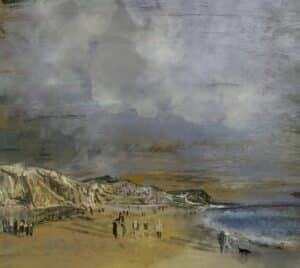
    The cliffs are very beautiful indeed. Anyone who has seen the brilliant crime series Broadchurch which finished after three excellent seasons will know the warm yellows and umbers of the cliffs here (the series was filmed at nearby Bridport). They make even winter feel warm, and I found myself sketching these too.

    The Cliffs of Charmouth, by the author.


    The hotel was a good place to beat a retreat to after fossil-hunting. As I’ve found is the case in the Harbour Hotel chain generally, the service is reliably excellent and warm: these hotels are extremely comfortable but they eschew the sort of grandeur which leads to too much formality. In some hotels, there is the exhausting sense that one is paying to have to be on one’s best behaviour. The Harbour Hotel staff were never less than kind and understanding: from Callum the restaurant manager to Abby the receptionist, Rachel the housekeeping manager, and Jay and Heather in the restaurant. The food was also superb throughout: the chateaubriand comes particularly recommended.

    In time, we came to eye our departure date with a certain contempt, until we decided to extend our stay partly with a view to taking advantage of the indoor swimming pool area. There is an outdoor area too which must be a marvellous place for an afternoon of cocktails in summer.

    On our final day we decided that it would be worth going to see the famous pliosaur itself. This is housed in the Etches Collection down in Kimmeridge, founded by another star of the paleontology world Steve Etches. Etches is another down-to-earth character who has found his calling. We found him cheerfully sweeping the car park area outside his excellent museum. This is rather as if one were visiting Julia Roberts at Paramount Studios and found her doing some light dusting.


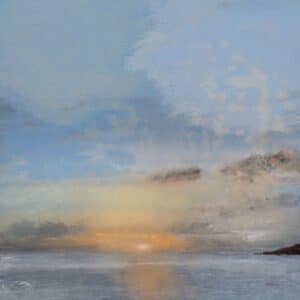
    Sundown, Charmouth


    The museum he has founded must be the envy of the Natural History Museum. On a screen above the fossils we see an almost eerie reproduction of the Jurassic seas, where a pliosaur might at any moment descend upon an ichthyosaur. The exhibit in the centre of the main room shows the complicated structures of the brain, and makes one wonder by what curious and secret processes it might have come to be at all.

    As you drive back to London, you can still hear the roar of the shingle and the surf for days afterwards. We had been among beauty and the mystery of evolution for what felt like far longer than a few days. Winter in the UK presents its challenges. It was Margaret Thatcher who said of Lord David Young: “Others bring me problems, David brings me solutions.” I might say the same of the Harbour Hotel.


    To visit the Harbour Hotel, Sidmouth go to: https://www.harbourhotels.co.uk/sidmouth