Tag: Hospitality

  • Cameron Kerr on the restaurant chain that beat the Covid crisis

    Cameron Kerr

    When the world economy ground to a halt in 2020, the hospitality sector was amongst those by far the worst hit.

    Restaurants, pubs and bars can’t operate through Zoom meetings, and unlike a supermarket we don’t go there to take our food home with us. So in March 2020, the only option for the hospitality sector was to go into hibernation.

    Workers were furloughed, premises closed up and lights turned off, waiting for vaccines that at the time were estimated to be 18 months away… which experts thought was actually a worryingly fast rollout.

    So when French dining chain Côte went into administration during 2020, the news may have seemed predictable.

    What may have been more surprising to some, is that its’ financial savior, Partners Group, was able to save 94 out of 98 of the chain’s restaurants.

    In 2023 that number had reduced to 82 restaurants, but for comparison, Byron Burgers, a restaurant chain founded in 2007 – the same year as Côte – had 70 restaurants across the UK at its’ peak.

    Once considered ‘the darling of the better burger scene’ according to Restaurant Online, a series of setbacks including three insolvency procedures has left its total number of remaining restaurants in single figures.

    So why has Côte – a chain focused on steak frites and beef bourguignon – stood the test of time, and not a brand specialising in crowd pleasing burgers?

    “We’re quite generous in our interpretation of dining. We’ve got a big menu and intentionally so,” former Côte CEO Alex Scrimgeour told The Telegraph in 2015.

    “We’re not setting the world on fire and trying to do anything too crazy in a culinary sense.

    “We’re trying to deliver very simple, high quality food that you would expect to pay quite a lot more for if eating in an independent restaurant.”

    Browsing the menu for my local Côte branch, I find a steak tartare starter priced at just £10.25, confit duck à l’orange for £18.50, and even that beef bourguignon comes in at under £20.

    This is 2023, when a London pub can charge you £20 for fish and chips – a dish once considered a cheap and nourishing Friday night takeaway.

    So to see dishes with the kinds of names you’d expect to hear when watching Masterchef: The Professionals, followed by the number £18.50, is a surprising sight.

    Perhaps this best demonstrates the gap in the market that Côte has been able to fill.

    Byron Burgers has plenty of competition that springs to mind: Honest Burgers, Gourmet Burger Kitchen, Shake Shack, every major chain pub that offers a food menu (and a lot of pubs these days operate more as restaurants).

    That’s before we get to the usually cheaper, fast-food alternatives.

    Burger King, McDonald’s, Five Guys, your local kebab shop.

    If you want burgers, you are spoilt for choice – but french food?

    Café Rouge, another French food competitor, had to publicly deny that it was in receivership earlier this year, after a columnist for the Sunday Times wrote that the chain was “struggling” and “the last few outlets are on the verge of closing forever”.

    Gordon Ramsay’s French restaurant ‘Petrus’ in London offers an A La Carte menu at £120 per person.

    But Ramsay’s expertise has found its way to Côte for a far cheaper price.

    Last year as part of a brand refresh Steve Allen, the former head chef of Gordon Ramsay’s at Claridges, took over the role of head chef at Côte.

    Allen rose from Junior Sous Chef, to Head Chef and then Executive Chef during his time at Claridge’s, and worked on Gordon Ramsay books including ‘Secrets’ and ‘World Kitchen’.

    When Allen introduced a new spring menu for Côte this year, he told reporters: “I have been cooking French cuisine since the age of 13 and this menu is a reflection of everything I love about French food in the Spring. Our main focus is and always will be about the taste of our food at Cote. Simple, yet complex and delicious.”

    More than three years on from the pandemic and lockdowns when Partners Group rescued Côte, the French restaurant chain has a new head chef and has carried out a refurbishment of its’ restaurants.

    The refurb aimed to create ‘contemporary and elegant French-inspired’ interiors, accompanying a new in-house butchery and development kitchen.

    The company reported a turnover of £144.9 million for the 2022 financial year, a flat turnover compared to 2019 – but money that was made amid the backdrop of the Omicron variant and the cost of living crisis.

    Commenting on the figures, executive chair, Jane Holbrook, seemed optimistic about the future:

    “We’ve built our foundations for growth and are very well supported by Partners Group.  We are excited about our recent progress and have embarked on a brand renaissance supported by a brilliant team.”


    Cameron Kerr is a freelance journalist


  • Patrick Crowder on Finca Cortesin: ‘this hotel reminds us what we’re working towards’

    Patrick Crowder


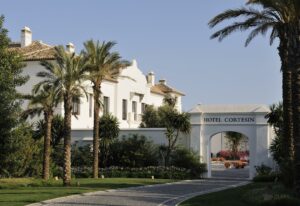
    Finca Cortesin is nestled in the hills of the Andalusian coast, a bastion of luxury on a 215-acre estate. The estate boasts six top-tier restaurants, four swimming pools, full spa facilities, a fitness and racquet club, and a world class 18-hole golf course. It doesn’t end there. As you might expect from an Andalusian resort, the weather is impeccable, and guests are invited to enjoy the crystal-clear Mediterranean Sea at the Finca Cortesin Beach Club, which is situated just under a mile from the hotel.

    In other words it’s paradise – but unlike so many other versions of the ideal, it’s paradise within easy reach. Travel to the resort is simple. The two best options for those coming from abroad are to fly into either the Malaga or Gibraltar airports, which are a 50 or 15 minute car journey away, respectively. We chose Malaga, and a chauffeur from the resort was there to pick us up, peppering us with facts about the area.


    The economic news from Andalusia – and from Spain generally – is reliably mixed. On the one hand, Andalusian exports shot up at the end of 2022 with a near 25 per cent increase – particularly to America and to Asia – partly driven by its powerhouse olive oil industry, but also by its surprise strength in other sectors such as aeronautics. Having said that, these numbers would look better if a great number of people were benefitting from them. Instead, unemployment remains stubbornly high at 19 per cent, though it is falling.

    As a Californian, the landscape looked remarkably familiar, as if I had stepped through a portal to a new version of my home across the ocean.

    We were taken to the Executive Suite, and shown a view which I’ll never forget: it looked out directly over the ocean, with a private terrace from which to enjoy the play of light at every time of day. Each evening, the sky would produce a gratis masterpiece of oxbloods and oranges for anybody who happened to be looking. Our rooms were beautifully laid out and succeeded entirely in soothing us from our flight: fresh fruit, confections, and hand-cut flowers awaited us in the tastefully decorated living room, and the king-sized bed provided a stellar night’s sleep. The high ceilings found in the living room and bedroom also extended to the marble finished bathroom, which had two sinks, a spacious shower, and an even more spacious bathtub.

    We began with a quiet drink at the Blue Bar. The décor inside the bar is classic and welcoming, though during our stay the unblemished weather would send us more often out onto the stillness of the patio with its view of the vast well-manicured lawn of the estate. Tapas is always available: beef carpaccio, complementary dried yucca and plantains, and of course the world-famous Iberian ham.

    The next morning, we wandered the estate, deepening our acquaintance with perfection. Though Finca Cortesin is of recent construction, the attention paid to traditional Andalusian architecture and décor gives it the sense of prestige which often comes with age. The estate forms two massive open-air courtyards which are filled with tropical plants. A fountain provides a centre to the impressive display of foliage, which towers above you, cushioning you from any outside imperfections which might have been wanting to come in. By being here, you come to realise the outside world is a sort of scandal, inferior to the beauty and glory of Finca Cortesin. I became particularly acquainted with a Moroccan-themed lounge, which features traditional tile patterns, cushions, lamps, and cast brass tables.


    Of course, paradise does have a few demands – like, for instance, needing to walk around it. It’s a hard life. Having surveyed the lawn, we moved with a sort of regality bestowed by the place itself to the pool, noting approvingly that it has a good variety of depths to suit your swimming style. Once these details are in your life you start to get used to them. Similarly, the poolside bar offers cocktails as well as food, with a variety of fresh fish kept on ice for you to choose from.


    Due to the desirability of coming here, tourism is big business in Spain, and especially here in the south, meaning there are a lot of careers to choose from. Had you thought of perhaps manning the spa facilities in paradise? Or might you wish to deliver the Thai massage I had on my second day? There, the knots of life outrageously perpetrated on me beyond the kindly walls of Finca Cortesin, were angrily bashed and kneaded, embedding me further in this place, making me more than ever a citizen of Eden.


    There are also a huge number of roles in food. Throughout our stay, this was impeccable. The a la carte breakfast at El Jardin de Lutz consisted of traditional Spanish fare with a modern twist. Alongside the tapas were croaker filets, carpaccio, foie gras, and numerous pastries. In the evening, we dined at Finca Cortesin’s signature restaurant Rei, which offers an ingenious blend of Japanese and Mediterranean culinary traditions.


    But this is also a mecca of golf. The course, blessed with Cabell B. Robinson’s course design and Gerald Huggan’s attractive landscaping, is one of the finest in the world and has played host to both the Volvo World Matchplay and will host the Solheim Cup in September this year. The clubhouse has a pro shop and a restaurant which provides a more laid-back dining and drinking experience, consistent with what one would expect from a world-class “19th hole”.


    It is impossible to leave the estate feeling anything but relaxed, rejuvenated, and satisfied. At Finito World, we’re all about working hard and achieving seemingly impossible goals. Places like Finca Cortesin remind us what we’re working towards.


    http://www.fincacortesin.com

  • Finito World Q&A: celebrity chef Tristan Welch

    Finito World Q&A: celebrity chef Tristan Welch

    Garrett Withington talks to the co-owner of Parker’s Tavern and host of Cooking with the Stars about life under Gary Rhodes and Gordon Ramsay and how the UK’s attitude to food has changed

    GW: How did you get your start in becoming a chef?

    TW: I fell in love with cooking from a young age at school during Home Economics. I realised whatever I cooked in the class, it made people happy and I really loved that feeling – that is what a get a kick out of, seeing people enjoying great food.

    Favourite Dish?

    Lemon sole with nut brown butter, shrimps and samphire. It reminds me of childhood holidays in North Norfolk – where I am taking my family this summer.

    You have quite a C.V. including Gary Rhodes and Gordon Ramsey. Were you intimidated working for these big names and are their personalities truly reflected when we see them on T.V?

    Working for some of the very best chefs in the world has been an absolutely inspiration to me – we all put on a bit of a pantomime now and again.

    Being a Chef often involves unsociable and long hours which can make it unappealing to the youth. What aspects of the job drew you to the kitchen that may inspire the next Tristan Welch?

    I think the hustle and bustle of the kitchen really enthused me and drew me in. There is nothing quite like the camaraderie amongst a kitchen team. Some chefs I worked with 10 years ago, when we bump into each other now, we greet each other like great friends – it is relationship-forming.

    Famously the kitchen is a stressful environment where much head bashing takes place with expletives thrown at one another, most exemplified by Marco Pierre White and Gordon Ramsey. But with more workplace environments and office spaces adopting a kinder approach, reprimanding and firing those who shout at their subordinates, is this attitude beginning to change in kitchens or does its unique environment separate it from this problem?

    Those days are gone. We are at a very interesting point now, that I identified 6 years ago (before we started Parker’s Tavern), the training we had and the style of training is no longer relevant to young talent today and as industry leaders, it is for us to take it seriously and find the solution to guide up and coming talent through and help them flourish in this fantastic industry.

    British cuisine has come a long way in a short time, now within the top ten countries with the most Michelin stars. What do you think has changed and is progress likely to continue?  

    I think the country’s attitude towards food has completely changed. When I was fresh out of college (even before then), my father would drive to France three times a year to stock up ‘on the good stuff’. Even in the early days of my career, I was told I had to live and work in France to really understand food and I did, I spent time there. But nowadays you don’t need to – you don’t have to go more than 300 metres in Cambridge to get to an amazing artisan bakery – we have great food on our doorstep.

    What advice would you give to a budding cook and where to start on the career path to become a chef? 

    Follow the food that you love, have a goal in mind and in the back of your head. Understand that there will be hard days and great days but never lose sight of your goal.

    Poor nutrition and obesity appear to be a problem in the UK. Do you think that there is an educational gap in public knowledge?

    Yes, I think there is a gap in nutritional knowledge. However my children are being taught about nutrition to the point they are questioning their own school dinners so the future is bright on that one…

    At school in Food-Tech I made Coleslaw, Pizza and a Trifle. Hardly set me up to be a great Chef. How would you go about inspiring children to cook and take what they eat seriously?

    That doesn’t sound too bad! One of the key things especially for children and young adults is don’t be afraid to experiment. One of the things I do as a parent is give my children the full run of the kitchen. They can mix and make anything – sometimes yes, it may be inedible and sometimes it is great. For me, that is the best way to inspire.

    School canteen food has also been the subject for debate by some chefs, expressed most by Jamie Oliver, but how would we go about bringing a Michelin star experience to children?

    I think in this question lies the problem, we don’t. Michelin star for kids is the wrong idea – it is about good, wholesome food that is nutrient rich and fresh. I know it is the toughest thing in the world to cook for children all the time but it is certainly something we need more of a focus on. Jamie Oliver did a smashing job however it seems to be slipping back a bit and at a time when we need to focus on our kids more than ever.

    Often for those trying to learn the skill of cooking from scratch it can be quite daunting. Thousands of cookbooks, an infinite number of online resources and numerous cuisines. Where would you tell these beginners to start and what path to follow to becoming a professional home Chef?

    During my cookalongs at 6pm every Thursday on @Parkers_Tavern on Instagram! If you aren’t joining, that is why you can’t cook!

    Famously around the world many countries have a negative perception of traditional British cuisine, how do you feel about this international reputation?

    Apparently we have bad teeth too!?

    When discussing British Chefs in general, Pierre Koffmann had stated that “Not enough Chefs cook from the heart. There’s a lack of originality, too much copying”. What are your thoughts on this and what advice would you give to aspiring chefs to avoid this problem? 

    I wouldn’t worry about copying too much, it isn’t something I would advise but I agree with Pierre, cook from the heart, cook what you love. On Cooking With The Stars, we made carbonara, is that considered copying? We made from the heart, it was fantastic and fun.

    Does food have to be complicated to truly be good?

    No – one of the most amazing salads is just picking tomatoes off the vine and serving with olive oil and a bit of seasoning.  Complicated? I think not. Completely delicious? Yes.

    After watching your performance on the Great British Menu it must be asked what you think of food critics. Are they viewed much like music and film critics who can judge but not create?

    Some restaurant critics are better than others, but to be fair everyones a critic nowadays.

  • How to be A Sommelier

    By Costeau

    Years ago Costeau was fortunate to meet the legendary sommelier Georgios Kassianos, the so-called Godfather of Cyprus Wine. He took me through all the things you must do when gauging a vintage: how to swill the glass, how to check for sugar and salt content, and then how to taste it properly.


    Then came the coup. “Now, once you’ve done all that,” he said, “nobody can tell you whether you’re right or wrong.” I found that liberating, feeling that it effectively meant that my ignorance in the matter of wine didn’t matter at all.


    And yet, Kassianos’ assessment, if it’s true, hasn’t stopped the profession of the sommelier from growing up over the years. It’s both an interesting, and reasonably lucrative profession with the median salary in the US being $62,000.


    Gabriel Veissaire is the head sommelier at the Le Meurice in Paris and couldn’t be more enthusiastic about the route he’s taken. So how did it begin? “I interned to a supervisor who was awarded the title of “Meilleur ouvrier de France”,” he tells me “I had the chance to travel all over the French vineyards with him. It’s a profession that is above all one of humility and curiosity.”


    So what attracts him to it? “It’s a passion above all which brings together a certain history of the vineyard, the mystical character of the vine which is the oldest plant in the world, the complexity of the soil and the geology where the vine grows, the oenological techniques and the principle of alcoholic fermentation and the microbial world and above all the pleasures that can be derived from the wine and food match.”


    That sounds like more than enough to keep you going for a very interesting career.


    I decide to talk to other sommeliers, and ask James Shaw, the sommelier at the Conrad St James in London, how a typical day goes: “It often starts by checking in with social media and seeing what everyone has been drinking the night before – always good to keep a finger on the pulse. Once I’m in the building, I will prepare our ‘wine of the day’ for our team briefing – it’s something we do each day to share the stories and styles of each of the wines on our list.” Then people arrive. “Once we are in service, it is full theatre time where we look to share the great stories behind the bottles, pour tasters for our guests to try and explain the thought behind our pairing recommendations.”


    It can sometimes be a hard road being a sommelier. Shaw recalls: “I left a background of Chemistry and Physics to work with food and wine, my parents thought I was nuts, but now that they have seen how far I have gone in my career they’re glad they supported my change in direction. I don’t think I was really aware of what it entails, but wouldn’t change a thing.”


    So what’s Shaw’s advice to young people thinking of entering the profession. Shaw is clear: “Taste, taste, taste and taste some more. Taste with others, discuss and don’t be afraid to follow your instincts over what feels right to you.


    Nadia Khan, the Head Sommelier of the Adam Handling Restaurant Group, notes the importance of setting aside time to think ahead: “Between the two services (lunch and dinner) I will dedicate some time meeting with suppliers and producers, tasting and talking about new wines and projects. This keeps me constantly informed and engaged with the wines from around the world, always training my palate and developing my knowledge.”


    So what talent is required to make it as a sommelier? Khan recalls: I think I have always had a discerning taste and smell. And, with time, experience and constant training, I have developed an analytical consideration, which now enables me to judge a wine after just two or three sips. I would say it’s a natural flair that I’ve applied to experience and knowledge.”


    So what would Khan recommend to young people thinking of becoming a sommelier. “I can advise that it will take time and a lot of hard work but nothing is more rewarding than making your passion what you do every day,” he explains. “Being a sommelier means that you can constantly learn and develop your expertise, whilst still having that incredible interaction with guests which often makes it all worthwhile.” Costeau will drink to that.


  • Taj Hotels: Ronel Lehmann Reviews a Festive Afternoon Tea Experience

    Taj Hotels: Ronel Lehmann Reviews a Festive Afternoon Tea Experience


    ‘Tis the season of goodwill and sumptuous gift goody bags. In mine, following a Winter Wonders Christmas Party at Taj Hotels, there was an invitation to afternoon tea. This was to be no ordinary tea but a festive production of Baubles and Ballerinas!


    We arrived at Taj Hotels and began to take off our coats, until we were ushered to our seats which were specially reserved in the centre of the grand conservatory. My guest elected to keep on her coat as it was still cold, and the sleet and snow outside hadn’t fully melted. It was a pretty scene outside with the twinkling lights contrasting with the daylight fast turning to dusk.

    There were a few diners occupying other tables after late lunches. Our thoughts turned to tea. The place setting was beautifully embroidered and the napkin holder the size of a giant ring. After a pause, the waiter brought us the menu and offered us a glass a water. A few minutes later, we were invited to select our tea leaves, English breakfast and Earl Grey were the order of the day. Two pots arrived. I requested milk. We noticed that there were no teaspoons and elected not to make a fuss.


    It reminded me of Ted Gladdish, a former client and old friend of mine who used to collect teaspoons wherever he went. I didn’t know about his habit, until after he died. I visited his home to pay my respects to his fiancé only to find picture frames with teaspoons all over his walls. I recognised some from my own office and always wondered why we were running short. My guest surreptitiously stirred with her fork. No-one but me noticed.


    Taj Hotels provided us a selection of themed teas, including The Indian Jamsine, Festive Vegetarian and Festive Afternoon Tea. We decided not to be adventurous. The two tea stands arrived consecutively. I had gestured to my guest that we should only begin devouring once each item could be tasted in unison.


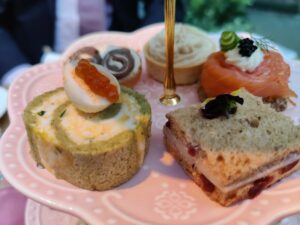
    The presentation was stunning, favourites included festive egg mayonnaise and mustard cress pinwheel; rosemary roasted beef roulade turnover; honey glazed turkey and cranberry sandwich; thyme roasted chicken mousse, open face pie and smoked salmon, cream cheese and caviar open sandwich.


    Suddenly there was a crescendo in the music which had morphed from Asian beat to The Nutcracker and two ballet dancers appeared En Pointe in pastel shades of blue. A few pirouettes later, we applauded. They were working while we were munching spiced mixed fruit scones with cranberry jam and clotted cream.


    After the entertainment, it seemed like a good moment to have a mini break before turning to the beautifully decorated and delicate patisseries, each one more tempting than the other. Santa’s parcel was a chocolate mousse, cherry with chocolate sponge. The pistachio roulade was made with Armagnac and milk chocolate crémeux. Gingerbread cheesecake hastily followed before the Christmas ornament, which was a strawberry bakewell tart and eggnog mousse. The final cake was a beautiful dark hot chocolate shaped, rocky road brownie with marshmallows and candies.


    Our waiter returned to enquire whether we would like a repeat cake stand. I politely declined and then remarked: you cannot be serious. Apparently other guests before us had requested further supplies.


    So there you have it, Tajness. Taj is legendary. They go out of their way to make you feel welcome. Everybody smiles. Service is important. They want you to remember the Taj experience. We really did.  On the way out, I had forgotten about the teaspoons.

  • The Crown Estate launches hospitality careers fair

    The Crown Estate is hosting a careers fair designed to support the hospitality industry. The free event will give over 500 applicants the chance to earn a role in hospitality at one of 25 West End businesses.
    The hospitality industry has suffered greatly from the pandemic, and a recent Opinium poll shows that only 5% of young adults are considering a job in hospitality. This means that it is an ideal time to find a position, with so many vacancies available.

    Crown Estate Customer Partnership Director Leanne Catterall explains how this jobs fair represents a new direction for the Crown Estate, and new opportunities for applicants.

    “This is the first jobs fair of its kind for The Crown Estate and will act as a pilot for how we can continue working with, and supporting, our customers and communities in the future,” Catterall says, “It will be a great opportunity to not only support our customers, by showcasing the fantastic career opportunities within hospitality, but also unlock new opportunities for people from all different backgrounds.”

    There is a wide range of positions to fill, so participating businesses are looking for baristas, bar tenders, waiters, chefs, operation managers, pastry chefs, housekeepers, and more.

    The businesses involved include top London restaurants and cafés, including Park Row, Ole & Steen, Café Murano, and the critically acclaimed Fallow restaurant. James Robson, who Co-founded Fallow in St James’ Market, is excited for the chance to participate following such a hard time to find staff.

    “What a great event to be a part of. We launched Fallow at a tremendously difficult time – just days before the first lockdown. Our sector has been crippled by the pandemic and staffing is a major part of this,” Robson says, “We need to do all that we can to show prospective employees the wonders that a role in hospitality can provide, and the jobs fair will do just this.”

    The event will take place on Tuesday, June 14th, from 10AM to 4PM at Park Row restaurant on Brewer Street. The fair, which will feature culinary and industry workshops, is free to attend.

    Tickets: https://www.thecrownestate.co.uk/en-gb/about-us/the-value-we-create/community-jobs-and-growth/hospitality-careers-fair/

  • Advice to a Young Restauranteur: Jeremy King

    Advice to a Young Restauranteur: Jeremy King

    by Jeremy King

    The funny thing is, I always thought 2020 might be a bit of a shakeout in the hospitality business. 2019 had been a year of the beginning of the collapse of the casual dining market and seen some very significant casualties – but of course I had no idea in what form it would come and had no anticipation about the damage perpetrated by Covid-19.

    But we were already up against it. I remain angry that we didn’t remain in the EU: I’m always immensely grateful to everybody who over the last 50 or 60 years has come to these shores and shown us how the business could be done. So many people associate restaurants with hot kitchens, swearing chefs, long hours, and not very good remuneration.

    Certainly, even as late as 1990, if you were in the restaurant profession you normally didn’t have a mortgage, you rented, didn’t fill in your tax returns, had no life insurance, and no pension. It was a transitory experience and not considered a career.

    There used to be shame and ignominy in being in the restaurant business. Now it’s as good as any there is – and in many ways even better.

    When it comes to employees, attitude is the main thing. There is no job anybody should do or will succeed at unless they have that. It’s what you make of it. If you start to think: ‘Who are these people coming in? What is the history of the building? Why do people know each other?’ that takes it all to another level. And then there’s the food, how it’s reared and grown, and the fantastic alchemy there is in cooking. By the same token, wine is an extraordinary subject. There’s a great joy in this profession – contrary to the Home Secretary’s opinion.

    And let’s not forget that it’s fun. I was always struck when Graham Norton was talking about how he had first come to London and worked in Covent Garden. He said, “I don’t think there should be National Service. Instead, everyone should be compelled to work in a restaurant. You learn about social skills interaction, disputes, reconciliation, any number of things.” He was right. For a generation which has become disconnected by the advances in technology, it really is something very special.

    People will return to restaurants. They will have missed the conviviality of community. Too many people are becoming almost entombed in their homes with the working-from-home phenomenon. And it’s interesting, having spoken to a lot of my staff over the last months, how much they yearn to return to work.

    It’s also interesting how many friends of my children – I have three all in their later twenties – have decided they don’t want to be in merchant banking or advertising. They’ve been setting up things and finding such happiness in working in restaurants to an extent that I’ve never seen before. With my generation, it was difficult to know what to do. You might have been ignorant but it was easy to find a job. This younger generation know what they want to do but it’s harder to get a job.

    I was someone who never quite knew what I wanted to do with my life. Did I want to create? Did I want to do languages? Did I want to be an architect? Thanks to the restaurant business, I’ve been able to do them all.

    Jeremy King is the co-founder of Corbin and King restaurant business

  • How the travel sector handled Covid-19

    How the travel sector handled Covid-19

    By Lana Woolf

    There is a phenomenon called Stendhalismo named after the French novelist Stendhal, which refers to the act of travelling abroad and then swooning before objects of great beauty. It was in Florence where Stendhal – born Marie-Henri Beyle – first experienced an almost hallucinatory sense of awe at the Italian experience: ‘I was in a sort of ecstasy, from the idea of being in Florence,’ he wrote, ‘close to the great men whose tombs I had seen. Absorbed in the contemplation of sublime beauty.’

    Two hundred years later, we have a new version of this phenomenon – but altered to reflect our new pandemic reality. It might be too flippant to call it Covidismo, but it can entail pausing in our UK homes and suddenly having a flashback as to all the travelling we did, which we now doubt we’ll ever do to the same extent. For those of us who were lucky enough to travel widely, a rhythm we hardly knew we had established has been suddenly suspended. Never again will the airport be quite so routine; nor shall we return home to find ourselves gearing up for the next trip with quite the same regularity.

    Time is now marked in a different way. What else to do then, but sit at home and dream – of Florence, of New York, of Kyoto, of all the places that we have been to and loved. In our best moments we can feel grateful we had what we had; but it is also possible to swoon Stendhalstyle in our kitchens and feel bereft at what have been so arbitrarily deprived of.

    Balearic Blues

    But what if travel is your livelihood? Like a career in aviation it would have seemed at the start of the year the safest of all sectors – and perhaps few countries would be safer to work in than that perennial favourite Mallorca.

    Sometimes during Covid-19 I have thought back to this island of peace and lemony light, where Robert Graves lived out his years, and where Chopin and George Sand visited. It was surreal to imagine a touristless summer there.

    Miguel Feliz is the general manager of Sant Francesc, a five-star hotel in the centre of Parma. ‘It’s been a tough and challenging year for all of us, especially those in the hospitality industry,’ he explains. ‘We are extremely lucky that Sant Francesc is a well-established, year-round property and Palma is a popular destination even in the cooler months,’ he explains, adding that he ‘remains optimistic that we will begin to see some normality from September onwards, which is just in time for my favourite month in Mallorca.’

    If the guests return – and at time of writing the government’s muchcriticised quarantine policy has made travel an anxious business – then guests will find a subtly altered hotel. ‘We have put extensive new measures in place by following the recommendations and directives from the Spanish National Health Services, as well as the World Health Organisation, in order to ensure the wellbeing of our guests and team members,’ Feliz tells me. ‘These include everything from twice-daily temperature checks for all staff as well as guests on arrival, to mandatory use of masks for our team – and masks and hand sanitizer being readily available to guests at all times. Extensive new cleaning programmes have been put in place for guest rooms and all public areas and social distancing will be encouraged wherever possible.’

    As workable as that sounds, it was also a tough time for the company in another sense when the owners had to address the question of the expected opening of a sister property Can Ferrerata in Santanyí. ‘We decided to postpone until March 2021 and take our time, in order to give it the opening it deserves.’

    This hiatus has been painful – and of course Sant Francesc is just one story among thousands globally where hotels have had to pause, pivot, or just take the financial hit. The effect on the hotel industry has been seismic, as any brief walk through central London immediately attests: one thinks of the empty forecourt of Buckingham Palace, or the nowunphotographed lions of Trafalgar Square.

    But travel is a vast industry with numerous professions attached to it, which  have experienced the knock-on effects of the virus. From aviation, hotel events, to travel PR, and travel journalism, it’s a sector full of economically significant subsets.

    I catch up with Cathy Adams, who is the travel editor at the Independent. She’s on maternity leave at the moment, and says she’s grateful to have a break from breast-feeding to share her thoughts with me. For her, travel journalism was already in a state of ruction pre-Covid. ‘Even before coronavirus swept the globe, travel journalism was changing fast,’ she tells me. ‘We were working to promote underserved destinations rather than those afflicted by overtourism; and the climate crisis had made us rethink how we spoke about travel and holidays to promote more responsible tourism. Then came coronavirus, which in many ways has accelerated the issues many travel journalists have been grappling with in recent years.’

    So is travel journalism still a career you can go into? The answer is yes, but with caveats. ‘Travel journalism, when, like travel itself, it returns to the masses, will continue to become more thoughtful: expect more coverage of British holiday spots as travel restrictions drag on and we want to inject more money into our domestic tourism market. Plus, the coronavirus has highlighted just how risky travel can be – in terms of spreading the virus, and how quickly border closures can stop travel; the world will no longer be seen as a free-for-all, and journalism will take this into account when deciding which destinations to talk about.

    And will hotels still feel able to host significant numbers of journalists in order to make sure they get their copy? Adams explains that ‘editorial will remain an important part of a destination’s marketing plans, but I imagine with the focus on fewer trips and a smaller tourism market generally, they won’t be quite the all-out affairs they once were.’

    How PR went into ER

    Every one of these hotels has its marketing budget and there are many PR firms around the world earning their crust by promoting them. One of the best of these is Perowne International run by the redoubtable Julia Perowne.

    Perowne recalls for me the bizarre events of February 2020: ‘I realised in February that the situation was getting more serious and that its impact would spread outside China. In many ways the hospitality industry was one of the first sectors impacted and sadly will likely be the last.’ It was a fast-moving situation, she says. ‘We have clients all over the world and several beautiful hotels in Italy which was impacted first in Europe. We were shocked by the speed and severity of its development there and could see quickly that this would not be contained to one country. In early March we started to analyse the situation in more detail and prior to lockdown actually went to our clients and offered them significant fee reductions to help them through this tough time.’

    Overnight, the nature of the job changed: ‘The most significant thing has been the emotional support the clients have needed rather than just the practical,’ explains Perowne. ‘This has been a devastating time for the industry – businesses that have worked so hard have been hit badly and there’s definitely been a need to help people emotionally get through this. In addition, we have needed to look ahead to the future and ensure that when we come through this, the clients are looking as desirable and as relevant as ever. The consumer’s values have changed over the last few months and we need to ensure that we are prepared for that.’

    Perowne was forced to take advantage of the furlough scheme (we’re hopefully in the process of reinstating them’), though she would have liked to have seen a different scheme in place. ‘It would have been great if the government could have subsidised salaries and allowed people to still work if they could as they did in Ireland,’ she argues. ‘We desperately needed all-hands-on-deck but simply weren’t getting the fees from the clients so we had to utilise the scheme.’

    Echoing Adams’ observations about journalism, Perowne says that Covid-19 ‘will simply accelerate the changes that were happening,’ adding that ‘we have to be compelling storytellers.’

    Tricky Calculus

    Perowne praises the agility of her clients. One of these is the Cambridge University Arms, where Ian James, the general manager, approached the crisis in a highly community-minded way. Although he closed the hotel on 22nd March ‘with heavy heart’, he explains that ‘it was also important to us to help alleviate the strain on our NHS.’

    As the city’s oldest continually operating hotel, the team was minded to take the long view. ‘The property has truly stood the test of time – living through two world wars, the fight for woman’s rights and in 1665, the University Arms temporary closed its doors due to the Bubonic Plague,’ James explains. ‘Isaac Newton had to work from home and he used this time to develop Calculus and the theory of Gravity. Therefore, we remain positive that we will soon put this latest travail behind us. As Solomon said, “This too shall pass”.

    It’s also a hotel which has been caring toward its staff and the people in the immediate locality. ‘As the hotel closed and we were heading into lock down, our main concern was the wellbeing of our team,’ he explains. ‘Our Chef Director Tristan Welch and his team coordinated care packages to keep everyone going during the difficult times of self-isolation. Our ‘Most Wanted’ packages were filled with essentials including many items that were proving difficult to come by in the supermarkets at the time. These included everything from pasta, flour and toilet paper, to oats, sugar, cereals, stock cubes, tinned goods as well as fresh fruit. In addition to this, the property has donated some key items locally to those in need. These included disposable aprons and gloves to the Papworth Trust as well as eggs, yogurt, vegetables and other food items to Cambridge Cyrenians.

    This is a sector which has experienced the severest setbacks of any. And yet it’s a hopeful sector. James is cautiously optimistic: ‘The desire people have to travel will always prevail and the industry will always need fresh talent.’

    Miguel Feliz echoes those sentiments: ‘The hospitality industry is so versatile and offers the unique opportunity to travel the world and learn about different cultures, so there is always an appetite for travel.

    Nothing will take that away from us.’ Perowne adds in respect of a career path in travel PR: ‘for those who really want to go for it, the opportunities are endless.’

    So in a sense the buoyancy of the sector comes back to Stendhalismo: a French writer broke out into a cold sweat because of the treasures of Florence, and there will always be a part of us that will long to do the same. Far-flung parts and new experiences are things we’ll always be susceptible to, and a virus will not decrease our need for adventure – indeed, in the long run it may only increase it.