
Tag: HNW families

  • Percheron Advisory CEO David Hawkins’ guide to the wealth industry

    Percheron Advisory CEO David Hawkins’ guide to the wealth industry

    by David Hawkins

    When I was at university (Durham 1993-96), the prevailing trend was to apply to accountancy, the law, management consultancy or banking.  

    Whilst I didn’t immediately enter the world of finance, I am quite unique in the “wealth” and family office space in that I started in politics and government relations, with a sojourn in PR, corporate affairs and private equity before working for a HNW (high-net-worth) family for their philanthropy, reputation and business interests – effectively establishing their family office in London. 

    I’m not sure what those of us applying for “banking” were really thinking what the career would constitute, investment banking sounded so grown-up, alpha-male, “greed is good” and en vogue (the mid-1990s saw a huge consolidation of investment banks and the end of “merchant” banks).  

    Private banking and wealth management in contrast seemed distant, purposely opaque and a bit stuffy. It wasn’t an attractive career option because it didn’t really care to explain what it was.    

    Wealth has to be managed – that is the focus of wealth management – and with this term I mean a form of investment management and financial planning that provides solutions to clients with £1 million plus in assets or ultra-high-net-worth (UHNW) with £30 million plus in assets.  

    It is a discipline which we can also call private banking and which includes financial planning, investment management, tax planning, luxury assets and some other services such as corporate finance and investment banking. It can also extend to trust companies who hold assets and even the private client law firms who advise, structure and act to protect the wealth of their clients.   

    So breaking this down, it can offer a career as a financial planner – working with clients on their strategy for wealth preservation and growth: which can include retirement planning, tax, legacy and succession and business planning.  Once this wealth strategy has been devised, an investment manager then works day-to-day to deliver returns that the client and their planner has objectified.  Tax planning is a third role and is vital as the tax implications for a HNW – whether dividend, CGT, inheritance, corporation tax or cross-border tax – can be huge.  As HNW’s purchase luxury assets – houses, jets, yachts, art – these need managing, financing and servicing.   
    When HNW’s need support in their business ventures, wealth teams often bring in their respective corporate finance teams of their institutions to support clients in corporate objectives – eg financing a new factory or the acquisition of a digital business.  A trust company holds assets on behalf of an individual, family or business – generally to minimise tax but also to reduce other risks and acts according to a constitution which has been agreed on behalf of the various beneficiaries.  

    Changes have come, but a lack of trust in banks and the wealth sector has driven a long-term move amongst the very rich (UHNWs) towards family offices. The ongoing criticism of private banking / wealth management is the high turnover of staff, that the investment manager operates in his (or their) own interests rather than always for the client, and they were increasingly limited by compliance from suggesting entrepreneurial solutions that suit the client. This has been further aggravated by the fact that clients themselves have been changing: the values of the rising next generation in particular have not been mirrored by their advisor, whilst clients want more bespoke products that banks struggled to keep-up with. 

    All these factors combined have been the catalyst behind the rise of the family office, a privately held company that handles investment management and wealth management for a wealthy family, with the goal being to effectively grow and transfer wealth across generations.  They also have impacted the less affluent as we shall see below.  

    To be an effective single-family office handling your own family’s investment requires a significant sum of cash as staff costs and compliance costs can be very high.  

    The definition of a family office can differ from one family to another – a family office advisor once wrote that to be a real family office – similar to the archetypal established by John D. Rockefeller –  one needs to follow the APPLE model: investment should be Active, Passive, there should be Philanthropy, Legacy-planning and Estates-planning.   

    Family offices may also handle tasks such as managing household staff, making travel arrangements, property management, day-to-day accounting and payroll activities, management of legal affairs, family management services, family governance, financial and investor education, coordination of philanthropy and private foundations, and succession planning. 

    Sometimes families combine costs and can be structured as a multi-family office – professional staff representing a number of affluent families and individuals, often creating their own co-investment products.  

    Given the very discrete nature of family offices, they are very hard to apply for internships or work – however multi-family offices: Stanhope Capital, Schroders Global Family Office Services, Stonehage Fleming are easier to identify and approach for jobs.  

    One of the key areas affecting recruitment into the wealth sector is the widening gulf in values between the rising next generation of clients and their existing advisors.   

    Millennials1 and Generation Z2 have a series of values that has fundamentally shifted from the generation above them.  They are a more socially-conscious generation which seeks businesses that mirror their values, are digitally enabled and allow for ease of use.   

    From this arises two distinct problems for the wealth industry. Firstly, the recruitment of the next generation of staff – when most smart graduates would rather go into a tech start-up, the wealth sector is not selling itself effectively. Secondly, how does the wealth sector engage the next generation of HNWs, the clients of tomorrow, when their staff don’t immediately mirror the values and thinking of their clients? 

    In their study from 2019, pricing consultants Simon Kuchner & Partners surveyed almost 650 high net worth millennials worldwide from six countries (Australia, China, Hong Kong, Singapore, the UK, and the US) to examine their attitude towards private banks and wealth management.  

    The report found that all of the participants had at least one private banking relationship in the family and/or at least 500,000 US dollars of investable assets in their personal accounts, with a significant portion of the wealth being inherited from the previous generation.  

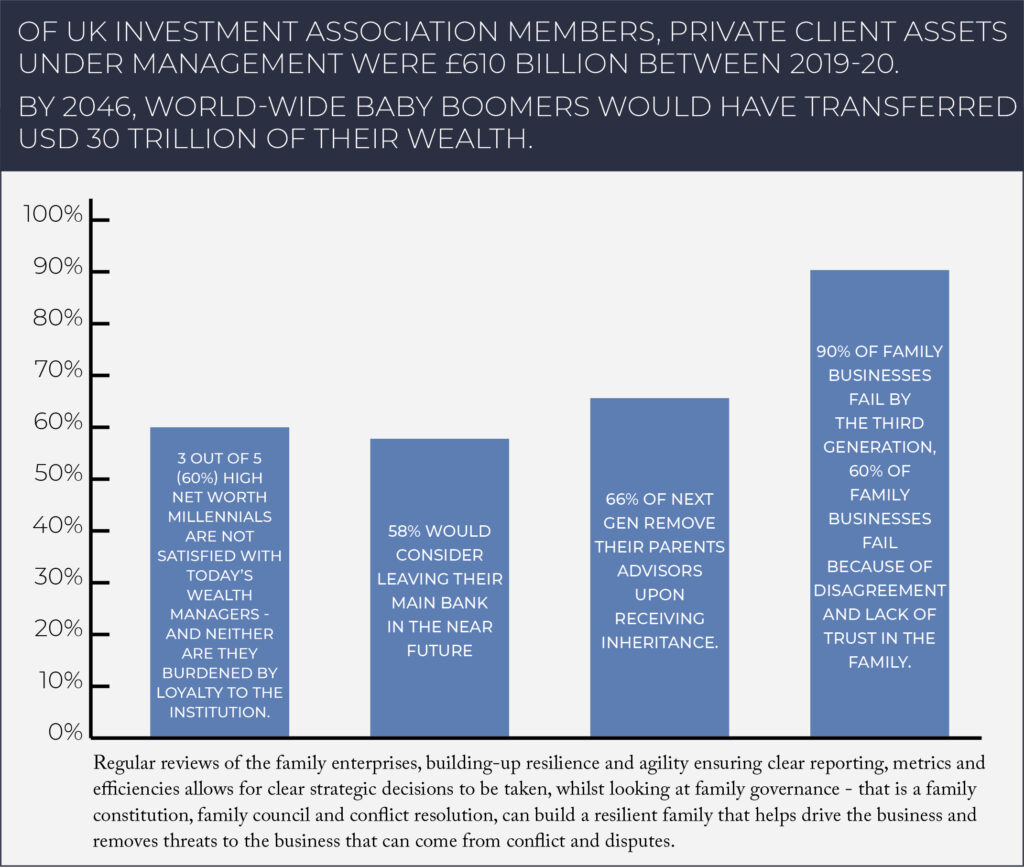
    The study also found that 60 percent of millennials were dissatisfied with their present banking and wanted a substantial improvement. The survey found that to attract future customers and build ongoing relationships with millennials, private banks have to comprehensively analyse their processes, assess their current shortcomings and potentially re-build a new bank from the ground up even if this means taking short-term losses for sustainable long-term profits. 

    There were other findings. Private banks also need a fundamental new brand position – old, male, pale and stale won’t cut it anymore – diversity is key and having staff that reflect the new client is key.  

    So private banks need to act fast and develop a ‘WOW’ digital ecosystem that highlights self-service capabilities or they risk becoming irrelevant. Millennials want the option of immediate and bespoke banking services – even so far as online bespoke investment and portfolio choice. To attract this generation, banks have to reposition itself as a millennial-centric bank and highlight the values that millennials look for, which according to the Simon Kuchner & Partners survey is quality and brand.  

    A number of banks have been developing their next gen offering, whilst some of the larger MFOs have been active to. But more needs to be done clearly define why millennials should pay for their financial advisory services. With a clear value proposition outlining what private banks and the wealth sector can offer, millennials are willing to spend more on financial services. 

    If the wealth industry moves quickly it can meet the challenges outlined above: reduce its opaqueness, become digitally-enabled and truly bespoke and so attract the next generation of clients but also of staff. 

    ____________________  

    David Hawkins is the Founder of Percheron Advisory, a firm which works with entrepreneurs, HNW clients and business families with a focus on building resilient and agile operational business frameworks and developing effective family governance structures. 

  • The Succession Question: why family businesses need to plan ahead

    The Succession Question: why family businesses need to plan ahead

    By David Hawkins, co-founder of Percheron Advisory

    What do we mean by the term ‘succession’? The term is most synonymous with the TV series Succession, which centres on the Roy family, the dysfunctional owners of Waystar RoyCo, a global media and hospitality empire, who end-up in a battle royal for control of the family business amid uncertainty about the health of the family’s patriarch, Logan Roy and his plans for the empire’s future. At his 80thbirthday Logan shocks his family – particularly his son Kendall who was primed to take-over the business reigns – with the news that he will not be stepping-down as planned whilst he also throws at his children the news that he is naming his third wife as successor.

    Who the Logan family are based upon is an open secret – think of an octogenarian Australian media owner and his warring family – but the issues raised here via satire are key to highlighting real world family, business and wealth survival.  What follows during Succession is a series of family and business conflicts, attempted hostile takeovers and family politics that makes Shakespearean narrative seem simple.  

    Fundamentally, a failure of clear family governance leads to family, business, asset and wealth destruction – that old chestnut “from clogs to clogs”: the first generation earns the family money, the second generation manages it and the third generation loses it. This trend turns out to be universal across cultures – think of the Vanderbilts in the West. In the East this was summed-up by Sheikh Rashid Al Maktoum: “My grandfather rode a camel, my father rode a camel, I drive a Mercedes, my son drives a Land Rover, his son will drive a Land Rover, but his son will ride a camel.”

    What are the main risks to a smooth succession and how should the present generation react, respond and accommodate the next generation? How does the next gen become more active in the business and play their role in the family business?   

    1) A lack of clear governance systems and processes across the family, business and wealth management

    Logan Roy’s impromptu tearing up of any coherent succession plan leads to war amongst competing family members, attempts at hostile takeovers, family members resigning and business, regulatory, security and political risks. So having family governance or a family protocol in place which formalises the family’s mission statement, its USP, why the family are in business together and what the long-term objectives are, is as vital for the family as corporate governance is for the business.

    This family protocol becomes enshrined as a family constitution from which policies and processes relating to the family, the business and its wealth are then outlined in detail according to the specific family’s requirements and it is discussed, bottomed-up and amended as a dynamic document during regular meetings of a family council – a council which present generation and next generation participate and lead.  

    This would seem foundational to all families – yet as Smith & Williamson’s Family Business Survey 2020/21 reveals, the percentage of families that have a key piece of family governance – the family constitution – in place, is still only around 38%, of which half thought they would have to review this within two years.  The Roys would have found it instructive to have a family constitution and council – and include input from the business units including non-executive directors who could have been involved with the succession discussion so turning a family decision into a corporate one.  The next generation would also have had the insight into first generation decision-making and a sense of the direction of travel which would have allowed them to avoid being frozen-out so spectacularly. 

    Without changing TV genres abruptly, the Game of Thrones analogy symbolises the challenges faced by India’s Ambani family.  When the patriarch died in 2002 like many Indian families there was no succession plan and no will. Chaos reigned.  Rather than a structured approach as to which assets brothers Mukesh and Anil Ambani would inherit, it was left to their mother to preside over an ‘organised demerger’ in 2005, which gave Mukesh control of oil and gas, petrochemicals, refining and manufacturing while Anil took reign over electricity, telecoms and financial services. As the Economist wrote at the time: “Why do family firms so often fail to make the generational leap? Family firms are frequently more riven with intrigue and visceral hatreds than a medieval court – and for similar reasons.”

    2)  Conflict and disagreement in the family destabilises the family and the business 

    The chief wealth destroyer, and one of the main features that family governance should work to reduce, is the exponential damage that conflict and disagreement can do to a family and its business. 

    When families fight, businesses lose their direction, fail to innovate and are often subsumed by their competition. 

    Whether it’s the ongoing dispute within the Ambani family – which even after the separation of assets was followed by defamation suits, involvement of the Indian prime minister and even Anil publicly blaming his brother for power-cuts that swept across India in 2009.  In Succession, Logan Roy takes his family to the family ranch, Austerlitz, to try to patch things up – yet this sticking plaster is too little, too late.  

    The core of family governance is trust, communication and the prevention of disputes spiralling out of control. In the Ambani case, a Family Council could have allowed managed conversation and dialogue unifying the family around values and mission but also outlining and preparing the brothers for ownership and management of specific business units.  If agreement could not be reached then the brothers could have been bought out.  Disagreement would have a forum for debate so issues that do arise can be dealt with via dispute resolution and mediation processes precluding the revelation that the founder has no will, or shock announcements at the patriarch’s birthday party, or even in an interview with Oprah which seems the de rigueur approach these days for airing grievance.  

    What is instructive is the new family council structure that Mukesh Ambani is working on, whereby his immediate family and three children are granted equal representation to enable succession planning whilst at the same time the children have been taking on increasing responsibility within the family business.

    3) The present generation is avoiding – or dreading retirement – or hanging on due to crises such as COVID-19 whilst the next generation wants to get more involved 

    The endemic issue that the institution of effective family governance and succession runs into is that often the founder doesn’t want to retire or be succeeded.  They may resist efforts to outline a clear succession plan – or if one is introduced may impede it: e.g., one American next gen was given 75% of the family business to run. The only issue was that he didn’t know from day-day which 75% it was. Pedestrian issues such as moving into father’s office or clearing out the old retainers caused emotional eruptions from the patriarch. 

    This issue has been particularly relevant due to the ongoing COVID-19 pandemic. As a Barclays Private Bank family business report on Smarter Succession of October 2020 shows: 57% of the present generation are concerned about trusting the next generation’s ability to manage the business. Drilling into the figures shows a possible reason why: 42% of the over 60s want to preserve the family business across the generations compared to 18% of under 40s.  So, there is a clear pretext as to why the present generation might want to stay on. 

    These figures highlight the lack of family governance.  The next gen should be mentored and grown into the business, socialised to understand the family’s source of wealth, the importance of their involvement in the business and how they can begin to play a role in the management or board team looking at questions such as:  

    • The focus and direction of the business.

    • Business transition and the impact of succession planning on the business.

    • The corporate governance framework – including appointments to the board or any significant changes to board structure.

    • The operational framework.

    • The family’s attitude to ethical and moral issues that may arise in connection with business operations.

    In conclusion, the message for the existing generation and next gen is: develop family governance, sincerely commit wholeheartedly to the succession plans that are developed and ensure that dispute resolution and conflict-mitigation mechanisms are in place.  Sadly Logan Roy did not get the memo. 

    About Percheron Advisory:

    Percheron Advisory works with entrepreneurs, HNW clients and business families with a focus on two key areas:

    • Building resilient and agile operational business frameworks so removing risks, developing robust and integrated systems and supporting new strategic directions, and; 
    • Where appropriate, developing effective family governance structures which encourage open and transparent communication, reduce conflict and integrate the next generation into the family business.  

    90% of family businesses fail by the third generation, 60% of family businesses fail because of disagreement and lack of trust in the family. 

    Regular reviews of the family enterprises, building-up resilience and agility ensuring clear reporting, metrics and efficiencies allows for clear strategic decisions to be taken, whilst looking at family governance – that is a family constitution, family council and conflict resolution, can build a resilient family that helps drive the business and removes threats to the business that can come from conflict and disputes.