Tag: history

  • 7th October one year on: A Letter from Israel

    Christopher Jackson


    This letter is ten years late. I went to Israel for the first and so far only time in 2013, and for obvious reasons have been thinking about the country a lot since the attacks on 7th October 2023, and the events which followed. This is really a letter to Israel – a delayed epistle I’d been waiting for an excuse to write.

    I was unlucky in the lead-up to that trip: I dislocated my knee playing tennis a week before flying. I was thus forced to cut a comic figure in Jerusalem and Tel Aviv, hobbling with my grandfather’s old silver cane around the Old Town, which, as visitors will know, contains numerous steep pathways, including the famous Via Dolorosa up which Jesus is meant to have shouldered his cross. At one point, I remember an eight-year-old girl trying to steal my cane off me, leading to a scene reminiscent of the sort of thing which might happen to Larry David in Curb Your Enthusiasm, where I sought to wrest it back and found myself only just equal to the task.

    But I found I loved the country: loved its noise and its contention, and the passion for theology, philosophy and history that lay behind its disagreements. Jerusalem is a microcosm of the human story. To step into it – even casually, and unwittingly – is akin to presenting yourself to humanity for inspection. It all amounts to the strangest of looks in the mirror.

    In Jerusalem, it’s not unusual to find people coming up to you in a bar and asking some variant of the question: “Who are you?” “Where are you from?” To ask this question in any other city in the world is to issue a pleasantry; in Jerusalem it feels deeper than that, an invitation to consider your personal identity. Most people who go to Israel end up feeling that they somehow needed the experience. At times, it feels like undergoing therapy.
     

    It’s no coincidence that in the Gospels Jesus’ opening remarks to his disciples constitute both a salutation and a challenge: “What seek ye?” Quite a lot of the time in Jerusalem one closely neighbours the related question: “What am I seeking?”

    The answer, if we’re honest, almost always involves some sort of large noun: truth, beauty, happiness, love, God – peace. Jerusalem is a place to consider all these things, although periodically, as on October 7th 2023, it particularly evokes the question of peace. That’s because that question: “What am I seeking?” hasn’t always summoned up the same answers in the hearts of human beings.

    The large nouns mean different things to different people: for some happiness is a rave – for others it’s a church service. Peace in turn can be the means by which we gently seek to bring others into our sense of the world, or open ourselves to new avenues of being.  Alternatively, as with Hamas, peace might almost slide into its opposite: it might masquerade as the means by which we seek to still a murderous resentment which all too readily rises up in human minds.

    The founding of the state of Israel was widely deemed necessary in the aftermath of the Holocaust, but soon ran into a difficulty which now feels somewhat inevitable due to the geography of the situation. And yet if we believe at all in human freedom then we can’t quite throw up our hands and shrug that it had to be that way. We must admit that the whole question of the state of Israel foundered on human frailty.

    As a general rule, wars are what incompetent governments inflict on unsuspecting peoples. We cannot call the period from 1948 a period of model governance. On the other hand, there have been periods of statesmanship: the Oslo Accords, begun in 1995, and the Unilateral Disengagement Plan in 2005 both amounted to attempts to move towards the solution of the problem.

    As I travelled through Israel, I found myself asking how the situation has deteriorated so seriously so rapidly. The first clue is in the history itself. Everywhere else on earth, history feels asleep by comparison. Here, you feel its urgency – its pulse. To be surrounded by so much holiness is to exist in a highly alert moral condition, and this is the case if you’re only visiting. To live here must be another step up.

    Secondly, I often think of an observation once made by Daniel Barenboim the c0-founder, with Edward W. Said, of the West-Eastern Divan Orchestra. This orchestra brings together Israeli and Palestinian musicians. Barenboim was at a rehearsal and stepped out for a moment, returning to find his orchestra at loggerheads over politics. He watched them argue and reflected that both sides of the argument are of a similar temperament. It isn’t, Barenboim reflected, like a conflict between the Swedes and the Italians. This fact alone, Barenboim says, accounts for much.

    It all amounts to a charged atmosphere. There is a lovely museum Ticho House in Jerusalem which all visitors should see. It was founded by Dr Abraham Ticho, the husband of the landscape artist Anna Ticho. When Abraham, an ophthalmologist, was injured in the 1927 Palestinian Riots everybody – Jews, Christians and Palestinians – prayed for his recovery since he was the go-to man for the treatment of the common ailment trachoma.

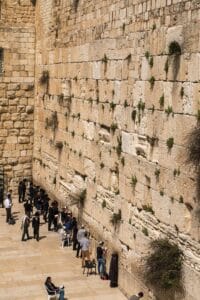
    These riots, in which 133 Jews were killed by Arabs and 116 Arabs killed predominantly by Mandate police, were sparked by questions of access to the Western wall. It all reads like a terrible promo of the conflict we now have. The Shaw Commission, charged with looking into the matter, would find that the riots were caused by “the Arab feeling of animosity and hostility towards the Jews consequent upon the disappointment of their political and national aspirations and fear for their economic future”.

    Of course, one might have feelings of disappointment and anxiety without resorting to murder, and Ticho’s story reminds us that many didn’t have these feelings. It is worth visiting the Ticho museum to remember not just Ticho, but the people of every denomination who prayed for him because his medical skill ensured he was part of their shared interest. In Ticho’s story, we receive a tantalising glimpse of another set of possibilities for the region which sadly has never yet been taken up.

    And there is something unique about his wife Anna’s landscapes too. In these pictures, it is as if the land of Israel, like Jerusalem itself, carries a particular charge. This isn’t solely to do with politics: for Christians (and for many Muslims), these are the hills which Jesus retreated to in between sermon and miracle; for Jews, each bush can be aflame, as it was for Moses, with the suddenness of God; for Muslims, the very sky is open – filled with the idea of ascending to the Heavens. That means that Ticho can never be painting landscape in quite the same way that, say, Constable is painting landscape: she’s painting spirit.
     

    Injured though I was, I decided it would be worth taking a taxi out onto the West Bank. In Bethlehem, you can visit the Church of the Nativity – the supposed original of the manger which we used to recreate in our youth in rural Surrey. As we drove out, I saw the grape sellers – all Palestinians – reduced to selling grapes on the side of a dusty road, where little traffic comes. All drivers know that non-dusty grapes are available in the supermarkets of the built-up settlements nearby. It is a hopeless situation and even those broadly supportive of Israel will wonder at a lack of humanity which is so evident but whose causes are so difficult to trace.

    In Hebron, the look and feel is of a warzone without the bombs falling. Children kick bedraggled footballs against the walls of shuttered shops; Israeli tanks move through the streets, like sharks through a fish tank. Here the guidebooks point you to the Cave of the Patriarchs, considered to be the burial place of Abraham and Sarah – figures whose importance the major religions agree on.

    Here one feels one is entering something like the crux of the matter. As a Westerner, I was only able to go in through the Israeli side. There is an entrance for Muslims I didn’t see, and the interior itself is partitioned. I hobbled up towards some Israeli soldiers who seemed to be mocking my injury in Hebrew, which didn’t strike me as the most welcoming start.
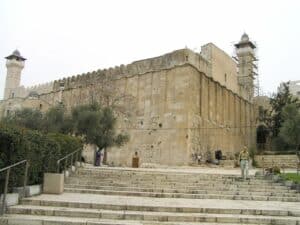
    Cave of the Patriarchs

    Inside, there is a seminary where Jewish students recite passages from the Torah, and everywhere there was a hushed seriousness and, to me at least, a palpable sense of things being about to kick off. This is the hard fact about Israel: from Woody Allen to Larry David, Jerry Seinfeld and Mel Brooks, nobody has made the world laugh harder than Jewish people. But to come to this land is to feel that everything keeps coming back to a flammable seriousness.

    In that Shaw Report which I quoted a moment ago, the writers added that the cause of those 1927 riots was the Palestinian sense that Jewish settlers were ‘not only a menace to their livelihood but a possible overlord of the future.’ In 1927, some two decades before the founding of the state of Israel, this was remarkably prescient: for many Palestinians this is what did happen.

    As you climb the hill to see Herodium, Herod the Great’s palace, I had a panoramic view of the homogeneous settlements somewhat resembling the worst kind of British council housing. As I hobbled skywards, the Adhan – the Islamic call to prayer – reached me easily from the skies. Sometimes it sounded like an assertion of some kind; at others a cry for help. Looking down on those towns from the archaeological site, everything felt so terribly boxed off.

    A commitment to freedom of movement is what we still have here in Britain and in the UK: this in turn is built on trust and the notion that everyone potentially has something to contribute through hard work to the betterment of all our condition. Interestingly, if you had to pick a country in the Middle East which has some of this spirit, you’d also pick Israel, especially Tel Aviv with its superb food and Miami-like energy of expansive bustle.

    We have all seen music festivals like the one which was taking place near Re’im on Black Saturday; most of us have been to them. These festivals, very far from my cup of tea, are part of our national life, and so we might recognise ourselves in the victims of the massacres. Alarmingly, I don’t think if Hamas were exported to the UK, that they would have much hesitation in massacring Glastonbury, as appalling as that might be to contemplate.

    This, in turn, cannot help but generate some questions regarding the pro-Palestinian – and all-too-often pro-Hamas –marches on the streets of London. Firstly, how many have been to Israel? Secondly how many of them have been to Glastonbury? One suspects here a far higher percentage in answer to the second question than to the first. But if this is the case, then many are marching in favour of the very people who would murder them if they had half a chance.
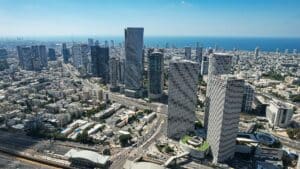
     

    Tel Aviv skyline

    None of this means that Israel has behaved in a flawless manner. Too often, violence has met with ratcheting language, and counterproductive violence. The failure is predominantly one of political leadership: no one would accuse Benjamin Netanyahu of too much resembling Nelson Mandela. But to consider this an isolated failure on the part of Israel’s leadership, as so many do, is a dangerous fantasy. To land on a fairly obvious point: any organisation whose central text is the Protocols of the Elder Zion, as is the case with Hamas, has a fair amount to learn about peace-making.

    Some people need to be fought; there is such a thing as the legitimate causus belli. In addition, the Mandelas of this world have a far greater dose of realpolitik in their make-up than we realise when we later lionise their achievements in peace. We forget that they often pivot to resolution only after having defeated the harshness of their enemies. Hamas has never been as cuddly as the left-wing intelligentsia has liked to imagine it.

    The reality is that history – any nation’s history – is peppered with injustices of every kind. The past is in some fundamental sense unthinkable – and yet it all happened.

    The usual way in which we move beyond atrocity is by acknowledging that many evils were perpetrated by the dead. This is the basis on which we forgive and forget. In England, we no longer identify with a particular side of the War of the Roses; I am as welcome in Lancaster as I am in York. Except when a rugby match rolls round, we have also rather forgiven the Norman conquest – and anticipate, as we walk through Paris, a degree of forgetfulness regarding Agincourt. The past has to recede because it was conducted by imperfect people.

    The same is true of the founding of Israel, and in relation to recent history in the region. There are two differences. Firstly, these events are closer in time. But secondly, the fear is that they shall in same way always remain so, because they revolve around both temporal and eternal questions. For so many people, Christianity, Judaism and Islam still matter, forming part of our essential hopes beyond the life of the body. It is not just that these affections won’t go away – it’s that anyone of religious inclination would be bereft if they did.

    If you want to know what that would look like then you have Soviet Russia, and maybe the hard-left wokeness in the UK to sample: identikit moralities where power goes not to the meek, the thoughtful or even the hard-working but to the noisy and the cunning. That’s the real reason one suspects that a large chunk of the left marches against Israel: they don’t believe in any eternal dimension whatsoever and would like to delete that from their lives. Like Christopher Hitchens, they loathe religion full stop, and can’t distinguish easily between the book of Genesis and Hamas: to them, it can all be grouped under the ‘God is not great’ banner.

    This is the intractability of the crisis: it goes deep into all of us and keeps refusing to recede. Israel is a remarkably complex undertaking with a paradox at its centre. It is, in one sense, a representative of the Western way of life in the Middle East. There are few cities so Bohemian as Tel Aviv. But, at the same time, when you get right down to it, it isn’t a particularly secular country. Too much of the Bible and the Koran takes place there for that to be possible.

    These two aspects have both created enemies. The hard fundamentalist right dislikes its licence; the left dislikes the obligation it places on us to consider religion. Israel is a land of miracles and from one perspective the bar of not killing one another over a set of misunderstandings feels sufficiently low that it ought to have been achievable by now. But we have to admit that it hasn’t been and that if you ever go to Israel you’ll be visiting the saddest, but also the most necessary, place in the world. It’s not a foreign country – it’s our collective story and that’s why it will always matter.


    For other examples of our letter series try these:


    Discovering the Charm Budapest: Tom Pauk’s Letter from the Heart of Hungary

    Omar Sabbagh’s Letter from Dubai: ‘As soon as it was safe enough to reopen, that was done’


  • 2021 highlights: Lessons from the Last Pandemic

    2021 highlights: Lessons from the Last Pandemic

    As the world comes out of COVID-19, Iris Spark looks for lessons from art created during the Spanish flu pandemic about where we go from here  

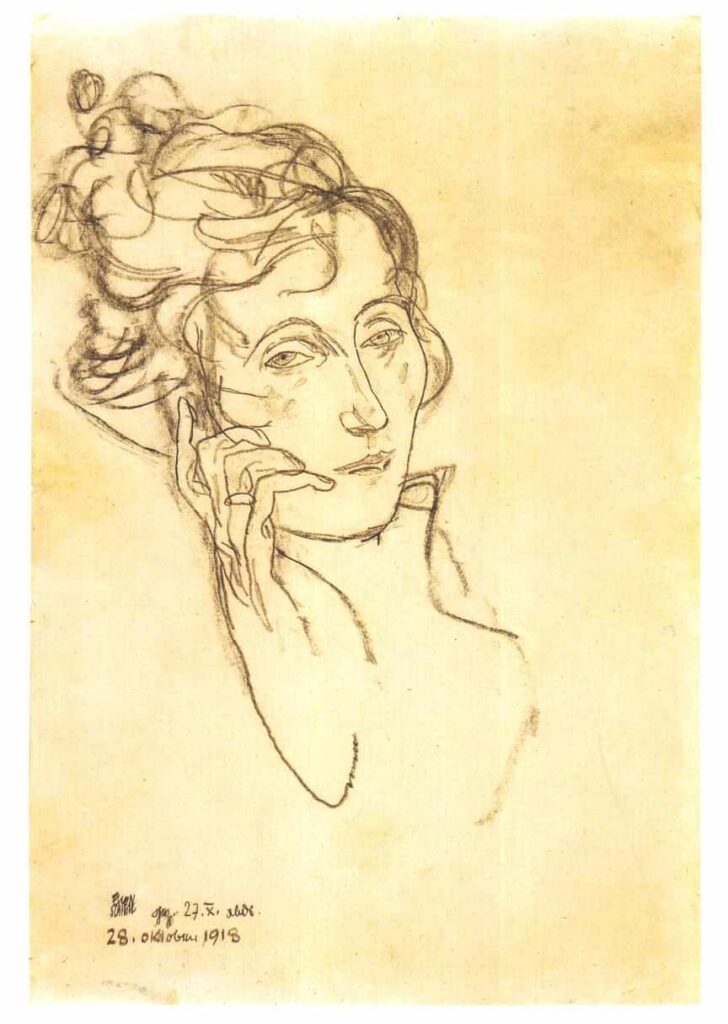
    Edith Schiele, Egon Schiele, 1918 

    Consider this woman above. Unless we were to look closely at her, we might not know that she is set to die tomorrow. It’s true that her gaze is melancholy, but we might miss that her sadness has a leaden weight to it, distinct from the sadness we see in many romantic portraits. The clue to her condition is her gnarled and crooked hand, which tells the rapid encroachment of death more than her face, which still – heartbreakingly – has youth on its side. The more you look, the more signs of the seriousness of her condition are brought home. There are the strokes of discoloration on her cheeks. The lips are thin, a sign of the cyanosis which accompanied a deadly case of influenza.  

    The woman’s name was Edith Schiele, and she was married to that brief star of the modernist period Egon Schiele, whose works today can fetch as much as $40 million. Egon himself would die three days after drawing this picture. He was 28. It was an unhappy end to a life about to take off. As inauspicious as this story might seem, as we seek to emerge from the other side of the pandemic, it is a useful place to start if we wish to consider what can be learned from a study of the last pandemic about our current direction of travel. 

    We all know the statistics about the pandemic: the numbers dead or infected; and the jobs lost. But the data does not tell the full story. 

    Modern Family 

    Statistics blur over time; what’s left is the poetry and the art which a society creates. If we consider the so-called Spanish flu pandemic, which raged from 1918-1919, and which killed 100 million people, and infecting 500 million, we can see clearly in the era’s painting a trajectory which might well prove relevant for our times as we implement our vaccination programmes. 

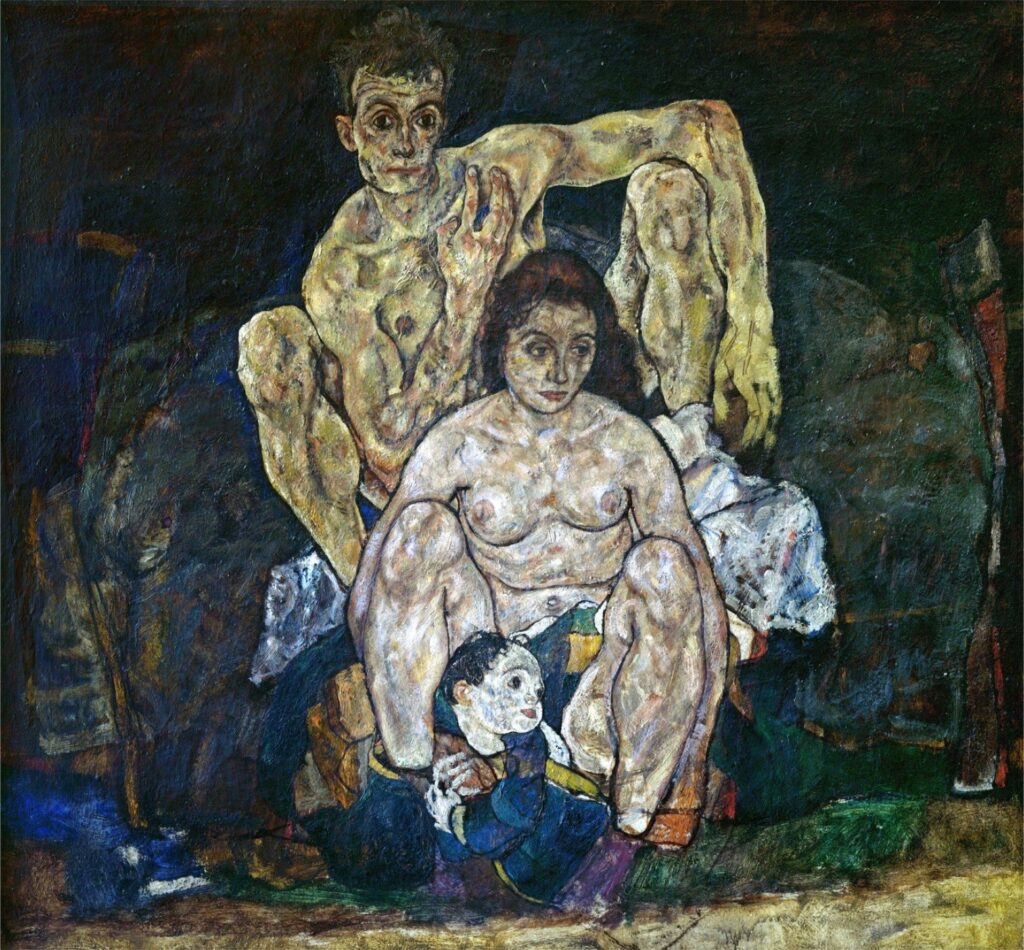
    We have to start with an acknowledgement of the enormity of what has happened to us with the pandemic. This was evident too during the Spanish influenza. It can be seen, for instance, in the pictures Schiele made towards the end of his life.  One is The Family (1918) – one of his last, and it would remain unfinished. This is a picture which in its mood is capable of placing us back in February 2020. It contains the foreboding of a vitality about to be stymied.  

    In this picture, two things alert us to the tragic state of affairs about to engulf the family: the first is the artist’s decision to depict his unborn child as if he wished to personify a child who would not survive the womb. The second is his painting of his own expression as blank and melancholy, his skin as jaundiced.  

    The baby might stand as a symbol for all the unborn projects which are stymied by the arrival of disease. But the definition of the musculature and the solidity of the forms make one feel uncomfortable about calling this an entirely pessimistic picture: there is will to endure here, and we can’t say it is any the less important simply because, in this instance, nobody in the picture survived.   

    Schiele, The Family 

    The picture is a reminder that the sheer oddity of what we have come through needs to be reckoned with and assimilated.  

    Fever Pitch 

    But surveying the art which arose out of 1918 pandemic, the most noteworthy thing is how difficult it is to depict illness. In pandemics we seem to enter a disjointed dreamscape. Illness isolates us, cuts us off from the solidity of the world. It partakes of the insubstantial, and can only be communicated in kaleidoscopic colours and the pictorial language of dreams.  

    In 1918, those artists who did experience a brush (or worse) with the Spanish flu, had already begun to intuit life as being at its core somewhat feverish and strange. This means we cannot always see how the influenza affected artists – they were, in some sense, feeling rather fluey about life beforehand. 

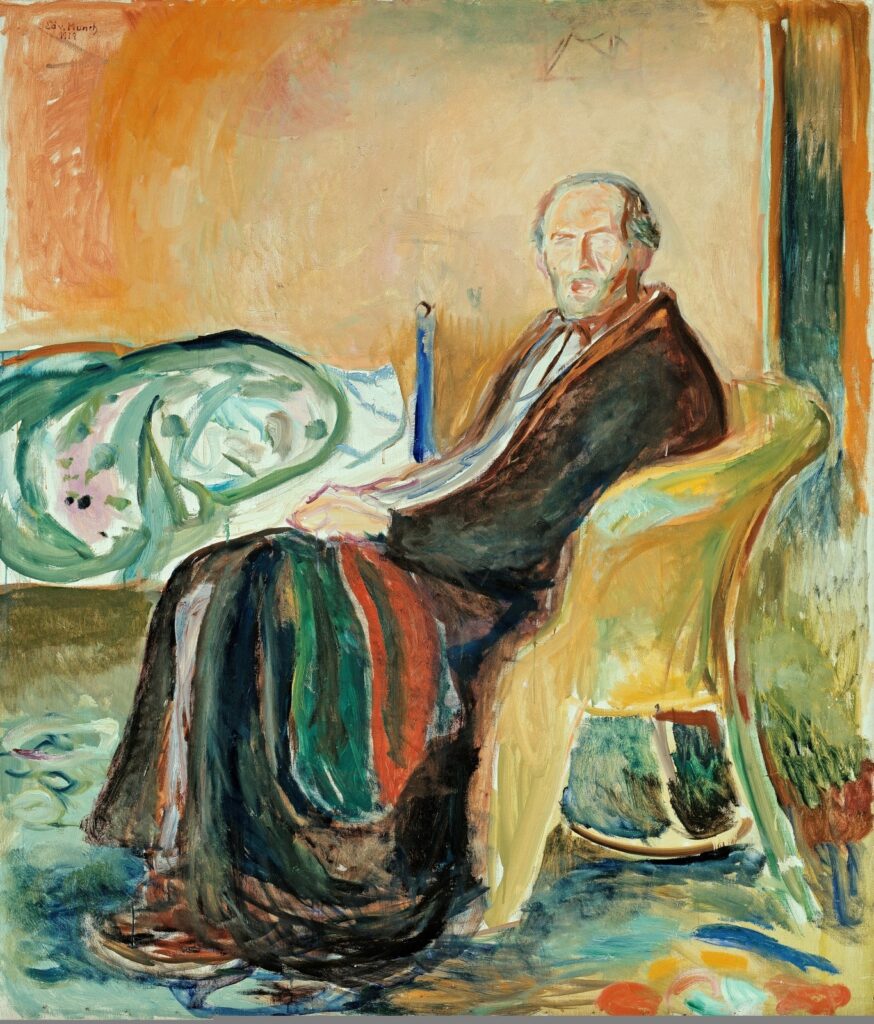
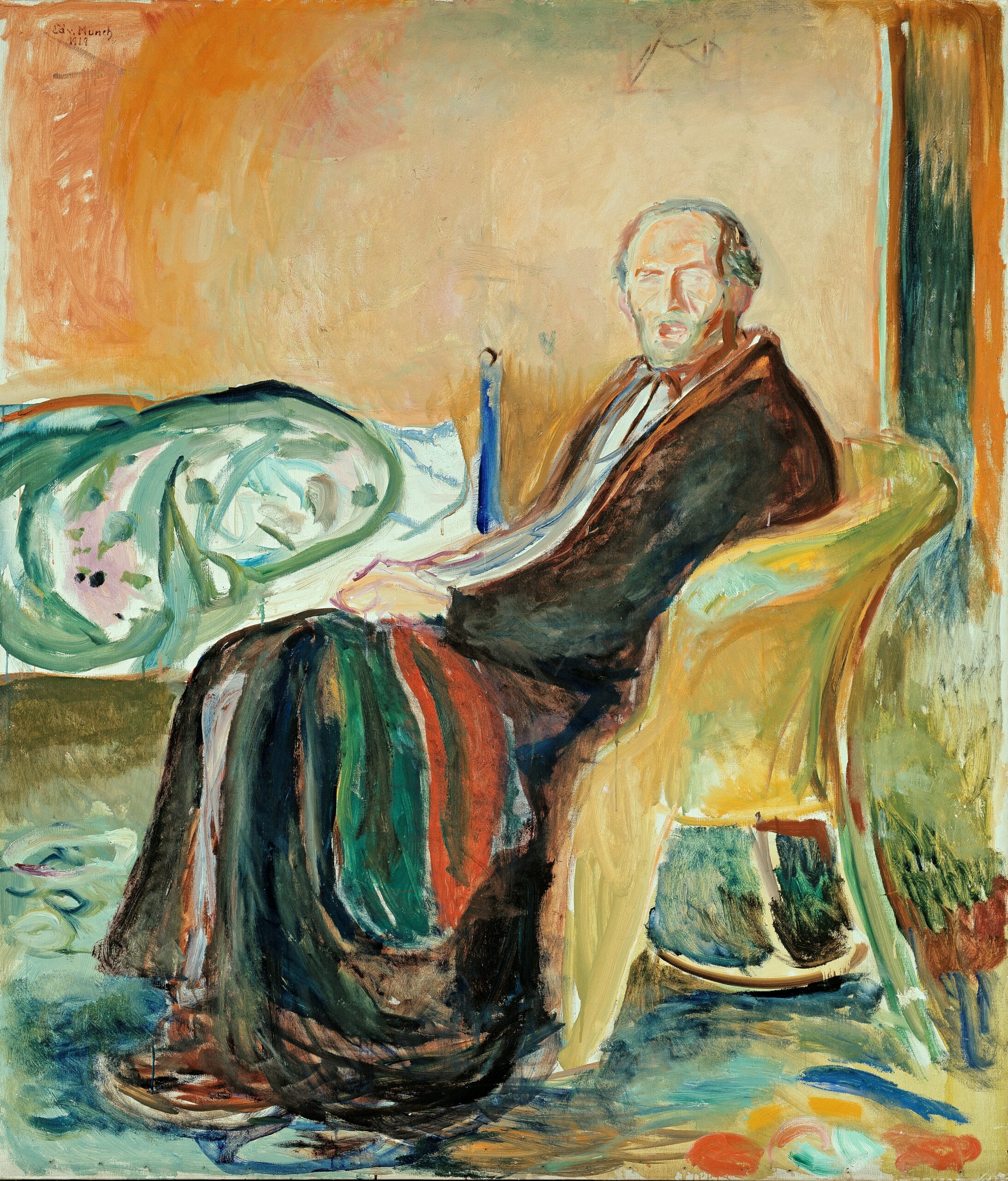
    Most notable among these was Edvard Munch (1863-1944)  who also contracted the flu and produced two portraits (see opposite) about the experience Self-Portrait with the Spanish Flu and Self-Portrait After the Spanish Flu. In the first, Munch is depicted in a seated position with a blanket over his knees. The sheet beside him seems to be developing into a face, as if artist or sitter is hallucinating. The detail of his face is subservient to a swirl of colour. But how different is this picture philosophically to 1893’s famous picture The Scream?  

    When I talk to art specialist Angelina Giovanni she explains: ‘It’s very interesting that in the case of Munch – probably because themes of loss and death had already been present in his work – the way he depicts himself is no different in terms of style. Instead, it has a certain linearity within his existing body of work.’  

    Giovanni explains that it is as if Munch found some sort of confirmation of his prior experience by falling ill. The world had seemed disjointed before; and it continued to feel so when the influenza struck him. Giovanni continues: ‘Munch can so effortlessly depict himself within his predicament that were it not for the historical information that tells us that the work was painted when he had contracted the Spanish Flu, we might not have been able to place it in a particular point in time.’ 

    While pandemics might illustrate our vulnerability vividly, they might not fundamentally change our method of vision. The world is elastic, and will return to its former shapes and structures.  

    But there is also no doubt that pandemics create an atmosphere of reflection which can be harnessed in future years. When I catch up with Fake or Fortune star Phillip Mould, he says: ‘When you’re locked down, and you remain in your own habitat, it’s a more meditative cultural experience and you think about the outside world in a different way.’ Mould even wonders whether we shall have more full-length portraits in future, now that we are all looking at each from six feet away.  

    For Mould this meditative spirit is best captured by Lorna May Wadsworth’s superb still lives painted during lockdown, in which mere things – cups and vases – attain a meditative quality which, in his view, supersedes her previous work as a portrait painter.  

    Edvard Munch, Self-Portrait with the Spanish Flu, 1919. 

    It was the American novelist Saul Bellow who once wrote that ‘Death is the dark backing a mirror needs if we are to see anything.’ The Spanish flu and COVID-19 pandemics caused a widespread awareness of mortality: what appears to happen is that our relationship to death is placed again under the microscope.  

    In 1919, the experience of finding oneself so suddenly vulnerable expressed itself visually.  

    Death Becomes Us 

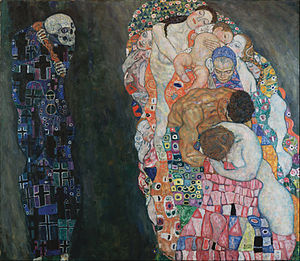
    Egon Schiele was not the only major artist to be claimed by the influenza. The other was Gustav Klimt, who suffered a stroke and died as a result of catching the infection. He was famous at the time for his painting Death and Life (1916). Here we have a close approximation of what death meant to the early 20th century mind – albeit through the prism of an individual of genius.  

    Death hovers to one said of the main grouping, his clothing patterned with crucifixes. These religious symbols act as a reminder that as radical as we think him, Klimt inhabited a world where Christian imagery was more prevalent than it is in our time. 

    Gustav Klimt, Death and Life


    How are we to feel about the figures on the right? Are they detached from death – in a kind of legitimate bliss of colour, and shared bodily warmth? Or are we to feel that they are failing to be awake to the menace of death as shown by the Reaper on the left-hand side of the painting? It’s likely that the picture contains both interpretations.  

    For Philip Mould the art of this period presents a problem in that ‘it is always hard to be sure what devolves from the First World War and what from the flu pandemic.’ What is clear is that with death more prevalent, something like a medieval acquaintance with death had been transposed into a modern setting. This can connect us with primitive political instincts – as was shown in the 1920s rise of fascism and as may be evident also in the riots in the Capitol, Washington D.C. on January 6th 2020.  

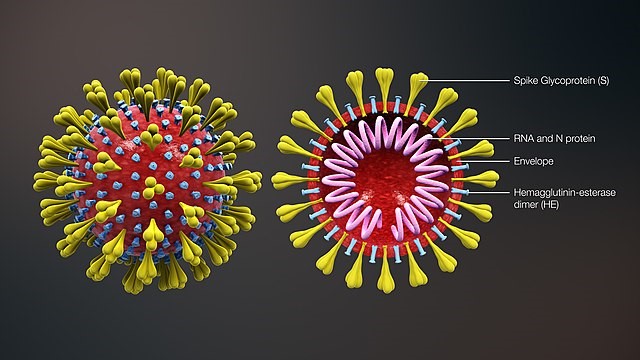
    Of course, in our own times, death has been depicted somewhat differently. Whereas death is still symbolised in Klimt by the medieval figure of the Grim Reaper, today death is represented with scientific diagrams such as the one opposite. Such images give a different sense of death. Here the virus appears has something spherical but prickly, but undeniably alien: an intruder. The Klimt picture shows death is demonic – which is to say almost human. It is an indicator of how our society has shifted. 

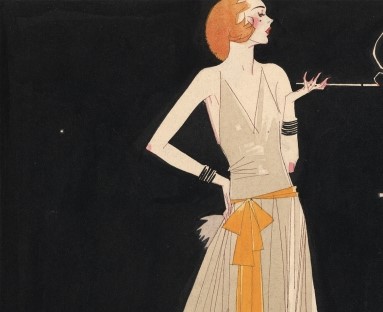
    Full-length illustration of a fashionably dressed flapper standing with one hand on her hip and a cigarette in the other hand. A stream of smoke from the cigarette forms a curving, twisting, decorative line.
    Russell Paterson, Where There’s Smoke There’s Fire

    Cocktail Hour 

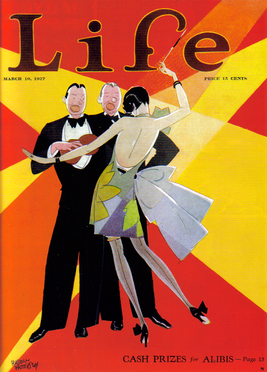
    But what happens in the 1920s once society has recovered from a pandemic and we are able to interact confidently again? In the visual arts of the 1920s, we see the return of the line. The Art Deco style, as shown by the superb Russell Patterson illustration ‘Where there’s smoke there’s fire’ couldn’t be further from the blur of the Munch paintings. Society has returned to health. The owner of this body is again confident not just in herself but also in the bodily pleasure of smoking.   Likewise, a renewed bodily confidence is again suggested in the cover of Life opposite which shows the joy of dancing – and again, all told in a strong line and healthful colours.  

    So might we find that once the world returns to normal we shall see the meditative aspects of our art today cede to something more dynamic, more fitting to the partying spirit?  

    That remains to be seen, of course, but as everyone knows the 1920s are not the end of the story. We find a move towards health and life in the art of the 1920s, but it is a fine line between this development and excess. In literature, the crucial text would be The Great Gatsby, in which F. Scott Fitzgerald’s own ‘crack-up’ is prefigured. His friend Ernest Hemingway would soon find his work affected by the excesses of drink – alcoholism would also lead to suicide. 

    In the visual arts, it might be said that the artistic world bifurcates along two vectors of greatness: towards Henri Matisse (1869-1954) and Pablo Picasso (1881-1973). Both were active at the time of the Spanish flu, though neither experienced a sufficiently severe case for us to say with certainty how it impacted their creative output. 

    Picasso’s own commitment to the line was always, with the invention of Cubism, synonymous with the notion of fragmentation. He seems in his pictures from 1906 onwards to see round things – to intuit time and meaning at work within the appearance of a given object.  

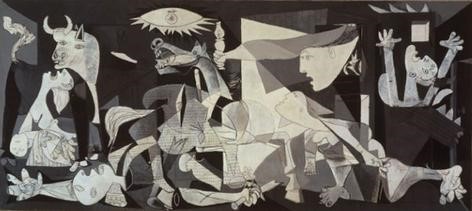
    But by the time we reach Guernica (1937), his vast oil painting depicting the Spanish Civil War, we can see how he is no longer depicting the complexity within objects as some fundamental fracture in society. Here, we find the sort of visions which might be intuited in the work of Schiele and Munch with which we began. It is as if we are now confronted with their worst fears enacted. 

    Pablo Picasso, La Guernica, oil on canvas, 1937 

    So what had happened in the intervening time? The short answer, of course, is fascism and there will be few who have witnessed developments in America these past years who can be certain that once the deprivations of coronavirus have passed, we might not head in that direction. 

    But the art of Henri Matisse shows a more hopeful story. In old age, he became a celebrator of simple colour, simple pattern, and graceful movement. If Picasso’s nightmarish canvas shows the fears of Schiele and Munch more than realised, then we might argue that Matisse’s scissor art in its childlike delight at colour and shape shows what they’d have liked to go on living for – they indicate something of the joy we all feel about the life which we all fear departing one day.  

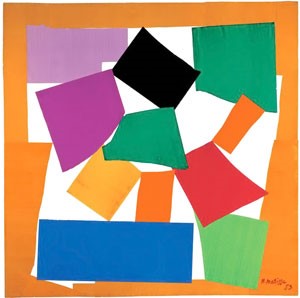
    Perhaps all this is encapsulated in his great late cut-out The Snail, which he worked on after his stroke from 1952-3. It is an exercise in chromatic colour but it is the title which might strike us: since there is no sense in which this a realistic depiction of a snail we are liberated into feeling that Matisse is here showing us something of the feeling he gets from looking at one of nature’s humbler creatures.  

    Henri Matisse, The Snail, 1953, Gouache on Paper 

    In 2021, we should hope for just such an arrival in ourselves. Locked down in our homes we have seen the world at a slower pace, with more centredness, than we had been used to doing during our frenetic pre-pandemic lives. Matisse reminds us that we must retain what we might call the joy of the sedentary.  

    Like this, the art of the past has its messages. We must never forget what happened to Schiele, and to Klimt – and pay it appropriate respect and remembrance. But we must realise how superior a life of activity is, as shown by the advent of the Art Deco, while not forgetting that an abundance of energy, especially if it is misdirected, can lead to the horrors that Picasso depicted in La Guernica. 

    And if we look at Edith Schiele again, it is possible to look at her eyes and imagine that all this is somehow contained in those nearly hooded eyes. She sees us and doesn’t see us – just as we see and do not always recognise ourselves. But this is the help art gives us, as there is one sitting across from her – an artist who happens to be her husband – who gauges her with unusual intensity.  

    This is the privilege of art – to come from us, and yet somehow to know more than we do. When the art galleries open again post-pandemic there shall be wonderful things to see.  

  • The Californian teachers who have never taught in the classroom

    The Californian teachers who have never taught in the classroom

    Patrick Crowder

    Schools in Ventura County, California first closed on March 13thof last year. As the pandemic continued, the county extended that shutdown multiple times with no set end in sight. Now, many districts are seeing students return to class. For many new teachers, this will be their first time in front of a class of real life, non-virtual students.

    Melissa Grennan is a 22-year-old history teacher in her first year on the job. It is apparent that she really cares for her pupils, and that she chose this job for the love of it.

    “I’ve always wanted to become a teacher. I’ve liked telling people what to do since I was little,” she jokes.

    Brennan now teaches US History to 16-year-olds in their Junior year at Ventura High School. She has never met any of them. A once exciting prospect, the reality of teaching in 2021 has not fitted with her expectations.

    “I was really excited about the aspect of getting to know my students, which is much harder online,” she says, while sitting in the same home office where she teaches. There are Polaroid photographs hung with clothes pins on her wall, and she keeps her camera angle high to disguise the fact that she is delivering lectures from her childhood bedroom.

    “I thought there was going to be a lot more interactive collaboration, and over Zoom there’s none,” Grennan continues. “We can’t require that the students turn their cameras on… we can’t even require that they attend because of equity issues. I only know what three of my students look like.”

    Ventura High School is public, so the school is not allowed to require parents to spend money on educational tools. Because some families cannot afford internet, attendance cannot be made mandatory.

    Getting students engaged with the material has always been difficult at the best of times. Now, with motivation at an all-time low, teachers often face black screens and muted microphones.

    “I feel so bad for them,” Grennan says. “I’ve had a few students reach out to me to say, ‘I’m sorry that my grades are so low, I just have no motivation right now’, and that’s a heart-breaking email to get from a 16-year-old.”

    She has attempted to make things easier on the students, but relaxed requirements are not enough to keep many of their grades afloat. 

    “My grading policy is pretty lax: there are no late penalties or homework. Everything I assign we do together in class,” Grennan explains. She has resorted to awarding one extra credit point for any comment a student makes in the chatroom – only one student regularly engages.

    “I once was able to bring Kanye West into the conversation,” she says, laughing to herself. “One student commented, ‘I miss the old Kanye’, and I said, ‘You know what? That’s an extra credit point right there, because at least I know that you were listening!’”

    New teachers report to a Cooperating Teacher (CT) who sits in on the class to keep things on track. Normally Grennan and her CT would alternate lesson plans, but with the pandemic, the CT has left her to fend mostly for herself. She has enjoyed this freedom, and often discusses current events in her online classroom. 

    Teaching US History today is in and of itself a challenge. Grennan had her students take a political typography quiz to provide an easier approach to the issue. 

    “On both sides of the spectrum, I had kids tell me that Trump was making the US a better place, and some tell me that AOC is their idol! Every one of them told me that they were going to vote in the first election they could,” she says. “I don’t share my own opinions, I mostly let them share theirs. Sometimes I do worry about turning kids away. When I say the election (of Joe Biden) was legitimate, which is a fact, I wonder how many of them just shut down.”

    While juggling lesson plans and drafting emails to concerned parents, Grennan attends Cal Lutheran University, pursuing her full teaching credential and a Master’s degree. She says that she faces the same feeling of distance and lack of motivation that her students face.

    “I think online learning works for some, but I don’t think it should become the norm. Even at the university level, I hate taking classes online,” Grennan says. “If I have to sit in class for three hours, I’d rather do it in a room full of people!”

    Despite the grim situation, Grennan is able to see the positive side of things. “If I’m able to teach online, imagine how much easier it’ll be in-person,” she says, adding that “so many teachers have quit because of how awful this is… I guess that makes it easier to find a job!”

    Ventura High School is set to re-open in August.

    Picture credit: Thought Catalog on Unsplash