Tag: Future of Work

  • Opinion: Stuart Thomson on work-life balance

    Stuart Thomson


    Many people come to think about the balance between their personal ‘work life’ and their ‘personal life’ later in a career. That should be a consideration from the start. But it also means appreciating that the two cannot often be neatly divided or evenly balanced.


    The idea of a work-life balance appears to suggest some type of equilibrium between the two. It also often places the burden on the individual to draw the lines between the work and the personal. Actually, most employers rightly recognise the benefits to themselves and the individual if the balance is considered. Personal health and productivity can improve, and the level of job satisfaction increases. If you feel as though you are being looked after, then the longer you may even stay in the role.


    Considerations about a form of balance should not, though, be left until later in a career. It is not just about the ability to spend time with children and families or focusing on leisure pursuits to counteract aging!


    Often the balance can entail quite serious commitments in the personal realm, for instance, those with caring responsibilities. Those responsibilities can impact anyone at any age.

    It is also up to each person what their time looks like outside of the workplace. It cannot, of course, clash with the day job or bring any form of potential reputational damage, but otherwise, the time is yours to do with what you will. That could be study, having a ‘side hustle,’ taking up a hobby, or finishing a box set—whatever works for you.


    That does not mean that a workday can be neatly divided. For many workplaces, especially in a professional setting, there is not really a 9-5. That requires flexibility on both the part of the employee and the employer. It becomes clear that the balance between work and life cannot be neatly divided and compartmentalised. For those with pressing commitments, such as caring, arrangements can be made, but for the majority, sometimes you will work ‘late,’ and there will be periods of intense work and potentially pressure. This cannot be avoided. Whilst employers recognise the need for everyone to think about their relationship between home and work, that does not mean the employee has all the control. There is often a lack of balance, and especially in the early years of a career, it will be weighted in favour of the employer.


    How can each individual think about setting some dividing lines from the outset?


    Boundaries – The UK hasn’t yet gone down the legislative route for a ‘right to switch off,’ but many firms have. There is no harm in having conversations with line managers about such matters.

    Time management – The better organised a person is in the workplace, the better able they are to finish their work on time and move onto the personal.

    Co-existence – There is no reason why some of the personal and professional cannot overlap. If, for instance, a class is during the workday, then as long as the work is done, the class could still be attended. A balance does not mean complete separation.

    Personal health – The critical role of physical and mental health is now largely uncontested in the workplace, so explore the opportunities for these from the outset. Do not leave it until later.

    Timesheet culture – For many organisations, the quality of the work is more important than the time spent at a desk. But for some organisations, particularly in professional services, they can expect both. It may be that this is reflected in the pay packet, but think about what you want from the outset.
    Never fall into the trap of thinking that there is any such thing as a perfect balance between work life and personal life. Especially early on, the boundaries can be extremely unclear. You may socialise with colleagues as well as work alongside them. That is an important part of building a culture—but is that ‘work’ or ‘personal’? It is both.


    It is important to think about what balance in life looks like rather than expecting an equilibrium to be achieved. Never leave that thinking too late.


    Stuart Thomson


    Stuart Thomson’s latest book is The Company and the Activist


  • ‘Room for improvement’: Tim Clark reacts to Bridget Phillipson’s first speech to the education sector

    Tim Clark


    Last Thursday (7th November) Bridget Phillipson gave her first major speech to the education sector at the Confederation of School Trusts’ annual conference. Her speech was personal, extremely positive and encouraging but also showed hints of naivety and even a lack of realism and understanding of the current situation in schools.

    She began, as her predecessor, Gillian Keegan, always did, by talking about her own journey from a disadvantaged background to becoming Secretary of State, something to be applauded and respected. After all, what is the prime purpose of education other than to nurture, develop and to open doors for all, regardless of background and ability? Her recurring theme was “achieve and thrive”.

    She highlighted the appalling inequality that still exists in this country and the fact that where you live and where you go to school are still key determinants in your educational outcomes. This is clearly wrong, even immoral, in a modern, advanced nation: every child should be able to access a world class education. Understandably, she enthusiastically listed several decisions made by the Labour government: the fully deserved 5.5% pay rise for teachers and the £2.3 billion increase to the core schools budget (although much will be taken up by the pay rise and the inexplicable hike in employers’ National Insurance contributions).


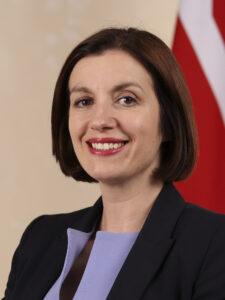
    Bridget Phillipson
    05/07/2024. London, United Kingdom.Secretary of State for Education,Bridget Phillipson poses for a photograph following her appointment to Cabinet by Prime Minister Sir Keir Starmer in 10 Downing Street. Picture by Lauren Hurley / No 10 Downing Street

    I also welcome her attitude to the teaching profession, “Teachers are partners not enemies” and the use of experienced professionals, rather than SPADS who have never stood in front of 30 stroppy teenagers on a wet Friday afternoon, to lead on various developments. I should have liked, however, to see a greater involvement of the profession as a whole. In my first, “Better schools, The Future of the Country” report in June 2023, I called for the establishment of a National Schools Council which would regularly and formally bring together ministers, civil servants and elected representatives from all areas of the school system. Real improvement will be dependent on the active involvement of those who successfully do the job, not those who just talk about it.

    Phillipson no doubt pleased many by offering to spend more on “crumbling classrooms”, referring to the recent Budget and the long overdue additional £550 million for rebuilding and the extra £330 million to improve the condition of our schools. We should not forget, however, that RAAC and asbestos existed at the time of the previous Labour government but rather than resolving these issues twenty years ago, it decided instead to spend the money on building a limited number of new, architectural masterpieces rather than on resolving underlying issues in all schools. Eye-catching new builds are presumably deemed more helpful at elections than a new roof here or a new staircase there.

    Clearly these are early days, but several of Phillipson’s comments do bode well for the future. The curriculum and assessment review may result in a curriculum that is more accessible and which will enable more young people to achieve and to make a positive contribution to the economy and society (but, I hope, without adopting a “prizes for all” mentality). The changes to Ofsted will, with any luck, lead to an inspection system that is far more clinical, accurate and useful to parents, schools and government, although we are yet to see what will take the place of the single, overall inspection grade. Providing early intervention for SEND pupils and of tackling the current atrocious absence rates [one in five children is deemed “persistently absent”] are both areas urgently requiring dramatic intervention.

    For all its positivity, however, there are two areas where I feel the Secretary of State’s speech lacked authority or understanding. The first is tackling the absolute crisis in teacher recruitment and retention. She made much of Labour’s manifesto promise to create an additional 6,500 teachers but, despite being an attractive soundbite, the number shows a complete ignorance of the magnitude of the problem. Last academic year, over 40,000 teachers (over 9% of the workforce) quit the profession for reasons other than retirement. In the same timeframe, only one half of initial teacher training places were filled (and only 57% in the previous year).


    This is the perfect storm – both retention AND recruitment. With over 20,000 schools in England, this equates to losing almost two teachers for every school; 6,500 new teachers is not even one new teacher between three schools. This is a crisis of extreme proportions and although Phillipson claimed she was not guilty of “a plan for happy ignorance”, much, much more needs to be done. The last administration pointed to the fact that there are in fact currently more teachers than ever before, but this ignores the fact that there are also 74,000 more pupils than in the previous academic year or that many of the additional teachers are either overseas trained (not in itself negative, but it obviously depends where and in what type of system they trained) or unqualified – hardly a recipe for dramatically raising standards. It is great teachers that change young people’s lives: until this crisis is resolved, any talk of curriculum, inclusiveness, standards or, indeed, any education topic, is simply pie in the sky.

    The area of Phillipson’s speech which has probably caused the most debate, is where she spoke about standards and the need for young people to be happy in schools. A survey has shown that one in three 15-year-olds “don’t feel happy in school. That’s worse than the average across our OECD neighbours”. Interestingly, this is the only international comparator that she chooses to quote: not the recent international reading and numeracy tests which, under the previous government, saw our comparative position rocket. Her message was clear – schools should not concentrate on academic achievement: “A*s alone do not set young people up for a healthy and happy life……This government will always be strong on standards….[but she warns against falling into]  “the trap of chasing a narrow shade of standards, structures-driven rather than child-focused”.

    Firstly, the vast majority of schools are not blindly focussed on exam results – to suggest that they are is simply insulting to all of us who have spent our careers committed to pastoral care, extra-curricular activities and to the development of the whole person. But why do some schools prioritise academic achievement? Not only is it the key to unlocking the future for every young person, it is also the metric by which schools are publicly judged – the annual examination performance tables. Phillipson makes no mention of scrapping these and they remain a central tool for how government and parents judge schools. Of course, issues such as “happiness”, ethos, the hidden curriculum and even extra-curricular activities cannot be quantified in the same way that examination results can – and nor should they. Let us understand that what makes a truly great school and gives it that special soul and feel, cannot always be defined in a league table. This is not a call for scrapping league tables, but if you chose to publicly rank schools according to their exam results, do not criticise them for playing the game.

    There is a clear criticism of previous governments in much of what the Secretary of State says: “previous governments have had tunnel vision……a sole focus on achievement is doomed to fail”. Anyone who has ever worked in a school, even briefly, knows that education is about so much more than exam results, but what she seems to fail to appreciate is that, sadly, this country is currently facing a genuine issue with academic standards.

    In recent years, England has done remarkably well in international league tables [PISA and PIRLS] but we must not confuse comparative ranking with a real improvement in standards. Yes, England has outperformed many competitors, which in itself may mean that our system has been more resilient to COVID and other pressures than that of other countries, but if you read these reports, our real terms performance in certain areas has declined at a frightening rate of knots: some maths performance is the lowest it has been since 2006; less than half of children feel confident in reading (it used to be more than half) and, what I personally find more worrying than anything else, less than one third of children going to secondary school now like reading. [And before anyone says this is the result of social media, our performance in this indicator is twenty points behind the international average.] In addition to making children safe and happy, we also need to raise academic standards as a matter of urgency and ensure that our schools produce youngsters with the knowledge, skills (soft and hard) and understanding necessary for them to contribute actively to society.

    Twenty years ago, I attended a conference which looked at the two trending education initiatives of the day, “Every Child Matters” (English) and “No Child Left Behind” (American). Unfortunately, the keynote speaker got tongue tied and called for a system where, “No child matters and every child is left behind”. The accidental slip inadvertently highlighted a very real danger – that political point scoring, that change dictated by those without knowledge or experience and that good, but flawed, intentions can seriously damage the education we provide for our young people. I have never doubted the sincerity and commitment of any Secretary of State or Minister of Education to do their very best for young people, but if the current and future incumbents want to really make a positive difference, they need to understand a few basic truths:

    ·       The very future of this country depends on how well we educate all young people, regardless of their starting point; education is too important to be a political football

    ·       A first-class education system requires significant investment.

    ·       Education is a complex matter: soundbites and a “one size fits all” approach are damaging in the extreme

    ·       The teaching profession is the most important commodity in any school system and makes the greatest difference to young people’s outcomes

    ·       While the role of elected representatives is critical, opportunity must be created to actively and meaningfully engage with those who have experience and proven success in teaching in our schools and of actually working with young people, not with advisors with absolutely no hands-on experience


    It is perfectly possible “to achieve and thrive”, but there is clearly much to be done.

  • Economist Roger Bootle on the positive side of AI

    The chair of Capital Economics has an optimistic view about the impact of Artificial Intelligence

    It seems strange to recall now that before the ghastly Covid pandemic descended on us there was a massive obsession in the media and elsewhere about Artificial Intelligence and robots. The conclusion was fundamentally negative. Most people argued that this great technological improvement was going to bring some form of impoverishment: basically, we were all going to lose our jobs.

    I got stuck into reading it all – and found that most of it was written by non-economists. I discovered they had their economics upside down and it was time for an economist to get to grips with it all, which I did. My take on the subject was fundamentally optimistic, so my book stands out from others on the subject.

    You’ve got to start with the history and the technological improvements which have been going on for ages. Since the Industrial Revolution, we’ve had a wave of improvements which have knocked out various jobs and skills, and in some cases industries. Others have sprung up to take their place. For me, the question was why should AI be any different?

    When you got down to the specifics what the pessimists focused on was that essentially there were going to be no areas where human beings will be able to compete with robots. They say that AI will be different as past machines had to be operated by human beings. I looked at that and thought: ‘That’s bunkum.’

    For a start the capability of robots is massively exaggerated in the literature put out by the enthusiasts. Every time I go through an airport, I chuckle at the AI-enabled automatic passport machines. When they work, they’re fine: rows and rows of officials guiding you here and there. When they don’t work, humans come into play. If we go onto robots, they’ve been going on in industry for forty or fifty years but the idea of the omni-capable robot is a long way off. They don’t have sufficient manual dexterity; they can’t plump a cushion or tie a shoelace.

    Of course, those shortcomings could theoretically just be temporary. But more important is the question of what you think human beings are. I quote someone as saying in my book that “the human brain is just a computer which happens to be made of meat.” I think that’s fundamentally wrong. There’s something about the way the human mind works which is very different from the way a computer works: we use instinct and make great jumps which a computer can’t make.

    The central thing is that human beings are social creatures and like to relate to other human beings. They’re naturally suspicious of machines and sympathetic to other humans.

    Take medicine as an instance. Not only is there room for great advances in record-keeping but also in diagnosis and some people suggest this will lead to the redundancy of medical professionals and surgeons. This is complete and utter nonsense. Human beings needs to interact with and trust other human beings. You’re not going to go along to an AI surgery and hear a robotic voice say, “You’ve got to have your leg chopped off” – and just go, “Okay.” We’ll need to have human beings intermediating between us and the robots and AI.

    At the moment, robotic surgery has bought some terrific advances but what it hasn’t done is make surgeons redundant. What it has done is make surgery much more accurate, reliable and quicker and potentially have it done at remote distances. I see a whole range of jobs where humans beings will want to interact with other human beings. There’s one thing which robots will never be better at than robots – and that’s being human.

    Of course, that doesn’t mean we’re not seeing the more menial tasks removed in favour of robots doing more. Checkout tills are still a nuisance at the moment, but they will get better. Translation is another interesting one. When these translation apps first started they were useless; now they’re not bad. Google Translate does a pretty reasonable job. Basic accounting and basic legal services are also possible.

    It won’t undermine the need for labour for people at the bottom of the heap. It’s the clerical positions which will change – people doing admin and clerical type jobs. I suspect they’ll be replaced. But overall, I see it as something which will massively increase productivity over time.

    Roger Bootle is the Chair of Capital Economics

  • Queen Elizabeth II: 1926-2022

    Christopher Jackson


    In September 1928, Winston Churchill went to shoot stag and grouse with King George V at Balmoral. There he met not only the Duke of York – who would in time become King George VI – but also a certain Princess Elizabeth. He wrote back to his wife Clementine of the young girl: “She is a character. She has an air of authority and reflectiveness astonishing in an infant.”

    Here we see the very young Elizabeth playing as a girl at the place of her death nearly a century later. It is a reminder of what the death of the monarch yesterday severs us from. In time Elizabeth’s first prime minister would be Churchill himself, and, as she carried out the obligations of her long life she became more and more a link back to the past.

    Elizabeth worked with 15 prime ministers from Churchill to Liz Truss, who she asked to form a new administration as recently as Tuesday. She also knew 14 US presidents, not to mention countless other world leaders. By nature not particularly intellectual, she nevertheless was in a position to take everyone’s measure: her experience of eminent people, though it may often have come through the distorting lens of her fame, is likely unmatched in the history of the world.

    Much has been written of the symbolic value of her tenure as monarch: Elizabeth was a reminder that the great changes in society have, from a certain perspective, a trivial nature. The latest iPhone update comes into a human hand which evolved 1.8 million years ago and our brains, aided by every imaginable technology, still crave the old affections. Not only did Elizabeth know that, she devoted her life to that principle of continuity as she saw it embodied in centuries of monarchy.

    What is the idea of monarchy? Really, it is a mystical notion – perhaps our last remaining popular mysticism. To understand it properly – and therefore to comprehend what Elizabeth Windsor stood for – it is necessary to go to the Tower of London. There you will find the Crown Jewels, but also an object still more interesting: the 12th century coronation spoon which is used for anointing the sovereign during the coronation ceremony. It will be in use soon to anoint King Charles III.

    That spoon can also be seen in footage of Elizabeth’s own coronation in 1953. It links her – and us – to the deep past, tying us to people who have long since departed, the precise meaning of their lives unknown to us. At this point of Elizabeth’s own departure, we feel the weight of this history as we too rarely do in our busy and exciting lives. By being historic, she asks us to consider what that history entails – and she does this especially in death.

    A lot is being written today about her admirable sense of duty, and, of course, the facts of her life show this to have been among her prime virtues. The vast number of assignments, trips, meetings, openings, occasions and obligations which she carried out over the years are testament to a work ethic which, during the pandemic era of working from home, has gone slightly out of fashion.

    Sometimes we talk of her dedication to duty as if we might immediately emulate it. This is difficult. The Queen’s role in life unfolded according to the known rhythms of Sandringham, Windsor, Buckingham Palace, and Balmoral as she partook in the ancient life of the nation. Our own duties, without those ceremonial structures, are sometimes less evident. What exactly do we wish to do? Where do our duties lie?

    This isn’t an easy question to answer, as we see every day in the mentoring we give to people. But this doesn’t mean the life of Elizabeth II has nothing to teach us on these important questions. One of her most-quoted phrases, referring to her tendency to be out and about as monarch, is: “I have to be seen to be believed.” In this, she presents herself as a believer in a proactive form of carrying out tasks: to work hard is to make oneself ubiquitous and to give full embodiment to whatever role you are called upon to do. That degree of endeavour might apply in any role.

    Sometimes our role will involve sacrifice; all forms of activity cause some deficit elsewhere in our life. The Queen’s humour is often attested by those who knew her in private, but the public persona was reliably straight-faced, and to her critics, could seem a little dour. To suppress a twinkle is hard, but her sober approach meant that she herself was rarely the meaning of a given occasion, though she might augment it with her presence. Fame, for her, was something to be put to use, never something to revel in for its own sake.

    Elizabeth is also on record as having lamented the regularity with which people change jobs today. When she came to the throne, it was usual to spend one’s working life at the same firm, amid the same people, conducting – and honing – similar tasks. Today’s gig economy seemed flighty to her.

    The whole question of a successful career can be boiled down to deciding what you want to do and sticking at it. When I recently encountered the clockmaker Keith Scobie-Youngs, who is currently restoring Big Ben, he referred to clockmaking as ‘a narrow pond but deep’. Similarly, when I have encountered those who work in wine, or coffee, or some small but intriguing area of finance or law, I have found them to be among the happiest people with regard to their careers. Elizabeth, with her staying power, would have understood this.

    The royals also, of course, are inspiring to young people, because they are surrounded by people doing their jobs well. Walk into Berry Bros, where the Queen purchased her wine, and you’ll see that same quality and commitment to service which you’ll find if you’re ever lucky enough to meet the solicitor Mark Bridges, who for years handled her tax affairs at Farrer & Co. The Royal family has long stood for excellence, and the Queen was always at the apex of that. It is another aspect of the inspiration which attaches to her.

    Her influence is especially difficult to gauge since it was subtle and exercised behind closed doors. Among the tributes issued by former prime ministers, Sir John Major’s strikes me as the most resonant. He wrote: “I think people would have been extraordinarily surprised if they realised the depth of information the Queen had about the lives of people in every conceivable part of the United Kingdom. She was always extraordinarily well briefed. And on foreign affairs, she would always say if there was a difficulty of a foreign leader, ‘Well I met him many years ago’ or ‘I knew his father’. There was always a wise word to be had. And those meetings with the Queen were always the better part of a prime minister’s week.”

    The Queen married a constant hunger for information with a certain unobtrusive watchfulness. Her prime ministers are unanimous that this accumulated to considerable wisdom.

    There were points during her reign, especially around the time of the death of Diana, Princess of Wales, when she was written off as irrelevant, or boring or unfeeling. Sometimes the joke was on her critics who simply couldn’t discern her relevance, or see why she was interesting, or understand why dignity is always to do with what you decide not to say. ‘A bore’, wrote Proust, ‘is someone who tells you everything’. Elizabeth often said little, but only because it wasn’t her place to be voluble. One of the threads, and it is a golden one, among the memories of her, is what a good listener she was.

    And now we listen to the silence of her passing, and must seek solace in a rainbow over Windsor Castle, the words of the new King, and the words of a new Prime Minister. If there is anything to be learned, it is that some lives have a sort of grandeur and symmetry which feels important in ways we can’t quite discern.

    Elizabeth knew it was her duty to see out her Platinum Jubilee, and to see the Prime Minister on Tuesday. One can see how another winter would have been too much, and that life without Prince Philip was always likely to be hard for her. Those who die in September have known the summer, and are spared the winter.

    Yesterday in London, if I read the crowds rightly outside Buckingham Palace, there was already a sort of solemn gaiety in the air which had to do with an appreciation of a monumental life.

    Gaiety was more an aspect of Elizabeth than we might realise. I read that Sir Alan Lascelles, Elizabeth’s first private secretary, wrote in his diary in relation to Churchill’s weekly audiences with the young Queen Elizabeth: “When Winston had his weekly audience in the Bow Room at Buckingham Palace, I, having shown him in, would sit next door till he came out, when we shared whiskies and soda for half an hour. I could not hear what they were talking about, but it was, more often than not, punctuated by peals of laughter.”

    It is an image which encapsulates her life: joy in a room we can’t visit. It might also serve as an image of what one would hope for her in death. But these are uncertainties and Churchill was on another occasion more specific about the young monarch: “All the film people in all the world, if they had scoured the globe, could not have found anyone more suited to the part.”