Tag: Food and drink

  • Socca Bistro: Ronel Lehmann Reviews an Energetic Dining Experience

    Sock it to them: Ronel Lehmann Reviews Socca Bistro


    Our dinner was booked at Mark’s Club, but my host informed me that the establishment was closed for a private event. I am not a member of any club. Instead, he had selected Socca Bistro in Mayfair which had recently opened. As I entered the lobby from the street, I struggled to hand over my coat and umbrella amid the onslaught of other guests arriving at the same time. The cupboard which intended to house personal effects was totally unfit for purpose and inadequate for the number of diners. It is best not to arrive there with a coat or briefcase and the freezing temperatures outside dictated queuing in an open doorway.


    The main brasserie was a hive of activity, and I was led to the rear of the restaurant into a private area and a corner table. My host warmly greeted me. He was already drinking tap water and I followed suit. Breads were served, two kinds of focaccia and a type of sourdough. No olive oil or butter was provided. For a while we both ate our bread and drank water.


    I noticed that there was a speaker immediately above our heads. Regular readers will know that I hate having to battle trying to have a decent conversation when music is blaring. I did ask the waiter to reduce the sound levels. He kindly obliged and for a short while we could hear each other.

    However, it was too good to be true and the volume increased again, so much so, I had to request another waiter to do something about it. I apologised to my host for making a fuss, until I was told by a member of management that the music is the result of seeking to create ambience in the restaurant. I thought to myself, I was enjoying the atmosphere without needing the insane music. We elected not to move table away from the by now very loudspeaker.


    This was supposed to be an early supper. I looked at the menu. Nothing caught my fancy. In fact, everything was fancy. There was a bold notice stating ‘Please always inform your server of any allergies or intolerances before placing your order. Not all ingredients are listed on the menu, and we cannot guarantee the total absence of allergens’. I wondered whether they might show similar tolerance for noise.


    My eye finally rested on Provençal Beef Cheeks and Sand carrots.  I asked if it was served with mashed potato. As it wasn’t, I asked for a side of Dauphinoise Potatoes to help soak up the gravy of the beef, however there was a lot of added cream with the gratin. There was only one single solitary carrot resting on the top of the cheek or two cheeks.


    My host ordered Steak with Galician Fillet Steak with Maitre D’Hotel Butter and additional sauce which did eventually arrive after further reminder. He too ordered the Dauphinoise Potatoes. It was comfort food after a cold windswept and rainy day.


    Two glasses of the house red wine, topped up for a third time from the 2017 Chianti Colli Senesi, Riserva, Bichi Borghesi, Tuscany, Italy which perfectly accompanied to our main courses.


    We didn’t order a starter nor a dessert. I did look at the puddings. Once again, they seemed rather fanciful. This didn’t feel like an establishment to linger in, although the staff were clearly extremely attentive and keen that we partake in a digestive before leaving.


    The rigmarole of finding my coat and umbrella in the cupboard was endured by me alone as my host decided to take air in the street and then walk me to my car. As I drove home, I thought: “Wouldn’t it be easier to be a member of a club?” At least I could hear myself think about it.

     

  • Review: The Wolseley

    Lana Woolf

    During the pandemic, I found myself having a delightful conversation with Jeremy King – the King in Corbin King, the chain which owns The Wolseley, The Delaunay, Colbert and numerous other favourites in the capital. He told me that due to Covid-19, people had become ‘entombed in their homes’.

    It was the sort of intelligent phrase that makes you know you’re talking to an intelligent man. And, in fact, intelligence is the secret ingredient which makes Corbin King a cut above the rest.

    On arrival, I find that there are plenty of people who agree with me, many well-known. If you want to celebrity spot, I’d regard the Wolseley as a better bet than the Ivy. My eye lands on the former secretary Amber Rudd, and then at a different table ITV’s Robert Peston talking to someone who looks as though he might be Toby Young. As I deposit my bag, I look up to see the Earl Spencer gliding past me to his seat.

    This used to be a place where you wouldn’t deposit your bag; you’d make a deposit. My companion, well into his eighties now, recalls how it used to be an important branch of Barclay’s. This dispels some of the mystery surrounding the architecture of the place which has often reminded me of a chapel; in fact it was a kind of cathedral to our contemporary god, money.

    The place is happier as a temple to food. We move to a side table, passing half of Who’s Who as we go, and look at the menus. As we’re doing so Jeremy King comes over looking immaculate and cheerful and tells us the good news that business is back.  

    We select the oysters and I recall the portrait by Lucian Freud of Jeremy himself. Freud apparently always took the same table – not so far from the one where Rudd is sitting today. On the day of his death, Jeremy draped it in black crepe.

    We order oysters, and soon twelve Colchester natives come to us on an icy platter. They slip down perfectly with lemon and tabasco sauce. I could live a long time and never get over the glory of a Wolseley plate of oysters; my companion, in his ninth decade, confirms that it is indeed a reason to keep going. 

    The Wolseley continues to produce food of high quality without slipping into pretentiousness. For the mains, my companion plumps with a kind of cunning for the Kedigree with Poached Eggs. When it arrives, he pronounces it delicious in a voice which could live forever. I, meanwhile, opt for Roast Corn-Fed Half Chicken morels and Madeira sauce.

    This was a triumph. Most of all it is wonderful to think, after what the Wolseley team has been through, how decisively it’s come out the other side. Entombed in our homes no longer, we walk out, nodding cheerily at the Earl Spencer on our way out. Caught up in his own post-prandial happiness, he waves back.

  • Orr Barry: The Israeli chef bringing the world into our homes

    Orr Barry: The Israeli chef bringing the world into our homes

    You may not have heard of the late Jim Haynes, but he was a pioneer in the world of hospitality. His insight was simple: we should get to meet as many people as possible. Haynes died in January 2021 and was known in his obituaries as ‘the man who invited the world over to dinner’.  

    He did just that. Haynes lived in Paris in the 14th arrondisement, and on Sunday evenings would have an open-door policy. Anyone could come. His death during the pandemic, saddening though it was, arguably made a kind of sense – as if a man who all along craved human interaction, should exit the world when that interaction was no longer possible.  

    And what of those of us left behind who might want to honour his spirit? As the Deliveroos mount, and as – to quote the restauranteur Jeremy King – we remain ‘entombed in our homes’ that seems harder and harder. 

    Jim Haynes (1933-21): ‘The Man who Invited the World for Dinner’. (Credit: Commons licence 3.0, attributed to Open Media Ltd.)

    But I would like to present the solution in the shape of a remarkable Israeli chef, Orr Barry, who has become a phenomenon in south-east London during the pandemic.  

    Like all the best things from The Queen’s Gambit to the furlough scheme, Barry has operated by word of mouth. In Dulwich, if you bump into someone friendly at school pick-up or in the park, the conversation might turn to Safta Cook, the name of Barry’s highly personal delivery venture. “Did you try Orr on Friday night?” It was a safe topic of conversation. You could be reasonably sure the person you were speaking with had. 

    I meet Barry outside his spot on Lordship Lane, and ask him why food matters so much to him. “For me, it’s something that takes you into memories and nice moments, certain feelings like you’re trying to kind of recreate something very social.” That’s what makes Barry’s food special – the sense that he is trying to communicate to his customers something almost intangible.   

    Another way to put it is to say he’s cooking with love. That has to do partly with his past. Barry grew up in the centre of Israel about equidistant between Tel Aviv and Jerusalem, but his heritage mixes central European, northern African and the Middle East. That comes across in his food. 

    But Safta Cook was also created out of necessity. Having been furloughed from his job as a new product development chef at Gail’s, Barry realised he had to keep cooking. Moreover, he could still access interesting ingredients: “I realised there was no limitation of supply. I wanted to be open and to tell people who I am through food – it was a way of practising my heritage.”  

    What distinguishes a Barry meal is the eclectic playfulness of his cooking, as well as the care – the handmade menu, the personal delivery – with which it’s presented. This is also healthy food at a time when the temptation – yielded to all too often by some of us – has been to fall back on pizzas and burgers. “You don’t want to go through an entire pandemic on pizzas,” Barry commiserates.  

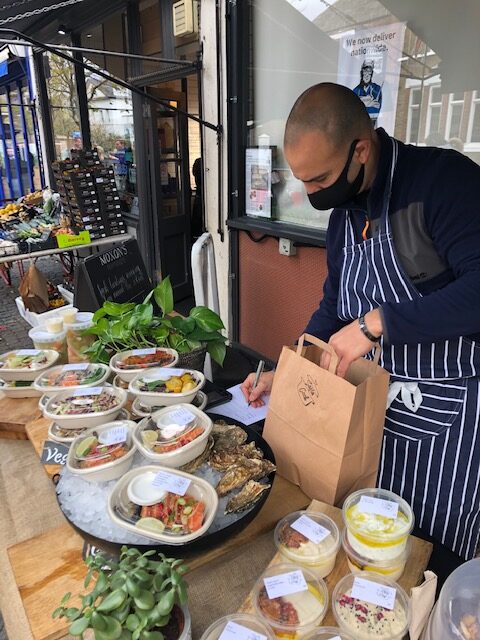
    Orr Barry at his Saturday stall on Lordship Lane

    But really Barry has demonstrated the possibilities of food when it comes to community. “Now when we’re walking down my street, I know all the neighbours,” he says, proudly. His is a very pandemic story – it is an example of how we might still reach one another while separated from one another.  

    There’s another aspect to this. Stuck in our locality, Barry invites the world into your home, just as in his different way Jim Haynes used to do. “I love to take the menu sometimes into the Jewish tradition – but sometimes you’ll find a twist of Asian food, whatever interests me at the time. I try not to repeat myself, because people want the unknown.” 

    We’ve learned that freedom and hope are deeply intertwined: in ordinary times, we feel optimistic about the time ahead, because it’s in our gift to make of it what we will.  That’s what the pandemic has robbed us of: instead of the ramifications of freedom, we see only limits. Barry is in opposition to that.  

    Barry – who used to run the no.1 Trip Advisor-rated restaurant in Tel Aviv – doesn’t want to turn Safta Cook into a restaurant once the restrictions are lifted: “A restaurant is like a military regime,” he says. 

    The following Saturday, I show up at Barry’s Saturday morning stand, and purchase some oysters, a shucker knife, and a mix of salads and vegetables, then back home eat my best meal of the pandemic. As I imagine the food must have tasted at Haynes’ house in Paris, Barry’s tastes of that rare thing nowadays: liberty. 

    Christopher Jackson

  • Food and drink focus: ‘People are fed up with things that aren’t good for you’ – Gabriel Bean

    Food and drink focus: ‘People are fed up with things that aren’t good for you’ – Gabriel Bean

    By Alice Wright

    A record 500,000 people signed up for Veganuary 2021, pledging to only eat plant-based foods for the first month of the year. This is double the figures for 2019 and also the first year that major supermarkets have run adverts promoting the movement. 

    I spoke to Gabriel Bean, founder of Grounded, a company which makes plant-based protein shakes about the movement towards plant-based products and sustainability shifts in the food and drink industry. “For me the move to plant-based kicked off a couple of years ago,” Bean explains. “But it’s taken a few years of test and trial. This probably marks the year that people are really feeling the benefits from it.”  

    Has the Veganuary movement impacted business? “I don’t think Veganuary necessarily changes business for us. We had exceptionally high sales volumes going into January in the November and December period as well. What plays a role is the attitude towards plant-based products. People are fed up with food and drink products that are not good for you and not good for the planet.”

    In the food and drink sector, sustainability was a luxury even a couple of years ago. If you want to package your product sustainably it costs more and it’s harder work. It’s particularly difficult for smaller brands to be sustainable and this is something that will have to change in the future. 

    “Sustainability has always been at the core,” Bean continues. “It was in the top three things to consider as we developed our new products. It was so important that this product be sustainable, not so we could jump on the sustainability hype but so we could scale consciously. I can sleep well at night knowing that the packaging has come from a responsible source and isn’t going to be floating in the seas of the Maldives. I think it’s a requirement now, if you’re not sustainable then you haven’t met the basic criteria for food and drink.” 

    When I think about protein shakes, I associate them with busy people commuting in and out of the office at ungodly hours with no time to cook a nutritious meal. According to Bean, Grounded’s shakes have managed to avoid being pigeon-holed like this. “We launched the product in August after the first lockdown,” he says. “So we were developing our sales plan for what life would be like after the first lockdown. We put a lot of time looking into online direct to customer retail – it’s an exponentially growing space anyway and retail sales are struggling.” 

    The other marketplace change I’m interested to hear about is the closure of gyms, another usual protein-shake hotspot. “Now people are working out from home,” Gabriel explains. “There aren’t the options to go into a post-workout gym store so we’ve angled the whole online custom to a workout from home attitude. It’s worked really well, and we have several campaigns on Instagram getting a lot of traffic.” 

    So what are his prospects for 2021. “There is going to be so much talk on veganism and sustainability this year. I think it’s really important to gauge from businesses what their core beliefs, morals and ethos are. A lot of companies will be jumping on this as a marketing opportunity. We at Grounded don’t see sustainability as a market opportunity but as the future of where food and drink are going.” 

    Picture credit: Tony Webster