Tag: Film review

  • Film Editor Meredith Taylor reviews new Donald Trump film The Apprentice: “A compulsive portrait of toxic narcissism”

    Meredith Taylor


    Dir: Ali Abassi | Script: Gabriel Sherman | Cast: Sebastian Stan, Jeremy Strong, Maria Bakalova, Martin Donovan, Catherine McNally, Charlie Carrick, Ben Sullivan, Mark Rendall, Joe Pingue, Jim Monaco, Bruce | Biopic Drama, 120′


    “You’re either a killer or a loser” is the advice a young Donald Trump (Sebastian Stan) gets from his acerbic mentor Roy Cohn (Jeremy Strong) in this polarising political biopic written by journalist Gabriel Sherman and directed by Iranian-Danish filmmaker Ali Abassi (Border) and Holy Spider (who is now perhaps best known for his involvement in The Last Of Us).

    Cohn, the lawyer responsible for putting the Rosenbergs on the electric chair and a key figure in the McCarthy witch hunts, offers up three key bits of business advice during The Apprentice – an entertaining romp that zips briskly through its two hours running time sketching out Trump’s early career as an eager apprentice trained under the high-flying lawyer, and eventually trumping him in a tale of machiavellian morals, ethics and business acumen.

    There are elements of poetic licence at play here: in other words Sherman plays slightly fast and loose with the facts in fleshing out Trump’s backstory. The result is a fairly even-handed feature that on the one hand sees the US former president as cold-eyed and devious, but on the other opines that these are the very tools of the trade for those wanting to get on in big business – or politics, for that matter. Crucially it also highlights the recent concept of the truth being a construct open to individual perception.

    The focus narrows in on Trump from a broad brush opening outlining the corruption of the Nixon years and the inherent dishonesty that is now rife in all circles of power, not least in America. It contrasts the ‘losers’ (those on welfare) with the killers, the ‘unscrupulous’ hard-working income generators during the Reagan presidency that led to the phenomenon of ‘corporate greed’.

    The Apprentice sees Trump starting out during the 1970s working for his property magnate father, Fred Trump (Martin Donovan). Dressed in a suit Donald is tasked with doing the rounds to collect rents. One disgruntled tenant throws a pan of boiling water in his face, another swears at him. The family business comes then under fire from a civil rights action alleging discrimination against Black tenants. Cohn wins the case, as his lawyer, with Trump senior claiming: “How can I be racist when I have a Black driver?”

    But Donald is determined to make it alone and sets his sights on transforming the downtrodden area around Grand Central Station where he vows to make a success in a project of urban regeneration involving the dilapidated Commodore Hotel, bringing jobs, European tourists and a facelift for Manhattan.

    Family wise we also meet Donald’s kindly mother Mary Anne (Catherine McNally), and his brother Freddy (Charlie Carrick) a failed pilot with emotional problems: Fred admits to having been tough on his boys. But Donald is hellbent on success and soon bonds with Cohn after a chance meeting at a fancy Manhattan nightclub frequented by the top flight business community. Working together they soon go from strength to strength in a business alliance with Trump styling himself in the same vein as Cohn with his fast-talking intransigence. His transformation into fully fledged killer who lives by his own standards happens almost overnight and feels a little too fast even given the film’s ample running time. But Stan grasps Trump’s essence charting his character’s transformation from reasonable business man to self-seeking  hardliner.

    Trump soon becomes a man who takes his own advice often rubbing Cohn up the wrong way, while at the same time chosing to turn a blind eye to his ‘strange way of life’ and hedonistic habits. Trump’s puritan background sees him gradually distancing himself from the lawyer who berates him for his lack of financial probity. Their relationship eventually sours during the AIDS crisis, although Trump offers an olive branch in the finale.

    The marriage to Ivana Zelnickova, against Cohn’s advice, is handled deftly and with some humour. Trump follows Ivana to Aspen to clinch their romance then falls flat on the ice after claiming to be a good skier. The Czech model is a little too sweet and sympathetic despite her purported savvy business sense, but Trump soon tires of her, claiming to find their home life ‘more like coming home to a business partner than a wife’. A shocking episode sees him beating Ivana, but whether this has a factual basis, despite his widely reported misogyny, is uncertain. Stan’s Trump may polarise public opinion in coming across as too likeable but this is surely the essence of a maverick who can charm as well as chastise and here he gives a compelling performance.

    With a killer score of hits that just reeks of the ’70s and ’80 and a scuzzy retro texture this is an compulsive portrait of toxic narcissism even more relevant now than it was back in the day.


    PHOTO CREDIT: Cannes Film Festival 2024 Première
     

  • Paul Joyce on Maestro: “A Rudderless Ship Adrift on a Sea of Vanity”

    Paul Joyce


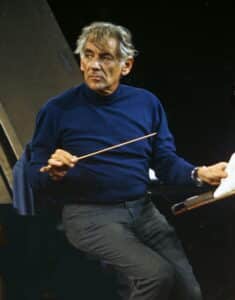
    In my decidedly less than humble opinion, the only real reason for “Maestro”, Bradley Cooper’s inconsequential biopic getting close to an awards envelope, is the astonishing power and charisma of his subject’s ability to haunt us from his grave- Leonard “Lenny” Bernstein. Here the quote that immediately comes to mind ends with “…all sound and fury, signifying nothing.” However, I would certainly not go so far as to claim his film, “Maestro”, is told to us, in the words of William Shakespeare, by an idiot, for Cooper is an accomplished actor and at his best a competent director; it’s rather that in taking on both jobs he has diluted his talents so severely as to render the whole enterprise little more than a miserable pastiche.

    Why am I being so harsh on a film which has some considerable highs alongside the overwhelming lows, included the presence of the magical Carey Mulligan as Bernstein’s all-forgiving wife and some, but by no means all, of Bernstein’s music of genius? Because a) he skirts the core cause and effect of Bernstein’s bisexuality, b) he fails to deal adequately with his Jewishness and c) the best of his wonderful music becomes rather in Cooper’s hands, a failed attempt to create a pied-piper like celebration of his unique scores, ending instead as a merely meandering and eminently forgettable soundtrack to a barely sketched-in life.

    It is not a widely known fact that Steven Spielberg was slated to direct the movie, which would have surely involved his experienced hand in the screenplay as well, but he withdrew from the project, I suspect due to the universal chorus of disapproval for his attempt at a musical with “West Side Story”;  this thankfully seems to have slipped into the equivalent of Rotten Tomatoes’ infamous tables, or perhaps is already there, as in a real list of worst movies of all time. However, I have no doubt that Spielberg’s involvement would have yielded a far more truthful and controversial film than the one that has finally appeared on our screens. Bradley Cooper is the latest in a long line of actors turned director, the usual advice for which is to let well alone, viz Angelina Jolie, Barbara Streisand and Warren Beatty to name only a few from a capacious and now overflowing pocketful of others.

    Before I proceed to the very blood and guts out of this near farrago, I should say, however, it is plain as a pikestaff that Cooper surely has his heart on his sleeve for our Lenny, but unfortunately to the point that his worst characteristics are glossed over or ignored altogether. For me, I sensed deep problems as soon as it was clear that Cooper’s putty-enhanced nose (four hours in make-up alone!). was attracting all the pre-release publicity. When the nose carries the performance before it, like a ship’s figurehead, we know that trouble will follow. Just ask those nose kings, Orson Welles, and Larry Olivier. Jeanne Moreau who starred with Welles in “Chimes at Midnight” said that Welles claimed he had lost his make-up case and was therefore unable to perform, until she found it hidden under his dressing room settee, thus shaming him into appearing with her in a scene on screen at last. Such was Orson’s fear of taking on the role of his life, Falstaff, showing that this mighty man still possessed human fallibilities. No such problems in Cooper’s case, on goes the schnozzle and on it stays. But if we all end up staring at it, what good is that to the movie itself?

    Let us now turn to the matter of more serious mistakes, omissions, blunders and directorial blindness that Cooper is prone to and ultimately responsible for. But these crimes and misdemeanours pale in the light of over-weaning vanity which smothers the whole enterprise like a cloak of untreatable plague: Bradley’s performance as Lenny.


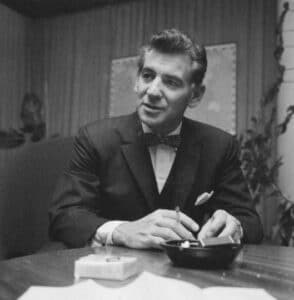
    When one has to say that his attempt to master the art of chain smoking scored a mere six out of ten, compared to Lenny’s twenty out of ten, one’s heart begins to sink. (In fact a whole fascinating documentary awaits the incautious director who undertakes to tell the story of nicotine addiction amongst creative classes. Cigarette-smoking killed both Lenny and his wife, alongside Humphrey Bogart, Nat King Cole and Robert Taylor together with a slew of stars active in the 30s, 40s and 50s.) Kurt Vonnegut was eloquent in defence of the weed, writing fascinatingly about the power of trading cigarettes for all and any kind of favour in war zones (“Starting when I was only twelve years old, I have never chain-smoked anything but unfiltered Pall Malls. And for many years now, right on the package, Brown & Williamson have promised to kill me. But I am eighty-two. Thanks a lot, you dirty rats.”)  Lennie was permitted to smoke anywhere he chose to be, otherwise he would not be there at all. To see him without a cigarette in hand was as if he appeared on the podium in boxer pants. In fact, it occurs to me now that his furious conducting, one place he was disallowed the weed, was an attempt to keep both hands occupied and therefore from reaching for the fag packet and Zippo.

    Quite apart from Cooper’s inability to deal with complex and contentious issues head-on, he embraces a dumbfounding decision to leave a crucial chunk of Bernstein’s life and work, from 1951 till the early seventies, entirely blank. These years were amongst Lennie’s most productive and open to proper critical examination, particularly in regard to the various prestigious appointments he received. There is no doubt that Bernstein was a practiced and at the very least slippery operator, playing his  50% straight hand against gay rivals with barely a backwards glance. His shamelessness was cleverly concealed and emerged, if ever at all, to the uninitiated as mere elements of an artistic temperament. With the probable exception of murder (actual or career), as opposed to character assassination, Lenny could surmount almost any obstacle in his path.

    Ultimately what Cooper was facing was the almost insurmountable task of making a film about someone heroic, universally admired, praised and very successful – in my view, a certain way to a directorial dusty death. With those flicks that do succeed, such as The Wolf of Wall Street, The Shawshank Redemption and The Aviator, most people would have difficulty in actually naming the protagonist. Who were they actually about? The question is not so much who, but what? And the answer is plain for all to see, the inevitable descent from even modest success to abject failure which cynics would maintain is the story of most if not all of our lives. Don’t almost all of us identify with the flawed hero, for in them we see a reflection of ourselves.? How much less of a challenge to make a film about failure, and here the list is far easier to assemble beginning with the greatest of all, Citizen Kane followed by such as: Once Upon a Time in America, Elmer Gantry, Aguirre, Wrath of God, and almost all of John Ford’s films starring John Wayne (with the possible exception of the earliest, Stagecoach).

    Even our greatest comedians were much better practiced in the art of failure than success: Charlie Chaplin, Buster Keaton and the joint kings of Failureland, Laurel and Hardy. In perhaps their greatest short film directed by Leo McCary, L and H only reach their nemesis by the simultaneous destruction of a neighbour’s house at the expense of seeing their new car being gradually but inevitably reduced to metal shards. In another short we see their priceless and failed attempts to get a heavy piano to the top of a steep and apparently endless flight of stairs. Two hugely successful laugh-out-loud movies depicting the paralysing nature of failure. Very well you may ask, trawling around for a film highlighting success, what about Oppenheimer?  Here, surely, is a film about one of the greatest successes of all, the making of the first atomic bomb? Gottcha! Well, actually, no, as Oppenheimer thought of himself as an abject failure in preventing the proliferation of his creation almost certainly resulting, sooner or later, in the ending of the world as we know it. Christopher Nolan’s monumental epic is a milestone in the depiction of a man who achieves all he could wish for but ends up as a fragile and intensely vulnerable man riven with doubts and regrets. Much easier than trying to show us the indefinable aspects of genius which are frankly not possible to depict:  the art of conducting (impossible); charisma (impossible); the creation of great music (equally impossible). I’m afraid Mr Cooper’s Maestro had the cards stacked against him from the start.

    All in all then an entirely hopeless, hapless case resulting in a hopeless and hapless film. But in truth I can’t think of any director with enough musical knowledge to undertake such a challenge. The only way to transmit the essence of Lenny to a contemporary audience would be to embrace a documentary format and trawl disparate materials from at least a hundred or more different archives. This would allow us to see his genius, charm, articulateness, inspirational compositions, concert-grabbing performances as a pianist, and his immense skills as a teacher to audiences of all kinds. Then, from within these interconnecting elements, you would need to put together a patchwork portrait of the man with all his charisma, wit, fire and passion that penetrated and transmitted to us through any camera lens trained upon him. He was, in my opinion, the intellectual and super-articulate equivalent of Marilyn Monroe with all her sensuality and innocent charm.  But in terms of sheer sex appeal alone, I would have to declare a dead heat. Mr Cooper, kindly leave the stage!


  • Meredith Taylor on Oppenheimer: “a fraught epic”

    Meredith Taylor

    At a time when the world has been holding its breath over the escalation of hostilities between Russia and Ukraine, a haunting vision of the future hangs over this fraught epic about the man who invented the iconic bomb that ended World War II.

    English director Christopher Nolan frames his feature through a stimulating Washington based court investigation as Oppenheimer’s florid life and times flash back urgently forward to a needling score – from Cambridge to Leiden and then California and finally Los Alamos in New Mexico – providing thrilling social and political insight into the final stages of the Second World War.

    Cillian Murphy is screen dynamite as Robert Oppenheimer, a Jewish scientist from New York, who was seen as a hero to many but later vilified as a threat to his country for questioning America’s arms race bravado with his learned opinions in those turbulent times. Based on the Pulitzer Prize-winning biography American Prometheus: The Triumph and Tragedy of Robert Oppenheimer, Murphy leads a cast who each pull their weight in this mighty masterpiece that mesmerises for over three hours, the final segment is the most riveting and allows the stern but softly spoken Murphy to expose the soulful side of this conflicted but brilliant man.

    Hoyte van Hotel’s coruscating cinematography is impeccable in vivid colour and black and white, the 15/70mm print showcasing Nolan’s most impressive film to date.

    Oppenheimer serves both as a densely plotted character study and a simmering slice of history that also delves into the brutal tactics of the McCarthy era, but never at the expense of some dry humour and a wise perceptive overview from Tom Conti’s ageing Albert Einstein as the father of scientific breakthroughs. Meanwhile in the Los Alamos labs a selection of topflight theoreticians cut through the science by simply dropping marbles into jars to illustrate the difference between uranium and plutonium as fusion bomb components.

    Performance-wise Downey is outstanding as Strauss, a major player in the Atomic Energy Commission and a monstrous ego; Matt Damon is masterful as Major Leslie Groves, in charge of security at the Manhattan Project; Emily Blunt (a steely Kitty) and Florence Pugh (a sensuous Tetlock) play the feisty women in Oppenheimer’s life and Jason Clarke’s Roger Robb (Special Council to the AEC) could put any cross-examiner in the shade. Gary Oldman gets a surprisingly powerful cameo as President Truman “people will remember who dropped the bomb, not who built it”.

    Director/Writer: Christopher Nolan | Cast: Cillian Murphy, Emily Blunt, Matt Damon, Robert Downey Jr., Florence Pugh, Josh Hartnett, Casey Affleck, Rami Malek, Kenneth Branagh, Benny Safdie, Jason Clarke | 180′

  • Film review: What does the case of Elvis Presley tell us about work?

    Christopher Jackson

    We sometimes talk as a society as though being successful were somehow the be-all and end-all – as if it were somehow all that mattered in and of itself. Some time in the 21st century, the cry went up that fame was all, and that a particular set of metrics mattered. In the world of music, it would mean that marvellous Holy Grail: the hit, the platinum disc.

    The history of rock and roll seems on the face of it to make it clear in bold italics that this entire thing was always a gigantic folly. Success as a musician, especially in an era of drug-taking and alcoholism made respectable, has with astonishing regularity meant premature death.

    In the light of the 2020s, the life expectancy of the rock star seems sometimes to veer wildly between those who die very young, such as Moon, Hendrix, Brian Jones, Michael Hutchence and so on, to the recent spate of octogenarians, including Bob Dylan, Paul Simon, Paul McCartney, and Brian Wilson. It is as if, if you can somehow manage not to die, then a hedonistic lifestyle can shade by gradations of mellowing into a pampered one, until a kind of creased longevity is achieved.

    Elvis, of course, did die – or rather didn’t manage not to. In fact, his death lacks the Chatterton-esque Romanticism of some of his peers, since he declined physically to such an extent before his eventual demise.

    But the fact that the Elvis legend persists is all to do with the enormity of his impact, and Baz Lurhmann’s excellent film, evokes that like no other biopic about Elvis.

    Listening to Elvis today can be a perplexing, even tame experience. Though we still to some extent inhabit the world of Elvis, we don’t always realise it: for one thing recording technology has come a long way since that time, robbing his sound of its original shock and immediacy. This state of affairs is to some extent exacerbated by the way in which the typical Elvis mix on Spotify or iTunes is a bewildering mix of his early stuff, which really was revolutionary, with the later Vegas work, which seems schmaltzy today.

    What lessons does the film have for a music career? In the first place, we see in the early scenes that great achievement is very often to do with being open to influence and to new information. Elvis’ real legacy was to listen to the great black music of the 1950s, and to open himself up to its influence – and insodoing to further it.

    There is a tremendous scene where the boy Elvis, is peeping through a window, and sees a black rock and roll band, and experiences the thrill and pulse of that music as a thing which he must have in his life – and the only way to do that will be to emulate it. It is often said that when Elvis first came on the radio, people assumed his vocal chords belonged to a black singer.

    In all our careers, there is knowledge which may have a forbidden quality; Elvis is a reminder of the potential benefits of running roughshod over that kind of prohibition, and of imbibing influence wherever it can be found.

    In the film, this idea that Elvis sounded black on the radio is conveyed to us through Tom Hanks’ performance of Colonel Tom Parker. The question of Tom Hanks in this movie is worth a small essay in itself. Hanks, an actor – and to the extent that one can be sure of these things – probably a man to admire is nevertheless the main problem with this movie. Some critics have pointed to his disastrous accent as the principal issue with Hanks’ performance and it is indeed a strange mishmash.

    I think the problem with the performance runs deeper in that Hanks, among major artists of our time, seems to me to be someone with an innate relationship to goodness. In this, he is similar to Paul McCartney, who can never keep optimism out of his songs: his inherent tendency is towards consolation. If you look at his performance in A Beautiful Day in the Neighbourhood (2019) you can see him exploring a terrain – in that case, saintliness – which he feels a natural kinship with.

    Here, in Elvis, he is fatally severed from the subject matter of human evil, meaning that he is at an odd distance from the essential topic of the performance. It is like a singer choosing to sing out of range, or a writer with no ability for dialogue switching from novel to the drama.

    The resulting performance doesn’t quite derail the movie, though it comes close. Elvis himself seems to have been born with something opposite: an innate capacity to know what could and couldn’t be done with a song on stage. Luhrmann’s movie shows that this ability was something that he first had to learn to wield: nervousness is something everybody must overcome at some point, and it is interesting to see Austin Butler convey Elvis’ tentative first steps into his gift.

    The greatest question for anyone with a creative bent is how to make money from it. It’s quite rare that an ability with the arts comes hand in hand with a talent for administration; the two aptitudes must occupy different parts of the brain, and where the one is accentuated the other is likely to be in deficit. So it was with Elvis; an outsize performative gift opened him up to exploitation, and he met, in the shape of Parker, a master exploiter.

    The film consistently shows Elvis seeking his authentic self in the teeth of the man committed to falsifying that self – and to commercialising the image he has created. A TV show, which looks like it will be an embarrassment of Christmas cliché perpetrated by the Colonel, is pushed back at by Elvis. Later, we see him inaugurating his big sound in Las Vegas.

    Elvis sometimes appears here as a great artist – a man with an unfailing sense of what audiences want, but able to enact something at some farther point just beyond that vague idea.

    In one sense, Elvis is still with us. We still have our popstars identifiable by one name – Beyoncé, Drake, Jay-Z, and so on. They are, to some extent, his inheritors. But not entirely. In another sense, the world has moved past his obsessions, or begun to wise up to the danger of self-indulgence. Today’s young people are often teetotal, and as likely to wear sneakers and design an app as they are to pick up a guitar and take drugs: they’re the better for it. Some of the 1960s susceptibility to self-indulgence was probably an inheritance of the Second World War: when life has been constricted and dangerous for so long, who could resist that bright day when it came along? It was not a time for the stricture of virtue. It was time to live again.

    This is a film which does more than listening to Elvis’ records can to describe his greatness. It shows how the compulsion of the performer can rise to art, and how if that performance can be captured in sound, a memory lingers on.

    What Luhrmann ultimately does is regenerate Elvis, and remind us what he did. He dragged the past with him into the future, and though he died along the way, he is as much an aspect of our lives today as the atomic bomb, or Winston Churchill, or Martin Luther King, or any of the other seismic things of the 21st century.

    The film ends with footage of a magnificent performance by Presley himself of Unchained Melody. Desperately overweight, and sweating under lights, he nevertheless finds the notes as only the great entertainers do – the more so when the chips are down, and the world is difficult. They find the right notes because they have to, because it’s what they do – and because of decades of practice at doing so.