Christopher Jackson asks why Only Murders in the Building is such a hit
In one sense Only Murders in the Building – known to fans as OMITB – is just another TV show. It’s well-made, and moreish. It takes its place among umpteen other binge possibilities on Disney Plus and the other streaming channels.
Yet there’s something so clever about it that makes one want to make claims for it. One wants to call it culturally significant and see if the label fits.
Put simply, why is Only Murders in the Building so good?
All-Star Cast
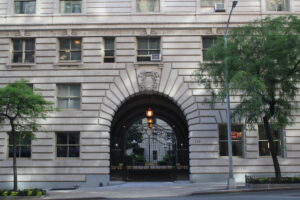
Well, the show stars Steve Martin, Martin Short and star of the moment Selena Gomez, and has just been renewed for its 5th season. The location of the show is The Belnord on West 86th Street, a building whose residents have included Marilyn Monroe and Martha Stewart.
This location is a clever choice since it creates a set of structures – dramatic laws – even which make the sure admirably tight. For instance, a murder has to take place in the building for it to qualify. This means that we get to know its layout, and its regulations and the people who live there. There’s a sort of cosiness to this – something almost familial.
The Belnord is where Only Murders in the Building is set
It’s a good tip for young writers to consider exploring a location as OMITB brilliantly does. A place will engender characters – and sometimes do so better than our imagination. Once you’ve chosen a communal building, then you have the janitor, the receptionist, the chairman of the building board – probably not the other way round.
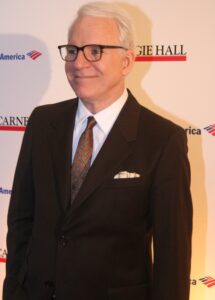
So who lives in the building where all these murders take place? Steve Martin plays Charles Hayden-Savage, a slightly has-been actor. Hayden-Savage probably has enough money to live there by virtue of having bought his apartment before Manhattan became unaffordable to anyone but the superrich.
Martin’s character is, like so many he has played in the past, eager to please but with a tendency to put his foot in it. He aspires to goodness, but something about that trait means he’s romantically alone, but that unexpected friendship comes to him.
Steve Martin plays Charles Hayden-Savage in Only Murders in the Building
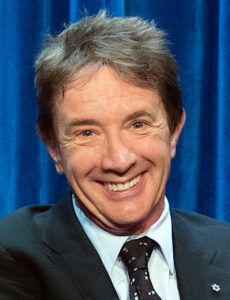
That’s true too of Oliver Putnam, played by Martin Short, a name-dropping Broadway director whose failures – especially his disastrous musical Splash – are far more memorable than his successes. Putnam can begin to grate a little by the fourth season, but he is essentially loveable, a fantasist who thinks the next big thing is round the corner – and also that his past is more illustrious than it was.
He has a sort of Tourette’s when it comes to other people and can be delightfully rude about people to their faces because everybody knows he doesn’t quite mean anything he says.
Martin Short plays Oliver Putnam in Only Murders in the Building
Age Gap
Finally, Selena Gomez’s character Mabel Mora is only in the building at all because her aunt lets her live there. It’s this age gap which provides much of the comedy. Mabel isn’t sure who she is yet, but it turns out – as so often – that who she is will be determined by the relationships she makes – in this case, the two older men.
At one point Mabel says: “A murderer probably lives in the building, but I guess old white guys are only afraid of colon cancer and societal change.” At another point, a walk-on character thinks Mabel is Hayden-Savage and Putnam’s carer.
Early on in Season One, Martin hilariously signs off a text to Gomez with ‘Best regards, Charles Hayden-Savage.” Her smile as she reads this is marvellous, full of the knowledge one generation cannot convey to the next. This shows tells us that the world moves fast – but also that on another level, the human heart is a realm of possible stability if we can manage to be open and kind.
In fact, the reason the show works so well is precisely because of the inter-generational nature of the humour – and also because audiences inherently enjoy unlikely friendships.
There is a sense in all of us that only befriending people of our own age narrows us somehow: it is as if, deep down, time doesn’t feel entirely linear and we want to teach it that lesson by striking out in surprising directions.
Clockwork plots
But all this would be incidental if the plots didn’t work. Murder is hard, not because it isn’t inherently interesting. It’s hard, because it’s so interesting it’s been done every which way a million times. When you write a murder mystery you’re up against Edgar Allen Poe, Arthur Conan Doyle, GK Chesterton and Agatha Christie for a start – and they’re just the headliners.
Added to that, because the audience is reliably dedicated, they’ve seen every plot-twist. So you need to be extremely clever to surprise people likely to tune into a murder mystery: you have to secrete your clues carefully, you have to feint to the wrong killers plausibly, and you have to get your pacing right.
OMITB does all these things, and for the most part fabulously. It’s also brought together by acting which it can be easy to underestimate. The best for me is Martin, because you don’t notice he’s acting. But the main three all combine a genuine off-screen friendship with on-screen rapport.
Walk-on Parts
In fact, the first season gives you the best possible measure of that when Sting appears as a cameo playing himself. Sting is a great musician, and an okay actor – but what makes him only okay at the latter is that you can see him trying too hard.
The camera loathes exaggeration – and Sting slightly strains for effect. In his day job, and especially in his heyday, he doesn’t know how to make a clumsy chord change. But this isn’t his day job.
It’s Martin’s though, and you can see that he’s always been much more than just a comedian. Nothing he does draws attention to the fact that he is trying to convey it; he becomes that emotion, that predicament.
This is what lifts OMITB – its ability to keep you engaged in the storyline while providing laughs, and also moments of surreal drift. In the first episode, Putnam tells us that in New York City we sometimes fall down only to bounce back up again.
It’s a metaphor but we end up seeing this enacted, as he falls off some stairs and floats dreamily upwards when something promising happens to him at the end of the episode. The famous White Room episode in Season 3 provides a similar moment for Martin.
In this scene, Martin corpses and enters a strange parallel dimension: a white room where he is walking with a wonderful manic grin on his face. When he wakes, he is without his trousers and everybody is traumatised. It’s the funniest scene in the show.
More than Whimsy
It’s whimsy, yes, but there’s something more solid about OMITB than that. Twin Peaks made a habit of such playfulness, and perhaps in the end didn’t quite know what it was. OMITB has stronger delineation, since everything which happens in some way serves the mystery. To do this while offering up brilliant one-liners is a rare achievement.
The show is a good indicator of where society is now. This is a world dominated by new media – the murders all revolve around a podcast which the three main characters are producing, and which becomes a surprise hit.
But while it has its finger on the pulse, it’s a show that also knows that the latest thing is just the latest thing: the age gap between the main characters shows us how we all react to the modern world at a slightly staggered pace, according to what we wish to assimilate, and we can manage to accept.
Along the way there are nuggets of wisdom. In Season 2, Episode 6, Tina Fey’s recurring character says: “Never become too good at a job you don’t want.” She doesn’t add that if you do that you can wake up halfway through your life with your options narrower than you’d ever thought possible: she doesn’t have to because the dialogue is so taut.
The Here and Now
Ultimately, the show is to do with a sort of light touch unity. Why is Only Murders in the Building so good? Perhaps for the reason that good art always is. It says, cleverly, even tangentially: the world’s like this now.
But it also knows in Martin and Short’s characters that now will soon be then. To say that without being portentous or preachy, and to make you laugh and tell a story at the same time is a rare achievement.
At the release of Ridley Scott’s new film, Christopher Jackson asks what we can learn from the great general in our working lives
There is a famous line by the 20th century Chinese statesman Zhou Enlai. When asked what he thought of the French revolution, he replied: “Too soon to say.” The same might be said about Napoleon: we’re too near him to know for sure what he means to us.
That doesn’t stop us trying to find out. The recent release of Ridley Scott’s film Napoleon (2023) has proven beyond doubt that Napoleon remains both compelling and controversial – as lively in his importance as many a living figure. By discussing Napoleon, we somehow give an account of ourselves.
Scott’s film establishes itself as a must-watch just by virtue of its title. It isn’t quite the film we want or need, but it is better to have it than not. All Stanley Kubrick fans lament the fact that the great director never finished his own version – and there is much hope surrounding the news that Steven Spielberg is now filming a seven-part series for HBO based on Kubrick’s script. For now, we can make do with this: Joaquin Phoenix as a gruff Napoleon, less intelligent by many magnitudes than the actual Napoleon; brilliantly shot battle scenes; and a film that feels oddly both too short and too long at the same time. What’s good about it will make us want to know more about Napoleon; what’s not so good will ensure that our appetite for stories about Bonaparte will not allay.
After Scott’s film was initially screened, and the reaction came in, one came to realise that however porous the world’s nations have become, they still mean something to most people. That’s because in France, the film has been considered anti-French, a viewpoint which has been much less notable in the English and American coverage. It was as if the Napoleonic Wars had never been away, which in itself brings to mind another quote, this time by the American novelist William Faulkner: “The past isn’t dead. It isn’t even past.”
This quote, whose truth has grown on me over the years, is undeniably the case with Bonaparte. Napoleon, perhaps more than any other historical figure, retains the power to affect us in the here and now, though he has now been dead for over two centuries.
What is it that makes him so powerful and even attractive? His daring, his military competence, and his glamour tend to spark the imagination of successive ages. Nobody is really immune from his dash, his competence, and the outsized nature of his deeds. Readers of Andrew Roberts’ Napoleon the Great will find it striking how much Napoleon wrote, especially in his youth – stories, plays, essays, all of them very bad. But really Bonaparte is the archetypal man of action and our interest in him perhaps speaks to a deficit in us: compared to Napoleon almost everyone else in history is too sedentary. To look on him is to marvel at a different energy altogether, one we can learn from.
But there’s a paradox at work here. Napoleon’s very power to interest us may make us wonder a bit about the validity of the helter-skelter progress we sometimes think we are making. Why, if we’re so content to rush off into a future of general artificial intelligence and drone cars and so forth are we so easily arrested by this man who lived not only before the Internet and air travel, but who lived most of his life without the steam engine having been invented?
One possible answer is that Napoleon, as Scott’s film shows well, remains a fascinating instance of human potential made actual. By any measure, he did amazing things – even though we might not agree with much of what he did. He stalked continents; proved himself one of the best military commanders in history; and created a legal system, the Napoleon Code, which is still in force in some 120 countries. It was the historian Kenneth Clark who said that Napoleon, for all his faults, was a difficult person entirely to discount. “We can’t quite resist the exhilaration of Napoleon’s glory,’ as he said in his landmark TV series Civilisation.
Glory, it must be said, has had a hard time of it in the past two centuries – not least because Napoleon, its principal embodiment, was defeated in the end. The poetry of Wilfred Owen (1893-1918) contains the best descriptions of why glory is at the very least to be distrusted. Put simply, it leads to needless death – Owen’s among them. So Napoleon embodies a discredited notion, but still we find ourselves affected by him.
I think some clue can be found in the etymology of the word ‘glory’ which comes from the Old French ‘gloire’: “the splendor of God or Christ; praise offered to God, worship”, though it also has connotations with the Latin word ‘gloria’ which naturally has pre-Christian associations of ‘fame, renown, great praise, or honour”. This might make us realise that Napoleon, in so embodying glory, is a sort of ladder we might descend into the deep past – almost into another version of human achievement, full of a kind of blazing intensity and adventure.
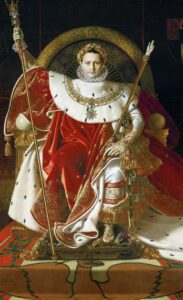
There is evidence that Napoleon knew that he might serve as a powerful, almost Pharaoh-like, symbol for his contemporaries. Take, for, instance, Ingres’ superb portrait which summons to mind Charlemagne: here we see the paraphernalia of immutable power. Napoleon, too fleetingly, understood himself as a force for stability – and, of course, in relation to what had gone before in the shape of the anarchy of the revolution, that wasn’t necessarily difficult.
But he was too complex to be only that – he was also on the move, athirst, full of a certain wild rampancy. He could never be a figure of unity and a figure of conquest at the same time. In his essence he was too questioning for that. This tendency to ask quick volleys of questions was the backbone of his character. Here is Roberts describing an encounter with the prostitute to whom he probably lost his virginity in Paris when a young man:
“He asked her where she was from (Nantes), how she lost her virginity (‘an officer ruined me’), whether she was sorry for it (‘Yes, very’), who she’d got to Paris, and finally, after a further barrage of questions, whether she would go back with him to her rooms…”
And here he is towards the end of his life, as witnessed by William Warden on the Northumblerand in transit to his final ending up in St Helena:
“His conversation, at all times, consisted of questions, which never fail to be put in such a way as to prohibit the return of them. To answer one question by another, which frequently happens in common discourse, was not admissible with him. I can conceive that he was habituated to this kind of colloquy…’
He certainly was habituated to it – it was a lifelong trait, which it would have been good if Scott’s film could have better conveyed. Napoleon’s curiosity was insatiable: given command when very young of the French army in Italy, he threw himself into the history of campaigns there.
But his curiosity also had its limitations. If we ask to what end he was asking questions then the answer is conquest. This was his raison d’être – and territorial conquest is always bound up in space and time, and so can never quite be enough. Perhaps it is never especially sane. Restlessness was the chief characteristic of his time – usually a restlessness combined with a nodding understanding of the centredness of the classical world. This paradox can be seen in figures as various as Byron, Beethoven, and Goethe. Goethe worshipped Palladio but wrote The Sorrows of Young Werther.
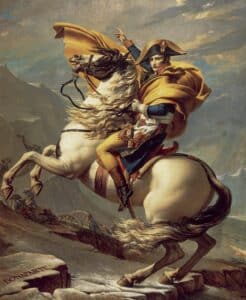
Napoleon til Hest fra bogen Kunstnere Z: David, Jacques-Louis 2005 Fotograf:. ACC:. HD Afdeling. Det Kongelige Biblotek.
The boon of this romantic restlessness was that it was exciting; the problem was that nobody particularly knew what they were travelling towards, a characteristic we often seem to have inherited in our own hyperactive inattention. One of Napoleon’s greatest contemporaries William Wilberforce, in his passion to abolish slavery, had a far clearer understanding of what life is than any of those others. This is one of the reasons why, in the end, Britain won the Napoleonic Wars: it was more securely anchored in a sense of identity than revolutionary and Napoleonic France. Napoleon was a far better military leader than any alive – in fact, he was the best military commander of all time. But his brilliant victories were always in service to nebulous aims.
This heady Napoleon – the one who, unlike Ingres’ version, actually existed – can be seen in David’s Napoleon Crossing the Alps: it is a picture full of movement, of appetite for the next thing. It is this need of motion – the lack of a viable centre – which really came to define him, and which brought about his own destruction. Some of the more picturesque scenes in Scott’s movie show the magnitude of Napoleon’s error in marching on Russia in winter.
This then is Napoleon: a new kind of hero, but someone also redolent of the old Christian Kings, and the pre-Christian Emperors. Of course, Napoleon himself isn’t someone we would think of as Christian in any meaningful sense – the body count alone arising out of his campaigns might make us laugh at such a notion. But in our disconnected and inchoate world, there will always be those who look to the strongman for solace, even a dead one. They are markers of what might be possible when we are feeling downtrodden and small. The spread of digitalised democracy hasn’t decreased this hunger; it has augmented it, as the existence of figures as various as Donald Trump and Viktor Orban, Vladimir Putin and Narendra Modi shows. Most of the people alive today who support these people, would have been sure to have supported Napoleon in his own day. The dynamic towards authoritarianism is a recurring one, and it is partly because it must always be fought that we can’t always be sure at any one time about the precise state of Napoleon’s legacy.
Yet our strongmen are neither so clever nor so interesting as Napoleon. Our politics seems full of a sort of pantomime glory which is sometimes called Punch and Judy politics. It is tempting to argue that without Napoleonic conquest the stakes simply aren’t high enough to make genuinely gigantic political figures.
Certainly the idea of glory seems to reach its apotheosis somehow with the conclusion of the Napoleonic wars. A sort of grey filter appears to descend which has to do with the nature of the victors – the dowdy Victorians – and with the absence of Napoleon himself. The wars which occurred during the 19th century lacked the drama of Napoleon’s wars. We don’t really watch films about the Crimean War. In fact, the principal development in war in the 19th century after Napoleon’s death is probably the writing of Tolstoy’s War and Peace, in which the romantic view of Napoleon is admitted into a vast canvas which is also at pains to show the grim reality of war. Tolstoy anticipated the War Poets by around half a century.
Clearly, the Tolstoyan view of war was important and much was gained: a healthy loathing of carnage. Human beings felt able in the wake of Napoleon to think about the individual life which is sacrificed by the Bonapartist need of conquest. We began to loathe, quite rightly, what war actually is. Owen called the idea that it’s sweet to die for your country the old Lie – and every Remembrance Day we come together in full agreement. One of the leitmotifs of my own life has been to visit the sites of atrocities. I have seen Hiroshima, Auschwitz, Anne Frank’s House in Amsterdam, Kilmainham Jail and Robben Island. They all tell the same story of the collateral damage which governments inflict on people when they hope nobody is watching. In one sense, Napoleon is on the side of the governments not the people.
Yet watching Scott’s film, it doesn’t feel quite so simple as that. He was also in another sense of the people, in that he was charged with bringing to some kind of order the unruly energies of the revolution. Napoleon’s Hundred Days would not have occurred without his having secured some powerful connection with the people. The complexity of Napoleon is that he emerged out of a set of forces which we have to some extent accepted. Furthermore, there was always a degree of treachery in Britain about Napoleon. Charles James Fox – essentially the Leader of the Opposition during the lengthy administration of William Pitt the Younger – had three meetings with Napoleon, and lavished Bonaparte with praise, saying that he had “surpassed…Alexander & Caesar, not to mention the great advantage he has over them in the Cause he fights in.” We would be surprised to hear Starmer say something like this about Vladimir Putin – but perhaps it is a measure of Napoleon’s attractiveness that he had supporters even in the House of Commons.
Yet it was also Kenneth Clark who approvingly quoted John Ruskin’s observation: “All the pure and noble arts of peace are founded on war; no great art ever yet rose on earth, but among a nation of soldiers.” Predominantly because of the horrors of the 20th century, and in our era of declining defence budgets, we find it hard to understand how much our forebears accepted soldiery as a pursuit. Much of the admiration towards Napoleon was therefore aimed at his military ability.
It can be possible to admire a thing done well for its show of technical and leadership ability – and few people have done anything as well as Napoleon made war. His strengths included a rapport with his troops, an ability to think tactically around the terrain of a situation, and an ability to ruthlessly seize the opportune moment. It might be added that these traits would be just as useful in the boardroom as on the battlefield: everyone who aspires to leadership will therefore have something to learn from Napoleon. This is categorically not true of Hitler, who people, possibly including Scott, sometimes want to adduce as a comparison to Napoleon.
Where I think Napoleon is deficient is in his sense of himself, and in his worldview. Heroes forget they are human at their peril. Bonaparte once said that if he were to fall off a building, he wouldn’t be scared but would take a last calm look around. This is unlikely – he would be as scared as the rest of us. In forgetting his humanity, he was unable to accept that humanity is wedded in some way to fear since we are in a universe we don’t understand. As a result he miscalculated about the wishes of others, what they would and wouldn’t do: most notably, the whole world was unlikely to want to live under his regime. Other considerations, which he didn’t understand, were in play. This is because his worldview was essentially Voltairean, and I don’t think it occurred to him in the insane rush of his life that the Voltairean view of life might be limited, or wrong, or both. In this he was very much a man of his time, and not, as he wished to be some eternal Caesar who straddles all the ages. The Voltairean view has nowhere to go, since it refuses mystery.
Nevertheless, some of the best scenes in Scott’s movie bring the 19th century battlefield to life: we witness the sheer flurry and insanity of battle, as well as Napoleon’s ability to exist within a complex situation and calmly read it. When asked who was the best general in history, the Duke of Wellington (conveyed here in a hammy performance by Rupert Everett) replied: “In this age, in past ages, in any age, Napoleon.”
Ruskin’s quote about the connection between military ability and literary output is open to the objection that we wouldn’t necessarily call Napoleon’s reign a brilliant time for literature. In fact, his biggest contribution to literature was again probably War and Peace, in which book he appears and which is impossible to imagine having been written without his extraordinary life. It took a writer of the magnitude of Tolstoy to approach Bonaparte.
But Ruskin’s idea cannot nonetheless be easily dismissed. It might be that soldiery and the skill that surrounds it are what’s missing from our society – that we have become too inward, bloated and self-regarding in a time of peace to produce work that is sufficiently vibrant and true to feel great.
In time, the example of Napoleon faded and the only clear historical example of le gloire since his life, is contained in the life of his admirer Sir Winston Churchill, who also depended on a war – albeit one he didn’t start – as the crucible in which to forge his own reputation. The peace of 1945 has broadly lasted until the present day, and it remains the case that wherever we see war we despise it, as in Ukraine or in the Holy Land.
This makes it all the harder to say that something was lost with the demise of Napoleon. But if something was indeed lost then that something was ambition. Most of us today, as we leave university, seek to join society and joining is an inherently unglorious thing to do. To coopt oneself can be to dream small. In his book Bullshit Jobs, the late philosopher David Graeber issued a brilliant takedown of the contemporary economy, which can sometimes seem to specialise in creating roles whose mundanity might be deemed the polar opposite of the glorious. There is something almost preternaturally un-Napoleonic after all about a middle manager.
This is not to say that the Napoleonic spirit is entirely absent in our world. In many ways, his example can most be found in today’s tech giants, especially in the companies of Elon Musk. Musk himself, when we see him at SpaceX or Tesla, in his constant questioning, his invention, and his desire to push frontiers, bears a remarkable resemblance to Napoleon in a battlefield situation.
Did Napoleon’s defeat lead to the banality of the modern world? No, we created that – and in fact, there’s a good case that Napoleon’s ultimate influence is now more to be found in the realm of the imagination than in political reality. Napoleon left remarkably little political legacy. Gore Vidal mischievously jokes in his novel Burr that Thomas Jefferson had a far bigger impact on history than Napoleon: the American revolution actually lasted and is still admired today, though it is also in peril.
Napoleon in fact never could have united Europe, especially without being able to control the seas. George III and his brilliant Prime Minister William Pitt the Younger were not about to agree to it, and he was probably temperamentally ill-suited to the creation of anything lasting. Napoleon’s bout of conquests came in the wake of the French revolution and since we to some extent inhabit the aftermath of those times, we can hardly access now the note of dismay across Europe at the idea of the old medieval order being so absolutely swept away.
Very occasionally, we glimpse what we were fighting for in opposing Napoleon. Napoleon’s greatest contemporaries have all had a subtle but real influence – in fact their comparative gentleness is liable to make us underestimate them. Arguably, the greatest of them was William Pitt the Younger, whose quiet conservatism and remarkable financial competence have had their own legacy. Pitt, like most of his contemporaries, believed in the monarchy, and although the monarchy has been watered down to a considerable extent, we saw in the coronation of Charles III last year how it has continued – and how its symbolism is even in many respects unchanged. Conservatism has had its victories too; we live in the time of Charles III as much as in the era of Rishi Sunak.
Similarly, we can see how the Founding Fathers of the United States, also Napoleon’s contemporaries, remain in the collective consciousness in a more meaningful way. Napoleon is a kind of a blaze, but he never, as Jefferson did, defined a philosophy. Life, liberty and the pursuit of happiness may in some way be a limited goal for a government to espouse – but it has been remarkably durable. Similarly, the financial system created by Alexander Hamilton has endured – and there is now a musical to show for it.
This isn’t to say that Napoleon is without concrete political achievements: in education with the creation of the University of France, and of course in law, he had remarkable impact. His love of books is an appealing thing about him, as is his occasional generosity when in power to those who had helped him on the way up. But Napoleon remains a riddle – since he opens up with startling immediacy onto the riddle of ourselves. If we ask what we really think of him, I suspect Enlai was right. It’s too soon to say.
“Talent hits a target no one else can hit. Genius hits a target no one else can see.” Something about the film Tár, directed by Todd Field, makes me think more of the second half of Schopenhauer’s maxim; it makes me want to toy with the highest accolades.
When a work of art is truly original, that originality permeates everything and that’s true here. The title, first of all – with the accent on the ‘a’ – snuck into cinemas with a kind of erudite and confident otherness, hints at a sort of must-see strangeness before the lights have even dimmed.
These impressions continue with the opening credits, which are in fact the closing credits: we see the full list of contributors to the film calmly, patiently described for us and rather than being irritating or tedious, somehow this decision, overturning all the conventions of cinema, projects an intriguing self-confidence.
Perhaps then, this is another thing about genius: not only that it is aiming somewhere we can’t see, but that it knows that’s what it’s doing, but never in too self-satisfied a way – never, that’s to say, into overconfidence.
What ensues is a film of rare beauty. We meet the star conductor Lydia Tár, who is seen first looking anxious in the wings of a stage, before entering the essentially surreal environment of an onstage New Yorker interview conducted by Adam Gopnik. We are therefore rightaway in one of those artificial environments of celebration which the media is so skilled at creating where someone is bolstered, made legendary, construed as ‘great’. It is perhaps the implicit goal of our society to somehow become the protagonist of one of these environments, where we are, by dint of our work, ‘celebrated’. And it is the stated goal of cancel culture to pluck people remorselessly from these positions of apparent safety and irreversible acclaim, to bestow humility on people who to whatever degree appear to have succeeded.
And so we meet Tár, in the spotlit glow of heady achievement. Her achievements seem initially superhuman: she is not just the conductor of the Berlin Philharmonic, the most coveted position in classical music, she is also a composer in her own right.
This opening scene is masterful: we get to know much about Tár, her backstory training under Leonard Bernstein, her attempts to emulate and perhaps surpass him in conducting the cycle of nine Mahler symphonies (reserving the fifth until last), and we get to enjoy her eloquence, her supreme self-confidence, and to guess at the quiddity of her genius, all while feeling it is somehow offkey, that she is being overpraised, overly pandered to, and that the environment is somehow not good for her.
What follows shows the human being behind the personage which the media is creating and bit by bit we get to know Tár without for a moment doubting that she was deserving of something like the approbation which she has achieved.
And we wouldn’t get to know Tár at all were it not for Cate Blanchett whose performance is a thing of genius in itself. It is in this which film reveals itself as a collective art – perhaps the greatest expression of community since the cathedrals were built. To refer to this as Field’s film is to disregard all the other contributions.
Blanchett swims through the refined milieu of classical music, in marvellous baggy suits – dapper and immaculate, but the cuffs free enough to allow her hands the dexterity of swooping down to play a piano. Her character is patiently delineated, and always played with the consciousness of having a huge amount of screen time. But it has a common thread: Tár always prioritises music above people, and what the film shows is that you can’t do this endlessly without ramifications.
In others words, Blanchett’s performance is both solid in terms of establishing Tár but responsive, in that it shows her development. Her character enters over time into difficulty, and as in Shakespearean tragedy these seem to arrive from without (initially without her sensing their existence, let alone how far advanced they are), while having been caused by flaws perpetrated by the character from within. Most of what will afflict Tár is already in motion before the beginning of the film.
Tár’s ‘downfall’ is to do with two sins. Firstly, lust. Without wishing to give anything away, she has a tendency to become besotted by female members of her orchestra. She is married to her first violinist, Sharon Goodnow, played by Nina Hoss, but all her human relationships are secondary to her ego – her relationships are, in the words of Goodnow, ‘transactional’.
It is a terrible indictment, and the penalty is terrible too: it is to discover in the end that all one’s achievements may turn out to be hollow, if we do not set aside the time to nurture human relationships while we carry them out. This mistake is the more easily made because work can be addictive, and once this addiction is ratified by repeated approval, it can become more so.
The film shows us the classical music world as a workplace with unparalleled intricacy. We glimpse the politics of orchestras – the favouritism which can alter the path of a career, positively or negatively. We also see Tár hiring and firing, always eventually to her detriment.
What emerges is a highly moral film. Tár fails to realise that her elevated position was never her sole doing, but contingent on others – more so, on people she feels to be her inferiors. There is no plaudit which comes your way in life without others having cooperate with you. Even a solitary profession like that of a poet or writer requires publishers, public relations people, editors, book designers and a whole raft of people to come in behind the idea of your genius. Very occasionally, somebody – like JD Salinger – decides against these structures, and gets noticed for doing that.
Even more occasionally, someone like Blake gets denied any serious interest during their lifetimes only to be rewarded after their death by a recognition that would have surprised their living selves.
But in general you have to work with people, and to bring them along with you. Shakespeare, to the extent that we can fathom his personality at this distance of time, seems to have been a humble member of the King’s Men, and we probably wouldn’t quote him at all now if he hadn’t. He would still have been a genius, but a genius in a garret, one without shareholder’s certificates.
Finally, this is a film which has surprising things to say about cancel culture. In one scene Tár is seen to dismiss a young student who, for reasons of gender identification, is unable to listen to Bach. Her dismissal of him is quite right as to substance, in that she really does understand Bach better than the student. What is wrong is the manner in which she dismisses him. ‘You’re a bitch,’ says the student as he walks out. We have noted throughout the scene that the student’s leg is shaking; he is nervous, unsure of himself. He did have something to learn but needed to be treated more gently.
Likewise, the finale of the film shows the real end that comes to those who are cancelled. Tár doesn’t do anything too dramatic once her position and her laurels are taken from her. Perhaps she has too much self-regard still for suicide. She also, like Kevin Spacey, has too much money to be seriously destroyed. Instead, she is consigned to a position far beneath her abilities – again like Spacey, her strengths which had once been lauded, now ignored, and the world is the poorer because we can no longer hear Tár’s music, just as we may never know how Spacey, a terrific actor, would have depicted Gore Vidal, a role he was surely born to play.
In some sense then the film, a true work of communitarian art, can’t quite be an individual tragedy, because that wouldn’t describe our times. We are too materialistic, too wealthy, too connected for individual tragedy. That means that tragedy is always felt jointly. This means too that the genius of the film can’t belong solely to Field or Blanchett or any one person. It’s ours. And this is why we love the cinema when it’s this great; it affirms us.
It’s a not uncommon thought during these times: “Is this reality or some awful dream?” As we queue in masked silence, told to keep two metres apart over the tannoys, our lives now feel post-apocalyptic, as if a dystopia fit for the silver screen had migrated somehow into our actual lives.
But if the pandemic is the stuff of movies, how is it impacting the way films are made and consumed? Finito World has identified the four key hurdles filmmakers are facing over the next few months. Strap yourself into your home cinema seats: it’s going to be a bumpy ride.
“Just keep swimming”: Keeping the momentum
Although filming has started again, many productions are still reeling from the psychological and logistical consequences of lockdown.
Finito World spoke to James Kent whose directing credits include Testament of Youth, starring Kit Harrington, and The Aftermath, starring Keira Knightley.
If you’re in the middle of a project and it has to be stopped, it’s a pain to remount it,’ he explains. ‘It’s very complicated to get your actors back as many of them will be booked on to other jobs. It’s definitely a bit of a logistical nightmare.”
But in some ways making movies is always a precarious business, he adds: “Filming is all about momentum. There’s a famous saying in the industry: You’re never sure it’s happening until you’ve got your bacon butty. The bacon butty guarantees the fact that you’re filming and until that moment comes, a film cannot happen.”
But perhaps it’s not all doom and gloom. Rebecca Johnson, who has directed an array of shows including Call the Midwife as well as her own critically acclaimed feature film, Honeytrap, says viewers might see a rise in indie films since they aren’t so vulnerable to the loss of momentum. “What’s good about indie films is they are usually shot over a short period of time. Usually about four weeks so potentially there will be a rise in these sorts of films. Cost is going to be an issue but if people really did isolate and it was just like a hermetically sealed unit that is fairly safe and easy to maintain.”
“Houston, we have a problem”: Keeping the crew healthy
Keeping cast and crew Covid-free presents an ongoing challenge. It was hard not to cringe while watching films in lockdown and noticing how recklessly the characters shake hands and spread their germs all over the set. So, should we expect the latest films to be sanitised and devoid of intimacy?
Rebecca Johnson says: “For me the most concerning thing is keeping actors apart. I just don’t see how you can do that. It’s too creatively inhibiting. There’s just too much content that you wouldn’t be able to make while keeping actors at a distance.”
James Kent worries about the costs associated with keeping people safe. He said: “If there’s an outbreak on set then your whole crew is off, there’s a whole issue about insurance and how that’s being covered. If Chris Pratt gets coronavirus when acting in Jurassic Park they won’t be able to shoot.”
And it looks like productions won’t be getting any financial assistance if coronavirus strikes on set. Kris Barnfather from the creative insurance broker Eggar Forrester Creative is blunt: “Without meaning to sound all doom and gloom, realistically there’s just not a way forward. Insurers are explicitly writing coronavirus cover out of contracts.
The reality does indeed sound grim. “Some people are worried about being sued if someone catches Covid-19 on set,’ Barnfather continues, ‘so we are suggesting everyone does a coronavirus risk assessment and that they make sure people understand the risks and sign documents to mark this understanding if necessary.”
Production companies are having to be especially careful. Actor Tyler Perry who owns studios in Atlanta was one of the first people to outline, in great detail, how to start filming amid the Covid-19 outbreak. His 30-page plan titled “Camp Quarantine” reveals the steps individuals should take. It says all luggage has to be disinfected, cast and crew should isolate before filming and they will also be required to take nasal swabs.
“Well, nobody’s perfect”: Keeping the cast looking good
Nasal swabs hardly scream movie industry glitz and glamour. Indeed, during lockdown, viewers watched TV presenters’ faces droop from lack of botox and saw their blonde fade to grey. So will coronavirus mark an end of polished stars?
James Kent explains: “Makeup is a real issue, particularly for period dramas. You can get away with it in a modern drama because you’ve got your own hair but with wigs or anything that involves prosthetics, it’s impossible.”
Sandra Exelby, who has done makeup on the sets of Doctor Who, Dad’s Army, and Bugsy Malone and now chairs the National Association of Screen Make-up Artists and Hairdressers, has been coming up with solutions to keep the stars looking good.
She explained: “We are advising all of our artists to wear appropriate PPE. This includes aprons and a visor as well as a mask. Of course, we are saying hand-washing must be regular. We are also suggesting that makeup brushes are left overnight in a UV cabinet.”
But hairdryers are getting the cut. She explains: “Hairdryers move air around and so they increase the likelihood of infection spreading and therefore we are saying no to hairdryers.”
“Makeup artists cannot adhere to social distancing. They are essential on set and with the right precautions risk can be minimised,” she says.
“I’ll be back”: Keeping people in the cinema
We’ve highlighted the hurdles and shown, for the most part, there are ways to minimise risk. So the shows will go on. But the question is, who will dare to venture to the cinema to watch them?
Cinemas in the UK have reopened again albeit without singalong screenings and pick’n’mix. Nonetheless, the industry is on track for its worst year since 1996, with box office and advertising revenue set to be down almost £900 million.
Rebecca Johnson admits: “I’m not sure I’m going to go to the cinema in a hurry, to be honest. Going to the cinema feels like an unnecessary risk. I’m not that scared of getting it but I will avoid it if I can.”
James Kent is also pessimistic: “The real problem is with film: how does anyone make any money when you can only put half the amount of people in the cinema?”
“Oscar winning films are generally skewed towards an older demographic and they are going to be the ones least wanting to go back into the cinema. Anybody over 55 is not going to be rushing back to the movie theatre.”
Which all sounds a bit bleak. So where’s the uplifting riding-off-into-the-sunset ending? Well, University of Exeter film professor James Lyons points out that coronavirus could encourage the film industry to consider its impact on the climate.
He said: “The film industry is a very resource-intensive enterprise in many respects, and it needs to come to terms much more seriously and urgently with its contribution to climate change.” Looking ahead, Kent is intent on identifying the positives: “This moment is one for us to all reflect on what we have taken for granted, and adapting in the months and years to come must surely involve thinking of more sustainable ways to live and work. The film industry is no exception.”
So hopefully in the future we will view post-apocalyptic scenes exclusively on the screen.