Tag: Features

  • Exclusive: Sir David Attenborough interview

    Exclusive: Sir David Attenborough interview

    This week Sir David Attenborough’s new series Asia airs. We look back at Robert Golding’s exclusive interview with the great man at the start of the pandemic


    ‘This is a man who answers his phone,’ a mutual friend has told me, and Sir David Attenborough doesn’t disappoint. He picks up after just one ring.

    The voice at the other end of the phone is the one you know. But it’s gravellier and without quite that voiceover theatricality it carries on Blue Planet. Those are performances; this is real life.

    This is Attenborough on down time, conserving energy for the next program. His work schedule might seem unexpected at his great age. But Attenborough, 94, exhibits more energy in his nineties than many of us do in our forties. ‘I’ve been in lockdown, and it does mean I’ve been a bit behind on things. But I keep myself busy.’

    To interview Attenborough is to come pre-armed with a range of pre-conceived images. Part-benevolent sage, part-prophet of doom, is this not the unimpeachable grandfather of the nation? Perhaps only Nelson Mandela towards the end of his life had comparable standing within his own country.

    In 2016, when the Natural Environment Research Council ran a competition to name a research vessel, a very British fiasco ensued whereby the unfunny name Boaty McBoatFace topped the poll. This was plainly unacceptable, and so in time the competition reverted, with an almost wearisome inevitability, to the RRS David Attenborough.

    Which is to say they played it safe and chose the most popular person in the country. One therefore has some trepidation in saying that these assumptions don’t survive an encounter with the man. It is not that he is rude or unpleasant; it’s just that he’s not as one might have expected.

    ‘Yes, this is David. What would you like to ask me?


    Perfectly Busy


    Though he has agreed to talk to us, the tone is adversarial. But there are strong mitigating circumstances to this. This is a man who is aware of his mortality: our conversation has a not-a-moment-to-lose briskness to it. He could also be forgiven for sounding somewhat tired. He can also be especially forgiven for having long since grown weary of his National Treasuredom. Throughout our call, he will refer to the claims on his time, of which I am one of many. ‘I get around 40 to 50 requests a day,’ he explains, adding that he seeks to hand-write a response to each. ‘I have been shielding during lockdown and am just coming out of that.’

     But there’s another reason he’s busy: habit. The stratospherically successful enjoy a pre-established momentum, and continue to achieve just by keeping up with their commitments. So what has he been up to? ‘I decided to take this as a moment to write a book on ecological matters and I continue to make television programs,’ he says, referring to A Life on Our Planet: My Witness Statement, but not in such a way that makes you think he wishes to elaborate on either. He refers to a ‘stressful deadline’ and when I ask for more information about the book, he shuts it down: ‘Just ecological matters.’ There is a hush down the phone where one might have hoped for elaboration.

    Nevertheless, Perfect Planet, one of his upcoming programs, is being filmed in his Richmond garden, and it has been reported that he is recording the show’s voiceovers from a room he made soundproof by taping a duvet to the walls.

    Generation Game


    In his courteous but clipped tone, he asks about Finito World and I explain that it goes out to 100,000 students. ‘I am often heartened when I meet the younger generation,’ he volunteers. ‘Their attitude to the climate crisis is very responsible.’

    This is the paradox of Attenborough: a man of considerable years who has found himself aligned with the young. He’s that rare thing: an elderly revolutionary.

    Perhaps we underestimate the sheer importance of his presence within the landscape. He is the benevolent sage who its bad form to disagree with, and he’s single-handedly made it harder for anyone in power to pitch the climate change question as a quixotic obsession of the young.

    But he’s a revolutionary only in the face of drastic necessity, and refuses to be drawn on the question of our sometimes underwhelming political class. ‘I wouldn’t necessarily say that: we actually have some very good politicians.’ He declines to mention who these might be – but it suggests that Attenborough doesn’t want to ruffle unnecessary feathers.
    Instead, he wants progress.
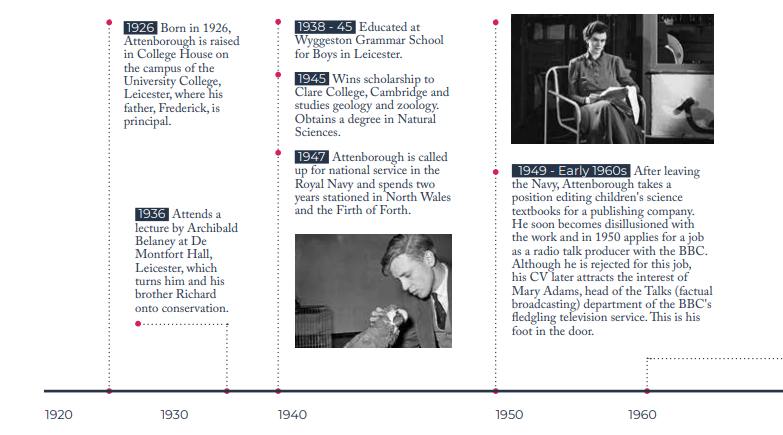
     

    What has Sir David Attenborough done


    Transparent Medium


    ‘The thing about David is he prefers animals to humans,’ says another person who has worked with Attenborough for years. I ask him if the coronavirus situation will accelerate change. Again, he is careful: ‘I don’t know about that. On the one hand, I can see that our skies are emptier now and that’s very welcome. I suppose the extent to which the aviation sector will return will depend on the price points the airlines come up with.’

    I suspect that some of his reluctance to be drawn into detailed discussion is that he doesn’t wish to claim undue expertise on areas outside his competence. There’s an admirable discipline at work, alongside a refusal to please

    Bewilderingly honored – Attenborough has a BAFTA fellowship, a knighthood, a Descartes Prize, among many others – he has learned that the only proper response to fame is self-discipline. At his level of celebrity – up there with prime ministers
    and presidents but with a greater dose of the public’s love than is usually accorded to either – he is continually invited for comment, and has learned when to demur.

    ‘I am sometimes asked about the well-known people I’ve come across in this life – the presidents and the royalty.

    I’ve been lucky enough to meet,’ he says. ‘I say, “Look, if you saw my documentary with Barack Obama then you know him as well as I do.” Television is very intimate like that. My job is to create transparency.’

    So instead of what one half-hopes for – backstage anecdotes at the White House or Buckingham Palace – one returns time and again to the climate crisis. This is the prism through which everything is seen, and our failure to follow his example, he says, shall ultimately be to our shame.

    He will not be drawn into negative comment on Boris Johnson or Donald Trump. Instead, he says: ‘Overall, I’m optimistic. All I can say is we have to encourage our political leaders to do something urgently about the climate situation. We have to all work hard to do something about this.’


    The Fruits of Longevity


    For Attenborough everything has been boiled down to raw essentials. And yet his career exhibits flexibility. His success must be attributed to open-mindedness about a young medium which others might have thought it beneath them. It would be too much to call him a visionary. But he was in the vanguard of those who saw TV’s possibilities.

    Fascinated by wildlife as a child, he rose to become controller at BBC Two and director of programming at the BBC in the 1960s and 70s. ‘Television didn’t exist when I was a young man, and I have spent my life in a medium I couldn’t have imagined. It has been a wonderful experience,’ he says.

    The very successful glimpse the shape of the world to come, seize that possibility and enlarge it into something definite, which they then appropriate and live by. What advice does he have for the young starting out? ‘My working life has taken place in television. I don’t know how we will see that change over the coming years as a result of what’s happened. Communication has proliferated into so many forms. It is very difficult to get the single mass audience, which I had something to do with creating, thirty or forty years ago.’

    There is an element of well-deserved pride about this. Attenborough’s original commissions at BBC2 were wide-ranging. The included everything from Match of the Day to Call My Bluff and Monty Python’s Flying Circus. One can almost convince oneself that he was a BBC man first and an ecologist second. ‘The world has become very divided in a way,’ he continues. ‘We prepare for a world when we’re young that’s gone by the time we arrive in it. To that I say, ‘It depends what your life expectancy is!’

    But all along it was nature that thrilled and animated him. Attenborough is one of those high achievers who compound success with longevity. His is a voice that speaks to us out of superior experience – he has seen more of the planet than any of us. He speaks with a rare authority at the very edge of doom – his own personal decline, as well as the planet’s.

    Urgent Warnings

    He says: ‘Whatever young people choose to do with their life they must remember that they’re a part of life on this planet and we have a responsibility to those who will come after us to take care of it.’

    I ask him what we should be doing to amend our lives and again he offers a simple thought: ‘We’ve all got to look to our consciences. Inevitably, some will do more than others.’

    He sounds at such times very close to washing his hands of the human race. But then everyone in their nineties is inevitably about to do just that.

    What Attenborough has achieved seems so considerable that one wishes to ask him how he has managed it. ‘I am sometimes asked about how I manage to do so much, but I don’t particularly think of it like that. I just reply to the requests that come my way: you can accomplish a lot by just doing one thing after the other.’

    Again, the simplicity of the answer has a certain bare poetry to it: Attenborough is reminding us that life is as simple as we want to make it. Interviewing him at this stage in his life is like reading a novel by Muriel Spark: no adjectives, no frills, just the plain truth.

    In his curtness is a lesson: there is no time for him now for delay, but then nor should there be for us. We must do our bit – and not tomorrow, now.

    He is interested in Finito World and very supportive of our new endeavor: ‘This is a time when the circulations of magazines and newspapers appear to be falling. A lot of newspapers are aware of the climate emergency and the way in which we disseminate ideas has diversified.’

    A thought occurs to me that stems from my lockdown time with my son, where we have been in our gardens like never before. Should gardening take its place on the national curriculum? ‘It’s obviously very important,’ he says, although he also adds – as he does frequently during our conversation – that he knows little about the topic. (Opposite, we have looked into the matter for him.)

    Hello, Goodbye

    I will not forget this interview with a man whose voice will always be with us. Part of Attenborough’s power is that he continues to warn us in spite of ourselves. He deems us sufficiently worthwhile to continually renew his energy on our behalf.

    I mention that we watch his program with our four-year-old in preference to the usual cartoons on Netflix when possible.

    At that point, perhaps due to the mention of my young son, he sounds warm: ‘Thank you very much, sir. It does mean a lot when people say that.’

    It’s a mantra in journalism not to meet your heroes. Attenborough in extreme old age is brisk and sometimes even monosyllabic. This in itself tells you something: the world is full of the canonized but in reality saints are rare. Conversely, I have met those whose reputations were fairly low, but who turned out to be generous beyond expectation. We should never be disappointed when the world isn’t as we’d expected. It is an aspect of the richness of experience to meet continually with surprise.

    But age will come to us all. If it finds me in half as fine fettle as David Attenborough I shall be lucky indeed. Furthermore, if it finds me on a habitable planet at all that shall also something I’ll owe in part to him. ‘Good luck,’ he says as he puts the phone down. This isn’t the man I had expected to meet. But I can persuade myself that he means it.

    ‘David prefers animals to humans’. Afterwards, it occurs to me that he saw me not so much as an individual, but a representative of that foolish ape: man. While Attenborough has been acquiring hundreds of millions of viewers, what he really wanted – and urgently required – was listeners.

     

  • That humorous feeling: how much comedy in the workplace is too much?

    That humorous feeling: how much comedy in the workplace is too much?

    The witty can sometimes prosper in the workplace, but take it too far and you may have a problem, writes Lana Woolf

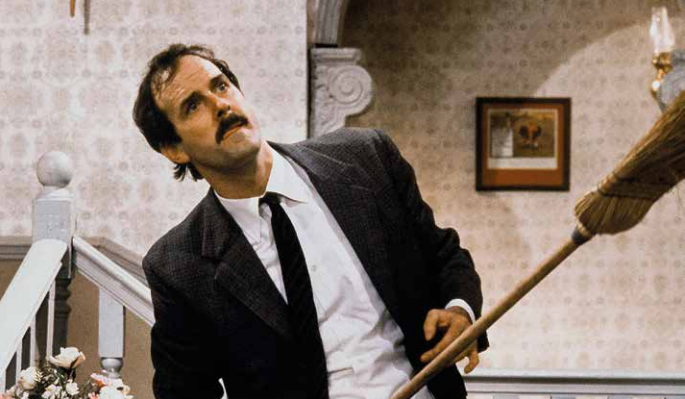
    Stephen Fry once said of the great Peter Cook that he was never unfunny, never ‘off ’. When Finito World caught up with the legendary comedian – and great friend of Cook – John Cleese earlier in the year, we asked him what he thought of Finito, and he showed us that he, too, never turns off the taps.

    When we told him about our mentoring programs, he was immediate: ‘It’s a very decent thing to do. I’ve heard of a finishing school – and I know Finito is Italian for finished because I eat a lot of Italian food – and I finish it all. But I’ve never heard of a finished school.’

    While we were laughing he was continuing, ‘I have heard of Finnish schools but they’re something quite different.’


    The Monty Python and A Fish Called Wanda star went on to share some advice as to how to forge a happy career. He quotes American comedian George Burns as saying: ‘If you do something you love, then you don’t have to do a day’s work for the rest of your life.’

    Wise advice, but our encounter with Cleese also had us thinking about an implied lesson that may be as important: what role does humor play in the workplace?

    Well, success in life can sometimes be attributed to ability to get on with people, and that is always to do an appreciation of nuance, which usually goes hand in hand with an ability to navigate intricate situations. The amusing are often, though not always, empathetic.

    Sometimes this proposition can have vivid illustrations. It was Jerry Seinfeld who observed that in US Presidential races it is an unwritten law of politics that the funnier candidate always wins. Obama was always funnier than Romney or John McCain; George Bush Jr. was funnier than Al Gore or John Kerry; Ronald Reagan was funnier than Jimmy Carter or Walter Mondale. Clinching for the theory, Donald Trump Jr. was demonstrably funnier than Hillary Rodham Clinton.

    But does this translate in the same way in the workplace, which is a less performativity space than electoral politics? Part of the force of a personality like, for instance, Sir Martin Sorrell derives from the sense that he might at any moment bark with delighted laughter even at a difficulty.

    Pat Thompson is the founder and managing director of Thompson Dunn, a central London-based psychologists’ firm. For 30 years Thompson has worked with CEOs on organizational culture and creativity in business: ‘I used to deal with delinquent adolescents and then went onto work for Michael Page selecting senior executives. I was once asked: ‘What’s the difference between a delinquent adolescent and a CEO. I replied: “Pinstriped trousers”.’

    The jury is out on how funny this is, but Thompson is arguing that humor is a way of making a ‘a difficult truth say able’. It is a form of smoothing – of moving the dialogue forwards in a way that we might miss if we proceeded solely in an earnest register. When asked about humor’s wider role, Thompson offers a two-word THAT HUMOROUS FEELING answer which dovetails with my own experience of office life: ‘Stress release.’

    A joke, said Nietzsche, is ‘an epigram on a death of a feeling’: the power of comedy is that it discharges feeling which had been accruing by admitting to that feeling and thereby ousting it.

    However, Thompson has a cautionary word about taking things too far, warning against becoming an office prankster à la David Brent in The Office. She also explains that one’s relationship to humor will depend on the tenor of the organization you work for. This can be challenging for women, she explains, recalling how ‘humor in the City was a darker shade of blue in a male-oriented environment. Women are often the butt of a joke and you have to cope with it. In financial services, you have to develop a thicker skin.’

    Moving on up: can a sense of humor lead to swifter promotion?

    Liam Williams is a professional comedian known for Sheep’s and Lad hood and the now the author of a brilliant debut novel Homes and Experiences. So what led him towards his career? ‘In the workplace, I’ve never known where the line is, and I was drawn to being a professional comedian because you are necessitated to go over that line.’

    Did he enjoy: ‘I found that having a laugh with my colleagues was the only thing that got me through the less fulfilling aspects of the job. Obviously, you don’t want to be like David Brent in The Office and you need to find a happy medium between not being too buttoned-up and boring, and not being the idiot with the Homer Simpson tie.’

    He notes that much humor comes from ‘absurd corporate language. This twee idea of ‘We’re all a family” – of language that comes down from on high and doesn’t mean anything to us. There’s so much euphemism.’

    Employers, then, must be careful not to alienate their employees with language that doesn’t match their real experience. A recent podcast produced by Fair Acre Press called ‘Word Bin’ invited participants to choose their preferred word to bin. A huge number of the choices related to corporate culture: normalcy, incentivize, optimized, moving forward, thinking out of the box, reach out/ reaching out, cascading down, time urgent, upgrade, inputting and solutions.

    Nadia Kingsley, the founder of the podcast, told us: ‘I was surprised at how passionately people wanted to bin some corporate speak. Having never worked in an office myself it was a real eye-opener. Some of the binning’s reveal something more than ridiculous management speak – but the old-fashioned hierarchy. For instance, the phrase ‘cascading down’, refers to minions who aren’t good enough to actually go to the conference but are given a version of it by someone above us.’

    Former deputy prime minister David Ludington makes a useful distinction between humor in the public and private spaces. Recalling life as the de facto no.2 in Theresa May’s 10 Downing Street, he explains: ‘Humor is vitally important in private. In a tense meeting, a well-timed and well-phrased quip can defuse tension. In the same way, if you looked at both Betty Boothroyd and Lindsay Hoyle operate as Speaker of the House, a joke or an aside can ensure that those tensions which had been building up would suddenly lapse.’

    Ludington also points to its impact in a speech: ‘Humor changes the register but also helps the audience to concentrate. A successful joke will make the audience listen as they’ll wonder whether there’ll be another joke coming. And humor that’s well received can get people on your side.’

    But he also has a warning against humor used against a political opponent which may also apply to life in a more ordinary workplace. ‘The risk is you get written off as a comic. You need to show you have the comic and the serious. In Shakespeare’s tragedies – even in Hamlet – you have tragedy and serious side by side.’

    Then Ludington laughs, recalling some of the inevitable ups and downs of government. ‘The truth is it sometimes feels more like a black farce. And black humor can keep you going in the inner team.’ This chimes with Thompson’s remarks: ‘Humor is an aspect of positive psychology. If you face difficulty in an organization, then looking on the bright side includes humor.’

    And if all that doesn’t work, and you find yourself caught in a job you dislike at the age of 40? Then John Cleese has some advice: ‘Don’t just take the money. But if you do and you get to 40, you can always kill yourself, I suppose.’ Black humor indeed.


  • Exclusive Interview: Sir Martin Sorrell

    Exclusive Interview: Sir Martin Sorrell

    A look back at Finito World’s mid-pandemic talk with Sir Martin Sorrell who offered advice for the days ahead in April of 2020

    Prior to coronavirus, one would have said that Sir Martin Sorrell is a difficult man to imagine confined to his house. With the new normal of global pandemic, we do not have to imagine. 

    A Zoom interview is not quite the levelling experience one might imagine. True, instead of visiting the 75-year-old’s offices in Mayfair, whose shine and power I am now left to imagine, Sorrell logs on from his central London house. But his energy – which seems part Napoleonic, part East End smarts – is a not a thing to be dissipated on a Zoom call. ‘You look about three years old,’ he says, first up, laughing with typical bonhomie. 

    Sorrell has been in Covid-19 quarantine like the rest of us for the last few weeks. ‘The house is okay. There’s a bit of outside space which makes it tolerable,’ he says. 

    Sat in my two-bed flat in Camberwell, his house seems somewhat better than okay. Under a wall of cartoons (‘You can’t see the half of them’) Sorrell will oversee the work of S4 Capital, the digitally-focused firm he founded straight after leaving WPP in 2018, during the indefinite season of lockdown. 

    For Sorrell, the coronavirus situation comes across as just another problem that requires solving: he’s seen plenty of these since the early days of Saatchi & Saatchi, through the years of expansion of WPP, taking in the global financial crisis and numerous other shocks along the way. 

    His bearing is that of a man likely to prosper in this, as in any other era. ‘I actually find I’m doing more work, as there are no interruptions,’ he explains. ‘No breakfasts; no dinners; no surplus travelling. So, on balance I’m more effective and certainly learning more.’

    For some, the idea of a more effective Martin Sorrell will be a fearsome notion. Perhaps one such group might be the leadership team at WPP, which Sorrell left under acrimonious circumstances in 2018. It was obviously an unhappy time, leaving the company he had built from scratch. What is perhaps more noteworthy is the swiftness with which he has moved on to the next thing. During our conversation, he refers occasionally to his time at WPP. But he usually does so as a point of reference regarding what he’s doing now at S4 Capital. And he does so far less frequently than he looks forward.

    Sorrell founded S4 in 2018, with the mission ‘to create a new era, new media solution…for millennial-driven brands.’ In typical Sorrell fashion, the business has moved fast, acquiring MediaMonks for $350 million in July 2018; MightyHive for $150 million in December 2018; and the Melbourne-based BizTech in June 2019. Sorrell’s modus operandi favours almost hyperactive expansion until scale and geographical presence is established. It seems to work. The firm recently published its preliminary 2019 results showing revenues up 292 per cent from £54.8 million to £215.1 million, and gross profit up 361 per cent from £37.2 million to £171.3 million.

    Sorrell cannot prevent noting with a certain glee the morning’s news: ‘I see WPP has suspended its dividend this morning. They were going in the wrong direction before the crisis. But now they have real uncertainty to hide behind.’ How does the present predicament of the firm he founded make him feel? He pauses a moment. ‘How does it make me feel? I think ‘sad’ would be the word.’

    DIGITAL FIGHTBACK

    But I don’t get the impression that Sorrell ever stays sad for long: he is too pragmatic and tough. Instead, throughout our conversation, Sorrell’s mind whirs about this historical plague moment – how best to navigate it, not just on his own behalf but on behalf of the 2,500 people S4 Capital employs. ‘If I’ve got 2,500 people in the business, and on average three in each family, that makes 7,500 dependents. At WPP it was 200,000 including associates – so that was 600,000, and a different scale – but you feel responsible for that.’

    For years now, Sorrell’s mantra has been digitisation. You might say that in his mid-seventies he is an unlikely evangelist for the great tech firms both in the US and China – but then, like Oscar Wilde, Sorrell has never pretended to be ordinary.

    And it’s the digital world which is impressing him during these coronavirus times. ‘The technology is very good,’ he says, bullishly, having been particularly impressed by an online seminar he participated in post-lockdown with Harvard Business School. Sorrell was swift to implement their recommendations. ‘We instituted our crisis group Wednesday last week [the first week of lockdown]. It’s very brief but it meets across the business. Every day we cover San Francisco to Sydney. It might have been more in the beginning but now it’s 15 minutes.’

    Regarding the immediate economic future, Sorrell already has a clear sense of how the virus will play out: ‘I’m of the V-shaped school. You feel it in the markets already. It’s terrible, it’s shocking, it’s catatonic – a lot of companies will go down. We were dramatically underprepared.’ The sentence hangs there as if it might want to turn into an optimism, as indeed it does: ‘Q2 will be horrendous, Q3 will be tough but better, and Q4 will be a recovery,’ he says.

    But it is in the nature of these uncertain times to be continually oscillating from hope to worry. Sorrell is no different, adding: ‘But a lot of companies will have gone to the wall by then. In our industry, a lot of highly-regarded production companies have gone. B-Reel, for instance – very good work, good people. Just gone. I think it’s going to be very difficult. This is a Darwinian culling.’ 

    LIGHT RELIEF

    I assume this refers to the business environment but it might also refer to the wider health story of which we’re all so acutely aware. A passionate Remainer in what we must now think of as the previous era, Sorrell has long since kept a businessman’s critical and bemused eye on politics.

    This time around, he has observed with bafflement the zigzagging government strategy. ‘I do find the government policy a little bit strange,’ he explains. ‘Going into this, they knew the head count – if I can put it like that – could be 300,000. This wasn’t new information. I think at a certain point Dominic Cummings and Boris Johnson changed their minds from an approach which basically entailed culling the herd to create herd immunity, to one of lockdown. They suddenly reversed their approach; I’m not quite sure why.’

    The CEO is also illuminating on the Chancellor Rishi Sunak’s rescue programmes for businesses. ‘They take time to implement,’ Sorrell says. ‘I spoke to someone who’s heading the UK Finance Initiative yesterday: on the loan schemes, you have to give personal guarantees. I have a friend who’s 75: he’s not going to give personal guarantees on a business that could go belly up. A lot of this stuff will be deployed where it is least needed – to large businesses and not to small businesses.’

    And what about Donald Trump’s view that the cure is worse than the disease? ‘I’m not one of those who thinks we should have gone down the herd immunity route. But when you’re in a leadership position, you tend to overegg things. Boris Johnson overeggs it; Dominic Cummings overeggs it; and the media focus magnifies it to such a degree that mistakes are made. People who lead companies and government departments err on the side of caution.’ 

    Sorrell adds: ‘And the enquiries into it will be everlasting and all the civil servants are terrified – and ministers are terrified – of investigative journalists who will be poring over the entrails. That makes people overcautious in the wrong way – as it stops them from making decisions when speed and agility is wanted. You see this in corporations – the lack of agility is huge.’

    FACING THE STRANGE CHANGES

    Beyond the immediate crisis, Sorrell discerns some changes which are likely to remain. ‘It will be an acceleration of what was already there. Consumers were moving online; now they’re going to move faster.’ Sorrell gives an example. ‘Harvard Business School has a virtual classroom. So now, with Zoom, you’re on a screen with me, I’m on a screen with you. Imagine 80 times that with three professors in the pit. You can email in, you can text in, you can raise your hand technologically.’ 

    So the virus will make us think differently about gathering together publicly when we don’t absolutely have to? ‘Before all this happened, you’d have to go to Atlanta or New York for a call like the Harvard one. But we did it in an hour and a half without all the concomitant waste, the travel, climate change.’

    Sorrell also expects there to be other profound structural changes to our leisure. ‘I am on the International Olympic Committee (IOC) commission, and I’ll probably go to Japan next year. But will I go to the Superbowl to see the Patriots with 100,000 people there? Because one thing’s for sure, Covid-19 will re-emerge. We may have a vaccine to deal with it – or it may come back in the cold weather of Q4 this year which will make the recovery more difficult.’ 

    Again, our conversation keeps swapping cautious optimism for melancholy pessimism. Our current condition is to be continually subject to revelations about how the virus will affect some hitherto taken-for-granted aspect of our life. Sorrell, you feel, has done more thinking than most, but he still has some thinking aloud to do. ‘This summer, where will people go for holidays? Very few people can take private planes, and there will be attendant risks to flying. There was a newsreel of the Chinese travelling in China. Everyone’s dressed in these spacesuits. You turn up and you’ve got these face masks. You’re assigned a seat before you get on, distanced from everyone else. Behaviour will change.’ 

    And the wider media landscape? Sorrell is more decided on that one. ‘It will accelerate media owners’ use of digital and also accelerate the decline of linear TV. I was on a call yesterday with a Morgan Stanley analyst. Of course, the tech giants will feel the short-term impact on SMEs, but in the long-term it will result in Google and Facebook having a more dominant position. Imagine the data that Amazon is buying on consumer buying patterns: it will give them a huge data advantage. The same will be true for Tencent, AliBaba and Tik Tok in the east.’ This in turn feeds into Sorrell’s business model at S4: ‘We will benefit as long as we get through the next few quarters’. 

    SCHEMES, STRATAGEMS AND SPOILS

    At other times, one has a sense that the reckoning of Covid-19 has created in Sorrell, as in most of us, a desire to pause and reflect. This sends our conversation – perhaps to our joint relief – away from the present crisis to wider questions of business. 

    So how to be effective in business? First, he says, you have to learn how to manage teams. ‘Even at small scale, you have the same issues around siloes and fiefdoms and people looking with blinkers,’ he explains. ‘When you have two people in a company, you have a cooperation problem. To get 2500 people to think as one, or to leverage whatever knowledge the 2499 have – that’s the game. If you can get people to share knowledge and insight, you have a much more potent organisation.’ 

    Sorrell is in full flow now: you have a sense that these are the issues he has turned over in his mind for 50 years, and he enjoys sharing his knowledge. ‘My favourite question to anyone I’m talking to is: ‘What’s your biggest problem? The answer in most cases is lack of agility.’

    What does he mean by that? ‘The siloes, the empires, and the fiefdoms within big organisations’. Sorrell is often known as a legendarily hands-on CEO, and this is sometimes presented as a flaw. But it might also be an aspect of impatience with barrier and impediment coupled with a strong sense of responsibility towards the workforce and its dependents. 

    Sorrell also recognises that talented people can present problems of their own as much as those who aren’t performing. ‘Good people are by nature not cooperative,’ he explains. ‘There are very few good people who work well in teams – and understandably so. They have good track records, and tend to think they’re right and don’t take advice easily.’

    The job of a CEO is to get everyone facing in the same direction. ‘Implementation is very difficult in large and complex organisations,’ he explains. ‘You’ve got functional matrix; geographical matrix; brand matrix. It’s very difficult.’

    So how to conduct the orchestra? One part of the answer is incentivisation. ‘At S4, we all own big chunks of the company. The WPP employee ownership schemes probably amounted to about three or four per cent. At S4, we’re smaller obviously, but about 50 or 60 per cent of the company is owned by people who work in it.’ This is an area too, where Sorrell’s education – Sorrell studied economics at Cambridge – has been helpful to him in his career. 

    ‘At Cambridge, there was a book by a left-wing economist called Robin Marris – a left-wing economist – called The Theory of Managerial Capitalism. In the capitalist system, there is a separation between management and control. Managers manage; shareholders control – but there is a split between the two. Out of that, you get the view that all you need is share ownership: if people own shares in the company then their mindset is different.’ Is that his view? ‘Well, it can produce too short-term an attitude but broadly I don’t disagree with that. In WPP, in the early days, I always insisted people put their money where their mouth is. Interestingly, after a couple of plans, the institutions preferred us either to pledge stock we already had or just waived the need to put cash in. That was a terrible mistake. It’s like Warren Buffett’s comment on share options many years ago. You wouldn’t give an institution a call on your stock for 10 years at zero cost so why do you give it to management?’

    HIRING AND FIRING

    The other way to keep a company in shape is to get the hiring right. To those who might be ruminating on a magic hire, Sorrell has this warning: ‘I used to call it the Jesus Christ syndrome. 

    The person running this area of the business is no good. We should get rid of him or her. And I’ve got this fantastic person I want to hire.” Then the person comes in and three months later, Jesus Christ didn’t walk on water!’

    Sorrell also argues that talent departments can get it wrong at both ends of the spectrum. ‘The hiring process is often too cumbersome or else it’s too intuitive,’ he says. ‘You either put somebody through 20 interviews, which anyone who’s good will not tolerate, or you have one interview and that person becomes a hero or heroine – a salvation. Advertising businesses are notoriously bad at hiring. 

    Individual predilections or preferences overcome what you should or shouldn’t do.’ He adds: ‘Another problem is to segment human resources and talent from the rest of the organisation. You shouldn’t rely on your head of HR to hire good people. The head of HR might supplement the list, but you should know who you think would be good to do x, y or z from your knowledge of your industry.’

    Somewhere in here is the key to Sorrell’s success – the need to be hands-on isn’t some bizarre need to micromanage but a sort of prudent due diligence, and a tacit acknowledgement of the complexity of the job. He draws the conclusion: ‘People are an investment not a cost – and we spend so little time maximising that investment. sixty per cent of our net revenues are invested in people. Our revenues are £400 million, and we represent £250 million. At WPP it was £20 billion, so £12 billion went on people. But most people think much more about how we should invest in computers.’

    And this, incidentally, is why government often moves with such little – to deploy one of his favourite words – ‘agility’. ‘In government, you don’t have the commercial levers or incentives: what you get is a splintered mess,’ he says.

    HANG-UPS

    Our time is nearly up. Towards the end, Sorrell strikes another note of cautious optimism: ‘I’m sure there will be a relief rally in the sense that when people are released from all this purgatory, there will be excesses. But I was talking to a client last night and I said, “I’ll call you in Q4 and we’ll say we overegged this.” 

    He continues: ‘I look at in a historical context. HIV has killed 36 million people. The two big flus killed 1 to 2 million. I’ve got a lot of friends in Brazil who are terrified about what the impact of corona is on the ghettos. We’ve lost proportion. That sounds callous, every life is important.’

    Such are the times we so suddenly live in: we wish to retain optimism but we have taken a collective decision to endure economic hurt in order to protect the vulnerable. It is the hardest time the nation has known since World War Two, and yet all our technologies remain intact giving – at least for the time being – an undeniable flavour of technological affluence even to this unprecedented stricture. 

    Deprivation is still allied in a certain sense to plenty: we are in our homes, but many of us still eat, drink and are entertained to standards which would be the envy of a Renaissance king. We retain a sense of our intelligence and scientific skill, and the power of the economy which the likes of Sir Martin Sorrell have been instrumental in building. But we also know all over again the scale of the obstacles – of disease and nature’s indifference – which we had to overcome to build it all in the first place. There are no guarantees of our success; it’s up to us. 

    Perhaps that’s why Sorrell – so self-reliant, and capable – is someone we should especially heed in these times. We need the likes of him as we have never done before. ‘Someone sent me a diary from the great plague,’ he tells me near the end of our call. ‘It was a world of self-isolation; there was the Peak District village of Eyam which cut itself off for a year. This is nothing new.’

    So nothing new – and everyone keep calm. Wisdom, like crisis, can often have an antiquated flavour. And with that, instead of the handshake at the lift, we say our Zoom goodbyes, and Sir Martin disappears out of my computer back into his improbable life. 


  • Bill Gates: Find the Cure

    Bill Gates: Find the Cure

    by Emily Prescott

    Heroes only truly reveal themselves when faced with a villain. The world is up against a mighty enemy, Covid-19, and many people have revealed themselves as everyday heroes; from Janet next door making sourdough bread for her shielding neighbour to all the key workers who kept the country running during lockdown. Bill Gates has squared up to coronavirus with huge financial donations. As he has invested more than $350 million to fight COVID-19 will history hail the Microsoft founder as a key heroic figure in the pandemic or is his philanthropy just another sign of a world gone wrong?

    Jeremy Hunt, the former secretary of state for Health, says philanthropy should not be met with cynicism: “Philanthropists should be welcomed with open arms and praised to the rafters. I really don’t understand those who criticise the generosity of others.”

    While Nick Dearden, director of Global Justice Now, is more sceptical about wealthy individuals being involved in the race for a cure as vaccines should be public goods. “The answer to massive economic, healthcare or environmental problems cannot be left to some of the richest people in the world, as if we were living in the Victorian Age when social harms were seen as matters of charity and benevolence.”

    With a net worth of around $120 billion, Gates is only the second richest man in the world. With an estimated net worth of $200 billion, Amazon founder Jeff Bezos comes in at number one. In contrast to Gates, and although he has pledged to invest billions into Covid initiatives, Bezos has been positioned as a coronavirus villain – Super Spreader – after hundreds of Amazon staff took strike action to protest issues around the company’s response to the pandemic, including limited sick pay

    In the 1990s, few people would have elevated Gates above Bezos. Gates was fighting a series of legal battles around the monopolistic business practices of Microsoft. Former Microsoft employees described the office as a confrontational environment, with Gates being “demanding”. According to James Wallace’s Hard Drive, more than one “unlucky programmer received an email at 2:00am that began, ‘This is the stupidest piece of code ever written.’”

    Then, towards the end of the decade Gates turned his attention to philanthropy. Alongside his wife Melinda, the self-proclaimed “impatient optimists” formed the Bill & Melinda Gates Foundation. It seems he turned over a new leaf but some regard the Foundation as a fig leaf, barely disguising the injustice of Gates earning more in a day than most will earn in a lifetime.

    Since its inception the Bill & Melinda Gates Foundation has given more than $50 billion to charities. Its raison d’être is to “reduce inequality” but Gates admitted in an Ask Me Anything Reddit session that he often uses a private jet when reducing inequality. “It does help me do my Foundation work but again it is a very privileged thing to have,” he conceded. But aside from the occasional uncomfortable bit of irony, his philanthropy also gives him an extraordinary amount of power. Put bluntly, Bill Gates chooses who lives and who dies. He influences the success or failure of a vaccine just because people bought his computers.

    But Hunt dismissed the idea that positioning philanthropists as heroes risks creating a plutocracy, saying: “A democratic society like ours has sufficient checks and balances to stop undue influence but if someone wants to pledge a fortune or a fiver to make the world a better place they should be thanked and encouraged. I spent a lot of time trying to boost philanthropy to the arts when I was Culture Secretary and was always struck by the difference in attitude between the UK and the US.

    “Philanthropists in the US are seen as heroes but here in the UK our first thoughts can be negative. That’s changing but we should do more to embrace the good work that many very generous and inspirational people do.”

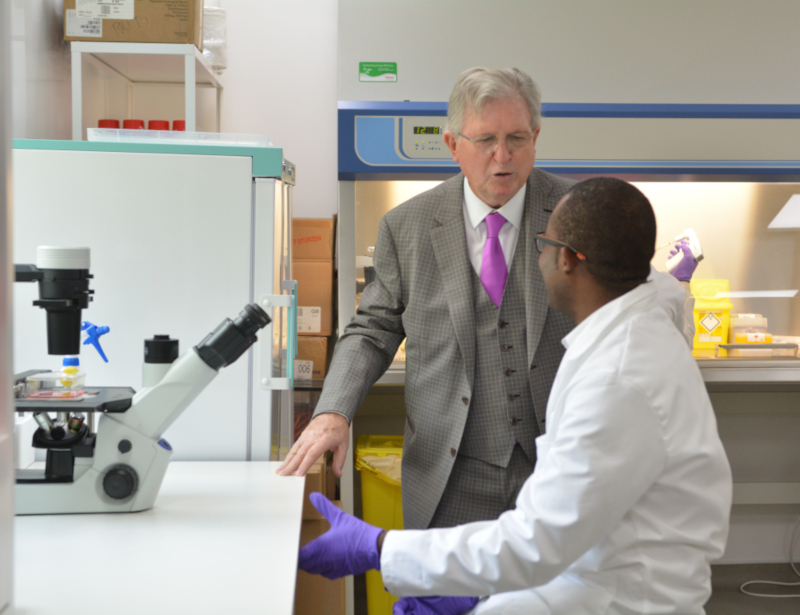
    Philanthropist and the founder of Addison Lee, John Griffin, shares this sentiment. Finito World can exclusively reveal that Griffin has invested £12 million into building a new wing at Northwick Park hospital to help speed up the race for a cure.

    Griffin endowed The Griffin Institute with his £12 million gift to Northwick Park Hospital


    Griffin has praise for Bill Gates and his commitment to finding a vaccine. “He’s a good man and he’s the right man to have in charge, he really is, I think that people who manage to achieve success should not ignore that, it’s a gift,” Griffin says.

    Indeed, within a few weeks of committing their first $100 million to the fight against Covid-19, the Bill & Melinda Gates Foundation announced a $50 million commitment to fund the new ‘Therapeutics Accelerator’. Alongside MasterCard and the Wellcome Trust they have invested in a variety of treatments, including the University of Oxford and AstraZeneca vaccine which is one of the seven vaccines in the final stage of trials.

    Professor Arpana Verma who is a clinical professor of Public Health and Epidemiology at University of Manchester said funding from the Gates Foundation is “key” to finding a vaccine and ensuring it is accessible.

    She regards philanthropy as a necessary component in successful public health initiatives. “Public health through the centuries has been based on philanthropists. When we got the industrial revolution, we got the core epidemiologists coming in. In Greater Manchester we had Edwin Chadwick, and in Liverpool we had William Varr, and in London we had John Snow. This was the crux of things happening fast. it gets things moving. Whilst governments and even NGOs might have more of the administrative to get through, philanthropists might not have that burden.

    “A lot of philanthropists are well up on the evidence so they know what things to do and can get ahead and do it,” she adds.

    The Bill & Melinda Gates Foundation has been focused on combating disease for years and it has made polio eradication one of its top priorities. One of the Foundation’s first big investments was to an organisation called Gavi, the Vaccine Alliance. Since 2000, Gavi and partners have immunised more than 760 million children, saving over 13 million lives.

    This knowledge of disease has made Gates a coronavirus Cassandra. In a 2015 Ted Talk he warned: “If anything kills over ten million people in the next few decades, it’s likely to be a highly infectious virus rather than a war. We need preparedness,” he demanded. Clearly, Gates’ value in the fight against Covid is not exclusively due to the amount of money he is throwing into the cause but due to his deep understanding of disease.

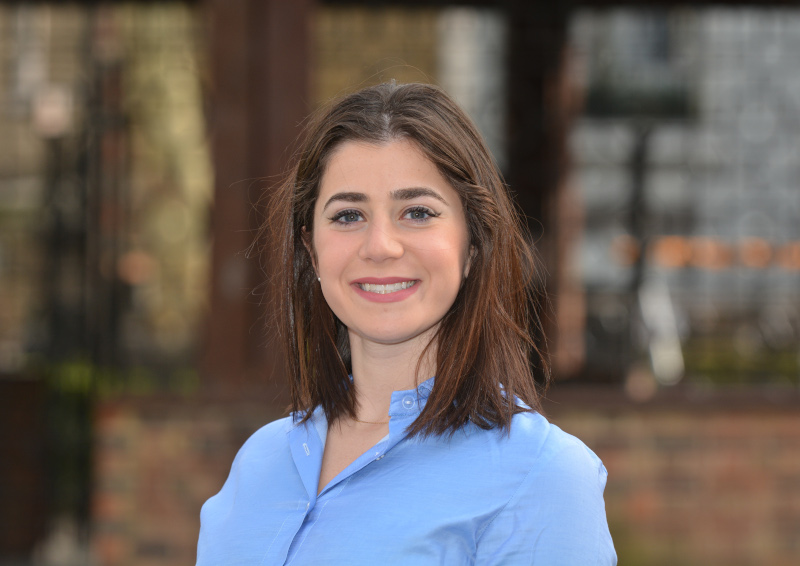
    Gabi Hakim, founder of VacTrack app


    He has inspired other entrepreneurs in the healthcare profession. Gabi Hakim who is the founder of a new VacTrack app which collates vaccine histories and sends reminders for follow up boosters, cites Bill Gates as an influence. “Bill Gates has always stood out as the standard to which we should all aspire. In particular, his work in both biotech and digital health through his Foundation has emphasised the fact that tackling health crises requires intervention at population scale, which aligns with our own mission of accessibility for the masses. I think personally, it’s seeing his ability persist through the bureaucracy and complexities associated with healthcare today that has motivated us.”

    WIRED’s editor at large, Steven Levy, who has been conducting interviews with Gates since 1983, points out that Gates has also made a positive impact through his cajoling of other wealthy people.

    He says: “I’ve met a lot of billionaires, the field I cover produces billionaires, basically he’s made it a point to stand up and argue for other very wealthy people to devote a huge portion, you know, half or more, of their fortunes to addressing issues like public health. He really is the person who speaks most of it. He’s sort of like a born-again philanthropist.”

    Gates may be a born-again philanthropist but he approaches his giving with pragmatic, almost heartless logic. In the documentary, Inside Bill’s Brain: Decoding Bill Gates, Gates recalls the moment he showed his daughter a polio video. “The video ends with the girl who’s got the paralysis limping down the road with a crummy wood crutch. My daughter said to me, ‘well what did you do?’ I said well we’re going to eradicate it. She said, ‘no no, what did you do for her?’”

    With a business analogy, he goes on to explain that this emotional attitude is not productive and that he believes in “optimisation”. “The emotional connection is always retail, even though, if you want to make a dent in this thing you better think wholesale, ten to the six, ten to the seven type magnitudes,” he says.

    Levy believes that Gates is primarily motivated by the intellectual challenge. “It isn’t ‘I’m doing good for the world’, ‘I’ve got to do good’ it’s like ‘these are fascinating challenges that engage me intellectually and I’ve got something to offer there’. I think he finds a lot of satisfaction in pursuing it and learning about the science and speaking to scientists and adding his brain power to solving this.” In the power, money, knowledge triad, it seems for Gates, knowledge always comes out on top.

    In many ways he is the archetypal nerd. He takes ‘think weeks’ where he goes off alone to a cabin in the woods and reads. When he is fascinated about a subject he reads as much as he can about it. His interest in the environment compelled him to read the rather esoteric Japan’s Dietary Transition and Its Impact by Vaclav Smil, for instance.

    Levy explains that it was Melinda who forced him to channel his intellectual brilliance into philanthropy. “Really, the big impetus for him getting into philanthropy at that point in his life when he did was his wife. I do feel it was her influence that led him to step back from Microsoft maybe sooner than he thought.” Melinda’s influence has been profound and since the beginning she has inspired Bill to be better and think differently.

    Melinda joined Microsoft after graduating with a degree in computer science and economics from Duke University and a master’s in business administration from the Fuqua School of Business. One evening after work, Bill asked her if she wanted to go out for dinner, in two weeks time. She declined telling him she wanted spontaneity and an hour or so later she received a phone call from him asking “is this spontaneous enough for you?”

    If Bill is deserving of a hero status, Melinda is too, perhaps even more so. It was Melinda who inspired the Foundation to focus on combating disease when as a new mother she read an article that described how children were still dying from diarrhoea. Now she is using her influence to protect women from the devastation of Covid-19.

    But no matter whether Gates’ philanthropy is driven by Melinda or by pure intellectual curiosity, it does not make his actions any less valuable. As Batman says, “It’s not who I am underneath, but what I do that defines me.” Heroes are also defined by their enemies.

    Last month, during the week polio was eradicated from Africa, 10,000 conspiracy theorists gathered in Trafalgar Square to protest against lockdowns, masks and vaccinations. In speeches they rallied against Bill Gates.

    Of course, unthinking reverence of philanthropists could lead to abuses of power, but as it stands the Foundation is contributing to developing a vaccine that could save the world and we need all the heroes we can get.

    The Bill & Melinda Gates Foundation Covid-19 response

    • The Foundation has committed more than $350 million to support the global response to Covid-19. This includes:
    • $250 million to improve detection, isolation, and treatment efforts; protect at-risk populations in Africa and South Asia; accelerate the development of vaccines, drugs, and diagnostics; and minimise the social and economic impacts of the pandemic. The Foundation announced $100 million to the global response in February, and then increased this commitment by an additional $150 million in April.
    • $5 million to support the Covid-19 response in the Greater Seattle Area. This funding supported local public health efforts in Seattle & King County as well as six regional response funds that aim to meet the needs of those disproportionately impacted by Covid-19.
    • $100 million to Gavi’s new Covid-19 Vaccine Advance Market Commitment, to support its future efforts to deliver Covid-19 vaccines to lower-income countries.
    • In addition to the more than $350 million committed, the Foundation will also leverage a portion of its Strategic Investment Fund, which addresses market failures and helps make it attractive for private enterprise to develop affordable and accessible health products. For example, the Foundation is collaborating with Gavi and the Serum Institute of India to accelerate the manufacture and delivery of up to 100 million doses of Covid-19 vaccines for low- and middle-income countries. $150 million came from their Strategic Investment Fund.

  • How William Shakespeare navigated the plague

    How William Shakespeare navigated the plague

    The life of William Shakespeare has lessons for how to make the best of your talents during a time of pandemic, writes Robert Golding

    In January 1593, the Privy Council of Elizabeth I issued the following order: ‘Forasmuch as by the certificate of the last week it appeared the infection doth increase…we think it fit that all manner of concourse and public meetings of the people at plays, bear-baiting, bowling’s and other like assemblies for sports be forbidden.’

    This was bad news for many, but perhaps especially so for a young playwright who was beginning to come out of the shadow of Christopher Marlowe and forge a place at the forefront of the city’s theatre. At the time of the plague’s outbreak, a certain William Shakespeare had begun to find his voice.

    Though plague was a fact of Elizabethan life, it must have come as a setback. His life up until that point had not been without gamble. William – Will, as he appears to have been known to friends – had left his wife and family behind in Stratford-upon-Avon and embarked on a career in the slightly louche world of the contemporary theatre.

    The language of the edict with its courtly leisure – ‘it appeared the infection doth increase’ – shouldn’t blind us to the cataclysmic impact on Shakespeare and his contemporaries. Shakespeare’s contemporary John Stow – responsible for so much of our knowledge of Elizabethan London – recorded that 11,000 out of 200,000 died between December 1592 and December 1593.

    The Elizabethan plague was, of course, far worse than anything we have experienced in 2020. People died in the street, rendering death an ever-present aspect of daily experience. We might miss, for example, the force of the famous insult in Romeo and Juliet: ‘A plague on both your houses’. What is being wished here is something far more awful than we, even as we live out this unsettling year, can imagine.

    It ought to be a certain comfort to us now, to realize that Shakespeare’s life – among the most marvelous that history records – was beset by plague at every turn. And those of us who fear even a vaccine won’t put an end to our woes might remind themselves that plague was both a constant and a mutating reality for Elizabethans.

    There was a serious bout of plague in Warwickshire the year of Shakespeare’s birth; the young Will would not have been expected to survive. Whatever talk may have swirled about ‘a merrie meeting’ having precipitated the playwright’s death in 1616 at the age of 52, there is nothing to say it wasn’t the proximate cause of his death. We worry about a second wave of coronavirus – our finest poet existed within an unbaiting wave of mortality.

    Yet he continued – and not only that, time and again reinvented himself. The plays and poems which follow on from the big plague years are evidence of a profound pooling of resources and a taking stock. Love’s Labor’s Lost, Midsummer Night’s Dream and Romeo and Juliet follow on from the plague year of 1593. They exhibit a richness, and even an urgency, difficult to discern in the ghoulish Titus Andronicus or the bombastic Henry VI trilogy, written the year before the plague struck.

    But William Baker points out in his book William Shakespeare, that between 1603 and 1613, London’s theatre land was closed for 78 months. Though the poet inhabited a society without any social safety net, let alone the largesse of today’s furlough scheme, there are lessons here for today’s young people starting out on their careers.

    In 1593, Shakespeare was swift to man oeuvre when the severity of that particular bout of plague became evident. Faced with an income gap due to a sudden pestilence, he was in no different a position to an airline pilot or live events manager today.

    So what did he do? He launched himself immediately as a courtly poet. For a country boy, it was an act of tremendous gumption, under the patronage of the Earl of Southampton. We therefore have two epic poems – Venus and Adonis and the Rape of Lucrece – which might be termed plague poems. Each breathes freshness, health and life; they must have been cathartic to those reading them, and indeed these long poems were hits among the student population at the Inns of Court.

    For some times, the theory has circulated – and been brilliantly argued on the website The Shakespeare Code – that Shakespeare was using existing connections to forge his career: it is argued that Shakespeare had in fact taught and conducted secretarial work in Titchfield, where the Earls of Southampton lived, prior to the plague. This might have particular resonance for those casting around for contacts during the time of coronavirus: open that contact book. It also shows the willingness of our greatest mind to undertake menial tasks if it meant getting in close proximity to someone with the power to make a difference to his life.

    What is clear is that Shakespeare was flexible and imaginative; at the critical point, he was willing to imagine another version of his life. He also remained true to his gifts. There is a strong hint in Sonnet 111 that Shakespeare found playwriting a drudgery: ‘my nature is subsumed/ to what it works in like the dyers hand’. He seems to lament his low birth. But when the moment came, he didn’t attempt the impossible. There is a strong pragmatic streak about Will; he might seem in the stratosphere now but this was no dreamer.

    What also might chime with today’s young is that he remained patient and took the long view. He might have been forgiven for thinking in 1593 that the long-term prospects for life in the theatre weren’t good. What was there to stop plague returning and scotching year after year of possible revenue? But he appears to have kept his options open, and retained connections within theatre land even while branching out into poetry. There is a strong hint throughout his career that Shakespeare had a quiet talent both for friendship – contemporaries would refer to him as ‘sweet’ and ‘honey-tongued’ – but also for business relationships. In his last will, he would bequeath memorial rings to the actors John Hemminge’s and Henry Condell; they would repay his memory by editing the First Folio in 1623, seven years after the poet’s death.

    This was networking, as it were, from beyond the grave. The hard realities of inhabiting a plague-riddled society appear to have made Shakespeare not just a better poet but a better businessman. This has sometimes been an inconvenient fact to those who would have preferred the Bard to be more Keatsian – more head-in-the-clouds, and klutzy with money. The record shows he was anything but.

     Instead, Shakespeare continually found ways to expand not only his poetic capacity and his knowledge of human nature, but also to develop what we now call his career. In 1594, he bought a one of James I would become the King’s Men: Shakespeare saw the main chance and took it. Again, there is a hint – but no real proof – that he was utilizing his connections. It has long been rumored that it was the Earl of Southampton who loaned Shakespeare the capital. If so, we might wonder whether he wisely used his time in lockdown to deepen existing connections.

    There is an onwards pressure to Shakespeare’s life which suggests a refusal to become down-hearted from which we might learn. The year’s show him steadily more active both as a property owner in London and Stratford, as a shareholder in his theatre company, and as someone with small businesses on the side in malt dealing, in lending, even going so far as to turn a property he owned in Henley Street into a pub.

    As for the plays, it’s true that they don’t always exist within a milieu of work which we recognize, unless that milieu is the court. But once you look past that you find a good deal is implied about loyalty and about the dignity of work, and indeed a certain amount about the kind of adaptability which we can vaguely detect in Shakespeare’s own life.

    It has been said that the characters Shakespeare most admires are Horatio in Hamlet, Kent in King Lear; Cassio in Othello, and Enobarbus in Anthony and Cleopatra. These are the characters still standing at the end in the tragedies; those who will be charged with rebuilding the state. This a recurring type: the hard-working, flexible, loyal aide who becomes clearer in his moral purpose as difficulty mounts.

    These are plays written by a man thrown back continually on his own resources, and who time again rose to that situation. William Shakespeare found new things within himself – new forms of language, yes, but also new forms of life. His relevance ought not to be surprising. Every period of history has found in Shakespeare a friend and teacher – but it’s fascinating during these unsettling times to see how much his life, and not just his poetry, has to teach us.

  • Mental Health in the Age of Covid-19

    Mental Health in the Age of Covid-19

    There’s nothing quite like a global pandemic to make people across society rethink their priorities writes George Achebe

    Simon Ferrar knows exactly where he’ll be buried: he’s ear-marked a plot worth £4,500 under some rather splendid blackberry bushes in Surrey Hills. ‘As in life, it’s location, location, location,’ he jokes, looking at one of the premier positions in the cemetery.

    Except this is no conventional cemetery, and Ferrar will also die knowing that he has been responsible for the burial circumstances of some 28,000 around him. He’s the founder of Clandon Wood, a natural burial ground, and a part shareholder in it as well. ‘I created a nature reserve because we were looking to encourage a huge diversity of wildlife here. We wanted to add another little corner of the natural landscape to the Surrey countryside,’ he says.

    The funeral business is, of course, recession-proof and has even been helped by the pandemic. Natural burial involves graves made from biodegradable materials; each plot is three-feet deep and involves no vertical memorial. Ferrar explains another difference: ‘What’s unique is that we set up a trust fund. Every single person who purchases a plot here pays a one-off fee of £250 which goes into the trust. By the time we’ve sold all 28,000 plots, that trust fund will be worth in excess of £7 million.’

    We drive out in a golf cart into the plots. Some of the graves look like large scratches in the earth. In other instances, one’s memorial is simply a tree, or some wild grass. He gestures at a plot. ‘Over there, there are buried two twins. One killed himself jumping off a building, and the other couldn’t live with it. Three years later his brother killed himself too.’

    But the funeral, he says, was meaningful. ‘The mother said they weren’t meant to live long lives.’ He adds: ‘We care for the living here as well as the dead.’

    A Morbid Culture

    When the pandemic struck, it found a morbid culture. Ours is an odd, almost sanitized plague, so unlike the Renaissance and medieval counterparts: when the deaths rack up, they do so behind closed doors. We don’t see them for ourselves. And this fact has created communal space with which to discuss another crisis: our mental health.

    Ferrar views his business as a ‘throwback to a couple of centuries ago where families can take the coffin on a handcart. We’ve been burying people on this island for about 30,000 years. It’s only in the last few hundred years, we’ve got used to the kind of Victorian funerals, the moralization and the grimness of that.’

    At a time when our former structures have been removed, and we experience uncertainty as to whether our life shall return to anything like ‘normal’, Ferrar’s project can teach us perspective. As the world quietens, many have found that they had become disconnected from the real cycle of nature.

    The £65K Club

    It isn’t difficult to understand why some who have lost their jobs, or who have had their weddings placed on hold, or found themselves subject to domestic abuse, might be struggling at the present time.

    It’s harder to explain why mental health has become such a problem for FTSE250 CEOs and the superrich. But according to Marta Ra, the founder of Switzerland based clinic Paracelsus, which also has a UK branch and charges £65,000 a week, that’s exactly what has happened. ‘There’s this unconscious bias that the very wealthy are always happy. But actually, they’re often sadder than people with less financial strain,’ she says.

    For some this will be a dubious sob story – and yet it tells us something too about who we are.

    ‘All individuals have their own private fears and problems,’ Ra explains. ‘Perhaps they worry for their employees, or the fate of their companies. And so they start turning to substance abuse. Or maybe they only did social drinking before, but now they start to drink heavily. And locked down with their spouse and children, they’re just as likely as anyone to think: “Who have I married? I can’t handle this.”’

    It would seem that at a certain point the noise of life became so great – and what the Victorians called ‘the Battle of Life’ (the title of a Charles Dickens novella) became more intense. Sometimes one senses that the virus has been specifically designed to make us look again at who we are – at where we’re going.

    Ra explains: ‘People who are stuck at home have to face themselves for the first time, and really face themselves.’ She adds: ‘Our society wasn’t functioning to be in the present.’

    The depths of the forest

    But what about those people who are trying to help us with our mental health? Before the crisis, buzz words like ‘mindfulness’ and ‘wellness’ had become ubiquitous, and when I meet Ferrar, I am struck by his laid-back intelligence. His is the sort of spiritual calm which the frenetic Londoners among us tend to envy.

    Across from Clandon Wood, tucked away behind postcard-idyllic Shere, is the Forest Bathing Institute [FBI]. In May 2019 Dame Judi Dench became a patron of the organization, but it’s been more broadly on the rise.

    I ask Gary Evans, CEO of FBI to explain its origins: ‘”Forest bathing” is actually a translation from the Japanese shinrin-yoku.’ he explains. ‘In Japan in the 1980s, the Japanese government decided they wanted to get people out of big towns and into nature.’ But this wasn’t some hippie whim: it was driven by hard science.

    They were researching the health benefits of nature and woodland. When they looked at blood, they found improvements in the immune system. A prolonged exposure to nature caused blood pressure to come down in people who had high pressure, and caused those with low pressure to experience a normalization.’

    Intrigued, I head to Surrey to meet with Kate Robinson who takes me into the woods near Newlands Corner.

    Over the course of a few hours, I am asked to focus on the shapes of the trees, to explore the smells, to play with leaf litter, to share my thoughts of the forest, and to listen closely to the breeze playing in the upper canopies. The session finishes with a meditation. For a few days afterwards, I find that the wood seems to exist alongside me, in a way which it wouldn’t if I had taken a long walk.

    I recall the words of Marta Ra: ‘You can be a billionaire at 23 and still feel fear and loneliness – and the uncertainty of the virus only adds to that fear.’

     And perhaps there is something especially apt about all this. Coronavirus, after all, took us by surprise out of the wet markets in Wuhan, where to paraphrase Oscar Wilde, the unspeakable went into pursuit of the uneatable – and duly ate them. As Green peer, and former Green Party leader, Natalie Bennett recently told me: ‘The economy is a subset of an environment. There are no jobs on a dead planet.’ Perhaps part of our duty now is to think again about what surrounds us. And it might after all be that the right job revelation lies just as much on a long walk, as it does on LinkedIn.

    Drawing Together

    And yet, for some, that will seem too solitary. Others have sought their own reckoning by looking in new and exciting ways at community.

    Sally Shaw at First Site gallery in Colchester had been busy in the run-up to Covid-19 with, among other things, a landmark exhibition with Anthony Gormley. Once the virus struck, she realized she had to do something to benefit the local community. ‘The NHS approached me during lockdown. They said: “We’re worried about the virus, yes, but the next thing we’re worried about is the mental health fallout for our staff and also those directly affected by Covid-19”.’

    But that assessment proved to be the tip of the iceberg. Shaw lists the challenges: ‘Of course, they were also worried about the stress the pandemic will cause through mass unemployment, emotional pressure and not being able to grieve properly.’

    Shaw thought of a way to help. The gallery is part of the Arts Council collection, which consists of 7,000 works collected over 75 years; it’s been built up with the national legacy in mind. Shaw continues: ‘We thought what we might do is invite people to interact with that collection and pick works which represent their experiences and, with a light touch, introduce talking therapies to people’s worlds.’

    The gallery introduced a private part of the website where NHS staff in the region and care home workers can submit their stories to the portal. Shaw now plans to find ten distinct stories which will comprise a spectrum of experiences to ‘enable us to create a narrative around the different types of effects on people’s lives.’ The goal, she says, is to create a ‘creative conversation which may be an exhibition at some point.’

    That sense of community is also evident at Clandon Wood where Ferrar regularly hosts theatrical performances. ‘We have things like Music in the Meadows where I invite local musicians down, and people bring a picnic. We had four Alan Bennett plays last year, and we had Shakespeare in the Meadow too. Then we have meditation mornings plus all the other events that we have to support grieving families.’

    The Forest Bathing Institute too is looking at children’s days, in part designed to help take the burden off local parents, and give children experiences valuable to them going forwards.

    It is an image of another life – one that would have felt impossible six months ago. We inhabit for the time being a world slower, quieter and in some ways smaller – but also one with the potential to be richer and deeper than what we had before. It’s a world where time and nature feel like more precious commodities than ever before. It’s also a period when money might matter less because our mortality has been vividly illustrated to us: we all lose our possessions in the end. Ferrar explains to me that a team of archaeologists found evidence of Bronze Age occupation at Clandon Wood. ‘We talk of possession, but the land is only ever held in trust,’ he says, as we pass another unmarked grave.

    The curious thing is that this fact, which might make us despair, turns out to be a beginning of happiness. Mental health begins in being rooted in the facts. The virus, awful though it has been, has reminded us how transient we are, but in doing so thrust us back on ourselves, and forced us to renew.

  • The Battle for the Soul of the Left

    The Battle for the Soul of the Left

    Christopher Jackson asks whether it’s now time for a National Education Service and finds a party unsure of the way forward

    As Sir Keir Starmer takes the reins of the Labor Party, how can the Party seize the narrative on education and finally connect it to employability?

    As you walk through Camberwell, every other house has a rainbow, proclaiming not just that household’s gratitude to the NHS, but the presence of home-schooled children within. Education is all around us in virus season: it is on our minds in a way it hasn’t been for years.

    But that can sometimes seem the limit of the good news. ‘Education hasn’t had a good crisis,’ as former education secretary Estelle Morris tells us on page 14. Part of this is due to the peculiar nature of the crisis: for the many senior Labor figures we spoke to for this piece, coronavirus was a problem designed to exacerbate existing problems of inequality and, with children taken out of school, always destined to be a different moment than the frontlines camaraderie that has defined the experience of those working in the NHS.

    Of those we spoke with, many lamented the lack of leadership from both the government and from the Labor front bench. During the composition of this piece, Rebecca Long-Bailey was demoted from her role as shadow education secretary due to a retweet of problematic remarks by actress Maxine Peake. She was replaced by Kate Green who at time of going to press was still finding her feet in the job.

    With the schools not yet back, all this contributed to a moment of pause. Under the empty skies, it felt like an intellectual reckoning was possible. After a decade of Conservative-led rule where should the left be on education?

    A Tale of Two Speeches

    Two quotes from two speeches, both given by Labor leaders in Black pool.

    The first: ‘Just think of it – Britain, the skills superpower of the world. Why not? Why can’t we do it? Achievement, aspiration fulfilled for all our people.’

    The second: ‘Tomorrow’s jobs are in green and high-tech industries. We need people to have the skills to take on those jobs, breathing new life into communities.’

    On the face of it, it would be difficult to tell apart the words of Tony Blair in 1996 (the first quotation) and the words of Jeremy Corbyn in 2019 (the second). Both open up onto a cherished idea for the Labor Party: that a commitment to education is an integral part of the party’s offer to the electorate.

    But scratch the surface, and differences proliferate, which still matter and must be resolved by the still relatively new Labor leader Keir Starmer.

    Blair spoke eloquently about investment, and with a can-do spirit about placing education first. But he would likely have seen Jeremy Corbyn’s espousal during the 2019 General Election campaign of a ‘National Education Service (NES)’ which was, like the NHS, ‘free at the point of use’, as a return to the socialist ideas of the past.

    As we all know, the Corbyn program was soundly repudiated by the British electorate in December 2019. But looking back at that election, it is startling – and a little depressing – how little education was discussed.

    As a result, it would be an exaggeration to say that the public rejected Labor’s education policy. Furthermore, we now inhabit different times where the government – even a Conservative one – has entered our lives in ways which would have seemed fanciful six months ago.

    So is the idea still relevant?

    And if it isn’t, where should the Labor Party go instead?

    Meet the Commission

    Among those who advised the government on its life-learning strategy – intended to form part of the NES offer – was the likeable Professor Ewart Keep, who holds a Chair at Oxford University in Education, Training and Skills.

    Brought in to assist with the Party’s Lifelong Learning Commission, Keep never felt particularly wedded to the NES idea: ‘Part of the problem was there was a headline slogan that emerged very suddenly and then there was an attempt to put things underneath that heading. We tried to sketch out what adult lifelong learning would look like in the context of an as yet unspecified National Education Service,’ he explains.

    There is a degree of comedy here which will feel to some very redolent of Cronyism: the very people brought into produce an enquiry skeptical about its overarching aims.

    Internal operatives tell me that things are far slicker under Starmer. Was this an attempt simply to evoke one of Labor’s greatest hits – the NHS – and tether it to an unrelated area? Keep continues: ‘they’re very different activities – particularly when you consider that one of the weaknesses of the NHS is that it doesn’t succeed in preventing illness: you’re treating people who are sick. Education is trying to be a preventative medicine. It felt misleading and not particularly helpful.’

    It is this sort of thing which Starmer will need to avoid in order to dodge amused disparagement from the education intelligentsia. When I speak to Phillip Blond, chair of Respublica, he announces cheerfully, ‘I generally regard the left with absolute contempt so you better to talk to Mark.’

    This turns out to be Mark Morin, also of Respublica, who has seen the NES idea knocked about for years, ‘and it’s never particularly excited anyone.’ He goes on to point out: ‘On the one hand, you can understand it intuitively with the reference to the NHS and the idea it will kind of bring together all aspects of learning education and skills from cradle to grave – that’s intuitively understood. But when you get past this you’re left with a leftist, statist idea and a big monolithic entity like the NHS.’ For Morin, who points to the poor health outcomes in the UK compared to countries like Germany who have a more localized system, the NHS is not only something the education system couldn’t emulate, such emulation would also not be desirable.

    If you talk to Sir Michael Barber (see page 7), Blair’s former chief education advisor, he swiftly disowns himself of anything remotely connected to Cronyism: ‘I would rather just have a conversation about new radical approaches for education.’ For Barber too, the very language of the left opens up onto a grim vista of statism.

    A meeting in St James’ Park

    When I contact Estelle Morris – now Baroness of Yardley – I am pleased, and a bit surprised, when she says she’d like to meet in person. I take myself up to the ghostly center of town, to St James’ Park on a drizzly July day. We walk along the lake on one of those tentative lockdown days we’ve all had when we’re not sure if our favorite coffee shop will be open. It is, and we sip our coffees, grateful for this minor return to normalcy.

    So what exactly is the NES? Like Morin and Barber, Morris is a little baffled. ‘That was my question as well. I thought it was a great idea but there was a real risk it became a slogan and a slogan only. It’s a great concept and I don’t think we filled it out. I’m stuck to have a ten-minute conversation about what we offered about it.’

    So is the NES an immediate nonstarter? That’s where Morris differs slightly. For her, everything depends on Labor’s commitment to detail. ‘The NHS represented a radical change and revolution in healthcare. So don’t claim the title unless you’ve done the work. The title doesn’t come before the work.’

    It is worth adding that when one reads the speech where Corbyn launched the NES idea, it is noticeably less detailed than a typical pre-power speech by Blair, where the party can sometimes seem to be governing even in opposition. This is a mistake unlikely to be repeated by the more details-oriented Starmer.

    So what message does Morris have for Starmer? Now is the time, she says, to launch something truly radical. ‘From 1988 until now, there’s not been a lot of changes in education; the narrative has been the same: national curriculum, national assessment, and external inspection, publication of results, parental choice and focus on standards.’ The tale has been one of back-and-forth between the two major parties and tweaking around the edges. ‘The narrative from 1988 until now has been the same. I don’t think it was wrong to have let that narrative run for as long as we have done. Schools are better now and children get a better deal because of national curriculum accountability. But it’s all come to a natural end.’

    But if Morris espouses an end to all this ‘fiddling’, what comes next? ‘We need a debate about the value of art, the value of sports and the value of community service.’

    In part, what Morris is espousing is a move away from the so-called character agenda which, though espoused by many Education Secretaries, is now particularly associated with Nicky Morgan, who held the secretary ship at education from 2014 until 2016. Morris wants instead a system which teaches ‘citizenship and wisdom’.

    But surely every side of the political spectrum will have a different idea of that? For Boris Johnson, wisdom is Conservatism; for Starmer, it will be socialism. But Morris says this is a debate we urgently need to have. And wisdom she says is difficult to have without some appreciation of the arts.


    Professor Ewart Keep speaks at PRAXIS 2 in Scotland

    Picture Imperfect

    Perhaps we need to think more about how we promote things we know to be good. The force behind Lee Elliot Major’s proposal of a National Tutoring Service (see page 15) stemmed from the demonstrable value of the one-to-one tutoring experience.

    For Susan Coles, the former president of NSEAD who set up an APPG in Parliament to promote greater coverage of the arts in our education system, the benefits of an arts education are equally clear. She worries that character is talked about as a ‘box you tick’ when, in fact, ‘the arts create resilience’ enabling you to ‘follow your own ideas without being wrong.’

    For Coles, and for Sharon Hodgson MP who chairs her All-Party Parliamentary Groups (APPG) (see page 27), what we have now is a ‘production line of high performing schools which is strangling the creative arts.’ Coles puts her views with the kindly persuasiveness of the truly passionate: she is one of those campaigners who is herself an advert for the sort of change she wants to see. ‘We’re coerced into believing the knowledge based curriculum is best, when in fact the arts enable us to make mistakes and experiment,’ she explains.

    This was one area where Corbyn wasn’t entirely idle in putting forward the detail behind the NES, stating in his Black pool speech: ‘The best is every child being able to learn musical instruments, drama and dance – the things that bring us joy – through our Arts Pupil Premium.’ For Hodgson and Coles this was an exciting moment, scotched only in December 2019 when Johnson was returned to power so thumping.

    So should it be part of the NES? While Coles appreciates the idea, she worries it is too little: ‘The only worry I have is there’s no guarantee it will be in the curriculum.’

    This, too, is where the eternal argument regarding free schools comes in. The schools minister Nick Gibbs would remind Coles and Hodgson that art is on the curriculum, but Coles – and the likes of writer Michael Rosen – would retort that it ought to be a core subject. Even if you resolve that part of the debate, you’re still left with the fact that academies are not obliged to teach it, and since 80 percent of secondary schools are academies and so are a large number of primaries, that’s a problem. Furthermore, there is the exclusion of the arts from the uber Gove Ian and, to Labor, loathed ‘EBacc.

    ’For Coles and Hodgson an opportunity is being missed, and for no decent reason. Coles continues: ‘If you do a teaching qualification, you learn how to teach the arts for around 2-3 hours in a 3-year course. So we have a lot of inexperienced teachers who are struggling to teach the arts curriculum.’

    The great irony in all this is that the arts appears to benefit the economy. ‘They’re valued by the Treasury but not by the education department and DCMS,’ says Hodgson.

    The Bonfire of the Quangos

    This opens up onto another perennial question: that of the structure of the entire system, and indeed the very nature of our civil service and the balance between national and local government.

    When I ask Professor Keep where he would begin in terms of fixing the English education system, he says. ‘The problem in England is that it’s very siloes.

    Even different bits of DfE don’t talk to one another. In education, central government controls so much. They have to deal with such a level of detail: it’s difficult for them to grasp the big picture.’

    So what needs to change? ‘We’ve gradually abolished all the intermediary bodies, which means everything’s an atomized marketplace. This isn’t functional for those who have to run it, and deliver education. I’d want to create relatively independent organizations which can act as a bridge between government and providers and also as a bridge between government and employers.’

    Keep is referring to the Learning and Skills Council (abolished in 2015-16) and the UK Commission for Employment and Skills, which was wound down in March 2017. For Keep, the restitution of these would necessarily exist alongside some devolution of power and decision-making to the regions. The overall goal would be ‘bottom up thinking’ and a move away from a system where everything is ‘controlled by the minister.’

    Mark Morin partially agrees: ‘We had the bonfire of the quangos under the Coalition. Some were well-deserving of that. The Commission for Employment and Skills was one of the most useless, and survived for a long time.’

    Morin argues that any National Education Service would need to be rebranded along devolved lines: ‘It can be packaged in a different way and be marketed in a different way, with devolution at the heart of how this is going to be funded,’ he explains.

    The civil service also needs a rethink, according to Keep. ‘Most civil servants do 18 months tops within a role. Every time I go to a meeting on higher education, it’s a totally different room of people. The last lot have all bloody left.’ This is a view echoed by Sir Michael Barber on page seven of this publication.

    Universal problems

    At the same time, we have a university system that increasingly seems unfit for purpose, and struggling to adapt to the new realities of online learning.

    Keep explains: ‘A lot of universities were in big financial trouble before Covid-19 arrived. After 2009, many went and splurged vast amounts of borrowed money on new nice halls of residence, new nice student bars, and gymnasiums – and of course it’s all borrowed from the banks. £8 billion of borrowing has to be repaid, and the interest rate racks up on that.’ So how bad is it? ‘There were strong rumors there were at least 20 universities in England that were likely to get into significant financial difficulties in the next year and you can increase that number very considerably now.’

    Morin adds: ‘We’ve created something that is too big to fail. Our universities are in trouble. How do we bail them out? One bad decision has been compounding another. We argued in the report we put out an the end of last year that we needed to stop sending so many people to university.

    Does Respublica have any specific proposals? ‘We’ve argued that we need to get rid of tuition fees. It’s a smoke and mirrors thing, it’s just accounting practices: in effect, the government picks up the tab for those who can’t afford it. It’s basically a tax on those who can afford to pay for it because they graduate and earn enough to trigger a repayment. The real issue is we’re sending too many people to university, but to what purpose?’

    That’s a view echoed also by Euan Blair, the tech entrepreneur with the famous father whose business White Hat, which he chairs, is unafraid to proclaim university a waste of time. Talking to Blair is a curious education in the Blair genetics and how they have played out in the next generation. It is as if the same incisiveness and ability to explain complex things in simple language which saw his father dominate British politics for a decade has been handed down a generation into a born tech entrepreneur.

    For Blair, universities have failed to prepare children properly for an AI-dominated labor market. ‘I think that there will always be and should always be a place for purely academic learning in a university environment,’ he admits. ‘The challenge is that the system has become this monopoly on early careers in a really negative way. That’s made universities complacent and it’s created this lack of equal access to opportunity, particularly around careers.’

    Whether Labor chooses to proceed with a National Education Service or with some other label, the Starmer offer will need to address a creaking university system, as well as the question of digital poverty in an age of online learning, and the perennial question of lifelong learning. If this is done meticulously, perhaps something will emerge worthy of the NES brand name

    Will You Still Feed Me?

    Stephen Evans, the CEO of the Learning and Work Institute, sat on the same commission as Keep in the run-up to the 2019 general election. For him, if the National Education Service is to have any meaning then it needs to solve the problem of keeping adults learning throughout life.

    He argues that lifelong learning can come in many forms from an apprenticeship to a change of career, or it can come in the form of informal community classes.

    ‘We need to build a more coherent system,’ he tells me over Zoom. ‘For me the NES was about this idea that we need to do much more learning throughout life.’ What kind of financial structures is he espousing? ‘Clearly you don’t need government to fund some lifelong learning. But for those people who missed out and struggled at school, they might need to be covered by a National Education Service. The question is: ‘How do we create a culture of learning and get more people wanting to go back into learning?’

    So it would be something of a patchwork quilt model? ‘If you’ve already got a degree, you’re more likely to get training at work. And if you’ve got no qualifications, I would say the government should have a role alongside trade unions and others to try and reverse some of those inequalities.’

    Keep agrees: ‘Lots of adults receive no training from their employers. A lot of the adult workforce leave school and college, and then don’t get much training. If you’re in a low paid job, the chances of getting trained are very limited. When you look at England and the UK as a whole, we’re a long way behind many developed countries.’ When does the problem date from? ‘In 2010, funding for it got cut, and the adult education budget has declined by more than 45 percent and there’s a lot less money from the government. Employers are doing less and less.’

    The Shape of Things to Come

    I begin to get a sense of what this might look like. A National Education Service would need to intelligently join up the dots.

     It might involve an acceptance of how we are failing to promote the arts, but also make us think in a more joined up way about the digital side, looking to tackle digital poverty (as outlined by Sir Michael Barber on page 7). It might also incorporate some of Lee Elliot Major’s ideas on tutoring, and build on what has already been agreed to by the Johnson administration (see page 15); the NES could potentially expand them into some form of mentoring service. The project might also involve greater investment in apprenticeships (see Robert Halfon on page 13), and a lifelong learning approach, where the state intervenes strategically to satisfy existing gaps. All this might be capped by Estelle Morris’ commitment to the promotion of wisdom and citizenship in place of – or perhaps in addition to – the Conservative years’ emphasis on character-building.

    All in all, Starmer’s Labor has a complex inheritance on education. It has produced a reasonably compelling idea too soon, without, as Morris says, having done sufficient work. The spectre of Tony Blair cannot now be entirely dismissed after the 2019 general election defeat, but he remains a figure whose toxicity remains surprisingly persistent

    Alongside these internal developments, there is a lot of dissatisfaction with the system and developments under successive Conservative-led governments. If all these points could be joined up, they might make a compelling proposition.

    A final complexity is the precise historical circumstances Starmer finds himself in – or ‘events, dear boy, events’ as Harold Macmillan had it. A coherent education policy must be enacted, and priorities established, at a time when the virus, Black Lives Matter (see our leader on page two), climate change, and the new realities of work in the furlough era must also be solved.


    Keir’s Choice

    The fact remains that Starmer will need to unite the left and the right of his party on one of its core priorities. One way to do this might be to appropriate a slogan from the Corbin era but put some more intricate and thoughtful policies underneath it. Another way would be to admit that the NES is tarnished, and find some new banner under which to build a new platform.

    Much will naturally depend on Starmer himself. So what are the new leader’s instincts on education?

    There is surprisingly little in the public domain on this, and Labour operatives we spoke to talked of a tight-knit disciplined circle where there are few leaks as to what the leadership is thinking.

    Lee Elliot Major recalls meeting the future Labour leader in their shared constituency during the Corbyn years: ‘I met Keir for coffee. He was on top of all the education issues of that day. At that point we were in the world of Corbyn, and at that time you were thinking someone like Starmer wouldn’t get in. Though education wasn’t his brief, he grilled me. He’s not ideologically obsessed: voters will vote for that, generally people like I worry about extremes.’

    As often with Starmer, this sounds promising. But it’s early days, and, wherever the party ends up on this, work has to be done – and everybody who contributed to this piece agrees there’s not a moment to lose.

  • Exclusive: David Cameron and Theresa May celebrate Ian Taylor: 1956-2020

    Exclusive: David Cameron and Theresa May celebrate Ian Taylor: 1956-2020


    Ian Taylor is a name that may not necessarily be familiar to all Finito World readers, and he would not have minded that. A giant of business and philanthropy, he was nevertheless, for all his success, a quiet and even shy man. Born in Croydon, the son of an Imperial Chemical Industries executive, Taylor would grow up in Manchester. He spent some time as a boy in Tehran where his father conducted some business in Iran before the Ayatollah came to power. This episode of early relocation established one of the leitmotifs of his life: an ease with other cultures, that would put him in good stead in the oil industry.

    Taylor’s educational attainments were impressive. He was educated at King’s School Macclesfield from 1968-74 before going on up to Merton College to study Politics, Philosophy and Economics. The politics aspect of his studies prefigured the interest he would take in The Conservative Party later in life; meanwhile, many would later note his philosophical nature.

    But it was the economics background which would have an immediate bearing on his life. In 1978, he joined Shell and prospered immediately, exhibiting traits which would be evident throughout his career: an ability to swim within global companies; a tendency to be quietly popular, infectiously kind and accordingly, loved; and a talent for finding oxygen and commercial man oeuvre within vast organizations. All this went hand in hand with an interest in other cultures: this was the man who would later display an expertise in Libyan affairs which would be of help to his future friend David Cameron during his premiership.

    Taylor’s success at Shell – he held successful positions in both the Venezuelan and Singaporean arms of the business – was a precursor to his remarkable achievements at Vitol. Taylor was one of those who proceeds steadily into the stratosphere, almost unnoticed – and then doesn’t mind it if he stays that way. In moving to Vitol in 1985, Taylor had happened upon his professional home for the next 33 years.

    What followed was a story of continual achievement. Taylor spent seven years in London, but when the firm needed a man to be posted to Singapore as managing director of Vitol Asia, Taylor’s previous experience in the region was decisive. But it was just the beginning: he would go onto set up numerous operations within the company. His rise was built on hard work, good manners, and extensive knowledge of the business.

    By 1995, he had risen to become CEO, a position he would hold until 2018. Under his tenure, Vitol had become the world’s biggest independent oil trading company with revenues in 2016 alone of some $152 billion. But as impressive as was his core work for Vitol, the way in which he grew and sustained his outside interests was if anything more so. Taylor became a restaurateur, owning two small restaurants in Wimbledon, and famously shored up Harris Tweed from collapse in 2005. Years later, it is a thriving organization.

    One might have said that this gesture was a sign of the philanthropy to come – except that since 2002 Taylor had already been making notable charitable grants through Vitol. By 2006, the company had established the Vitol Foundation, which ‘looks for initiatives with the potential to generate social returns in a sustainable way.’ The effect of that work has been incalculable, with well over 2,000 projects supported – and counting – the charity supported 113 projects in 2019.

    These were considerable achievements, but Taylor was only just beginning. In 2007, he established the Taylor Family Foundation, with a specific focus on promoting education and the arts. It is impossible to list the sheer number of projects the foundation has supported but the Royal Opera House, the Tate Foundation, Maggie’s, Great Ormond Street Hospital, Noah’s Ark Children’s Hospice and tens of others would not be in the position they are today but for Taylor’s generosity. Politics continued to be an interest for him, and he became a valued adviser to leaders in both the political and business spheres. He famously turned down a knighthood from David Cameron after the press delved into – and misunderstood – Vitol’s operations in Iraq and Iran. Afterwards, with typical humor, he expressed himself relieved. He had become extraordinary, but the spotlight wasn’t necessary for someone who took meaning from life in proportion to what he could do for others.

    But not even the kind and the dedicated escape some form of ending up. Taylor’s battle with cancer was a painful illness which his friends watched unfold with a sadness only mitigated by the fact that Taylor was never seen to complain. Indeed, as the ensuing reminiscences show, he only showed himself a more thoughtful colleague as the disease took hold. It only remains to be said that he is survived by his wife Tina and his four children, and that those we spoke to express the same admiration for them as they did for Ian.

    Finito World asked a small selection of friends to recall the man they knew in their own words.

    Theresa May, former PM

    To me Ian Taylor was primarily a gentleman and a philanthropist. Of course, he was a successful businessman and a political supporter, but what struck me from the first time I met Ian was his deep desire to help others and to improve their lives. He was a passionate believer in the importance of education. He knew that a good education gave young people the best start in life, and he wanted others to be able to be their best, achieve their goals and fulfil their dreams. But perhaps the best example of his concern for others was seen when he received ground-breaking cancer treatment in Switzerland. Being Ian he didn’t just say, “Thank you it’s helped me”. He wanted others to benefit from it as well – hence the money he provided and the work he did to bring the treatment to the UK. He was good company, considerate of others and always a gentleman.

    David Cameron, former PM

    I first met Ian when I was Conservative Party Leader. He was a brilliant businessman, but also greatly understood politics and political realities. Wise, loyal, discreet; Ian was one of my most valued advisers – and, over the years, we became firm friends. I came to respect Ian’s counsel even more during my time as Prime Minister. Countless times – in particular during the Libyan conflict in 2011 – he acted in a way that helped his country, not his business. Of course, alongside Ian’s business knowledge, was his philanthropy. Since it was set up in 2007, The Taylor Family Foundation has done truly amazing work – supporting vulnerable children and young people, and going a long way to improve Social Inclusion in this country.

    Lord Spencer, Founder, NEX Group

    Ian Taylor was one of my best friends – a man of humor and generosity and thoughtfulness. But he was far more than that. He was also an ‘achiever’. A prodigious ‘doer’ of things – in business, with the spectacular success of Vitol, the oil trading group he built into a global titan, but also in art, culture and politics. He was a man of real presence who gave so much to his family and friends, his business associates and to politics. Of my contemporaries I hold him in a special place; I have had the greatest respect and admiration for him. It may be a cliché but it is totally true about Ian. He leaves the world a better place but with a great hole behind him. He will be much missed.

    Dame Mary Richardson, Finito Advisory Board

    I came into contact with Ian Taylor about 16 years ago when he was setting up the Vitol Foundation. As I was Chief Executive of HSBC’s new Foundation, I was approached informally for advice and was later invited onto his Foundation’s Advisory Board.

    I was immediately struck by Ian’s kindness in welcoming me warmly and ensuring that I felt at ease. Throughout the many meetings I attended, which he chose not to chair, he was quiet, attentive, respectful of the views, which were sometimes conflicting, of the advisory board members. There was no dominance. He wanted to learn from any expert advice and his uncomplicated single aim was to do well and improve lives wherever possible, without recognition. His approach was flexible even if this meant funding new projects in challenging areas. Possible failure did not deter him if the need was great. He was brave in his approach in this area of his life as he was in his illness.

    I eventually left the Vitol Foundation Advisory board after some years. Ian was already ill but typically he did not miss Foundation meetings. At my last meeting he was clearly unwell and in pain and I wondered if he would remember that I was leaving. It was typical of Ian that he not only remembered but had spent time considering how to thank me. He had arranged a valedictory charitable grant, a considerable sum of money to be donated to whichever charity I chose.

    Like all great leaders, Ian enriched lives. He enriched mine.

    Jeremy Isaacs CBE, Founding Partner JRJ Group

    I got to know Ian over the last six years. He had been unwell to varying degrees over that time which underlines both his physical strength and incredibly positive outlook. I had the privilege to develop what was for me an important relationship. I always learned something new after spending time with Ian. Although we did quite a lot of business together, we rarely spoke about work, our conversations were about life, politics and philanthropy. The combination of his high intellect, remarkable generosity and of course his many unbelievable experiences always left me feeling amazed, optimistic and genuinely happier. He will be greatly missed by me but very fondly remembered.


    Lord Fink

    A man of many talents, it simply isn’t possible to say it all in a few lines. But if I had to sum Ian up in one word, it would be ‘selfless’. That is how I will remember him. I had the pleasure of meeting Ian Taylor and subsequently Tina at a Conservative Party function when David Cameron was our Prime Minister and I was Party Treasurer. I knew Vitol, the large and successful trading company that Ian led, from my former career at Man Group and knew how successful and large the company was, having had a few friends work there or do business with them. I was surprised when I met Ian, by his quiet unassuming manner, the thoughtful way he approached politics and his devotion to his family. Having headed a FTSE 100 company for quite a few years, I knew how hard it was to balance one’s life between business (which could become all-consuming) and family. I had seen so many cases where a CEO chose business over family life or became rather self-obsessed and frankly a little arrogant. Yet in Ian I saw someone who saw material success as just being part of life that earned him freedoms and one of those freedoms was to support his family and show his intense patriotism for our country through loyal devotion to the Conservative party.

    At all the meetings and functions he attended, I never saw any case of him trying to use his really powerful status, role and the wealth that goes with it to try to dominate debate or push any agenda for his company. I just saw this remarkably humble guy talk passionately about his party and family and always ask about others. I saw him deal with the early and ongoing setbacks in his long brave battle. My wife Barbara and I saw him attend functions usually with Tina, who was his rock. At a time when we all realized how awful it must have been to go through the pain, discomfort and partial disfigurement of his various treatments, he kept on attending and supporting the party. They would never let their lives be dictated by this cruel illness, nor did I ever see self-pity or bitterness that this gilded life he had built for his family and the colleagues that adored him had been undermined in his prime. He was always optimistic that the disease was being overcome. Then came coronavirus and lockdown. Most of us spent our time following Government instructions limiting our social lives. Our horizons narrowed to our immediate friends, family and neighbors, and so Barbara and I were so sad when we learned of Ian’s passing. We were also saddened by the fact that we had never had the chance to show our respect, liking and affection for this lovely gentleman. Our thoughts are with Tina and the family. The world was a better place as he’d passed through it.


    Andrew Law, CEO Caxton-Associates

    Ian was a role model to aspire to. Aside from all his documented huge success in business, and his philanthropy, he was very much a citizen of his country and communities. Supporting struggling historic businesses in line with his Scottish heritage, or being active in his London locality, this was all second nature to Ian. In addition, he had one very special gift above all that, personal generosity. By that I mean generous with his time, the greatest gift one so busy can give. Whether it was supporting Speakers for Schools with his personal appearances at state schools, celebrating friends’ important occasions, or visiting great charitable causes, nothing was ever too much. He had an innate ability to multi-task and see opportunity in even the most basic of interests. As a lifelong supporter of Manchester City Football Club Ian saw the team’s renaissance a decade ago as an opportunity for good. He founded the Blue Moon rising group of London-based lifelong long-suffering City fans. Aside from interesting dinners with the club hierarchy and former players, it was designed to support and drive the initiatives of the club’s charitable foundation – City in the Community. The group has had a tremendous impact around Manchester. Ian’s ability to draw people into his circle and coalesce around common causes was legendary. The diverse group of fans who have participated includes a former World Cup-winning England rugby player, England cricketer, rock star, former head of the FSA and numerous others who all shared a common passion. Everyone aspired to be in his wonderful warm circle. In essence he made helping others fun. Accommodating the demands of work, hobbies, friends and so forth alongside his family must have been a constant struggle. From the friend’s perspective, he was the one making sure that we would be back home to sleep wherever we had been in Europe following the trials and tribulations of his beloved football team. He was the one offering wise life counsel to those younger than himself. Ian was simply the most rounded accomplished individual I have had the pleasure of knowing.

    Dominic Johnson, CEO, Somerset Capital

    Ian Taylor was a very special man who cared deeply about his country and was a passionate Conservative. He built a hugely significant business in a very complex area where sheer determination and guts are the defining feature of those who are successful. He was always unfailingly polite and interested whenever you met him and retained a strong sense of humble optimism right up until the last time I saw him, only a few months before he died – coming out of his office having done another full day’s work. In all seriousness I thought he was a genuinely great man and he will be missed by everyone who knew him, worked with him or who he supported through his incredible and understated generosity.

    Sir Michael Hintz

    Ian Taylor was always a man of huge integrity. He also had a wealth of understanding of how to work in our much nuanced world. His depth of understanding of the politics in the emerging world, especially Cuba, made for fascinating and also entertaining insights.

    Closer to home he always spent the time to provide good counsel and excellent friendship. He gave selflessly to various charities and endeavors. The Conservative party in times of good and bad were always close to his heart. I will sorely miss his friendship and his insight. The world is poorer for his passing.

    Peter Cruddas, Founder and CEO, CMC Markets

    Ian was a beacon of light, a great businessman and philanthropist. We both shared a similar passion for helping disadvantaged and disengaged youth. Nothing gave us more pleasure than helping young people to be able to get a better start in life. Ian was a magnificent example to the younger generation.

  • Should today’s young still hold out for their dream job?

    Should today’s young still hold out for their dream job?


    Wondering whether to shoot for the ideal career or to settle for something you weren’t expecting to do. Emily Prescott has some advice

    Despite living in a small Wiltshire village, my four-year-old best friend had rather lofty and exotic ambitions. There was no doubt about it: she was going to be a lion tamer.

    This exciting notion was encouraged by our teacher Mrs. Turner. Reminiscent of Miss Honey in Roald Dahl’s Matilda, Mrs. Turner would never tell children that no amount of auto tune would fix their singing or that their SATS scores hardly screamed astronaut or that aspiring to be a lion tamer was frankly ludicrous. She was endlessly encouraging.

    Even so, optimism can come at a cost, and indulgence of this kind can have cruel consequences. A concerning report this year revealed that there is a major disconnect between young people’s career aspirations and jobs in the UK. Martin Rogers, who co-authored the report, told Finito World: “It’s striking that the sectors to which young people aspire are basically not where the jobs are now and in the future.”

    The study of more than 7,000 participants found that five times as many 17 and 18-year-olds wanted to work in art, culture, entertainment and sport as there were jobs available. These concerning findings have prompted the report’s authors to call for a significant improvement to career-related learning.

    It is positive that young people are aspirational but if they are not being taught the realities of the job market, it is no wonder so many graduates leave university feeling disheartened.

    We spoke to a number of students about their careers experiences; they replied on the condition we didn’t use their surnames.

    Liam, who studied architecture at the University of Edinburgh, explains: “I wanted to be an architect, before I came to university, it was my dream. Then studying it, discovering the reality of what working in architecture would be like, put me off.” That has created real anxiety. “I do feel slightly lost as I don’t know what I want to do anymore. I’m unsure how to use my degree – if I can at all. It’s strange hunting for jobs now.”

    While Kate, who recently graduated with a shiny English degree from the University of Exeter, also said she was feeling lost and let down. “We are not typically set up to succeed,” she explains. “Teachers help us follow our vague interests or whatever subject we might be good at, with no clear career path to follow. Coddling comes to mind.” Is there anything schools should be doing to improve ultimate student outcomes? “A lot of people do a degree as that is the expected next step in the life of a young person. I think the process of choosing A-levels should have been supplemented with advice on which jobs are attainable with which degrees (if indeed a degree is even needed).”

    This feeling of disappointment is likely going to be exacerbated by Covid-19. A report from the Institute of Fiscal Studies predicts that those who graduate in 2020 will suffer a decade of economic scarring as a consequence of the pandemic.

    Top jobs to which young people aspired included professional gamer and a sportsperson, according to the disconnected report. No one can predict exactly what Covid-19 will do to the job market but it is unlikely to create an enormous demand for footballers.

    Alarming as that all sounds, there is no need to lock up your dreams and throw away the key just yet. Improvements may be needed to career education in schools and universities but by setting themselves deadlines and educating themselves young people can also take steps to ensure they are not destined for disappointment.

    Whatever you think of her politics, Esther McVey MP, who ran for the Conservative leadership in 2019, is an example of someone who has achieved success in multiple careers despite adversity. Although she grew up in Liverpool in the 1980s amid high levels of unemployment, McVey became the first person in her family to attend university, she became a television presenter and then rose through the ranks to Cabinet level as Secretary of State for Work and Pensions under Theresa May.

    She explained to Finito World that adversity had spurred her on and she achieved success by ensuring her dreams were always founded in reality: “I was growing up to the music of UB40, with the lyric I am the One in Ten, or to the Specials who sang: ‘This town is coming like a ghost town’. I had that in the back of my mind and I guess I used that as a fuel or as an energy. All I knew is these are the statistics and then I don’t want to be a statistic – a reminder of a world that doesn’t care.”

    While McVey was paying her way through a law degree by working as a waitress in Covent Garden, she decided she wanted to go into the media.

    McVey shares the best advice she was given by her father, who thought success would be achieved by – perhaps counterintuitively – limiting dreams. ‘My dad said: “Well, if you want to go into the media, you better put a time limit on it. Don’t be a wannabe or a could be. If you’re going to do it, you’d better give it 100 percent and put a time limit on because then you need to go back to law if these doors or this opportunity doesn’t open up.’ McVey adds: ‘The clock is ticking and there are other things you can do. I think it’s just as important to close an avenue down that isn’t for you,” she added.

    Putting a deadline on dreams also proved successful for David Nicholls. He decided he wanted to be an actor despite the fact that, by his own humble admission, he could “barely act”.

    When we contacted Nicholls, he told us he’s wary of giving advice and that his advice generally “stinks”. But his story is worth considering.

    He spent around five years being an understudy and playing bit parts. “I don’t think I ever spoke more than four lines in a play. I gave myself a deadline which was 29 and if I wasn’t playing slightly larger roles, not huge roles then I would give up,” he told Elizabeth Day’s How to Fail podcast.

    He did give up and he has since written five novels and adapted each for the screen, including One Day, starring Oscar-winning actor Anne Hathaway.

    As well as putting a time limit on dreams, it is wise to do as much research as possible on what the dream actually involves: Can you get work experience? Will it be worth the low pay? Is it really for you?

    Esther McVey said: “I always thought: “Ah, would I want to own my own restaurant chain? And then working as a waitress for three or four years I kind of thought: “Oh no, I’ve enjoyed it but this isn’t an outlet for me.”

    She adds: “Opening up your life is important and now you can do that on the internet, you can do that through research.”

    It may seem like uninspiring advice but giving up on dreams can mean finding career satisfaction in reality. My best friend didn’t become a lion tamer but she has just been offered a job as a farm vet. She says she’s more like a pig tamer. It’s not quite as glamorous but it will pay her bills and she is delighted. Vets are also listed on the Government’s occupation shortage – a good place to go for career advice.

    And I think Mrs. Turner would be pleased too.

  • Estelle Morris: ‘The education system is a political tool’

    Estelle Morris: ‘The education system is a political tool’

    Blair’s former education secretary on how lessons from 1997-2007 can be applied to the current moment.

    These are difficult times for education. It didn’t come up much in the election or the leadership campaign.

    I’m not critical of Keir Starmer – he’s done outstandingly well so far. But I’m not entirely happy with where the party is on education at the moment. It needs to get back to the top of our agenda.

    Under Tony Blair, we used to say to teachers: ‘If you want, you can teach when education isn’t a priority of the government.’ It’s true that when education is a focus of government, there’s a lot of pressure, and that perhaps goes away when education ceases to be the main talking point. No one will be on your back; the government won’t be passing laws or monitoring you – but they won’t be giving you money or leadership.

    Under Blair, if teachers were under the cosh, so were ministers: he was monitoring every detail. He was a consummate politician – and human being. He would admit if he didn’t know something. If we had a catch-up meeting and we raised something quite detailed – on literacy, for example – he would turn to Michael Barber (his chief education adviser) and say, ‘Michael, what does that sound like to you?’ And if we had a big initiative, he would make time. He never once said no.

    That kind of leadership matters. It’s sometimes not what the leader does; it’s what the leader gives cause to do that counts. Everyone thinks: ‘This is the bus to be on; this bus is going places.’

    But I was never sure where his motivation on education came from. When I worked for David Blunkett you could see it was all to do with his background. But Tony’s not got that. His socialism was all about social justice because he’d had those advantages. He knew the value of education.

    It comes down to this: there really isn’t an easy route out of poverty besides education. If you have a dictator, what do they do first? They go and fiddle with the education system. It’s the institution by which we lay down our values regarding the society we are, and the sort of world we want to inhabit.

    No one wants to say that the education system is a political tool, but it is. Whatever you dream your society to be, you need to see it worked out in school – otherwise you won’t see that vision of society in the next generation either.

    It’s been a period of great loss – certainly in education. It’s not a bad thing that we’ve not had fumes going into the air; but it’s definitely not a good thing not having kids in school. We need to get it right from here, but I wouldn’t go through this again to learn the lessons we’re learning now: they were learnable before. Once again we’ve been much too slow on the uptake.

    If you go to the health service, you can see relationships changing. One example I’ve heard about involved a nurse on
    a Covid-19 ward. Senior consultants from outside that discipline were filling syringes for nurses. A huge amount of
    goodwill is generated by those sorts of things. But where is that spirit in education? There’s been no sense of the government, the unions, and the local authorities sowing the seeds of a new relationship for the future.

    So education hasn’t had a good crisis. The government has done well to get the Whitehall machinery moving quickly and been imaginative in general, but it dismays me that we haven’t come together more.

    Universities have a responsibility on the quality of provision. If you are at a university or a school in this period of online learning, not all students have had the same high quality. That really bothers me.

    When you have a child of five you’re always trying to catch up on in-built disadvantage. It’s not a party political point.

    Each government has tried to make new initiatives on this, and that’s the reason we’ve closed the gap. But now in the last few months, we’ve built a new gap in terms of social class and deprivation. I hope the virus will push us to do better.

    In terms of Boris Johnson, I don’t see anything in his background that will turn him onto education intellectually. What we don’t want is another argument about academies, and we don’t want 50 years arguing about whether a school should be an academy or local authority.

    A good leader frees up something in society that’s already there. Blair used to do a lot of speeches about sport. He didn’t personally then go and teach sport. But if you were a PE teacher in that room, metaphorically you grew. It’s the power of the office.

    Estelle Morris was Secretary of State for Education and Skills from 2001-2002.