Tag: Employability

  • Leading nutritionist Lucy Epps: ‘We need to think about what diet can do for ourselves, the NHS, and the economy’

    Lucy Epps


    I was brought up with a really strong food ethic. My mum always worked in food, and understood its importance even before organic became trendy. She always discussed its importance for health. By my 20s, like most people, I thought I was invincible. I was working long hours in TV, often into the small hours.

    I ended up getting an autoimmune disease called Graves’ disease. With this disease, your immune system produces antibodies which attack the thyroid gland, a hugely important gland that effects practically all cells in the body. The symptoms include a very high heart rate – sometimes as high as 200 – leading to weight loss and anxiety. Sometimes my hand would shake so much I wouldn’t be able to put the phone on the receiver on my desk. I remember fearing anyone that wanted to discuss a project with me at my desk because I couldn’t point to anything on my computer screen because my hand was shaking so much.

    I didn’t understand what was going on and it was affecting my eyes –  one of them was closing and the other one was open wider than it should be. I ended up getting diagnosed via an ophthalmologist at Moorfields. I then went on the medication which suppresses you thyroid gland but obviously it doesn’t do anything to your immune system which is where the problem is. Over time I got my thyroid levels under control.

    I was feeling a lot better but always knew deep down that this was masking the actual problem. I had to re-evaluate things, and look at lifestyle. I went on sick leave, and looked into diet. I thought I knew a lot about food because of my mum, but I realised that I didn’t and there is so much science in it as well.

    My degree had been in English literature and I always thought that was how my brain worked. I didn’t think I was science-y at all. There was so much information online with all these different people telling you what to do. It was confusing so I signed up to study nutritional therapy for three and half years, which included a year of Biomedicine and clinical training. I now see clients on a 1:1 consultation basis online.

    This is a different area to being a nutritionist. In a nutshell, a nutritionist works in public health. You have dieticians who work in hospitals and for conditions such as kidney disease where patients are on dialysis or with acute cases in intensive care. I went to the College of Naturopathic Medicine. There were some amazing lecturers who were very evidence-based; as I was studying I became more and more committed to a science-based approach, which my clinical approach is informed by.

    There are a bewildering array of media stories out there surrounding food. As a general rule, if anyone is talking in a reductionist way or very explicitly about things, it’s best to be cautious about that report. The dose makes the poison with any food. For example, we know that processed meat and red meat is associated with an increased risk of colon cancer and cardiovascular disease but that doesn’t mean you can’t include them as part of a wider dietary pattern. Often the headlines will grab parts of the study: they will cherry pick something but they won’t look at the finer details of the study.

    Through diet, I managed to put Graves’ disease into remission but what I really noticed was that it’s not just about food. Your overall lifestyle is so important too, and to do with sleep, stress levels, and physical activity. These other pillars are really important alongside nutrition and are integral to nutritional therapy.

    In terms of the work landscape, once you leave you’re on your own. I am registered with BANT which is the British Association for Nutrition and Lifestyle Medicine and I am registered with CNHC – Complementary and Natural Healthcare Council. BANT are doing lots of work with NHS doctors, pharmacists and other health practitioners to get our names out there. I think it is being more and more recognised that there does need to be more of a dialogue between nutritional therapy and the mainstream.

    My practice focuses on cardiovascular health and women’s health. Sometimes men can have a more transactional relationship with food than men. If you grew up in the 90s, you had Kate Moss heroin chic. If you look back on the models they are very underweight and that is all we saw. I think a lot of women are not nourishing their bodies the way they should do because of how society views the shape of a woman’s body should be.

    Even before the 90s, you had Twiggy and Jean Shrimpton. It’s so damaging to the body, as well as to reproductive health and to bone health. Then they think they should look a certain way and in terms of exercise its cardio because they think that will burn the most calories and there is nothing about health and nourishing the body which would be resistance training.

    I knew I had to be entrepreneurial, so I began doing corporate talks for banks and law firms as well as 1:1 consultations. It’s been a steep learning curve in marketing.

    I have provided corporate talks on the relationship between diet and mental health, specifically the gut-brain connection. Deloitte estimates that poor mental health is costing employers £56 billion annually. Meanwhile, 48 per cent of workers say their workplace hasn’t checked on their mental health in 2022. It’s a very complex area and the research is really scratching at the surface of the gut microbiome but we now know there is a bi-directional relationship between the gut and the brain.

    Our guts contain trillions of bacteria and broadly speaking, high numbers of favourable or “good” bacteria and lower numbers of less favourable bacteria have been associated with healthy individuals.  When we eat fibrous foods such as wholegrains, pulses and veg, we are essentially feeding our commensal gut bacteria as they ferment these fibre and as a result produce bi-products that are known as short chain fatty acids. These fatty acids are intrinsic to the health of our colons but also have far-reaching beneficial effects of our bodies, including our hormones, skin, immune system, cardiovascular system and mental health.

    Science is constantly evolving, and we are now at the point where we can make a real difference towards our health and prevent many chronic diseases with the right dietary patterns.  We need to think about what it could do for ourselves, the NHS and our economy if we were to pay more attention to diet.


    To book a consultation with Lucy go to lucyeppsnutrition.co.uk



  • From Ukraine to London: how the Finito bursary scheme helped Ukrainian refugee Valeria Mitureva

    Christopher Jackson reports on the moving success story of Valeria Mitureva from Ukraine and her experience of the Finito bursary scheme

    Very often mentoring can deal with minutiae – the creation of a LinkedIn profile, the process of CV-writing, and all the small steps which, taken together, move a job hunter into the category of employee. These things are very important, of course, but they can seem to be a long way from the daily drama of news headlines. But everything we do in this life has a historical context; we can’t escape history even if we’d sometimes like to.

    This truth was brought home to us at Finito by the arrival on our bursary scheme of refugee Valeria Mitureva from Ukraine. Valeria grew up in eastern Ukraine and says of her upbringing: “I grew up as a curious child. From early childhood I was interested in books, other countries and cultures. At school everything was interesting, so in my youth I was faced with the fact that it is very difficult to choose one thing and move in that direction.”

    Valeria’s instinct was towards broad enquiry and international travel, and in ways which she couldn’t then predict, these wishes would indeed be granted. But initially, she decided that it would be better to specialise. “I decided to enrol in a technical specialty at the university – technical information security systems,” she recalls. Characteristically, she didn’t leave it there. “I additionally studied French and English in my free time,” she recalls. This latter decision would prove useful, again in ways she couldn’t have imagined at the time.

    So what happened after university? “I accidentally got into IT in the sales field while finishing my bachelor’s degree,” she recalls. “But I was still ready to explore the world and decided to change my career to the design sphere, and I am glad to have been doing it for four years now and I see incredible opportunities for my development,” she says cheerfully.

    All this might have proceeded upon the expected track, and Mitureva would have continued her progress towards a design career within Ukraine. But, as the world knows, Vladimir Putin was gearing up for his 2022 illegal invasion of Ukraine – that appalling violation which would upend so many lives, including Valeria’s.

    Valeria recalls the terrible ructions which took place a year ago. “I did not plan to move: everything happened very tragically and quickly. A full-scale invasion of the Russian Federation into the territory of Ukraine began in February 2022. We call it full-scale, because in 2014 the Russian Federation already occupied part of the Eastern region of Ukraine, where I grew up, and where my home is.
    Therefore, for my family, this is already the second war.”

    Valeria was proactive during that terrible spring. “I read about the Homes for Ukraine program and decided to apply. I contacted my future sponsors (my British family!), packed my suitcase and all that was left of my courage and landed in Heathrow on April 30th.”

    It is impossible to imagine her emotions on being forced to leave her homeland and making the leap into the unknown. So what were Valeria’s initial impressions of the UK? “It felt as if it was my second home. The culture is familiar through books, films, music. It’s also a very friendly and open people, with incredible stories – and, of course, I was shocked in a good way by the incredible support of the British people. You have a beautiful country and incredible people.”

    When Valeria refers to her British family, she is referring to the family of Amy le Coz, the founder of Digital Media Services, who immediately took to Valeria’s infectious and optimistic spirit. “In those first few weeks when she lived with us, my husband and I were immediately very impressed and delighted with her work ethic and proactive attitude both for her job for her Ukrainian employer, as well as around the house,” Le Coz recalls. “We were both also profoundly moved by all that she had had to endure and at such a young age.”

    By good fortune, Le Coz met Finito Education Chief Executive Ronel Lehmann at The Spring Lunch which raises money for Conservative Marginal Seats and Women2Win soon after Valeria’s arrival in the country. Valeria recalls: “My sponsor met Ronel at the event, who explained to him that they were hosting a Ukrainian woman and he immediately offered his help. I was impressed with the approach, professionalism and, most importantly, the structure of the organisation. Finito has a huge team of mentors with a wide variety of expertise. It was indeed like a guiding light for me at that time.”

    Le Coz recalls that Valeria was “buzzing with excitement” upon hearing of the opportunity – and it was certainly one which she took with both hands.
    Valeria worked mainly with three mentors: “I worked with Robin Rose, Claire Messer, and Kate King. I’m grateful for their support, ideas and that they let me work it out myself, rather than tell me exactly what to do. Sometimes we would discuss my hobbies – so, for example, Robin gave me links to music events, which was helpful for a person who had just moved to a new country.”
    Mentorship is sometimes really a kind of friendship. But the pair also got down to work.

    Initially, Rose held two Zoom meetings in order to get himself up-to-speed on Valeria’s situation, and began to carve out a plan. “We needed a workable strategy to find her a role in web or graphic design at a level which matched her experience and which would provide sufficient income for her to fund an independent lifestyle,” he recalls.

    But there were initial headwinds, partly due to the uniqueness of Valeria’s situation. “Valeria had had a good education and relevant training throughout her career in Ukraine. She is personable and speaks good English,” Rose continues. “However, recruiters and HR people were unlikely properly to appreciate her potential from just seeing her CV when evaluating her documentation against other candidates particularly at junior or entry level. She had sent off over 50 applications and had had just one video interview.”

    Rose looked hard at the situation, and made the following assessment: “This shotgun approach was unlikely to return any result for the time invested and continuous rejection was likely to sap her confidence even further.” Rose saw that the starter salary jobs in the sector – typically around £20,000 per annum weren’t a fair reflection of Valeria’s experience in Ukraine: “I felt that Valeria was, in reality, better experienced and should have been competing for jobs in the £30-40K bracket. She had, however, an understandable confidence issue with this approach.”

    This meant that Valeria needed confidence training: “She needed to re-establish her belief in her own abilities. We needed to set up exploratory meetings with people working in the industry so that she could see how she would be of value. I thought that this activity in itself might lead to opportunities.” Rose also suggested that the pair conduct web research to identify at least four organisations she’d like to work with.

    In time, Rose worked closely with Valeria to make more targeted approaches, and provided her with a list of London-based creative agencies. Meanwhile, Valeria was also paired with another Finito mentor Claire Messer, who worked with her in August 2022, casting an experienced eye over her CV.

    Messer says: “I explained to Valeria that recruiters look at CVs for an average of six seconds, and so it was important to make sure we had complete clarification over what kind of visa Valeria had obtained, right down to the number of hours a week which she was able to work. I also worked on clarifying the CV, and making sure that her work experience was tailored to the companies she was applying to.”

    Valeria was beginning to realise that she didn’t want to work for a large company but for a smaller graphic design or creative agency. Claire explained to Valeria the valued of LinkedIn Premium, and showed her mentee how direct messaging of creative agency owners might be to her advantage: “I suggested that messaging owners and CEOs might have traction,” Messer recalls. “This is because some smaller agencies tend not to use recruitment companies as the fees are too high for them. I told Valeria they tend to work by word-of-mouth referrals.”

    In time, Valeria was put in contact with another Finito mentor Kate King, and this led to her first interview. “She felt that the interview went well but that the actual role was outside her technical skill,” King recalls: “It was a great practice interview and helped her to increase her confidence.”

    Her confidence had in fact been transformed and Valeria was then well-prepared when she had the interview with the design studio where she now works, as she had hoped she would: “I’m currently working as a graphic designer at a company called Spark,” she tells us. “I mostly do packaging design but also I do some motion graphics and am learning to use new software as well.”

    Most of all, she feels part of a team. “I am participating in design studio brainstorms and I learn from my experienced colleagues how to deal with nontypical issues. I am happy to have the opportunity to be involved in most of the projects the studio creates. I simply love what I’m doing now as there are a lot of training and a lot of challenges.”

    So how does Valeria see her future now? “The main task is to keep enjoying my job and do everything possible for it. I want to be a worthy professional and to be proud of my projects. For now I’m concentrating on feeling more confident in my role in the UK, studying the culture, the people and concentrating on developing as a designer.”

    For Ronel Lehmann, Chief Executive of Finito Education, this has been an important mandate: “I myself finally got to meet Valeria in person at a Women2Win Business Club dinner in Fenwick of Bond Street. The guest speakers were Gillian Keegan MP, who was at the time Minister for Care and Mental Health and Virginia Crosbie MP. It was particularly apt to be able to listen to two Parliamentarians speak about overcoming adversity. I felt that it resonated with Valeria who is simply inspirational”.

    The support which our bursary scheme has given to Valeria would have been impossible without the generosity of one donor in particular.

    We would therefore like to thank Dr Selva Pankaj, the CEO of Regent Group, who says: “As CEO of a UK education group, I fully appreciate how difficult it can be to take those first steps onto the career ladder, especially in the volatile landscape during and after the pandemic. Hopefully, by supporting this initiative, we can help more individuals find the path that is right for them.”
    That’s certainly the case with Valeria, who now has a bright future ahead of her. We will continue to help her in her career journey and report back in these pages on any developments.


    Interested in our bursary? See these other stories:


    2022 Highlights: How the Finito Bursary scheme changed my life

    Finito Bursary Candidate Nick Hennigan: “I Want to Do My Family Proud”

  • Opinion: Are General Elections in the UK still fit for purpose in 2024?

    Opinion: Are General Elections in the UK still fit for purpose?

    Finito World


    ‘Laugh about it/shout about it/when you’ve got to choose/anyway you look at this you lose.’ So sang Simon and Garfunkel in their song ‘Mrs Robinson’, and judging by the sheer number of people who voted for smaller parties and independents in the July 2024 general election, it would seem many feel the same.

    This isn’t about the result of the general election, which was the largest display of collective schadenfreude ever aimed at a UK government, but about process. When Sir Keir Starmer arrived on the steps of 10 Downing Street to announce that the country had voted for change, most people in the country inwardly assented. Indeed many Conservatives had been privately wanting their leadership to change tack for years.

    But then the question followed: what kind of change? Even when Starmer announced at the end of that first address to the nation as Prime Minister that he was heading indoors to get to work there was still a good deal of doubt as to what precise work he might be referring to.

    Would he empty the prisons as his new advisor James Timpson wanted him to? And how would his new Justice Secretary Shabana Mahmood feel about, having said rather different things? Would Starmer raise taxes? And if so, which ones? And to do what?

    Labour’s campaign had been a masterclass in campaigning according to Napoleon’s dictum of never interrupting your opponent while they’re making a mistake.


    The format of our general elections had meant that by and large he hadn’t had to elaborate on his plans. This isn’t good for the electorate – and it’s not ideal for the Labour Party itself which will eventually disappoint partly because people have been projecting their hopes at this vagueness. “I serve as a blank screen on which people of vastly different political stripes project their own views,” as President Obama wrote in The Audacity of Hope.

    At one point in his speech, Starmer said he would be ‘unburdened by doctrine’. This was good to hear, since we are crying out for sensible politics – but it’s difficult to think of a more ideological policy than the end to the VAT exemption for private schools.

    Starmer has said some promising things, but mainly people like the way he has said them, since that’s mostly what they have had to go on. At the tail end of 2024, positions will need to be carved out and crises will need to be responded to. Shakespeare’s Hamlet found out that there is nothing quite like events for forcing you into a display of your character which will smoke out your beliefs whether you like it or not.

    When it comes to employability, the subject of this magazine, the matter hardly came up throughout the six-week campaign – except tangentially in that there was talk of an increase in green jobs due to decarbonisation of the economy. Labour also stated that a ‘back to work plan’ would aim to increase the employment rate from 75 per cent to 80 per cent.

    The new Department for Work and Pensions secretary Liz Kendall spoke during her 2015 leadership campaign of her commitment to the living wage, and expressed support for worker representation on company boards – which Theresa May also at one time espoused. None of this is much to go on.

    In fact, the media must take a larger share of the blame for our lack of knowledge about the nature of the new government. The TV debates were once again ludicrous with the whole of the taxation or healthcare system having to be explained in 45 seconds. The manifesto coverage was slender, as were the manifestos themselves.

    The typical response from the media is that they must whittle the issues down in order to cater to voters’ dwindling attention spans. But what if there is a far greater hunger for detail than they think? One often hears its chief reporters speculating about how a certain matter is ‘only for people in the Westminster bubble’. The depth of emotion around politics at each election cycle makes on think that at 45 seconds into an explanation around tax, the people may not be tuning out – they may just be tuning in. To paraphrase Starmer, it’s time for a change.

  • Fatima Whitbread: World Champion javelin thrower on her campaign to improve the social care system for children: “We’re all in it together”


    Christopher Jackson


    I meet Fatima Whitbread at a restaurant in Westminster and immediately warm to her kindly down-to-earth manner. Whitbread is one of our best-loved athletes, having won the World Championship in the women’s javelin in 1987, and a former world record-holder in that event.

    We sit in a corner and order our food, which prompts reminiscences about Whitbread’s relationship to diet when she was a top athlete: “You are what you eat – for me, when I was a competing athlete I was constantly working three times a day training. Most of my competitors were six foot and I’m 5 foot 3 so my diet had to be right. I was on a diet of about 8,000 calories a day which is a huge amount, usually women are on 2,500-3000.”


    But Whitbread’s story isn’t an ordinary one. Her childhood is enough to make you fight back tears. She was abandoned as a child and spent her early life in care. “I was left to die,” she recalls. “A neighbour heard a baby cry and called the police. They rammed the door down and rescued the baby. I spent the next seven months in hospital with malnutrition and nappy rash – I’m pleased to say I’ve recovered from that.”


    Whitbread says this matter-of-factly and I find it hard to feel that there is residual trauma: she is serene, and I will come to learn that this has to do with the rare sense of mission she feels about fixing the social care system. “The reason it’s been my ministry is that I was made a Ward of Court by Hackney Borough Council. I spent the next 14 years of my life in children’s homes. These were institutions with large numbers, all run by matrons – and our emotional needs were not really being met.” Whitbread then gives me a heart-breaking detail: “My first five years were spent in Hertfordshire.

    I spent a lot of time in the playing room which faced the car park. I remember whenever I saw anyone come in I’d say: ‘Is that my mummy coming?’ A lot of us children felt that way. Nobody ever really sat me down to discuss things. There was nothing at Christmases – nothing to indicate there was anybody out there for me.”

    One day Whitbread’s mother did turn up, when the future World Champion was five years old, and this led to an unspeakable set of events. “That morning I sat in the foyer. There was an opaque glass window and the matron opened the door and a large lady with curly hair came in –  but she never looked across to me or made eye contact. Then there was a lady with mousy hair, duffel coat on, smiling and engaging and I thought: ‘That must be my mummy’.”

    But of course, her mother was the lady with the curly hair: “In all the journey down to the next home in Hertfordshire, I sat in the car and nobody spoke to me. The biological mother never spoke to me. We got to the next home, a small residential place, and I was told to go through to the garden. There was a little girl of four there, and I started playing with her. I was about to go down a slide, and then I felt a hand on me: “You look after your sister otherwise I will cut your throat.’ Those were the first words my biological mother said to me.”


    what happened to fatima whitbread

    Another appalling episode occurred when Whitbread, aged nine, was taken out of the home and raped “at knifepoint” by her mother’s then boyfriend. There seems to be no other word for this than evil. But incredibly, the story has a happy ending. “Sport was my saviour. I was at a netball match and I saw a javelin on the floor and it seemed interesting to me. Then a voice behind me said: ‘I see you looking at that javelin. Would you like me to teach you to throw it?’ This would turn out to be her surrogate mother. “Through that I discovered the love of the Whitbreads,” she recalls.

    All this amounts to a damning indictment of the social care system as it was in the 1970s, but more worrying than that is that it isn’t necessarily leagues better today. In fact, it seems an issue which governments don’t want to go near. “In many respects it’s the same. I’ve seen governments come and go, and the care system really is broken. It’s not serving the children well.”

    To say that Whitbread is a passionate campaigner is to riot in understatement: throughout our conversation I can sense the intensity with which she used to throw a javelin has been transferred to this admirable mission. She is also, of course, a loving advocate as she knows exactly what she’s talking about – precisely what it feels not to have your needs met as a child. Knowing the terror these children are experiencing, she knows the dimensions of love required to fill these gaps. “I’m a great believer that children are our future, and that what they become will define what our society will become.”

    So what’s the goal of Fatima’s campaign? “I want to build happy lives, better communities, and a better society, and the only way we can do this is with collaborations,” she tells me. “I’ve confirmed a two day summit next year for the 23rd and 24th April at the Guildhall in London. We’re non-political but we do need cross-party support. We want to harness the power of one voice and bring the four nations together. There’s a lot of good work on the ground level but there’s no collaboration.”

    The summit will include young people (‘they’re at the forefront of everything’), as well as decision-makers, charities and donors. What Whitbread is aiming at is nothing less than “the rejuvenation of the system” through strategic partnerships. “I want to bring the private sector in too,” she says with her bright, kindly eyes flashing.

    “We’re looking at employability initiatives for our young people who are between 18 and 25 year olds to help upskill our young people. 27 per cent of our young people suffer from mental health problems too – and affordable housing is another issue which we need to tackle. The people in the system don’t have Mums, Dads, aunts and uncles to advise them and, appallingly, the government wipes its hands of it. In addition to all this, when they leave the system, 33 per cent of them in their first two years end up homeless.”

    But the forces of darkness likely haven’t reckoned on the astonishing energy of Whitbread. “It’s down to me to use my lived experience and Olympic platform to meet people, to get through doors, and get the campaign together.”


    what happened to fatima whitbread

    Fatima’s UK campaign is seeking private funding in order to roll out an ambitious scheme across the country. For only £20 a week – which translates to £1000 a year – individuals or companies can sponsor a child in care to take part in weekly activities around technology, sport or art – according to what the individual’s interests are. “I want to make sure every child has the chance I had to become an Olympic champion.

    I want to put them on a human path to reaching their potential and their goals.  Every child has a right to a safe and happy childhood, but if they do end up in the care system, they need to have a safe, secure pathway to come out of that system, to be educated properly, and to feel secure that there’s a proper foundation for the future. In that way, they can break that cycle and live a proper independent life so that history won’t repeat itself when they have a family. I believe we can manage that: it’s not impossible – in fact it’s very doable.”

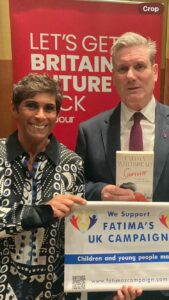
    Others agree and have pledged their support – especially those in the new Starmer administration. “We have a charity dinner on the first night where Lord John Bird, the founder of The Big Issue will speak. Sir Keir Starmer has pledged his support as have members of his government such as has Yvette Cooper. The Timpson family do a lot of work in prisons and they are also on board.”

    what happened to fatima whitbread

    Prisons are very important to the campaign. “I do a lot prison visits,” Whitbread says. “I want to engage with young people so they have something to go to. That’s half the problem for young people when they come out: there’s nothing to come to. Then they realise they’ve got a warm cell, food and friends inside and it’s a wasted opportunity for life. We have these collaborators but who don’t talk to each other, which is a shame. We’re all in it together.”

    Whitbread is one of those rare people who has found a second act in life – and she is pursuing it with the same passion that she did the first. There is a possibility that if we heed her call, we can all hand on a better life to the children of the future.


    To learn more go to: fatimascampaign.com


  • Introducing the Shadow Pledge

    Finito World

    The employment market can be a bewildering place for hirers and job-seekers alike, As a rule, the people who leave school, college and university who know exactly what they want to do are lucky – and rare. Not everyone can be a doctor, an architect or a lawyer where the path is set, and the profession regulated to make life easier for the entrant.

    The rest of us are encouraged to apply for internships and work experience – and we do so in droves adding to the general confusion. This is highly competitive and, although the Old Boys’ network is not as powerful as it once was, the chances of success still all too often revolve around who you know. Of course the difficulty works the other way as well. Employers routinely point to recruitment as one of the most difficult areas of business. Organising work experience placements requires time that many small employers simply do not have.

    Given that today’s workers are likely to need two or three careers with reskilling and lifelong learning becoming the norm, the fight to get experience or even find out what is out there will become even more important. With AI increasingly involved in the job application process, candidates are often left rejected, dejected and without really knowing whether the job would have been right for them in the first place. Employers may be screening out the best person for the job who has an amazing attitude to work because they do not tick all the algorithmic boxes.

    But what if we did this another way? At Finito, we always encourage candidates to select a minimum of three separate career paths. This focus is best tested by shadowing someone in the sector to check rigorously their suitability and commitment. This is why Finito has decided to join forces with the MP for Stroud Siobhan Baillie and campaign for the Shadow Pledge.

    The brainchild of Finito CEO Ronel Lehmann, the Shadow Pledge is a simple idea: anybody over 18 years old can shadow someone who is employed, and most workers can spend that time with a Shadow without it negatively impacting their week. While there are strict HMRC rules about payment for internships and work experience, under this scheme there will be no requirement for funding, remuneration or travel expenses because the candidate is simply shadowing.

    The benefits of this are innumerable. There is no need for parental chaperoning, extensive risk assessments or insurance issues (save that certain roles such as manufacturing, engineering or jobs involving children may still require additional steps). It would be up to the employer to set the rules and requirements like providing a CV in advance. The simpler for all involved, the better.

    As a result of the Shadow Pledge, people of all ages will be able to gain a new sense of understanding about the workplace and opportunities at the right time in their lives to foster ambition.  Meanwhile, employers will acquire not only the pleasures of short term mentoring but also advance knowledge of potential candidates and spot key employability skills that a computer may miss.  The Shadow Pledge will enable us to shape and win the future of work.

    This is why we’re asking all businesses pledge to offer up to half a day of shadowing every year for all levels of their team: normal time in the life of CEOs, secretaries, HR assistants, plumbers, teachers, drivers, journalists, MPs, dentists, supermarket managers – including the boring bits. For the rest of us, the request is that we normalise shadowing.  We can start encouraging everybody to ask for shadow placements whether or not there are jobs going at the time and regardless of background and lack of connections.

    This would amount to a major shift in our work culture, and it’s one which is badly needed. It will provide an important flexibility for job-seekers and employers alike. Happily the idea has already met with some high-profile endorsements. The legendary Rob Halfon MP endorsed the idea, even while he was Minister for Skills and Apprenticeships. Meanwhile, the Rt Hon The Lord Mayor, Professor Michael Raymond Mainelli (Alderman) has offered Mansion House to get the square mile engaged. The Department for Work and Pensions has also shown considerable interest in the idea.

    We live in a world of too much regulation where people feel stymied by lack of opportunity. The Shadow Pledge is an idea intended to connect us and it is on the basis of this connectivity that the will should be built. This is the way to start to do that and we commend the idea to our readers.


  • Siobhan Baillie MP on her new Employability APPG

    Siobhan Baillie MP


    I have spent over a decade talking to the fabulous founder of Finito about education and whether our various education systems get people work ready.


    Since the pandemic, the country is also facing an urgent need to have a work ready population leaving school, college and university to boost the economy.  And with over 1m job vacancies, businesses I visit often place recruitment and retention issues at the top of their concerns.

    As part of their mission to grow the country, the Prime Minister and the Chancellor of the Exchequer are focused on ensuring people have every opportunity to train and retrain at all times of life.

    But many young people still do not leave education prepared for work or the multiple job changes they are likely to have as technology forces us to adapt.  Many families do not have the contacts to set up work experiences.

    This is why, together with Ronel Lehmann of Finito Education, I have recently launched an All-Party Parliamentary Group (APPG) for the Future of Employability.

    As an MP, I sometimes think back on the circumstances which led me to Westminster. I left home at 15, I left school at 17 and my prospects were frankly not great.  I got a job as a legal secretary and then worked my way up to become a family law solicitor.  It was hard graft to study while working full time, but worth it.

    Throughout all of that I also took Saturday jobs, had a paper round, I waitressed in a pub and led dancing classes amongst other things.  I taught aerobics and spinning to pay for law school.  Every interaction with the public and endlessly getting things wrong in the full glare of real life was useful training.  I learned a lot from the people I worked with too.

    Yet this country still views on the job training, further education colleges and apprenticeships as inferior to university degrees.  Many employers do not invest in training staff.  In some areas work experience and careers guidance is poor or non-existent.  Young people no longer work at the weekends or in school holidays.

    How do we shift our thinking? The first thing might seem cosmetic but it would put rocket fuel under the issue. The Secretary of State for Education – currently the brilliant Gillian Keegan MP – could become the Secretary of State for Education and Employability.

    Secondly, we need to really land the benefits of lifelong learning and remove barriers to retraining, including with fees for employers and employees.  Making it easy for mothers, people who have been out of work due to illness and recently retired people to return to work at some level could be transformational for them and the country.

    Thirdly, we need to value work experience. Employers are often faced with red tape when it comes to offering young people work placements. The confidence, learning and contacts you get from a real life day at work cannot be replicated online.

    There will always be a place for education for its own sake, but I believe it would benefit millions of young lives if studies are undertaken with a sense of ultimate direction.

    We will use the APPG to explore with businesses, organisations and think tanks what is making the UK underinvest in job related training and work experience opportunities.  We need to interrogate brand new government initiatives like the lifelong learning loan entitlement and old problems like how the apprenticeship levy works for small and medium companies.

    I am excited about the challenge.


    The writer is the MP for Stroud


  • Opinion: Job-seekers need to embrace this period of change

    Finito World


    It was Ernest Hemingway who said in respect of bankruptcy that it happens ‘bit by bit, then all at once’. Societal change can sometimes seem similar. 2022 has felt like a fast forward button pressed on our lives: everything appears to be occurring helter-skelter, and at breakneck pace.

    The state of play geopolitically has been accelerated by Vladimir Putin’s tragically stupid invasion of Ukraine. This, in turn, has sent the economy spiralling, as inflation has gripped the UK, partly due to the legacy of Covid-19, and partly due to successive administrations’ failure to produce a plausible and independent energy policy.

    The economic turmoil has been exacerbated by an incompetent Bank of England interest rate response, which piled on unnecessary pressure on homeowners. Add in a dicey shift to the Truss administration, and the death of a beloved monarch, and the world looks very different at the finish of 2022 to what it looked like at its start.

    But what period of history is without turbulence? In truth, no age is without its anxieties and shocks, its disasters and its queasiness.

    Besides, political turbulence always has an inner meaning. To take a historical parallel: when Joseph Chamberlain and Winston Churchill were tearing apart the Conservative Party over the question of free trade, in a way which might remind us of the 2022 summer battle between Liz Truss and Rishi Sunak, few could have known that this would lead to the redistributive Asquith pre-war administration, and the beginning of the birth of the welfare state. One order was ceding to another: and that would mean, in time, opportunity for workers previously undreamed of.

    Similarly, as Keir Starmer’s Labour Party seeks to pivot – not always convincingly – to the right, and as sizeable swathes of the Conservative Party argue for higher taxes, and not, as used to be Thatcherite orthodoxy, a smaller state, then it can seem as if some new alignment is struggling to be born. It will have its opportunity alongside the uncertainty.

    That’s because turbulent periods always house creativity – and creativity leads to economic activity. The period in the leadup to the Asquith administration saw an enormous amount of invention from air conditioning (1902), to radar (1904), radio broadcasting (1906) and the electronic washing machine (1907). Even World War One engendered numerous inventions we still use today from daylight saving time to Kleenex, zippers and even sanitary pads.

    Ingenuity and perception sharpens in times of crisis. Most economists agree that technology is inherently deflationary insofar as it saves business costs and reduces labour requirements. It was recently noted by chief executive of Ark Investment Management, Cathie Wood that in 2022 companies are rapidly increasing innovation across a range of areas including adaptive robots, autonomous mobility, blockchain, gene editing, and neural networks. And these technologies, once they are introduced and widely adopted, will either lead to jobs, or free up human capital for further invention.

    The world, especially as it is portrayed by today’s media, might be full of vicissitudes, crises and sudden shifts, there are in reality certain constants which don’t get reported.

    The first is human creativity. Consider this array of geniuses in the 20th century: the Wright Brothers, Amelia Earhart, Albert Einstein, Marie Curie, Charlie Chaplin, Sir Timothy Berners-Lee, TS Eliot, Igor Stravinsky, Pele, and Nelson Mandela. All were undeterred by the grim news of the day, and of course, another list might be compiled at will – and another and another – until it filled up the whole of this explanation simply with the names of high achievers – without even enlarging on the actual content of their exploits.

    Now consider that they all operated in the same centuries as Nazism, Stalinism, Maoism, and numerous genocides and disasters.

    That brings us to the second reason for optimism: opportunity. While opportunity isn’t evenly distributed across society at any one time – an inequality which has led us to create the Finito bursary scheme – its overall quantity is clearly on the increase as education broaden, and as the standard of living rises.

    These considerations ought to buttress job seekers against despair and make us realise that however the economy or the world might look at any one time, the next development is round the corner, and it’s just as likely to be a good one as a bad.

  • Stuart Thomson: ‘Universities need to protect and enhance their career offer’

    Stuart Thomson

    There is no doubt that most people’s time at University goes past in a flash.  It is a heady time of friendships, socialising, expanded horizons and, of course, learning.  But the realisation soon dawns that attention has to be turned to getting a job. That’s when things start to get really difficult.

    Universities must sell themselves to prospective students.  Most place an emphasis on the learning and wider life experiences that a student can look forward to when they study there.  There may even be a nod to how successful students are in finding jobs when they leave.  But such numbers are quite blunt and frankly don’t really reveal much about a students’ real job prospects.  What students really need are activist careers services that offer support from Day One.  Careers services are one of the most undervalued parts of university life but ever increasing in importance.

    There is no doubt that the government recognises the value of education.  It is constantly looking to help support students at schools and in further education. It sets standards and makes demands of institutions, not least for careers support.  For a large part higher education is no different but the case is different when it comes to careers services, where universities are left to their own devices.  While higher education institutions are not actually required to provide careers advice, they clearly must because students expect it.

    There is help and support available, so each university does not have to find its own way.  There is also help and support available to students. For instance, the Office for Students has issued a “Graduate Employment and Skills Guide” and has offered a local graduates competition to help graduates into local employment opportunities.

    The government has put in additional investment in the National Careers Service.  The Department for Education in Westminster is working with Universities UK, the Association of Graduate Careers Advisory Services, the Institute of Student Employers, the Office for Students, and others to understand what else they can do to support graduates entering the labour market.

    The Higher Education Careers Services Unit supports the work of careers and employability professionals and their institutions and AGCAS is a membership organisation for higher education student career development and graduate employment professionals.

    But the reality is that the picture remains a mixed one.  When political inquiries are undertaken into the careers support available then the picture that comes back doesn’t always reflect well on the university system.

    The All-Party Parliamentary Group on Social Mobility issued a report in 2017, “The Class Ceiling: Increasing Access to the Leading Professions”, which suggested that: “Universities should ensure careers services are a core part of the university support system and, in particular, target proven interventions at disadvantaged students to improve their awareness of career opportunities.”

    This highlighted the varied quality of careers advice but also suggested that employers needed to be more proactive in working with universities as well.

    There are often arguments about the balance between equipping students for the workplace and seeing education as a widening of horizons.  In other words, it shouldn’t just be about getting a better job.  But the reality, especially given the levels of debt that students come out of university with, is that there is an expectation that the institutions need to help students equip themselves for the world of work.

    Universities must challenge themselves as to the types of job markets they are looking at – local, national, global?  And that will vary between courses as well.  Many educational institutions are focused on the inputs – the courses, the variety of learning, quality of teaching, the research base – but there needs to be an emphasis on the outputs for graduates as well.

    The reality is that as universities come under the glare of government for how they have dealt with teaching during Covid, the money they pay their leadership teams etc, that makes more aspects of their operations open to government diktat.  This government isn’t averse to intervention so there is no reason to believe that the university sector should believe itself to be exempt.

    So, careers services certainly need to empower individuals, offer mentoring, provide online skills for LinkedIn but also help improve personal productivity.

    Universities also have to help students appreciate the importance of their careers service offer as well.  Most students only start thinking about these issues towards the end of their time at university.  The help and support from universities only comes in towards the end as well.  Instead, the careers advice should be built in from the very start.

    The reality is that a student that is ready for the job market has a CV that allows them to stand out.  That means giving it attention throughout university life, not simply looking at it towards of the end of their study.

    It is another pensions problem. One of those issues that we only start thinking about when, in reality, it is already too late.

    Universities need to protect and enhance their careers offer.  They need to ensure that at a time of tight finances, especially post Covid, that careers services are not cut.

    Built and financed properly, engaging with businesses, helping to challenge social mobility, a university’s career service can help to attract students looking to build a career and ensure a return on their investment.


    Read Stuart Thomson’s piece on the importance of a creative working environment

  • Worried about the cost-of-living crisis? Coldplay can fix you

    Ronel Lehmann


    And so we enter yet another doom and gloom period as the cost of living crisis tightens. This follows on from other uncertainties such as Brexit, the Covid pandemic, Vladimir Putin’s invasion of Ukraine and the jockeying for position which always accompanies a Conservative Party Leadership election. All this is probably why I have been thinking about ways to gain some perspective.

    Fortunately, help has been at hand. When I attended the 8th annual Global Family Office Conference, it was the guest speaker Sir Anthony Seldon who summed up best what really makes us happy.

    Seldon explained that it wasn’t having money but enjoying a purpose in life and good friends which provides the stability we crave during troubled times. It was obvious that his comments resonated with all the guests.

    Purpose, of course, can encompass many things – not just job satisfaction, but also passions and interests, and the belief that life has meaning.

    Towards the end of his 82 years, Johanna Wolfgang Goethe totted up the pros and cons of life. He found when he had completed his ledger that it was music which tipped the balance in favour of life having been worth it. This point was driven home at the weekend when I went to Wembley Stadium to watch Coldplay live in concert.

    As an employability expert, I find Coldplay inspiring. Here are four student friends who studied at UCL, Chris Martin (Greek & Latin), Will Champion (Anthropology), Jonny Buckland (Mathematics) and Guy Berryman (Mechanical Engineering). They followed their passion and love of music.

    In my field, we find that many of our students are afraid of what their parents think a sensible career should be. The daughter of a forensic accountant didn’t want to join her parent’s profession but was passionate about teaching. Another wanted a career in the creative arts. Both sets of parents confided in their concerns about what salary their offspring would earn. But there is always more to life than this. What also matters is whether children will be happy or fulfilled.

    Had Chris Martin’s parents been a client of my business, would they have shared their salary concerns with me as their son began to take his first steps into the industry? Very likely, they would. But with over 100 million albums sold worldwide, Coldplay are the most successful band of the 21st century and one of the best-selling music acts of all time. He followed his passion.

    Of course, the creative arts can be a difficult career, but people forget that prior to Covid, according to the Policy and Evidence Centre, the creative industries contributed £116 billion and grew twice as fast than the UK economy as a whole.

    At Wembley, Martin entertained an audience of nearly 100,000 people. As you arrived at the Stadium, you were given a wristband. This is all about audience participation, and we soon discovered that the bands flashed to the beat of the music. It was quite emotional to view all the coloured lights, not to mention confetti, balloons and fireworks.

    Popular music is essentially democratic. Coldplay’s music is not reserved for the few. There were audience members straight from work, those who had travelled from overseas, old and young people, a multitude of different cultures, ethnicities and religions, all brought together by music.

    Upon my return home, I was honestly happier than I have been in years. I think Anthony Seldon would approve – and thank goodness for those who follow their passions in life. It’s bravery which really drives the economy forward and will get us through.

  • New year, new job – navigating the market amid a flood of first quarter applications

    Patrick Crowder

    Is finding a new job on your list of resolutions for this New Year? Research from the staffing firm Robert Half shows that, for many, the holiday season was a time for polishing CVs and considering new roles.

    The pandemic has given people time to reflect on their priorities not only in the workplace, but in life in general. The holiday season is also traditionally a time for reflection, and this year’s resolutions included finding a new job for many people.

    The research shows that 21% of UK employees planned to look for a new role before March of 2022. UK Managing Director Matt Weston explains why so many people are choosing to look for new jobs right now.

    “Holidays are typically a time for people to take stock and assess their priorities in the year ahead,” Weston says, “it’s why we usually see a jump in activity in Q1, and after the summer holiday period in Q3.”

    Taking some time away from a role can provide the break needed to continue on with it once the vacation period is over, but increasingly it also allows employees the chance to long for something better. Coupled with the pandemic, this has created the perfect conditions for a flood of new applicants.

    “With the uncertainty of the pandemic, many employees were holding fast until the situation was a little more secure,” Weston says, “Even with the rumours of a fresh lockdown approaching, many are now tired of waiting and keen to take the next step in the careers.”

    59% of employees surveyed said that they planned to update their CVs over the holiday period. In response to this, Robert Half published some recommendations to make your CV stand out and avoid the rejection pile.

    They suggest a more personal CV – one free of jargon, and that is written in the employees own voice. Rather than formulaic entries about “being a good problem solver” or similar, they maintain that examples of an employee’s use of such traits in the field is a better way to highlight their abilities.

    Additionally, they state that short, to-the-point CVs are more likely to be considered by potential employers. By saving something to talk about during the interview, the uncomfortable process of parroting information to an interviewer which is already on your CV can be avoided. Also, by listing your biggest, most relevant achievements first rather than relying on a chronological structure, you can be sure that the most important information about you as an employee is considered.

    The high volume of applications will certainly mean higher than usual competition, but Weston explains why this particular new year provides some attractive opportunities.

    “For those thinking for taking the leap, there couldn’t be a better time to look for a new role,” he says, “Companies have been hiring to back-fill roles and take advantage of the economic rebound, which left 1.2 million vacancies across the UK without the candidates to fill them. As a result, the best talent will be able to command healthy salary packages from potential employers.”

    The switch to a new role can bring many challenges, and plenty of people are happy with the stability that staying with their current employer provides. However, if the prospect of returning to that old job feels more daunting than usual, now may be a great time to dust off that CV and look for a better fit.

    Credit: www.roberthalf.co.uk