Many people come to think about the balance between their personal ‘work life’ and their ‘personal life’ later in a career. That should be a consideration from the start. But it also means appreciating that the two cannot often be neatly divided or evenly balanced.
The idea of a work-life balance appears to suggest some type of equilibrium between the two. It also often places the burden on the individual to draw the lines between the work and the personal. Actually, most employers rightly recognise the benefits to themselves and the individual if the balance is considered. Personal health and productivity can improve, and the level of job satisfaction increases. If you feel as though you are being looked after, then the longer you may even stay in the role.
Considerations about a form of balance should not, though, be left until later in a career. It is not just about the ability to spend time with children and families or focusing on leisure pursuits to counteract aging!
Often the balance can entail quite serious commitments in the personal realm, for instance, those with caring responsibilities. Those responsibilities can impact anyone at any age.
It is also up to each person what their time looks like outside of the workplace. It cannot, of course, clash with the day job or bring any form of potential reputational damage, but otherwise, the time is yours to do with what you will. That could be study, having a ‘side hustle,’ taking up a hobby, or finishing a box set—whatever works for you.
That does not mean that a workday can be neatly divided. For many workplaces, especially in a professional setting, there is not really a 9-5. That requires flexibility on both the part of the employee and the employer. It becomes clear that the balance between work and life cannot be neatly divided and compartmentalised. For those with pressing commitments, such as caring, arrangements can be made, but for the majority, sometimes you will work ‘late,’ and there will be periods of intense work and potentially pressure. This cannot be avoided. Whilst employers recognise the need for everyone to think about their relationship between home and work, that does not mean the employee has all the control. There is often a lack of balance, and especially in the early years of a career, it will be weighted in favour of the employer.
How can each individual think about setting some dividing lines from the outset?
Boundaries – The UK hasn’t yet gone down the legislative route for a ‘right to switch off,’ but many firms have. There is no harm in having conversations with line managers about such matters.
Time management – The better organised a person is in the workplace, the better able they are to finish their work on time and move onto the personal.
Co-existence – There is no reason why some of the personal and professional cannot overlap. If, for instance, a class is during the workday, then as long as the work is done, the class could still be attended. A balance does not mean complete separation.
Personal health – The critical role of physical and mental health is now largely uncontested in the workplace, so explore the opportunities for these from the outset. Do not leave it until later.
Timesheet culture – For many organisations, the quality of the work is more important than the time spent at a desk. But for some organisations, particularly in professional services, they can expect both. It may be that this is reflected in the pay packet, but think about what you want from the outset.
Never fall into the trap of thinking that there is any such thing as a perfect balance between work life and personal life. Especially early on, the boundaries can be extremely unclear. You may socialise with colleagues as well as work alongside them. That is an important part of building a culture—but is that ‘work’ or ‘personal’? It is both.
It is important to think about what balance in life looks like rather than expecting an equilibrium to be achieved. Never leave that thinking too late.
Stuart Thomson’s latest book is The Company and the Activist
Are language degrees useful? David Landsman argues that they’re highly underestimated
In Britain we often like to play down our skills and achievements (except perhaps in sport). There’s nothing wrong with a bit of modesty. But I’m not sure we do ourselves – or the next generation – any favours if we end up boasting about how bad we are at something or another. We rightly admire those who have overcome, say, dyslexia to achieve academic success and a great career. But it’s decidedly odd how people make light of not being able to do maths (“not really my thing, thank goodness for calculators”). I’ve never heard anyone in Asia, for example, boasting about being functionally innumerate….
We’re also a bit too ready to shrug off being monolingual in what is, without doubt, a multilingual world. Pretty well everywhere you go, you’ll meet people who take speaking multiple languages for granted. I once visited a village school in Eastern India: the schoolgirls, aged from 8-12, spoke to me in reasonable English, one of the five languages they could communicate in. In many, people speak one or two “home” languages, but I’m not sure our culture values these skills highly enough. I remember asking a South African lady how many languages she spoke. Her initial answer was “just a bit of French from school [in addition to English]”. After a few more questions, she admitted that she spoke a couple of African languages, but hadn’t thought it worth mentioning…
My own story with languages, like most, started at school, in my case with French and Latin, followed a year or so later by Ancient Greek. I recall my teacher saying that the best thing about the ancient languages was that they had no practical use – probably not the best motivational talk for a twelve-year-old boy!
But what I found exciting about Greek and Latin was their sheer “otherness”: new words, new grammar (and lots of it) and new ways of expressing yourself, for example in Greek you express the idea of “if only…” with a whole new piece of grammar (the optative mode for anyone who’s interested). The puzzles that you have to solve in order to decipher complex constructions are the classics’ answer to a tough computer game or Sudoku.
It was, in my case, the language puzzles rather than the ancient history or archaeology that persuaded me to opt for classics at university. But before starting my degree, I spent a few months in Greece, which without making me change my degree plans, ultimately changed everything. Within a minute of landing in Athens, I realised that the linguistic skills which had landed me my place at Oxford wouldn’t let me read most of the signs at the airport, still less order a beer.
That’s when I decided to spend as much as possible of my time in Greece learning the modern language which, apart from being of more use in the bar, also got me fascinated by how the language had evolved. I took this fascination with me to university where I studied philology (the history of languages) as part of my degree and with that went on to do a Masters and PhD in linguistics (the structure and behaviour of languages), focusing naturally on Modern Greek.
I can’t say that my languages were an essential part of my path to the Diplomatic Service, but they certainly helped me once there. The British Foreign Office doesn’t require candidates to speak foreign languages before they arrive, but instead uses a (pretty reliable) language aptitude test to find out who’s best suited to being trained in the most difficult languages.
In my own case I soon found myself being sent off to fill a gap in the Embassy in Greece, belying the old joke that if you speak Russian, they’ll send you to Brazil. Later I learned Serbo-Croat and Albanian for postings in Belgrade and Tirana; I also took a course to improve my French which is still a key diplomatic language; and have acquired along the way varying amounts of German, Turkish and Hungarian, though not as much as I would like.
Today, after over a decade in business, I’m still at it, trying to improve my German (an important wedding to attend next year) and taking an online course in Russian with a brilliant teacher, just because I can. I’m a strong believer in the BOGOF principle of languages: learn one, get another if not actually free, much “cheaper” as every language you learn trains your mind to learn the next one.
There are so many ways to learn languages, and different things you can be good at. I’ve got quite a good ear, so sometimes my pronunciation can be deceptive and give the (dangerous) impression I know more than I do. On the other hand, I’m no artist, which always put me off languages like Chinese and Thai as I’m sure I couldn’t master the elaborate writing systems. You can learn by reading classic literature if you like, but if you prefer the news, or social media, or films, it’s your choice. My wife has to put up with me listening to songs in whichever language I’m focusing on at the time.
But is it really worth learning languages, when “everyone speaks English”? First, it’s good for you. There’s plenty of evidence that language learning staves off Alzheimer’s because it’s a great form of gymnastics for the mind, which makes sense even if you’re far too young to worry about losing your memory.
Languages are an excellent way to understand quite how differently it’s possible to think. Take colours, for example: some languages don’t distinguish between “blue” and “green” and have a single word covering both. On the other hand, Greek and Turkish have completely different words for light and dark blue. So if you’re speaking one of these languages, you’ll see light and dark blue as differently as we see, say, red and pink.
This opens up a new world of understanding difference, going well beyond colours to the essence of people and civilisations. And when you understand better, you can communicate better. Nelson Mandela might have been talking to diplomats when he said: “If you talk to a man in a language he understands, that goes to his head. If you talk to him in his language, that goes to his heart.” But it’s not just diplomats who need to communicate. As former German Chancellor Willy Brandt is reported to have said: “If I’m selling to you, I speak your language. If I’m buying, Dann müssen Sie Deutsch sprechen”. Prosperity depends on trade, and trade depends on dealing with abroad. Language learning isn’t just an academic exercise. I’d like to see more businesspeople, not just teachers, speaking up for language learning.
If I were back at school today, what would I want to study? To be honest, I’m not sure it would be classics (maybe my old teacher had a point). But perhaps it wouldn’t be a pure languages degree either. I was talking recently to students about languages at a secondary school in London and was struck by how many were thinking about taking a course combining a language with another discipline. There are many more such courses today and they look to be well worth exploring. You choose law or business or maths, while getting all the benefits of studying a language at the same time. You prove that you can acquire a valuable real-world skill while giving your mind two different types of gymnastics at the same time. And don’t worry if you can’t decide which language to study: once you’ve tried one, there’s always BOGOF.
David Landsman is a former British Ambassador and senior executive. He is now Chair of British Expertise International and the author of the Channel your Inner Ambassador podcast.
Looking back I was prepared to do whatever I could to gain an edge.
First of all, you are what you eat. For me, when I was a competing athlete I was constantly working hard in the gym – three times a day training. I wasn’t that tall: I’m five foot three and most of my competitors were six foot. The important thing was I needed to be sure I was technically very sound.
I realised my diet had to be right – I was losing weight from the training and needed to maintain a certain weight. In the build-up to my being World Champion I was on a diet of about 8,000 calories a day. That’s a huge amount because on average women consume 3000 calories a day – but I was burning it all off. The diet I took was properly designed for me to have lots of iron: so I took in lots of offal, and had a special drink with raw eggs, banana and milk in a blender. I made sure it was all protein-based.
It was basically body-building and sculpting: it was about eating the right kinds of food – and then in training making sure you’re the right shape to maximise performance.
Back then we didn’t have the tools we have now. VHS was the main recorder. I would record everything I saw with regard to technique. I could analyse the footage mechanically and technically as to the different shapes and sizes of the different athletes I was competing against. I could observe their speed and velocity, their leg movement, the position of the hand, and the position javelin. It all varies from athlete to athlete.
For me it was all about learning in that level of detail, and I suppose I was doing it way before my time. I really did my homework. When I’m passionate, I don’t hold back.
I always saw the javelin as a weapon of war: kill or be killed. When you step into the arena, you’re going back to Greek ancient times. The need to step on the runway was about claiming my territory: if I didn’t claim that and own that, then why was I there? The idea was to be able to know everything you needed to know and have a close affinity – a sort of love affair – with your javelin. It was a passion: to become the best in the world, you need to know everything that can be known about javelin-throwing and the disciplines you engage with.
I started as a pentathlete in the early days and trained very hard. I would sprint with Daley Thompson: as a young man, he was incredibly dedicated to his work. My mum was a javelin coach. I also did sprint training with our then golden girl Donna Hartley. It was a fantastic era for track and field, I suppose partly because it was a period when there was a lot of trouble with football and hooliganism. We became the number one sport.
It’s mind over matter. 90 per cent of the mind application is based on preparation and training. As an athlete I understood there are two championships going on: with yourself and in the arena himself. Rory McIlroy at the 2024 US Open when he missed that crucial putt, was battling with himself. I could always sense what was going on in the arena in terms of psychological warfare: I never let that distract me. When you’re doing sport at that level you have to have tunnel vision to keep your focus on what you’re doing.
You’ve got six throws and every throw counts. I taught myself the skill of being able to perform as well on my last throw as on my first: I might often win a championship on my last throw. Anyone can do an amazing throw – and suddenly perform out of your skin.
The press might tell you your number one and should win. But if you think like this, and start to wonder if you’re going to get gold, silver or bronze, you’re in the wrong mindset.
There’s always great expectation – from friends and family, from yourself and from the public. It’s fairly easy at the start of your career when nobody expects anything of you. Then the expectation and the pressure starts to creep in. The only way to cope with that is mind application and doing your preparation and being able to fall upon your experience.
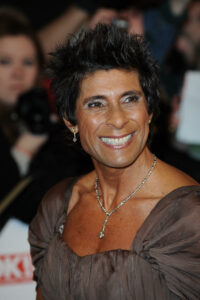
C9MJNM FATIMA WHITBREAD 2012 NATIONAL TELEVISION AWARDS O2 ARENA LONDON ENGLAND 25 January 2012
Finito World takes a look at what employability skills are the most important and how it can improve your career prospects
Employability skills might seem to be a bit of a mouthful. But the world is becoming more competitive. A phrase which takes as long to say as to make a cup of coffee is becoming increasingly important.
Why are employability skills so essential? It’s do first of all with the global economy, an inheritance of the settlement after the end of the Second World War. Borders are becoming more porous and businesses more international. The pool of talent competing for jobs has radically increased.
The only way to meet that reality is to up your game. Gone are the days when you could stroll into Dad’s friend’s bank or law firm without an interview. Now is the time of AI interviews, and fierce competition for every role. Even roles which may not seem all that desirable are competitive.
Tips for career employability
So what’s necessary? First of all you need to work on your communication skills. That will be verbal and in-person, and in written communications.
Sir Winston Churchill famously wrote of the importance of short, sharp memoranda that go to the point. The same is true when we are speaking aloud. Anyone starting out on their career would do well to learn to calibrate what they say. You need to put your hand up, but not seek to dominate.
All that entails good listening skills, and that in turn implies teamwork. How well can you read the emotions of others? Are you able to see your way round corners? When it comes to employability skills which employers need, teamwork is important. We need to make sure we fit in.
Most roles also entail some form of problem-solving. The world very rarely runs smoothly. Employers want to know that employees can engage in critical thinking and analyse situations. They need to work to the advantage of the overall organisation.
Why teamwork matters
One must become adept at not thinking primarily about oneself. You must ask yourself each day what you can do to further the good of a particular organisation.
But no employer expects you to get everything right all the time. Setbacks and disappointments are built into business as they are into life. In a changing, rapid world mistakes happen. Employers want to see that employees have resilience and a willingness to learn.
All of us has capacity for growth: career employability is to do with seeking to foster those capacities. You must not turn your back on any notion of self-improvement at the first crisis or letdown.
If you can do that, you’ll be well on the way to developing leadership skills within yourself: employers often say they’re looking for self-starters. You must demonstrate over a reasonable period of time that you are able to arrive at the answer to difficult questions on your own. Then management will start to consider you for a leadership role.
That will take time – and perhaps that will imply patience. But at the same time, it is to do with work ethic. That is an area where young people can really differentiate themselves. The famous West Coast lawyer John Quinn used to take his cohort of new arrivals down to the lake on his estate. He would say: “Swim to the other side!” The first two to enter the water would get jobs at the end of it.
You need to be the first in that lake to succeed: if you don’t someone else will. It was said of the tennis-player Tim Henman that he wasn’t the best tennis player in his class at Reed’s School. But if the coach said: “Go and hit a ball against the ball for ten hours” would go and do it.
Working hard
Fostering that work ethic can lead you to surprising places. Doing things over and over again might seem boring from the outside, but commitment leads to deeper understanding.
But none of this should be at the cost of the bigger picture. When it comes to career employability, you need to realise you’re in a globalised economy. You must also seek to understand the variety of functions which your organisation carries out.
Above all, career employability is about never stopping learning. It is an avenue to a rich and fulfilling career, and therefore to a productive life. You might find that the employability skills important to an employer are also important to you.
Considering an accountancy career? Successful accountant Grace Hardy gives her advice
Growing up with dyslexia wasn’t easy. School was often a frustrating experience for me. I struggled with reading, writing and spelling, which made traditional learning environments incredibly challenging. I often felt like I couldn’t keep up with my peers, and my confidence took a hit.
The thought of spending another three or four years in a similar environment at university filled me with dread. I couldn’t afford to go to university without getting a job on the side and I was worried that doing a degree wouldn’t set me apart from others when I’d eventually have to find a graduate scheme after.
During this time of uncertainty, my mum introduced me to the world of apprenticeships. I’ll be forever grateful for her suggestion because it opened up a whole new realm of possibilities for me.
The apprenticeship route appealed to me because it offered a different way of learning – one that suited my needs better. It promised hands-on experience, practical skills, and the opportunity of earning money while learning. Plus, the prospect of no student debt was certainly attractive!
I secured an apprenticeship with a Top 10 Accountancy Firm, and it was a game-changer for me. At 18-years-old I was on a £20,000 salary; I was over the moon. This gave me the financial stability I had been craving. From the very first week, I was working on real client projects and given responsibilities that expanded my portfolio and experience. Despite having no prior accounting knowledge, the firm provided comprehensive training and created a nurturing environment for me to learn and grow.
As I progressed through my apprenticeship, I began to see the inner workings of different businesses. This exposure was invaluable and sparked my entrepreneurial spirit. I realised the skills and the knowledge I was gaining could potentially be used to start my own accounting practice one day.
After completing my apprenticeship and gaining my AAT qualification, I decided to take the plunge and start my own firm, Hardy Accounting, at the age of 21. It was a scary but exciting move!
The transition from employee to business owner came with its own set of challenges. Suddenly, I was responsible for everything – from finding clients to managing finances, and from marketing to delivering services. But the foundation I had built during my apprenticeship proved invaluable.
One of the most liberating aspects of starting my own business was the ability to work in a way that suited my neurodiversity. I could structure my work environment and processes in a way that played to my strengths and mitigated the challenges posed by my dyslexia.
For instance, I leveraged technology heavily, using speech-to-text software, dyslexia-friendly fonts, and other tools to help me work more efficiently. I also found that my dyslexia gave me a unique perspective on problem-solving, which often proved beneficial in finding innovative solutions for my clients.
Whilst growing my business I quickly became aware of the fact that a very small number of my clients had any understanding of financial literacy – a key element of running a successful business. This was the seed that later blossomed into a full passion for the topic of financial education.
After looking into how financial education is integrated into the UK curriculum (or how it really isn’t) I quickly realised that the situation was much worse than I originally thought. An inquiry by the All-Party Parliamentary Group on Financial Education for Young People found that over two-fifths of secondary school teachers surveyed did not know that financial education was a curriculum requirement.
In addition to this, only two-in-five (41%) young adult respondents were considered financially literate, showing the impact that a lack of childhood education has down the line. Almost two-thirds (61%) of young adult respondents confirmed they did not recall receiving financial education at school – that math adds up pretty clearly.
Those who were receiving financial education lessons in the UK were taught for an estimated 48 minutes per month on average instead of the recommended 30 hours. These findings made it clear that something needed to happen. In response, I started to lobby the Government for legislative change on financial education. This initiative became a crucial part of my journey, combining my accounting expertise with a mission to improve financial literacy across the board for the better of our communities, economies and people’s every day lives.
In my business my goal was simple: to provide personalised, tech-savvy accounting services to small businesses and startups, helping them navigate their financial journeys with confidence. I wanted to create a firm that wasn’t just about numbers, but about building relationships and helping to educate business owners about finance so they could understand the ins-and-outs of their businesses.
The accounting industry is on the cusp of a major transformation. As we move forward, I see a future where accounting is more than just bookkeeping and tax preparation. It’s about being a strategic partner to businesses and providing insights that drive growth and success. The future accountant will need to be part financial expert, part technology guru, and part business strategist.
Artificial Intelligence is also revolutionising the accounting industry. From automating routine tasks, to providing predictive analytics. In my firm, we’ve embraced AI tools to enhance our efficiency and accuracy. This allows us to focus more on providing valuable insights and strategic advice to our clients.
However, it’s important to note that AI isn’t replacing accountants; it’s augmenting our capabilities. The human touch – our ability to interpret data, understand context, and provide tailored advice – remains crucial. The successful accountants of the future will be those who can effectively leverage AI while maintaining personal connections with clients – allowing it to maximise our talents rather than replace them.
For young people looking to follow a similar path in accounting, there are several key pieces of advice I’d offer. Being yourself is the best thing you can do. There are many business owners and everyone has their own approach, therefore it’s key to find something that makes you unique. What is your unique selling point (USP)? Developing soft skills such as communication, problem-solving, and leadership is equally important as technical accounting knowledge.
Seeking mentorship from experienced professionals can provide valuable insights and guidance in this respect. Being adaptable is vital in the constantly evolving accounting field, ready to learn and adapt to new methodologies and regulations. Lastly, knowing that failure is not something negative is vital. In the entrepreneurial journey, setbacks are not just inevitable; they’re invaluable. Every failure is a stepping stone to success, offering crucial lessons that shape your path forward.
These experiences, though challenging, provide unique insights and foster resilience – essential qualities for any entrepreneur. Embracing failures as opportunities for growth and learning is what often sets successful business leaders apart from the rest.
Being self-employed has opened a realm of possibilities for me. I have since started the Unconventional Podcast and have launched the Unconventional Academy to help other young people start businesses and learn about financial education. In addition to this I am in the midst of my campaign to get legislation passed through Parliament to improve financial education throughout our school system – building for a better future, now.
The road might not always be easy, but with determination, the right support, and a willingness to learn and adapt, you can achieve great things. Your journey is just beginning, and I can’t wait to see where it takes you!
Ever wondered why hybrid working is the future? Finito World looks at a question likely to be of perennial interest well into the future
Hybrid working is proving itself remarkably flexible and popular.
New research from IWG shows that hybrid working has led a boom in ‘active commuting’, with increasing numbers of workers travelling to local flexible workspaces via foot and bike.
That’s good for our health, both physical and mental and is just another reason why employees seem to be voting with their feet nowadays.
The study found that commutes to local workspaces are 38% more likely to be active than commutes to city centre locations. Workers aged 55-64 have reported a 109% increase in active commuting, the most of any age group.
Health benefits
That also has a significant knock-on effect. This follows recent census data which revealed that those who walked or cycled to work face a lower risk of mental or physical ill health, lowering their risk of admission to hospital for any illness by 10-11%.
The increased use of local flexible workspaces by hybrid workers has been central to this shift. Almost two thirds (62%) of commutes to local workspaces are now mostly or entirely active. This is a 38% increase compared to commutes to city centre offices.
The study was conducted by International Workplace Group (IWG), the world’s leading provider hybrid working solutions. It included brands such as Regus and Spaces, and included more than 1,000 hybrid workers. It found that walking (88%), cycling (34%), and running (28%) were the most common forms of active commuting. Workers travel on average 324 km via walking, 366 km via running, and 418 km on bike to a local workspace annually.
The research also revealed some more novel forms of active transport, including travelling to work by scooter (7%), skateboards (6%), and rollerblades (4%), as workers cut long daily commutes by train or car and take advantage of workspaces closer to where they live.
Rise of the “silver strollers”
Hybrid work creates generation of “silver strollers”
The research also reveals that older workers have made the most significant increases to the time they spend exercising as part of their commutes. Those aged between 55 and 64 reported a 109% increase in active commuting when travelling to a local workspace instead of a central office.
Two thirds (67%) said they are more likely to incorporate physical activity into their commute when travelling to a local workspace instead of a city centre location. Meanwhile, more than three quarters (79%) have reported improvements to their physical health as a result.
The most popular form of exercise for this “silver stroller” generation is walking, with workers aged 55-64 travelling an additional 259 km a year on foot by active commuting.
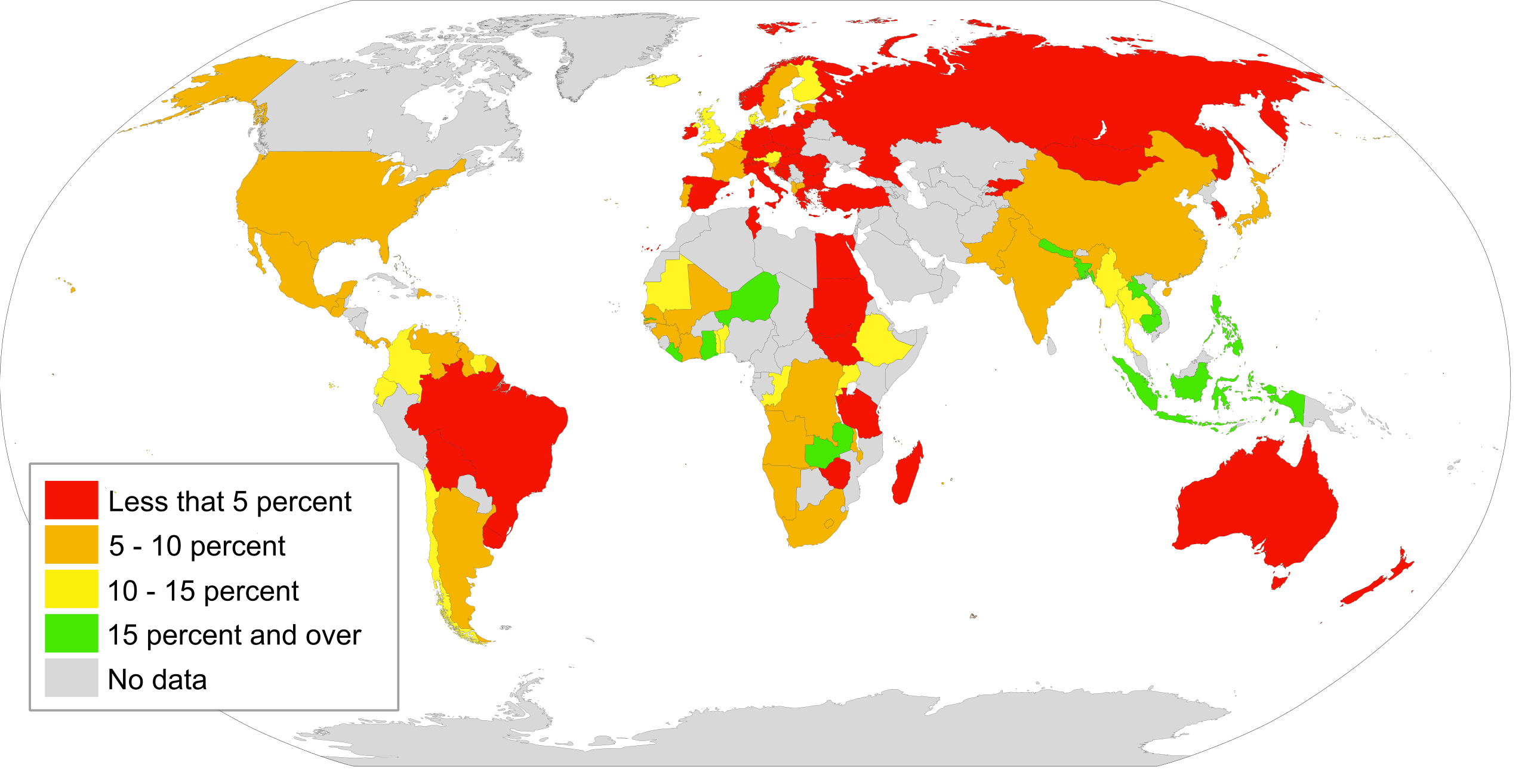
This map shows the percentages of hybrid working by country
A Question of Productivity
Active commuting fuels mental health and productivity gains
Beyond the obvious physical health benefits for all generations, active commuting to local workspaces has improved mental wellbeing, productivity and work/life balance. More than four in five (82%) of those that active commute said that incorporating exercise into their commute improved their mental health, with three in five (60%) reporting increased productivity at work.
This is supported by additional research from International Workplace Group which found that three quarters (75%) of workers experienced a dramatic reduction in burnout symptoms, after transitioning to a hybrid model***.
The improvements to work/life balance have resulted in 85% of hybrid workers saying they are more satisfied in their jobs and 75% reporting higher levels of motivation.
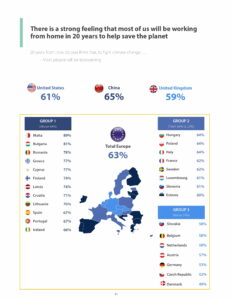
This chart shows strong consensus around the ecological benefits of working from home
Closer to Home
Given the clear health benefits of active commuting, it’s no surprise that nearly three in five (59%) of workers want their employers to provide access to local workspaces closer to home, so they can fit in more exercise – as three quarters (75%) say they are more likely to incorporate physical activity into their commute when using a local workspace.
It appears that business leaders are listening to their employees. Recent research among more than 500 UK CEOs found that three quarters (75%) said that returning their employees to a central office five days a week isn’t a business priority. Two thirds (65%) said they would lose talent if they insisted on their employees being present in a central office every day.
IWG locations in rural, suburban, and commuter areas have seen a surge in foot traffic since the lifting of Covid-19 restrictions. Towns like Uxbridge (up 1839%), High Wycombe (up 1412%) and Maidenhead (up 1186%) experienced significant growth in footfall between June and August compared to the same period in 2021, when Covid-19 restrictions were in place.
Win/Win
To help meet this demand, IWG has opened more than 300 new locations in the first half of 2024, with the majority in rural, suburban and commuter areas closer to where workers live.
Mark Dixon, International Workplace Group CEO stated: “The growing use of workspaces closer to where employees live, allowing them to reduce long daily commutes, is contributing to major improvements in worker’s physical and mental wellbeing.
“This research demonstrates that hybrid working is a win/win for everyone. Business leaders are seeing substantial productivity and financial gains, while employees enjoy a better work/life balance and higher job satisfaction.
Companies are increasingly appreciating that they will not only will they have a happier, healthier workforce when they allow people to work flexibly, but people actually feel more productive and motivated.”
Need mentoring about hybrid working and the future of work? Go to finito.org.uk
Christopher Jackson tours a fine new exhibition at the Sainsbury Centre about the many ways drugs impact our lives
After reading about the death of Liam Payne in Buenos Aries recently, one felt a sense of grim recognition. It was another story of a famous person with a bleak ending up, where the prime mover in the tragedy was drug addiction. This followed on from Matthew Perry‘s sad death the previous year.
But you don’t have to look far in recent history to find others: Amy Winehouse, Jimi Hendrix, Jim Morrison, Michael Hutchence. It is a grim roll call of squandered talent. The trouble with talent is that it all too often distracts you from learning how to live. Know thyself, was the injunction above the entrance to Plato’s Academy.
Drugs certainly can prevent that process, but the Sainsbury Centre has embarked on a larger mission: to consider drugs from many angles and therefore to arrive at a deeper sense of what drugs have meant to the species recreationally, socially, politically, in healthcare, as well as artistically and even spiritually. The results are shown in a series of exhibitions, and also in an accompanying book which is both well-written and beautifully designed.
It was Gore Vidal who, in his usual lordly manner, said he’d tried each drug and rejected them all. He settled in the end on alcohol as his main source of recreation and it didn’t do him a huge amount of good, especially in his old age. But most people in their forties and fifties today will have dabbled in some form of drug, usually when too young to know precisely what kind of self they were supposedly meant to be experimenting with.
This has without question hugely contributed to the mental health crisis which we see all around us. It manifests all too often as an employability problem, but this is ordinarily a symptom of addiction and not a cause.
There is much in this exhibition to warn us off drugs, with heroin singled out as a particular disaster area. This was the tipple of the great Nick Cave, and he got through by the skin of his teeth to his present incarnation as a musical seer and global agony uncle.
Cave always made sure he was at his desk at 9am, and wrote some of the great songs of this or any age while in the clutches of this particularly brutal drug. The section of the exhibition called Heroin Falls makes it clear that the high-functioning heroin addict is likely to be an extremely rare phenomenon.
One such is Graham MacIndoe who chronicles his own addiction in photos of raw power. MacIndoe wasn’t robbed of agency by his addiction – or not entirely – and found that the drug made him focus with considerable obsessiveness on lighting his pictures.
My Addiction, Graham MacIndoe
And yet heroin remains a grim topic whatever spin you put on it. That’s even more the case when you consider the current trend in South Africa for Nyaope, known as ‘poor man’s heroin’. This is highly addictive and can contain anything from detergent to rat poison or antiretroviral medications. Anybody who has been to Johannesburg knows that it can be hell on earth: and here’s why.
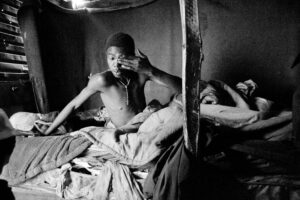
SOUTH AFRICA. Johannesburg. Thokoza. 2015. Thabang waking up in the early hours of the morning.
SOUTH AFRICA. Johannesburg. Katlehong. 2015. Bathing in Katlehong after a long day.
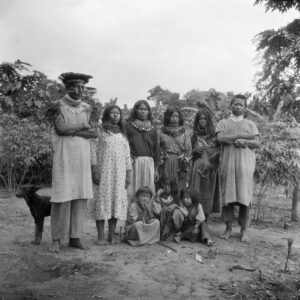
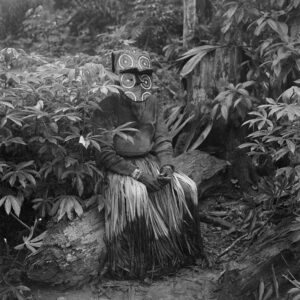
But the Sainsbury Centre frequently points out that drug use hasn’t always been this destructive. The message is that, as with anything in life, it helps to know what you’re doing. There still exist today peoples in South America with a positive relationship to Ayahuasca.
Richard Evans Schultes, The Cofan Family that met Schultes at Canejo, Rio Sucumbios, April 1942
Richard Evans Schultes, Cano Guacaya, Miritiparana, 1962
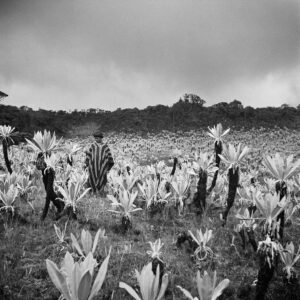
Richard Evans Scultes, Youth on the Paramo of San Antonio above the Valley of Subondoy, 1941
These pictures show another setting to drug exploration: we are in the great outdoors where drugs really originate. Quite simply, they grow in nature, and it is a relief to the viewer to be out of the urban setting where drug addiction so often goes badly wrong, into landscapes where the existence of drugs has a saner context.
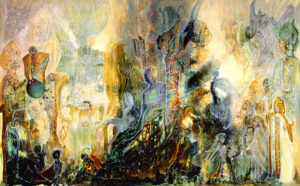
As interesting as they are, they rather pale in comparison to some of the images of visionary art in this exhibition, the best of which is Robert Venosa’s Ayahuasca Dream, 1994.
Robert Venosa, Ayahuasca Dream, 1994
All one can say about this picture is that if this is how the world looks on ayahuasca, you’d be a bit crazy not to want to try some. This is why people take drugs: they sense that the external world might be an end effect of something larger and that drugs might be a way to move towards that cause.
Venosa’s picture, with its sense of a drama we can’t quite grasp conducted involving figures whose identity we only vaguely know will touch a chord with many. It is impossible to look at something of this scale and beauty, and feel that drugs can be of no benefit to humankind.
Most people suspect that their mind is operating at a very low percentage as they conduct the rote tasks which the modern world can sometimes seem to require of them. They know they’re capable of more.
I think it’s more than possible to do all that in a state of sobriety, and that route will be better in the vast majority of cases, simply because so many people lack the willpower not to fall into perennial addiction. Who can sort the real drug mentors in the Amazon jungle from the charlatans?
But the Sainsbury Centre has done a great thing by tackling this subject in such an encyclopaedic fashion to remind us that though we each have our inner Amy Winehouse where everything can go badly wrong, we also potentially have a sort of Sergeant Pepper Lonely Hearts Club Band within as well – a new level to go to, whoever we are.
One sometimes hears someone called a ‘black sheep’ of a family as a pejorative term. It needn’t be like that. Most people who look inward in any concerted way find some surprising differences between their own hopes and dreams and their outward circumstances. Knowledge of this difference can open surprising inner capacities and point the way to a fruitful life. In the best cases, it is possible to strike out in a different direction from one’s family, and to feel no sense of alienation whatsoever – but instead to feel a sense of loving journey, which ultimately all members of the family will accept and profit from in understanding.
Something like this appears to be happening to Finito candidate Leah Houston. I ask her about her upbringing: “I’m from very humble beginnings,” she tells me, her accent distinctively Northern Irish. “Education was never pushed for me. It wasn’t the world I was in. I’m the first in my close family to be interested in my studies, and then to want to pursue them, and then to go onto university at the Belfast Bible College in Dunmurry, Belfast.”
Despite this, Houston is aware of many similarities between herself and her family. “On the other hand, working hard was pushed on me – it was a question of financial necessity. I’ve had a part time job since I was 14. After school you went to work: food had to be placed on the table somehow. In hindsight, I wouldn’t have changed a thing at all.”
So what did her parents do for a living? “My Dad is typical Northern Irish. He is a part-time farmer and he sells animal feed from a local agricultural shop. My mum worked in office work all her life – then she had me. She felt that to stay at home was her calling, but then she started looking after other peoples’ kids and soon she had her own childminding business.” This seems to amount to a strong entrepreneurial streak in the family. Houston agrees: “You have your hands and you can do something about it – so go work,” she says, simply.
This innate understanding of business was already becoming apparent in Houston’s choices. “Business makes sense to me,” she explains, “seeing something through from 0 to 100. You’ve got to see what you’re good at and make something of it. I studied Business through to A-Level and initially thought I would study that subject at university as well. But I had a bit of a change of heart.”
This brings in another side of Leah – her religious belief. “I grew up in a strong Christian household,” she recalls. “It wasn’t pushy but it was fostered. So I studied religion and law at university which was a major change.” Throughout our conversation she will talk about her faith in the relaxed, confident way which people do when their beliefs are deeply embedded.
I am interested to know how this degree was structured. She explains: “The main aspect of it was theology, but with world studies, policy and law examined. It was all to do with how one’s faith works out in the public sphere. I was focused predominantly on Christianity but I also did world religion modules.”
This decision garnered a mixed reaction at home. “My extended family – my cousins and so on – weren’t sure. Firstly, because I’m a woman – that didn’t go down well, and led to some opposition. Some also thought I would lose my own faith, and question what I believe.” And has she? “I haven’t. Growing up in a Christian country, Christianity can be ugly because it’s political. There have been civil wars in the name of Christianity in my country. I came out the other end with a wider appreciation of all religions and the part they can play.”
Houston loved her degree, but like most humanities degree, the gain of doing something one loves had a flipside: such courses don’t lead to such clear destinations as vocational courses. “I didn’t want to go into the Church, so in hindsight it was a much harder option. For the first few years I thought it was all amazing, but I’m not philosophical – I’m much more practical. My interest is in thinking how faith values can be implemented. During the three years of my degree, I did some time with a charity at home called the Evangelical Alliance. That organisation tries to bridge the gap between Church and politics. In hindsight, my time there planted the seed for politics and the public sphere.”
This seed came to fruition when Houston began working for Baroness Anne Jenkin in the Houses of Parliament. “When I finished university, I thought: ‘What the heck am I going to do next?’ I came across Christian Action Research Education (CARE) a charity which seeks to facilitate getting a job as a Christian in politics in addition to offering training in thinking about politics. Anne Jenkin is extremely kind and said she’d take me for a year.”
And what were her impressions of the role? “Anne is so hard-working – no two days are the same for Anne,” Houston recalls, laughing perhaps at the remembered bustle of it all. “I was involved in diary management, speeches and organising meetings she would host. It was general ad hoc stuff and I was an extra pair of hands.” Leah brought a very clear sense of purpose to the role. “I was there to serve Anne – to allow her to do her job better. That could be sending letters, or photocopying, or making a cup of tea. I also became immersed in the question of gender ideology, which is one of the key issues for Anne.”
And what was the culture like in Parliament? “As a practising Christian myself, I was interested to discover the APPG, Christians in Parliament, that is a cross-party group of Christians. As long as you were a passholder you could be a part of that: MPs, kitchen staffers, it didn’t matter. It brought a sense of community, with weekly services held in the Chapel of St Mary Undercroft. Politics is so polarised and tends to be all or nothing. It is meaningful to have something that unites: at election time we prayed for whoever was in leadership.”
Through Baroness Jenkin, Leah met Finito Education CEO Ronel who saw Leah’s potential. “Ronel is a great supporter of Anne and he took me under his wing. I was with Finito for half a year and the investment in me was incredible.”
This is good to hear and I ask her what the impact has been. “Besides all the practical things such as the LinkedIn training, the CV writing and the mentoring, I especially value the confidence that the Finito service gives to someone in my circumstances. It was as if I was being seen for the first time. This was so encouraging for me especially given my upbringing, where my wanting to succeed was perhaps sometimes considered a bit weird. My extended family would wonder why I was in London, and why I’m in the job I’m in. This was an organisation which wanted me to succeed.”
This process of building confidence in an individual is integral to the mentoring process. It begins from our first encounter with a new student. Houston recalls: “I remember vividly the first meeting with Ronel where I brought him my CV. When I had been in parliament I had co-founded a network for the protection of gender-critical views. I showed my leaflet to Ronel and it was an incredibly important moment, because someone was looking at my work, and taking an interest in me. It brought me an overwhelming sense of pride.”
Mentoring is to do with becoming reoriented in one’s life by coming into one’s essential self. Houston recalls that her being photographed by in-house photographer Sam Pearce continued this process. “I spent an afternoon with Sam and I noticed that she took the time to make me feel comfortable. She also took time to ask questions between pictures – it was not a transactional photoshoot, it was more an investment in who I was.”
Following on from there, Leah had her LinkedIn training with Amanda Brown (‘incredibly helpful’) and then began work with her lead mentor Tom Pauk. “He was so lovely and I was telling my heart and how I feel things deeply. He said: ‘I think you need to go into the charities sphere’. I said: ‘ I think you’re correct.’ And now I’ve landed a job with a charity which is a start-up. Tom was amazing, and gave me contacts.’
From Pauk’s perspective, Houston made an excellent impression. He recalls: “Leah struck me as a highly intelligent, articulate and values-driven young woman, seeking a position where she can employ her myriad skills to improve the lives of others, especially those of women and children.” Pauk noted early on that her priority was ‘to use her lobbying skills to help bring about changes and social impact,” adding that “she is not driven by earning a high salary, though she’ll need a sustainable one.”
When the job came along it all happened very quickly ‘in the space of a week’. Houston brings me up to speed: “I now work for a charity called Forum which is based in London and has launched in America too now. Its purpose is to serve leaders and influencers from all sectors of society. It tries to link up like-minded people. I’m a data manager and administrator, which is important for Forum, as someone’s name in the database is like gold to the business. I’m also EA to the founder David Stroud, who is married to Baroness Stroud.”
So how does she see the future? “I actually don’t know,” she admits. “My life these past few years has been full of uncertainty, but I can see myself settling here for a good while. It’s a start-up with huge potential for growth and now the whole past five years makes sense.”
At the end of our interview Houston reflects a little on her journey so far. “It’s strange to be in London and not be money-driven. Wealth to me isn’t money. It’s what I had growing up: I had family and friendship and relationships and that to me is wealth. Marriage and education is wealth.” And are her family beginning to understand the nature of her journey now? “My parents have been massively supportive, but we don’t always speak a common language. My cousins have their own convictions and they don’t necessarily agree. But the relationships are there and really there’s so much love and support.”
One is tempted to call this attitude mature except that many people live their whole lives without realising the importance of things which Leah innately understands. She also has an immense capacity for empathy and understanding. Houston is someone whose narrative is not to be judged by the usual metrics of success: money, or position or anything else – though there’s nothing to stop her acquiring these. But she is in such a strong position because she isn’t a materialist. She is someone who will make her own way – and in fact is already doing so.
The help which Finito gave to Leah would have been impossible without the generous help of the Stewarts Foundation. The firm’s managing partner Stuart Dench says: “In a perfect world comprehensive career guidance would be available to all regardless of their background. The Stewarts Foundation is delighted to support the important work of Finito via its bursary scheme.”
When it comes to someone like Leah, the importance is difficult to measure because it has to do with ineffable things like confidence, connectivity, and the unleashing of possibilities within a person who may not yet know how capable they are. In her case, it is also to do with helping someone to arrive at the realisation that the place they’re born in need not be a limiting factor. Ultimately it’s for us to make our own way – though it is right that we do so with the help of others.
Christopher Jackson reviews Bodysgallen Hall and enjoys every minute of it
It is always a curious thing to arrive somewhere at night: we experience a world without contours and landmarks – a dense dark which really could be anywhere, and yet we also know we are entering somewhere new.
We arrived in northern Wales just in time for a storm to lambast Conwy, just as storms have been doing for millions of years: Wales always feels like ancient history.
My main memory is of watching the windscreen wipers rushing back and forth in increasing desperation to rid the windscreen of rain, as if seeking some slightly higher setting than the maximum.
We negotiated a long winding drive, unimpressed sheep crossing the pathway in their own time to move out of the way of our car. As we emerged from our vehicle, our bags immediately weeping with rain, we scaled some steps and the door peeled back magically: this was the greeting of the avuncular night porter Marion.
First impressions
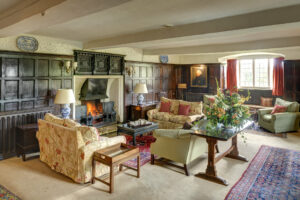
As I glanced at the décor of Bodysgallen Hall – the fireplace, the 17th century panelling, the venerable portraiture – I thought: “Well, this is a whole better than the M6.” Better than the M6, and indeed better than more or less any hotel I’ve stayed at, as it would turn out.
Reception, Bodysgallen Hall
We were shown upstairs to a warm upper room, and learned from Marion that the building was initially constructed as a tower house at some unspecified point in the Middle Ages. Its meaning was to serve as support for Conwy Castle, that marvellously preserved stronghold overlooking the bay: from Bodysgallen you can replay how a signalling system might have worked between this place and Conwy. One imagines Irish ships, a flame of warning, and then the bustle of preparation for whatever came next.
What came next is what always comes: invasion, conquest, resistance, peace – the known variations of human life. It is, in fact, a marvellous place for a spa, as the history here is so rich you know precisely what it is you’re seeking to get away from.
I had just enough time before I drifted into sleep to learn that Bodysgallen had once been a place where Cadwallon Lawhir, King of Gwynedd – the name means ‘long-fingered’ – had lived, when a luxurious peace enveloped me, which probably had something to do with not being on the M6 but also something to do with excellent bedding.
Into Enchantment
The following morning, the first amazing thing I did in what was to be an entirely enchanted day, was to open the curtains. This isn’t normally a particularly marvellous aspect of life in London: my curtains usually reveal Southwark Council branded bins and houses opposite which look identical to the house I have just woken in.
At Bodysgallen Hall, the experience is very different: you look out onto an unbroken glory of horticulture, leading onto a still more beautiful and dreamy landscape: that masterpiece of nature which is Wales’ northern coastline.
It must be admitted that Wales probably gets about three days of delightful sunshine per year: we got one of them, and in late October. The trees everywhere were having their annual rethink, deciding on russets and umbers. Their dying can sometimes seem peculiarly optimistic.
Our first move was to eat a breakfast of champions in the tall-windowed breakfast room: a full English exactly as it should be done – heartily, and without any unnecessary complications. The food in the restaurant is Michelin standard.
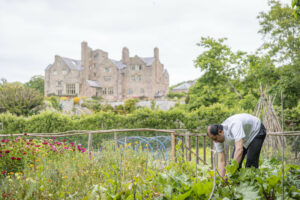
Kitchen Garden at Bodysgallen Hall
The views from the gardens are not to be forgotten. It was a day of bronze and misty light: Conwy seemed in shadow. The medieval folly can be seen in the distance, and it’s possible to walk up there for a better view of the coastline beyond the Orme and Little Orme headlands.
The garden has a remarkable history. The original garden design dates from 1678 and is credited to Robert Wynn, son of Hugh Wynn, who was the first of that family to come into ownership of the Hall. A sundial bears that same date 1678. In that year Bunyan published the first part of The Pilgrim’s Progress, and the Battle of Saint-Denis was conducted between the French and the Dutch, with the verdict disputed by both sides, though its result all too clear to the 5,000 or so soldiers who lost their lives.
In those days, everything was in the Dutch fashion: with high walls which make you want to know what lies beyond them. There is also a topiary maze, and a rose-garden which was still giving out a beautiful scent even in mid-October. The herb garden produces herbs and vegetables which form part of the menu in the first-class restaurant.
Everywhere you go is beauty – and this was an unusually beautiful day. One could really spend a week walking these grounds, and not be near the end of it, but our time was more limited.
The Spa
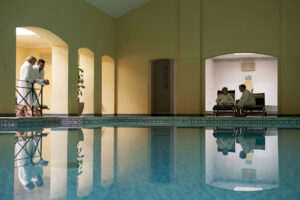
Bodysgallen Hall is known also as a spa, and so we went there during children’s hour. Newspapers I would not have time to read were laid out in civilised fashion in the reception area.
The spa itself consists of a warm swimming pool, a jacuzzi, steam room and sauna. My eight year old boy splashed around in children’s hour, which wasn’t quite long enough for him, and one sometimes wishes there weren’t such severe regulations around jacuzzi use when it comes to children.
Spa at Bodysgallen Hall
After that we walked again up to the obelisk, which was built in 1993 and a landmark visible from all around. It is, like Kafka’s castle, a thing which one nears but never quite gets to. But the trying to get there yields acres of mushroomy woodland, and a sense of blessing at trying to get there at all.
Lunch consisted of sandwiches taken in the crocodile alcove. Bodysgallen Hall is a place of little nooks and surprises. It is also a place of superb beef sandwiches. My son and I agreed we could quite easily have eaten 400 of them, but had to settle for eight.
The Land Beyond
As the afternoon began I sensed Conwy calling. We had been in the castle before on a previous visit: it is an extraordinary place which the first-time visitor will need to do. But the joy of second-time visits is to strike out in surprising directions, and so we decided instead on two churches.
The first is Llangelynnin Old Church, which is to be found a 20 minute drive out of Conwy up a winding slope. It isn’t where you’d expect to find a church, amid the beginnings of the Welsh hills. We didn’t expect it to be open, but the door had an obliging give when we tried it: inside the side walls date from the 13th century and the impression is of a peace which is worth climbing up here for.
Round the corner is St Mary’s church which is on the site of Aberconwy Abbey which was founded in 1172. Here, you begin to get to the nub of the matter: two yew trees older than Chaucer preside over the church, and there is information inside establishing the ancient nature of this site, where the Romans also had an outpost. Both these churches are supported by the National Churches Trust.
This is the infinite nature of Wales: its wonder is to do with deep time, and the many layers it contains. Bodysgallen is the way to explore it and also to experience a luxury which is both classy and not too ostentatious. It is an additional pleasure that to come here is also to support the National Trust, which in addition to maintaining our nation’s heritage, also clearly knows how to run a hotel. A special mention must also go to the magnificent receptionists Catherine and Hayley who were helpful and kind throughout our all-too-brief stay.
In our second swimming session, my son Beau, determined now and fortified by a fine day in Wales, swam his first length – a cunningly constructed amalgamation of front crawl and breaststroke. We might have arrived at night – but we left sensing a sort of dawn in ourselves.
There used to be a dead tree in Ruskin Park in South-East London, which always struck me as somehow sculptural. The other day I saw that it had fallen. I had grown so fond of this particular tree, it’s optimistic reach towards the skies, that I was bereft when I saw it had collapsed.
But this probably minor development in the history of my local parklands makes me all the more delighted that this same tree is still standing in the work of a remarkable artist Nadeem Chughtai. Chughtai’s recent exhibition A Liminal Statehas people talking in Peckham, which as everybody knows is also the artistic centre of the universe. Chughtai used the tree as a basis for his picture There’s This Place On The Edge of Town (2020).
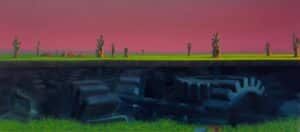
There’s This Place on the Edge of Town
One of the most basic requirements of an artist is power: Chughtai’s images always have an immediacy which nevertheless lets you know that your first impression is only the first part of your journey with that work of art. In this picture we see how we have become mechanised in ourselves, and how this can only lead to stunted growth. But the beauty of the tree, which looks like it almost wants to be an upwards staircase, suggests potential.
It’s a brilliant conception, like all Chughtai’s pictures. So was it always art for him, or did he toy with other careers? “It really was art all the way for me,” Chughtai tells me. “Ever since I was very young I’d draw. Encouraged by my mum and influenced by a beautiful framed pencil drawing my dad made of my mum in the 1960’s. However, I did loads of jobs before going full time with an art publishing contract which set me on my way. Before that I always kept myself in the minimum wage positions for fear of committing myself further down other career paths.”
Chughtai has had some major successes, with some celebrity clients including Roger Federer who chanced upon his work in Wimbledon village one year. Chughtai is particularly well-known for Nowhere Man, his character which he gave up at the start of the pandemic. These pictures, taken together, amount to a vast dystopian opus which tell the viewer unequivocally what we all sense: we are not headed in the right direction as a species.
We never see Nowhere Man’s face. Sometimes there’s more than one of him. It is also possible to say that Nowhere Man is always in a negative setting, beset by the circumstances of modern life: alarming architecture, the trippiness of drug culture, the terrifying ramifications of contemporary uniformity.
I Dream of a World That the Capitalist Philosophy Will Never Make Possible. Oil on three canvases (2017)
I also note that they’re always dramatic force in these pictures, and I related this to the career Chughtai had on film sets, with his work including the Bourne series and Love Actually. Did that experience impact the way he paints now? “Yes, I always mention my scenic art days. I call it my apprenticeship. It was absolutely magical to be working on those film sets at Pinewood and Shepperton Studios,” Chughtai recalls. “I originally went there to try and make films after losing my way with drawing and painting after college, but as soon as I saw the huge painted scenery backdrops surrounding the sets I was sucked back in.
I had hands on experience of painting pictures on giant canvases, off scissor lifts using strings, hooks and chalk to draw our lines. I learnt about so many aspects of painting as well as the cameras eye. The big one was perspective. Learning about that was enlightening for me.”
I ask Chughtai if he has had any artistic mentors, and his answer also dates to this time: “Well, I always mention Steve Mitchell, the scenic artist who I assisted over a five year period from 1999- 2004. He’s still doing it at 70 and we’re still in touch. He’s one of the world’s top scenics. I can’t tell you what I learnt over those scenic years and how it got me back into the art of painting.”
I can tell how passionate Chughtai is about his calling, but the melancholy of these pictures is always there. It seems to cry out for some kind of remedy. Is Chughtai pessimistic about the human race and its future? “I believe we are not only on the path to a dystopian future but within it now. Just look at all the horrific and unnecessary human suffering going on all over the world and right down to our own neighbourhoods. However, I remain an eternal optimist and have every faith that the human race will unite to overcome this and bring about the necessary change required.”
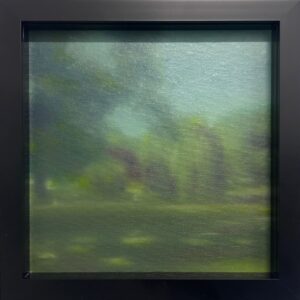
The new pictures, with their liminal greens, seem to be the start of some new potential. Here we see Green Park as it might be seen in a dream, or in the hypnagogic state between sleep and waking. The journey to the centre of town to make these pictures is perhaps indicative of an interior shift in Chughtai. The new pictures also mark a big change away from character towards some other kind of painting which feels like it is yearning for mysticism – maybe even a metanoia away from despair.
Was it hard to give up Nowhere Man? Might he ever experiment with another character? “It was very hard to shed the Nowhere Man. I doubt there would ever be another character. For me it represented humanity. If I ever need a central character again I’m pretty sure I’d call him up.”
Humanity then is for Chughtai somehow passive and faceless – asleep perhaps. This makes the notion of an exploration of the liminal all the more important; it is to do with exploring what Seamus Heaney called ‘the limen world’, that curious borderland of the unconscious. I have a sense that these recent works are a necessary transition period and that it may in time lead to some sort of reconciliation between Chughtai and the damage of the world – a more optimistic vision perhaps.
How did these new paintings come about? “The works exhibited recently at the Liminal State exhibition are exactly that; Liminal, as in kind of between or on the threshold. For me personally, up until just before lockdown in 2020 I was creating paintings with a central anonymous figure – the Nowhere Man. 16 years through the eyes of this character, so, shedding that to allow the next body of work to arrive has taken these last four years, and counting… The title, A Liminal State can also have numerous interpretations and could additionally refer to many other aspects; mentally,, physically, technically, artistically, societally… liminal.”
These then are between states, and that means flux – in Chughtai’s art certainly, and therefore, since artists are their art, in his life. I ask Chughtai about his method of composition. Is it evolving? “It’s evolving and continuing its journey. I’ve changed the approach, technique, materials used and so much more since 2020. In fact, almost everything – but still the work has naturally evolved through different states to where it is now.
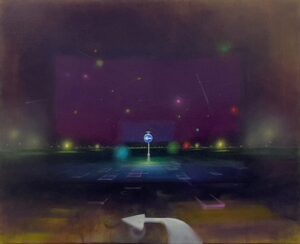
It’s a continual fluid journey. I have also been developing an artistic theory and putting that into practice. It involves perspective and the way the eyes see and the brain interprets an image. It’s great testing a science based theory on my artistic practice… and it actually works. My most recent painting entitled, Turn Left. (2024) shows the theory in practice in its most developed stage to date, and I was blown away by the positive reaction it got when exhibited for the first time at the show.
Turn Left, 2024
This again, seems to me like a dream where the dreamer is sometimes given clear but mysterious indications of what to do – strange snatches of disembodied advice. To look at these pictures after immersing oneself in the Nowhere Man corpus is to see a kind of hope peeping through, because the world seems to be acquiring a kind of charge, groping towards some form of meaning. My sense is that this makes the next few years of decisive importance for Chughtai’s art. If we follow that sign, where does it lead?
This new work has also sent Chughtai on a rewarding course of study. “Over the last four years I have really delved deep into studying and expanding my artistic learning. Visiting the London galleries on a weekly basis and getting to understand the philosophies of some of the great painters, while also educating myself about the amazing artists from around the world and their histories.”
So who are his heroes? “I have to mention Van Gogh, I just love. His pencil drawings, they make me wanna scream. I would say that more recently I have been appreciating 20th century Western heavyweights such as Bacon, Klee, and Rothko who’s section 3 of the Seagram murals brought me to tears on more than one occasion. It was during a particularly emotional time for me personally whilst simultaneously looking to move my work along an different path. That painting allowed me to see within it what I wanted to do with my own work.”
Chughtai has been going strong for a long time. So what are his tips for young artists about the business side? “Well, yes, it is a business – if you do it full time for your living. So if you don’t have the luxury of financial security, you will need to sell your work.
This predicament will most likely influence the type of work you produce and therefore could involve compromise. That’s the tightrope. It can work in your favour but can also be a hindrance if not deterrent, which is a real shame because then we miss out on hearing and experiencing the voices from within those walks of life. So, believe in what you’re doing, put the time in and keep on making your art.”
Maxted Morning, 2024
And would Chughtai recommend the art fair route? “I love going to art fairs. It’s where it all started for me. Like our society, the art world is very hierarchical, but whether you’re at the bottom rung or at the very top, when all is said and done they’re markets with their stalls out. It’s great because people can stand in front of the work in the flesh, which is how I feel art works are best experienced… and there is so much under one roof. Art fairs are a great way to spend an afternoon… if you can afford the entrance fee, of course.”
That’s often the problem for young artists at all. Has the conversation around NFTs affected him at all? “I did look into NFT’s a little some years ago but it seems to have gone quiet on that front so am unaware of where it currently stands. The whole digital thing is obviously a direction the art world is going down and there are many possibilities to explore. However, my focus and studies are with oil paint and a canvas because there’s so much more to come from there and that will always be ahead of any artificial intelligence.”
Chughtai is an artist of rare talent, who is doing something very valuable: he is pursuing his vision where it leads. It takes courage to do that. Every artist can learn from somebody who has chosen his path so decisively then pursued his craft with such passion.