The charity Young Citizens has partnered with law firm Mishcon de Reya to produce free classroom resources designed to teach young people about the law. The Big Legal Lesson 2022 will include the very basics of law for primary students, and more intricate law relating to social media and privacy for older students.
Learning about the law can help young people more deeply understand the legal system, and even encourage some of them to go into careers related to the justice system. However, CEO of Young Citizens Ashley Hodges says that The Big Legal Lesson goes far beyond inspiring the next generation of solicitors.
“Every young person should understand their rights, responsibilities, and the rule of law, whether or not they go on to practice it,” Hodges says, “To build a fairer society, students and pupils need to have positive encounters with the legal system from an early age.”
Knowing and understanding the need for the law is an important part of education, and last year the Big Legal Lesson reached over 55,000 students. Of those students, 83% said that the programme “improved their understanding of the rule of law and why it is important.”
This year’s focus on social media, online privacy, and free speech for older students is a timely choice given the increasing amount of disinformation and privacy risks young people face on the internet. Understanding the value of free speech in an era where everyone with internet access can have a platform is vital, as is identifying the line between the right to speak one’s mind and dangerous statements designed to foster rage and incite real-world violence.
Teaching UK law from a young age can serve to demystify the system, taking it from an abstract, often scary threat of punishment to something tangible, to be engaged with and changed when necessary. Young Citizens hopes to give young people positive experiences with the legal system and a solid understanding of it from an early age.
“The Big Legal Lesson is a special way to do this,” Hodges says, “equipping teachers across the UK to offer an engaging, accessible starting point on the law and justice, building young people’s understanding and confidence to engage with the subject.”
The next iteration of The Big Legal Lesson education campaign will launch on March 14th, 2022.
The Labour leader has outlined his policies in a 31-page essay, Patrick Crowder doubles down on the employability aspects
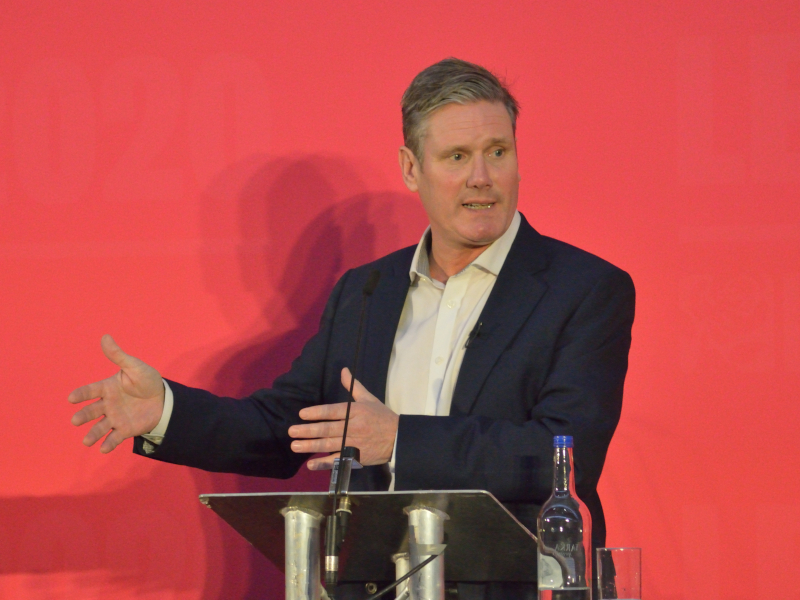
Labour leader Sir Kier Starmer has released an essay entitled “The Road Ahead”, setting out his beliefs and goals ahead of the 2021 Labour conference.
In his essay, Starmer writes of a nation “at a crossroads” between returning to the “same old Tory approach to economy and society” which he says is a con, and a Labour government in which “everyone has the chance to fulfil their potential and their ambition”, and everyone’s contributions to “a healthy society, safe communities and a strong economy (are) properly rewarded”. He separated the essay into “past”, “present”, and “future” sections, addressing climate change, public health and the pandemic, public safety, and the economy. These issues will surely lead to hot debate, but today we’re focusing on his plans surrounding education and employability.
In a section entitled “The best start in life for every child”, Starmer addressed issues at the primary and secondary school level. He pointed out that the UK had the “largest primary school classes in the developed world for the first time ever” in 2019 and promised to decrease inequalities between richer and poorer students. He also believes in modernising education, referencing data which states that fewer than 50% of British employers believe that full-time students leaving school have sufficient digital skills.
Starmer believes that vocational training is essential to developing relevant skills in school and university, but he is quick to point out that he has “no time for those who say that when it comes to poorer children, we should stick to the hard, vocational skills.” Starmer stated that all children should have the same access to extracurricular activities that those in independent schools do, with the belief that the ‘soft skills’ developed through these activities can greatly benefit children’s confidence, self-worth, and communication skills.
He outlined a desire to make sure that vocational training is not merely practical, but exciting, creating a system for young people “that is as ambitious as they are”. Starmer also lamented the “wasted potential” he sees in the current system, stating that children from all backgrounds must be given the tools needed to succeed in order to “remake the nation” following the pandemic and the failings he sees in the current educational system.
Turning to jobs, Starmer promised a “new deal for business and working people”. Addressing the relationship between government and businesses, he says that a Labour government will follow an approach “in which (they) don’t treat the economy as a battle for supremacy between public sector and private sector, but a joint effort”.
The main points of Starmer’s new deal include raising the minimum wage, ensuring that workers receive the rights they are entitled to by strengthening unions and closing current loopholes, and replacing universal credit with a social security system in which “work pays”.
Starmer says that he sees the shift towards sustainability and addressing climate change as an opportunity to create jobs. By building more offshore wind turbines, increasing clean steel manufacturing, and making Britain the leading producer of electric vehicles, Starmer hopes to create jobs for working people while reducing industry’s effects on the planet. He also announced targets to remove “the vast majority” of carbon emissions by 2030.
Starmer stated that the approach to the relationship between the government and the private sector must be a “partnership”, outlining expectations for businesses and promises from the government. Businesses must “play by the rules, respect their workforce, and contribute to their communities,” Starmer said, in order to enjoy the benefits of “a level playing field, a skilled workforce, and modern infrastructure from transport to public services” which he says a Labour government would provide.
On taxes, Starmer stated that the government officials should spend taxpayer money as if it were coming out of their own pockets, and accused the Conservative government of using the pandemic to “hand billions of pounds of taxpayer money to their mates and to flaunt the rules they expected everyone else to live by.” He also called for an end of “the shambolic experience of public procurement” and promised to “fix holes in the shoddy Brexit deal”.
In the past, Starmer has been accused of not being vocal enough about his views, and not making it clear to voters what he stands for. Some believe that this essay is his way of silencing critics before the Labour conference begins. He will speak at the conference in Brighton, which runs from Saturday the 25th to Wednesday the 29th of September.
Photo credit: By Rwendland – Own work, CC BY-SA 4.0, https://commons.wikimedia.org/w/index.php?curid=87235934
My parents came to these shores in 1978. I was 11 years old and I couldn’t speak a word of English – or very few words. I was a very proud young man in the sense that I didn’t want to make mistakes in class in school with my English, so I sat in the back of a class trying to string words together to make a sentence to join in the class. Of course by the time I made the sentence in my head, the subject matter had moved on!
So the teacher called my parents and said, “Look, we think that he has a learning disability because he is really not contributing at all.” And within six months of course I’d picked up the language, and very quickly worked out that this is an amazing country where there are many people are prepared to help a young man like myself.
There were lots of mentors who have helped me in my career. I went to University College London, where I read chemical engineering. Very fortuitously in many ways, I founded YouGov which has now become one of the United Kingdom’s unicorns, and is now worth over a billion dollars. I left that 10 years ago after taking it public. I am particularly proud now to be the Member of Parliament for Stratford-upon-Avon in the heart of England, which is the birthplace and the resting place of William Shakespeare.
All this means that every morning, I wake up and pinch myself to think that the boy from Baghdad, born to Kurdish parents, has achieved this. I attribute it to the extraordinary nature of this country which offers two gifts. One is freedom, and the other is opportunity. These two things embody everything which is great about the family of nations that makes up the United Kingdom.
I am sometimes asked how I relax in my high-pressure roles. One thing I love doing – and which everyone should do – is to walk, as it’s very good for the mind. During 2021, walking has kept me sane. I actually listened to a programme on Radio 4, and there was an advert for mental illness describing how the best way to combat that condition is to walk. If you ask me the best way to unwind is put on trainers and walk to work. We’ve been in a pressure cooker this past 18 months and I think it’s good for the soul.
The other thing I do is watch box sets late at night. By far the best we’ve watched so far has been Larry David’s Curb Your Enthusiasm, which simply can’t be outdone.
I’m asked sometimes which politician is the most misunderstood – I’d say definitely Theresa May. She can be amazingly passionate about a cause, especially on behalf of her constituents. I saw this in action recently. She came up to me in the House of Commons and said, “Nadhim, I really need to talk to you”. And I thought, ‘Wow, where is all this energy coming from?’.”
When I think back on what we did in the vaccines programme it was extraordinary. It was a truly impressive coming together of institutions, with the NHS at the centre of the core delivery mechanism, but people don’t know how absolutely embedded our Armed Forces were in that whole process. I particularly salute Brigadier Phil Prosser, who is the commander of the 101 Logistics brigade and is brilliant at delivering things to remote terrains and geographies around the world, in Iraq and Afghanistan.
I should add that the private sector has played an equally important role, with Boots and Superdrug at the back end of the chain. At the front end DHL has done a great job delivering the vaccines to the primary care networks. It was a real coming together of the private and public sectors. That’s before you count the 80,000 vaccinators that have gone through the training programme – or the 200,000 volunteers that have come forward to be marshals and receptionists.
Brigadier Prosser described it best. He said: “Minister, we’re building a supermarket chain in about a month, and we’re going to grow it about 20 per cent every week.” And I said: “That’s right, Brigadier, that’s exactly what we’re doing.”
I’ve never been a great policy man, or a think tanker. I love operational challenges, and I was grateful to the prime minister for picking up the phone in mid November, and saying, “Nadhim, I want you to do this job for your country.” It was a great privilege to do.
Of course, the press can sometimes make top-flight politics stressful. But the media have a job to do. This is a democracy. I will take an aggressive free press any day over a dictator. You only have to look at what’s happening to Russia, or the Uyghur people in China. A free press is what makes this country truly great. Is it challenging? No doubt. Can it be frustrating? Absolutely. But I value that freedom far more than I lament the challenges that come with it.
Nadhim Zahawi was talking to Emily Prescottand Robert Golding
On 3rd September 1939, as Great Britain teetered on the precipice of the second world war, the crackling voice of the BBC could be heard across the nation. The great British broadcaster was instrumental in Britain’s fight against fascism, acting (as they put it) as “informant, morale-booster, propaganda weapon”.
While there are many differences, the past year of pandemic has had its similarities to wartime – a comparison that’s been prompted in part by the tendency to describe our struggle against the virus as a ‘fight’ against an ‘enemy’. Covid-19 has brought about food shortages, the loss of loved ones and infringements on our liberty not seen since the dark days of the 1940s.
As was the case back then, times like these test the pillars of our democracy: as schoolchildren are plunged into another lockdown and integral years of educational development are compromised yet again, the BBC has stepped up to its role as a trusty national service.
It’s a good time for it to step up. Last year the validity of the BBC as a national service was called into question by gender pay disputes, issues with the license fee funding model, and grumbles over its political impartiality. Meanwhile, the Department for Education’s handling of the exams fiasco in the summer called into question whether it had young peoples’ futures under control.
Last week, the BBC promised millions of home-bound children across the country curriculum-based educational videos and resources on TV, online and BBC iPlayer, in what they are calling the “biggest education offer in [the BBC’s] history”. As well as providing essential (and entertaining) education for children in lockdown, the BBC’s decision will also come as a blessing for parents who are struggling to balance remote working with childcare.
Airing today, these will include content for younger children on CBBC and BBC Live Lesson and popular programmes like Horrible Histories, Celebrity Supply Teacher and Art Ninja for 3 hours every day. BBC Two will support secondary school students through classical drama and Shakespeare adaptations as well as science and history programmes.
The BBCs Director General Tim Davie said that “ensuring children across the UK have the opportunity to continue to follow the appropriate core parts of their nation’s school curriculum has been a key priority for the BBC throughout this past year.” The move signals the much awaited entrance of the new Director General: lets hope it’s a sign that the BBC is headed for clearer waters.
The decision to provide thousands of confined children – not to mention exhausted parents – with virtual learning tools remedies part of the damage woven by the government in its handling of school closures and exams. But is it enough? Parents still understandably lament the loss of face-to-face teaching, especially for younger pupils, and many do not welcome the shift to online learning with open arms.
Is this tech takeover a long term reality for education?
Like the switch to a remote working culture, however, this transition towards a digital learning environment is inevitable, and the pandemic has merely highlighted this inevitability.
Technology has begun to infuse most areas of our lives, and education is no exception: before the pandemic struck, age-old principles of education were beginning to change. Many predict that the concept of a physical classroom, whiteboards, and even teachers, will become outmoded as Artificial Intelligence and digital learning landscape play a greater role in education.
Traditional tools of learning like memorising information, handwriting, spelling and grammar may be irrelevant in the future and replaced by the omnipotent power of the internet. The younger generation will need to harness a whole different set of skills to help them manage new technology, interpret search results and even determine real news from fake news. And, as jobs in tech expand, the need to harness technological skills like coding, ‘Blockchain Technology’ (bitcoin and digital money), Virtual Technology or Data Analysis will be ever greater.
The digitalisation of education which the BBC has begun is not just a short term solution; it’s the long-term reality of a world governed by technology and online spaces. Just as the war redefined working habits and reformed the education system, the pandemic may be the final push needed for us to recognise the benefits – or, indeed, the inevitability – of an online education.
THE DIRECTOR OF STUDIES AT REGENT GROUP ON CHARACTER
The trouble with education is that it’s full of buzzwords, and too rarely do we pause to think about practical implications.
In the Blair years, citizenship education was a prominent preoccupation of schools and colleges in England and Wales – but the term sometimes lacked definition, and in any case, wasn’t citizenship an implication of the Cameron government’s Big Society agenda? Definitions tend to blur.
With the coalition government – and latterly the single party conservative governments – we have seen a shift in preoccupation, away from citizenship education and towards character education. So how do we avoid falling into generality and making the same mistakes again?
Fostering character sounds well and good – who could seriously object to it – but what does it mean? Simply, character seeks to cultivate resilience, courage, and personal responsibility. It also has intellectual pedigree, dating all the way back to Aristotle. In his Nicomachean Ethics the philosopher argues that character education creates virtuous individuals who live a good and meaningful life, a life full of happiness, purpose and achievement: this he called Eudemonia.
What’s interesting is that in character education these individual traits – resilience, grit, courage and so on – do not exist in isolation. They exist together: you cannot be courageous without being resilient, for example. What we seek to do at Regent College is to develop these psychological states so that students learn to better act, overcome obstacles and embrace challenges.
For Aristotle a person of good character has practical wisdom – phronesis: the ability to act in the right way, with courage, with resilience etc., because they have developed the correct habits. Furthermore, a good character can only be developed by choosing right actions over and over again until that right action becomes a habit. The goal is to repeat certain behaviours associated with the development of a good character, initially under guidance and instruction, until they become embedded as habits.
So does it work? At Regent College, we have founded a framework for character education to be delivered alongside our core curriculum. The project began in May 2019, and we have called it Thinking Into Character.
The programme is designed by Dr. Selva Pankaj and aims to give students a solid foundation in character education. Topics covered by the programme include goal setting, habit formation and the principles of personal leadership. Each lesson is designed to encourage students to take responsibility for their results and to develop the confidence to believe that they can achieve dream goals. Among some of the values and attitudes developed by the programme are personal responsibility, a positive mind set, resilience, grit and self-confidence.
It has had startling results. One example was Abdi Raman Fara, a bus-driver who wants to be a transport manager with his company. He felt he’d been with the company a long time and wasn’t progressing. Under our instruction, he spoke to his manager, who agreed to be his mentor. As a result a career action plan was implemented and he decided to start his own business. ‘My entire life has to be geared towards goals that I am happy to pursue. It’s about achieving your life goals, and not just in the short or medium term,’ he says.
Another case study was Amelia Giurgiu who had been too nervous to start turning her photography in Provence into painting. She was facing what we would call ‘the terror barrier’. For her character education enabled her to ‘take action and to show courage in the face of previously acknowledged fears’.
Meanwhile, Ahasan Habib, the founder and CEO of H&K Associates, found that an immersion in the programme ‘helped my business by showing me where I lacked discipline and holding me responsible for all my results.’
So the effectiveness of this character development programme is measured both objectively and subjectively. The subjective benefits are there for all to see in testimonials like those above. Objectively, we are looking at data such as grade attendance and assignment submission rates as well as external ventures that students have set up following their engagement with the programme. These ventures could be study groups, entrepreneurial businesses or engagement in voluntary programmes.
We still have a way to go and are at the data compilation phase, but the signs are very encouraging. And we hope that our programme will give others the impetus to think hard about the language we use in education theory, and to turn the theoretical into pragmatic and meaningful steps. Aristotle would be proud.
Our Woman in China gives us her take on the nuclear arms race in education between China and the rest of the world
This is going to be quite a year in China. There’s going to be about eight and a half million graduates in China – and that’s a figure which dwarfs any figure you can imagine in the UK. They’ll be graduating into the toughest job market in living memory.
It’s worth considering the history. Before 1990, China’s was essentially a planned economy and everybody had roles given by the state. Since then, the economy has grown by around ten percent a year. Unemployment has been incredibly low. Now lots of factors are happening at once. With Covid-19, there’s speculation that you have 100 million unemployed people in China right now.
Concurrently, you have automation which is happening dramatically in China, with every company becoming leaner. So all these graduates are going to be piling in to this very problematic situation. And there is such faith in education in China. In the 1980s and 90s, if you went abroad and studied, let’s say engineering, and you came back to China, it’s quite likely you’re a millionaire at this point, or senior in the government. Why? Because you brought back information that was incredibly valuable and gave you a massive strategic advantage. Because of that, you now have a generation of parents who believe education is a fast track to employment. That’s heart-breaking as the young today are ill-equipped for the modern world in terms of creativethinking and communication skills.
It’s an incredibly depressing situation. I speak to a lot of students doing undergraduate degrees and they’re looking at the realities of the economy and thinking, ‘Should I go and get a Masters?’ But even that doesn’t guarantee a job now – when for their parents’ generation, it did.
That means there’s a major problem for Chinese students studying in the UK: they’re not getting their return on investment. In China, these young people are called ‘sea turtles’: even after having studied in a good, solid university in the UK, they’re unable to get jobs. All this will be detrimental to the higher education system in the UK. There are 900,000 graduates from UK universities in China, and there could be a big shift where Chinese students start to wonder whether it’s worth studying abroad if you don’t get a job at the end of it.
I don’t think the effects will be felt immediately. Xi Jinping sent his daughter to Harvard. These wealthy people will have better connections, and so they’ll end up with jobs and power, and will end up running the country and the biggest companies. That’s a powerful example; it might take 20 or 30 years for these trends to be felt.
Working against all this is the fact that China is going to go global at some point. So if a young person understands the UK, they are going to be a natural person to go and work in that London office at some point. The historical trends are clear. In the 50s and 60s, China was all about manufacturing; suddenly in the 70s and 80s, we had Sony and all these other companies booming around the world. But global China is in the future. This year’s graduates will fall through the cracks because none of this will have kicked in yet.
As someone who has been here for 15 years, I would say the UK doesn’t understand that China is absolutely zero sum. China doesn’t want its students to go to the UK and spend lots of money. It wants to learn as much as it can from the UK, the US and Australia and then it wants to export its own education. You only need to read the state media to understand the undertones of what they’re really thinking and what they’re really plotting right now. The longerterm goal is that they don’t want to send anyone to the UK. That’s not explicit, but I would guarantee you it’s the case if you speak to the highest levels of government in China. Why would they want to give money to the UK?
I’ve probably become a bit more patriotic since I’ve been here: if I had to back a team, I’d like to back the UK. The UK education system is filled with people for whom education is a vocation. They believe in the system. They’re autonomous, and opinionated: it’s filled with brilliant people. In China, nobody has any autonomy; it is control-based. I don’t want that system to win. China’s version of history is that there is only one version of history. Our discipline of history is that you have analysis and the past is open to interpretation. It’s not a good thing when education is used as a weapon to control a population or to politicise everything. I would love to see the UK compete, but I fear that a lot of UK universities are very slow, siloed and very complacent. China is moving incredibly quickly.
It was Charles Dickens who said of the time of the French revolution that ‘it was the best of times, and the worst of times.’ The same might be said of Covid-19 in the education space.
On the one hand, there was much to celebrate. Some institutions already experienced with digital learning become ‘virtual schools’ within days; others too, prepared for remote learning with mere hours of staff training.
But throughout there was a sense that our educators responded to the learning needs of their pupils during the pandemic with what was available in their schools and colleges and what they felt able to use. The pandemic also laid bare the fact that you can’t afford to neglect infrastructure, teacher training and the provision of devices for our young people. Too many of our schools did not have the platforms, infrastructure and devices for pupils to maximize their use of remote learning.
It was good to see that many schools limited the learning loss as they grew in digital confidence. But on the whole the devolved nations did better than England: Wales, Scotland and Northern Ireland all had an array of content at their disposal as the virus broke.
In England, we had taken too long to publish and get to work on an Edtech strategy – it was only in 2019 due to the determination of Damian Hinds MP when he was serving as Secretary of State for Education, that DfE began to articulate the ‘Edtech Dividend’ for our system.
The point is that education technology doesn’t replace teachers: it supports them. Technology can consolidate knowledge and maximise learning opportunities for pupils. The introduction of the computing curriculum may have developed some specialised skills in some but has it been at the expense of broader digital skills for many?
In my view, it is not a failure for expensive reforms to be corrected before they properly flourish. In 2020, we can’t afford to be ambivalent about digital skills, confidence and digital literacy for our young people. The essential Digital Skills Framework for adults also shows us how much of a national challenge we have.
And as Covid-19 unfolded, these areas of neglect became clearer. I hope this will accelerate the use of Edtech across our education system. I want our government to be a ‘stubborn organiser’ of modern technology infrastructure for our schools, and promote the positives of digital learning. Nor should they shy away from leadership that liberates the talents of and the entrepreneurial flair of our Edtech company founders.
This is a sector deserving of more than an afterthought on an overlong list of ministerial responsibilities. Education technology is not a ‘mobile phones in school’ scare story or a ‘social media end of days’ nightmare but an imaginative set of tools to support and access learning. For many, it’s easier to lump all technology together in some dystopian playbook.
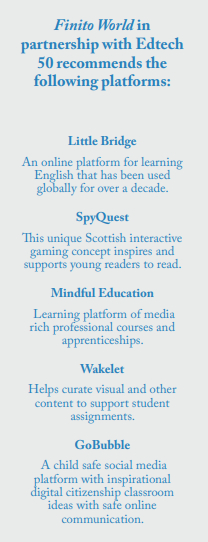
But this a sector that creates jobs, grows our exports for UK plc and attracts muchneeded investment. Our Edtech sector is vibrant (see panel opposite for some recommendations from the Edtech 50), growing and plays its full part in our ‘New Start’ Industrial Strategy. So what do we need to do? For me there are six easy steps.
Firstly, we need to build on the success of the rural broadband introduction with a staged approach to rolling out access to super-fast broadband to our schools.
Secondly, it’s vital that we become more ambitious about devices for pupils. Digital poverty is corrosive and can be ended. Let’s build national delivery of devices for young people – Year 8 is too late.
In the third place, now is the time for more professional development for teachers. I would argue that peer to peer support like the successful Edtech Demonstrator Programme is a model for national action.
Fourthly, we need to see the immediate changes to initial teacher education with training in education technology. This is another long overdue addition.
Fifthly, I believe we need to see priority for Edtech in the Ofsted Inspection Framework. There’s much to share about effective use of technology and much to learn from Wales and Scotland in their approach.
As a final point, we have to learn to appreciate the complexities of organisational change across our school estate. We need to focus on technology support but also ‘system’ support to introduce and embed changes.
If we can do all these things then I believe we can have a truly 21st century education system.
Guy Fowles found the rug swept from beneath his feet when Covid-19 hit. Here’s how he turned it around.
In February this year I was in the fortunate position of weighing up four job offers, all with reputable companies, all in different industries.
The job market was buoyant, particularly within the performance marketing vertical I specialise in, but despite the many opportunities it had still been a long, arduous journey to get to the point of receiving an offer.
There were countless applications, many initial phone calls, multiple faceto-face interviews and a number of psychometric tests and presentations over the course of a few months, not to mention the research, prep, travel, logistics and thought process that goes into each and every interaction with a potential new employer. It was exhausting and stressful, particularly as a new parent.
For one role with an exciting start-up, I’d been through five stages and spent around 40 hours in total preparing, interviewing and presenting to them, only to learn they’d gone for the other candidate after the final stage. I didn’t mind the drawn-out process to decide on the right person, but the lack of constructive feedback afterwards was extremely disappointing given the time I’d invested.
For another final-round interview I was asked to drive to the north-west to the company’s UK headquarters, a 10-hour round trip, for a 60-minute interview, only to be told over a short phone call a few days later that I’d been unsuccessful. There was no offer to cover any travel costs.
My experience within the job market earlier this year equipped me for what happened next.
Within two months of starting a great role at a global events company, who bring people together to create unforgettable experiences, the company made 50 percent of its global workforce redundant, centralising resources back to their HQ in San Francisco. Frustratingly, it was time to climb back into the search saddle.
This time though, things were different. There were still roles available, but already, in May, the number of applicants for jobs advertised on LinkedIn had gone up from around 100 per role to over 250. During a number of conversations I was then told the positions I’d applied for were suddenly put on hold due to Covid-19.
The process itself also changed – initial phone calls turned into Zoom video calls, which I think is a positive step, and subsequent interviews obviously had to be done by video too, which, whilst you lose that physical interaction that meeting in person affords, saved on travel time, which made a big difference when also trying to look after a baby.
Covid-19 changed the location of the jobs I went for. Given the shifting nature of working remotely within a number of industries, I was able to expand my search to outside the confines of the M25. This can only be a good thing for both employers and employees as it enables companies to attract the highest quality workers, unrestricted by geography, and then offer them rewarding benefits such as the ability to work from home or flexible working.
In June I was lucky to come across my dream role heading up the Marketing and Communications team for the National Literacy Trust. The Trust works to improve the reading, writing, speaking and listening skills in the communities that need support, where one in three people have literacy problems.
The interview process was clear and concise, held on three consecutive Fridays to allow both sides time to prepare for the next stage. I researched the role, my interviewers and the Trust itself thoroughly, and as I did so I became more and more impassioned about the job and joining the team. I met a cross section of employees over Zoom, and an external partner, and after a presentation and one final meeting I was absolutely thrilled to be offered the position. All in all it had taken about a month from start to finish.
Searching for a job can be a draining, demoralising process. However, it can also be exhilarating, stimulating and ultimately hugely rewarding. It is most definitely a journey that will propel you through twists and turns, highs and lows, dead ends and suddenly, the right path for you. Treat every conversation as you taking one more step on that journey.
With this in mind be prepared to put yourself out there, tailor your cover letter for each role, put in the time to look into your interviewers, prepare engaging questions that demonstrate you’ve really thought about the role, show your willingness to learn, develop and grow and, once in the role, prove that you will be a valued member of the team through your actions.
The National Literacy Trust helps to transform lives through literacy. Whilst my previous role was cut short due to Covid-19, I can’t think of anything else I’d rather be doing than trying to make a difference to the lives of children, young people and families that need it most. I’ve now been in the role for two months and I couldn’t be happier – it’s a fantastic team to be a part of.
If you have any questions about my job search, or would like advice about your own, please drop me a line at linkedin.com/ in/guyfowles
Christopher Jackson asks whether it’s now time for a National Education Service and finds a party unsure of the way forward
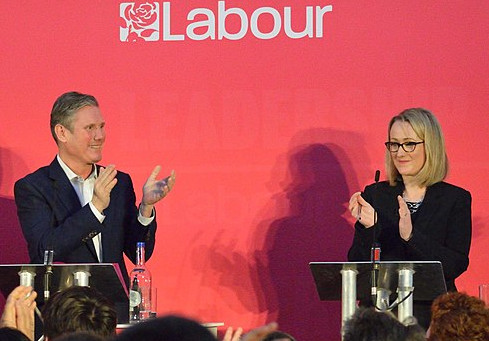
As Sir Keir Starmer takes the reins of the Labor Party, how can the Party seize the narrative on education and finally connect it to employability?
As you walk through Camberwell, every other house has a rainbow, proclaiming not just that household’s gratitude to the NHS, but the presence of home-schooled children within. Education is all around us in virus season: it is on our minds in a way it hasn’t been for years.
But that can sometimes seem the limit of the good news. ‘Education hasn’t had a good crisis,’ as former education secretary Estelle Morris tells us on page 14. Part of this is due to the peculiar nature of the crisis: for the many senior Labor figures we spoke to for this piece, coronavirus was a problem designed to exacerbate existing problems of inequality and, with children taken out of school, always destined to be a different moment than the frontlines camaraderie that has defined the experience of those working in the NHS.
Of those we spoke with, many lamented the lack of leadership from both the government and from the Labor front bench. During the composition of this piece, Rebecca Long-Bailey was demoted from her role as shadow education secretary due to a retweet of problematic remarks by actress Maxine Peake. She was replaced by Kate Green who at time of going to press was still finding her feet in the job.
With the schools not yet back, all this contributed to a moment of pause. Under the empty skies, it felt like an intellectual reckoning was possible. After a decade of Conservative-led rule where should the left be on education?
A Tale of Two Speeches
Two quotes from two speeches, both given by Labor leaders in Black pool.
The first: ‘Just think of it – Britain, the skills superpower of the world. Why not? Why can’t we do it? Achievement, aspiration fulfilled for all our people.’
The second: ‘Tomorrow’s jobs are in green and high-tech industries. We need people to have the skills to take on those jobs, breathing new life into communities.’
On the face of it, it would be difficult to tell apart the words of Tony Blair in 1996 (the first quotation) and the words of Jeremy Corbyn in 2019 (the second). Both open up onto a cherished idea for the Labor Party: that a commitment to education is an integral part of the party’s offer to the electorate.
But scratch the surface, and differences proliferate, which still matter and must be resolved by the still relatively new Labor leader Keir Starmer.
Blair spoke eloquently about investment, and with a can-do spirit about placing education first. But he would likely have seen Jeremy Corbyn’s espousal during the 2019 General Election campaign of a ‘National Education Service (NES)’ which was, like the NHS, ‘free at the point of use’, as a return to the socialist ideas of the past.
As we all know, the Corbyn program was soundly repudiated by the British electorate in December 2019. But looking back at that election, it is startling – and a little depressing – how little education was discussed.
As a result, it would be an exaggeration to say that the public rejected Labor’s education policy. Furthermore, we now inhabit different times where the government – even a Conservative one – has entered our lives in ways which would have seemed fanciful six months ago.
So is the idea still relevant?
And if it isn’t, where should the Labor Party go instead?
Meet the Commission
Among those who advised the government on its life-learning strategy – intended to form part of the NES offer – was the likeable Professor Ewart Keep, who holds a Chair at Oxford University in Education, Training and Skills.
Brought in to assist with the Party’s Lifelong Learning Commission, Keep never felt particularly wedded to the NES idea: ‘Part of the problem was there was a headline slogan that emerged very suddenly and then there was an attempt to put things underneath that heading. We tried to sketch out what adult lifelong learning would look like in the context of an as yet unspecified National Education Service,’ he explains.
There is a degree of comedy here which will feel to some very redolent of Cronyism: the very people brought into produce an enquiry skeptical about its overarching aims.
Internal operatives tell me that things are far slicker under Starmer. Was this an attempt simply to evoke one of Labor’s greatest hits – the NHS – and tether it to an unrelated area? Keep continues: ‘they’re very different activities – particularly when you consider that one of the weaknesses of the NHS is that it doesn’t succeed in preventing illness: you’re treating people who are sick. Education is trying to be a preventative medicine. It felt misleading and not particularly helpful.’
It is this sort of thing which Starmer will need to avoid in order to dodge amused disparagement from the education intelligentsia. When I speak to Phillip Blond, chair of Respublica, he announces cheerfully, ‘I generally regard the left with absolute contempt so you better to talk to Mark.’
This turns out to be Mark Morin, also of Respublica, who has seen the NES idea knocked about for years, ‘and it’s never particularly excited anyone.’ He goes on to point out: ‘On the one hand, you can understand it intuitively with the reference to the NHS and the idea it will kind of bring together all aspects of learning education and skills from cradle to grave – that’s intuitively understood. But when you get past this you’re left with a leftist, statist idea and a big monolithic entity like the NHS.’ For Morin, who points to the poor health outcomes in the UK compared to countries like Germany who have a more localized system, the NHS is not only something the education system couldn’t emulate, such emulation would also not be desirable.
If you talk to Sir Michael Barber (see page 7), Blair’s former chief education advisor, he swiftly disowns himself of anything remotely connected to Cronyism: ‘I would rather just have a conversation about new radical approaches for education.’ For Barber too, the very language of the left opens up onto a grim vista of statism.
A meeting in St James’ Park
When I contact Estelle Morris – now Baroness of Yardley – I am pleased, and a bit surprised, when she says she’d like to meet in person. I take myself up to the ghostly center of town, to St James’ Park on a drizzly July day. We walk along the lake on one of those tentative lockdown days we’ve all had when we’re not sure if our favorite coffee shop will be open. It is, and we sip our coffees, grateful for this minor return to normalcy.
So what exactly is the NES? Like Morin and Barber, Morris is a little baffled. ‘That was my question as well. I thought it was a great idea but there was a real risk it became a slogan and a slogan only. It’s a great concept and I don’t think we filled it out. I’m stuck to have a ten-minute conversation about what we offered about it.’
So is the NES an immediate nonstarter? That’s where Morris differs slightly. For her, everything depends on Labor’s commitment to detail. ‘The NHS represented a radical change and revolution in healthcare. So don’t claim the title unless you’ve done the work. The title doesn’t come before the work.’
It is worth adding that when one reads the speech where Corbyn launched the NES idea, it is noticeably less detailed than a typical pre-power speech by Blair, where the party can sometimes seem to be governing even in opposition. This is a mistake unlikely to be repeated by the more details-oriented Starmer.
So what message does Morris have for Starmer? Now is the time, she says, to launch something truly radical. ‘From 1988 until now, there’s not been a lot of changes in education; the narrative has been the same: national curriculum, national assessment, and external inspection, publication of results, parental choice and focus on standards.’ The tale has been one of back-and-forth between the two major parties and tweaking around the edges. ‘The narrative from 1988 until now has been the same. I don’t think it was wrong to have let that narrative run for as long as we have done. Schools are better now and children get a better deal because of national curriculum accountability. But it’s all come to a natural end.’
But if Morris espouses an end to all this ‘fiddling’, what comes next? ‘We need a debate about the value of art, the value of sports and the value of community service.’
In part, what Morris is espousing is a move away from the so-called character agenda which, though espoused by many Education Secretaries, is now particularly associated with Nicky Morgan, who held the secretary ship at education from 2014 until 2016. Morris wants instead a system which teaches ‘citizenship and wisdom’.
But surely every side of the political spectrum will have a different idea of that? For Boris Johnson, wisdom is Conservatism; for Starmer, it will be socialism. But Morris says this is a debate we urgently need to have. And wisdom she says is difficult to have without some appreciation of the arts.
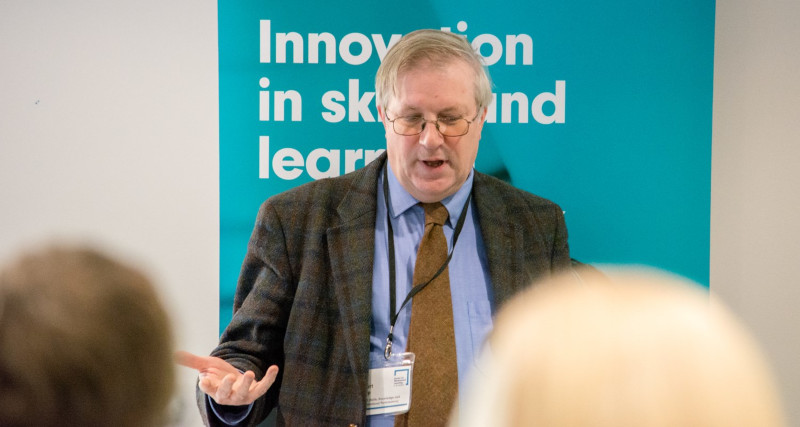
Professor Ewart Keep speaks at PRAXIS 2 in Scotland
Picture Imperfect
Perhaps we need to think more about how we promote things we know to be good. The force behind Lee Elliot Major’s proposal of a National Tutoring Service (see page 15) stemmed from the demonstrable value of the one-to-one tutoring experience.
For Susan Coles, the former president of NSEAD who set up an APPG in Parliament to promote greater coverage of the arts in our education system, the benefits of an arts education are equally clear. She worries that character is talked about as a ‘box you tick’ when, in fact, ‘the arts create resilience’ enabling you to ‘follow your own ideas without being wrong.’
For Coles, and for Sharon Hodgson MP who chairs her All-Party Parliamentary Groups (APPG) (see page 27), what we have now is a ‘production line of high performing schools which is strangling the creative arts.’ Coles puts her views with the kindly persuasiveness of the truly passionate: she is one of those campaigners who is herself an advert for the sort of change she wants to see. ‘We’re coerced into believing the knowledge based curriculum is best, when in fact the arts enable us to make mistakes and experiment,’ she explains.
This was one area where Corbyn wasn’t entirely idle in putting forward the detail behind the NES, stating in his Black pool speech: ‘The best is every child being able to learn musical instruments, drama and dance – the things that bring us joy – through our Arts Pupil Premium.’ For Hodgson and Coles this was an exciting moment, scotched only in December 2019 when Johnson was returned to power so thumping.
So should it be part of the NES? While Coles appreciates the idea, she worries it is too little: ‘The only worry I have is there’s no guarantee it will be in the curriculum.’
This, too, is where the eternal argument regarding free schools comes in. The schools minister Nick Gibbs would remind Coles and Hodgson that art is on the curriculum, but Coles – and the likes of writer Michael Rosen – would retort that it ought to be a core subject. Even if you resolve that part of the debate, you’re still left with the fact that academies are not obliged to teach it, and since 80 percent of secondary schools are academies and so are a large number of primaries, that’s a problem. Furthermore, there is the exclusion of the arts from the uber Gove Ian and, to Labor, loathed ‘EBacc.
’For Coles and Hodgson an opportunity is being missed, and for no decent reason. Coles continues: ‘If you do a teaching qualification, you learn how to teach the arts for around 2-3 hours in a 3-year course. So we have a lot of inexperienced teachers who are struggling to teach the arts curriculum.’
The great irony in all this is that the arts appears to benefit the economy. ‘They’re valued by the Treasury but not by the education department and DCMS,’ says Hodgson.
The Bonfire of the Quangos
This opens up onto another perennial question: that of the structure of the entire system, and indeed the very nature of our civil service and the balance between national and local government.
When I ask Professor Keep where he would begin in terms of fixing the English education system, he says. ‘The problem in England is that it’s very siloes.
Even different bits of DfE don’t talk to one another. In education, central government controls so much. They have to deal with such a level of detail: it’s difficult for them to grasp the big picture.’
So what needs to change? ‘We’ve gradually abolished all the intermediary bodies, which means everything’s an atomized marketplace. This isn’t functional for those who have to run it, and deliver education. I’d want to create relatively independent organizations which can act as a bridge between government and providers and also as a bridge between government and employers.’
Keep is referring to the Learning and Skills Council (abolished in 2015-16) and the UK Commission for Employment and Skills, which was wound down in March 2017. For Keep, the restitution of these would necessarily exist alongside some devolution of power and decision-making to the regions. The overall goal would be ‘bottom up thinking’ and a move away from a system where everything is ‘controlled by the minister.’
Mark Morin partially agrees: ‘We had the bonfire of the quangos under the Coalition. Some were well-deserving of that. The Commission for Employment and Skills was one of the most useless, and survived for a long time.’
Morin argues that any National Education Service would need to be rebranded along devolved lines: ‘It can be packaged in a different way and be marketed in a different way, with devolution at the heart of how this is going to be funded,’ he explains.
The civil service also needs a rethink, according to Keep. ‘Most civil servants do 18 months tops within a role. Every time I go to a meeting on higher education, it’s a totally different room of people. The last lot have all bloody left.’ This is a view echoed by Sir Michael Barber on page seven of this publication.
Universal problems
At the same time, we have a university system that increasingly seems unfit for purpose, and struggling to adapt to the new realities of online learning.
Keep explains: ‘A lot of universities were in big financial trouble before Covid-19 arrived. After 2009, many went and splurged vast amounts of borrowed money on new nice halls of residence, new nice student bars, and gymnasiums – and of course it’s all borrowed from the banks. £8 billion of borrowing has to be repaid, and the interest rate racks up on that.’ So how bad is it? ‘There were strong rumors there were at least 20 universities in England that were likely to get into significant financial difficulties in the next year and you can increase that number very considerably now.’
Morin adds: ‘We’ve created something that is too big to fail. Our universities are in trouble. How do we bail them out? One bad decision has been compounding another. We argued in the report we put out an the end of last year that we needed to stop sending so many people to university.
Does Respublica have any specific proposals? ‘We’ve argued that we need to get rid of tuition fees. It’s a smoke and mirrors thing, it’s just accounting practices: in effect, the government picks up the tab for those who can’t afford it. It’s basically a tax on those who can afford to pay for it because they graduate and earn enough to trigger a repayment. The real issue is we’re sending too many people to university, but to what purpose?’
That’s a view echoed also by Euan Blair, the tech entrepreneur with the famous father whose business White Hat, which he chairs, is unafraid to proclaim university a waste of time. Talking to Blair is a curious education in the Blair genetics and how they have played out in the next generation. It is as if the same incisiveness and ability to explain complex things in simple language which saw his father dominate British politics for a decade has been handed down a generation into a born tech entrepreneur.
For Blair, universities have failed to prepare children properly for an AI-dominated labor market. ‘I think that there will always be and should always be a place for purely academic learning in a university environment,’ he admits. ‘The challenge is that the system has become this monopoly on early careers in a really negative way. That’s made universities complacent and it’s created this lack of equal access to opportunity, particularly around careers.’
Whether Labor chooses to proceed with a National Education Service or with some other label, the Starmer offer will need to address a creaking university system, as well as the question of digital poverty in an age of online learning, and the perennial question of lifelong learning. If this is done meticulously, perhaps something will emerge worthy of the NES brand name
Will You Still Feed Me?
Stephen Evans, the CEO of the Learning and Work Institute, sat on the same commission as Keep in the run-up to the 2019 general election. For him, if the National Education Service is to have any meaning then it needs to solve the problem of keeping adults learning throughout life.
He argues that lifelong learning can come in many forms from an apprenticeship to a change of career, or it can come in the form of informal community classes.
‘We need to build a more coherent system,’ he tells me over Zoom. ‘For me the NES was about this idea that we need to do much more learning throughout life.’ What kind of financial structures is he espousing? ‘Clearly you don’t need government to fund some lifelong learning. But for those people who missed out and struggled at school, they might need to be covered by a National Education Service. The question is: ‘How do we create a culture of learning and get more people wanting to go back into learning?’
So it would be something of a patchwork quilt model? ‘If you’ve already got a degree, you’re more likely to get training at work. And if you’ve got no qualifications, I would say the government should have a role alongside trade unions and others to try and reverse some of those inequalities.’
Keep agrees: ‘Lots of adults receive no training from their employers. A lot of the adult workforce leave school and college, and then don’t get much training. If you’re in a low paid job, the chances of getting trained are very limited. When you look at England and the UK as a whole, we’re a long way behind many developed countries.’ When does the problem date from? ‘In 2010, funding for it got cut, and the adult education budget has declined by more than 45 percent and there’s a lot less money from the government. Employers are doing less and less.’
The Shape of Things to Come
I begin to get a sense of what this might look like. A National Education Service would need to intelligently join up the dots.
It might involve an acceptance of how we are failing to promote the arts, but also make us think in a more joined up way about the digital side, looking to tackle digital poverty (as outlined by Sir Michael Barber on page 7). It might also incorporate some of Lee Elliot Major’s ideas on tutoring, and build on what has already been agreed to by the Johnson administration (see page 15); the NES could potentially expand them into some form of mentoring service. The project might also involve greater investment in apprenticeships (see Robert Halfon on page 13), and a lifelong learning approach, where the state intervenes strategically to satisfy existing gaps. All this might be capped by Estelle Morris’ commitment to the promotion of wisdom and citizenship in place of – or perhaps in addition to – the Conservative years’ emphasis on character-building.
All in all, Starmer’s Labor has a complex inheritance on education. It has produced a reasonably compelling idea too soon, without, as Morris says, having done sufficient work. The spectre of Tony Blair cannot now be entirely dismissed after the 2019 general election defeat, but he remains a figure whose toxicity remains surprisingly persistent
Alongside these internal developments, there is a lot of dissatisfaction with the system and developments under successive Conservative-led governments. If all these points could be joined up, they might make a compelling proposition.
A final complexity is the precise historical circumstances Starmer finds himself in – or ‘events, dear boy, events’ as Harold Macmillan had it. A coherent education policy must be enacted, and priorities established, at a time when the virus, Black Lives Matter (see our leader on page two), climate change, and the new realities of work in the furlough era must also be solved.
Keir’s Choice
The fact remains that Starmer will need to unite the left and the right of his party on one of its core priorities. One way to do this might be to appropriate a slogan from the Corbin era but put some more intricate and thoughtful policies underneath it. Another way would be to admit that the NES is tarnished, and find some new banner under which to build a new platform.
Much will naturally depend on Starmer himself. So what are the new leader’s instincts on education?
There is surprisingly little in the public domain on this, and Labour operatives we spoke to talked of a tight-knit disciplined circle where there are few leaks as to what the leadership is thinking.
Lee Elliot Major recalls meeting the future Labour leader in their shared constituency during the Corbyn years: ‘I met Keir for coffee. He was on top of all the education issues of that day. At that point we were in the world of Corbyn, and at that time you were thinking someone like Starmer wouldn’t get in. Though education wasn’t his brief, he grilled me. He’s not ideologically obsessed: voters will vote for that, generally people like I worry about extremes.’
As often with Starmer, this sounds promising. But it’s early days, and, wherever the party ends up on this, work has to be done – and everybody who contributed to this piece agrees there’s not a moment to lose.
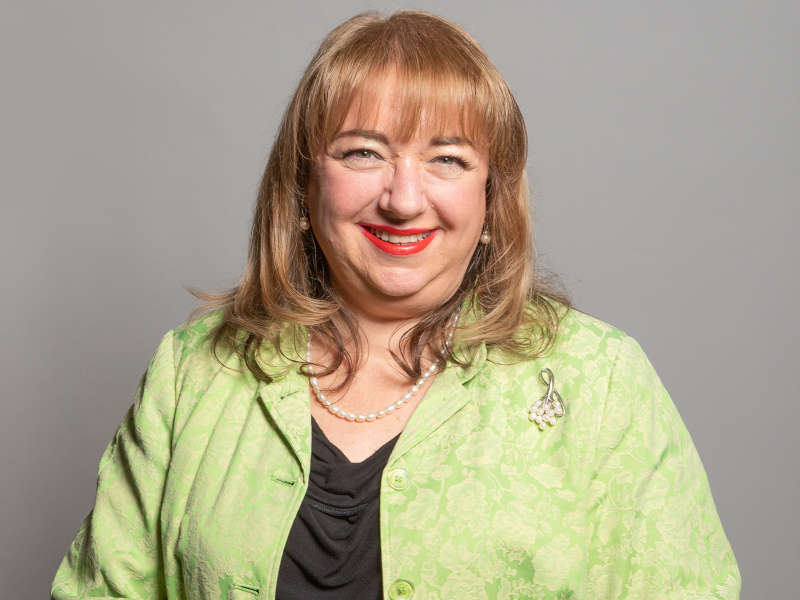
The Shadow Minister for Veterans Sharon Hodgson explains how a broader arts-based curriculum could transform our economy.
It was Jeremy Corbyn who first came up with the idea of an arts pupil premium that might be used to close the gap for disadvantaged children. Myself and Susan Coles – with whom I set up the All-Party Parliamentary Group on Arts Education – were excited when we heard the announcement. It seemed the right thing to do: if you grow up in households where the arts are appreciated that just happens. Usually it’s poorer households that don’t get that cultural capacity.
School is meant to be a leveler and an equalizer. Lockdown has shown that when you take school out of the equation it really does lay bare not just the inequality in economics but cultural inequality. A whole generation of people are then going to be the best part of a year behind. Some will have had an amazing lockdown education, but overall the cultural gap will have widened.
You hear a lot from the Conservatives about character in education, but it’s my belief that the arts are the best teacher of resilience and confidence: in the arts, you tend to try and fail before you get it right. That’s definitely what you need in an employee when they get into a workplace, no matter what work is conducted in that place. If all you’ve got is someone filled with knowledge and the ability to pass exams, then they’ve got no capacity to think outside the box.
They’ll have no capacity for innovation or freedom of thought; they might only have been told what’s right and what’s wrong. They lack the creative freedom and too often seek instruction from their employer.
That’s why the Chinese have started looking here for our creative education – and the same is true in Singapore and South Korea. Those countries have tended to churn out people who are good at passing exams. The irony is that just as they’re looking to learn creativity off us, we’re leaving creative learning behind in our state sector.
What’s really required is a broad and balanced curriculum. In Wales from September 2020 there’s been a new curriculum with arts and well-being taught as a mandatory part of the curriculum. The same is true in Scotland, where the arts are also valued. What we are aiming for is for the arts to be elevated to that extent in England.
Some people have criticized the idea of the arts pupil premium as being all about ephemeral away days – trips to the theatre and museums, and so on. There’s nothing wrong with away days, but it needn’t be only that. Imaginative teachers could use it for a whole host of things. Under Corbyn, we imagined that if we did have an arts pupil premium we might give guidance to make sure teachers understood the range of things it might be used for: it could be used to buy fantastic art materials, to recruit amazing teacher specialists, or to bring artists into the school setting.
The argument is clear – and if anything, it’s been brought into sharper focus by the pandemic. More and more children under lockdown are having troubles with their mental health – and we know that art is able to help with that. I’m not saying that Math and English don’t give joy, but our spare time as adults is usually spent around the arts but in school that seems to have been left to one side, by people like Nick Gibb especially.
The irony is that the creative industries are valued by the Treasury but not so much by the Department of Education. There’s no joined-up thinking across government. We’ve had five education secretaries in ten years, and unfortunately Nick Gibb has been around for a lot longer than I would have liked. I don’t wish him ill – I just wish him into another job. He doesn’t have a background in anything to do with arts and education. He has fully bought into Michael Gove’s ideological stance.
It’s because of Gove that our APPG was formed. The EBacc has been especially problematic in terms of its unintended consequences for the arts. Gibbs came to our APPG and we told him he needed to acknowledge the effects of the EBacc. We had 80 experts in the room and Gibbs simply stated that he had an ‘alternative set of facts’.
The trouble with academies is that they create a system of ‘postcode luck’ with regards to whether you have access to the arts. Sometimes the free school system allows schools to be innovative but at others they detract from what should be a standard. We may have to look at governance again and consider getting schools back under local authority control.



 On the one hand, there was much to celebrate. Some institutions already experienced with digital learning become ‘virtual schools’ within days; others too, prepared for remote learning with mere hours of staff training.