Tag: Edtech

  • Edtech Interview: Plum Innovations founder Ji Li on the rise of remote learning

    Christopher Jackson


    By the time I talk to Ji Li the pandemic has receded enough that I could probably meet with him face to face, but it’s fitting that I don’t. That’s because our conversation is all about the way in which information technology has changed in schools over the last twenty years or so – and the remarkable ramifications that’s had for education in this country.

    Li is the CEO and founder of Plum Innovations which specialises in the provision of education technology to schools, and so is well-placed to give an overview. “It’s a fascinating evolution,” Li says over Zoom. “It helps to look a bit deeper at the statistics to consider the scale of the change. According to the British Education Supplier Association Research, in 1998 there were 820,000 computers in schools in the UK. That amounts to about 31 computers per school.”

    It’s worth briefly concentrating on that statistic, and thinking about what it meant. This was a world without that culture we’re familiar with: a laptop for every table – a computer as a kind of accessory of yourself. And of course that had ramifications for schools. “As a result of that,” Li explains, “most of the schools in the UK were serviced by local authority IT technicians.”

    But then Li produces the latest statistics: “However, in 2019, before the pandemic, there were over three million computers in schools. And you also have to remember that during the pandemic – because of the way that period went – that number has increased dramatically.”

    Those statistics aren’t yet available but are likely to be equally eye-popping when they are released. So what are the ramifications of that seismic change for the IT industry? “The IT landscape has changed absolutely. But what’s most notable is the way in which schools have relatively limited budgets and so technicians have to provide a cost-effective way to manage large quantities of computers – and they have to do that still with very limited time. They might still only visit each school once or twice a week.”

    It’s a radical but also exciting change – although, of course, it places stress on teachers, parents, students and the education technology industry alike. But Li also points out that it’s taken place alongside another development which might be deemed to be as significant in its way. “This trend for remote-learning and remote-working has come along at a time when there has also been a dramatic expansion in the number of multi academy trusts,” he says. “Before these came along, most of the computers were located in one premises – and so the technician’s role would be to attend that site, and whatever problem needed solving would be done there, within that boundary.”

    That might feel like a simple way of servicing schools, but of course it also places a certain strain on the technician involved. “Not only has the quantity of computers increased but the workload has too, and technicians have had to change their schedules in order to meet other requirements. On top of that,” Li continues, “another issue must be navigated: a good education technology company will also need to service the question of working from home and working at school – and that may even include servicing the parents as well. So I think all this has changed the way in which technicians work with schools, and how they can work more closely with providers. It comes down to a question of there being far more devices in circulation in schools – but a perennially limited budget.”

    All that, of course, means that Li, who has a team of four, has to pay extra attention to looking after his staff, as well as making sure that all things run like clockwork in the schools which he services. “The workload my technicians have is something we have to think about – but also we deal with the fact that every day we’re confronting new challenges. That’s part of the joy of working in a changing industry. But it also means that I need to make sure I concentrate on the well-being of my technicians – because that’s important to the schools as well.”

    So how does Ji Li cope with all this? This is where it helps to be a small and nimble business, he says: “As Plum, we’re quite small and more flexible than a large company and can adapt to changing situations. When teachers work remotely, we also work remotely so we don’t have to visit all different physical locations.” It’s details like this which make you realise how Li’s success is partly due to an ability to be in lockstep with his schools. Li continues: “We’ve also been very diligent about setting up a proper infrastructure so that when we have more devices we can manage them in a centralised unified platform and that reduces workloads.”

    The more time you spend with Li, the more you realise that what sets him apart is his passion for education – and his admiration for the teachers he works with. “We also work with teachers who are tech-savvy,” he explains. “And we work with teachers until they feel they’ve become used to the technology we’re all working with. That way everything goes smoother. It’s a challenge for them sometimes on the IT side – so our job is to reduce this stress wherever we can.”

    And how do schools feel about this seismic shift? Li is admiring of the headteachers he works with and their ability to see the bigger picture. “A good leader in schools will know what’s happening in their schools – and the ones I speak to are simply happy that they have more devices to access. The most important thing we can do is create a trusted relationship with schools, and send a positive message about the potential for IT learning.”

    And how are teachers handling the shift? Li is very positive about this. “In one of my schools in Kent, one of the teachers was pinged during the pandemic and told he had to work from home. But there weren’t enough supply teachers. Luckily, we had enough laptops for the class. So the teacher in question was able to be at home and do a Zoom call with his teaching assistant to plan the lesson. He was then able to do the whole class on Zoom, and the assistant was able to be present in the classroom. This was a huge reduction in stress for everyone – without that arrangement, the children would have missed the whole day.”

    What is enjoyable in this story is the sense we get of how much each day matters in a child’s education. Another positive is that the pandemic has accelerated teachers’ familiarity with technology. “Throughout the past two years, teachers are up to speed now. During lockdown, teachers had to use these platforms,” Li explains.

    Talking with Ji Li, I am struck by his passion for education, and his desire to drive things forward: “I’m lucky to work with schools who continue to utilise the equipment they became accustomed to throughout the pandemic. When they can, they want to teach in class, but they also understand the importance of digital skills especially from the top down. Headteachers know that for future generations digital skills are going to be vital.”

    All this makes for considerable job satisfaction for Ji Li, and for those working with him. “It’s a great feeling,” he says. “Before the pandemic and during it, we’ve tried to see how we can be ahead of the curve and that’s what we’ve done.” They certainly have.



  • Edtech interview: Plum Innovations founder Ji Li

    Edtech interview: Plum Innovations founder Ji Li

    Christopher Jackson interviews the founder of impressive start-up Plum Innovations, a company with the wind in its sails

    The young Edtech company Plum Innovations is one of the success stories of the pandemic. When you talk to its founder Ji Li, you soon feel pleased for him: there’s always room in the world for unassuming and competent leaders.

    Plum’s business is to assist its client base – which consists of an impressive range of 14 primary schools – with their Edtech delivery. 

    Li comes from Shanghai, China and has seen the business which he founded as a sole trader in 2014 in grow by word of mouth: “I was working for a school and the head teacher recommended me by word of mouth.” He had soon incorporated Plum Innovations and has now grown the business to four people.

    So how does the business work? Li works with schools to set up their Google systems and make sure that the teachers are confident with Google Classroom, a system which, Li argues, has many benefits: “It’s really powerful, but it’s also cloud-based, and it’s secure,” he tells me. “In addition, it’s free and teachers can access their files remotely regardless of where they are.” 

    Li points out that his business is especially helpful to teachers now that there has been an expansion in multi-academy trusts which means that teachers have to work in different schools. “That definitely gave a push and means that people realise what benefits they can derive from cloud-based platforms,” Li explains

    Clients were helped through the pandemic by Li and his team. “My wife and kids flew to China in January 2020. Then Chinese schools switched to remote-learning in February,” Li recalls. “The government announced that schools were moving to remote-learning. So I was able to provide my clients with warning and the right infrastructure to cope.”

    Li has a scrupulously polite and efficient manner, but beneath the unassuming demeanour this is also a fierce advocate for making sure teachers are empowered by technology. You get the impression he really wants schools to function better – and knows that Plum Innovations is able to make that happen. 

    “That’s the difference between us and other tech companies,” Li says. “We want to give teachers the power and the ability to use technology themselves.” Li doesn’t want anyone to walk away from these sessions without a greater sense of excitement not just about technology but about teaching generally. “We work closely with computing leaders so teachers can be trained with necessary digital skills as much as possible. In return, we have learned a lot from our teachers too.”

    Li is also animated by a keen social conscience. During our conversation, he repeatedly expresses his concern that those in disadvantaged backgrounds lack access to technology: “Parents don’t have enough knowledge about how to work, and so we have been helping schools deal with parents as well.” 

    Plum Innovations remains a small company – Li even calls it a ‘micro company’, and the firm has no grand sales operation, even though it has won several awards. “We basically just try to do a good job, and then grow organically.”

    When discussing the overall impact of the pandemic, he says: “Remote-learning cannot replace class-learning at all – you need to have in-person interaction from the teacher. We need to move towards blended learning, where you use the time at home to memorise or understand theories – then put them into practice in the classroom.”

    Once you’ve finished talking to him, you realise that Plum’s success isn’t just to do with technical knowledge and smart delivery systems: it’s to do with the fact that Li has a passion for education. 

  • The A-Z of launching a new business

    The A-Z of launching a new business

    Simon Hay and Joe Mathewson

    Sometimes businesses get started for the most every day reasons. In our case it was procrastination. We were both studying for our GCSEs and were happy to do anything other than revision. 

    It was 1999 and the internet was really taking off. We were frustrated that we couldn’t access any school work online. During study leave we’d need to cycle back and forth to school to pick up printouts, revision advice and tests. Our bedrooms were in complete chaos with paper and revision notes everywhere.

    There’s no denying we were techie teenagers. We surveyed the mess, applied our teenage ingenuity, and thought it would be fun to write some software that could make the situation better. 

    And that was much more interesting than actually doing some revision. We didn’t know it then, but seeing a problem and not being able to resist ‘scratching the itch’ is pretty common amongst entrepreneurs who found businesses. 

    At the same time, our Physics teacher who was an early evangelist for technology, ran a student competition to develop ideas for using the Internet to improve learning. We both entered, and he encouraged us to collaborate.   

    School success and encouragement

    We created the very first version of our platform with the Physics department. From there, pupil power really spread the word and soon teachers from other subjects were asking if they could use our software. By the time we started A levels our school was using it across all subjects and we were being called out of lessons to set things up and troubleshoot. 

    It was incredibly exciting to have made such a difference at our school, but we soon realised schools across the world faced similar challenges with technology. Encouraged by our initial success we approached other schools and by the time we left sixth form we had a handful of founding customers. 

    Taking the plunge from hobby to full time business

    However, we still didn’t see its full potential as a business.  We went to university, travelled, Joe became a semi pro DJ, and we took up jobs in the City.  I think our families maybe thought we would settle down. But all the time we were working on the trading floor we had a second job running Firefly.

    It was challenging as we’d be taking calls from schools in the middle of the day.

    These constraints forced us to produce a really strong product that was easy to use and reliable – and it reduced the calls.

    Looking back, it is clear that despite the City being exciting and fun, we really wanted to run our own business and have greater control. We secured our thirtieth school customer and thought “right let’s do this”. It was a hugely important moment. We were leaving well paid, enjoyable jobs to launch into the unknown. But we knew we had a product the market wanted.

    Since then, Firefly has grown rapidly. We’ve raised £10m in investment to support expansion into 40 countries and now have nearly 1.5m students, teachers and parents using the platform. It’s been hard work but the sense of purpose we have and fulfilment it gives us makes it worth it. 

    Advice to others 

    • Find a buddy– We constantly challenge each other, and develop and refine our thinking. We have known each other for 20 years. It’s the combination of ‘us together’, which makes the special sauce that is Firefly. 
    • Don’t drop everything straight away– We slowly incubated Firefly whilst we went to university and got jobs. Starting a business isn’t always about dropping everything immediately. We wouldn’t have been successful without the experience we got along the way. 
    • Tightly focus your tech product–  Think really hard about the right shape of your product – what should be in and out of scope. Early clients will want you to build features that won’t have widespread application, learn to say no nicely, but firmly.  
    • Ask for help – People are ready to help young entrepreneurs. We received lots of advice and people were really generous with their time. Just remember to say thank you! 
    • Don’t stand still– Continually look ahead to help ensure your product remains relevant. We are still doing this and recently launched our Parent Portalin response to what schools now need.

    The Covid-19 pandemic has demonstrated how innovation, courage and dogged hard work can make a difference to individuals, communities and the world. These are the qualities needed to launch business ideas. It’s a tough economic climate, but history shows that many of the strongest and longest-lasting companies have been started during downturns.

    As technology advances, the barriers to getting started are getting lower and lower, and there are also more successful UK tech start-ups to light the way. We are keenly aware that young people have been affected significantly by the pandemic. However, we know they are also going to be key to taking us forward. We really encourage any young person with a smart tech idea to give it a go. Scratch that itch and you might well have a roaring success on your hands.

    Simon Hay and Joe Mathewson are co-founders of Firefly Learning, an education technology company.

    https://fireflylearning.com/
  • Ty Goddard on the direction of Edtech

    Ty Goddard on the direction of Edtech


    Ty Goddard

    It was Charles Dickens who said of the time of the French revolution that ‘it was the best of times, and the worst of times.’ The same might be said of Covid-19 in the education space.

    On the one hand, there was much to celebrate. Some institutions already experienced with digital learning become ‘virtual schools’ within days; others too, prepared for remote learning with mere hours of staff training.

    But throughout there was a sense that our educators responded to the learning needs of their pupils during the pandemic with what was available in their schools and colleges and what they felt able to use. The pandemic also laid bare the fact that you can’t afford to neglect infrastructure, teacher training and the provision of devices for our young people. Too many of our schools did not have the platforms, infrastructure and devices for pupils to maximize their use of remote learning.

    It was good to see that many schools limited the learning loss as they grew in digital confidence. But on the whole the devolved nations did better than England: Wales, Scotland and Northern Ireland all had an array of content at their disposal as the virus broke.

    In England, we had taken too long to publish and get to work on an Edtech strategy – it was only in 2019 due to the determination of Damian Hinds MP when he was serving as Secretary of State for Education, that DfE began to articulate the ‘Edtech Dividend’ for our system.

    The point is that education technology doesn’t replace teachers: it supports them. Technology can consolidate knowledge and maximise learning opportunities for pupils. The introduction of the computing curriculum may have developed some specialised skills in some but has it been at the expense of broader digital skills for many?

    In my view, it is not a failure for expensive reforms to be corrected before they properly flourish. In 2020, we can’t afford to be ambivalent about digital skills, confidence and digital literacy for our young people. The essential Digital Skills Framework for adults also shows us how much of a national challenge we have.

    And as Covid-19 unfolded, these areas of neglect became clearer. I hope this will accelerate the use of Edtech across our education system. I want our government to be a ‘stubborn organiser’ of modern technology infrastructure for our schools, and promote the positives of digital learning. Nor should they shy away from leadership that liberates the talents of and the entrepreneurial flair of our Edtech company founders.

    This is a sector deserving of more than an afterthought on an overlong list of ministerial responsibilities. Education technology is not a ‘mobile phones in school’ scare story or a ‘social media end of days’ nightmare but an imaginative set of tools to support and access learning. For many, it’s easier to lump all technology together in some dystopian playbook.

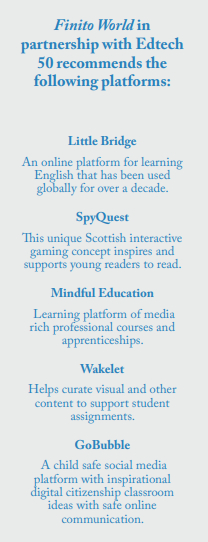
    But this a sector that creates jobs, grows our exports for UK plc and attracts muchneeded investment. Our Edtech sector is vibrant (see panel opposite for some recommendations from the Edtech 50), growing and plays its full part in our ‘New Start’ Industrial Strategy. So what do we need to do? For me there are six easy steps.

    Firstly, we need to build on the success of the rural broadband introduction with a staged approach to rolling out access to super-fast broadband to our schools.

    Secondly, it’s vital that we become more ambitious about devices for pupils. Digital poverty is corrosive and can be ended. Let’s build national delivery of devices for young people – Year 8 is too late.

    In the third place, now is the time for more professional development for teachers. I would argue that peer to peer support like the successful Edtech Demonstrator Programme is a model for national action.

    Fourthly, we need to see the immediate changes to initial teacher education with training in education technology. This is another long overdue addition.

    Fifthly, I believe we need to see priority for Edtech in the Ofsted Inspection Framework. There’s much to share about effective use of technology and much to learn from Wales and Scotland in their approach.

    As a final point, we have to learn to appreciate the complexities of organisational change across our school estate. We need to focus on technology support but also ‘system’ support to introduce and embed changes.

    If we can do all these things then I believe we can have a truly 21st century education system.