Tag: Dream Job

  • Dream jobs around the world

    Patrick Crowder

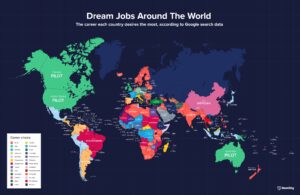
    What’s your dream job? It’s a question asked of most everyone, and often from a very young age. An individual’s goals and aspirations often change over time, so it is always important to keep one’s mind and options open. However, if you have a dream, there is nothing stopping you from finding out if it’s truly the right choice for you. A study from Remitly, which provides financial services for immigrants, has revealed the jobs held in highest regard by people around the world. With almost 1 million Google searches per year, becoming a pilot is the world’s top dream job.

    In most English-speaking countries, the top listed dream career is to become a pilot. By analysing Google search data, Remitly found that people in the UK, the US, Canada, Ireland and Australia are most curious about the difficult, rewarding, and highly regarded professions in the aviation sector. 20 additional countries are also interested in taking to the sky, including Cyprus, Moldova, Papua New Guinea, and Montenegro. High pay and frequent travel are likely factors driving this interest, not to mention the fact that pilots often receive generous pensions and benefits.

    Dream Job Map

    Image from Remitly

    The second most desired job worldwide is that of a writer. In general, a career in the arts is a popular dream job choice, with dancing and acting also ranking highly on the list. All of the Nordic countries show the most interest in writing for a living, as do Estonia, Latvia, and Lithuania. India, Pakistan, Myanmar, Bhutan, and Bangladesh all list writing as their top dream job, and a number of African countries including Kenya, Tanzania, and South Africa did the same. The freedom which a career in writing offers is unparalleled as it is often a career which can be built from home. Following the pandemic, we have seen an increased emphasis on job enjoyment, flexibility, and creativity, and a career in writing holds the unique position of offering all three.

    In addition to the more traditional creative careers, the new-age offerings of youtuber, influencer, and programmer were also represented. Mexico, Peru, Bolivia, Uruguay, and Chile place YouTube as their top dream career choice, as do Slovakia, Indonesia, and the Czech Republic. Columbia, Venezuela, Argentina, and the Dominican Republic are among the countries who chose the more general career of influencer, reflecting the growing number of non-YouTube platforms rising to prominence, including Twitch and TikTok.

    Jago McKenzie, Business Management Director at Remitly, says that the trends reflected by the study are consistent with his expectations.

    “People are getting used to the idea of changing careers at least once in their lifetime as the flexibility to work online and retrain increases. Some of the main reasons people seek a career move are for better work-life balance, higher pay and a more meaningful and fulfilling career. With that in mind, I wasn’t surprised to see so many people around the world showing clear search intent for a change,” McKenzie says, “We can see a huge range of different professions featuring prominently, including many that can be done solely online, from anywhere in the world. It’s clear that our desire for travel and exploration has not been dimmed by the past couple of years and, despite it being a tough time for the aviation industry, becoming a pilot remains a much sought-after lifestyle.”

    Whatever your dream may be, all is achievable with the right amount of dedication and tenacity. Of course, having a network of people to help you along the way is also a major boon to success, so always be on the lookout for mentors. Finito World wishes you the best of luck on your journey.

  • Desperate measures: how to get noticed in a crowded job market

    Desperate measures: how to get noticed in a crowded job market

    Georgia Heneage 

    If you scour the internet for ways to get yourself noticed, you’ll likely land upon generic advice about pumping up your CV, calling recruiters or improving your skill sets. 

    But the fiercer the competition, the greater the need to stand out. And sometimes, these are just not enough.  

    It turns out that’s especially so during global pandemics. The arrival of coronavirus has caused economic woe such as we’ve not seen since the Great Depression. Increasingly, employers are looking for that bit extra in their candidates. But what’s heartening is that there is an increasing number of instances where employees are providing just that. 

    Trevor Walford, a 63 year-old former butler for the royal family, had been working on a cruise ship when he was let go of following the first lockdown in March. In order to find a new job, he sent out over 700 applications. Having had no luck, he came up with the idea of standing outside the railway station in Leeds with a cardboard placard advertising that he was looking for a job. It worked. He was picked up by the executive of a restaurant group, and is now working as its training and development manager. 

    While the story of Walford is heartwarming, it’s also a sad reminder of just how competitive the job market has become. The explosion of the internet and social media has made it especially hard to stand out, and competition for entry-level jobs in particular has swelled alarmingly.  

    Amber Shrimpton, an HR consultant at Centrica energy, sees the trend of job-seeking stunts as part of a wider socio-economic context. The current economic situation, she explains, has engendered a ‘loose labour market’ where there are more people looking for jobs than employers offering them. She points out that there is a high number of applicants with university and other qualifications, meaning that jobseekers have more need to distinguish themselves. 

    “It’s the jobseekers who needs to make themselves more attractive,” Shrimpton tells Finito World. “My work in talent resourcing has shown that when you have 500 applications which look the same, having something which stands out is probably going to work in your favour.” 

    So is this trend born of desperation? “More and more jobseekers feel they have to do that extra”, continues Shrimpton. “It’s not okay anymore to just have a good degree. There has to be something else, and that’s the impetus behind it.” 

    Like marriage proposals, many eager and frustrated job seekers have resorted to unusual means of public advertisements. Liz Hickok strung up fairy lights to spell out ‘My wish- HR job’ and her LinkedIn handle, which landed her four interviews; Pasha Stocking used a billboard plastered “Hire me!: Unemployed and Seeking Employment” which gained her the media coverage to start her own PR company (which ironically specialised in helping people rent billboards). There was also high-school student Josh Butler who auctioned himself on eBay. His post went viral, landing him several interviews. He is now a successful city broker in London.  

    Even more creative examples might be cited. Lithuanian marketer Luka Yla found a job in his new home of San Francisco by dressing up as a courier to deliver a box of doughnuts to the companies he admired. The boxes carried the following inscription on the inside: “Most resumes end up in the trash. Mine—in your belly.” And, after writing a three-minute music video in place of a CV and cover letter, Alec Biedrzycki got his dream job at a marketing agency. 

    These success stories suggest that unusual methods of jobseeking may be the way forward for the millions currently facing unemployment. It might just be a question of changing one’s attitude towards what has become, in most industries, a deeply standardised and homogeneous application process.  

    When Lucy Martin, a 23 year-old graphic designer from London, first started searching for a job, she fell victim to this relentless process.  

    “I was at a point last summer when I was applying to so many jobs that I was becoming a number in the application process,” she said. “You just see thousands of people who are applying for the same job. I knew I just needed to get noticed in some way.”  

    This desire to stand out led Martin to pull a stunt in her application to the highly competitive advertising firm Saatchi & Saatchi.  

    Having got through to the second round of the application process, Martin was given a brief to come up with a design solution to the slogan “nothing is impossible” and told that she’d be notified if she’d been “picked”. Martin decided to take the second point quite literally. As well as fulfilling the brief, she headed down to her local sweet shop, bought a bag of pick ‘n mix, personalised some love hearts with her name on them, stuck a note inside saying “I hope you pick me”, and sent it on to the CEO of Saatchi. 

    “The concept was that he had no other option than to pick me- there was no one else in the bag apart from me,” says Martin, who got through to the next round and then finally got the job. “They really liked it. They thought it was really awesome” she added. 

    Part of Martin’s creative ingenuity came from her graphic design course at Edinburgh, where her tutors encouraged her to do “ridiculous things” to get noticed, and to “think outside the box”.  

    “I did this art installation where I froze flowers in ice cubes, and my tutor said I should go and give them to every single person I wanted to work for. There’s such a sense of urgency, because you’ve got a melting ice cube in front of you,” says Martin. “With any job, sending something physical is really effective, even if it’s not a creative job.” 

    It might seem like creative industries are better equipped (or more likely to be impressed by) such stunts. But across the job spectrum, people are finding they are having to think creatively when it comes to job applications.  

    Last year, Jack Nugee was working on an application – one of hundreds he’d produced that month – while listening to a cricket podcast. He decided to go off-piste and write his cover letter as a narration of an Ashes innings by Jack Leach innings, which had then acquired a kind of cult status, particularly in the cricketing world. 

    “I thought it would be interesting to try and relate my job experience to cricket, which I’m really interested in,” says Nugee. In an ‘Ode to Jack Leach’ he wrote: ‘I ask you to please engage your imagination as I attempt to equate myself to the English spin bowler Jack Leach’s innings in Headingly, highlighting, through his actions, the skillset at my disposal that align me perfectly for the account executive position.’ 

    In response to the letter, the employer said she wanted to speak to someone “weird enough to write a full page on a cricket innings, even though she’d never watched cricket in her life,” says Nugee. “She said it was the kind of thing they were looking for.” Having had no advertising experience at all, Nugee got to the final two and says “they were going purely off character based on the application.” 

    Though he didn’t get the job, Nugee’s current position was won through writing a similarly off-beat poem which begins; ‘I would like to apply for the role of Account Executive sat in the account management team/ You will find this application has a rhyming theme.’ 

    Though the need to be outlandish is more apparent now than ever, standing out doesn’t have to entail an eccentric application. It can come in the form of being proactive and presenting yourself to the bitter outside world.   

    Tibi Hodgson, a 23 year-old fashion stylist from London, never went to university and the sense that she lacked the right qualifications meant that she lacked confidence when first embarking on her job hunt.  

    Having had no experience in styling and facing rejection after rejection, Hodgson decided to contact someone she admired in the industry directly. “I said I felt an innate connection to her work and I could work for her at the drop of a hat.”  

    Hodgson says she didn’t know any of the “lingo” around styling and was launched straight into the deep end. She learnt the process just through doing it, and was soon styling high-end models like Adowa Aboah and Suki Waterhouse. 

    After her employer left for the US and Hodgson began working in a gallery, she kept an eye on her old job. “I was still being kept on the email loop and I noticed that some dresses and shoes hadn’t been returned properly,” says Hodgson. “So I volunteered to go pick them up myself. After that I just began going to different shops in Mayfair after work and seeing if there were items she needed to return, without her asking me to.” 

    Hodgson says that through doing this she made her own contacts in the industry, and this has led to other jobs. Now a seasoned stylist, Hodgson is a case in point that experience, qualifications and traditional means of job searching aren’t necessarily the be-all and end-all.  

    “I feel like with these unconventional ways it’s all about luck and for luck to happen you need exposure. So the more ways you can expose yourself, the better,” she says.  

    And, of course, the need to be outlandish applies not just to those seeking a job. The emergence of a gig economy and the sheer number of freelancers competing against each other is ensuring that freelance workers need to find alternate means to stand out from the crowd as well. 

    Rahoul Baruah, a freelance software developer from Leeds, was at a meet-up social with some fellow workers when he met a guy called Jamie who was “sort of famous in our world”. 

    Chatting over some beers, Jamie seemed excited because he’d just set up this agency called ‘Made in London’. The next day, “just for a laugh”, Baruah decided to set up a spoof of his website called ‘Maid in London’, featuring a picture of a barmaid with Jamie’s face and a link to the real company’s website. 

    The prank website ended up getting Jamie’s original company loads of business, and three months later Baruah was offered a year-long contract from them. 

    “I basically got a year’s work- which was really good pay- from just putting up a prank website,” says Baruah. “Me and my group of friends have always said that to stand out you’ve got to do stupid stuff.” 

    These stories all show that difficult economic circumstances can be traversed by imagination. You don’t always need to get noticed via outlandish means: it’s about putting yourself out there – whether that’s via personalised love-hearts, a cricket match for a cover letter or, like Baruah, just taking the time to show up. It’s about being bold and fearless in the face of the unknown.  

    “If you want something so badly, you have to make sure you respect it more than the next person,” says Hodgson. “You have to be that person who goes that extra mile.” 
  • Should today’s young still hold out for their dream job?

    Should today’s young still hold out for their dream job?


    Wondering whether to shoot for the ideal career or to settle for something you weren’t expecting to do. Emily Prescott has some advice

    Despite living in a small Wiltshire village, my four-year-old best friend had rather lofty and exotic ambitions. There was no doubt about it: she was going to be a lion tamer.

    This exciting notion was encouraged by our teacher Mrs. Turner. Reminiscent of Miss Honey in Roald Dahl’s Matilda, Mrs. Turner would never tell children that no amount of auto tune would fix their singing or that their SATS scores hardly screamed astronaut or that aspiring to be a lion tamer was frankly ludicrous. She was endlessly encouraging.

    Even so, optimism can come at a cost, and indulgence of this kind can have cruel consequences. A concerning report this year revealed that there is a major disconnect between young people’s career aspirations and jobs in the UK. Martin Rogers, who co-authored the report, told Finito World: “It’s striking that the sectors to which young people aspire are basically not where the jobs are now and in the future.”

    The study of more than 7,000 participants found that five times as many 17 and 18-year-olds wanted to work in art, culture, entertainment and sport as there were jobs available. These concerning findings have prompted the report’s authors to call for a significant improvement to career-related learning.

    It is positive that young people are aspirational but if they are not being taught the realities of the job market, it is no wonder so many graduates leave university feeling disheartened.

    We spoke to a number of students about their careers experiences; they replied on the condition we didn’t use their surnames.

    Liam, who studied architecture at the University of Edinburgh, explains: “I wanted to be an architect, before I came to university, it was my dream. Then studying it, discovering the reality of what working in architecture would be like, put me off.” That has created real anxiety. “I do feel slightly lost as I don’t know what I want to do anymore. I’m unsure how to use my degree – if I can at all. It’s strange hunting for jobs now.”

    While Kate, who recently graduated with a shiny English degree from the University of Exeter, also said she was feeling lost and let down. “We are not typically set up to succeed,” she explains. “Teachers help us follow our vague interests or whatever subject we might be good at, with no clear career path to follow. Coddling comes to mind.” Is there anything schools should be doing to improve ultimate student outcomes? “A lot of people do a degree as that is the expected next step in the life of a young person. I think the process of choosing A-levels should have been supplemented with advice on which jobs are attainable with which degrees (if indeed a degree is even needed).”

    This feeling of disappointment is likely going to be exacerbated by Covid-19. A report from the Institute of Fiscal Studies predicts that those who graduate in 2020 will suffer a decade of economic scarring as a consequence of the pandemic.

    Top jobs to which young people aspired included professional gamer and a sportsperson, according to the disconnected report. No one can predict exactly what Covid-19 will do to the job market but it is unlikely to create an enormous demand for footballers.

    Alarming as that all sounds, there is no need to lock up your dreams and throw away the key just yet. Improvements may be needed to career education in schools and universities but by setting themselves deadlines and educating themselves young people can also take steps to ensure they are not destined for disappointment.

    Whatever you think of her politics, Esther McVey MP, who ran for the Conservative leadership in 2019, is an example of someone who has achieved success in multiple careers despite adversity. Although she grew up in Liverpool in the 1980s amid high levels of unemployment, McVey became the first person in her family to attend university, she became a television presenter and then rose through the ranks to Cabinet level as Secretary of State for Work and Pensions under Theresa May.

    She explained to Finito World that adversity had spurred her on and she achieved success by ensuring her dreams were always founded in reality: “I was growing up to the music of UB40, with the lyric I am the One in Ten, or to the Specials who sang: ‘This town is coming like a ghost town’. I had that in the back of my mind and I guess I used that as a fuel or as an energy. All I knew is these are the statistics and then I don’t want to be a statistic – a reminder of a world that doesn’t care.”

    While McVey was paying her way through a law degree by working as a waitress in Covent Garden, she decided she wanted to go into the media.

    McVey shares the best advice she was given by her father, who thought success would be achieved by – perhaps counterintuitively – limiting dreams. ‘My dad said: “Well, if you want to go into the media, you better put a time limit on it. Don’t be a wannabe or a could be. If you’re going to do it, you’d better give it 100 percent and put a time limit on because then you need to go back to law if these doors or this opportunity doesn’t open up.’ McVey adds: ‘The clock is ticking and there are other things you can do. I think it’s just as important to close an avenue down that isn’t for you,” she added.

    Putting a deadline on dreams also proved successful for David Nicholls. He decided he wanted to be an actor despite the fact that, by his own humble admission, he could “barely act”.

    When we contacted Nicholls, he told us he’s wary of giving advice and that his advice generally “stinks”. But his story is worth considering.

    He spent around five years being an understudy and playing bit parts. “I don’t think I ever spoke more than four lines in a play. I gave myself a deadline which was 29 and if I wasn’t playing slightly larger roles, not huge roles then I would give up,” he told Elizabeth Day’s How to Fail podcast.

    He did give up and he has since written five novels and adapted each for the screen, including One Day, starring Oscar-winning actor Anne Hathaway.

    As well as putting a time limit on dreams, it is wise to do as much research as possible on what the dream actually involves: Can you get work experience? Will it be worth the low pay? Is it really for you?

    Esther McVey said: “I always thought: “Ah, would I want to own my own restaurant chain? And then working as a waitress for three or four years I kind of thought: “Oh no, I’ve enjoyed it but this isn’t an outlet for me.”

    She adds: “Opening up your life is important and now you can do that on the internet, you can do that through research.”

    It may seem like uninspiring advice but giving up on dreams can mean finding career satisfaction in reality. My best friend didn’t become a lion tamer but she has just been offered a job as a farm vet. She says she’s more like a pig tamer. It’s not quite as glamorous but it will pay her bills and she is delighted. Vets are also listed on the Government’s occupation shortage – a good place to go for career advice.

    And I think Mrs. Turner would be pleased too.