Tag: doNALD tRUMP

  • “Trump will be good for business”: Sir Martin Sorrell’s take on the 2024 US election

    “Trump will be good for business”: Sir Martin Sorrell’s take on the 2024 US election

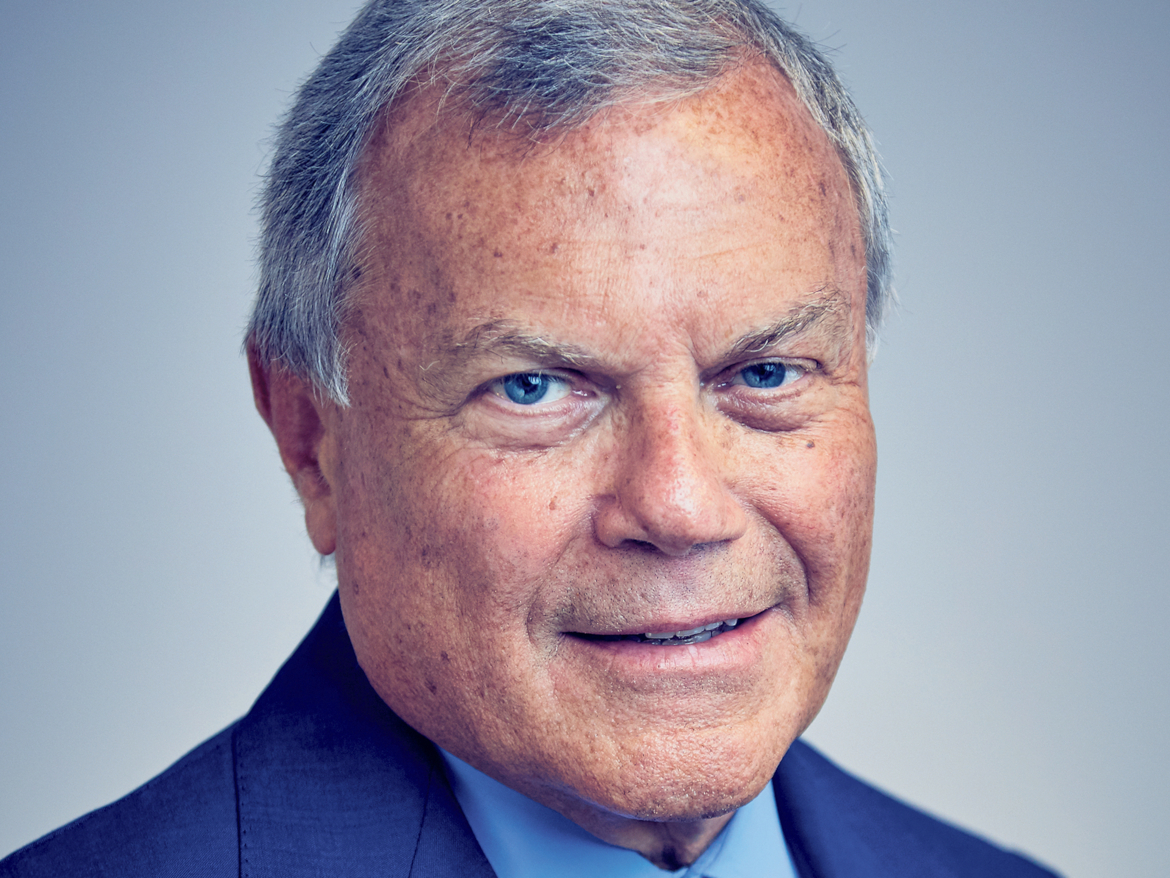
    Sir Martin Sorrell

    There were two clear issues in the 2024 US election: firstly, as James Carville put it, it’s the economy, stupid. Secondly, it was the immigration question, though there were some signs in the exit polls that the future of democracy was also important.

    The Democrats got it wrong – and the pollsters did too. But then I think Trump, for the second time out of three, has conducted really tactically interesting campaigns. In 2016 he used a San Antonio agency called Giles-Parscale which was run by a guy Brad Parscale with only about 100 employees. It was the days of Cambridge Analytica and personalised data: they ran an extremely effective campaign in 2016.

    In 2024, the Democrats outspent the Republicans very heavily. In 2016 they had new media; in 2024, they had a “new-new” media. They only had a staff of about four people; the Democrats had about 100. It’s ironic that the Democrats are left with a bill for £20 million for three celebrity concerts which they’re unable to pay for: I think Trump has offered to pay off the debt.

    I thought Trump would win until the last few days. Then I thought the issue with the comedian Tony Hinchliffe calling Puerto Rico an ‘island of garbage’ in the warm-up at the Madison Square Garden comment – I thought that wouldn’t go down well. I also wondered whether the comments he made about Liz Cheney would have a negative impact on his prospects.

    But fundamentally, it doesn’t matter what Trump says. When he once said he could shoot somebody on Fifth Avenue and not lose any votes, he was right. In 2024, he hit the nail on the head over and again and was very disciplined, especially when he repeated the Reagan line: “Are you better off than you were five years ago?”

    He was also very disciplined on the advertising. The Democrats used the “new-old” media: Facebook and Instagram and so on.

    Nevertheless, it was a surprise that they took the seven swing states, as well as the House and the Senate: it was the scale of the victory more than the victory of itself which came as a mild surprise.

    All of this means that Trump is in a very strong position, particularly for the first two years, since there’s usually a reaction in the mid-terms. The stock markets have welcomed the win and Treasury yields have risen slightly and so there are some natural concerns now surrounding inflation. We’ll also see what the impacts of the proposed tariffs are going forwards.

    On the Democrat side, I don’t know if it would have made a difference if Biden had pulled out of the race earlier, and if the Democratic Party had had an open convention. I don’t think Tim Walz was a good pick as Vice-President – Pennsylvania governor Josh Shapiro would probably have been better, but perhaps Kamala was worried about the competitive element there. She didn’t want a strong personality.

    Going down into the results a little, the Republicans managed to engage with Latinos, with young blacks, and with less college-educated young whites. The other surprise for me was that the Roe v Wade decision and abortion was not as prominent as we expected: women didn’t react as aggressively as we thought they would do.

    Of course, Trump’s rallies and speeches were extremely dark. Kamala’s rallies were the opposite, with her smiling a lot – but there was a lack of content. That left a gap for Trump to make some shrewd moves: to take tax off Americans living abroad; and to take corporation tax down from 21 per cent to 15 per cent as well as lowering income tax. All these were far more substantive than anything the Harris campaign said.

    I saw a TikTok of a young black woman with a massive apple in her hand. She said to camera: “Do you know how much this apple costs?” It was a massive apple, about the size of a pomegranate. She said: “I thought it was one or two dollars – but it was seven dollars!”

    At the end that was the thing which swung it: the economy.

    And going forwards? Trump has put into place a Cabinet and advisors who very much represent what he was going to do.

    People say he didn’t expect to win in 2016. This time around, it’s not a surprise and he has the four years of experience. He is somewhat controversial, to put it mildly. But he has firm views.

    Whatever business said before the election, deep down they wanted Trump because he stands for low tax and low regulation. Overall, Trump is good for business and good for North America.


    Sir Martin Sorrell is the chair of S4 Capital.
  • Jon Sopel’s fascinating take on January 6th, the Starmer administration – and why he left the BBC

    Jon Sopel


    I am sometimes asked about why I left the BBC. I remember the corporation went through this spasm of asking themselves how to attract the young. If you watch the news, by and large you’re over 60. The same is true of the Today programme.

    The editor of the 6 O’Clock News was thinking about how we get more young people. Do we need younger presenters? Or do we need old people like me talking about young people’s issues? This was at a time when LPs were making a comeback. We sent a young reporter down to Oxford Street, and said to a teenager, holding up an LP: “Hello, I’m from the Six O’Clock News. Do you know what this is?” The teenager replied: “Yes, it’s an LP. What’s the Six O’Clock News?”


    Thinking back to January 2021, I can’t forget the day after the inauguration when Joe Biden was finally President. Washington DC that day was less the elegant neoclassical city that most people remember from the Capitol through to the Supreme Court and the great museums that go to down the Mall. It was a garrison town, the place was absolutely sealed off. There were rolls and rolls of barbed wire because of what had happened on January 6th. I will never forget the shock of that.


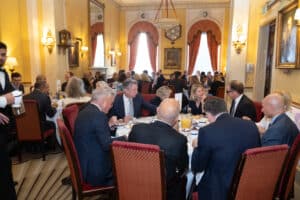
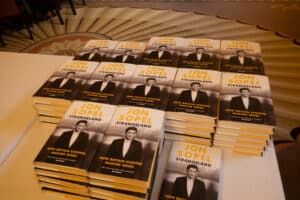
    Jon Sopel book launch in aid of Hospice UK and hosted by Finito at The East India Club, London. 17.9.2024 Photographer Sam Pearce / www.square-image.co.uk


    January 6th is also inscribed on my mind. I’ve been in situations where I’ve faced greater personal danger, when you’re in a warzone and you’ve got a flat-jacket one, and there’s incoming fire. But I’ve never seen a day more shocking than January 6th when the peaceful transfer of power hadn’t happened. I went on the 10 o’clock news and the mob still had control of Congress and Joe Biden’s victory still hadn’t been certified. That’s the starting point for my new book Strangeland: I wonder how safe our democracies are. My experiences in America made me realise that we cannot be complacent in the UK.


    Another thing happened the day after January 6th. The Capitol had been sealed off by razor wire and I went as close as I could, and went live on the 6 O’Clock News. There were lots of Trump supporters around and they heckled me throughout so that the anchor Sophie Raworth had to apologise.

    It soon morphed into a chant: “You lost, go home! You lost, go home!” I was trying to figure out what that meant. At the end of my live broadcast I said to this guy: “What on earth does this mean?” He poked me in the chest and said: “1776.” I thought: ‘Do I explain that my family was in a Polish shtetl at that stage?”


    Peter Hennessey, the great chronicler of government in the UK, talks of the good chap theory of government – you rely on people to do the right thing otherwise the system falls apart. I came back to the UK at the beginning of 2022 after eight years in America. The first election I voted in was 1979. For the next three years I knew three prime ministers: Margaret Thatcher, John Major and Tony Blair. In 2023 we had three in one year – that’s a reminder of the volatility of the times we live in. In many ways in 2016 – with Brexit and with Trump – the world jumped into the unknown.


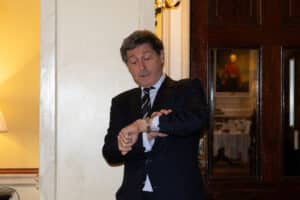
    Jon Sopel book launch in aid of Hospice UK and hosted by Finito at The East India Club, London. 17.9.2024 Photographer Sam Pearce / www.square-image.co.uk


    It’s always seemed to me that the Labour Party finds power a really inconvenient thing to happen. They much prefer it when they’re forming Shadow Cabinets and discussing the National Executive. Then you’d get pesky people like Tony Blair who come along and remind them it is about power. The Conservative Party was always the ruthless machine of government: there is an element in which the Conservative Party is in danger of going down the Labour Party route. It was the Conservative Party membership, for instance, who gave us Liz Truss, the patron saint of our podcast The News Agents. We launched in the week she became Prime Minister – and my God, she was good for business.


    What would Britain look like if there were 10 years of Starmer? He’s done the doom and gloom, and how everything is the Conservatives’ fault. That’s fine – but so far, he’s not set out what the future is going to look like under him. Is it Rachel Reeves’ vision of the growth economy? Or is it Rayner’s vision of increasing workers’ rights. I think Starmer is an incrementalist and simply doesn’t know. If he has any sense at all he will look at the centre of political gravity in the electorate and go for growth because that’s what the country needs.


    Jon Sopel book launch in aid of Hospice UK and hosted by Finito at The East India Club, London. 17.9.2024 Photographer Sam Pearce / www.square-image.co.uk


    Hospice UK do the most amazing work. The book I’ve written Strangeland deals with the challenges facing Britain at the moment. Hospice UK do the most amazing work. Strangeland deals with some of the huge challenges facing the . Hospice care is one area where something urgent needs to be done.


    Jon Sopel was talking at a Finito event given in aid of Hospice UK. To donate, go to this link: https://www.hospiceuk.org/support-us/donate


  • Film Editor Meredith Taylor reviews new Donald Trump film The Apprentice: “A compulsive portrait of toxic narcissism”

    Meredith Taylor


    Dir: Ali Abassi | Script: Gabriel Sherman | Cast: Sebastian Stan, Jeremy Strong, Maria Bakalova, Martin Donovan, Catherine McNally, Charlie Carrick, Ben Sullivan, Mark Rendall, Joe Pingue, Jim Monaco, Bruce | Biopic Drama, 120′


    “You’re either a killer or a loser” is the advice a young Donald Trump (Sebastian Stan) gets from his acerbic mentor Roy Cohn (Jeremy Strong) in this polarising political biopic written by journalist Gabriel Sherman and directed by Iranian-Danish filmmaker Ali Abassi (Border) and Holy Spider (who is now perhaps best known for his involvement in The Last Of Us).

    Cohn, the lawyer responsible for putting the Rosenbergs on the electric chair and a key figure in the McCarthy witch hunts, offers up three key bits of business advice during The Apprentice – an entertaining romp that zips briskly through its two hours running time sketching out Trump’s early career as an eager apprentice trained under the high-flying lawyer, and eventually trumping him in a tale of machiavellian morals, ethics and business acumen.

    There are elements of poetic licence at play here: in other words Sherman plays slightly fast and loose with the facts in fleshing out Trump’s backstory. The result is a fairly even-handed feature that on the one hand sees the US former president as cold-eyed and devious, but on the other opines that these are the very tools of the trade for those wanting to get on in big business – or politics, for that matter. Crucially it also highlights the recent concept of the truth being a construct open to individual perception.

    The focus narrows in on Trump from a broad brush opening outlining the corruption of the Nixon years and the inherent dishonesty that is now rife in all circles of power, not least in America. It contrasts the ‘losers’ (those on welfare) with the killers, the ‘unscrupulous’ hard-working income generators during the Reagan presidency that led to the phenomenon of ‘corporate greed’.

    The Apprentice sees Trump starting out during the 1970s working for his property magnate father, Fred Trump (Martin Donovan). Dressed in a suit Donald is tasked with doing the rounds to collect rents. One disgruntled tenant throws a pan of boiling water in his face, another swears at him. The family business comes then under fire from a civil rights action alleging discrimination against Black tenants. Cohn wins the case, as his lawyer, with Trump senior claiming: “How can I be racist when I have a Black driver?”

    But Donald is determined to make it alone and sets his sights on transforming the downtrodden area around Grand Central Station where he vows to make a success in a project of urban regeneration involving the dilapidated Commodore Hotel, bringing jobs, European tourists and a facelift for Manhattan.

    Family wise we also meet Donald’s kindly mother Mary Anne (Catherine McNally), and his brother Freddy (Charlie Carrick) a failed pilot with emotional problems: Fred admits to having been tough on his boys. But Donald is hellbent on success and soon bonds with Cohn after a chance meeting at a fancy Manhattan nightclub frequented by the top flight business community. Working together they soon go from strength to strength in a business alliance with Trump styling himself in the same vein as Cohn with his fast-talking intransigence. His transformation into fully fledged killer who lives by his own standards happens almost overnight and feels a little too fast even given the film’s ample running time. But Stan grasps Trump’s essence charting his character’s transformation from reasonable business man to self-seeking  hardliner.

    Trump soon becomes a man who takes his own advice often rubbing Cohn up the wrong way, while at the same time chosing to turn a blind eye to his ‘strange way of life’ and hedonistic habits. Trump’s puritan background sees him gradually distancing himself from the lawyer who berates him for his lack of financial probity. Their relationship eventually sours during the AIDS crisis, although Trump offers an olive branch in the finale.

    The marriage to Ivana Zelnickova, against Cohn’s advice, is handled deftly and with some humour. Trump follows Ivana to Aspen to clinch their romance then falls flat on the ice after claiming to be a good skier. The Czech model is a little too sweet and sympathetic despite her purported savvy business sense, but Trump soon tires of her, claiming to find their home life ‘more like coming home to a business partner than a wife’. A shocking episode sees him beating Ivana, but whether this has a factual basis, despite his widely reported misogyny, is uncertain. Stan’s Trump may polarise public opinion in coming across as too likeable but this is surely the essence of a maverick who can charm as well as chastise and here he gives a compelling performance.

    With a killer score of hits that just reeks of the ’70s and ’80 and a scuzzy retro texture this is an compulsive portrait of toxic narcissism even more relevant now than it was back in the day.


    PHOTO CREDIT: Cannes Film Festival 2024 Première


  • Sir Martin Sorrell: “You have to devote your energies to the essential’

    Sir Martin Sorrell


    Of course, it has been a terrible time. The 2020-2022 pandemic has been a disaster for so many people, especially the disadvantaged – and it’s been disastrous across all nations. Having said that, people don’t always realise the sheer scale of the digital transformation which took place alongside it.

    Consumers are buying healthcare online, and High Street retailers are struggling here in London. Habits have shifted dramatically: in the media, the streamers continue to gain market share, and free-to- air networks are under pressure, as are newspapers and traditional media enterprises.

    In this context, inflation ought not to come as no surprise. Clients will look for price increases to cover commodity increases. The big question is whether inflation is endemic or transient. We clearly have shortages of labour supply, as well as supply chain disruption, and that means that companies will be looking to cover those problems with price increase. That means inflation will be well above trend throughout 2022 and 2023.

    The priority in central bank policy to date has been on employment, and now there is more friction in the labour market. Employees have more power now: the pandemic has encouraged people to think about what they want to do and how they want to do it. That’s made inflation in wages significant. I expect wage inflation to continue throughout the year but that in turn means that employers will look at their cost structures.

    Crucially, it will also bring automation into the picture. If labour is in short supply and increasingly expensive, that will accelerate the technological changes around AI (artificial intelligence) and AR (augmented reality). The metaverse has been thoroughly hyped but listening to Bill Gates and others, it clearly will have a major impact.

    As we look ahead, I think people who underestimated Donald Trump are going to be surprised – and I also wouldn’t personally underestimate Ivanka. Trump’s moves on the media side with Truth Social are interesting.

    We are still talking to one another in our echo chambers. I spoke to a Chief Executive of a leading package company recently; he had just been holidaying in Alabama, Kentucky and Mississippi on a motorbike; there were Trump fans everywhere. Lionel Barber, the editor of the Financial Times, tells the story of the Tuesday before Brexit. He went to see Cameron and right up until the last minute Cameron’s polls told him he would win; Barber told him he was wrong. It is the same with Trump now; everybody underestimates his pull with voters.

    Lately I have been reading Ray Dalio’s book: The Changing World Order: Why Nations Succeed and Fail, and that’s an interesting read which I highly recommend. It contains some fascinating graphs on the rise of inequality; the book explains how there are forces at work there whose power we have a tendency to underestimate. It’s a book which makes you realise the importance of China, where his intellectual focus is.

    But I don’t see much reason to despair. Companies were better run during Covid; it meant that the entre was unable to interfere, and individual employees were given greater responsibility. By the end of 2022, we’ve begun to see some of the downsides, having been initially very positive about it. I’d say a digital fatigue began to set in towards the end of 2021, and so we’ve had to manage that.

    Sometimes, I think back on what we’ve lived through over the past few years. I think in retrospect Kate Bingham was the hero of that hour, and I see she has just realised her memoir The Long Shot: The Inside Story of the Race to Vaccinate Britain.  What she achieved with her procurement team ought to be a continuing source of inspiration. She was more focused on getting the product than the cost. That was crucial – that she realised she wasn’t buying sugar or commodities – but something essential. There are lessons there for business: you have to devote your energies to the essential.


    The writer is the founder and CEO of S4 Capital


  • Jeff Katz: Letter from an American

    Jeff Katz: Letter from an American

    We at Finito World were all deeply saddened by the sudden death of Jeff Katz in December 2020. Here we publish his last piece, submitted to us only a few days before his death. We shall publish our full tribute to him next week.

    Truth, lies; facts, alternative facts; news, fake news; information, disinformation; reality, conspiracies—how and why did our views of the world get so divided? 

    Joe Biden won the US election, but not without accusations of fraud from Trump and his supporters.  It was mostly likely the coronavirus pandemic that gave the Democrats the edge, but not by as much as they expected.  Trump’s effort, in the words of New York Times journalist Will Wilkinson, to sweep “a medium-sized city’s worth of dead Americans under the rug turned out to be too tall an order.”   

    When facts and truth become casualties of deliberately created social and political confusion, we all suffer.  And that extends to our day-to-day dealings with each other.  As someone once said, you start off by committing murder and end up being late for appointments. 

    One of my abiding lessons about facts occurred during my high school years in New York.  In a school of 5,000 boys I found my niche in the English Department’s journalism class, taught by one of my first mentors, a teacher named Louis Simon. 

    Lou was the advisor for the school newspaper, a broadsheet that came out four times a year.  He also taught the journalism classes.  By my second year I was in the advanced class and was a reporter for the paper. 

    One day Lou asked me to assist him with an experiment for the new intake of the journalism class.  After the class settled, I came in and Lou told me to distribute textbooks.  I dropped the books noisily on the desks.  He first admonished me and, when I ignored him, sharply reprimanded me.  I then muttered something that sounded like “*uck you,” but wasn’t.  He ordered me out of the room.  Then he told the class that he intended to report me for bad behaviour and wanted them to write an account of what happened to back him up. 

    About half the class wrote that they didn’t want to get involved.  A quarter of the class quoted what they thought they heard—but hadn’t.  The final quarter wrote that they weren’t sure what I had said, but that my behaviour had been disagreeable.  

    At that point in my life, the fact that half the students didn’t want to get involved surprised me.  But that the other half either reported the events incorrectly or couldn’t decide what they heard taught me that at best many people will be unsure of the facts.  More importantly, many people will simply be wrong because they hear what they are programmed to hear. 

    Forty years later I was invited to make a presentation to pupils at the City of London School.  This time I was in the teaching role.  I began by making an offer.  Everyone who gave me a £1 coin would get two back at the end of the session.  There was a flurry of activity as pupils who didn’t have a coin borrowed from their mates.  As each person contributed a pound into a bag, they signed their name so there was a record of the transaction. 

    I put the bag of coins and the list of signatures into a briefcase and began explaining to the class how fraudsters work, how con men and women rely on the gullibility of people who want to believe in opportunities that that promise rewards, regardless of how unlikely.   

    After half an hour or more of my explanations and examples of how such things happen, the teacher hosting the event thanked me and there was a nice round of applause.  As I picked up my briefcase and prepared to leave the room there was a murmur among the pupils.  I asked if there was something the matter.  They asked about their investments that were supposed to double at the end of my talk. 

    “Oh that,” I said.  “No,” I told them.  “That was just speculation.  If I manage to double your money, I’ll let you know.”  And I began to leave the room.  Of course, I didn’t.  All the pound coins were returned to their rightful owners, but I suspect that those few minutes at the end taught them more than anything I said during the preceding half hour. 

    “Dishonesty, greed, double-dealing,” wrote Professor Churchwell in The Guardian, “are symptomatic of entrenched maladies.”  The only remedy is education.  And that will take time.