Tag: design careers

  • Inspiring Q&A: CEO Katia Luna Benai on her unique journey in design

    Finito World interviews Katia Luna Benaï on her Amazigh heritage, her design vision and her plans for the future


    Your grandmother was clearly a very important figure for you – can you talk about your upbringing? Was it an aesthetic culture which laid the groundwork for your future career?

    My upbringing in Algeria, deeply rooted in my Amazigh heritage, was where my journey as an artist truly began. Living with my grandmother and aunts, I was surrounded by a world where every element of life was infused with vibrant colours, patterns, and stories—each one shaping my essence as an artist. The silver jewellery we crafted was more than just adornment; it was history gleaming in every piece, with stones whispering tales of identity. Our tattoos, symbols etched into flesh, represented a tradition now fading, yet they carried deep significance, a connection to our past. Even I carry one of those tattoos, symbolizing five generations of women.

    The architecture of our region, shaped by influences from the Roman and Ottoman Empires, was another source of inspiration, with arches that seemed to embrace the sky and courtyards that echoed with communal songs. Music, dance, and the act of sharing within the community were integral to our way of life, bonding my soul to the instruments of time and land.

    As I travelled later in life with my father, experiencing different cultures and their unique traditions, this early immersion in my heritage continued to influence me. It deepened my fascination with the arts and stories that connect us all as humans. These experiences laid the foundation for my work with Luna Benaï, where I strive to create artefacts that not only capture beauty but also tell multi-layered stories rooted in cultural and historical research.

    Through Luna Benaï, each piece I create is a tribute to the communities and traditions that inspire it. I am deeply committed to ensuring that our work gives back to these local communities, preserving the very cultures that have shaped my identity and continue to inspire my creative vision.


    Your father was a diplomat – has growing up in lots of different places deepened your sense of commitment to the Amazigh culture?

    My father was a man of the people, a true polyglot who spoke eight different languages and was an intellectual deeply respected in Algeria. His work with the UN took our family to many places, and each new city or country we visited was embraced with enthusiasm and a deep commitment to understanding the local culture. This passion for learning and cultural exchange was a fundamental part of our family life.

    The Amazigh people have historically been diplomatic and open-minded, known for their ability to share cultures and live harmoniously with others throughout the centuries. Although not widely recognized, the Amazigh are indigenous to the Mediterranean region and have played a significant role in history, mythology, and culture, with connections that trace back to ancient Egypt and continue to the present day.

    Growing up in diverse environments only deepened my commitment to the Amazigh culture. I see it as part of my mission to represent their essence through the arts, bringing their rich heritage to the forefront and ensuring that their stories and traditions are not forgotten but celebrated and shared with the world.


    Were there creative challenges to be surmounted when it came to negotiating any feelings of rootlessness growing up which diplomats’ children often have?

    It’s a bittersweet symphony, indeed. Growing up as a diplomat’s child often brings a sense of rootlessness, but with that comes a profound thirst for understanding and a deep compassion for the world around you. The feeling of being displaced at times fuels a desire to connect with others on a more meaningful level, to truly understand the nuances of different cultures and perspectives.

    For me, this has been both a challenge and a gift. Art and creativity have become my signature tools for navigating these feelings, allowing me to express the complexities of my experiences and communicate across cultural boundaries. This ever-evolving journey has enriched my work, infusing it with a depth and authenticity that comes from a life lived between worlds.


    Have you had a mentor who gave you the confidence to create?

    Pursuing my postgraduate studies at the Royal College of Art was a transformative experience that truly pushed my boundaries. The philosophy there of deconstructing everything and then rebuilding it, blending academia, research, and art practice, gave me a profound new perspective on identity and communication. Being at one of the finest art institutions in the world, I found a space where intellectual freedom was not just encouraged but expected. This environment allowed me to explore and redefine my creative voice, giving me the confidence to push the limits of my artistry and to trust in my vision.
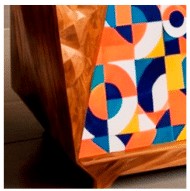
     

    I’m fascinated by your process. You have said that you want to think about creating things which stand the test of time. How do you go about sifting your inspirations to make sure that it is likely to produce work which has that sort of longevity?

    At Luna Benaï, we take a vertical approach to creation, guided by the belief that “every object has a story,” and those stories must endure through time. To ensure that our work stands the test of time, I collaborate closely with museums, scholars, and architects from the initial concept to the final creation, always prioritizing absolute authenticity.

    My process involves immersing myself in artefacts that are often 2,000 to 4,000 years old. I fall in love with these pieces and bring them back to life, blending their ancient essence with modern mediums and technology. Through masterful artisanal craftsmanship, honed by decades of experience, we create objects that not only resonate with historical depth but are also built to endure.

    By taking history and completing a full circle—much like our Luna Benaï logo—I strive to ensure that each piece we produce is timeless, capable of supporting its own story across generations.


    Your collaboration with Sotheby’s was obviously a wonderful moment in your career. How did you come to think in terms of the rhombicuboctahedron and what does that particular shape mean to you?

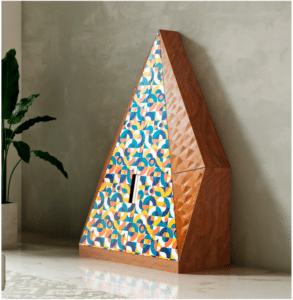
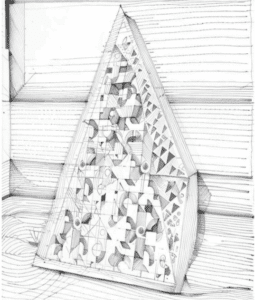
    Geometry is the visible manifestation of math, embodying themes of continuation and infinity. When I was commissioned by Tiffany Dubin, a curator at Sotheby’s, to create a bespoke jewellery box for the “Art as Jewellery as Art” exhibition in New York, I wanted to design something that embodied these timeless concepts. The exhibition aimed to reintroduce jewellery and accessories by famed masters of the 20th century and beyond, placing them in a unique juxtaposition with contemporary visionaries and modern artists.

    The specific shape of the Atlas Box, a rhombicuboctahedron, was chosen for its symbolic resonance. The rhombicuboctahedron, with its harmonious blend of triangles and squares, represents balance and unity—qualities that are deeply connected to the myth of Atlas, the Titan who bore the weight of the heavens. Just as Atlas symbolizes strength and endurance, the shape reflects the idea of holding together different forces in perfect harmony.

    The carvings and metalwork on the Atlas Box are traditional Amazigh designs, merging ancient craftsmanship with a contemporary vision. This fusion of geometry, mythology, and cultural heritage makes the Atlas Box not only a functional object but a piece that tells a story of harmony and timelessness.

    I think it’s wonderful that you give 15 per cent of your earnings to charitable projects. Was that something that you resolved to do from the beginning? How do you go about choosing the causes that you give to?

    Creating synergy with the local community has always been a core value for me, and it’s something I resolved to do from the very beginning. When we embark on a project, we actively engage with the local communities, seeking out grassroots causes that create visible, tangible impact. It is important to us that these initiatives are ones we can track, interact with, and even participate in directly.

    For instance, with our Sotheby’s piece, we chose to support the UK-based charity Hannan School, which has a genuine and significant impact on improving education for remote communities in the Atlas Mountains. This hands-on approach ensures that our contributions not only make a difference but also align closely with the values and needs of the communities we aim to uplift.
     

    What would you say to young people looking to work in the luxury sector? What do you look for in a hire?

    Look beyond superficiality. If you pursue what you truly love, you will excel, and don’t be afraid to make mistakes—they are an essential part of the learning process. For young people choosing a career path in the luxury sector, I would advise prioritizing knowledge and experience over superficial gains. Think long-term and focus on building a solid foundation of skills and understanding across different sectors.

    If you eventually decide to embark on your own entrepreneurial journey, believe in your vision and stay committed to it. Your vision will be tested repeatedly, but perseverance is key. Over time, you’ll start to see the building blocks come together, and that’s when your dedication will truly pay off.

    Luna Benaï are entering the Middle Eastern market. Can you describe that journey and tell us more about the thinking behind it?

    The Middle Eastern market is currently undergoing a significant transformation, with new initiatives aimed at diversifying tourism, enhancing arts and culture, and promoting their rich and vibrant heritage. I find this cultural renaissance absolutely captivating, and it’s a landscape I can easily immerse myself in.

    As a British, French-Algerian artist, I have a deep understanding of both Western and Middle Eastern worlds, which has uniquely positioned me to contribute to this evolving market. This strategic expansion is an exciting chapter for Luna Benaï, and I’m thrilled to be embarking on this journey with my business partner, Denise Ricci. Denise is my right-hand woman—a former Goldman Sachs professional with an incredible background rooted in Italian culture and the film industry. She’s a polyglot and a true powerhouse, bringing her diverse expertise to our team.

    This cultural renaissance in the Middle East aligns perfectly with our vision as a woman-led team, allowing us to make a powerful impact. Together, Denise and I are committed to deepening our engagement with the region through bespoke cultural and artistic commissions. This expansion represents not just a business opportunity, but a chance to bridge cultures and celebrate the region’s rich heritage through the arts.


    Which cultural figures most inform your aesthetic? Do you find inspiration in other art forms, whether it be literature, film, music or the visual arts?

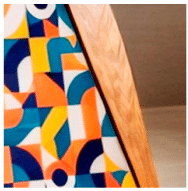
    I’m a bit of an eccentric, and there isn’t just one figure that drives my inspiration. My aesthetic is informed by a diverse range of cultural figures across history. The artistic legacy of ancient Greek sculptors and the intricate mosaics of Byzantine artisans have always captivated me. In the modern realm, Zaha Hadid’s groundbreaking architectural designs, which challenge conventional forms and spaces, serve as a major inspiration.

    I’m also deeply influenced by the Bauhaus movement, which revolutionized design with its emphasis on functionality and simplicity, merging art with everyday life. Sonia Delaunay’s bold use of color and geometric abstraction, Hilma af Klint’s exploration of spiritual abstraction, and Dana Awartani’s meticulous blending of cultural traditions with contemporary expression all resonate deeply with me. These varied influences, spanning ancient to contemporary, each contribute to the unique narrative I aim to express through my work.


    What are you working on at the moment?

    We’re entering an incredibly exciting phase at Luna Benaï as we expand into a full-fledged atelier and bespoke design studio. We’ve joined forces with our esteemed Italian partners, who bring over four decades of master artisanal experience. This collaboration enhances our ability to work across various mediums, all while preserving the integrity and creative DNA that defines Luna Benaï.

    Our first atelier collection, Tessellation, is set to launch this winter. This 11-piece, post-modern inspired collection draws from the rich aesthetics of Middle Eastern and North African design, reimagined through a contemporary monumental lens. Each piece in the collection marries fine art and architecture, making a distinctive statement in the world of interior design and bespoke furniture. Made-to-order, Tessellation seamlessly blends timeless cultural influences with modern innovation. We’re thrilled to introduce this next chapter in our journey, where tradition and cutting-edge design converge.


    For more information go to: http://lunabenai.com
  • Review: WOW!house at the Design Centre Chelsea Harbour

    Christopher Jackson

    Sometimes your job as a writer is to critique, or nitpick – or at least to recommend improvements. At other times – and this should be done with a sigh after much internal questioning – it is to upbraid.

    Very rarely, your only duty is to praise and recommend – to add footfall and eyeballs if you can. At such times, the role is evangelical: to shout above all the crosswinds of bad news, in order to trumpet the good.

    WOW!house, currently showing at the Design Centre Chelsea Harbour, puts me happily in the third category. I won’t say it’s unmissable – a word whose etymology feels unsound, because it can obviously be missed. But you shouldn’t miss it.

    It turns out to be the work of a restless visionary – a visionary caught up in a pandemic. Claire German, the business’ superb CEO, dreamed up the scheme during lockdown: it starts from the premise that designers are too often snookered into fulfilling a client brief. Instead she has asked the question: What would happen if 18 world-class designers were to give free vent to their inspiration in the same space? Having asked the question nobody else had asked, she then did what nobody else could do: she made it reality.

    Iksel Entrance Foyer by Mark D. Sykes

    Iksel Entrance Foyer by Mark D. Sykes


    To discover how it all looks, you have to visit the place itself: the reality is so comprehensively visual that language is inadequate. It turns out to be not so much a house but a sort of Wow!apartment located all on one level of the company’s vast space near Imperial Wharf. (Could the 2024 iteration somehow take us upstairs?). 2023’s version features an entrance foyer, various reception rooms, bedrooms, bathrooms, studios, a kitchen, and much else besides.

    I can imagine Bertie Wooster living here, though he would perhaps be baffled by what he would deem various futuristic touches: the soundscape in each room, the TVs, the modern appliances. It could also house an artistically-minded billionaire like a latter day Sir John Soane, or the 13th Duke of Devonshire on the back of a spree. It is as if all the most tasteful and aesthetically ambitious Rothschilds had convened, decided to pool their resources, and hi-fived all round.

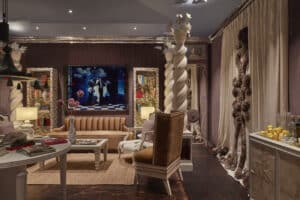
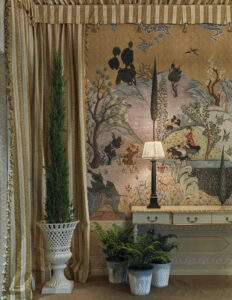
    The Iksel Entrance Foyer sets the tone. This is the work of Mark D. Sikes who is quoted as saying with considerable understatement: “We’re doing something quite different that I think will be a surprise.”

    Living up to this billing, Sikes turns out to be a man of boundless imagination who sets the tone for the installation: the wallpaper, inspired by Chinese scroll painting, took 18 people nine months to paint. Plants and fronds are beautifully spaced, and elegantly tented fabrics flare out at you and overhang you. It’s a beautiful space: the fact that Sikes is now designing a room at the White House makes you tempted to announce your candidacy for the presidency, just on the off chance.

    The next room is by the deservedly famous Nicky Haslam and is called the Legend Room. Haslam says: “This room is a prelude to the many rooms to come. It has no dedicated role, but it needs to have diverse activities…reading, studying, gaming, eating, chatting.” Not for the first time, as it will turn out, I’m struck by how much can be achieved at the level of detail in design when you’ve made sure underlying symmetries are in play: in Haslam’s room, the supporting pillars are cunningly spaced, and even the positioning of the chairs suggests a certain cunning which enables him to meld different eras elsewhere.

    Nicky Haslam, Legend Room

    In fact, it turns out that playing with time is a theme: most of the rooms overlap one era with another, almost always successfully, and always interestingly. In something this vast, I doubt everybody will like every design decision here: but there’s so many to see that only the terminally incurious could come away uninspired.

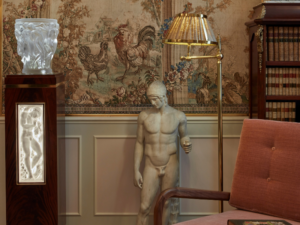
    My favourite rooms are Tim Gosling’s library, full of a light but deeply felt nostalgia, and a French chateau feel. Gosling explains in the Wow! wonderbook: “Libraries are rooms that you amass emotional objects for, creating links to things and people that span thousands of years of human knowledge and skill. It’s the room in your house that you would save if there’s a fire.” It’s a gorgeous achievement, and probably the most unified aesthetic in the house.

    Tim Gosling, Library


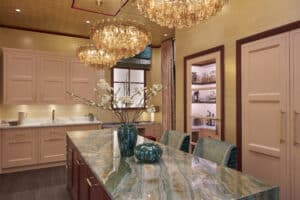
    Another favourite was the kitchen by Henry Prideaux Interior Design. This is a confident space, reminding me of Voltaire’s dictum that great works of art need quiet patches. I loved the stretch of richly coloured marble, and the careful way in which details accumulate – the desk to one side, the interior of the cupboards roofed with gold. ‘A well-imagined interior should make its inhabitants feel good. Your emotions should be satisfied by the space.” Mine were, and I also now know I need a new kitchen. Specifically, this kitchen.


    Kitchen, Henry Prideaux Design

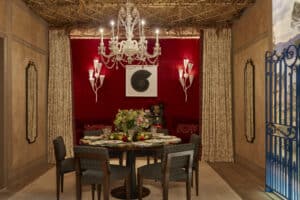
    The room I could most imagine hosting in was Joy Moyler’s dining room, with its little curtain-surrounded nook – a tribute to Christian Dior, who apparently liked to have a niche to withdraw into specifically to gossip. Moyler is another stratospheric achiever whose clients include Leonardo DiCaprio and if you want to know what the view is like from his house, then you can find out by visiting this room. The strong suspicion is that DiCaprio has a nice house – and not least because some of it has been designed by Moyler.

    Joy Moyler


    But does he have a Wow!house? Very possibly: not quite. Only the visitor to the Design Centre Chelsea Harbour has that. In the Wow! Wonderbook, Moyler explains her ethos: “Every room should include people who are wonderful, who you want to spend time with, and comfortable furniture, which will create an environment for people to linger.”

    She’s right of course and it makes you think. We all sometimes play that game of constructing our ideal dinner party: Oscar Wilde tipping his head back in astonished laugher at your latest witticism, while a hand reaches across to enfold yours – a hand which turns out to belong to Marilyn Monroe. Shakespeare comes up and asks if you’re free for his latest leading role; but sadly you’re unavailable because you’ve just agreed to be Roger Federer’s doubles partner at Wimbledon. Leonardo, from a corner, nods approvingly and quietly decides to make you the centrepiece of the picture he’s painting.

    The thing about Wow!house is it makes you feel better about yourself just by being there: you begin to detect possibilities within which, you fondly think, might just make the world go ‘wow!’ yet.

    Wow!house runs at the Design Centre Chelsea Harbour until 6th July 2023 

  • Meet Design Centre Chelsea CEO Claire German


    Christopher Jackson is impressed by the talented and dynamic star of the design industry

    The space strikes you so forcibly that you’re already planning your next visit as you arrive. The Design Centre Chelsea has a cathedral-like entrance, opening up onto 125,000 square feet of space. It’s remarkably well-lit – the light flooding in from above the riverside at Imperial Wharf – and feels, above all, like a place to explore. The feeling is like Bond Street on an epic scale, but you sense rightaway from the signage and the layout that it’s navigable: you’re going to have a good time here.

    Upstairs, I meet the delightful Claire German in her impressive walnut-panelled executive boardroom. My sense is of someone infectiously kind, and highly impressive. “You have to get up in the morning and feel great, and not dread your work,” she says. “It’s not about money; it’s about enjoyment and getting full satisfaction.”

    She seems so absolutely suited to her position that it’s hard to imagine her anywhere else, which in itself makes me curious to know how she got to where she is. Initially, German worked in publishing, which she obviously loved. “ I graduated in history and politics, and then worked at various publications at The Independent and The Evening Standard, and then I went to Condé Nast, and worked at House and Garden. I found I loved the magazine and the industry: it was that whole aesthetic.”

    After a spell at Brides magazine, German returned to edit House and Garden (“that was like coming home”) and you get the impression talking to her that she could happily have stayed there for the rest of her career.

    But life often has a way of intruding on our peace, and sometimes in good ways. “After ten years, this role came up,” she recalls. “I had met Mark Steinberg and Terence Cole, and had begun producing their biannual magazine. When the MD left, they asked me to take over. I loved where I was, but I decided to consider it. It’s a world I know, and I realised a lot of the things I loved doing with the magazine I’d still get to do here.”

    It’s a tale of how journalism can often lead you to other things. Today she presides over the only design collective of its kind in Europe. “There are 120 permanent showrooms, and within those showrooms there are 600 of the top international brands,” she explains.

    The centre also needs to be distinguished from its equivalents in the US. “What I like to nurture here is a sense of community,” she continues. “For the UK, and even the European industry, we’re seen as the mother ship. If there’s a product launch, or something exciting – an event which brings everyone together – it happens here.”

    You get the sense that German has succeeded due to astonishing attention to detail. “When we have a contemporary craft fair like Artefact in May, when 19 galleries will be exhibiting, they’re still very curated. Everything has to be the best, and sit together well, without any jarring – and that expectation rolls out to everything.”

    But what really sets the place apart is the community ethos. “Most design centres have an ordinary landlord and tenant relationship,” German continues. “They arrive, and they‘re given the keys. The design centres in America will do one or two events a year, maybe. This is different; it’s a labyrinth of support.”

    German gives me an example. “Osborne and Little have been on the King’s Road for 50 years and have decided to uproot and come here. That speaks volumes. They’ve always had their independence there, but now they want to be here, as they want to be in the hub of it.”

    The fact that the place is a hub means that collaboration often happens.  “We’re good at playing Cupid. For example, we’ve got a wonderful outdoor furniture company called Summit, and also Jennifer Manners who’s a great rug designer. Jennifer arrived a couple of years ago and she’s now doing a bespoke range for Summit. The great thing about being here is there’s this opportunity to create, converse and connect on a daily basis. You’re not on a High Street on your own, maybe feeling a bit isolated. There’s a network.”

    This opens up onto another important point: the essential generosity of the creative industries. German explains: “Creative people celebrate other creative people and respect their work. It’s a close-knit, professional and friendly industry – although of course, like all industries, it can also be competitive.”

    This ethos has led to perhaps her greatest achievement to date, the creation of WOW!house. This was something which German had long wanted to do and which she produced, to exceptional industry feedback, for the first time in 2022. The idea was to give interior designers a blank canvas to create the most beautiful room possible “and not have to react to a client’s brief.”

    German recalls the scale of the challenge: “I announced it and didn’t realise I’d taken on such a huge job! I have the most fantastic team so we all worked together and pulled it off. We also produced the occasion together with Centrepoint, and made sure homeless youths could come along and learn about what career opportunities the industry can offer them. I’ve been thrilled with the reception it’s had.”

    So what’s next for The Chelsea Design Centre? “Artefact is coming up on 9th May, and then beyond that we have Wow!House again, which lasts for a month. Formed with Future Heritage is also a very important event for us later in the year where we seek to give young people the platform to launch their careers.”

    But German’s ambitions are far greater than simply fulfilling her demanding calendar year. “Art is an area which we want to develop and expand,” she says, pointing to a potential gap with the demise of Masterpiece London. “I think we can then look at other topics. We could be doing something on kitchens, and something on bathrooms. When we did supplements on these things for the magazine it was always a good circulation driver. We also want to look at the superyacht industry and private aviation.”

    Would she consider expanding internationally? “The idea of Wow!house is to take it to new markets. But I wouldn’t do a Design Centre Paris as it’s too close and it would cannibalise. If the French designers want to do a good comprehensive sourcing, it’s easier to come on the Eurostar than to navigate Paris. They put their staff up at the Chelsea Harbour Hotel and they run around like locusts. I’d also be interested to take Wow!house to Dubai. There’d be a lot of interest there and I think it would be very well received.”

    As you listen to her say those words, you’re left in no doubt that she will: she clearly has the appetite and ability for the task. Her advice to young people is straightforward: “What’s great about this job is the world is your oyster and if you’ve got the strategy and enthusiasm, then just give it a go.”

    She’s right about that – and about a lot of other things. I leave inspired, plotting my return.


    Artefact is at Design Centre Chelsea from 9th May 2023.

    Wow!House runs from 5th June-6th July 2023.