Tag: Cricket

  • Rafael Nadal: a member of “the elite of the elite of the elite”

    Why is Rafael Nadal so important? As the great tennis-player retires, it is clear he inhabits very rare company, writes Christopher Jackson


    It is the humility of Rafael Nadal which is part of what makes him so magnificent. Retiring from professional tennis in mid-November 2024, he described himself as ‘just a kid who followed his dreams’.


    He was that, of course. But his great rival Roger Federer came closer to the mark when he wrote in his moving statement marking Nadal’s departure from the sport: “You made Spain proud. You made the whole tennis world proud.”


    In fact, Nadal – like Federer himself – comes from a very small group of sportspeople who make the whole world proud. They are a credit to their species. Part of living in an era whose defining obsession is sport is to find a dramatic increase in the type which we might call the elite of the elite of the elite.
     

    Why is Rafael Nadal so important?
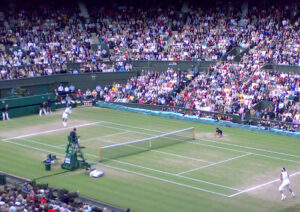
    The 2008 Wimbledon final. Federer is serving for the third set


    The group I am describing is not made up of No.1’s – though all of the people I would put forward for this category have been at one time or another the best in the world at what they do. But being no. 1 in the world doesn’t get automatically get you entry to this club. Being the best in the world here is a mere starting point to being perhaps one day somewhere near this conversation.


    Anyhow, you need to be World No. 1 for a long time to qualify. You have to be world no.1 over and over and over – but even that doesn’t get you there. Rory McIlroy has been the no.1 golfer time and again, but he isn’t in this category: he isn’t actually particularly close. The English swing bowler James Anderson is closer, but not quite there either.


    To be in the elite of the elite of the elite you need to do things nobody else can do – in fact, you need to perform at a level to which nobody else has ever performed. And you need to do it in a certain way. We can call this genius, or magic.


    In the first place, it has partly to do with ease of doing – or apparent ease. When we watch Simone Biles performing her floor routine we can see that she is doing much more than the relatively prosaic thing of winning her gold medal. She is reinventing that sport: she is qualitatively different. The same used to be true of Federer when he would waltz through a Grand Slam without dropping a set. It wasn’t just the ease with which he did this – it was the beauty with which he did it.


    Usually the elite of the elite of the elite express themselves in memorable moments – moments where time itself might seem to slow down, to expand, or to become elastic in some way. Furthermore, these moments will usually be tied to some form of necessity: they therefore represent necessity surmounted, or responded to with unusual skill and awareness.


    These are the moments which send a shiver. One thinks of Michael Phelps in the Beijing Olympics in the 100m breaststroke. Going for his seventh gold medal – to tie the Michael Spitz record which he subsequently beat – he was looking tired coming down the stretch against Milorad Cavic.


    Then something happened. Nearing the finish, Phelps summoned some last ditch strength, and rose out of the water with a sudden show of speed, to tap 0.01 seconds ahead of his rival. He rendered himself above an impossible moment.


    Tiger Woods was able to do the same. At the 2005 US Masters, Woods needed a birdie on the famous 16th hole. His drive went left down a precipitous slope. Viewers at home tend not to know how difficult the greens at Augusta National are: it’s like putting on glass.


    Woods, as every golf fan knows, lofted the ball up and it ran down the slope. It teetered on the edge of the hole then toppled in. Woods went on to win the tournament. He needed to do something nobody had ever done before and he did.


    The presence of someone who is in the elite of the elite of the elite doesn’t always need to come in moments when their backs are to the wall. It can also show itself with a certain ease of doing which can lend itself to a sort of inverse drama: it is the drama of things not being close at all.


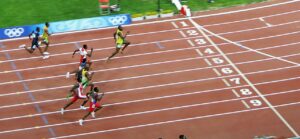
    In this category one thinks of Usain Bolt at the 2008 Beijing Olympics already celebrating about 80 metres in as he broke the world record by a vast margin. He looked almost as if he was flying. Nobody else has ever looked like that. In Bolt’s case it was tied together with a sense of theatre which in retrospect had to do with an extra awareness about the nature of the occasion: the nature of the occasion being that he was very likely to win and so could afford to lark about a bit.
     

    Michael Jordan is another example. When we watch reels of him hanging in the air before dunking a ball, it really can seem as though he has a different relationship to the essential physical structures of life to everybody around him.


    In team sports sometimes we find a certain heightened sense of strategy and inventiveness – the ability to conduct surprising situations with a certain innate virtuosity. In this category we find the great footballer Pele. I have always been fond of the last pass that leads to Carlos Alberto’s goal against Italy in the 1970s World Cup Final.


    Pele looks like he’s playing against children. He collects the ball with his left foot, cradles it briefly, and then with a kind of infinite laziness sends it off to Carlos Alberto, who rifles into the net.
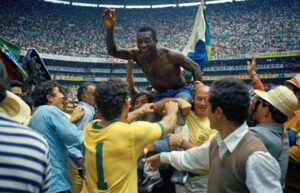


    Some of my favourite Pele moments have almost a kind of silliness to them. The attempt to score from behind the halfway line against Czechoslovakia in the group stages of the 1970 World Cup. The ball misses, but its sheer audacity opens up onto a whole realm of possibilities about how we might play football.


    Similarly, in the same tournament against Uruguay, Pele is running towards the box and the keeper coming towards him, both towards a cross coming from the left wing. Instead of trying to poke it past the keeper, Pele lets the ball go and circles back on himself while the goalkeeper flounders. That he then misses the goal doesn’t matter: he’s shown that there are another set of possibilities for the people to come after him to explore.


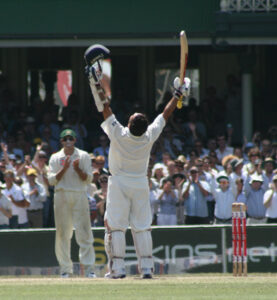
    Sometimes the elite of the elite of the elite can create moments which enter national folklore: inherently patriots, they can have a heightened sense of what their country requires of them. In 2008 Sachin Tendulkar, batting against England in the wake of the appalling Mumbai attacks, needed to produce a century to lift his country’s spirits, and he did. There can be something solicitous about the elite of the elite of the elite: they do what we need to them to do on our behalf.


    Clive James used to tell a story of Joe DiMaggio towards the end of his career. One of the greats of his sport, he was asked why he was warming up so hard when the game didn’t matter all that much in the context of a hugely successful career. “Because there’s a kind out there who hasn’t seen me play before,” came the reply.


    When this top flight of sportspeople are obstinate, their obstinacy can take on infinite proportions. Shane Warne, another member of the elite of the elite of the elite, was once asked who was the best batsman he’d ever bowled against. He replied: “Tendulkar first, then daylight, then Lara.” Asked why, he recalled how during one particular tour Tendulkar had found himself getting out to the cover drive. Unprepared to accept this reality, he simply cut the shot out of his repertoire all day long. Warne was shocked and delighted at the sheer determination of the man.


    Warne shows another example of the way this rarefied group can respond to circumstances. In Warne’s case, everything he did was characterised by a certain adventurous humour. During the 2006-7 Ashes, Warne was provoked by Ian Bell’s sledging to produce his highest test score. Bell, who Warne had been calling the Shermanator throughout the series, chose to answer back.


    Warne pointed his bat at Bell who was in the slips and said: “You mate, are making me concentrate.” Warne went on to score 71 from 65 balls. The implication is that he was so good he could stand in the great arenas of his sport, and not need to concentrate. But if you ever provoked him to do so, he could be as much a batsman as a bowler.


    Nadal reached these heights not because it was easy for him, but because he managed to balance extraordinary effort with profound humility. It was this which made him seem, as commentators frequently said, of another planet.


    That perhaps is what really unites these great sportspeople: they feel separate from us – they seem to resemble gifted visitors. One is sometimes left with the impression that the gulf between us and them is too great for it so be possible to learn anything from them.


    And yet at other times, it seems as though they have everything to teach. What makes it all a little easier to swallow is that time and again they teach the same sorts of things: hard work, humility, endeavour, a mysterious depth of commitment and even humour. We will need all those things in our own lives: that’s we won’t go far wrong if we make the Nadals and the Federers of this world our mentors.
     

  • Ian Botham’s unbelievable journey: Headingley 1981, Geoffrey Boycott, and transformative philanthropy

    Christopher Jackson


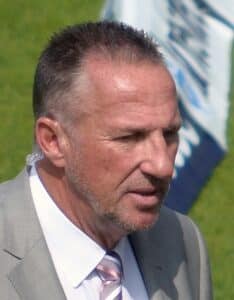
    In person, Ian Botham is utterly solid, calling to mind a rugby prop forward more than England’s greatest cricketing all-rounder. Botham is a famous wine enthusiast, and hunched over his lunch as if he could easily eat one’s own meal as well, it would be a lie to say one can’t see that he’s enjoyed himself from time to time.

    Botham is one of those very few sportsman whose achievements carry across the generations. Sport is really to do with the dramatic maximisation of the present moment: we are rarely quite so conscious of life as when we watch closely to see whether a ball has nicked a bat. Especially because there is so much of it, little sticks in the mind.


    1981 and All That


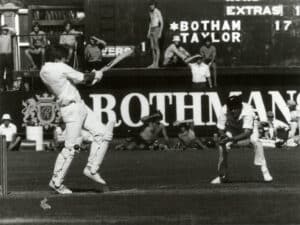
    Something about Botham did: it was to do with the fearlessness with which he played the game, allied always to a certain laddish humour which is still in evidence today. Especially Botham is known for the Ashes in 1981 now forever known as Botham’s Ashes, when Botham’s swashbuckling 149 not out at Headingley began an unlikely set of events. Not until 2005 would cricket come alive in this country to anything like the same extent.

    When we think back on that Test match, It should really be Bob Willis’ test, since it was Willis, who died of cancer in 2019, took 8-43 to bowl out the Australians. Willis hangs over lunch, since Botham is here to raising money for the Bob Willis Fund which raises money for better prostate cancer research.

    Botham tells a wonderful anecdote about that storied day in 1981: “Australia needed a 130 to win. The Australians were 50-1. Bob comes on, and turns to Briers [Mike Brearley, the then England captain] and he said: ‘Any chance I could have a go down the slope with the wind?’ He steamed in and took 8-53.”

    This led to an amusing administrative issue over the unexpected celebrations which Botham, as the world knows, enjoyed more than anyone. “We had this young lad – Ricci Roberts, a 140year-old: he was over from South Africa as a runner. I said to him: “Look we haven’t got any champagne, because obviously thought we weren’t going to win the game.” The Australians thought they would. I said to Ricci: “Go and knock on the Australians door, and be polite and just say: ‘Could the England boys have a couple of bottles of champagne, please?” He did exactly that, but added on the end: ‘Because you won’t be needing them’.”

    The Australians may not have reacted well. Botham continues: “Ricci came through the door horizontal. He had one bottle in each hand and he didn’t spill a drop. Ricky Ricci went on to be Ernie Els’ caddie in all Ernie Els’ major wins. That was down to what we taught him – and how Bob taught him to pour a pint.”


    The Two Geoffreys

    At Lord’s, alongside the extraordinarily likeable Geoff Miller, Botham gave a jovial tour through his career, joking that Geoff Miller was ‘the livelier of the two Geoffreys I played with’ referring to his long-running grudge against Geoffrey Boycott, who Botham famously ran out in Christchurch in 1978. On that famous occasion, Boycott was batting at his usual glacial pace when the situation required runs. Botham picks up the story: “I was asked by Bob, who was then the vice-captain, to run him out and I said: “I’m playing my fourth game and he’s playing his 94th.” Bob replied: “If you don’t do it, you won’t play your fifth.”

    It is impossible to not feel nostalgic about the fun of those times. Botham has come along way. In fact, when Botham recalls his upbringing, as is usually the case with the extraordinarily successful, his story comes into focus in all its glory and improbability: “My father was in the services in the Navy and was serving in Northern Ireland on active duty. When his wife Marie, my Mum, was due to give birth, they sent us over to Heswall in Cheshire.”


    Crunch Time

    The family then moved down to Yeovil and Botham, having shown exceptional sporting prowess, had a difficult decision to make by the age of 15. “I had to make a choice between soccer and cricket. Crystal Palace offered me an apprenticeship. I had just signed at 14 with Somerset – I registered with them and when it came to the decision, I sat down with my dad. He said: “You are by far a better cricketer”. I listened to him – for once.”

    Botham then transferred to Lords for a year and half, before being called back to Somerset at 18. It didn’t work out too badly, did it? Botham smiles: “Not too bad.”

    Botham recalls his first Test match. “The way they did it in those days – well, let’s just say it wouldn’t happen nowadays. You’re driving down a motorway. At three minutes to 12 you turn into a layby and switch the radio on and wait for the 12 O’Clock News. And the England team to play Australia is…And I thought: ‘Yes, I’m in’.”

    That sent Botham up to Trent Bridge, where another lovely anecdote occurs. “We lined up at the start of the game and it was the Queen’s Jubilee. The Queen went down the England line, and wished me luck on my debut. Then she went over to the Australia line, and came to DK Lillee [the great Australian fast-bowler].

    Dennis pulled out of his back-pocket an autograph book. “Ma’m, would you sign this?” She said: “I can’t do that now.” But clearly the Queen had remembered the encounter. Botham continues: “When Lillee got home from the tour six or seven weeks later, through the letterbox there came this envelope with the Royal seal and there was a picture of the Queen. It now sits on his mantelpiece.”


    Merv the Great

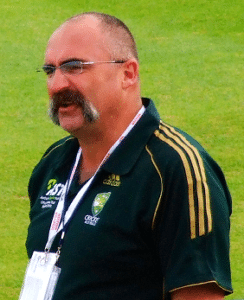
    It’s a lovely story – and the more time you spend in Botham’s spell, the more the stories keep coming. Merv Hughes also gets the Botham treatment. “In 1977-78 we toured Australia, one of my first tours. We were sponsored by a company called JVC Electronics. They decided in their infinite wisdom that on the rest day morning at about 10 o’clock – when most of us had only been in bed 10 minutes – we’d go to a shopping mall in north Melbourne to mingle. None of us were particularly excited about that prospect.”

    So what did Botham do? “I hid behind this tower. This young lad came up in a tracksuit and said: “Good day, Mr Botham. Mate, I want to be a fast bowler have you got any advice for me?” I wasn’t feeling great so I said: “Mate, don’t bother – go and play golf and tennis.”

    Fast forward to 1986: the first test at Brisbane. Botham recalls: “Merv Hughes makes his Ashes debut in that game. In Brisbane, you could see this little black line, that in about 30 minutes became a thunderstorm – hailstones the size of golf balls. Hughes bounces it in, then the gigantic hailstones. Merv wasn’t happy as I’d hit him for 22. We weren’t going to play anymore, the ground was covered with these golf balls.

    One of the lads brought me a beer. Merv comes out and I say: “Congratulations on your first Ashes.” He said: “You know we’ve met before.” I said: “No. Where?” “At the shopping centre in Melbourne.” I was that kid who came running up to you, and you told me not to be a fast-bowler but to play tennis and golf.” He said: “What do you reckon now?” I said: “I was bloody right.”


    Beneath the swagger of the public persona, there is his immense generosity as a philanthropist and his life as a family man. His grandson, James, is following in Botham’s footsteps as a sportsman. Botham speaks with evident pride: “He’s had a couple of years with injuries. His confidence is back – he played very well against South Africa at Twickenham. James was born in Cardiff and said: ‘I’m playing for Wales’. He’s got a task on his hand and we’ll see.”


    A Decisive Difference


    But it’s the philanthropy which really brings a tear to the eye. “I’m very proud of it,” says Botham. “In 1977, I was playing against the Australians and stepped on the ball and broke a couple of bones in my foot. In those days you didn’t stay with the England squad, you got sent back to your mother county. Mine was Somerset.  So I get to Musgrove Park Hospital in Taunton, the club doctor’s waiting for me. To get to the physio department you had to go past the children’s ward.”

    This turned out to be a fateful walk since it would change many peoples’ lives. “You can see children who are obviously ill – tubes sticking out, and their feet up. There were four lads sitting round the table playing on the board games. I said: “Are these guys visiting?” He said: “No, they’re seriously ill.” I said: “But they look fine.” He replied: “You’ve got eight weeks of intensive treatment to get it right for the tour. Those four lads in all probability will not be there when you finish your treatment. True enough at the end, all four of them had passed away.”

    It made a deep impact on Botham who found he couldn’t stand by and do nothing. “What the hospital used to do was give them a party, whether for one of their birthdays or for Christmas. And they were so drugged up with painkillers. As I was leaving the hospital, I said: “Is there anything we can do to help?” He said: “Well, you’ve now seen four parties. We don’t get any funding for those.” I said: “I’ll stick my hand up and pay for the parties.”


    By mid-1984, Botham wanted to do something more substantial. “I was flicking through a magazine which someone had left on the train – a colour supplement. There was an article about a certain Dr Barbara Watson, who lived on the south coast. Every summer she would get on the train and go to the most northerly part of the UK, John O’Groats and meander back. I thought: “Right, I’m going to do a sponsored walk. I’m going to do John o’Groats to Land’s End. My geography wasn’t great. 400 miles to the English border, then 600 miles to the Land’s End.”

    It was a huge learning curve for Botham who had never walked like this before, but he managed to do the walk in 33 days. “You couldn’t do PayPal: you had to physically collect. By the end of the walk we got over £1million. That was used immediately to build a research centre outside Glasgow.” Then the conglomerates came behind us. “When we started the walk, there was a 20 per cent chance of survival for kids with leukaemia – a few years ago we announced it is now 94 per cent.”

    It’s an astonishing story of how something so innocent as being good with a bat and ball and can lead with the right heart and mindset to genuinely consequential change. Botham’s is a reminder to us all to start with what we’re good at – but to keep an eye out for what we might do for others along the way.


    Lord Botham was talking at an event at Lord’s Cricket Ground in aid of https://bobwillisfund.org/


    https://www.beefysfoundation.org


    Like this? See also our other cricket articles:


    Cricket Nostalgia: Henry Blofeld on PG Wodehouse, Ian Fleming and the Remarkable Cricket of the Past

    Culture Essay: What we can all learn from cricket


  • Diary: Henry Blofeld on his new book, not retiring and how to pursue a career in cricket

    The legendary commentator on not retiring, his Eton education, and why the BBC wouldn’t look at him today

    My new book Ten to Win…And the Last Man In isn’t so much a reflective pandemic book, as a book which has to do with the importance of Test Match cricket. If Test Match cricket were to stop, the game would pall alarmingly. The fact that it’s still there, to some extent keeps T20 and the Hundred honest in a funny way. The game which bores me is the 50 over format, particularly when play sags a bit in the middle. T20 and The Hundred are both fine – provided you don’t make the mistake of calling them cricket. It’s showbiz.

    I write my books on my iPad on my knee – the last eight books have been done like that and I must say I find it very easy. When I write a long paragraph on the iPad I might correct the prose there and then – but when I really have corrections to do, I print it out and make my alterations from the hard copy. I find if I sit with a computer or iPad, it has a nasty habit of cutting it and disappearing, meaning I must spend 25 minutes typing it again.

    Right into my eighties now, I’ve worked very hard. I suppose I’m driven by the fear of boredom and the fear of waking up and not doing anything. Fortunately, I have a fantastic Italian wife, and we prefer to be on the road. Besides, you hear of lots of people who retire at 60, and by 65 they’ve become not only the worst bores you’ve ever met, but alcoholic bores. I have a brother who was a High Court judge for 35 years, and though he might try to deny it, he hasn’t really done anything since he was about 75 and he’s now 89: he still champs at the bit rather as if he’s in the High Court. They force them to retire, and in one or two cases it’s a good thing, but it probably wastes quite a bit of good brain power, because experience is important.

    I grew up in a farming family – the Hoveton Estate has been ours since about 1520. My father wasn’t interested in cricket, it was something I picked up at Sunningdale, where I was in the first XI for four years. I was completely nuts about cricket from the age of seven. When I arrived at Eton, I was quite a good cricketer. I loved my five years there, and all my ten years at boarding school. It gave you the confidence to look the world in the face.

    During my last year at Eton, I had a terrible accident and I felt I had the whole of my life taken away: for a long while, life and cricket wasn’t what they’d been before. It took me a while to reinstate the confidence which I might have had had I left Eton unscathed. I have no idea if I would have played Test match cricket had I not had that accident.

    If I arrived today at the BBC and asked for trial commentary, they wouldn’t look at me. For a start, my voice would be a grave handicap. And the way I did it – with the assumption that the whole scene needed to be described, and the picture should be painted – they wouldn’t want that now. I don’t think John Arlott or Brian Johnston would get a look in either, any more than Neville Cardus would get a look in at a newspaper today.

    The ex-players aren’t commentators in radio; they’re summarisers. But of course, commentators on television are the equivalents of summarisers on the radio, because the commentator on television is the camera. Whereas the commentator on the radio is the equivalent of the camera on the television. On the radio you say, “He comes in and he bowls”. You don’t say that on television because you see it.

    If a young person came to me and said they wanted to commentate, I’d recall the advice of Johnny Woodcock, who was the reason I became a journalist in 1971. I said, “I want to write about cricket,” and he said, “I wouldn’t advise that”. But if they persisted, what l’d do is ring up Henry Moeran who’s the assistant producer at TMS and I’d say, “Over to you.” And from there it’s anyone’s guess what he’d say.

  • Culture Essay: What we can all learn from cricket

    Culture Essay: What we can all learn from cricket

    by Robert Golding

    In the post-war period, my grandfather used to go to Lord’s and the Oval every year without fail. In his later years – he died in 2013 – he’d tell me about the time he watched the last innings of the great Australian batsman Don Bradman. 

    As the story goes, Bradman needed to score four runs to finish his Test match career with an average of over 100. He received a guard of honour and the most sentimental version of the story claims that he was still wiping the tears from his eyes when his second delivery by Eric Hollies bowled him. He would finish with the famous average 99.94.

    The story is well-known. But what I particularly remember is the civility of cricket as my grandfather recalled it. In those days, if you suspected you had trapped a batsman leg before wicket, you would witness the delivery, mull the possibility of an appeal, and then, on the way back to bowl, politely enquire of the umpire: “How was that?” 

    In little details like this, we realise how fast the world is changing. Today, a typical appeal will involve frenetic shouting of Howzat!, and an utterly theatrical despair if the appeal is turned down. The way the sport is played today reflects a society which wants it all – and, to paraphrase, that well known cricket fan Queen guitarist Brian May – wants it now.

    Our cricket, then, speaks to the society we’ve become. Alongside these developments, cricket has grown exponentially as a professional sport – as every other sport has also done. Many of these activities – including billion-dollar industries like football, tennis and golf – were invented to supply activity to the Victorian gentleman liberated from drudgery by the Industrial Revolution.

    Suddenly everyone had a weekend to fill. The growth of village cricket and other pastimes might also be put down to something more mundane: the invention by Edwin Budding of the lawnmower in 1832. This, the year that Goethe and Sir Walter Scott died, feels like one of those hinge years when a whole way of life cedes to another. Without Budding’s invention, the English summer with its sound of leather on willow, its players in cricket whites moving towards the batsman ‘like ghosts’ as the poet Douglas Dunn observed, and its sense of the day unfolding with relaxed culinary predictability – sandwiches for lunch and cake for tea – would have been impossible. 

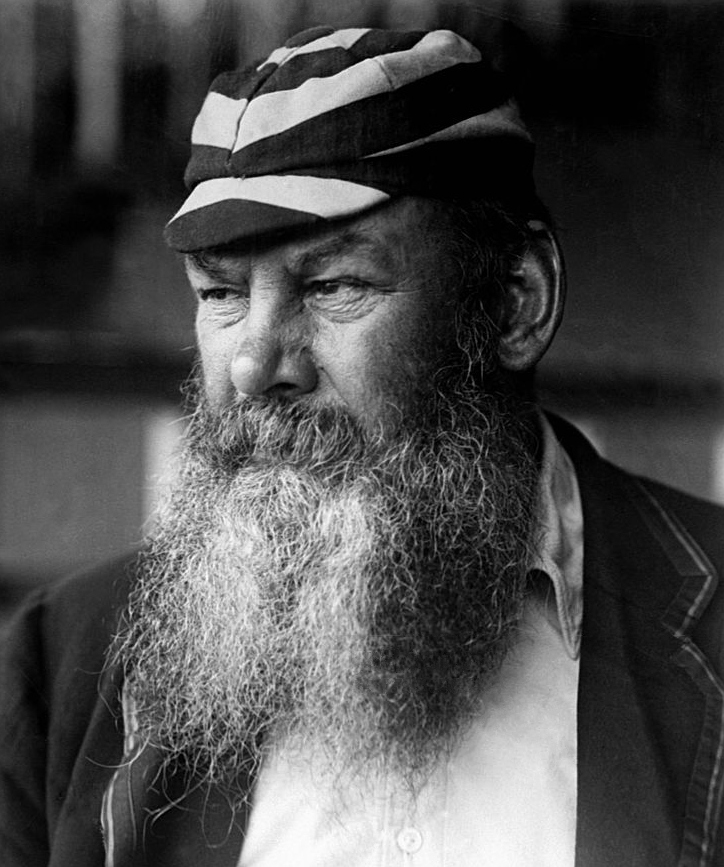
    WG Grace is usually credited with being the first professional cricketer.

    2020 feels like just such another year, and it finds cricket also at a crossroads. Today, if you type the phrase ‘cricket jobs’ into Google, you’ll discover a bewildering array of options – although applying for many them appears to contain the implicit stipulation that the applicant be extraordinarily good at cricket. At time of writing, jobs are already being advertised for player coaches and coaching and talent specialists for the coming season in Australia. Although many of the ads require the applicant to have played at a high level of cricket, most also require significant administrative ability.

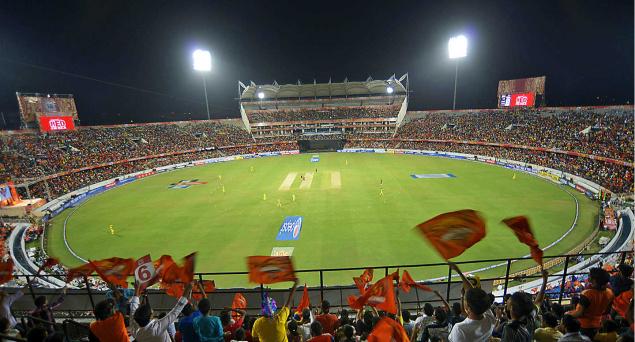
    Expansion and growth in the sport has been driven in recent years by the Indian obsession with the sport. Photo credit: By Jms1241 – Own work, CC BY-SA 4.0, https://commons.wikimedia.org/w/index.php?curid=42650055

    In addition, as cricket has become more complex, the number of roles of a purely administrative nature has also increased: ads for operations officers, and brand managers abound. In addition, there’s even an ad for an umpire manager posted by Queensland cricket. The job description explains to applicants that they will need to ‘develop and implement strategies designed to attract and recruit potential umpires across the state’ while also ‘building and overseeing a network of appropriately skilled people who can provide umpire training and assessment.”

    The ads in Australia are a reminder of the international nature of cricket, but they also point to the great hinterland of people who are talented at cricket, but no longer able to consider playing professionally. Or perhaps they never were never in the running. 

    As cricket has resumed, I’ve had a sense that this is a sport peculiarly suited to post-pandemic life. Yes, it’s always been international which rather goes against the grain of our travel-restricted lives this past year. But it’s also one of the remaining sports which are really to do with stasis and patience – qualities which we have been forced to learn during the pandemic. 

    That’s not all. It was John Arlott who in his great book on Jack Hobbs asked himself what made Hobbs great and decided it was his “infallible sympathy with the bowled ball”. When I mentioned this to Jonathan Agnew recently, he looked delighted at the remark, and nodded vigorously: “Yes, yes, I like that. That’s what cricket’s all about – and it’s also why I don’t like football.” 

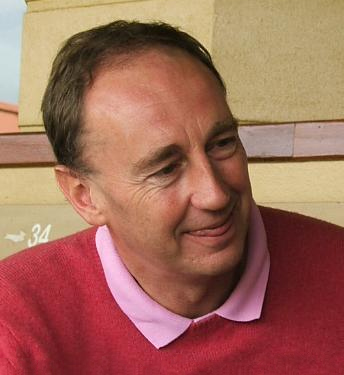
    Jonathan Agnew is a reminder that many careers exist today beyond the traditional playing routes. Picture credit: By Blnguyen – Own work, CC BY-SA 3.0, https://commons.wikimedia.org/w/index.php?curid=1376670

    This opens up onto the essential civility of cricket. It is what makes it, beyond other sports, relevant to our wider lives – including our careers. We wouldn’t speak of the spirit of football, or tennis, or golf: but we can and do talk of the spirit of cricket. 

    It is, in fact, an essentially democratic sport. For instance, the phrase ‘good cricket’ refers to a passage of play where typically, a good delivery has been bowled, a fine shot made, engendering in return a skilled piece of fielding and wicket-keeping. Usually in such moments, the actual score hasn’t been advanced but something has been achieved by both teams together.

    It’s this civility, and undercurrent of decency, which creates a sense of hiatus from the stress of the world, and therefore makes the sport an ideal way to switch off. Sir David Lidington recalls how the sport sustained John Major in his time in office. “To John, cricket remains a great solace, a place where he can switch off, and cares fall aside for a time,” he tells us. Most famously, Major, having lost the 1997 General Election to Tony Blair, declared he was off to watch the cricket: one could feel his delight.

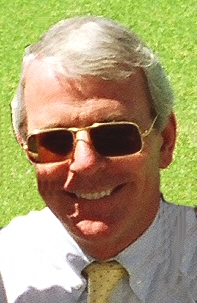
    Former prime minister John Major enjoying his retirement at a cricket match

    For many of us therefore, cricket has been a dimension almost beyond capitalism, and certainly beyond the cut and thrust of politics. It is this notion of cricket as a protected zone of our lives which accounts for the indignation at the rapid commercialization of the sport, especially by the IPL and The Hundred.

    But perhaps we should be careful about saddling cricket with a Victorian flavour forever. Major himself was no classist as Lidington points out: “What was true about John was his absolute commitment to social mobility and loathing of snobbery.” One cannot imagine Major ever minding, say, Ben Stokes’ tattoos; one can only imagine him delighting in his talent. 

    So now cricket enters a new phase, where an international test championship hopefully heralds the beginning of a new purpose for cricket. It may also be that we’ve been reminded of the importance of the slow. I’ve no doubt my grandfather would have heartily approved.