Tag: Costeau

  • Review of Galvin at Windows: “reliably first rate”

    Christopher Jackson

    ‘Now is the time for eating. Later is the time for regret.” So said my companion as we sat down to lunch at Galvin at Windows. In the end we had the eating, but not the regret.

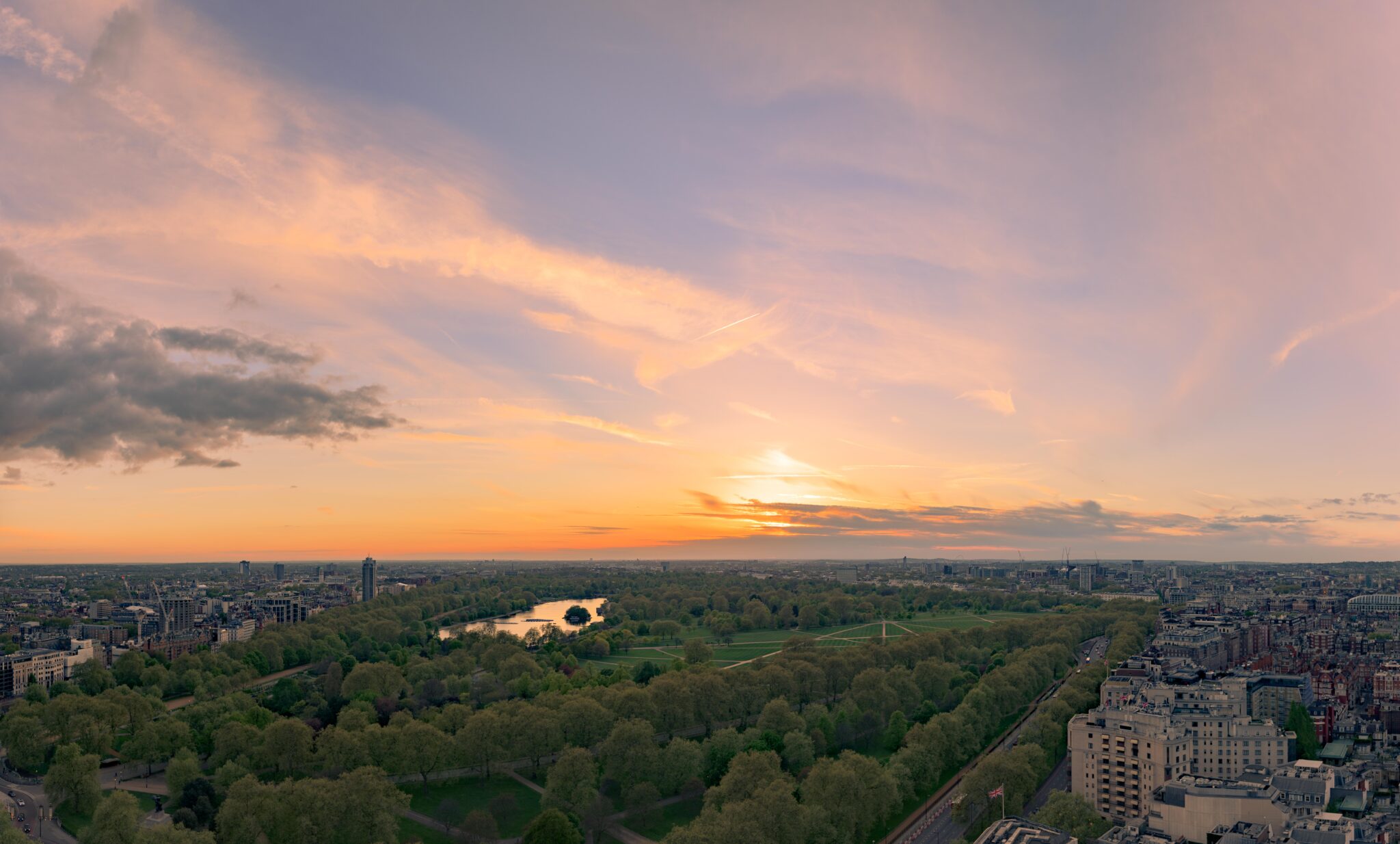
    But first the view: London, unlike New York and Paris both of which are built to comprehensible plans, looks delightfully mad from the skies. The Thames is never quite where you think it should be, swerving in and out of everything, seeming to force the architecture into unexpected arrangements. From on high, you realise too that the tube map is a perfect liar, giving you a false sense of distance and relationship when you travel through it.

    From the 28th floor of the Hilton Park Lane you discover if you didn’t know it already that London is a mystifying place to live. What is Westminster Cathedral doing being so near, for instance, to the back garden of Buckingham Palace? Throughout our meal, we were able to see a peaceful soul mowing the gardens at the palace, looking in his way more kingly than the king. Talking of the regal, there was also an emperor of a seagull presiding over the area near Vauxhall, a bird who, we came to decide, certainly views Nine Elms as his terrain not ours. I noted the occasional stray drone skating along clouds – inquisitive, knowing things we didn’t.

    But we knew also what it did not: the supreme glory of the food at Galvin at Windows. The butter came, slightly fanned and petalled, like an apricot rose on a basalt slab. The butter-knife resembled a sort of bladed paperweight, whose balance would self-correct if you nudged it so that its sharp end always pointed upwards. Like this, admiring a minor novelty, we embarked on one of the meals of our lives.

    In retrospect greatness was coming at us from every possible angle; but I think it was the service which began to alert us to the sheer quality of the afternoon. One by one, good-humoured and knowledgeable staff arrived at our table, conducting the rituals of public dining with a notable intelligence and thoughtfulness. A great meal must of necessity be to some extent incidental to the food: a Burger King would have tasted good up here.
    But happily, this was no fast food experience. Tasting the bread, we already knew that the food at Galvin would be reliably first rate. At around this point, the attentions of Rudina Arapi began to weave in and out of the experience. Arapi cheerfully told us about her upcoming sommelier exams – and the thoughtful pairings throughout the meal make me think she’s likely a shoo-in for these.

    Hearing that I wasn’t drinking alcohol, she caused a revelation in the shape of a few glasses of Wild Idol, the closest non-alcoholic approximation to champagne I’ve experienced – only the very slightest alien tang giving the game away.

    Food-wise, we started with caviar, which came amassed on an oyster shell at the centre of a plate of ice. Adjacent to it, was an oblong plate of bite-sized pancakes together with a tiny china saucepan of whipped cream cheese, sprinkled with chives. I recommend trying the caviar without any additional flavour in the first place so as to concentrate entirely on the pop and brine-rush of the little fish beads.

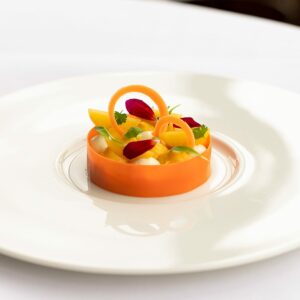
    This was mere prelude to our main courses. I consulted the menu. After a period of anxiety, where every decision seemed to cordon off too many delightful possibilities, I opted – grieving for what I wouldn’t eat – for the artichoke soup. But I hadn’t erred: what emerged was a gorgeous broth, topped with truffles. I found myself reflecting that I never regret ordering soup. My companion went with the crab, which came with a veritable garden of edible flowers, as well as dill. A generous splash of caviar was to one side – like a kindness when someone doesn’t demand a thank you.
    By the time of the main, I was by any reasonable standards already full – almost to the extent where food was beginning to present itself as a dangerous notion. But I had previously committed to a bulky steak. At this point – though my steak was delicious, I might have preferred the cod which my companion had ordered: a thing of delicate crutons, scattered capers, grapefruit, and mash.

    No onlooker, seeing what we had already eaten, would have expected us to order dessert. But our ambition had increased, and so had our curiosity regarding what was possible. Not to eat dessert would have been like hearing the first four movements of Beethoven’s Ninth, and not listening to the finale. That would be to miss out on the Ode to Joy.
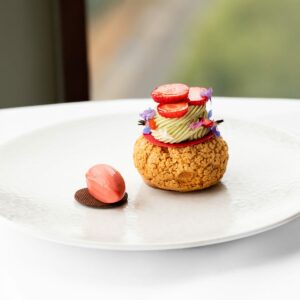
    I opted for the araguani chocolate and dulce de leche, which came with banana and lime ice cream, topped with a sort of hyperloop of caramelised banana. To my own amazement, its deliciousness caused me to eat it in its entriety. My companion meanwhile showed no compunction about finishing her apple tarte tatin, with Calvados caramel and Tahitian vanilla ice cream.

    When she laid down her spoon, it was with the confidence of the soothsayer who has been proven right. It had indeed been the time for eating. We had done our duty – and perhaps if you’re reading this, you should too.

    To make a booking go to www.galvinatwindows.com


  • How to be A Sommelier

    By Costeau

    Years ago Costeau was fortunate to meet the legendary sommelier Georgios Kassianos, the so-called Godfather of Cyprus Wine. He took me through all the things you must do when gauging a vintage: how to swill the glass, how to check for sugar and salt content, and then how to taste it properly.


    Then came the coup. “Now, once you’ve done all that,” he said, “nobody can tell you whether you’re right or wrong.” I found that liberating, feeling that it effectively meant that my ignorance in the matter of wine didn’t matter at all.


    And yet, Kassianos’ assessment, if it’s true, hasn’t stopped the profession of the sommelier from growing up over the years. It’s both an interesting, and reasonably lucrative profession with the median salary in the US being $62,000.


    Gabriel Veissaire is the head sommelier at the Le Meurice in Paris and couldn’t be more enthusiastic about the route he’s taken. So how did it begin? “I interned to a supervisor who was awarded the title of “Meilleur ouvrier de France”,” he tells me “I had the chance to travel all over the French vineyards with him. It’s a profession that is above all one of humility and curiosity.”


    So what attracts him to it? “It’s a passion above all which brings together a certain history of the vineyard, the mystical character of the vine which is the oldest plant in the world, the complexity of the soil and the geology where the vine grows, the oenological techniques and the principle of alcoholic fermentation and the microbial world and above all the pleasures that can be derived from the wine and food match.”


    That sounds like more than enough to keep you going for a very interesting career.


    I decide to talk to other sommeliers, and ask James Shaw, the sommelier at the Conrad St James in London, how a typical day goes: “It often starts by checking in with social media and seeing what everyone has been drinking the night before – always good to keep a finger on the pulse. Once I’m in the building, I will prepare our ‘wine of the day’ for our team briefing – it’s something we do each day to share the stories and styles of each of the wines on our list.” Then people arrive. “Once we are in service, it is full theatre time where we look to share the great stories behind the bottles, pour tasters for our guests to try and explain the thought behind our pairing recommendations.”


    It can sometimes be a hard road being a sommelier. Shaw recalls: “I left a background of Chemistry and Physics to work with food and wine, my parents thought I was nuts, but now that they have seen how far I have gone in my career they’re glad they supported my change in direction. I don’t think I was really aware of what it entails, but wouldn’t change a thing.”


    So what’s Shaw’s advice to young people thinking of entering the profession. Shaw is clear: “Taste, taste, taste and taste some more. Taste with others, discuss and don’t be afraid to follow your instincts over what feels right to you.


    Nadia Khan, the Head Sommelier of the Adam Handling Restaurant Group, notes the importance of setting aside time to think ahead: “Between the two services (lunch and dinner) I will dedicate some time meeting with suppliers and producers, tasting and talking about new wines and projects. This keeps me constantly informed and engaged with the wines from around the world, always training my palate and developing my knowledge.”


    So what talent is required to make it as a sommelier? Khan recalls: I think I have always had a discerning taste and smell. And, with time, experience and constant training, I have developed an analytical consideration, which now enables me to judge a wine after just two or three sips. I would say it’s a natural flair that I’ve applied to experience and knowledge.”


    So what would Khan recommend to young people thinking of becoming a sommelier. “I can advise that it will take time and a lot of hard work but nothing is more rewarding than making your passion what you do every day,” he explains. “Being a sommelier means that you can constantly learn and develop your expertise, whilst still having that incredible interaction with guests which often makes it all worthwhile.” Costeau will drink to that.


  • Is this the end of the boozy lunch?

    Is this the end of the boozy lunch?


    Our eyes on the restaurant industry wonders whether Covid-19 has put an end to a great institution.

    Costeau was recently talking to a grand dame of the publishing industry, publicist to a host of well-known names in the publishing world including Julian Barnes and John Banville. She recalled her first week at work in a major publishing house in the 1980s. As she told us, her start seemed to go well, but at the end of it she was summoned to her boss’ office: ‘Yes, you’ve had a good week, but there’s one problem,’ he said. ‘You don’t appear to be having enough boozy lunches with your authors. This week I want you to take yourself down to the Wolseley.’

    As much as one appreciates any efforts the publishing industry is making to rekindle that spirit, it hardly needs stating that you’d be unlikely to hear this complaint today. And the part-owner of the Wolseley, Jeremy King, acknowledges precisely a hard truth: post-2020 may well be the era when the sozzled lunch is finally put to bed.

    He told Costeau that the trend had been part-driven by America: ‘It had been eroded for a long time. I remember in LA ordering wine at lunchtime and being looked at as if I were a psychopath.’ To some extent he says, the shift was caused by an increase of women in the workplace. ‘It was always the men who would booze the most and do the least. The women were much straighter and to the point: avoid the booze, and reduce the amount of time in a restaurant.’

    This decline in wine-addled prandials was caused also by the rise of breakfast. King continues: ‘A while back, we witnessed the growth of the breakfast which was really all about avoiding the boozy lunch. It’s accepted it’s going to be 45 minutes to an hour; it’s a much more efficient way of working. And in some ways it clears space for people who do want to have a social lunch. I think there will be less business lunches in terms of Covid-19, but more boozy social lunches because people will have missed the conviviality.’

    And yet when we caught up with Sir Martin Sorrell earlier in the year, he was radiant with the thought that he didn’t need to begin his day in a meeting which he plainly views as time-wasting. ‘I actually find I’m doing more work, as there are no interruptions,’ he explains. ‘No breakfasts; no dinners; no surplus travelling. So, on balance I’m more effective and certainly learning more.’

    Of course, your future alcohol intake will depend to some extent on which industry you find yourself in. One friend who runs a recruitment business is dismayed at the thought of forgoing his champagnefuelled lunches in Bob Bob Ricard. ‘We’re still going to do it – we’re doing it now!’ he says. But there is a sense that such spirited folk represent the last bastions of the boozy lunch.

    Journalism, of course, is famous for having a few too many, and yet even here there have been some notable setbacks.

    The death of that great advocate of the alcoholic meal Christopher Hitchens at 61 to throat cancer in 2011 is set to be recalled in a melancholy memoir-cumnovel Inside Story by his friend Martin Amis, who recently in interview said he stared in the mirror and thought: ‘I look finished.’ AA Gill was another who turned away from booze – but later wished as cancer also claimed him that he had turned away sooner.

    That’s the trouble with the boozy lunch: it takes its toll, and the young, who haven’t grown up dreaming of being rock and roll stars, but of designing tech apps, are cannier about their health than their parents’ were.

    So is this a morbid culture? Jeremy King thinks so: ‘I think it is a morbid culture, and that’s potentially drained the fun, but I still think we’ll return to an approximation of what we had before.’

    It is probably a danger in any case to glamorise the whole thing. When Costeau last saw his publicist friend, the wine did indeed flow. ‘Well, this was just like the 1980s!’ she said at the end, by way of slightly slurred summary. It was, and her saying so expressed surprise as much as pleasure.

    I also think it expressed foreboding: and indeed the headache the next day made you wonder even before Covid-19 whether this old institution might after all deserve its place on the scrapheap of history.