Tag: Conservative Party

  • Baroness Anne Jenkin: ‘In 2024, Women Must Have a More Powerful Role in Every Meeting’

    Baroness Anne Jenkin

    I founded Women2Win with Theresa May in November 2015. At that stage the Conservative party had nine per cent women MPs – I spin it around the other way and say ‘91 per cent male’. The first thing was to rattle the cage and explain to the Party why it mattered.

    It was just before David Cameron became leader and he embraced it. In his first speech he said: “I want the Party to better reflect the country I seek to serve.” Now we’ve plodded onto 25 per cent. The Labour Party is at 51 per cent but they use all-women short lists.

    Besides, Labour has an easier pond to fish in. They have the trade unions and the public sector, and these structures mean that young female candidates are better supported on their journey. Labour also has a far less rigorous system of quality control in order to get on the candidates list.

    Women2Win matters because women’s life experiences are different to men’s. You have to have that different experience better reflected around the Cabinet table, as well as in Whitehall and in Westminster more broadly. I’m absolutely sure that we wouldn’t have made such a hash of education during Covid if we’d have had more women around the Cabinet table. That’s why I urge senior colleagues never to have a meeting without a woman round the table, and preferably two.

    After a recent reshuffle, a senior minister said to me: “I hope you’re pleased that there’s been an increase.” I said: “Yes, an increase of one, and the Cabinet Office has no women in it. It has nine male ministers.” They also don’t often consider the impact of appointments. I think the Foreign Office has more female ministers than men, meaning they travel a lot. But then there are no women in the Business, Energy and Industrial Strategy departments (BEIS), or in Scotland, Wales or Ireland. They need to be aware that our voices need to be heard.

    My campaign was to get more women to come forward. The sort of women who would make good Conservative MPs may be on a trajectory to become partner at a firm like PwC. They know if they work hard and do a good job that although it may be challenging, they’ve a very good chance of making partner, and being well rewarded. We’re asking them to move to a risky profession where they may not get selected or then elected – and if they get elected they may well lose their seat.

    Furthermore, no matter how hard they work, promotion isn’t dependent on ability. Not surprisingly they see sharp-elbowed men who know how to play the game differently being promoted and it gets very frustrating – and they leave. That’s not always the case, of course: the government is currently busy promoting women ahead of men, which can create frustration in the other direction. Even so, it’s not an easy path.

    My concern has always been around attracting the right people. In the main from my experience it’s about character which you can’t define easily. I regret that the party doesn’t use our best asset – our people – to show the fascinating narratives of those who do get into Parliament.

    I’m focussed on getting more to step forward, and on helping them navigate the maze that gets them into Parliament. That means assisting them with selection, and explaining how to appeal to those are going to pick you as a candidate. Then I aim to help them once they’re in the job.

    Finding MPs, however, should really be the Party’s job. Famously, Gillian Keegan, who’s now minister of state in the Department of Health with responsibility for social care, I met at the theatre. The Party needs to step up and do a focused outreach job. 

    We really work with women once they have passed the Parliamentary Assessment Centre and are on the official candidates list. We do speech practice, Q&A practice, and we have weekends away where candidates work on their CVs and other relevant skills. We have even included improv comedy sessions, as women can find humour difficult. That aspect is hard for women, who tend to take ourselves more seriously, especially if we’re entering public life. We aim to give our female candidates confidence to do the self-deprecating humour.

    Theresa May remains our patron, and she comes to things regularly. We had our 15th anniversary last year and she was our guest of honour. She’s unlikely to be mentoring people individually as she used to do. She helped that generation of Amber Rudd and Andrea Leadsom a lot. We now have quite an effective group of female Conservative MPs and Peers called the 2022 Committee – she comes to all those meetings, and has made a real difference for young women in the Party.  
  • Opinion: Are General Elections in the UK still fit for purpose in 2024?

    Opinion: Are General Elections in the UK still fit for purpose?

    Finito World


    ‘Laugh about it/shout about it/when you’ve got to choose/anyway you look at this you lose.’ So sang Simon and Garfunkel in their song ‘Mrs Robinson’, and judging by the sheer number of people who voted for smaller parties and independents in the July 2024 general election, it would seem many feel the same.

    This isn’t about the result of the general election, which was the largest display of collective schadenfreude ever aimed at a UK government, but about process. When Sir Keir Starmer arrived on the steps of 10 Downing Street to announce that the country had voted for change, most people in the country inwardly assented. Indeed many Conservatives had been privately wanting their leadership to change tack for years.

    But then the question followed: what kind of change? Even when Starmer announced at the end of that first address to the nation as Prime Minister that he was heading indoors to get to work there was still a good deal of doubt as to what precise work he might be referring to.

    Would he empty the prisons as his new advisor James Timpson wanted him to? And how would his new Justice Secretary Shabana Mahmood feel about, having said rather different things? Would Starmer raise taxes? And if so, which ones? And to do what?

    Labour’s campaign had been a masterclass in campaigning according to Napoleon’s dictum of never interrupting your opponent while they’re making a mistake.


    The format of our general elections had meant that by and large he hadn’t had to elaborate on his plans. This isn’t good for the electorate – and it’s not ideal for the Labour Party itself which will eventually disappoint partly because people have been projecting their hopes at this vagueness. “I serve as a blank screen on which people of vastly different political stripes project their own views,” as President Obama wrote in The Audacity of Hope.

    At one point in his speech, Starmer said he would be ‘unburdened by doctrine’. This was good to hear, since we are crying out for sensible politics – but it’s difficult to think of a more ideological policy than the end to the VAT exemption for private schools.

    Starmer has said some promising things, but mainly people like the way he has said them, since that’s mostly what they have had to go on. At the tail end of 2024, positions will need to be carved out and crises will need to be responded to. Shakespeare’s Hamlet found out that there is nothing quite like events for forcing you into a display of your character which will smoke out your beliefs whether you like it or not.

    When it comes to employability, the subject of this magazine, the matter hardly came up throughout the six-week campaign – except tangentially in that there was talk of an increase in green jobs due to decarbonisation of the economy. Labour also stated that a ‘back to work plan’ would aim to increase the employment rate from 75 per cent to 80 per cent.

    The new Department for Work and Pensions secretary Liz Kendall spoke during her 2015 leadership campaign of her commitment to the living wage, and expressed support for worker representation on company boards – which Theresa May also at one time espoused. None of this is much to go on.

    In fact, the media must take a larger share of the blame for our lack of knowledge about the nature of the new government. The TV debates were once again ludicrous with the whole of the taxation or healthcare system having to be explained in 45 seconds. The manifesto coverage was slender, as were the manifestos themselves.

    The typical response from the media is that they must whittle the issues down in order to cater to voters’ dwindling attention spans. But what if there is a far greater hunger for detail than they think? One often hears its chief reporters speculating about how a certain matter is ‘only for people in the Westminster bubble’. The depth of emotion around politics at each election cycle makes on think that at 45 seconds into an explanation around tax, the people may not be tuning out – they may just be tuning in. To paraphrase Starmer, it’s time for a change.

  • Valete to Michael Gove: Reflecting on an extraordinary Political Legacy in 2024

    Valete to Michael Gove, Tim Clark


    I was fortunate to be able to attend a hastily arranged breakfast in support of Helen Grant OBE, MP for Maidstone and Malling with Michael Gove, who agreed to be guest of honour, despite announcing a few days earlier and making news headlines that he would not be standing at the next General Election.

    Although many of our readers will want to say a more formal farewell and thank-you to him at a later date, this was an historic last Ministerial breakfast on the day Parliament dissolved.

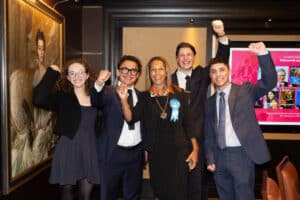
    The event was held in the Beaumont Hotel in Mayfair and attended by some 25 supporters and well-wishers. Also seated around the table were four student foot soldiers in Helen’s campaign team who have already been hard at work pounding the streets of her constituency; welcomed and treated as equals, together with other business leaders, such is the example of Finito’s commitment to supporting and inspiring young people.

    Michael, of course, needs no introduction here. At 56, the MP for Surrey Heath since 2005 he has held several key offices of state: Secretary of State for Education; Chief Whip; Secretary of State for Justice; Secretary of State for Environment, Food and Rural Affairs and latterly, since 2022, Secretary of State for Levelling Up, Housing and Communities.

    There can be few who have been so continually in such high-profile roles and so continually in the limelight. But Michael brings so much more to the table than just being an experienced, consummate politician: he co-founded the conservative think tank Policy Exchange and has had a successful career in journalism and as a writer – his controversial Celsius 7/7 analysed the roots of radical Islamism and the West’s response to it.

    To list Michael’s achievements, however, completely fails to really paint the true picture: he is a man of razor-sharp intellect but with the ability to explain and simplify complex issues; his knowledge and deep understanding of contemporary politics is phenomenally extensive; his wit is ready and genuine and his manner always engaging and polite.

    Over breakfast he was pressed on everything from national service to education; from the economy to defence; from taxation to foreign affairs, but not once did he faulter or miss a beat: every question received an immediate, logical, coherent and convincing response. Where appropriate his responses were light-hearted, such as when he said he had carried out market research into national service – he had asked his son and daughter!

    But despite the ability to be disarmingly charming and funny, his political steeliness and assertiveness are never far from the surface, for example when exposing Starmer’s former support for Corbyn (“Corbyn without a beard”) and Starmer’s comment when a barrister that, “Karl Marx was, of course, right”. Equally, however, his warmth and compassion were also evident in his support for Diane Abbott, someone with whom he profoundly disagrees on practically every issue, because for the way she has been treated by the Labour Party.


    Michael Gove
    Finito breakfast networking event at The Beaumont Hotel, London with Michael Gove. 30.5.2024 Photographer Sam Pearce/www.square-image.co.uk


    Michael’s departure from front line politics will be a massive loss to Parliament, to the Party and to the country as a whole. Whether or not you support his passionately held views on education, Brexit or whatever, no one can deny his remarkable ability to think radically and to argue his case in an engaging and convincing manner. Helen Grant, in her vote of thanks, admitted to not usually shedding a tear over breakfast, but saying farewell to Michael was just one such occasion.

    As was to be expected, he kept his cards close to his chest as to what happens next – more books, a return to journalism or, as many at the breakfast publicly hoped, a high profile role in the Lords – but there’s one thing of which we can be sure: in our host’s closing remarks he likened Michael Gove to the end titles in a Bond film and, like James Bond, Michael Gove will return.


    Tim Clark MA, PGCE, FRSA

    Author of bi-annual Better Schools: The Future of the Country