Sitting on this little red patch of dirt in the South Pacific Ocean, I’ve been trying to get some perspective on the craziness that’s upon us.
How to make sense of the craziness in the news? One place to start is the global coal debate. The first thing to understand here is the basic difference between metallurgical (coking) coal for steel-making and other coals for energy production, concrete and paper manufacturing, to name only a few. Without this distinction the climate change discussion risks creating significant dangers, and the conversation around ceasing coal production will have an adverse effect on all of us. That’s because of these two coal sources is crucial to the existence of man kind.
Let’s start with the basic question of where coal comes from. There are many varieties of coal in the world, ranging from brown coal or lignite to anthracite, also known as hard coal. All coal is formed when dead plant matter submerged in swamp environments is subjected to the geological forces of heat and pressure over hundreds of millions of years. Over time, the plant matter transforms from moist, low-carbon peat, to coal, an energy- and carbon-dense black or brownish-black sedimentary rock.
That means there are two broad types of coal. In the first place, thermal coal makes up for about 65 per cent of all global coal production, also known as ‘steaming coal’ or just ‘coal’. This is widely used as the principal means of generating electricity in much of the world. It’s reliable and stable as a base load energy source and forms part of the energy cycle which includes nuclear, hydro, wind and solar energies to name a few. This is the source of much of the debate around finding renewable energy resources.
But thermal coal must be distinguished from coking coal, also known as metallurgical coal. This is used to create coke, one of the two irreplaceable inputs for the production of steel, the other being iron ore. The property which really sets coking coals apart from other coals is its caking ability, which is the specific property required to make coke suitable for steel making.
Now, coke is produced by heating coking coals in a coke oven in a reducing atmosphere. This is known as the caking process. This refined coking coal is then used in blast furnaces along with iron ore as the base minerals to make steel (pig iron).
So, what will happen if those who win the argument and coal mining becomes phased out altogether?
Well, in a world where coal-mining stops altogether, there would be an obvious and undesirable side effect: we would stop steel production. That would mean no more high-rise buildings, football stadiums, bridges, cars (Telsa included), trains, planes, air conditioning, computers, mobile phones, solar panels, wind turbines, power stations, refrigeration, hospitals, ambulances, shipping, recycling – and of course the needle used in the syringe that vaccinated you against the Covid-19 virus. It’s a scary but real prospect.
Humans rely on steel, we have been making it for over 3,000 years. It’s in every facet of our lives and without it we stop. Transportation, communications, food production, economies and modern medicine rely on it. Take away metallurgical coal and you stop steel production.
Here, we take a breath. There are smart minds looking to alternative fossil-free steel-making processes such as hydrogen steel which is gaining traction and significant investment as a future process. But realistically, we’re decades away from producing steel on anything like the scale we do today.
Besides, so long as developing and emerging economies such as China, India and Indonesia are dependent on the production of steel – and so long as steel is heavily reliant on metallurgical coal and iron ore – it would seem the debate about stopping coal mining is in some sense a misguided one.
It seems certain then that coal-mining will remain for some time to some degree. Thermal Coal and most non-renewable energy resources will be slowly phased down as we find and implement renewable alternatives. That’s a good thing, but it will take some time.
If we agree that steel is important and therefore metallurgical coal must remain in our lives, then we have the parameters of a sensible debate. Perhaps we need to also start at the level of language by referring to thermal coal as ‘energy coal’ and ‘metallurgical coal’ as ‘steel coal’.
The writer is the founding Director of AMC Supponor
Very possibly, if one had to pick a word of this century so far you’d come up with ‘data’. We all receive data, examine it, worry about the data we’re not receiving, and question the data we have, wondering if its bona fide or in some way false.
But data, by its very nature, feels invisible. It’s this which gives it its power – the sense of something both powerful and intangible.
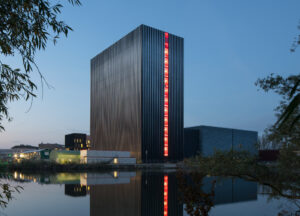
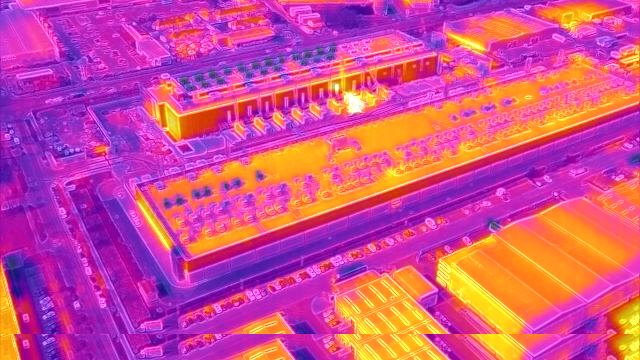
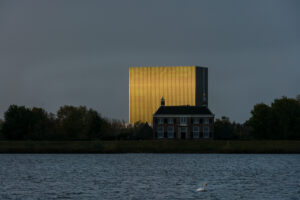
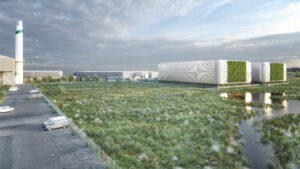
Yet a recent exhibition at Roka in Imperial Wharf showed that this isn’t the case. In actual fact, the need to store data has created a new and varied architecture. Facts which at first seem like they might belong to the ether – such as the fact that Google processes around 5.6 billion search requests per day – turn out to have ramifications in the real world around of us.
Sometimes data centres are housed in our midst in sheds and buildings – in precisely the sort of non-descript architecture you’d expect. But sometimes they are in the world around of us – for instance, in the former department store Macy’s. This fact alone might be taken as an emblem of the way our world is going: people used to go to this place physically to buy clothes, but now it is a place committed to housing the data by which we can do so online.
Meanwhile, former print works in Chicago, which used to produce Sears Catalogues and Yellow Pages, is now the Lakeside Technology Centre. In these instances, it can be surprising to find that the usage of a building has changed right before our eyes. The sense is then not so much of the pace of change, but of its surreptitiousness, even its secrecy.
This new architecture can also surprise by being housed underground as is the case at Pioenen Bunker in Sweden, which formerly hosted Wikileaks and can only be accessed deep below 30 metres of granite. But if data lies beneath our feet, it also now inhabits the skies: in 2016, NASA created the New Solar System Internet to communicate with its Voyager and Mars rovers. It’s the first space-based data centre – another sign of the times.
But if one looks at the question of the energy it takes to create the architecture which houses our data then you realise that it is in a head-on collision with the question of climate change. Put simply, these places have gigantic carbon footprints. Some architects have come up with renewable solutions. Lefdal Mine Centre, for instance, is 85 feet underground and surrounded by solid limestone. It is 100 per cent renewable and is cooled by water from nearby fjords.
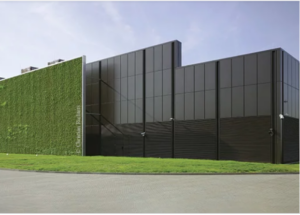
But often in these designs, we find a knowing juxtaposition between the sheer amount of energy used to fuel our online lifestyles and prevailing climate anxiety. At Gak Chuncheon in China, trees planted on the roof reduce the amount of electricity used for air conditioning, as well as blocking the glare of the summer sun, protecting the site from heat island effect. At AM4 Equinix in Amsterdam, a moat intervenes between the public and the enormous data centre to take into account public awareness of the amount of energy these buildings use.
This is how the world changes – almost imperceptibly, and never without anxiety or regret. It would be tempting to say that the buildings in this essay represent our future, and perhaps they do to some extent. But really they represent something much more complicated: our restless, ambitious present.
In the 1630’s and during what is now considered the Dutch Golden Age, contract prices for newly introduced species of Tulips reached astonishing heights that were completely removed from concepts of fundamental or inherent value. The rapid escalation of interest in the fashionable bulbs, however, dramatically collapsed within a few years causing what is believed to be the fall of the first speculative bubble and the start of what is now coined the futures markets.
Fast forward 400 years, and it appears we are entering into another type of flora-based mania – this time under water – as venture capitalists masquerade to save the planet from carbon dioxide (CO2) and other equivalent molecules.
Enter into the discussion Algae, one of the most important substances on earth. A complex evolutionary masterpiece, there are approximately 12,000 known Algae species, and which are popularly (if incorrectly) merged into the term Seaweed.
The Seaweed family contributes more than we could ever understand to life on earth, from sequestering CO2 from the earth’s atmosphere, to supporting the base food source of all marine life, through to cures in modern medicine and the foundation of the skin and beauty industries.
And Asparagopsis Taxiformis, a red seaweed species, is no exception. It is marketed as a leading solution to combat methane emissions, and has shown to reduce ruminant enteric methane (CH4) production up to 99%, decrease the carbon footprint of ruminant livestock and potentially increase production efficiency.
Across Australia, New Zealand and many other parts of the world, the race is on to produce, refine and manufacture this wonder seaweed due to its incredible effects on reducing methane in the ruminants of Cattle, Sheep, Goats and Deer.
In Australia the market controlled by a joint venture between CSIRO (Federal Government Research Agency), James Cook University and producer owned Meat & Livestock Australia held under the entity ‘Future Feed’. Future Feed licenses companies to grow, harvest and manufacture the seaweed for commercial use in feedlots.
Large scale investment and government grants have produced seaweed farms across the southern shorelines of Australia and New Zealand with hundreds of millions of investments. And with the intellectual property seemingly locked up, investors are in a frenzy to lay their claim. And like any bubble, it seems few are pausing to address either the potential harm to humans or impacts on the environment of the associated growing, harvesting, manufacturing and distribution channels.
It is well understood that the active ingredient in Asparagopsis Taxiformis that reduces methane is the compound Bromoform (CHBr3). The first challenge for proponents and investors of this Seaweed is that in its raw form, Bromoform is a carcinogen. It could have immediate and long-term effects on the nervous system depending on the amount and frequency of exposure. While human data thus far is considered inadequate in providing evidence of cancer by exposure to Bromoform, animal data indicates that long-term oral exposure can cause liver and intestinal tumours. On the question of whether Bromoform administered to livestock will find its way into the food chain, a recent study from a Dutch University (Wageningen University and Research) concluded that in dairy Cows tested, Bromoform was found in samples of both milk and urine. This concerning transfer and retention of Bromoform has of course been vigorously defended by Future Feed as it pushes the boundaries of production with the few licenses it has granted, creating scarcity, demand and an economic bubble.
The second challenge is that to materially reduce methane emissions from cattle, the recommended daily dose for cattle is understood to be approximately 0.5% or less of highly bioactive Bromoform. With 27 million head of cattle in circulation annually in Australia and only 4% in a feed lot environment at any one time, how this dose is efficiently administered is anyone’s guess. Sheep, Goats and Deer are even less controlled.
The third challenge is the carbon footprint of growing, manufacturing, and distributing this form of seaweed. By way of example, the Australian company Sea Forest is licensed to grow the seaweed product in a suitable environment off the far south-eastern corner of Tasmania. The electricity and diesel used to grow and harvest the seaweed from the oceans, coupled with the high electricity output required to freeze dry it and the subsequent distribution to feedlots on mainland Australia (often over 3000km away), are staggering for a commercially unproven and potentially unsafe emissions reduction product.
As a cautionary tale, in recent times the New Zealand dairy industry was hit with extreme export sanctions from China on the basis of a perceived threshold issue relating to the DCD nitrogen prohibitor in dairy cattle. This locked NZ out of trading dairy items with China for 12 months, costing the industry and investors heavily.
Just as tulip traders met with overzealous buyers in smoky taverns in the Netherlands in the mid 1630’s, we are today confronted by frenzied investors and venture capitalist players chasing a potentially harmful and environmentally risky product that may well be better left in the oceans to absorb CO2 naturally and replenish the marine ecosystem.
The world is heating up. We’ve known it for a long time, and the recent heatwaves across Europe and the world serve as a reminder that things are very wrong. While Summers get hotter, many businesses still enforce dress codes which leave employees sweltering. Luckily, the fashion experts at Karen Millen have come together with wardrobe solutions for the workplace.
The first item to consider is the shirt dress – a long version of the dress shirts synonymous with traditional business. Collared shirt dresses look smart and professional, especially when paired with a light blazer, but Karen Millen also recommends t-shirt dresses as a better way to stay cool, providing that your employer allows them. They say that incorporating a belt can help dress up this light outfit into something that even more traditional employers will have trouble taking issue with.
Free-flowing maxi dresses are also a popular option as they often come in lightweight, breathable materials. They also come in a variety of colours and patterns to fit every level of workplace dress expectation.
A lightweight trench coat can be an interesting addition to Summer wardrobe which allows you to transition from a cool morning to a warm afternoon. Forget the heavy Winter wool – these trench coats often incorporate cotton to keep the wearer cool.
In terms of footwear, it all comes down to what you can get away with at work, but ultimately less is more. If sandals are allowed, go for it, but if not look for smart trainers with good ventilation to keep both your employer and your feet happy.
While cotton is the standard, it is good to remember that you can find just about any item of clothing in linen these days. This lightweight, breathable, and smart-looking fabric is not to be underestimated.
Climate change is an undeniable threat which requires immediate, decisive action. Even with such action, it would take time for the changes in our food production, transport, and manufacturing practices to take effect. Until then, we might as well be comfortable.
Looking for a change in workplace culture? Check out Finito World’s guide to the top 50 cities to work in around the world here
Matt Thomas interviews the barrister and climate change advocate on COP 26 about his extraordinary career on the front lines of the great fight of our times
MT: I saw that you first trained as a barrister, how did you end up in the environmental world?
I went to the University of Western Australia, and I did law there. And then I came back to the UK, really only because my mother was terminally ill and I went to University College London to do my undergraduate law degree.
And for all sorts of reasons – only part of it was to do with the course or the university – I didn’t connect with undergraduate law at all and I struggled to perform having been used to doing well in the art subjects, particularly in English literature and other subjects, I found English law really pretty dark.
I just didn’t connect with it so I had a period of time, right at the end of my degree, which was very intense and rather sad, and with the help of friends and then a girlfriend, I somehow managed to get a decent grade. That was largely because in my last year I focused on international law and jurisprudence legal philosophy.
Suddenly I found a way I could understand – partly perhaps because I had grown up in Lebanon and Singapore and Australia. International law seemed to fit more my understanding. I was interested in the cases of international negotiations and the things that international law seemed to be based upon, and I was attracted to the more obvious moral and political case for law that you see in the legal system that’s still forming itself.
And it just seemed to work. I got my first proper job I suppose at the Research Centre for International Law, I became director Studies in Law at one of the colleges and the Chernobyl incident had inspired intense academic conversations about the question of what you do when environmental harm so obviously crosses borders.
The Soviet Union did not inform its neighbours about Chernobyl. They kept it secret, and the world really found out about it because of a private satellite who saw it and followed the clues on the radionuclide cloud. Governments did not bring actions directly against each other in the international court. It seemed to us at the time this was just an example of the legal system not working.
MT: So, the Chernobyl disaster was the ‘lightbulb moment’ I guess in terms your first link to the environment?
Yeah, that was it. It was a graphic example of a trans-boundary environmental harm. And the way the law worked – or didn’t – reveal inadequacies of the international legal system. It needed a fresh approach. And then after that, the climate change issue emerged and had similar more substantial problems to resolve. But the obvious place to be is international law because the problem could not be resolved by individual nation states.
Q: As a ‘friend of COP’ what has been your involvement in the conference?
It’s a day to day, topical question. All the governments who have this role of president form groups of advisors, and they vary. I’ve done a few, they vary in type, but they’re meant to help the president’s function which is to shepherd everybody towards agreement.
Equally, all presidencies have some kind of thematic approach to the climate problem, as well as their principal obligation which is to get agreement on whatever the agenda items are for the year.
The UK Government which obviously has a very substantial and competent civil service doesn’t really need the kind of advisors that other governments have needed. I’ve been a senior advisor to Morocco and to Fiji, where I was really hands on.
Outside of government, I think it is useful to have another circle of advisors who are independent and can say straightforwardly what they think and are worried about the consequences. Even so, it can be frustrating sometimes when you aren’t adequately listened to and anyway. But we have regular calls, as a group, directing into Alok Sharma who is the president of the process. We also have calls with his senior officials on particular topics. And, you know, there are several themes, and each of those themes have subsets of the group and often I happen to be involved, particularly with the nature theme at the moment because that’s part of a project I’m working on. But I also get involved in the finance and because I’d be an experienced negotiator, I’ll talk to the chief negotiator as well about how they’re running the process.
Where you’re going to arrive in terms of negotiations is always contingent on things that have nothing to do with climate change or some other geopolitical issue. Some other pressing immediate concern, something that has to do with a relationship that is central to power in the world.
Success or failure usually turns on the US and China. There are really only 20 other countries that have to come to agreement to make a difference, even though the whole process works by consensus here.
But if you don’t have India, China, US, the EU aligned or capable of coming to agreement then your event fails.
MT: I was going to ask later on about what sort of challenges there are but from what you have mentioned it seems topics like geopolitics seem to actually come before addressing climate change?
They can’t be separated. Every now and again, you see the potential for climate change. As an existential issue, it has the capacity to bind, and it can actually bring people together; it can make people desire cooperation. That remains a hope that I have that at a very elemental level. There is common ground between these big forces in the world who have other reasons for disagreeing. But that might be the idealist in me speaking.’’
MT: On your website you say that, when addressing issues centred on tackling climate change, you are ‘interested in the space between law, policy, finance and technology’. Can you elaborate on what you mean by this?
I’ve decided that’s probably my function. So, for example, if you want to deploy capital to solve the climate change problem you want your money either to have very specific obligations to deal with climate, or, that there is an opportunity for you to compete with incumbent businesses and technologies that may actually be causing the problem but have been there for a while.
So if you want a marketplace for money and technology and other resources, you have to change the rules. So changing the rules means changing the law or changing the application of the law, or changing the public policy interpretation of the law.
Clearly, there’s politics and power politics involved with that but there’s also permanent civil servants who have mandates that are already set. They, on the whole, either make or implement policy depending on where they are in the world. Frequently, the language spoken by all parties is so different, they don’t quite understand each other. And they certainly don’t trust. And then, the world of finance has his own ecosystem, all sorts of different types of finance, they have become quite distinct tribes with their own return expectations. They have their own sense of themselves. Believe me, they really do have their own sense of who’s best.
And sometimes that doesn’t connect with people who create enterprises, entrepreneurs, innovators, people starting out, have no experience of any of these phenomena. They need to be helped, but they also need to have an environment in which they can actually compete where they can thrive.
I like to keep on top of what’s coming through in the world of innovation I want. I have got some experience to offer but I don’t know the answer, so I’m interested in being something of a carrier of ideas, and a connector of people.
MT: It seems to me that there is a strong focus on climate change but the interrelated issue of biodiversity loss gets far less attention. Climate change is just one of the factors behind the destruction of habitats and the degradation of the natural world. How can companies, consumers and policy makers elevate understanding of the impact of biodiversity loss on human societies?
‘Yeah, and they are completely interrelated, which makes it evermore complex to solve. I spent most of the last year, more focused on nature.
I’ve worked a lot on wildlife. I did the International Whaling Convention, the Convention of Endangered Species, illegal trafficking with wild birds and other species.
It’s quite dangerous work too. I work with people who risked their lives trying to reveal what was going on. So this has been there all along but it’s been a relatively minor issue for big politics. It’s an issue for people who care. It’s an issue for people who’ve got a particular concern about a species, and it’s widely felt. People do feel a connection with nature.
Clearly something happened to us psychologically during COVID, where people started to appreciate nature wherever they lived – maybe, particularly if they lived in a city.
The climate issue has highlighted aspects of the decline and threat to nature, but not all of them. It has a tendency to deal with climate as a priority that has sometimes led to people thinking too little about the complexity of natural systems. Planting trees is not a solution a guaranteed solution as planting trees means monoculture, and actually, biodiversity loss, which can happen. And as has happened.
Recently some good research came out of Oxford, on how many 50 degree days there are in a year now. The more you have those a year, the more you suffer economically, but there are things that can be done and relatively quickly to change that and a lot of it is to do with planting trees or creating green surfaces. But we also need to manage rainfall, because we’re getting more intense rainfall which our hard surfaces can’t handle.
Q: Do you expect these conversations around biodiversity to become more mainstream in upcoming years?
I do. And I think that language is important. Biodiversity doesn’t reach people. Nature does. So choosing the right language to communicate, choosing the right messengers, obviously we’ve had the legendary David Attenborough to do a lot of the messaging, and he has made the connection between climate and biodiversity pretty clear. But if you want to do something about it in your own place, you probably need to organise at a community level. And that’s really hard to do, but necessary.’
Q: We touched on it briefly earlier but what do you see as the main barriers to tackling climate change?
I think one of the main barriers is psychological. It’s a problem that feels too big for me as an individual. If I don’t think I’ve got any levers of power to pull, then I want someone else to do it.
And meanwhile, I’ve got something that’s immediately pressing on my concerns that I’ve got to feed children or I’ve got to find shelter, I’ve got something that right now I have that I have to care about. This issue looks literally beyond me – beyond my levers – and has a temporal dimension that encourages you to postpone action.
The other psychological fact is that we all experience is that we all have a kind of status quo bias. I don’t mean that in a political sense I mean, we’d rather not be disruptive.
And, and also, there’s a generational problem here that the generation that benefited from the tremendous growth in the 20th century that was driven by widespread use of fossil fuels, miraculous, use of fossil fuels, the innovation that went into fossil fuels the number of products, God knows. Look around you. Now, how many things in my room right now have a petroleum base or hydrocarbon base. Yeah, staggering.
It’s very hard for that generation, to feel like there was anything wrong, you know, good things came from that place, wealth, and security, and material benefit.
On top of all that, there are cultural connections that are very, very deep. You can see that most clearly in in the kind of mining and mineral cultures of Australia and Canada and the US.
So, you know someone from the soft city comes along and says, all that, all those minerals and oils are there bad thing, they get dismissed because they come from the soft city and they don’t know how hard it is to win this stuff from the earth and create wealth. Those things are hugely important.
But in the last few years that the things have shifted quite markedly. Because there has been some government intervention the barriers are different now. They’re to do with how quickly you can make the transition, and how fairly you can make the transition.
There are several set piece battles, I don’t like to use war language, but what the hell. One of them is that renewables have to beat coal in Asia. And yeah, then you got to ask, “Where’s the money going to come from?” Well, there’s lots of domestic capital in China. Actually, in the end I’m not that worried about China.
There’s a very confused picture, because they’re the largest renewable energy market in the world but they’re also still doing a lot of coal. But Indonesia is crazy. Why on earth are they building more coal plants?
MT: How would you rate progress in the UK in comparison to other mature economies around the world?
‘Very good in parts. Very good in creating the legal frameworks and very good in concentrating expertise in many disciplines, less good on implementation.
Unfortunately, we’ve had some quite mediocre government where people who are more interested in politics as played out in the media.
And that’s not a party political point because it works across the spectrum. It just is the case that too much politics is based on how you appear on a screen and how you are interpreted by the media and not enough with how you govern your department.
Unfortunately, climate change is one of those issues that you need good government. A nice soundbite doesn’t actually solve the problem.’’
Who would you say are the best at implementing right now?
As a structural point, I think it is much easier to implement in smaller states, where there’s a high level of trust in the community. Denmark would be an example of an effective response/
Periodically, the other Scandinavian countries do well and you see elements of progress in Germany and the Netherlands. I mean elements because it’s not perfect by any stretch. And then you see it also in the highly educated and technocratic cultures like Singapore and Korea. So those places have done well.
But nobody has all the answers, and nobody can solve the problem on their own. So, unless you get something like 20 to 25 of the major economies of the world, all doing something broadly similar in terms of effort, then nobody, nobody can protect themselves from all consequences.
People will move. Of course, they will move. You would, I would. If I’m living in a place where I’ve got no water I am going to go somewhere where there’s water. If I’m living in a place where there are 20 days above 50 degrees in a year, I’m taking my family out of there. I want them to survive.’
MT: Are there any specific goals that you and your ecosystem have for the next couple years?
I’m working at the moment on natural capital. I’ve got goals associated with that. And, and they’re largely to do with lining up a big general principle, like, we should value natural capital, and then taking it, drawing that down into the institutions, where they have the power to apply that in practice, and then showing examples of how the principles applied through investment in a real transaction.
These are the kinds of things that are both short and long term because I think we’ve got some momentum on the topic. But then there are others that are just the same as they always were, really: they’re about trying to get agreement to keep as far as humanly possible under or not too far past the 1.5 degree threshold.
I’m constantly scanning for enterprises that I think have a solution that could scale. Now I want to find an institutional capacity to do that routinely so it’s not left to a few individuals around the world, whereby we actually have good well-structured, well-motivated, incentivized institutions, to find the solutions that can be accelerated and deployed, because we’re in a race. Alot of these great ideas will emerge organically over time but we actually need to speed the whole process up.’’
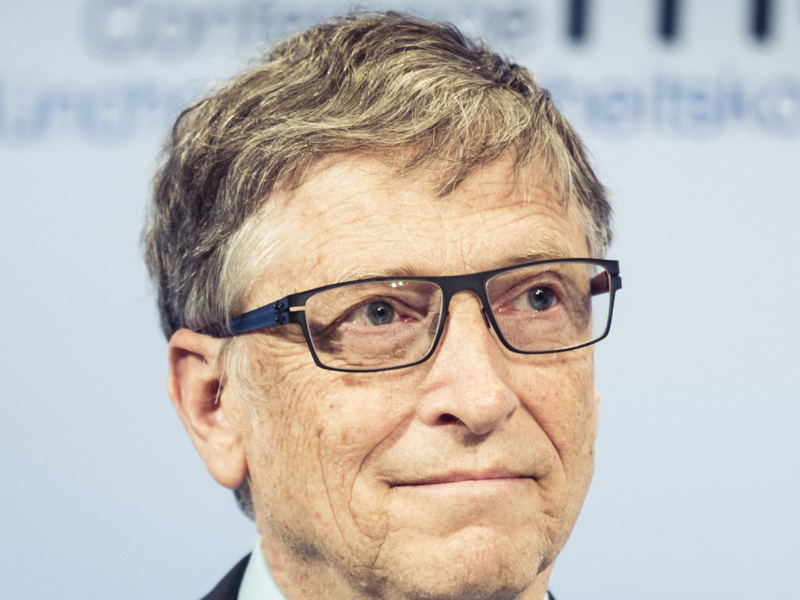
How to Avoid a Climate Disaster: The Solutions We Have and the Breakthroughs We Need by Bill Gates, Penguin, £20.00
A climate disaster is looming and although its impact is mostly invisible in our day-to-day lives, the damage humans have done to the planet already seems dauntingly irreversible. As Bill Gates points out, “fifty-one billion is how many tons of greenhouse gases the world typically adds to the atmosphere every year” and merely aiming to reduce emissions by 2030 is not an adequate target. He explains: “The climate is like a bathtub that’s slowly filling up with water. Even if we slow the flow of water to a trickle, the tub will eventually fill up and water will come spilling out onto the floor. That’s the disaster we have to prevent.” Simply put,“if nothing else changes, the world will keep producing greenhouse gases, climate change will keep getting worse, and the impact on humans will in all likelihood be catastrophic,” Gates says. But How to Avoid a Climate Disaster focuses on the “if” as Gates considers the changes needed and sets out an optimistic road map of how we can divert a climate disaster.
By his own admission, the burger-loving billionaire founder of Microsoft is an unlikely poster boy for saving the environment. “I own big houses and fly in private planes – in fact, I took one to Paris for the climate conference,” he confesses. While Extinction Rebellion seemingly sees anti-capitalism as crucial to the cause of environmentalism with many of its followers protesting by causing disruption in London’s financial district, Bill Gates is proposing a way to reduce greenhouse gases which will be palatable to big businesses. In each chapter he considers the financial implications of his suggestions. He proposes that countries should implement what he calls “green premiums”. He explains: “Most of these zero-carbon solutions are more expensive than their fossil-fuel counterparts. In part, that’s because the prices of fossil fuels don’t reflect the environmental damage they inflict, so they seem cheaper than the alternative.These additional costs are what I call Green Premiums. During every conversation I have about climate change, Green Premiums are in the back of my mind.”
Indeed, Gates is pragmatic in his approach and is constantly aware of the feasibility of his proposals. In the chapter about eating meat for instance, he says although animal consumption causes a lot of environmental damage, it is unrealistic to stop it entirely. He looks at meat alternatives, such as Beyond Meat, a company which he has invested in. He reasons: “Artificial meats come with hefty Green Premiums, however. On average, a ground-beef substitute costs 86 percent more than the real thing. But as sales for these alternatives increase, and as more of them hit the market, I’m optimistic that they’ll eventually be cheaper than animal meat.”
Gate remains optimistic throughout the book and suggests the threat of a climate disaster provides mankind with an opportunity to be innovative. He is always looking for the silver linings. For instance, he says: “I never thought I’d find something to like about malaria. It kills 400,000 people a year, most of them children, and the Gates Foundation is part of a global push to eradicate it. So I was surprised when I learned there is actually one nice thing you can say about malaria: It helped give us air conditioning.” In the most compelling chapter, What each of us can Do, he suggests we should all be hopeful. He says: “It’s easy to feel powerless in the face of a problem as big as climate change. But you’re not powerless. And you don’t have to be a politician or a philanthropist to make a difference.” Of course, we hope he is right. Gates was a coronavirus Cassandra. In a 2015 Ted Talk he warned: “If anything kills over 10 million people in the next few decades, it’s likely to be a highly infectious virus rather than a war.” “We need preparedness,” he demanded. This time, hopefully people will listen.
Photo credit: By Kuhlmann /MSC – https://securityconference.org/en/medialibrary/asset/bill-gates-1523-18-02-2017/, CC BY 3.0 de, https://commons.wikimedia.org/w/index.php?curid=100184908
The Covid-19 pandemic has upended the global economy and shaken public faith in the ability of governments to act decisively in the interests of citizens during a crisis.
Yet the unprecedented, disruptive policy actions taken to lockdown economies and reduce Covid transmission have exposed the unwillingness of politicians to seriously intervene in another looming crisis, from which it is not possible for us to self-isolate. Climate change.
In the absence of swift policy action by national governments to deliver on the promise of the 2015 Paris Agreement, many business leaders are now asking themselves what they can do to prepare their firms and staff for a future increasingly disrupted by climate change.
One of the most powerful levers we have at our disposal to fight global warming is finance. Where we invest today, shapes our future tomorrow – yet most of us currently have little visibility or control over where financial assets like our pension funds are invested. This needs to change.
Some 79% of people polled for Good Money Week 2019 agree that we are responsible as individuals to take action to combat climate change, yet 76.5% of us remain unaware that our pension has an impact on the environment at all.
The disconnect between public attitudes on climate and financial sector investment practice, means consumer pressure is not being applied to decarbonise our pension funds.
An analysis by Telegraph Money of the 10 biggest pension providers’ default funds found that pension fund money had been sleepwalking into stocks that were negatively affecting the climate, with only one of the top-10 funds, Nest, having no fossil-fuel producing firms among its largest investments.
This is one area where business managers can take an active leadership role, creating space for conversations on pension fund investment choices, and ensuring fossil fuel free alternative investment options are made available for staff.
Where company pensions are invested is a top 10 issue workers would like to discuss with their boss – with Good money week polling finding 12.6% of workers wanted to discuss issues such as pension investments in arms, tobacco and fossil fuels and potential alternatives.
Research by Royal London has found 40% of people want to be offered fossil free investments ‘as standard’, but with a strong age gradient – 54% of under 35s support this proposition compared with only 34% of over 55s.
In July 2020, it was announced the Nest pension fund with 9 million UK members would begin divesting from fossil fuels to ensure alignment with the Government Net Zero strategy.
Reducing fossil fuel investments is no longer viewed as an ethical or moral imperative alone. With the energy sector the worst performing sector over the past decade, money managers have a fiduciary duty to manage the investment risk posed by fossil fuel investment in a rapidly changing world, where energy transition continues apace, and future demand for oil, gas and coal is no longer assured.
On the Future was written a few years ago and it was an attempt to summarise all the things I’ve been thinking and talking about regarding the future. Astronomers tend to have a longer term perspective on the future as they also do in relation to the past.
The book is now translated into 20 languages, and for the paperback version I wrote a new preface about Covid-19; previously I had spoken about pandemics in the abstract. Another book is out in the spring called The End of Astronauts, expanding on some other points which concerns the future of humans in space. I argue that as robots get better and more sophisticated, the practical case for sending people into space– at least lower than Low Earth Orbit – gets weaker all the time. That’s because it’s very expensive to support humans on a journey to Mars; you have to provide a year of food, and protect them from all sorts of hazards – whereas robots can be sent more easily and with one-way tickets.
For that reason, if I was an American taxpayer or European taxpayer I wouldn’t support NASA’s or ESA’s programmes for manned space flight. On the other hand, I’m prepared to cheer on the endeavours of Jeff Bezos and Elon Musk in the private sector. Firstly, they’re not using taxpayers’ money, and secondly they can take higher risks than NASA or ESA can when sending civilians into space.
Of course, it’s also important to think of space as being a dangerous environment We should talk about Space Adventure and not Space Tourism, for instance. I’d argue that Branson makes a mistake in talking of tourism as if it would ever be normal; if you take that view the first accident is going to be traumatic. If these private sponsors are prepared to send risk-takers up into space – the Sir Ranulph Fiennes of this world and so forth – I’m prepared to cheer them on.
My prediction is that by the end of the century there will be a few pioneers living in Mars, but they’ll be that kind of person. Elon Musk has said he wants to die in Mars but not on impact. And he’s fifty years old; it’s just about achievable. These pioneers will have a long-term importance, and they’ll be in a very hostile environment. They’ll want to take advantage of all the techniques of genetic engineering and cyborgs and so on. Here on earth we’re going want to regulate and constrain things like genetic modification on both prudential and ethical grounds. These guys will be away from all the regulators anywhere and have a far greater incentive. I imagine a few centuries form now they will have become a new species – secondary intelligent design will be much faster than Darwinian natural selection.
Of course, the money might be better spent on the environment – but if it’s spent by individuals who otherwise would buy a football team or a huge yacht, I’m prepared to support it. Musk, like my late colleague Stephen Hawking, thinks that there should be mass emigration to Mars to escape the problems of the earth. That’s a dangerous delusion. Dealing with climate change is a big challenge, but it’s a doddle compared to terra forming Mars. There isn’t a Planet B for ordinary risk-averse people.
I don’t think we’ve missed the boat on climate change. If we’d acted sooner there’d be less risk. But given where we are now, we’ll need drastic and difficult action to limit further emission of CO2 to a level of minimising really serious tipping points. It’s harder than it would have been if we’d had more forethought.
The problem politically is it’s very hard to get public support to devote resources to something which benefits people in the future by removing a serious threat from them. It’s also more important for people in distant parts of the world than it is for people here. Climate change isn’t going to be catastrophic in England but it will be in Sub-Saharan AFRICA: it’s a global and long-term threats.
Politicians are happy to allocate immediate resources to an immediate crisis like a pandemic, but it’s hard for them to spend money on a long-term insurance policy like an effective climate change policy. I quote in my book, I quote Jean-Claude Juncker: “Politicians know the right thing to do – they just don’t how to get re-elected when they’ve done it.” There’s something in that.
The UK Government declared a Climate Emergency in the summer of 2019. There is no single definition of what action this mandates, but MPs have pledged to reduce the country’s carbon emissions by 80% by 2050. Whilst not the ‘carbon neutral by 2030’ goal sought by campaigners such as Extinction Rebellion, it is still a sizeable task.
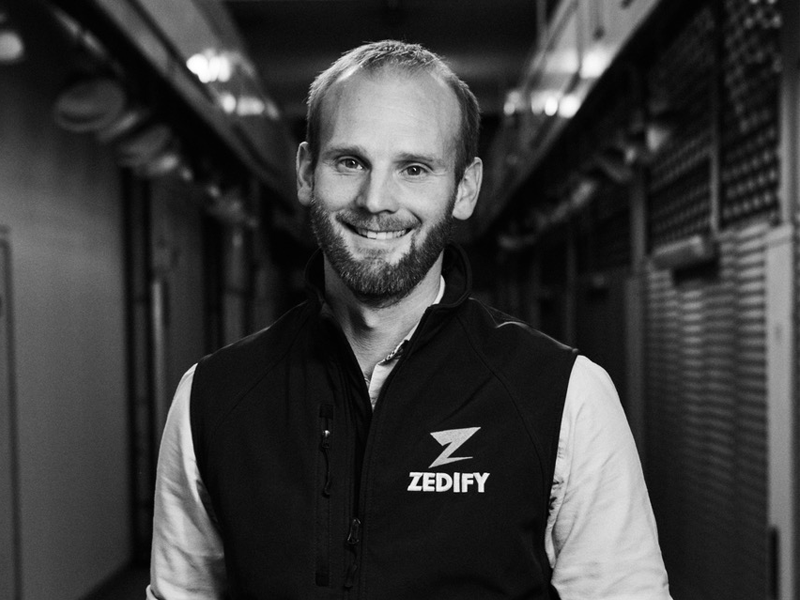
Rob King is making lowering emissions in UK cities his life’s work. Alongside co-founder and CCO Sam Keam, King is responsible for Zedify, a zero emissions delivery company with depots across ten UK cities. And Zedify is expanding, having opened a branch in Bristol last month.
We begin by discussing the ongoing restrictions and how they have affected businesses for better or worse. “The pandemic hasn’t really changed much in terms of keeping connected,” King says. “However, people’s expectations on needing a physical meeting have changed. I no longer have to travel all the way to Wimbledon from Cambridge for a one-hour meeting.” It’s not surprising that restrictions seem to have benefited rather than hindered Zedify: after all, delivery services are booming and expected to continue to rise.
The story of Zedify’s origins goes back about sixteen years when King was looking to set up a business with his brother. While hitchhiking in the Lake District, King got a lift with a man who was doing cycling courier work in York. The encounter planted a seed. “It seemed like a fun, outdoorsy job,” he recalls. “At the time, I was doing expeditions all over the world, and my brother was in the army getting fed up with being sent to Iraq. We always wanted to go into business together, so we thought this would be fun.”
The brothers first spoke about doing cycling couriers for small items, such as moving flowers and material from printers, but soon moved into bigger items that could be taken by cargo bikes. “There were almost no cargo bikes in the world when we started,” King continues. “We found a mad, wacky designer who had designed Chris Boardman’s bike when he won the Olympics.” The brothers grew the business around Cambridge and then three years ago King spoke to his financial adviser: he sensed that Zedify’s time for expansion had arrived. “The urban landscape was changing, people were talking about emissions a lot more, and about reducing car and van use,” he says.
By creating a licensed network, Zedify expanded into other cities, including London, and were able to access deliveries coming from outside the cities, as well as deliveries contained within the city. “We knew that cargo bikes were the most efficient vehicle for use in cities, but our competitors don’t use them because they are coming from depots 50 or 100 miles away. They have to use a van, which is good for going up and down the M1 but not for going about the city.” By using cargo bikes, King explains, “we want to make our cities better, to reduce congestion, reduce emissions. That’s how we sell our services: better deliveries and better cities.”
Included in this better service, are narrower time windows for clients and ethical treatment of Zedify’s staff, now numbering around 150 people. “Even now, 95 per cent of our industry competitors are engaged in the gig economy with self-employed drivers,” King tells me. “Instead, we decided to hire living wage-employed drivers. If something goes wrong, they’re protected and will still get paid.”
Although there has been huge interest from larger corporations that have recently been pressured into making their own climate targets, King remains skeptical of their motives and keen to keep Zedify true to its mission of providing an exceptional as well as ethical service. He admits that the environmental angle is a great selling point but that “the price and service must be right, otherwise companies will use us once and it won’t last or they will use us in one of their cities but not all. They will use us as a bit of greenwashing. We want to make sure we offer such a good service for such a good price that anyone would take us up. That’s when we will have the biggest impact on our cities, on our environment and make them better.”
As well as private work, Zedify conducts work for local councils. Waltham Forest Council supported the set-up of Zedify’s operation in London during the ‘Mini Holland’ scheme funded by the Mayor’s office a few years ago. The aim was to recreate London streets in a Dutch style, a harbinger of the current Low Traffic Neighbourhoods. “Initially local businesses were up in arms questioning how they would get their deliveries in and out. So the council put out a tender for a cargo bike delivery scheme.”
With that success under their belts Zedify now encourages other councils to review their work tenders, asking them to consider whether a van is truly needed for delivery work, to at least give firms like Zedify the opportunity to bid for the work.
On the controversial Low Traffic Neighbourhoods, King is optimistic: “We’ve got a really good case study here. People want clean air, clean streets but need to balance that with being able to get around and make deliveries. Because of Low Traffic Neighborhoods deliveries in vans are taking too long, so companies are starting trials with us. Businesses are adept at change. They can utilise our schemes or go in-house and use low emission vehicles or their own cargo bikes that are more suitable to liveable cities.”
King explains how city schemes that challenge businesses can work out for the better. “We use our depots as consolidation hubs. This means that we can do deliveries with our cargo bikes completing several routes in a day. Whereas a van would normally only do one route in a day. We can actually do two to three times the volume of work.” For example, Zedify works with a veg box supplier in Cambridge, which used to drive into town with their old diesel van to make around ten deliveries. They now drop the produce at Zedify’s depot on the outskirts of town and then the last mile of transport is done on cargo bikes. “That’s a great service for a company like that which wants to focus on other things rather than driving.”
Zedify has won significant recognition for its work, and came runner-up for the ‘Clean Air in Cities Award’ from the prestigious Ashden Foundation the year before last. King has no thoughts of slowing down anytime soon: “We’re still small but there is definitely potential for changing the whole way deliveries are made.”